Created by Tomas Kalisz
Should the proposed practical experiments with installation of solar panels cooled by water evaporation i cities and urban / industrial landscapes prove that this concept is harmless for the environment, the next step may be expansion of such solar facilities into arid landscapes, enabled by cooling thereof cooled with sea water evaporation. There are hints that such concept might exhibit a synergy in climate change mitigation, by combining (i) "decarbonization" of the electricity production by massive solar energy exploitation with (ii) water cycle restoration in arid landscapes, enabling the desired non-radiative cooling therein.
I’ve just read:https://www.preprints.org/manuscript/202302.0393/v1/download
The two main conclusions are: 1) the peak CO2 concentration will likely be no more than 475ppm
2) there will therefore likely be at most another 0.4C temp rise from now.
To my, very inexpert, eye the first conclusion is plausibly supported by the data and analysis, whereas the second conclusion relies on an, admitted, dubious model of temperature dependence on CO2 concentration i.e ignoring cloud albedo changes.
Thoughts?
@John Shanly says: – ” … i.e ignoring cloud albedo changes. – Thoughts? ”
ms: — Anyone who produces an apparently climate-scientific paper in 2023 without taking into account the developments and changes in radiation conditions in recent decades (e.g. CERES data from 2000 to 2020) is tormenting the paper and the attention of the readers with a stupid, insufficient overview. (This also applies to the 5 above answers from the 5 commentators on your sent link and question. They also ignore or denie the loss of cloud albedo. and evapotranspiration)
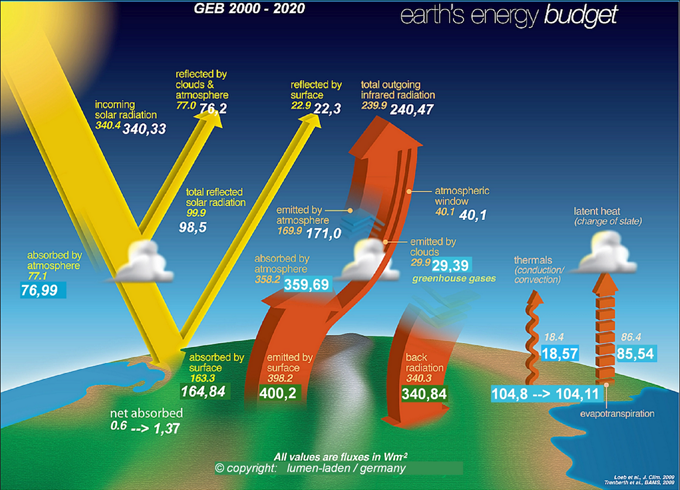
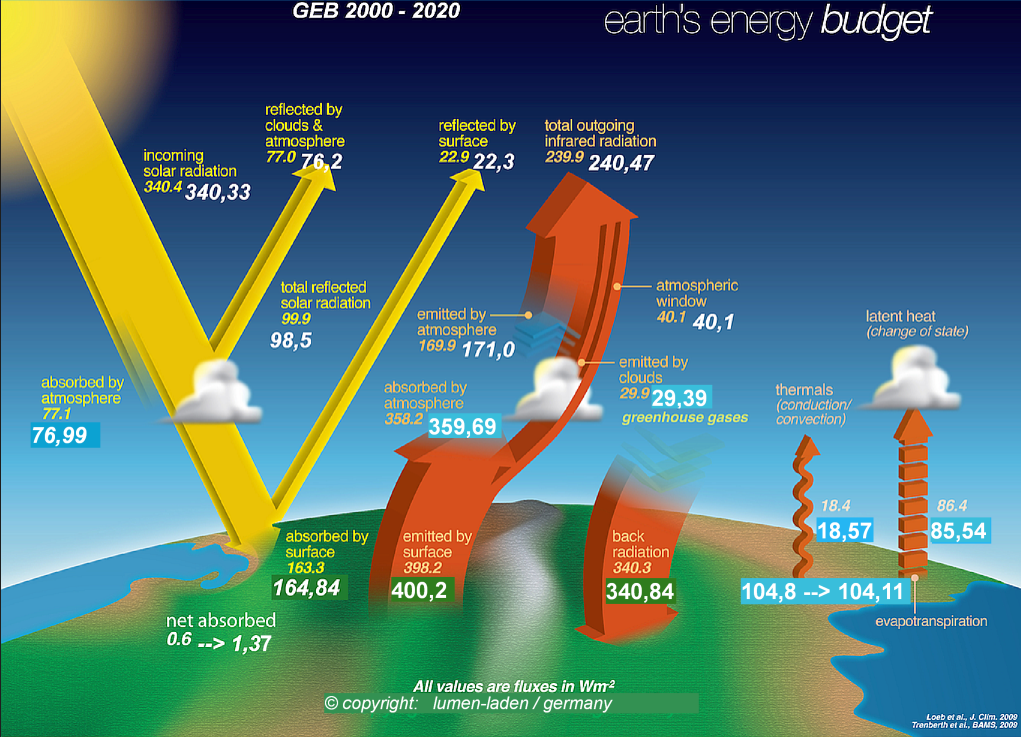
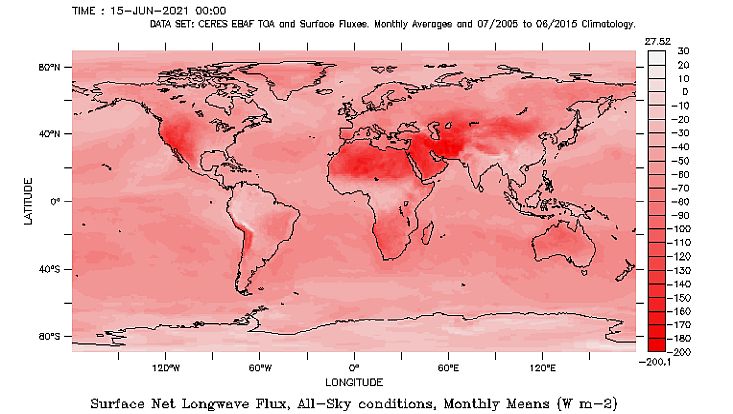
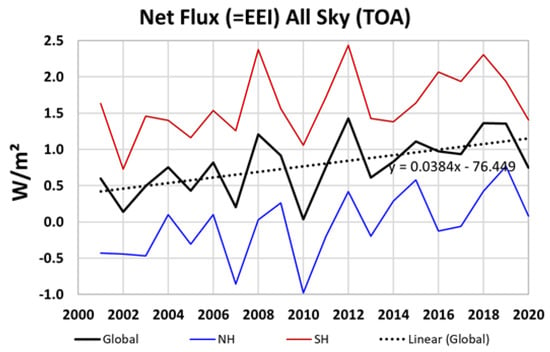
The CERES data 2000-2020 clearly show an increasing earth energy imbalance (EEI +0.77W/m²) due to an albedo loss of -1.4W/m² and for higher CO2 concentrations a completely atypical increase in the LW-out-@-TOA of +0.57W/m².
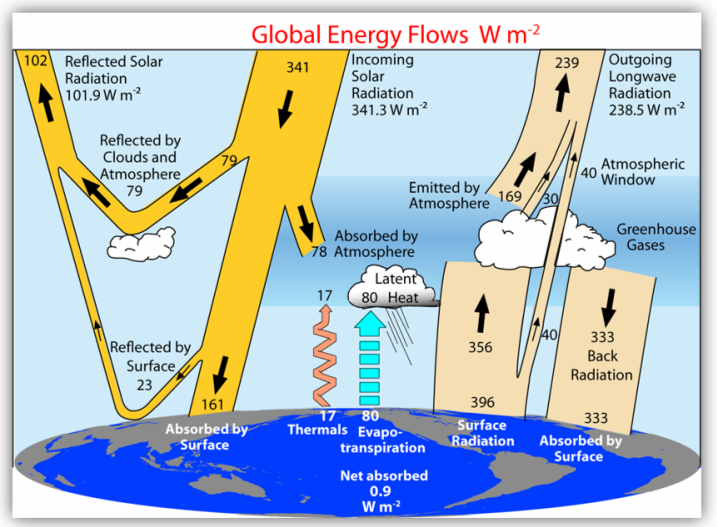
You can see the climate development of the last 2 decades most clearly in a model of the global energy balance, which I have supplemented with the observed and measured CERES data (white digits):
A significant increase in GW or EEI due to a stronger greenhouse gas effect cannot be traced using the CERES data 2000-2020. The global climate has shifted and continues to shift towards a “clear sky atmosphere” and desertification – accompanied by the loss of snow & ice albedo. .I suspect cloud albedo loss to be 1.7% over the 20 years.
John Shanly, The authors of the non-peer-reviewed article titled Emissions and CO2 Concentration – an Evidence Based Approach you link to are Joachim Dengler & John Reid. Who are they? What are their areas of expertise? Do they have any track record of peer-reviewed scientific papers in the field of climate science? No?
Meanwhile, it seems to me Dr James E Hansen has a long and distinguished track record in the field of climate science, with many heavily cited peer-reviewed papers in the field of climate science – websearch: “scholarly james e hansen”
James Hansen & 14 co-authors submitted a new scientific paper titled Global warming in the pipeline to a broad reaching interdisciplinary journal Oxford Open Climate Change on 8 Dec 2022. With permission of Editor-in-Chief Eelco Rohling, the submitted version is available on arXiv, the website used by physicists for preprints.https://arxiv.org/abs/2212.04474
Figure 6 (in the Hansen et. al. pre-print) indicates to me that the cooling effect of aerosols (primarily human-induced from the burning of fossil fuels) in the atmosphere has kept the global mean surface temperature of the order of 0.7 to 1.0 °C lower than it would have been if there were no aerosols in the atmosphere. By decarbonising, humanity will be exposed to a rapid temperature increase as the cooling effect of aerosols diminishes. This is the ‘Faustian Bargain’ humanity has committed to that Hansen et. al. alludes to in their pre-print paper.
Figure 19 shows expected accelerated warming rate post-2010 (yellow area) if aerosol reductions approximately double the net (GHG + aerosol) climate forcing. Upper and lower edges of the yellow area are 0.36 and 0.27 °C per decade warming rates. Per the temperature anomaly graph, the likely Earth System mean surface temperature trajectory is +1.5 °C by the end of the 2020s and +2.0 °C possibly sometime in the 2040s, unless we act rapidly and drastically.
The Hansen et. al. pre-print also includes this statement:
<blockquote<Eventual global warming due to today’s GHG forcing alone – after slow feedbacks operate – is about 10°C.
In a piece by science communicator David Spratt published on Feb 24 at ClimateCodeRed.org, he included:
In summary, emissions still have not peaked and are unlikely to be significantly lower in 2030 than 2020; warming of 1.5°C is likely this decade; the emissions trend and reduction commitments are currently nowhere near keeping warming to 2°C; and once the full range of feedbacks, non-linearities and cascades are taking into account, warming may well exceed 3°C this century, a level of warming that will likely result in climate-driven collapse of ecological and social systems. The contradiction is stark: the world will sail past 1.5°C, but 1.5°C may be enough to trigger ‘Hothouse Earth’ cascades; indeed, it is evident that some tipping points have already been passed, and some cascading events are occurring already.
http://www.climatecodered.org/2023/02/faster-higher-hotter-what-we-learned_24.html
The atmosphere in 2021 contained GHGs with CO₂-equivalent of 508 ppm, of which 415 is CO₂ alone. Humanity has now entered climate territory not encountered for millions of years.https://gml.noaa.gov/aggi/
On our current GHG emissions trajectory, large regions of the world (where the mean annual temperature exceeds 29 °C) could become unlivable in less than 50 years. See Fig 1 in the PNAS peer-reviewed paper titled Climate Endgame: Exploring catastrophic climate change scenarios, published 1 Aug 2022:https://www.pnas.org/cms/10.1073/pnas.2108146119/asset/6fb2b07d-d899-441e-8c1c-1795d738c124/assets/images/large/pnas.2108146119fig01.jpg
I think it would be foolish to bet that Hansen & colleagues are significantly wrong on this issue.
macias shurly: – “…is tormenting the paper and the attention of the readers with a stupid, insufficient overview. (This also applies to the 5 above answers from the 5 commentators on your sent link and question. They also ignore or denie the loss of cloud albedo. and evapotranspiration)”
Have you fully read the Hansen et. al. pre-print I referred to in my earlier comment, MS? Perhaps you missed the paper’s discussion on slow, fast and ultrafast feedbacks? Perhaps you also missed in the Hansen et. al. pre-print, for example:
Earth’s albedo (reflectivity) measured by CERES (Clouds and Earth’s Radiant Energy System) satellite-borne instruments⁷⁹ over the 22-years March 2000 to March 2022 reveal a decrease of albedo and thus an increase of absorbed solar energy coinciding with the 2015 change of IMO emission regulations. Global absorbed solar energy is +1.01 W/m² in the period January 2015 through March 2022 relative to the mean for the first 10 years of data (Fig. 17).
MS, I’d suggest your inference of my ignorance or denial of “loss of cloud albedo and evapotranspiration” is baseless.
White numbers (for 2020) added by MS
@Geoff M. says: –
” Have you fully read the Hansen et. al. pre-print I referred to in my earlier comment, MS? Perhaps you missed the paper’s discussion on slow, fast and ultrafast feedbacks? ”
ms: — Actually, I reflected on your answer to John’s questions and there is nothing written about “cloud albedo” – the word albedo does not appear in the links you sent either. This decreasing albedo is only present through the CERES data from 2000 to today. (and maybe earlier too)
Also present is the fact that the GHE in 2020 has decreased and the atmosphere has become more permeable to long-wave radiation in the last 2 decades, although the concentrations of H2O, CO2, CH4,… have increased.
These very fundamental facts and questions are neither analyzed nor discussed by climate science / IPCC and also by the majority of the audience here in the forum – but outsourced deep into the subconscious of the individual. Climate science asleep. – Why ?
I am not denying climate change, the greenhouse effect or H2O, CO2, CH4 & Co as climate gases – but the IPCC is obviously wrong in solely assigning the CO2 eq. concentrations as the cause of global warming. There is plenty of fact-based evidence for this. You can find them on my website:
https://climateprotectionhardware.wordpress.com/
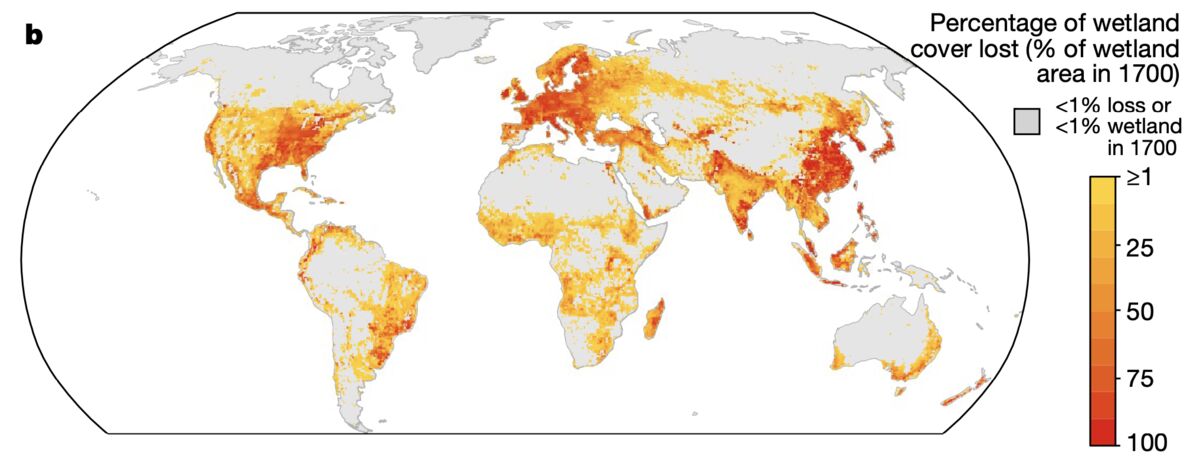
There you will also find a quantification of how humans affected evaporation, clouds, CO2 uptake and (land) temperatures long before industrialization. But please do NOT tell me that draining wetlands, sealing urban land, degrading soils and losing evaporative landscapes in general is a (slow, fast, or ultrafast) feedback of CO2 concentrations. — I suppose that’s enough for you to go to sleep.
macias shurly: – “…the word albedo does not appear in the links you sent either.”
If you had been observant enough to look carefully at the arXiv webpage I’d linked to in my earlier comment (posted on 6 MAR 2023 AT 8:00 PM), then you should have noticed a link near the upper right-hand side of the screen for downloading the pdf file of the full Hansen et. al. pre-print paper. But it seems to me from your latest comment, even after my quoted reference to “Earth’s albedo (reflectivity)” from the pre-print in my comment addressed to you (posted on 7 MAR 2023 AT 11:51 PM), you apparently still fail to concede that you were too quick to judge others.
It seems to me you are continuing to make excuses for your baseless inferences about my ignorance or denial of “loss of cloud albedo and evapotranspiration”, and are now attempting to deflect by an apparent ranting about “fundamental facts and questions are neither analyzed nor discussed by climate science / IPCC”, as well as about how good you seem to think you are about understanding the Earth System.
@macias
“please do NOT tell me that draining wetlands, sealing urban land, degrading soils and losing evaporative landscapes in general is a (slow, fast, or ultrafast) feedback of CO2 concentrations..”
Yes it is exhausting to hear about how watershed restoration does not assist to limit trace gas concentration in atmosphere. So that, therefore, it is of less absolute value.
The mathematical and astrophysical geniuses who are now suddenly and simultaneously the most emotionally attached and expert in environmental outcomes. A sort of mockery, or appropriation. Phony environmentalists; completely disconnected.
ms: the GHE in 2020 has decreased and the atmosphere has become more permeable to long-wave radiation in the last 2 decades
BPL: None of that is true. Where do you get this stuff?
If you have a time series for longwave optical depth, I’d like to see it. The continued increase in temperature implies that it is up, not down.
@ Geoff M. says: –
” If you had been observant enough to look carefully… / It seems to me you are continuing to make excuses for your baseless inferences… / fundamental facts and questions are neither analyzed nor discussed by climate science / IPCC”
ms: — If I had to follow – all the links in the upper right link of a link near the upper right-hand side of the screen for downloading the pdf file – to follow your own non-existent opinion on a climatological problem – I will be 3500 years old. Why are you hiding behind Hansen?
Neither Hansen nor you attribute the decrease in cloud albedo to the loss of evaporation. According to Hansen, falling aerosol concentrations are the main reason for this.
What makes you think I’m apologizing for something? I am world champion in LED light cooling, I also cool PV and planets with water. I give you a sustainable “no regret” strategy to reduce sea level rise, earth temperature and CO2 concentrations. I have no reason to apologize. –
I criticize your somewhat limited view of water, cloud physics and surface cooling and the far too neurotic perspective on greenhouse gases and GHE. And when I say yours, I mean you, Hansen, the IPCC and all other climate experts who believe here and elsewhere that humans are only causing global warming through CO2 and GHE and that disruptions in the global water cycle are solely feedback from CO2.
You are one of those people whose ancestors drained landscapes, cleared forests and sealed millions of km² of soil for centuries and millennia and now have a problem with dersertification, droughts and record temperatures – but point all 10 index fingers at the greenhouse gases and GHE. This is just too stupid to be true.
@JCM says: –
” Yes it is exhausting to hear about how watershed restoration does not assist to limit trace gas concentration in atmosphere. ”
ms: — The investment costs of the water retention measure described on my website to operate watershed restoration in my home region are estimated (by me) at $ 3.5 – 7.5 million.
My home area is 1250 km², approx. 13.5 million m³ of water/year are retained and approx. 750,000 citizens live there.
Scaled up to 130 million km² of land area with 7.5 billion inhabitants, this means global total costs of an estimated €400-750 billion and $10 to $100 per person on earth for a resilient infrastructure built up over decades. Each m³ of water retained can be sold (here > $ 2/m³), thereby financing the construction and maintenance of the measure.
It`s a win win win + situation, because each m³ of water also cools the region with 680KWh and can absorb 3.7-7.4kg of CO2 through photosynthesis.
The ~12.5 km² roof area in the same region has a similarly high retention potential of ~10.6 million m³ with ~850mm annual precipitation if equipped with rain barrels & overflow on unsealed terrain.
@bpl says: – ” If you have a time series for longwave optical depth, I’d like to see it. The continued increase in temperature implies that it is up, not down. ”
ms: — I’ve pressed the time series on your blind eye three times already:
and 6 months ago we have here:
https://www.realclimate.org/index.php/archives/2022/09/a-ceres-of-fortunate-events/
already extensively debated about CERES data 2000-2020 and their analysis. I don’t have any hope with you anymore because of your massive disability from blindness and Alzheimer’s.
The Ceres data 2000-2020 on which my analysis is based on are 20year trends and you can (maybe ?) find it here:
https://www.mdpi.com/2073-4433/12/10/1297# —> Browse Figures
or here:
https://journals.ametsoc.org/view/journals/clim/31/2/jcli-d-17-0208.1.xml
I’ll quickly explain to you what the three black dots on your yellow blindfold mean – and then it’s over for me.
Dot 1) – Longwave (out) All sky (TOA) = +0.568W/m²/20y Dot 2) – Longwave surface up flux All sky = +2W/m²/20y Dot 3) – Longwave surface down flux All sky = +0.54W/m²/20y
EEI = +0.768W/m²/20y
Go to the Beer-Lambert Institute and get your longwave optical depth kit for time series from the blind department.
The GEB linked above clearly shows how the 20-year course of the climate from 2000-2020 was caused. The evaporative loss of 0.86W/m² causes an increase in LW surface up flux by 0.69W/m² and also increases sensible heat flux by 0.17W/m². The increase of LW surface down flux by 0.54W/m² is far too low to prove a stronger GHE. With the same or higher atmospheric absorbance as 2000 – the value should actually be > 342W/m²
The falling evaporation, together with falling aerosol concentrations ~(-0.2W/m²), also reduces the cloud albedo by -0.8W/m² – which, together with the ice and snow albedo (-0,4W/m²) also falling, explain the total loss of albedo by 1.4W/m².
Now you should be able to explain to me where you can squeeze in a rising GHE in this GEB
@macias
It’s difficult to adequately articulate, but budgets related to environmental stewardship and landuse management regulations are being slashed in practically all jurisdictions.
The leadership class is more keen to announce the technological investment they have attracted with their public expenditure (embezzlement) related to trace gas emission programs.
A relatively simple problem definition and associated solution has been proposed by the astrophysical and computational geniuses in their reductionism.
They plot the increasing temperature as it relates to trace gas and the case is closed on matters of “environment”.
The narrow and shallow propositions from the climate change community are too appealing. The genius of a simple idea that is too good to resist.
Easy enough to understand, and now embraced by practically everyone. A mental shortcut for environmental knowledge and a personal sense of virtue.
Minimize flood, drought, and temperature extremes by purchasing an electric vehicle and installing rooftop solar panels. It’s for the grand kids.
Personally I think it’s is ludicrous, but well intentioned.
After all, it’s the thought that counts, right?
PS
Well meaning people are good people, this I know is true. There is little point in making enemies among ourselves.
JCM: A relatively simple problem definition and associated solution has been proposed by the astrophysical and computational geniuses in their reductionism.
They plot the increasing temperature as it relates to trace gas and the case is closed on matters of “environment”.
BPL: Right, JCM. Physicists think global warming is due to increasing greenhouse gases, therefore they think nothing should be done to reform land use. Good thinking,
You need to Google “non sequitur,”
ms: bpl says: – ” If you have a time series for longwave optical depth, I’d like to see it. The continued increase in temperature implies that it is up, not down. ”
ms: — I’ve pressed the time series on your blind eye three times already:
and 6 months ago we have here:
https://www.realclimate.org/index.php/archives/2022/09/a-ceres-of-fortunate-events/
already extensively debated about CERES data 2000-2020 and their analysis. I don’t have any hope with you anymore because of your massive disability from blindness and Alzheimer’s.
BPL: Neither of those is a time series of optical depth, which you apparently don’t understand the definition of. And as for the accusations of blindness Alzheimer’s, well, boy, at least mine aren’t self-induced.
@BPL
“therefore they think nothing should be done to reform land use”.
i said no such thing. Rather, minimization of hydrological and temperature extremes appears to fall outside the purview of radiation enthusiasts, synoptic dynamicists, and computational experimentalists.
We cannot blame them. our mistake is to confer upon them a sort of faith.
Experts in a small niche, with an aura of grandeur. Deeply influential concerning well-meaning people. Authorities now on policy recommendation. Congrats to your idols.
The reductionism too good to resist; creating a sense of order among chaos. Do this “thing”, first and foremost, and all will be well for your offspring.
A lot of preaching, and defending a narrow conceptual view. So be it. That is the prerogative here.
It is a place to discuss matters of well mixed non condensing trace gas and global average temperature anomalies. Much less do to with real climates.
“Everything should be made as simple as possible, but not simpler” when it comes to our conceptual understanding, yes?
For the trace gas point of view is but a subdivision of the climatological system. The climatological descriptions a subdivision of the ecology. Somehow this has all been inverted….
We collectively wander completely confused now, but more sure than ever. Talking over ourselves. Knowledge displaced.
@JCM
Looking at the glass as half full, “Phony environmentalists;” may be an alternative food source at some point:
@Don Williams
tackle non point P loading and minimize agricultural inputs by re-assessing the role of soil genesis.
For a few hundred years now the soil oxidation is overwhelmingly exceeding the biosequestration.
Biosequestration = the soils eating the plants.
Once upon a time the food web below our feet in the mid-latitudes was vastly more productive than any conceivable above ground mono plantation today.
Rapid cycling – the litter and deadfall devoured before next season into stable soil carbon.
Unimaginable today. 100 billion tons C/year pedogenesis missing.
For the audience here who might think it’s normal to see mats of leaf litter piled high in the residual ‘nature reserves’. hint: It’s not normal at all.
Caused by humanity in the blink of an eye, reversing the soil development which has been occurring for 400 million years.
The soils now starving to death, biosequestration at a crawl. Soils on life support, rendered to dust. More truckloads of P input, please.
The neo environmentalists really do think the carbon is sequestered in the plants themselves, above the surface. LOL.
If one feel inclined to meddle in agricultural inputs, focus not on prohibition of fertilizer but on development of soil organic matter.
Limiting biocides first and foremost, and minimizing the fallowing is a good start. Dead soils are in fact dead. They consume nothing.
This requires systems thinking, not reductionism.
Do not seek to plant trees, seek rapid biogeochemical cycling.
The ecosystem co-benefits cannot be understated, which includes climate related observables.
This is how you leave wealth to future generations.
It is not an afterthought or something of secondary importance.
JCM
@bpl says: –
” If you have a time series for longwave optical depth, I’d like to see it. The continued increase in temperature implies that it is up, not down. // Neither of those is a time series of optical depth, which you apparently don’t understand the definition of. ”
ms: — Transmittance (T) is the fraction of incident light which is transmitted. In other words, it’s the amount of light that “successfully” passes through the substance (/atmosphere) and comes out the other side.
It is defined as T = I/Io, where I = transmitted light (“output”) and Io = incident light (“input”). %T is merely (I/Io) x 100. For example, if T = 0.25, then %T = 25%. A %T of 25% would indicate that 25% of the light passed through the sample and emerged on the other side.
Absorbance (A) is the flip-side of transmittance and states how much of the light the atmosphere absorbed. It is also referred to as “optical density.” Absorbance is calculated as a logarithmic function of T: A = log10 (1/T).
The GEB from Trenberth & Loeb –
supplemented with the 20-year trends of the CERES data shows the following differences in the values below ————————————————-~ 2000 // 2020
Φet —————- radiant power transmitted by atmosphere; — 239,9 // 240,47 (W/m²)Φeatt ————– radiant power attenuated by atmosphere; — 498,6 // 500,57 ”Φei —————- radiant power received by atmosphere; —– 398,2 // 400,2Φee ————— radiant power emitted by atmosphere; —— 340,3 // 340,84
T = Φet/Φei ——- transmittance of that material; ———– 0,602461 // 0,600874 A = Absorbance = 2 – log(%T): ——————————— 0,220071 // 0,221216τ = optical depht: ——————————————— 0,506732 // 0,509369 ATT = Φeatt/Φei — attenuation of that material; ————— 1,2521 // 1,2508 E = Φee/Φei —— emittance of that material, —————– 0,8546 // 0,851674
Levenson! You are correct that a warmer planet means a higher optical depth. But the warming is mainly due to short-wavelength loss of albedo – and not due to the increase in greenhouse gases – and as a result corresponds to a shift from an all-sky to a clear-sky climate.
Since 2000, declining evaporation, clouds and (relative) humidity have been the main triggers and not the GHE. The cause of the decreasing evaporation is a long term trend from fewer El Nino events (more evaporation and clouds) to more La Nina phases (less evaporation and clouds) but also human land use change. BTW, the loss of sea ice & snow albedo and aerosols has a very similar SW & LW effect to the loss of clouds.
@ JCM says: – ” They plot the increasing temperature as it relates to trace gas and the case is closed on matters of “environment. ”
ms: — Last week I saw a graph in the business newspaper showing the global production and sales of ice cream. It fits like a glove with the global temperature trend curves.
Today I am sure that the more ice cream we eat, the faster global warming will progress. !!! Please stop sucking ice cream lol…
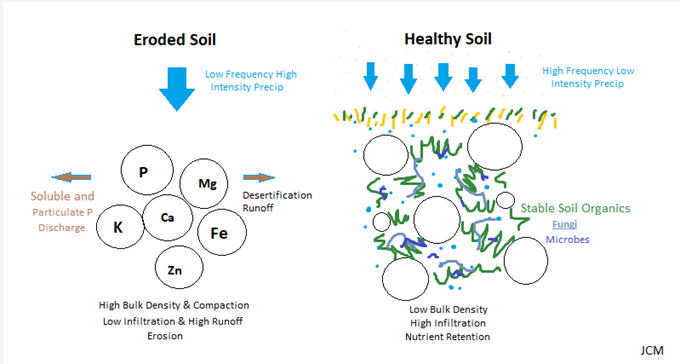
my response is perhaps unclear! so I have composed using MS PAINT a highly technical schematic (sarc) to illustrate the relationship between soil carbon, soil structure, essential minerals, biodigesters, biosequestration, water, erosion, and nutrient retention. The stable soil organics (green zig zags) creating the structure and voids among the minerals with which the biogeochemical process operates. https://www.dropbox.com/s/ae1zswhcloxoi9n/SOILMATRIX.png?dl=0
ms: the warming is mainly due to short-wavelength loss of albedo – and not due to the increase in greenhouse gases
BPL: No, it is not. Warming by greenhouse gases has been observationally confirmed.
Evans, W.F.J., and E. Puckrin 2006. “Measurements of the Radiative Surface Forcing of Climate.” 18th Conference on Climate Variability and Change, P1.7
“The earth’s climate system is warmed by 35 C due to the emission of downward infrared radiation by greenhouse gases in the atmosphere (surface radiative forcing) or by the absorption of upward infrared radiation (radiative trapping). Increases in this emission/absorption are the driving force behind global warming. Climate models predict that the release of greenhouse gases into the atmosphere has altered the radiative energy balance at the earth’s surface by several percent by increasing the greenhouse radiation from the atmosphere. With measurements at high spectral resolution, this increase can be quantitatively attributed to each of several anthropogenic gases. Radiance spectra of the greenhouse radiation from the atmosphere have been measured at ground level from several Canadian sites using FTIR spectroscopy at high resolution. The forcing radiative fluxes from CFC11, CFC12, CCl4, HNO3, O3, N2O, CH4, CO and CO2 have been quantitatively determined over a range of seasons. The contributions from stratospheric ozone and tropospheric ozone are separated by our measurement techniques. A comparison between our measurements of surface forcing emission and measurements of radiative trapping absorption from the IMG satellite instrument shows reasonable agreement. The experimental fluxes are simulated well by the FASCOD3 radiation code. This code has been used to calculate the model predicted increase in surface radiative forcing since 1850 to be 2.55 W/m2. In comparison, an ensemble summary of our measurements indicates that an energy flux imbalance of 3.5 W/m2 has been created by anthropogenic emissions of greenhouse gases since 1850. This experimental data should effectively end the argument by skeptics that no experimental evidence exists for the connection between greenhouse gas increases in the atmosphere and global warming.”
Philipona, R., B. Dürr, C. Marty, A. Ohmura, and M. Wild 2004. “Radiative Forcing–Measured at Earth’s Surface–Corroborate the Increasing Greenhouse Effect.” Geophys. Res. Lett. 31, L03202
“…Here we show that atmospheric longwave downward radiation significantly increased (+5.2(2.2) Wm 2) partly due to increased cloud amount (+1.0(2.8) Wm 2) over eight years of measurements at eight radiation stations distributed over the central Alps. Model calculations show the cloud-free longwave flux increase (+4.2(1.9) Wm 2) to be in due proportion with temperature (+0.82(0.41) C) and absolute humidity (+0.21(0.10) g m 3) increases, but three times larger than expected from anthropogenic greenhouse gases. However, after subtracting for two thirds of temperature and humidity rises, the increase of cloud-free longwave downward radiation (+1.8(0.8) Wm 2) remains statistically significant and demonstrates radiative forcing due to an enhanced greenhouse effect.”
Feldman, D.R.; Collins, W.D.; Gero, P.J.; Torn, M.S.; Mlawer, E.J.; Shippert, T.R. 2015. Observational determination of surface radiative forcing by CO2 from 2000 to 2010. Nature 519, 339-343.
The climatic impact of CO2 and other greenhouse gases is usually quantified in terms of radiative forcing1, calculated as the difference between estimates of the Earth’s radiation field from preindustrial and present day concentrations of these gases. Radiative transfer models calculate that the increase in CO2 since 1750 corresponds to a global annual mean radiative forcing at the tropopause of 1.82 ± 0.19 W m-2 (ref. 2). However, despite widespread scientific discussion and modelling of the climate impacts of well mixed greenhouse gases, there is little direct observational evidence of the radiative impact of increasing atmospheric CO2. Here we present observationally based evidence of clearsky CO2 surface radiative forcing that is directly attributable to the increase, between 2000 and 2010, of 22 parts per million atmospheric CO2. The time series of this forcing at the two locations—the Southern Great Plains and the North Slope of Alaska—are derived from Atmospheric Emitted Radiance Interferometer spectra3together with ancillary measurements and thoroughly corroborated radiative transfer calculations4. The time series both show statistically significant trends of 0.2 W m-2 per decade (with respective uncertainties of ±0.06 W m-2 per decade and ±0.07 W m-2 per decade) and have seasonal ranges of 0.1–0.2 W m-2. This is approximately ten per cent of the trend in downwelling longwave radiation5,6,7. These results confirm theoretical predictions of the atmospheric greenhouse effect due to anthropogenic emissions, and provide empirical evidence of how rising CO2 levels, mediated by temporal variations due to photosynthesis and respiration, are affecting the surface energy balance.
@ Levenson
The real problem here to my opinion, is that the role of water in all its forms remain a vector or factor of highest uncertainty to global warming.
“What about the clouds? what about the waters and vapours? and what about the snow and ices?
That all is also some of my highest interest, where I look forward to real improovements. Because I can follow and discuss water and thermics and optics if necessary.
But the accute problem comes then, that we cannot have Schürlers that are most obvious German para- scientific romantics of traditional style, namely the Dia- lectic materialists, , those perpetually unsucessful poets, painters, , politicians, and teachers , fishing and stirring into those foggy waters and horizons, that are not yet too clear,…. and telling us the truth abouit it.
And denying the shown primary role of CO2 all the time, due to that peculiar warrant..
That is sinful, and a quite serious pollution problem.
Humboldt Planc Helmholz Kirchoff Fraunhofer,…even Rahmstorf…. were better.
This value does not fir the GEB above, because it give sthe difference in LE flux between 2000 and 2020 ( 86.40 - 85.54 = 0.86) W/m2
@bpl
Levenson! – bad news first – you’ve missed the point again. It is about the global development of the climate from 2000 to today – and not about local observations in the Alps or anywhere else before the year 2000. I am not denying climate change, the greenhouse effect or H2O, CO2, CH4 & Co as climate gases , but it is necessary to subject the individual absorbers to a more up-to-date, more precise analysis.
– You, me and above all our Grandmaster G.A. Schmidt know that the total net effects for water vapor, clouds, CO2 and the other forcings are 50%, 25%, 19% and 7%, respectively.
https://agupubs.onlinelibrary.wiley.com/doi/10.1029/2010JD014287
– Seen in this way, clouds make a 31.5% higher contribution to the GHE than CO2. Together with the aerosols, they belong to the LW absorbers, which cause heating when they are (partially) removed, since their cooling SW effect outweighs the LW effect. So it is quite possible to provoke a higher earth temperature with a less stronger GHE.
– The relationship between CO2 and radiative forcing is logarithmic at concentrations up to around eight times the current value. Constant concentration increases thus have a progressively smaller warming effect. Between 2000 and 2020 the radiative forcing of CO2 = ~ 0.6W/m² for CO2-eq was ~0.71W/m².
CO2-eq. or GHE as the sole driver of the GW should, according to the general definition of the GHE , cause a decrease in LW-out-@TOA of -0.71W/m² and then also increase LW-down-surface accordingly. But in the period under consideration this is not visible and is superimposed as the observed CERES value shows an increase of +0.57W/m².
As an explanation for this invisibility of the climate forcing of CO2-eq. overall an increased LW-up-surface flux of at least +1.28W/m² (0.57 +0.71) is needed. —— * ~ +0.51W/m² due to lower LW effect(GHE) of -1.7% clouds (albedo) * ~ +0.08W/m² due to 10% less aerosols and disappearing sea ice. * ~ +0.69W/m² through !!! less evaporation at the surface !!! as can be seen in the Trenberth & Loeb GEB above.
The generally observed trend towards more heat and drought events is of course visible in the GEB.
Now the good news: Earlier this week my national government announced an action plan to counteract the water shortage. The media also mentioned cisterns and rain barrels in the cities, about which half a dozen idiots have been making fun of here in the forum for the last 2 years.
@crabonito
With your penchant for acting as an obnoxious, aggressive crab, you should urgently find another club – preferably one for aging white conservative idiots or other racists with hot air in their heads.
The Russians on evaporation, condensation, and the atmospheric circulation
https://acp.copernicus.org/articles/13/1039/2013/acp-13-1039-2013.pdf Makarieva, Gorshkov, Sheil, Nobre, & Li, 2013
A summary of the associated biotic pump and global hydroclimatological teleconnections
“The Biotic Pump Theory, as set forward by Drs. Makarieva and Gorshkov, states that the primary force driving surface winds, certainly in the tropics, is induced by the negative changes in atmospheric pressure caused by condensation of water vapour when clouds form. A high rate of condensation is necessary and therefore the theory requires that a sufficiently high rate of evapotranspiration from large areas of forest provides the ‘fuel’ for the process.”
“The theory therefore runs contrary to the traditional view, as introduced in climate models, that surface winds are the sole products of differences in surface heating as well as of latent heat release during the process of condensation. Indeed, Makarieva and her colleagues claim that transitions in the phases of water play a far more important role in driving atmospheric dynamics than is currently recognised (Makarieva, Gorshkov, Sheil, Nobre, & Li, 2013).”
“The challenge is to find empirical data which indicates whether significant correlations exist between surface airflows and cloud condensation. That is not an easy task given the spatial distance between the ground and those atmospheric events which lead to clouds appearing and vanishing. Temperature and humidity undoubtedly play critical roles in generating the right conditions as indeed do the cloud condensation nuclei which are emitted from the surface, not least from vegetation, and which act to prevent super-saturation with water vapour and thereby enable it to condense at dew point temperatures.”
“Nevertheless, more work needs to be done, more evidence brought to bear before the climatological community will accept the biotic pump theory and its implications for modelling climate change”
[Response: This was all shown to be nonsense in the epic series of comments on a submitted (but never accepted) paper. An error in their theoretical derivation was ‘recast’ as a new parameterization but one that has no actual basis in reality. The rejection of this ‘theory’ has absolutely nothing to do with it’s supposed consequences. – gavin]
darnit. i see that nowhttps://www.science.org/content/article/controversial-russian-theory-claims-forests-don-t-just-make-rain-they-make-wind
“Gavin Schmidt, a climate modeler at Columbia University, says, “It’s simply nonsense.” The authors’ responses to criticisms were “really just mathematics that gave no one any confidence that there was any point in continuing the dialogue.””
I will not hang my hat on it.
low impact work continues https://www.sciencedirect.com/science/article/pii/S2405844022024616
on land clearing and soil desiccation, irrespective of the direct 10 hPa/km “evaporative/condensation force” conjecture:
“Incomplete understanding of vegetation-water feedbacks as related to temperature have implications for models and resulting global climate projections. Recent studies demonstrate that the warming that results from reduced transpiration more than compensates for the cooling that results from increased albedo”
This phenomenon is well known to land stewards.
JCM I shall try and look at this.
The study of para- sciences also is important for our understanding of science. And especially interesting that it is russian in our days.
Hr. JCM
After thinking it more over, I come to that Gavin Schmidt may have a point due to quite common things that urbanized people and people far from nature, farming, responsible ownership of own homes and gardens by economic and oecologicalo traditional order maybe never saw.,
Together with Matthias Schürle, You are discussibng it by one and only one seemingly popular, qvasi- scientific, conscept, Global Cooling by “Evapo-transpiration”
Hardly consceiving its whole- ness, namely its parametric connections and naturally balanced reversibility..
Keyeword, The fameous warming by condensing of water from vapour.
You are apparently proceding by no conscepts of both processes taking place at the same spot at the same time, thermo molecular processes going both ways at the same time and the macro- scopic result will be a balance of both.
I am more aquainted to that from chemistery you see, where we have that everywhere, so we learn about it and must respect it. Else, bad results.
Surrealism did fight “backradiation” fiercely ideologically , until Roy Spencer knocked down his own folks on that political point.
In any case, green forests and lawns and bushes cooling the average world situation and landscape is not obvious at all to me, because, here where I live the situation is rather obviously opposite. Green forests and lawns and tight bush vegetation quite obviously rather warm us and the situation and the landscape, houses gardens and ackers and flowers and fruits for ripening here where I live, and that situation is well known and traditionally true for the very tempered and sub- arctic and sub alpine and glacial zone on earth!.
I repeat…..!
We even arrange it cunningly artificiallye traditionally to make “microclimate” for houses and gardens and ackers…. thus expand the area of sensitive thermophile crops and animals fruits and flowers way out of the original quite warm climatic zones where they did origine naturally.
Again I repeat….!
Because we do not live in Las Vegas, Hollywood and Southern California and on Cicilia and the Holy Land and in Tyrkia only. where the monocausal evapotranspiration political doctrine may be most valid and vital.
Personally, I am able to save maybe 2 deg of warmth and winter fuel and 5-6 weeks of summer season length by protecting the natural tempered and taiga forest vegetation right here on the spot, and even save higly industrially purified drinkwater for my lawns and my flowers, and rather harvest tomatoes cherries apples and wines northslope in the old Taiga, where wild oaks and apples are coming over the hill to us in quite recent years .
Those big trees obviously warm us and need no artificial evapotranspiration.for thriving.
There is birdbath and birbath-festival under it now, with bare ground, as the neighbours only have snow and ice on their pavements and lawns. This is obvious and traditional kinowledge in Scandinavia and in old England and in Holland. .
The “Jungle” obviously stabilizes and protects against the extreeme temperatures and weathers, alltogether rather by a bit warming, not chilling effect. As Life and Bio obviously knows how to ajust the environment to its own advantage due to an obviously very long history of evolution or maybe even intelligent creation.
As for the last, Bio and life has the ability in itself to create and to evolve intelligently at least.
@carbomontanus
thank you.
however
I am not discussing the trees and the multiple reflections of solar beams important in northern high latitudes. neat stuff tho.
nor do I have much interest in the sub arctic periglacial shallow sandy till and bedrock regions. Such geographies are pretty stable from a hydrological standpoint. There really isn’t much to erode.
Importantly, I am not talking about “monocauses”, I find such reductionism to be the domain of intellectually lazy and phony environmentalists.
A lot of people fall into this trap – especially well intentioned ones. Everyone does it, I think.
I am most interested in the regions with active and ongoing soil erosion, drainage, and desiccation. This is my niche.
De-vegetation is a related sub-domain. But I’m not hung up on “tree planting”. The hydrological stability is always paramount.
In some cases the trees make things worse.
The good europeans did enough damage with introducing their Scotch Pine in the colonies during the 19th century. What a total disaster ecologically and hydrologically speaking. Today we’re pulling them out. They’re absolutely everywhere!
The preachers are free to go on about their energy transitions, technophilia, emergency declarations, and trace gas emission cutting programs. Good for them.
However, in their reductionism they are causing net harm. This I know for sure. In all the excitement the do-gooders really do show a kind of willful blindness.
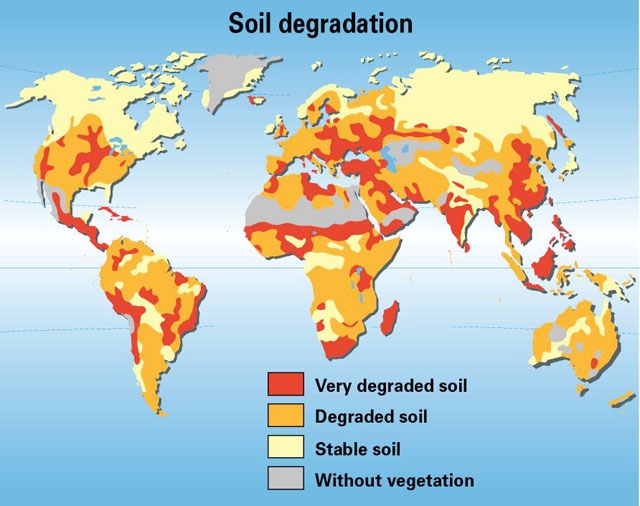
In 1997 we could have predicted with reasonable precision using the crude products from UNEP where the hydrological emergencies would be observed over the coming decades.
https://www.globalagriculture.org/fileadmin/_processed_/csm_Soildegradationalles_886cca3dd4.jpg
They hydrological emergencies have been re-branded “climate emergencies” in the headlines.
“As Life and Bio obviously knows how to ajust the environment to its own advantage due to an obviously very long history of evolution” –
I totally agree. An equilibrium of sorts, completely untangled in the blink of an eye. No wonder things are different now.
JCM
@ JCM
I do not buy that evapotransoiration theory or folklore propaganda and suggestion for countering global warming, neither that folklore of earth being a water cooled planet.
especially not on behalf of wholeness and holism contra all that IPCC has forgotten or ignored.
When the same actiivists here wear blinkers against the whole truth and serve my only less than a half of it.
Water is also what is warming the earth, and the evaporation entrophy of water does also warm the situation as well as it cools.
And as I told and showed by obvious examples from the very Eurasia, , trees bushes and jungles do also warm the planet over maybe most of the planets jungle and bush and forest areas.
The holists in their hurry seem not to be aware of this at all.
You have suggested that there is hardly anything to erode in the rocky mineral sandy north, subglacial and subalpine areas, thus Amazonas is in charge..
False. That is where it erodes for the most. In the tropics, is has allready eroded and is not much more there to erode exept by human help.
The rather very high erosion of sub-boreal landscapes follow from the fact that it is especially young landscapes and young soils hardly more than 10-20 000 years old.
large meandering river systems and especially kaolinized soils like in the tropical rainforests tell us the opposite. Namely that it is allready edoded and can hardly erode anymore. It is allready eroded and flattened and washed out to sea, and all plant nutricians frogs and birds snails mosses and spiders are thus living up in the treetops.. When that falls down it rots rapidly in the warmth and all minerals are re- cycled up there again, whereas the ground is fully eroded and has become sheere, poor Kaolin.
Chop down and sell aqnd burn all that biomass, and possible fertility rushes out the river in a few years, and you can pay for and carry on it waggons of NPK & Dolomite and ammoniumm nitrate fertillizer to have any crop yield at all.
That is the problem. Not evapotranspiration and rainbarrels.
Whether trees and palms will cool Sahara Arizona and Las Vegas and Southern California and the plains in spain,…and give rain in the plains,…. I really doubt it.
There is also night, namely bright light moonshines night in Sahara and in Spain in the Plain where hurricanes hardly happen. With nightfrost! becaus that cools especially fast half of the time.
Holism you see.
Moral and summa summarum is then easy to see and to agree on.
Water neither cools nor warms the planet. quite on the contrary it anti- warms and anti- cools. It stabilizes the situation and protects planetary lifre against extreme chill and heat.
And so does also the wild natural vegetation and jungle as far as I can judge it.
Water and jungles ar not heaters or coolers, they are thermo- stats that damp and even break the swingings. .
Psevdo- holism and quasi- science must be shown back behind the ropes and the bars here to the aspirand and tourist visiror class…….
where they should rather be given the chanse to rather pay and to obey and to pray, in order to qualify first……
because they fight politically against the wholeness and the global environment and even against humanity, flowers birds trees and wildlife., rivers, mountains and glaciers and waters.
JCM
I forgot to say it, but ththis is also orthodoxy.
Water vapour, an invisible greenhouse gas way more potent than CO2, will warm the situation in southern California and Las Vegas, in Sahara and in Spain, in the plain, if there has been enough evapotranspitration there.
And due to IR- backradiation it will not cool down enough again in Spain, and in the plain in the nights,……… that is more or less half of the time in Spain in the plain
But in Hereford Hardford and Hampshire where hurricane hardly happen there may be grey and foggy dews and rain……. with no proper summer warmth……. but rather nasty bathing weather.
Evapotranspirations from the sea that falls down again as warm rain in the plain and further on the glaciers is what eats glaciers more than anything else.
Thus again,….,!
All this is Real Climate, you see. Not just in Amazonas.
They are fearing it now in southern and northern California, that all that evapotranspiration with rain in the terrain in the plain, but quite especially in the mountains when it rains,….
…..it will wash them out from the plain.
Because, what really eats snow is warm rain in the plain. , much more than sunshine in southern California and in Hollywood.
Because, Holism tells us that the Earth is a water- warmed planet, not a water- cooled one. Contra veteres.
All this is Real Climate and timeless wisdom.
@carbomontanus,
a lot of effort there,
but less trying.
an amateurish interpretation of landscape.
has no idea what is the meaning of erosion in reality.
an audacious lecture, directed to those who live by the nature of the watersheds.
the glamour of chemistry, and physical mathematics notwithstanding.
A disappointing space created, here, by climatology.
snap out of it, y’all.
JCM
JCM
What I am correcting here is “evapotranspiration” being the holistric understanding of global warming and progressive scientific political solution to it.
“Evapotranspiratiuon” is an invasive pagan (vulgar moslem), dia- lectic materialistic progressive DDR scientific, southern so- vi ett union mission doctrine formula, from the special desert walkers, flat earthers, and blind believers in Las Vegas, Hollywood, Southern California (where it rains again), in , Arizona, and in Death walley where the earth is severely dry and flat. .
Blind believers, flat earthers and desert walkers on their way to Mecca in order to find and to kiss Allah are not to be our experts and teachers, especially not in Las Vegas, Hollywood and southern California and quite especially not in Amazonas.
In Kasakhstan and in Donbas you see, where the Earth is also flat and where all blind believers and desertb walkers have settled and instructed, they need other medicines now.
The Aral sea is an environmental ruin due to monopoly capitalism and politicians, much worse than even Las Vegas, Lake Mead, Hollywood, Salton Sea, and Death Valley.
Antarktis is an important reference. (The Norwegians are claiming Queen Mauds land there due to Roald Amundsen.)
There are death valleys there due to evapo- transpiration so severe that even the snow and ices have evapo- transpirated
I repeat….
and there is only sheere apparently sterile desert rocks remaining, as JCM suggests and understans from the inferiour unimportant north where they have not yet understood what erosion is about..
. Some seals have immigrated and have simply died, and remain there in Antarktis>`death valleys as evapotranspirated http://www.Stoccavisso mummies. at zero Fahrenheit exactly.
A sublime situation, that is due to sublimation.
So evapotranspiration does not do it and is no good medicine regardless, not even the upper hand and most important principle and explaination and medicine against global warming and climate.
There are typical http://www.Stoccafisso see also www,Stokkafisk mummies of humans found in the sands on the plains in the Spains where it hardlyb rains and where hurricanes hardly happen… all along the silk- roads in central Eurasia. You do not have to go to Las Vegas, Hollywood, Southern California and to Death valley for it.
In fact, one finds proof of desert walkers as dried out mummies and skeletons in the sands, with a hat, and a frying pan in their right fore- paw, only 4-5 steps ahead of a poisoned well of water thrieving for “evapotranspiration”.
it is not called “Death Valley” for nothing with so extreeme evapotranspiration.
“Blow boys blow to Californai oh Theres plenty of gold so I am told on the banks of Sacramento”
SANN Because,
Fanatism, Reductionism Holism Capitalism Dia- lectic materialism and Evapotranspiration youn see,… is not automatically successful and sustainable.
It may end up as I pointed at, as a dried out Stoccafisso skeleton 4 steps ahead of a poisened water hole in Death Walley with hat still on and a frying pan forward to it in the right hand.
Just think of it.
Your Amazonas is where they try again. “There`s plenty of gold so I am told…”
@crapomontanus says: –
” Green forests and lawns and tight bush vegetation quite obviously rather warm us…”
ms: —
Then take a chainsaw and saw off all the trees and bushes in Norway – you complete idiot, to finally save us from global warming. When you’re done with that in Norway, you can go to the Amazon – there’s still a lot of work waiting for you there.
But be careful! Some natives still live there behind the bushes, and they can also use chainsaws. Out of sheer gratitude, they will saw you and your stupidity into small slices to feed their pigs. — Well done – I think.
@ JCM
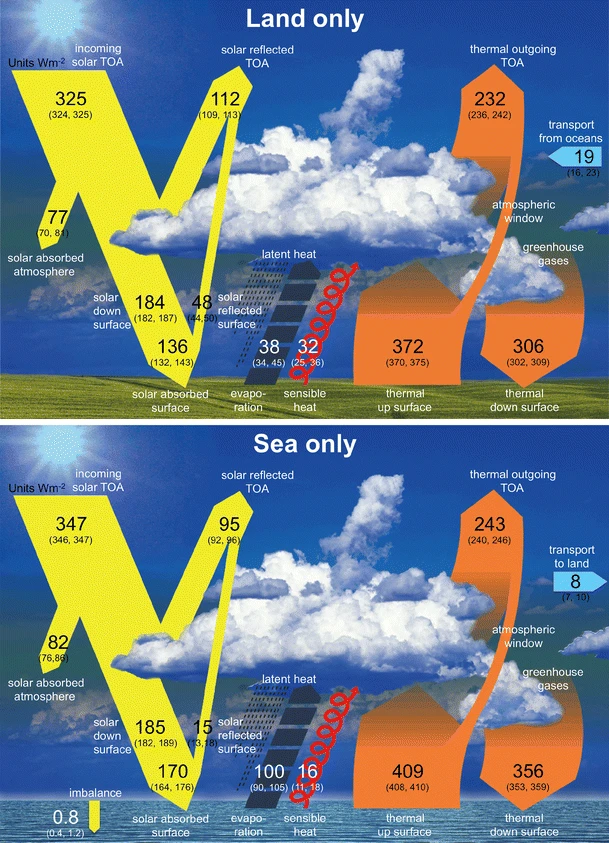
2 graphics and a link should complement your above posts about mongobay & others.
https://link.springer.com/article/10.1007/s00382-020-05451-8
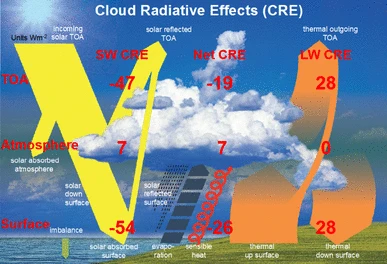
Our host Dr. GA Schmidt (2010) is the man who ascribes a warming GHE of ~75% (+116.25W/m²) to water (vapour) and clouds (total GHE = ~ +155W/m²). But water(vapour) & clouds warm AND cool the earth system. However, the cooling effect of clouds and evaporation according to Prof. M. Wild et al (2018) is ~ 129W/m² (evaporation = 82W/m² + cloud radiation effect = 47W/m²)
https://link.springer.com/article/10.1007/s00382-018-4413-y/figures/14
Makarieva and Gorshkov’s Biotic Pump Theory would further reinforce the perception that the hydrological function of rainforests is far more important than their ability to act as a sink for atmospheric carbon dioxide. In fact, ET is a cooling process and thereby helps to reduce global warming and climate change due to cloud generation.
The historically fatal and very likely deadly mistake for creation of presenting CO2 concentrations as the sole driver of global warming stems from the stupidity of climate scientists and the IPCC. In their attribution research on climate change, they actually forgot to price in their own stupidity.
I would love to see your continued support to break down the blind glass windows of their ivory towers. And if we fail, don’t despair. The SUN stands by our side and will help us to dry out the last stupid brains until the lukewarm pee is in their underpants. I vouch for this with my name and my word of honour…
I do the opposite here, genosse,
I let it come up as free as possible and chop it as little as possible by a very basic principle of carpentry, do it with as low number of chops and cuts as possible and avoid grinding and milling it or sawing it if possible. Thy and make least possible number of material particles out of it. That means, cut whole trees and whole branches or nothing
Es ist besser das Wekzeug zu schleiffen als das Holz zu schleiffen.
Thus, We save you from global warming.
It rather falls down from itself by the storm ready dried and seasoned for barbeque, and we avoid using tropical charcoal and blue butane gas boxes for the same. and have a much finer barbecue.
But flat earthers, desert walkers and blind believers are unable to get any geopgysical idea of any global situation and the role of water and bio in the universe, not even on earth.
Here we see, it, They just smash around with cycles and chainsaw sales promotion arguments.
Der Wald wuchert in Deutschland aber man nennt ihn Unkraut. Was da los ist, das ist kein Waldsterben sondern grassate, direkte Tortur von alles lebendige was man nicht kennt und erkennenn kann,
Auf Armlänge Abstand.
Und jene fanatische Pöbel wollen uns was beibringen.
They are envious to us who reallize that we have maximum cash prophit allready from not being at war with the green values and do not go across the creek for water Think globally and act locally.
Oline came from the Rudolf Steiner- school with a very fine portrait drawing of herself and the cat. I showed her my own technical drawings and told her to get us some ” common reed” and some bark of older, Alnus incana and glutinosa L for ink calligraphy..
By good techniques , it looks as if you could draw, I said her. Take it out of empty air and quite localm resources. Not from Amazonas. Our own nature and environment must be defended first
Tell also Killian about that. Who told us to heat for the crows and burn and make “Terrapreta” here out of our best materials and resources and kill all we have of mushroms and microbes in it..
@macias,
thank you and I appreciate your ongoing virtual companionship.
I offer further notes below –
A compiled listing from the New York times of the observed hydrological and temperature extremes attributed solely to trace gas emission last summer:
1) In the U.S., a heat wave on the West Coast has sent temperatures soaring above 110 degrees Fahrenheit in the past few days. About 100 million Americans across the country suffered another heat wave earlier this summer. And floods have ravaged parts of the U.S., including Kentucky and Missouri.
2) The earlier heat wave that hit Pakistan reached India, too. A severe drought also struck parts of India this summer, reducing the country’s food exports. And floods in Bengaluru, India’s tech capital, forced workers to ride boats and tractors to get to the office.
3) A heat wave and drought in China dried up rivers, disabling hydroelectric dams and cutting off ships carrying supplies.
4) Another heat wave in Europe sent temperatures in Britain to a record 104 degrees Fahrenheit. Droughts across the continent dried up rivers, exposing sunken ships from World War II and disrupting the river cruise industry. And wildfires in Europe have burned nearly three times as much land so far this year as the 2006-2021 average.
5) In April, heavy rainfall caused floods and mudslides in South Africa that killed at least 45 people.
Conspicuously absent in the reporting and from scientific authorities are aspects of catchment hydrology and soil desiccation acting in addition to trace gas effects.
The imprints of desertification cannot be denied. So we evidently have a total failure in our institutional systems of communication.
My new thinking is that the fundamental aspects of landscape are so simple to understand in reality that discussion of the mechanism beggars belief and results in outright rejection.
The scope of human alteration to biophysical catchment characteristics is vast. I think there might be a psychosocial technical term for when something becomes so omnipresent that we come to filter it out of our conscious awareness. It may be related somehow to the phenomenon ‘inattentional blindness’.
Sabine Hossefielder has discussed some aspects of our inattention and systematic bias on her wildly popular youtube channel, in the segment labelled “Collective Stupidity – How Can We Avoid It?” https://youtu.be/25kqobiv4ng
In a fit of rage Angel F. Adames Corraliza, PhD prof. in moist atmospheric dynamics has the following remark on Twitter: https://twitter.com/afadames/status/1639049114578219008
“The academic system needs to burn to the ground and be built from scratch. It’s elitist and based on “prestige” rather than access, following centuries of racist/sexist/classist policies. It’s mostly a place where rich boys talk and act superior and that’s why the public hates us”
This is an extremist view, but it is a symptom of something very real.
It some respects I think we are still capable of thinking and discussing instead of regurgitating reductionist concepts from superiorists. However, this ability is waning as we descend further into collectivist camps. On one hand the ‘denialists’ who scoff at any notion of human alteration to earth system process, and on the other hand the blind ‘believers’ with myopic visions of trace gas. A reasoned milieu is absent.
I couldn’t help but notice the myopia on another youtube channel “Texas Methane Hunters” in their segment “Uncovering the Permian Climate Bomb”. We see the activists filming in great detail the emission of trace gas exhausting from the fossil fuel facility. However, the omnipresent total ecosystem desiccation in the background surrounding the facility extending across countless millions of hectares goes unnoticed. A useful metaphor. It’s all captured on film plain for all to see. if you cannot see consider yourself part of the collectivists stupidification. https://youtu.be/dMT2ESXlZ14?t=178
Makarieva, Nefidov, and Nobre remain defiant in their ongoing efforts to learn, discuss, and to communicate the role of ecosystems in atmospheric phenomena and how it relates to our experiences and measurement of climates. “The role of ecosystem transpiration in creating alternate moisture regimes by influencing atmospheric moisture convergence” https://onlinelibrary.wiley.com/doi/10.1111/gcb.16644
The reductionist superiorists may completely reject notions of landscape because it does not explain all things climate But the ideas are meant to offer a bridge for multi-disciplinary and across-class and non academic practitioner engagement.
You complete idiot, he writes.
“It takes one to know one” Putin remarked.
When one tries to explain by best knowledge and will, they get large arrogant wild and brutal and smash around with chainsaws when they reallize only faintly that they may be unright and misconsceived.
That seems to be the core and the bottoms of mafia mobsters syndicalism and denialism, dia- lectic materialism when they begin to feel that they may be loosing in the wars and in the disputes. It was so fine as it was only peaceful rainbarrels.
But to all and everyone including Gavin Schmidt, who may be responsible here,
They reallize only halfway and half of the truth and half of it all and “further” and sell that as the wholeness, that the alians and “the west” and IPCC has forgotten or hidden in a cheating way.
They hide the decline. It takes one to know one, namely.
They forget and they hide half of the time, they hide the whole night and the whole winters when water and all the vegetation rather warms as well and even more than thyat, without even have to burn.
They fight and they ridicule autentic nature and elementary physics and possible whole understanding of it
It shows and documents and it betrays backgrounds and upbringings in the artificial and halved and flattened and sterilized prisons and peoples republøics on the factory floor where the earth is flat behind barbed wires, and where they were lacking elementary clean waters and were served only the substitute pure Vodka in the baby bottles to strengten and to cool them and referesh them.
I saw it again this morning, the obvious and natural. At the most neutral situation of vernal equinox where day and night are equally long and can be compared at windstill and clear sky high pressure.
Frost on the car roofs and clear surfaces and windeows onwards to the jungle and earthly and thick vegetational side and evapotranspirational side of the cars and of the earth, the warmer side of the cars and of the globe half of the time.
The evapotranspirational believers forget the frosty desert nights due to no vegetation and no warming “evapotranspirational” water.
And smash around with motorsaws against both people andv vegetation as you can see, when they begin to reallize in their core and at their bottoms that they are fanatically wrong and misconsceived.
Another way of examining it is to compare annual mean temperature in a set of tro0pical jungles and rainforests with annual mean temperatures in known deserts north and south in the high pressure and representative desert areas.
We will hardly find night frost in the tropical rainforests and why not? because water and vegetation has got a consequent warming effect there when the sun is away, and a cooling effect only at day and bright sunshine.
Then compare to the desert data of annual mean temperatures, and compare also the amplitude of annual and of diurnal temperature swing and extreemes. Burning sun and hot during day, and with nightfrost and even snow during night and in winter.
T heese are things that were not guessed and not conscidered by our evapotranspirationists, who at the same time also seem also to play down the fameous role of CO2 as hard as they dare to.
Instead of simply guessing and grasping that the earth is not a water- cooloed planet but rathere a water- and vegetation- damped planet, because it is also q1uite obviously a water and vegetation and evapotranspirational warmed planed.
My car is standing with windows at the roadside next to my garden with thick bush and tree and jungle- vegetation on the right side and open sky at the left side.
Guess on which side I have to scrape frost from in the winter mornings at sunrise, and on which side it is rather allways all clear without frost?
Dew and frost settles on the coldest side you see, and that side both of the car and of the earth radiates against the starry heavens at night.
No ice and frost on the jungle and bushy evapotranspirational side of course, because that warms my car at night in the winters by radiation half of the year and half of the time on earth when sun and daylight is away and with no burning fossile fuel inside.
And frost that I have to scrape on the side against open sky is due to the fameous BIG BANG, that is what cools the situation on earth,
IUndeed, Nothing else can possibly cool us. The Earth is a Big-Bang cooled planet, you see. by the chill of outer space, not by any chill of water and evapotranspiration of the same. .
Not the water, . and not the jungle, and not the Bio , the mosses, and the vegetation because all that rather warms us actually all the time. .
Bio jungle and vegetation and water clealy warms the situation half of the time when the sun is away. which is half of the time also in Amazonas.
Thus declared holists here are exelling and forgetting and hiding and denying and fighting half of the truth at least As they also damn and swear for stating proof of their illusions.
jcliD1300163 757..768 (washington.edu)
“frosty desert nights due to no vegetation”
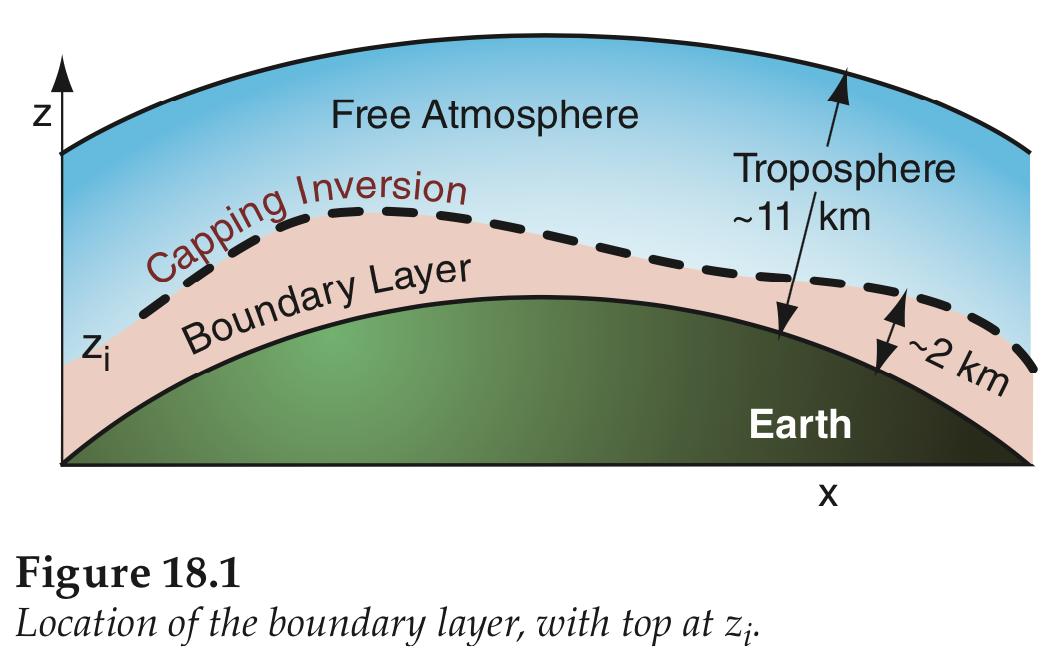
yes exactly. during the night the net turbulent flux in the boundary layer is directed downwards, always opposing the direction of net radiation.
That residual water vapor circulating in the boundary layer, which has not sufficiently released in condensation at altitude, is returned to the surface condensing as ground frost and dew.
This is most common in times of calm weather and high pressure systems.
Overall the reality is that condensation occurring aloft far exceeds the condensation occurring at surface.
With net transport aloft, the condensed matter surfaces act as broadband IR radiators at height where the atmosphere is more transparent.
The effective radiating surface observed from space includes this condensed matter.
from a local perspective, to reduce extreme heat accumulation the goal must always be to maximize net heat transport aloft, up and out of the boundary layer.
This can be accomplished by reducing optical depth to radiation, and by a restoration of the net latent flux and dynamical transport process.
The night is dominated by longwave radiative cooling, during which time net radiation is directed upwards.
The day is dominated by cooling latent heat transport aloft, during which time net radiation is directed downwards.
A sufficiently high rate of net latent transport by surface water availability + condensation aloft during the day also corresponds with lower optical depth in the evening.
The air is cleansed of the heat trapping humid haze with the aid of a functional ecosystem process.
Importantly, the specific heat and radiation regime of naturally dry sandy deserts is far different than unnaturally exposed loam subsoils in more humid regions.
Sensible heat is very poor at penetrating up and out of the boundary layer. The best bet is by latent and radiative flux.
The symbiotic vegetation, fungi, and microbes are intimately involved with the latent heat transport and cloud condensation mechanisms, in addition to ensuring the windows are left sufficiently ajar to longer wave radiative flux.
Perhaps it can be argued these processes on the continents play a role in larger scale dynamical process. There appears to be an increasing budget of SW down penetrating into ocean where this energy is not immediately reradiated to space.
Indeed, there is no dispute IR actives gases act in harmony with the dynamic equilibrium process.
There is no need to minimize the multiple co-benefits of ecological restoration out of some fear that this might undermine the reductionist trace gas policy communication efforts.
The attached preprint was retrieved on December 24, 2022 from: https://esd.copernicus.org/preprints/esd-2022-5/esd-2022-5.pdf
 esd-2022-5_modely_non-radiative-cooling.pdf
Access to published final text
https://cris.vub.be/ws/portalfiles/portal/88409508/DeHertog_etal_2022_ESD.pdf
Of course, assuming that other parameters usually considered in the energy balance, like solar radiation, Earth surface albedo etc., remain stable (constant).
JCM
The vertical currents that fully explain the climate, is another rumor, meme , and folklore in the denialist state religion. If that “parcel of air ” mooves downwardes , it will heat up adiabatically, and fogs will dissolve. Cfr extreemly dry and hot föhn- winds.
Dew and frost on the ground happens when the air for some reason contains enough invisible H2O- gas, its partialm pressure or molar pro9portion being high enough, and then, thew whole temperature falls in steady air hardly with winde, and that seems only possible by …. radiation.
Rather the surfaces, the car roofs and windows radiate and have low enough heat capacity to cool down (thin car roof metal isolated inside) below the condensing and freezing point of H2O that is allready there in the air. And the temperature at the ground falls low enough tho the very fameous Dew- point” because of radiation upwards. in trhe night.
Fogs in the air near the ground at night and at windstill comes because of the same, but by aerosols enough in the air for drop nuclei in the air. .
There is morning dew and frost in the grass for the same reason and I have seen it extreemly at the shore in Pisa in summer. With burning sun and hot during day but clear nights, and strong morning dew everywhere on the tents and on the willow tree- leaves.
A German who knew said that “Theese trees have no other water in summer than this morning dew. “!.
The land is heated by the sun during day, the air rises leaving a vacuum. . The sea is more cool, there water evaporates from the sea, and blows in over land.
Homer has written about it allready. “It smells pristine sea in town during day and smells sinful town at sea during night.” The Odysse.
Moist air going up may give Cumulus and cumulonimbus. But moist air being forcede down will give fönwind and deserts. Eventual clouds and fogs will disasolve.
The watering and greening of mediterraneann coasts such as southern California and Holluwood is mainly horizontal.
That effect may be quite important for arid areas and desert vegetation. But that water has evaporated at sea and blown in from the sea during day. Not fallen down from above. in vapour form
Wherefore you also see green stripes of vegetation at the sea shores everywhere in arid and desert mediterranean climate…. worldwide.
Italian mountains and californian mountains are green. There, the moist sea- winds are forcede up against mountains and water condenses by lapsrate and adiabatic expansion to hit the claussius clappeyron dewpoint- curve in empty air.
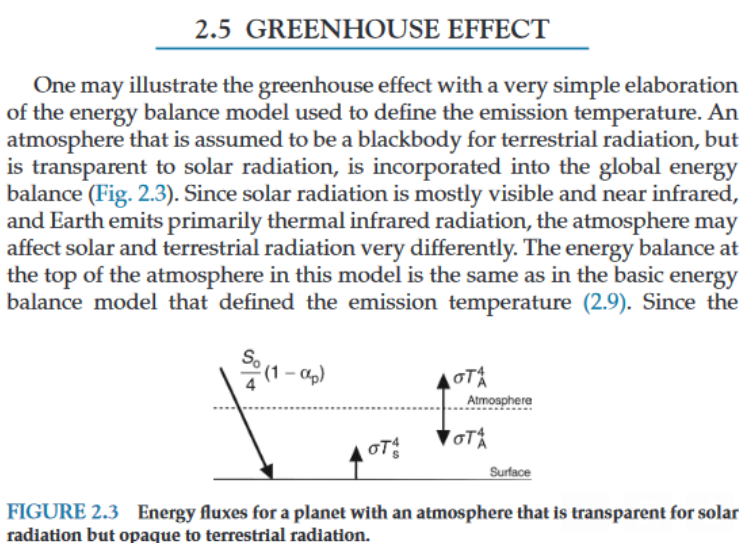
Purely radiative greenhouse effect, with no other mechanism of heat transfer from the surface into atmosphere, results in maximal possible difference between surface temperature and cover temperature. Contact of the cover (atmosphere) with the surface, enabling also heat transfer by hot air convection and by water evaporation from the surface and condensation thereof in the atmosphere, enables lower surface temperatures as radiative cooling alone and thus reduces the difference between the surface temperature and cover temperature (makes cooling of the surface more efficient and the greenhouse effect less powerful):
https://www.nature.com/articles/s41467-022-33279-9
(open Access)
Carbo, this is pretty incompetent stuff. Terra preta kills microbes? LOL….
I would correct this in detail, but it’s pretty much impossible to make this mistake if one has even the slightest understanding of what terra preta is, so I’m confident nobody else will repeat this gobsmackingly obvious error.
Hartmann, Physical climatology, 2016:
Model of a thin glass plate separated from the Earth surface by vacuum:
Therefore, in the models,global warming resulting from the loss of transpirational cooling is, for the same deforested area, at least one order of magni-tude smaller than our estimate (Table 1).
see page 8, penultimate paragraph + page 10, first paragraph:
In current models, it is assumed that as the planet warms, the temperature lapse rate should slightly diminish followingmoist adiabat (the so-called lapse rate feedback, Sejas et al., 2021). This robust model feature is not, however, supportedby observations (Fig. 5). Satellite data are consistent with an increase in the lapse rate (Fig. 5). The temperature differencebetween the surface and the upper radiatve layer ze (located between 500 and 400 mb, Benestad, 2017) grows at approximatelythe same rate as the surface temperature itself. This effect is especially pronounced over land (Fig. 5c,f). This is consistent witha radiative forcing imposed by changing non-radiative fluxes, including those due to the land cover change (Fig. 3d-f).2301.09998_Makarieva_et_al_20230124.pdf
@ Killian again
“”nobodey else will repeat this gobsmackingly obvious error”
“Terrapreta kills mictobes? LOL”
Your hair is long, genosse, but your thoughts seem quite much shorter.
As if fire and heat does not kill microbes and sterilizes, de-naturates the materials, which is exactly what is done artificially in order for the substrate not to rot and be eaten away quickly by microbes in that climate..
But may be a necessary technique when the tropical soil is hardly more than sheere kaolin and biological decay goes especially fast.
Where it is burnt, all life is killeds, and it takes years for it to grow back again if ever. But there are typical pioneering plants also after bushfires and where houses have burnt down. Rubus idea L for instance, and young birches. And quite interestingly Leguminosae.
Plants and life show high diversity. Tomatoes I have learnt, can be grown on sterile glasswool with sheere lifeless mineral fertillizer. But with potatoes,… you hardly have success without fresh… bullshit… or Man-shit… They seem special in their ability of taking up ammonium before it is oxidized to nitric acid buffered with limwestone. and very fond of phosphate.
Carrots and cabbage shall rather have it thorroughly decayed odeourless without any smell of “manure”.
Ribes negrum rubrum and album and uva crispi like well drained stony ground like we have, Morrhaines. But with ferilliser, leavefall and piss. I have had very fine results simply with sawdust morraine sand rough grinded dolomite and NPK fertillizer. When the mushroms blossom atop of that after 3-4 years it is ready , and you get record yield for many years. .
Potatoes were phaenomenal in fresh sawdust. Hardly in freshly grinded charcoal.
Mushroms do it you see, they take the sawdust and the needlefall of pinaceae make mykorrhiza, and re- cycle the minerals..
But the premises for all this is burnt by Terrapreta. That is not to be recommended , rather to be dis- qualified and warned against,… for agricultre and gardenintg in tempered and northern areas.
It grows most phaenomenal in basaltic volcanic aqshes by the way, on Island, on Hawai, on Vesuv , and in Vulkaneiffel Germania.
Not because of the char and the coal and the “brand” but because of the plutonic original mineral content that is weathered from it rather fast.
Litt: Slash–and-burn Wikipedia.
Not recommended by FAO, because not sustainable.
https://www.realclimate.org/index.php/archives/2023/04/unforced-variations-apr-2023/#comment-810544
@ JCM
That argument of “surface budget” relasted to “H + LE” scaled from 1:10 to 10:1 can hardly be relevant fruitful and valid for the discussion of climate,…… and the fameous wealth of nations and bio- productivity as long as a series of further parameters and realities are ignored. Parameters and realities that are basic in soil science and especially in the FAO litterature and learnings that I have seen.
So why suddenly hide, ignore or forget all that?
I am getting suspiscious.
And there is nothing that I have not yet understood or never learnt, or forgotten about all that.
I first suggested and insinuated “Hide the decline” where the very winter and the very nights are hidden for demagogic political progressive sales reasons.
Then the quetrion whether the earth is cylindric, Mercators projection, or conical in cone- projections of the truth namely in order to make it flat again in the books and on the screens.. That is also rather 50:50 but, why hide the decline? The shortest way to China is not via Gibraltar Suez and the Malacca strait.
And whether the earth is a water cooled,… or a water warmed planet. Beware of launching your sales as holism there with waterbarrels like someone else has done..
Then remark the holism of the worlds flora, especially the trees. We go for trees don`t we? There are also weeds and trees underwater.
The tropical trees are broadleaved and green all the time. The tempered zone trees are broadleavet with leavefall in wither There are even broadleaved with leavefall in the dry summers to avoid too much “evapotranspiration”. and stay wealthy.
And then the very Taiga, the coniferaceae and evergreen needlewoods. What can it tell us? the worlds largest climatic and forested land area.
Then the Cactaceae, who seem to need no rain at all and seem to live from Claussius Clappeyron in the air only rather at windstill withouit turbulent boundary layer streams of air.
And where have you got your summer and winter isoterms in your climatic theory?
And in addition, only the slogan “Soil health”. What about the pH and the reserves of acessible mineral plant nutricians such as Potassium Nitrate Phosphate Sulphate Magnesium Calsium Copper Zink Selenium Vanadium Litium and Boron?
Where is Justus von Liebig and Gay Lussac? were they not PENSUM in public school?
Where is Norman Borlaug and the green revolution? Is there only Rudolf Steiner who cheat and buy their manure from those industrial peasants who better can afford NPK with Dolomite powder and ammonium nitrate and diesel for their machineries?
Where are your thoughts and explainations about eventual volcanic ash sediments, fossile and weathering marine clays, and fossile seashells and corallinales worldwide?
Only that “Evapotranspiration” Stalin and Lysenko, 2 flat earthers, also performed by such monocausal, progressive brand new terms in Ukraina and in Siberia to grow oranges and wines like they had tasted it in Krjeml from southernmost Kryim.
@Carbomontanus
“The vertical currents that fully explain the climate”
I said no such thing! I detect an obsession with the “monocause”. My cause, or your cause. A false choice. Denialists suffer the same defect.
The principles of turbulent flux are discussed in great detail by TR Oke 2nd ed 1987. it is probably still being used to support undergraduate lecture.
The turbulent fluxes of H and LE, he labels it, if I recall. A solid foundation without which further discussion will be fruitless!
“If that “parcel of air ” mooves downwardes , it will heat up adiabatically”
yes it must be so! the H transforming to and fro the kinetic and potential energy reservoirs. The latter representing a storage term.
This is happening everywhere always, not only in the extreme case of the Foehn winds. The sunlit side charging of the potential energy reservoirs.
In the evening the air relatively warmer than it otherwise might have been.
The LE operating by different physical mechanism, the energy stored in vapor phase. That heat stored until condensation, being on the ground or at altitude. That is a turbulent flux too.
The H has no mechanism to transport heat to space. It simply rises and cools, decreasing the kinetic energy and increasing the potential.
The LE, on another hand, delivers heat effectively in condensation aloft. In the night it can be delivered to the surface too, if the radiative conditions permit.
Along with the LE, the surface radiative transmission are of primary interest from a cooling perspective.
The warmist perspective may want to study the H in some more detail, and its relation to the LE. Shifting flux more to the H will evidently reduce the ability for the system to cool.
So we must understand in great detail the surface energy budget. That is my viewpoint.
the net radiation = the H + LE. Now which terms are in charge?
Or is there a dynamic radiative-convective type equilibrium situation occurring here. a codependency across domains like a bad marriage.
Another model asserts the same conlusion for deserts along to Red Sea.
Semiconductor physics implies that solar cell efficiency decreases with teperature of the p-n junction included in the cell.
https://www.realclimate.org/index.php/archives/2023/04/unforced-variations-apr-2023/#comment-810561
This has become evasive and frivolous. Far too many obviously smart people squander their gifts on antagonistic argumentation. It is only deepening disunity, which is opposite to my goals.
JCM
I nave not come to any bconclusion about that Biotic pump of Makarieva yet, others than it being more rain where it is green may have the opposite cause. Where it rains there will be more green. But, I would guess that it is a phaenomenon that works both ways. A causes B , while B also causes A..
I consequently go for the green values, being our only serious carbon sink, so protection of natural and sustainable vegetation has highest priority in any case. But then it is important not to contaminate or ridicule the propaganda for it by para- sciences and quackery. It can be advocated for many enough reasons without having to fight the IPCC. or serving that rumor of the earth being a water cooled planet, for personal career- reasons.
One does not have to disqualify and to showel away climate research and meteorology for having audience and room and money for it. On the contrary, It can very well go together,.
Sahara and Central Asia were clearly more green at Max holocene, and the worlds major Loess- areas settled sub- glacial by enormeous and frequent dust- bowls during the ice- ages. That together entails clearly that the higher the earth temperature, the more it rains, also inland.
Google Earth clearly shows fossile lakes and river systems everywhere in todays deserts. Oase- culture remains everywhere in relict old water systems from max holocene.
The southern California and Las Vegas and Hollywood- and lake-mead arguments are wrong and misconsceived in other words, or rather quite provincial, not appliciable worldwide. .
The Congo- bassin and Amazonas seem to have been rather Savannas in Max holocene and grown over with jungle as the world has cooled. The worlde is ratherv turning back to that situation in our days. Desertification today is rather antropogene sheere local human error. and not the main tendency. anymore.
Currently, photovoltaic cells used for direct solar energy coversion into electricity are passively cooled by radiation + air convection.
@ JCM
To your remark 30 mars 857 am
We must take it next month, it will soon be closed here.
“The turbulent fluxes of H and LE…”
and futher down
“the net radiation = the H + LE..”
Seems not defined. I cannot understand it.
Turbulent and laminar fluxes, I simply cannot see what turbulent fluxes means here. Turbulence in the fluxes will soon dissapear because of gaseous viscosity if not steadily and fiercefully forced. Hope that is not part of your argument..
Also be aware of the fameous http://www.Hans/Jelbring & al argument of lapserate and global warming having its simple “physical scientific” explaination of weighty air falling down in the gravitational field along with E = mgh, Energy = mass times graitation times heigth of falling.
A theory that shall fully explain the ground temperatures on Venus and all further planets..
That fameous folklore constitutes a Perpetuum mobile, that was Ruined by Roy Spencer
See Roy Spencer, “Thibute to Willis Eschenbach for setting the Zeller Nicolov silliness straight”
If you pump up a gas tank of air, it gets hot. Next day it has cooled down, and you can tap off the conndense water by a cock at the bottom next day. It did hardly condense before next day.
Venus would have cooled fully down during the last 4 billion years also.
That fameous Hans Jelbring- argument is not the way to disqualify James Hansens explaination of the russian Venera sonde data.
And turbulence is irrelevant to it. It heats and cools in a hurry by adiabatic compression expansion, not by turbulence friction. either.
https://www.realclimate.org/index.php/archives/2023/04/unforced-variations-apr-2023/#comment-810595
JCM
You are becoming evasive and frivolous here and squander your eventual gifts on antagonistic argument.
The Sahel belt is greening in our days.
The main world desert and arid land stretching from China through central Asia via the middle east over to Africa and out to Marocco has been taken serious by NASA and by the Google Earth and Google maps..
Las Vegas Lake Mead and southern California however US american are irrelevant in comparision, only local provincial details that are being cherry- picked by flat earthers blind believers, and desert walkers. for their worshipful antagonistic argumentation deepening disunity.
I repeat. ….!
I tend to believe that you hardly have got autentic oasis- culture anymore in the USA whereas it exists all the way from China to Marocco as can be found and focused in by Google maps.
And in the same same way, artificial microclimate against chill and uncertain percipitation for the cultivation of rather termophile crops has existed for 6000 years at least all the way from Mt.Ararat via central and eastern Europe to Flåmsdalen in Sogn and further to to Gardar in Austerbygd Grønland.
Do not teach the chineese and the japs how to heat , how to piss, and how to irrigate by critical resources.
Do not try and teach the aborgineans in China or in Sogn how to cultivate their very steep and scarce ackers on both sides in a sustainable way. Because, they could allready read and write for the last 5000 years.
Mao tsedong tried that.
Q. How shall we dissolve the contradiction in the People?. . Answer: The agriculture must be industrialized!
In that way, Mao deleted the very chineese Peasant wisdom by a pen- stroke , and set Guinness world record of hunger cathastrophy…
Which is typical Besserwisserei “Know-it-all” from the progressive verbal chat faculty of Bejing with its deputees in the provinces worldwide. , Where the earth is as flat as a military training camp within barbed wires, , where also matter is dia- lectic, and further artificial planting and irrigation of the same to cool down the situation.
Examples:
Q How to doubble Chinas rice production?
Answer: Plant the rice twice as tight.
Q: How to fill up the Colorado river and lake mead? The Aral Sea? ?
Answer: By Evapo- transpiration.
Next question: What the Hell are they fighting for?
Answer:L The Donbas and Dnipro river and cernozem – resources Tallgrass semi arid steppe.
Stalin and Lysenko, two fameous pioneers and flat earthers, managed to make guiness world record hunger cathastrophy even there.
(Evasive and frivolous, he wrote.)
One of the oldest and simplest means for an effective cooling is making the cooled object wet and ensure an efficient air convention around the object. Heat created in the object converts into latent heat of water vapour.
Vaporization of 1 kg water consumes ca 2257 kJ (0.627 kWh) energy.
“Sahara and Central Asia were clearly more green at Max holocene”
as the theory goes the descending air masses of the so-called Hadley cells shall dictate the location of the major natural deserts.
so there has been an exception at Max holocene which defies theory. Even today, many locations defy theoretical desert effect by global circulation.
what has occurred there in Central asia and Sahara (or elsewhere by teleconnection) during holocene to cause such a change?
what causes such exceptions – how do such exceptions influence our views about global circulation, trade winds, and forced response?
certainly the currently observed aridification there in Afghanistan and associated social unrest is not caused by trace gas emission. In earlier times the area was indeed quite affluent by anecdotal records. Moreso like Switzerland.
It is evidently a human caused phenomenon. Certainly at a much smaller scale than today, but equally impactful for the residents there.
The biotic pump hypothesis asserts that water evapotranspiration by terrestrial vegetation, enhancing the small water cycle, may play a crucial role for water transport from ocean to land and thus for functionality of the entire "big" water cycle.
https://www.youtube.com/watch?v=uxEwJYNb_zA
Dear Dr. Gavin Schmidt,
I would like to ask you for your kind comment on a relatively recent preprint published by Makarieva et al, https://arxiv.org/abs/2301.09998 . Particularly, I would like to know your opinion about significance of concerns raised under Figure 5 in this article, with respect to differences between modelled and observed trends in temperature profile developments.
I am aware of your negative comment on an older article describing the “biotic pump” hypothesis co-developed by this author under JCM post of 20 Mar 2023 at 3:23 PM, mentioning this yet unproven concept:
[Response: This was all shown to be nonsense in the epic series of comments on a submitted (but never accepted) paper. An error in their theoretical derivation was ‘recast’ as a new parameterization but one that has no actual basis in reality. The rejection of this ‘theory’ has absolutely nothing to do with it’s supposed consequences. – gavin]
However, I very recently learned from discussions with scientists like prof. Dennis Hartmann of the University of Washington or Bjorn Stevens of the Max Planck Institut für Meteorologie in Hamburg that latent heat transfer from Earth surface in the atmosphere is among temperature regulation mechanisms implemented into state-of-art climate models.
Furthermore, from the publication by De Hertog at al https://cris.vub.be/ws/portalfiles/portal/88409508/DeHertog_etal_2022_ESD.pdf , it is apparent that these computational tools indeed predict some global effects of measures changing the latent heat flux, like e.g. increased irrigation. It is thus my understanding that the current mainstream climatology recognizes changes in the latent heat transport as one of climate “forcings”.
I therefore suppose that the question raised by Makarieva et al (whether or not the recent models properly address the assumed interplay between small water cycle intensity and long-range moisture transport from ocean to continents, as a mechanism that may play a role in regulation of the overall intensity of global water cycle and thus of the intensity of the said global cooling effect) may be indeed justified. I will highly appreciate if you review the recent preprint published by Makarieva et al and comment thereon, irrespective of possible older mistakes made by any of the authors.
Thank you very much in advance and best regards
Tomáš Kalisz
P.S. I arrived at the recent article by Makarieva when I tried to learn how relevant can the predictions made on the basis of the state-of-art climate models be with respect to supposed increase of precipitation in deserts of Arabian Peninsula or Sahara in case of their exploitation for solar energy conversion into electricity. I summarized it in my public orgpage (an interactive dynamic scheme made in application OrgPad) which is accessible under link https://orgpad.com/s/VhvfDd5uRIP
Dear Rasmus,
this executive summary is, possibly, the first one in the history of IPCC reports, mentioning measures changing the non-radiative heat flux among “forcings” (see the fulltext pdf file with figures available under https://www.ipcc.ch/report/ar6/wg1/downloads/report/IPCC_AR6_WGI_SPM.pdf page 6, Figure 2 (c)).
A few days ago, I asked a question in this respect (see attached below). It remains unanswered yet. Possibly it was not asked on the right place, I do not know yet how this forum does work.
Perhaps you could reply? Thank you in advance and happy Easter TK —
Dear Dr. Gavin Schmidt,
I would like to ask you for your kind comment on a relatively recent preprint published by Makarieva et al, https://arxiv.org/abs/2301.09998 . Particularly, I would like to know your opinion about significance of concerns raised under Figure 5 in this articke, with respect to differences between modelled and observed trends in temperature profile developments.
I am aware of your negative comment on an older article describing the “biotic pump” hypothesis co-developed by this author under JCM post of 20 Mar 2023 at 3:23 PM, mentioning this yet unproven concept:
[Response: This was all shown to be nonsense in the epic series of comments on a submitted (but never accepted) paper. An error in their theoretical derivation was ‘recast’ as a new parameterization but one that has no actual basis in reality. The rejection of this ‘theory’ has absolutely nothing to do with it’s supposed consequences. – gavin]
However, I very recently learned from discussions with scientists like prof. Dennis Hartmann of the University of Washington or Bjorn Stevens of the Max Planck Institut für Meteorologie in Hamburg that latent heat transfer from Earth surface in the atmosphere is among temperature regulation mechanisms implemented into state-of-art climate models.
Furthermore, from the publication by De Hertog at al https://cris.vub.be/ws/portalfiles/portal/88409508/DeHertog_etal_2022_ESD.pdf , it is apparent that these computational tools indeed predict some global effects of measures changing the latent heat flux, like e.g. increased irrigation. It is thus my understanding that the current mainstream climatology recognizes changes in the latent heat transport as one of climate “forcings”.
I therefore suppose that the question raised by Makarieva et al (whether or not the recent models properly address the assumed interplay between small water cycle intensity and long-range moisture transport from ocean to continents, as a mechanism that may play a role in regulation of the overall intensity of global water cycle and thus of the intensity of the said global cooling effect) may be indeed justified. I will highly appreciate if you review the recent preprint published by Makarieva et al and comment thereon, irrespective of possible older mistakes made by any of the authors.
Thank you very much in advance and best regards
Tomáš Kalisz
P.S. I arrived at the recent article by Makarieva when I tried to learn how relevant can the predictions made on the basis of the state-of-art climate models be with respect to supposed increase of precipitation in deserts of Arabian Peninsula or Sahara in case of their exploitation for solar energy conversion into electricity. I summarized it in my public orgpage (an interactive dynamic scheme made in application OrgPad) which is accessible under link https://orgpad.com/s/VhvfDd5uRIP
Tomáš Kalisz, You appear to be asking whether the increase in latent heat transport in a warming world is being properly represented in climate models as you are of the view that they are not. Your previous attempt at obtaining an answer to this question probably wasn’t very helpful for you.
Perhaps it should first be made plain that increasing in rainfall under AGW is more involved that simply the annual global average such that changes in that annual global average don’t even feature in this Carbon Brief piece ‘What climate models tell us about future rainfall’. So annual global average rainfall is an obscure part of a complex bit of climatology.
There is perhaps an initial rough-&-simplistic way of testing the potential scale any error in rainfall that may exist in climate models. Rain gauges measure rainfall over land (not perfectly) giving a century length record globally and any rise in annual rainfall can be simply converted into changes in the surface energy flux.
Thus the EPA web page ‘Climate Change Indicators: U.S. and Global Precipitation’ provides data showing that measured annual rainfall over land globally has risen something like 0.5″ in a century: so roughly 1.3% increase. Now that would if extended over ocean as well as land constitute +1Wm^-2 of latent heat entering the atmosphere. But note there is no indication of this average global rainfall mirroring global temperature wobbles. (That is the early 20th century shows a rise equal to the late 20th century, times when temperature supposedly driving any rainfall change were not rising equally.)
And we do now have also satellite data which given the extremely lumpy nature of rainfall is likely a better measure. The Global Precipitation Climatology Project give a value per ºC of global warming over the period 1979-2017 of 1.3%, which miraculously agrees with the EPA rain-gauge-derived data, temperature increase 1900-2021 being roughly +1ºC. GPCP point to the ENSO wobbles impacting precipitation do even out over the period 1979-2017, not something that would always occur.
Now your contention is that this increasing rainfall is not represented in the climate models. However, the Global Precipitation Climatology Project disagree saying of the 1.3%/ºC “This value is close to the value often quoted coming from climate models” while pointing to the wobbly nature of the data making the result a rather sensitive one.
So it does appear that the increase in latent heat transport in a warming world is being properly represented in climate models.
Sir,
Thank you very much for your feedback and extremely useful references. I was not aware of the GPCP data.
Greetings TK
@Tomáš Kalisz says: –
.” We emphasize that our goal here is not to obtain an accurate estimate of global transpirational cooling, but to present plausible arguments showing that it can be large.
Therefore, by construction, global climate models cannot provide any independent information about the climatic effect of evapotranspirational cooling ”
ms: — Hello Tomáš Kalisz – I am a biologist and artist and I looked at your graphic about heat wave mitigation / global water cycle restoration. dr Gavin Schmidt is hard to reach when it comes to evapotranspiration and ecology. I’ve been posting on more or less the same topic for many months and it’s hard to have fact-based communication. Broad sections of the audience here are convinced that water cycles should only be seen as feedback on higher GHG emissions. A theory according to which man has actively interfered with the water cycle for thousands of years and actively impeded evaporation – they reject.
So don’t let that unsettle you. Of course, the water cycle plays the primary role in regulating the Earth’s temperature. According to the IPCC, on agricultural and forestry areas and urban land areas land use change has decreased evaporation extensively on 72% (94 million km²) of the ice-free land area (130 million km²).
BOX | BREAKDOWN OF THE GLOBAL, ICE-FREE LAND SURFACE (130 MILLION KM2) 72% of land directly affected by human use: – 37% of pastures, of which 16% are used savannahs and shrublands, 19% extensive pastures and 2% intensive pastures (since 1961, the number of people living in areas affected by desertification almost tripled). 22% of forests, of which 20% are managed for timber and other uses and 2% are planted 12% of cropland, of which 10% are non-irrigated and 2% irrigated (since 1961, the use of fertilisers increased by nearly ninefold and the use of irrigation water doubled. 1% of settlements and infrastructure
28% of unused land: – 9% of intact or primary forests 7% of unforested ecosystems, including grasslands and wetlands (since 1970, wetland areas have declined by 30%). 12% of barren wilderness, rocks, etc.
Thank goodness the IPCC at least recognized in 2021 AR6 that irrigation has a cooling radiative forcing, even if IMHO the value is far too low and cooling through the albedo change of land use change is a very questionable matter in particular.
Since the loss of evaporative landscapes cannot be denied (nor can the GHE of CO2) a value for this loss is missing in the 200 times peer reviewed graphic (@ Dan).
The following graphic is the combination of a GEB model with the observation values CERES 2000-2020, which also quantitatively captures the loss of evaporation and the 20-year development of the global climate. Less evaporation (-0,86W/m²) —> less cloud albedo (~ -0,8W/m²) are the main driver of the increased energy imbalance.
https://climateprotectionhardware.files.wordpress.com/2023/03/geb_2000-2020finish.png?w=1024
I also really like the project of conquering/populating the desert with solar cells. However, at the moment it seems that the production of electricity via mirror power plants and concentrated solar radiation in combination with a steam turbine has better efficiency, since the electricity production can be sustained at night by thermal storage.
But you probably know that cooled PV modules show an improved power production with every °C of cooling (~0.5%/°C). A PV module that is cooled down from 95°C to 35°C, for example, produces ~ 30% more energy and is certainly more durable. I myself develop prototypes in the field of *water-cooled LED light and PV-T modules with ~85% efficiency”. If you are interested – just contact me.
Mirror power plants are very expensive in terms of production costs – which not every desert state can afford. PV systems in the desert require significantly less effort, time and capital. If I understand your graphic correctly, you want to evaporate water with hot solar cells ????
https://climateprotectionhardware.files.wordpress.com/2023/03/geb_2000-2020finish.png?w=1024
https://www.realclimate.org/index.php/archives/2023/04/unforced-variations-apr-2023/#comment-810534
@ms,
I would like to respond also to your comment on my post of March 30 (I am new here and do not see an option how to reply to this older comment directly). I exploit the circumstance that you touch the same topics – the role of latent heat flux and the intensity of water cycle in climate regulation.
macias shurly says
1 Apr 2023 at 11:43 AM
@Tomáš Kalisz says: –
.” We emphasize that our goal here is not to obtain an accurate estimate of global transpirational cooling, but to present plausible arguments showing that it can be large.
Therefore, by construction, global climate models cannot provide any independent information about the climatic effect of evapotranspirational cooling ”
ms: — Hello Tomáš Kalisz – I am a biologist and artist and I looked at your graphic about heat wave mitigation / global water cycle restoration. dr Gavin Schmidt is hard to reach when it comes to evapotranspiration and ecology. I’ve been posting on more or less the same topic for many months and it’s hard to have fact-based communication. Broad sections of the audience here are convinced that water cycles should only be seen as feedback on higher GHG emissions. A theory according to which man has actively interfered with the water cycle for thousands of years and actively impeded evaporation – they reject.
So don’t let that unsettle you. Of course, the water cycle plays the primary role in regulating the Earth’s temperature. According to the IPCC, on agricultural and forestry areas and urban land areas land use change has decreased evaporation extensively on 72% (94 million km²) of the ice-free land area (130 million km²).
BOX | BREAKDOWN OF THE GLOBAL, ICE-FREE LAND SURFACE (130 MILLION KM2) 72% of land directly affected by human use: – 37% of pastures, of which 16% are used savannahs and shrublands, 19% extensive pastures and 2% intensive pastures (since 1961, the number of people living in areas affected by desertification almost tripled). 22% of forests, of which 20% are managed for timber and other uses and 2% are planted 12% of cropland, of which 10% are non-irrigated and 2% irrigated (since 1961, the use of fertilisers increased by nearly ninefold and the use of irrigation water doubled. 1% of settlements and infrastructure
28% of unused land: – 9% of intact or primary forests 7% of unforested ecosystems, including grasslands and wetlands (since 1970, wetland areas have declined by 30%). 12% of barren wilderness, rocks, etc.
Thank goodness the IPCC at least recognized in 2021 AR6 that irrigation has a cooling radiative forcing, even if IMHO the value is far too low and cooling through the albedo change of land use change is a very questionable matter in particular.
Since the loss of evaporative landscapes cannot be denied (nor can the GHE of CO2) a value for this loss is missing in the 200 times peer reviewed graphic (@ Dan).
The following graphic is the combination of a GEB model with the observation values CERES 2000-2020, which also quantitatively captures the loss of evaporation and the 20-year development of the global climate. Less evaporation (-0,86W/m²) —> less cloud albedo (~ -0,8W/m²) are the main driver of the increased energy imbalance.
https://climateprotectionhardware.files.wordpress.com/2023/03/geb_2000-2020finish.png?w=1024
I also really like the project of conquering/populating the desert with solar cells. However, at the moment it seems that the production of electricity via mirror power plants and concentrated solar radiation in combination with a steam turbine has better efficiency, since the electricity production can be sustained at night by thermal storage.
But you probably know that cooled PV modules show an improved power production with every °C of cooling (~0.5%/°C). A PV module that is cooled down from 95°C to 35°C, for example, produces ~ 30% more energy and is certainly more durable. I myself develop prototypes in the field of *water-cooled LED light and PV-T modules with ~85% efficiency”. If you are interested – just contact me.
Mirror power plants are very expensive in terms of production costs – which not every desert state can afford. PV systems in the desert require significantly less effort, time and capital. If I understand your graphic correctly, you want to evaporate water with hot solar cells ????
(TK) My comment amendment thereon is as follows:
I am a physical and organic chemist by my education and a technologist and patent engineer in several chemistry-related industry branches by my career. Being since 2011 in organic semiconductor industry and dealing also with materials for organic solar cells, I strived to grasp in which extent might photovoltaics (and organic photovoltaic as a part thereof) contribute to a switch of electricity production from non-renewable sources to renewable ones.
Although my primary focus is on electrochemical technologies for a cheap long-term electricity storage that might make electricity production from intermittent renewable sources such as wind and sun reliable and still cheap enough to be economically competitive with fossil fuels, see e.g.https://orgpad.com/s/5BfLP-cxj-7 , I see as potentially important also the questions pertaining to economy and possible environmental consequences of massive renewable source exploitation.
As you may take from the link https://journals.ametsoc.org/view/journals/hydr/23/1/JHM-D-20-0266.1.xml (also saved in the orgpage https://orgpad.com/s/VhvfDd5uRIP you looked at), some models predict that making a hot desert even hotter by lot of waste sensible heat released from classical solar panels should paradoxically bring more precipitation thereto.
This prediction is exactly opposite to the assumptions of the biotic pump hypothesis assuming that for bringing moisture from the ocean to the interior of continents, an intensive small water cycle enabled by forests and wetlands should be beneficial.
The idea behing my proposal is testing both hypotheses practically, on urban islands as a model of a desert, by installing either lot of classical solar panels, or (togerther with a necessary infrastructure for rain catching and storage) “2.0” solar panels cooled by water transpiration. A statistical evaluation of both alternatives could show if rather the first or the second alternative brings more precipitation into hot cities and makes the conditions therein more livable during the hot summer seasons.
The results migh then serve as a testing benchmark for the respective microclimate models. Finally, the results of such comparisons could be perhaps exploited also for testing the available global climate models.
I hope that although Dr. Gavin Schmidt may not become impressed, someone else from the climate modelling community might perhaps still perceive this idea as worth of an attention.
https://www.realclimate.org/index.php/archives/2023/03/unforced-variations-march-2023/
macias shurly says
The CERES data 2000-2020 clearly show an increasing earth energy imbalance (EEI +0.77W/m²) due to an albedo loss of -1.4W/m² and for higher CO2 concentrations a completely atypical increase in the LW-out-@-TOA of +0.57W/m².
You can see the climate development of the last 2 decades most clearly in a model of the global energy balance, which I have supplemented with the observed and measured CERES data (white digits):
A significant increase in GW or EEI due to a stronger greenhouse gas effect cannot be traced using the CERES data 2000-2020. The global climate has shifted and continues to shift towards a “clear sky atmosphere” and desertification – accompanied by the loss of snow & ice albedo. .I suspect cloud albedo loss to be 1.7% over the 20 years.
https://www.realclimate.org/index.php/archives/2023/04/unforced-variations-apr-2023/#comment-810588
Greetings @Tomáš Kalisz
I will consolidate a few items of interest to me:
I am a land steward who wishes to offer climate stabilizing perspectives in addition to efforts to reduce trace gas emission. In this forum my goal is to frame the concepts of hydrology and ecosystem effects in terms of interest to the climatological community.
These concepts discussed, such as minimizing hydrological and temperature extremes, are resisted for unknown reasons here – perhaps it is for computational simplification. The definitions proposed by radiation theorists and experimental computationalists have somehow now permeated into and displaced definitions and teaching of environment, climates, & change.
The human related factors proposed by those who reduce their perspective of climates to computational capability and radiometer observation appear to include: Surface albedo, aerosol, ozone, and trace gas emission. Everything else, therefore, such as real climates, real environments, and change is deemed a feedback to such effects.
Alternative themes centre around overall drying of the continents, directly by human intervention, in addition to feedback effects from trace gas, with particular rapid pace over the most recent centuries.
The observations related to highly degraded ecosystems and watersheds include, but are not limited to: hydrological extremes such as increasing flood and drought extremes, and increasing temperature extremes.
These observations of climate changes appear to be confused with the equally important notion of “global warming”. The result is that local community decision makers have minimal understanding of the local factors of risk for their residents, and they have no sense of accountability when things go wrong.
@macias has recently shared the following work by Liu & co which depicts a clear reduction oceanic moisture flows to continents in Figure 5. https://link.springer.com/article/10.1007/s00382-020-05451-8
Nobre & co. have noted that additional heat over land “can block oceanic” moisture transport. https://www.sciencedirect.com/science/article/pii/S2405844022024616
Wang & co. highlight an overall reduction of evaporative fraction over continents.https://hess.copernicus.org/articles/25/3805/2021/
Makarieva & co. notes a hysteresis whereupon the shift to a dry regime is self-reinforcing /resistent and can therefore cause some confusion about the benefits of ecological restoration.https://onlinelibrary.wiley.com/doi/10.1111/gcb.16644
In various works Huyrna and Pokorny highlight the far greater impacts of ecohydrology working in addition to albedo and sinks/sources of Co2.https://www.semanticscholar.org/paper/The-role-of-water-and-vegetation-in-the-of-solar-a-Huryna-Pokorn%C3%BD/15f3d6ee13d35aaeb1867b781a19f29fec509048
The factors of reduced oceanic moisture flows over continents + reduced evaporative fraction is evidently a compounding effect. The drying continents directly by the hands of humanity with increasing temperature and hydrological extremes has far reaching consequences for changing climates. The common view here is that increasing continental “heat” should increase rising air currents and therefore promote “sea breezes” and return flows. But it seems there must be more going on.
I look forward to hearing more of your novel perspectives.
https://www.realclimate.org/index.php/archives/2023/04/unforced-variations-apr-2023/#comment-810616
@JCM “overall drying of the continents,”
Been reading your commentary on and off, thank you.
I am assuming however that this overall drying is directly and cumulatively caused by human activity, being intervention in the destruction/change in the vegetation state of global ecosystems including over plains, grasslands, savanna and rain-forests etc over millennia and extremely rapidly during the last ~200 years and still increasing in extent.
Is this your view, or do ahve some additional insights explanations. Thanks
https://www.realclimate.org/index.php/archives/2023/04/unforced-variations-apr-2023/#comment-810728
@Ned Kelly,
the themes wide scale continental desiccation and profound ecosystem change, directly by human activity, is the crux of the argument.
Always consider that there is 10x the ecological activity, biomass, and hydrogeological process occurring below the terrestrial surface compared to what’s visible above. I look to the soil first and foremost – where change is unobservable directly by radiometer.
It should be uncontroversial that such direct impacts have consequences to local and regional climate observables – such as temperature and hydrological extremes, and the depth and duration of such events. This, irrespective of trace gas emission.
But, such effect are thought of as second order importance. Dare I say, hydrological stabilization is deemed an “adaptation’ to climate change? What a funny way to think about things.
On the controversial side of things, unnaturally limiting the duration, extent, and intensity of latent fluxes and/or condensation processes may have broader impacts for climates more generally.
Even in a preindustrial atmosphere with unperturbed trace gas concentration, such changes would impact upon hydrodynamic balancing processes.
The fluid mass flux has always been coupled to net solar and transmitted radiative flux, particularly in the turbulent layer.
Unnaturally limiting the hydrodynamic freedom surely has impacts.
The pressure is only increasing today with the proliferation of trace gas emission. A double whammy for climates, where the feedback regime has been perturbed in addition to IR atmospheric optics.
@ Tomáš Kalisz says: ” -https://www.ipcc.ch/report/ar6/wg1/downloads/report/IPCC_AR6_WGI_SPM.pdf
ms: — Hello Tomáš – I have already posted the same IPCC graphic from 2021 3 times here at RC and asked very similar questions about it in modified form. *** Land use reflectance and irrigation with a cooling effect on Earth temperature of ~ – 0.1°C. *** Uhpps – after 33 years something new ??? A water cooled surface ???
First some facts:
– The current global irrigation amounts to ~ 2600 km³/y, of which only ~ 38% (~1000 km³) arrives at the plant and is evaporated. 62% is surface and underground runoff.
– Cooling from increased land use reflectance actually refers to the difference in albedo between densely forested wet areas with a low albedo – and deforested areas whose soils dry out quickly and thus almost always have a higher albedo. Has the IPCC taken into account what this means for the energy balance on a land surface ??? I don’t believe!
– Have they accounted for the expected higher ground temperatures of up to 30-40°C that will occur on the cleared, sealed, canalized land??? I don’t believe!
Thermal radiation of the planetary surface Fs = σTs^4 (Wm−2)
– Did the IPCC calculated the loss of transport capacity of energy between the land surface and the upper troposphere and the guaranteed loss of cloud albedo ??? I don’t believe!
Does the upper troposphere possibly remain too cold due to a lack of surface cooling and less condensation heat from water vapor ?
The upper radiative layer to space Fe = σTe^4 )
As a result, isn’t this a very similar effect as the GHE – ( outgoing radiation is reduced and incoming energy is increased ? )
YES – BUT IN THE SHORT WAVE RADIATIVE EFFECT OF THE CLOUDS (CRE)
https://climateprotectionhardware.files.wordpress.com/2023/03/cre-cloud-2.png
Could it be that some IPCC scientists wear sleepy woolen hats with ears and eye patches to avoid having to take in what has happened in the last 2 decades? I think so!
https://climateprotectionhardware.files.wordpress.com/2023/03/geb_2000-2020finish.png?w=1024
In the Trenberth and Loeb GEB valid for the period 1999-2009 I have added the CERES data from 2000-2020 as 20-year trends. So pay attention to the difference between the yellow and white digits. These are the current developments in the climate over the last 20 years. GHE & CO2 are only ~1/3 of global warming. Both the Trenberth & Loeb energy balance model and the CERES observation data used are part of recognized science and the IPCC. The measured values @ TOA have the smallest uncertainties.
– Albedo decreased by ~1.4W/m² (cloud, ice and aerosols) – The outgoing longwave radiation (OLR) has increased by ~0.57W/m². – The EEI has more than doubled. ~0.4-0.6W/m² —> ~1.37W/m²
(back to the IPCC table) – There has been no cooling albedo from land use reflectance or irrigation for at least 23 years. In fact, the IPCC has not yet recognized that humans can not only irrigate, but have also the ability to drain, dry out, burn, seal landscapes for centuries and millennia…etc. – unbelievable lol
On my website you will find plenty of facts quantifying the lack of evaporation on the ground, in the atmosphere and @ TOA … putting human knowledge of water cycles back on its feet. You can also contact me there – ( I looked on orgpad – but didn’t find any possibility for feedback there.
@Rasmus Benestad says: * IPCC AR6 SYR SPM *
ms — … who knows the number of pages of the synthesis report – has a clear advantage. He knows how much time he has saved before he throws the bullshit, preferably unread, into the dustbin of history.
@ Thomas Kalisz
MA Rodger has given you a quite good answer here.
By occasion and looking after the fameous Aral sea to find out about desertification, I found rather what I believe and take for granted, having other learnings and routines for this, than people are having from the fameous, political carriere and commercial Verbal Squat faculty.
The vapour pressure curve of water that ranges continously from overheated steam boilers and down to Antarktis in winter and further down to Mars and Pluto—–
………..Together with………
………..The Claussius Clappeyron-principle of eqvilibrium phase transition…. also in vacuum on the moon…..
……and seen Together with fossile evidence from oligozene 30 million years ago when there was much warmer and thus also much more rain in the world….
….. there was a large freshwaqter system in todays deserts of Central Asia.
Not only the fameous http://www.Taklamakan, but also in the west , Lake Aral The Kaspian sea and the black sea all connected and flooded by central continental rain and snow. At 5-8 deg warmer than now.
Further fossile documents of the same is enormeous lignite and Kaolin sediments from that period at high latitudes..
The worlds fameous Loess- sediments due to enormeous frequent dust- bowls on the other hand,….
………. settled sub- glacially at high latitudes during the recent, very cold ice ages. with extreemly low CO2 in the air.
I repeat.
Thus rumors of general desertification in the world due to global warming does contradict a large material of archaeological and geophysical evidence. as also natural and obvious along with elementary geophysics.
In addition, the fameous recent drying up of lake Aral is obviously and officially Antropogene, due to the need for evapotranspiration by Stalins progressive, grand old Party programs with P.
The rivers running into Aral were taken and regulated artificially for cotton production..
There should be many enough systemjatically independent empirical reasons to draw a conclusion then, about the main causes of increasing drought and desertification here and there in the world and not only in the wild west around Grand Canyon Lake Mead, Las Vegas, and Southern California.
Look also Petroglyphs of savannas in Sahara from max holocene and even relict nile crocodile populations in the oases.. ,the history of the fameous Lake Chad is further a document.
In addition to the vapour pressure curve of water, on must also look after the patterns of the meandering jet streams, that seem to be quite sensitive and change more, and also more unpredictable, along with global warming.
That system of global and circumpolar jet streams do decide quite much on where the rain and snow will fall down , Evaporated water will fall down again somewhyere in any case. At sea or on land, But there is hardly less and less percipitation on land in our days due to global warming, there is rather more and more due to warmer oceans. but in an unpredictable way of patterns.
Tis is a more efficient way of seeing it instead of purchasing oneself as artist biologist hydrologist and rainmaker. We see what comes out of it when we puncture them.
It is ugly.
But, such is industrialized dilettantism dia lectic materialism, and trained religious syndicalism that is all the same. .
https://www.realclimate.org/index.php/archives/2023/04/unforced-variations-apr-2023/#comment-810576
@ tomas Kalisz
Several interesting things.
Solar mirrors can be made rather cheaply by aluminium plate and even aluminium foil and cheapest straw or bamboo for rigidity. I have seen it suggested and even demonstrated for boiling teawqater and frying egs without fire or electricity. And for heat storage, molten salt where sodium sulphate hydrate is suggested with a high phase transcision entrophy that can also worh further with a heat pump.
Promising, but please, resign on higth consumption waste and brutality of the product then, which is just as important.
We shall try it tomorrow with barbecue at the shore, the art of heating and make piquenique with leat possible firewood smoke and waste., which is quite an art. If people only could train on that.
Why not a smooth, large wheeled local diligence taxi, , why porsche and BMW and Tesla at those brutal accelerations and speeds?
Square kilometers of photovoltaic…. what about dustbowls and birrshit? Common windows must be cleaned quite often and that is expensive.
I am expert on microclimate as a passionate sea bather at 60 deg north.
Microclimate is even more important for comfortable living further north. We have managed ripe tomatoes and wine without greenhouse glass or plastic in the sunny wall. By good design and needlewood trees that break the wind even breaks the snowfall and make their own natural microclimate, you can acheive maybe 2 deg warmer than the average climate by such rather traditional means.
What the aspirands here are not yet aware of is that the earth is round and that solid vegetation and evaporation rather warms the situation at night and in the winter.
It is shadowy cool under a large tree in the summer at noon, but rather pleasant warm in the nights and in the winter.. It breaks the storm and the winds so you will not loose heat by wind and storm convection. That rules also for houses.
The ground thaws first in spring under the proper trees. Sensitive animals rest and go to sleep in the bushes and under the trees. Birds sit warm in the trees in the winter. And there they also find the first grass in spring. Birdshit especially there makes warm fruitgardens under the old trees.
There is obviously a special “greenhouse” for life in the woods. Thus in order to fight greenhouse effects, and to cool the earth, get all the bushes and trees away first .
https://www.realclimate.org/index.php/archives/2023/04/unforced-variations-apr-2023/#comment-810582
@carbomontanus
Thank you very much for your commment!
You have very good point in that the terrestrial vegetation may have both the cooling as well as the warming effect on the microclimate. I believe that its effect could be, as a rule of thumb, characterized the way that vegetation makes the microclimate milder, with less extremes in comparison with the same area unplanted.
I think that in some extent, the influence of the vegetation cover can be mimicked by irrigation of the bare land. Of course, there are limitations, because mere change in production of latent and sensible heat cannot mimics all processes taking place in the soil, e.g. biodegradation of dead “biomass” that may likely also contribute to the pleasant microclimate of the forests and bushes you mention.
The idea behind the proposed “urban heat island mitigation” experiment is exploiting the assumed analogy (between urban heat islands and deserts) as a test bed for existing climate models.
Let me assume that the available urban microclimate models correctly predict the effects of massive solar cell installation in cities. Then – if global climate models are built on the same principles – such a good fit (between the observed results on one hand and microclimate model predictions on the other hand) could be a hint that predictions of the global climate models, as regards the effects of various human activities that perturb the complex system of the global water cycle and thus may perhaps influence also the global climate, might be also reliable.
Production of additional sensible heat (e.g. by albedo changes) or change of the ratio between latent and sensible heat (e.g. by irrigation, or by replacement of the “classical” solar cells with solar cells immersed by water / cooled by water vapour transpiration) may serve as examples of such human-caused “perturbations” to the global water cycle or “interferences” therewith.
As an outsider, I lack a solid knowledge base in this respect. Therefore, I propose that my public orgpage “Discussion forum: Heat wave mitigation in urban environment, solar energy exploitation and global water cycle restoration”, easily accessible under following link
https://orgpad.com/s/6jf-rtG8wUP
could serve as a platform for sharing the respective knowledge.
The link gives everybody the right for adding any suitable content – comments, documents, videos, links to other websites etc. Hereby, you are invited to participate.
I think that OrgPad might be the suitable platform because it enables, by structuring the content without limitations by a given format, visualize complex relationships without losing an overview of the big picture.
https://www.realclimate.org/index.php/archives/2023/04/unforced-variations-apr-2023/#comment-810614
Tomáš Kalisz says: – ” wind and sun reliable and still cheap enough to be economically competitive with fossil fuels … pertaining to economy and possible environmental consequences of massive renewable source exploitation. ”
ms: — The overall efficiency of a typical wind turbine is currently around 50% – that of PV only 20-25% if it is not cooled in summer with the rising temperatures – even less.
However, the energy efficiency of PV modules can be tripled by using a water-cooled absorber and using the heat for heating and hot water. Solar panels cooled by water transpiration will need a lot of water, that is better transpired by vegetation or crop, thereby absorbing CO2.
My concept to cool down cities is to use the summer heat to heat in the winter. And vice versa, using the cold of winter for cooling in summer. Large seasonal heat and ice storage in combination with heat pumps also have space underground and can possibly be combined with pumped storage or compressed air storage and serve as a protection against drought and flooding.
https://www.realclimate.org/index.php/archives/2023/04/unforced-variations-apr-2023/#comment-810862
@ macias and Tomáš
“evaporated amount of water”
In addition to the mass flux and associated fluid heat transport – you will have the added latent heat of vaporization along for the ride.
For increased efficiency, consider the equally important process of condensation in any scheme.
Just as Turkey is watered using vapor flows off the Carpathian uplands 1000km upstream, all continental watering must have a condensation / precipitation trigger.
Else, the vapor flies right by.
Such triggers reduce the duration of vaporized molecules in atmosphere. They also produce synergies in the hydrological regime which extend across vast regions.
Plumes of condensed matter surfaces.
Consider enhancing condensation triggers, such that abundant fungi and bacteria species are provided to hop on board vapor streams to make things happen. When available, they travel well in fluid dynamic atmosphere. In sufficient abundance, they provide a hygroscopic trigger.
While it is not very glamorous, I suspect the atmosphere is starving for the stuff. Restore the deficits and ‘seed’ the water cycle by incorporating aspects of natural ecology.
https://www.realclimate.org/index.php/archives/2023/04/unforced-variations-apr-2023/#comment-810673
Dear Macias Shurly,
I would like to comment on your idea
“My concept to cool down cities is to use the summer heat to heat in the winter. And vice versa, using the cold of winter for cooling in summer. Large seasonal heat and ice storage in combination with heat pumps also have space underground and can possibly be combined with pumped storage or compressed air storage and serve as a protection against drought and flooding.”
Basically, there is a significant overlap between you and me in the aspect that providing ctities with an infrastructure for collecting and re-use of precipitation could be beneficial, despite of costs. One of the goals of the proposed “Urban heat wave mitigation project” is to prove in which extent the amount of such colected precipitation water could be sufficient for my idea of evaporatively cooled photovoltaics as a means for making hot summers days in cities more livable for inhabitants.
Another goal is testing whether or not a massive installation of classical solar panels producing lot of additional sensible heat may indeed bring more precipitation in the urban heat islands – as could be expected by analogy to a prediction made for Arabian Peninsula: https://journals.ametsoc.org/view/journals/hydr/23/1/JHM-D-20-0266.1.xml by WRF model.
https://www.realclimate.org/index.php/archives/2023/05/unforced-variations-may-2023/#comment-811404
Kalisz
Certain things can be said apriori.
Higher temperature gives more evaporation provided that water is there. And since higher precipitation is predicted, this seems physically plausible.
Decrease of global cloud cower, there I am not so sure, and I preferre not to believe in the experts, it must have a set of plausible reasons that I can check up and understand.
Then we come to the morphology and plausible physics of clouds.
There is a lot of clouds from which it does not rain, at least not down to earth. That can also be seen in the summer. It obviously rains but the rain dissolves evaporates before it hits the ground.
And there is also traditionally a lot of flat grey weather without any rain or snow.
Then there are predictions that due to global warming, rain will come in stronger showers and not as steady light rain all the day.
This is for the tempered zone here where I live but I have learnt that the situation is similar but quite more dramatic in the tropes.
The troposphere with all the rain will become thicker by global warming, that is for sure.
But, why it should clear up more and more in between the clouds, that I cannot quite understand. Only one effect that hardly can explain it, as long as China India and South Africa are heating up with coal. The effect of H2SO4 acid rain, sulphate haze and aerosols in the atmosphere. It indeed clears up if coalsmoke is shrubbed. But I would recommend a qualified meteorologist on this, able to explain to us also How! about the weathers.
Then you also have the arid belts north and south between tropes and tempered, between passat and antipassat wind. The “silent belts” at sea and deserts on land. There it is high- pressure and blue sky and the air falls down . If tose areas get larger, then it will clear up but it will rain more in the low pressure belts.
This explaination rules both for local thunderstorms and for the earths major climatic zones.
https://www.realclimate.org/index.php/archives/2023/05/unforced-variations-may-2023/#comment-811401
to anyone:
chiming in from the anomalously compacted plains which are entirely devoid of functional ecosystem services:
Seems to me that profound human caused continental desertification, particularly in northern mid-latitudes, must be associated with overall reduction of evaporative fraction, reduced magnitude of local water recycling, and lower precipitation efficiency.
Instead of several-times weekly low-intensity rain received at the surface, we must wait weeks in hopes of a major frontal system to come through to clear the sky of anomalously accumulating dusty-humid-haze.
Measured in averages it might appear as reduced cloud fraction, increased cloud height, and reduced average cloud top temperature. Increasing verticality, coinciding with diminishing cloud fraction observed by optical horizontal spectrometrists (or keen eyeball using observationalists).
Less frequent, but higher intensity rainfall events seems a reasonable hypothesis related to massive soil degradation. Check the weather logbook scribbled with permanent blue pen.
Due to the higher bulk density of eroded soils compared to relatively high soil organic matter historical terrain, and higher average precipitation intensity, a greater proportion of rainfall surely runs off due to infiltration excess overland flows; thereby exacerbating hydrological and temperature extremes. ouch.
check the hourly levellogger timeseries for the well.
Lower frequency flushing of the skies, with more violent events when the time finally comes.
Reduced soil moisture, reduced periods of green growth & associated transpiration, warmer thermodynamic surface temperatures, lower cloud fraction, lower cloud top temperature, increasing ocean-continent contrasts, etc.
It’s not really so complicated in principle (and climatologically relevant when trying to rationalize change).
https://www.realclimate.org/index.php/archives/2023/05/unforced-variations-may-2023/#comment-811329
Dear Dr. Schmidt,
Referring to my question of 30 Mar 2023 at 11:46 AM and to the reply thereon by MA Rodger on 8 Apr 2023 at 7:52 AM, I would like to know if I understood correctly that
– climate models predict higher global precipitation due to higher average global temperature,
– this trend is in accordance with observation (both from meteorological stations across the globe as well as from satellite measurements),
– climate models further predict that the global warming causes decrease in global cloud cover,
– this trend is also confirmed during the last 25 years by satellite observations.
Do I conclude correctly that, in nutshell, there is (at least in the last 25 years and in a global average), more rain from less clouds?
Another reply to my post aserts that thank to increased rain frequency, the African Sahel is greening, is it true?
Thank you very much in advance for a comment.
Best regards
Tomáš Kalisz
https://www.realclimate.org/index.php/archives/2023/05/unforced-variations-may-2023/#comment-811446
JCM
You are describing a situation that is not happening here where I live. There has not been drought summers for years, and the groundwater level increases, allthough swings more than before.
A lot of fameous cathastrophies that come through media , are rather obvious consequenses of urbanization and mis-use of water resources, bad water management from human side, that rather should be adressed and they say the same in souithern California. They blame on climate and nature what should be blamed on humans, local politicians, and entrepreneurs.
Also, I find it hard to believe that destruction of vegetation and of “Humus” is causing less rain It is rather opposite . Rain and snow increases. But destruction of high enough and natural vegetation makes the landscape more vunerable to drought periods. That is an accepted fact. Do not cut your lawn for instance when growth obviously stagnates against predictable warmer and more sunny days . And avoid making lawn monoculture Do not fight the obviiously more drought resisstant local flora speecies with deeper roots in your “lawn”. ..
I have heard the same from the USA praiiries, Wild “tallgrass” with buffalos is better.
Motorized leave- blowers and lawn moovers will be forbidden in private hands now. Rain and humus is there , it even increases, but it is fanatically fought against and raked out and remooved as fast as it appears.
Where nothing willl grow, think opposite and seet on what you cannot get rid of at your place. The pioneering “weeds” after your land was ruined. And soon after, just in a few years, the quite local, wild forest will come up again. That can be carefully iinfected with valuable flowers and fruit trees. it stands very well together. Look over old and lleft gardens for species that have survived any human treatment and mistreatment for centuruies, then you have the cheapest and mosts valuable garden wiith least effort for max prophit. Avoid changing the soil too much from what it is from natures side. Then you willl have no desertification.
Nature adapts to human presence in any case, but it takes time. A new chief gadener every 3rd year willl turn anything healthy and alive into betonized pavement.
It takes 50 years at least for a garden or a park or a forrest to grow up with representable, sustainable, and valuable vegetation..
In the meantime, all experts and knowitalls, / all witches and spindoctors must be kept at distance. where Stnging nettles, Artemissia vulgarisi, and Vespa vulgaris are recommended.
https://www.realclimate.org/index.php/archives/2023/05/unforced-variations-may-2023/#comment-811478
“groundwater level increases, allthough swings more than before.”
rapid recharges indicates bedrock controlled drainages. One in which a piezometer is practically useless. Shallow or non-existent drifts, and a climate already adapted to the ecosystem. No amount of action can perturb this rocky terrain where there is no capillary pressure head nor unnatural resistance to infiltration..
However, climatologically, I suspect the +/- 60 degrees latitudes are unique zones, to-which there is a net delivery of heat in the global thermodynamic fluid transport system.
Some conjecture..
The true mid-latitude continents are but transit zones. Bypassed further-still by unnatural desertification of the deep organic soils, and associated unnatural blocking ridges.
For the cause of this behaviour, it may relate to the hypothesis of maximum dissipation in fluid dynamics discussed by Axel Kleidon (linked elsewhere here).
In nature, the rate of poleward decrease of heat vs the poleward increase of atmospheric transparency operates to maximize dissipation and dynamically moderate radiative transmittance.
Somehow a peak of transmittance is found around 60 degrees in the turbulent optical greenhouse system.
A mechanism of variable latent heating and opacity of the atmospheric column in variable dynamic global mass flux configurations.
Such that the poleward and vertical dynamic gradients are less steep than in static concept, but not too little.
A natural scheme so that heat is to arrive where there is best opportunity to transmit radiation to space, while simultaneously sustaining a maximum rate of mass dissipation.
The effect is low radiative transmittance in the tropics where the atmosphere is too opaque, but also a low rate of transmittance at the high poles where the temperature is too low. Instead, a peak rate of radiative transmittance at about +/- 60 degrees. Just warm enough, in a just transparent enough column of air. Selected by nature.
Some folks at +/- 60 are luckier than others. For dwellers in rafts in the southern ocean (an unlikely occurrence!) the result is persistent cloud cover and rough seas. The net radiative flux configuration is best achieved from low suspended condensate there. It is conceivable the surface in the southern ocean might cool with enhanced latent heating delivered in the unnatural global warming circulatory configuration. The South is quite free to do so, and the ocean surface temperature is disconnected from the outgoing flux on cloudy seas.
In Scandinavia, and other land areas +/- 60, a greater proportion of real surface radiative transmittance provides a more perfect mix along with varying degrees of low cloud. For Scandinavia specifically, a comfortable mix fed by the northern seas on terrain unlikely to be perturbed much by humanity.
end of conjecture.
The western Scandinavian catchments relatively stable hydrologically, with a clear path of latent influx via oceanic conveyors. It is mostly sheltered from the vast continental biohydrological disruption. So, uninhibited and increasing latent flux should be anticipated to easily recharge and raise the average well loggerlevel under unnatural global warming.
https://www.realclimate.org/index.php/archives/2023/04/unforced-variations-apr-2023/#comment-810775
@ Tomáš Kalisz says: –
“…, despite of costs. One of the goals of the proposed “Urban heat wave mitigation project” is to prove in which extent the amount of such colected precipitation water could be sufficient for my idea of evaporatively cooled photovoltaics…”
ms: — There are no water retention costs. It’s a good deal that you can easily invest in – or not. I pay for 1m³ of tap water > 2$. If I have a roof area of 100m² and an average annual rainfall of 1000mm, $200 for a rain barrel/cistern with a few meters of pipe is amortized after a year. If the installation lasts 30 years I will have saved at least $5800 if I use the rainwater in the garden and toilet/washing machine etc.
I don’t think your evaporative water-cooled PV modules are very efficient, because the thermal energy is not harvested and used, but escapes into the atmosphere as water vapor. I imagine your modules so that their surface is sprayed with collected (rain) water at short intervals on hot days.
The cooling corresponds to the evaporated amount of water (0.68KWh/L). An average PV module with 1m² produces approx. 200Wp at a module temperature of 35°C and incident solar radiation of 1000W/m² – let’s say on a long, cloudless summer day an energy yield of 2KWh and therefore also 8KWh of heat. So on a hot day you may need 12 L of water / m² of PV surface. I don’t think that’s very sustainable idea at a time when water is becoming scarcer in many places speacially in heat waves.
Drops on the pane of glass can focus the light and selectively disrupt the power production of the solar cells like a small shadow. If the PV system is mounted on roofs, the inhabitants hardly feel this evaporation cold and a park with a fountain, which is watered with half the amount of water / m² in the early morning hours, has much more pleasant cooling effects, shade and quality of life for the city dwellers.
In comparison, a water-cooled PV module with absorber and heat exchanger (& without water consumption) is ~3-4 times more energy efficient, since you can save a lot of electricity, oil & gas with the harvested 8KWh of heat in the bathroom, kitchen, washing machine, dishwasher – with large water tanks and the right heat pump, this also works for heating in winter.
I hope you don’t get this wrong and enjoy arguing about the measures we need to implement in cities to reconcile heat waves, climate change and the energy transition. Ultimately, capitalism will also be a measure of how much urban cooling, energy production and adaptation to climate change is possible for one $
I also don’t think a reliable increase in precipitation coming from the sea in a coastal region through large-scale PV is very promising.
https://www.realclimate.org/index.php/archives/2023/05/unforced-variations-may-2023/#comment-811372
Tomáš Kalisz 8 MAY 2023 There seems to be a major factor missing in your pondering. Less cloud (or fewer clouds, whatever one prefers) isn’t the same as global cloud cover unless residency time is included in the calculations. I know nothing about what it is, I’ve never studied it, but it’s patently obvious that if clouds were to form and then precipitate more rapidly then there could indeed be more cloud and more precipitation with less average cloud cover over a year.
https://www.realclimate.org/index.php/archives/2023/05/unforced-variations-may-2023/#comment-811349
TK,
As to greening in the Sahara, this paper differs:
https://journals.ametsoc.org/view/journals/clim/31/9/jcli-d-17-0187.1.xml
https://www.realclimate.org/index.php/archives/2023/05/unforced-variations-may-2023/#comment-811388
Dear BPL,
many thanks for the reference.
Actually, when I googled for “Sahel greening”, I arrived on an older article file:///C:/Users/tomas.kalisz/Downloads/Journal_of_Arid_Env_63_pp556-566.pdf
Comparison of both articles suggests that the alleged “greening” migh have been a temporary change rather than a long-term trend, I think.
https://www.realclimate.org/index.php/archives/2023/05/unforced-variations-may-2023/#comment-811466
I apologize for a wrong link to the old article I mentioned. The correct one is http://dx.doi.org/10.1016/j.jaridenv.2005.03.008
https://www.realclimate.org/index.php/archives/2023/05/unforced-variations-may-2023/#comment-811355
@Tomáš Kalisz says: – ” …more rain from less clouds? ”
ms: — It depends on how you want to quantify clouds. Clouds can be very different, also in water content, optical density, height, temperature, global distribution, etc.
In that case, I recommend classifying by weight. Since the proportion of condensation or sublimation in nature is very small even without cloud formation, you can assume that 1kg evaporation = 1kg cloud = 1kg precipitation.
In your home region, the loss of clouds can be traced back even 70 years and decreasing precipitation even for 140 years. Your home region is clearly one of the dry regions that are becoming even drier and are therefore warming up above average (+0.5°C / 20 years).
https://www.dwd.de/DWD/klima/national/gebietsmittel/brdras_sun_17_sn_8110_abs.png
https://african.business/2023/03/resources/is-africas-great-green-wall-collapsing
https://www.realclimate.org/index.php/archives/2023/05/unforced-variations-may-2023/#comment-811348
Tomas, it would be helpful if you would be more precise in forming your questions. (I understand that English may not be your original language, so this is not meant to be insulting.)
-There is definitely a prediction that there will be an increase in occurrence of intense rainfall events. -There may also be a slight increase in global rainfall averaged over the course of a year.
Not sure which you are asking about. The first has serious consequences for humans, but the second, if it is correct, is not that significant.
With respect to “global cloud cover”, your question is similarly unclear. The metric “cloud cover” tells us nothing about the type of cloud, so “more rain from less clouds” is essentially meaningless. You would have to give more details to get a useful answer.
As to the Sahel, you would have to give a peer-reviewed source for that claim.
https://www.realclimate.org/index.php/archives/2023/05/unforced-variations-may-2023/#comment-811442
– Tomáš: “ Do I conclude correctly that, in nutshell, there is (at least in the last 25 years and in a global average), more rain from less clouds?
Zebra Tomas, it would be helpful if you would be more precise in forming your questions .
Classic Zebra – the triumph of form over substance – lecturing others on … their language, even when his answers are more confusing than the questions:
Tomáš asks about global annual AVERAGE of cloud cover and rain – so Zebra lectures him about … the VARIABILITY (extreme rainfalls, different types of clouds) even though their effects are already included in the calculation of annual global AVERAGES.
https://www.realclimate.org/index.php/archives/2023/05/unforced-variations-may-2023/#comment-811389
Dear macias,
The background of my imprecise questions was as follows:
If the data from the GPCP (see my response to zebra) might enable estimating not only the trend in global rainfall but also “partial” trends in the rainfall over seas and over continents, it could perhaps clarify if the tendency to “drying” that you mention is special for Europe, or if it is indeed a common feature of the observed climate change, applying for all continents, as some authors claimhttps://www.mpsr.sk/en/index.php?navID=54&id=84
https://www.realclimate.org/index.php/archives/2023/05/unforced-variations-may-2023/#comment-811457
@Tomas says: – “… if the available data (e.g. from satellite observations) may enable estimating the development of the earth energy imbalance (EEI) in the last two or three decades, and if so, wherther or not contributions of e.g. cloud cover changes…”
ms: — Actually, I had already posted the following GEB to you weeks ago. I thought you knew what a global energy balance is – and how to extract the EEI.
https://climateprotectionhardware.files.wordpress.com/2023/03/geb_2000-2020finish.png?w=1024
The tendency to dry out is a global phenomenon and is felt wherever temperatures rise. Long before industrialization and rising GHE, humans actively practiced this dehydration. (see website)
https://www.realclimate.org/index.php/archives/2023/05/unforced-variations-may-2023/#comment-811387
Dear zebra,
many thanks for your reply.
Actually, I tried to find out if the available data (e.g. from satellite observations) may enable estimating the development of the earth energy imbalance (EEI) in the last two or three decades, and if so, wherther or not contributions of e.g. cloud cover changes, precipitation changes etc. can be assigned precisely enough to be comparable with models.
To be more specific, when I learned from this forum that the global precipitation climatology project (GPCP, see e.g. https://www.mdpi.com/2073-4433/9/4/138) collects the data about precipitation, I asked if somebody evaluated the contribution of the observed changes in the global summarized rainfall (that, I think, may be seen as commensurate to non-radiative heat transfer from the surface, having a “cooling” effect thereto) to mitigation of the observed global warming.
Similarly, if there are satellite observations that perhaps collect the data about clouds, I asked if this data enable estimating cloud cover change cotribution to a possible change in the respective “forcings” caused by changes of sunlight absorption in Earth surface and, oppositely, in longwawe infrared absorption by clouds).
https://www.realclimate.org/index.php/archives/2023/05/unforced-variations-may-2023/#comment-811578
Hallo macias,
I asked if somebody knows how your GEB diagram looked like in, let say, years 1990, 1995, 2000, 2005, 2010, 2015, 2020. In other words, if we can construct a graph showing a temporal trend in the EEI, and, similarly, in the flows that form the EEI in GEBs for the respective year.
So far, I have not seen any such graph. If you know, please give me a hint.
BRT
https://www.realclimate.org/index.php/archives/2023/05/unforced-variations-may-2023/#comment-811443
Tomáš Kalisz: “estimating the development of the earth energy imbalance (EEI) in the last two or three decades, and if so, whether or not contributions of e.g. cloud cover changes, precipitation changes etc. can be assigned precisely enough to be comparable with models.
The effect of cloud cover change on the EEI – will be latitude-, land-cover-, and season- dependent (10% decrease in cloud cover over tropical ocean in summer would have very different effect that the same 10% drop in cloud cover over high latitude lands in winter, Therefore, you won’t get any meaningful answers from global annual averages.
Plus could cover does not capture type and elevation of clouds that affect the balance between albedo and IR radiation.
https://www.realclimate.org/index.php/archives/2023/05/unforced-variations-may-2023/#comment-811440
Tomas,
Perhaps this would be helpful:
https://agupubs.onlinelibrary.wiley.com/doi/full/10.1029/2022JD036728?campaign=woletoc
I think that you should attempt to formulate your questions in a more direct manner rather than stringing together multiple phenomena/concepts.
If you have further questions about a specific topic, try asking it in one shorter sentence; that makes it easier for people to provide an answer.
https://www.realclimate.org/index.php/archives/2023/05/unforced-variations-may-2023/#comment-811461
Piotr, the confusion seems to be on your part not mine.
“Tomáš asks about global annual AVERAGE of cloud cover and rain – so Zebra lectures him about … the VARIABILITY (extreme rainfalls, different types of clouds) even though their effects are already included in the calculation of annual global AVERAGES.”
“The effect of cloud cover change on the EEI – will be latitude-, land-cover-, and season- dependent (10% decrease in cloud cover over tropical ocean in summer would have very different effect that the same 10% drop in cloud cover over high latitude lands in winter, Therefore, you won’t get any meaningful answers from global annual averages. ”
Sounds like you are arguing with yourself, not me.
https://www.realclimate.org/index.php/archives/2023/05/unforced-variations-may-2023/#comment-811467
Thank you very much for this reference. I have to admit that this is too complicated reading for me.
It appears, however, that the authors did not deal with precipitation at all, neither globally, nor with a distribution thereof over land and sea.
As the relationship between moisture and precipitation does not seem to be addressed in this publication, I suppose that the document in fact does not clarify my question regarding temporal trends in the EEI and in contribution of latent heat transfer thereto.
https://www.realclimate.org/index.php/archives/2023/05/unforced-variations-may-2023/#comment-811518
zebra: May 14: Sounds like you are arguing with yourself, not me.
No, I am arguing with you. You made 3 arguments in response to Tomáš:
1) Completely irrelevant to his question: Tomáš asked about global average precipitation (in the context of global average radiative budget), and you lectured him on … extreme rain events … “having serious consequences for humans“. You see the problem, right?
2) Lazy truism:. Truism: clouds of different types may have different radiative balance effect. Lazy – because incomplete : whether clouds form over ocean or land, in low or high lats, and at what height – each is as, or more, important to radiative balance than what type of clouds they are. And it’s lazy also because you didn’t know?/didn’t bother ? to explain directly the relevance of your comment to Tomáš question (the way I did in my response to him ). And that’s incomplete and failing to clearly identify the relevance of argument to the other person’s question, comes from zebra, whose main contribution to this group seems to be … lecturing others on their ineffective, not direct, and imprecise writing.
And your third argument? Ahh: 3) “ Tomas, it would be helpful if you would be more precise in forming your questions. and I think that you should attempt to formulate your questions in a more direct manner.
Given your performance in pp. 1) and 2) – that’s … rich. Him that makes shoes go barefoot himself, eh?
https://www.realclimate.org/index.php/archives/2023/06/unforced-variations-jun-2023/#comment-812597
Tomáš Kalisz Jun 18: “I merely wrote that the cooling effect of a technically feasible (and, possibly, economically advantageous) mode of solar energy exploitation roughly corresponds to the sum of “forcings” that likely drove the global warming in the last two decades. Actually – your post from May30 proves the opposite:TK. May 30: “ I asked a slightly different question: Was it theoretically possible, by providing enough water for evaporation, that the infrared radiation flux from the surface remained constant, and the increasing power input was fully transformed in an increase in the latent heat flux? For transforming 2 W.m-2 into latent heat flux, we should artificially create ca 25 mm increase to global annual mean precipitation, what corresponds ca 12750 km3 evaporated and condensed water.Ergo the opposite to what you claim now – that you arrived at your 13 000 km3 of evaporation as feasible first, and then only by happy coincidence it turned out to “neutralize” the net 2W/m2 of global warming from GHG emissions.So much for your intellectual integrity of owning up to your earlier words. To the question whether you are “useful idiot” of Russia, Saudi Arabia and other fossil fuel beneficiaries it doesn’t even matter how you arrived at your conclusion, only the conclusion itself:by claiming that there exists “ technically feasible (and, possibly, economically advantageous” ALTERNATIVE to reduction of the root cause of the climate change – GHG emissions – you do precisely what they need both their paid trolls and the useful idiots like you to accomplish – make the need for decarbonization questionable and/or much less urgent.
https://www.realclimate.org/index.php/archives/2023/05/unforced-variations-may-2023/#comment-811486
Tomaz, I assume you are responding to me re:
https://agupubs.onlinelibrary.wiley.com/doi/full/10.1029/2022JD036728?campaign=woletoc
So far, I still can’t understand your reference to “contribution of latent heat transfer to EEI”, nor quite what you mean by “the relationship between moisture and precipitation”.
The reference tells us that there is an increase in water vapor, which we know contributes to EEI. (It also tells us that the moisture content varies with altitude and over different regions.)
Perhaps you could explain:
JGR_Atm2022_Allan_GlobalChangesWaterVapor_1979-2020.pdf
https://www.realclimate.org/index.php/archives/2023/05/unforced-variations-may-2023/#comment-811580
Dear zebra,
Thank you very much for your comments. I will try to explain the background of my assumptions / questions:
1. Climate models seem to predict that relative increase in humidity caused by temperature increase is significantly larger than corresponding precipitation increase, see e.g. Pendergrass and Hartmann, Journal of Climate 2014, p. 757-68, DOI: 10.1175/JCLI-D-13-00163.1.
According to an earlier answer to my question, satellite data on global precipitation seem to confirm this difference.between relative increase in absolute air humidity on one hand, and relative increase in global precipitation on the other hand,
2. I suppose that any mechanism cooling the Earth surface by intensification of the heat transport into upper atmosphere may influence the EEI. In this sense, latent heat transport may compensate the increased greenhouse effect.
By asking my questions, I would like to learn if the increase in surface cooling by latent heat transfer caused by 1 K increase in Earth average temperature (which is commensurate to the respective increase in the global precipitation) would have been higher than it actually is, if there was less terrestrial deforestation in the past.
And/or, if the current positive EEI causing global warming could be reversed to a negative sign, provided that we will be able to increase the evaporation rate from the land significantly (e.g. by reforestation and/or irrigation) and secure the corresponding water supply enabling to keep such intensified evaporation sustainably.
Greetings
T
https://www.realclimate.org/index.php/archives/2023/05/unforced-variations-may-2023/#comment-811519
Zebra: “ Since we can already measure water vapor, what exactly is average global precipitation supposed to tell us?”
My guess would be that water vapour does not tell the whole story – the latent heat transport is realized only when the water vapour condenses into clouds. Further, water in water vapour only absorbs IR, water in clouds absorbs IR and increases Earth’s albedo. And rain removes the water from clouds. But as I mentioned before – these can’t be resolved with using global annual averages.
https://www.realclimate.org/index.php/archives/2023/05/unforced-variations-may-2023/#comment-811652
Tomas:
Thank you very much for your comments. I will try to explain the background of my assumptions / questions:
Climate models seem to predict that relative increase in humidity caused by temperature increase is significantly larger than corresponding precipitation increase.”
If there was a question here (e.g. why?) – the increase in evaporation cause increase in absolute humidity (AH), in not relative humidity (RH % of the max. water vapour content at given conditions) and it is the relative humidity that determines whether clouds would form and whether it rains – below 100% you should not have any clouds/rains. So you could have had an increase AH with decrease in RH and in precipitation.
As for countering EEI by increasing evaporation it won’t likely work. The two main effects of evaporation is the warming by water vapour absorption of IR by water vapour gas and water in clouds vs. increased albedo of clouds.
Over the scale of Earth the first is larger than the second, that why (water vapour +clouds) have warming effect and in fact it is an important POSITIVE warming feedback. Your latent heat has a minor contribution at best – as Zebra already indicated it does not remove the heat into space, it just puts it higher in the atmosphere, so the only cooling effect would be if a bigger fraction of the IR was re-emitted at that height escaped into the space.
But I doubt it would make a huge difference.
As for your suggestion of increasing ground level evaporation- I doubt reforestation/irrigation would be of much help. Say you evaporate at site A – RH=40% and site B – RH=80%.
At site A) evaporation would just raise AH, and RH, but as long as RH you get ONLY warming part without any cooling part (no increased albedo nor your latent heat)
At site B) evaporation – at first (i.e. for RH 80% => RH 100%) you only warm, then you start forming clouds, thus adding cooling, but once clouds have formed – their albedo effect is close to max, and the only extra cooling is your latent heat – but this one is limited only to the probably minor increase in the % of IR re-emitted from clouds that escape into space.So depending on the local balance between warming due to increased AH and increased absorption by droplets or crystals of water in clouds, and cooling from increased albedo and slight(?) increase in the IR emissions into space from your latent heat – it may go either way – so even if it were a slight cooling, it WON’T be enough to compensate for having the 50% higher conc. of CO2 today than in the preindustr. times. Finally – the difference in the increased absorption IR and increased cloud albedo and latent heat is HIGHLY LOCAL and Seasonal- hence the global annual averages of evaporation would be useless, or worse – misleading.
https://www.realclimate.org/index.php/archives/2023/05/unforced-variations-may-2023/#comment-811606
Tomas, thank you for taking the effort to clarify your question(s). I will attempt to explain what I think are problems in your reasoning.
You say:
“2. I suppose that any mechanism cooling the Earth surface by intensification of the heat transport into upper atmosphere may influence the EEI. In this sense, latent heat transport may compensate the increased greenhouse effect.”
The EEI is defined as the difference between the radiant energy the climate system is absorbing from the Sun and the radiant energy emitted from the climate system to space. This is quantified by satellite measurement and Ocean Heat Content. It is increasing, according to the measurements.
This empirically contradicts your “supposition”, and it validates the underlying theoretical/quantitative principles, about which you seem to be confused.
Water vapor is the major contributor to the Greenhouse Effect, which is causing EEI. So increasing evaporation, resulting in increased water vapor, would have exactly the opposite effect from what you suggest, and that is what we observe.
You also seem to have a misconception about latent heat. When vapor condenses, that energy is converted to thermal energy in the climate system, so there is no immediate effect on the EEI… the energy is still in the system.
The effect, as I said in the previous comment, is limited to whatever increase in radiant energy escaping to space there is compared to radiant energy from a lower altitude. So you would have to balance this in relation to the increased Greenhouse Effect from the water vapor that doesn’t condense. But in any event, you are still “warming” the system.
I hope this clarifies what is happening. If you have any questions or disagreements I am happy to respond.
https://www.realclimate.org/index.php/archives/2023/05/unforced-variations-may-2023/#comment-811606
https://www.realclimate.org/index.php/archives/2023/05/unforced-variations-may-2023/#comment-811741
Dear Piotr, and dear zebra (apology for replying to both of you at once),
I have a feeling that there are three central points in your answers:
1) water vapor is an important greenhouse gas (what is certainly true)
2) condensing water may form clouds that have very different influence on the radiation balance, depending on cloud character, however, there is an evidence that when average tempeature rises, the greenhouse effect of increased water vapor concentration (absolute humidity) overweights the effect of cloud albedo (mostly because, due to basically constant relative humidity, cloud formation will not increase substantially)
It sounds quite reasonably.
3) Earth surface cooling by non-radiative heat transfer in form of latent heat cannot influence EEI because the condensation heat only warms troposphere and stays in the system:
“Your latent heat has a minor contribution at best – as Zebra already indicated it does not remove the heat into space, it just puts it higher in the atmosphere, so the only cooling effect would be if a bigger fraction of the IR was re-emitted at that height escaped into the space. But I doubt it would make a huge difference.”
I think that in this third point, both of you may be wrong. As it appears that the view according 3) is still shared and spread by some scientists dealing with climate, I would be happy if the topics attracted the attention of moderators on this discussion site. As it has not happened yet, I will strive to do my best and try to explain my present reasoning as well as uncertainties linked thereto myself.
In my public orgpage (a dynamic interactive scheme in the web application OrgPad), accessible per link
https://orgpad.com/s/VhvfDd5uRIP ,
you may see the story behind my questions put on RealClimate. It might be perhaps characterized as an „unsettled discussion about role of water in Earth climate“, which I translated into an idea of a „pilot scale geoengineering experiment“. In this orgpage, I put also some references that may be relevant for the presently discussed topics.
First of all, you can consult the cell comprising a very basic, rough explanation of the greenhouse effect from a textbook (Physical climatology, Dennis Hartmann 2016).
Let us imagine Moon inside a glass sphere having a perfect transparency for sunlight and completely absorbing longwave infrared radiation. Assuming that the mean surface albedo of the Moon and Earth are the same, the sphere would have established a new steady state („equilibrium“) with an average surface temperature ca 303 K (30 °C) and temperature of the sphere about 255 K (– 18 °C), which is equal the original average surface temperature of the Moon without atmosphere.
As soon as we fill the vacuum between the glass sphere with a gas, the situation changes due to an additional heat transfer enabled by thermal convection. The difference between the average surface temperature and average temperature of the glass sphere will decrease, because part of the energy coming from the Sun is now transported to the sphere by convection and the average radiative temperature of the surface decreases accordingly.
The original difference 48 K (between the average surface temperature and the average radiation temperature of a hypothetical „greenhouse cover“ as described above) thus clearly represents a maximum (let me call it „greenhouse limit“) of the greenhouse effect that may be achieved under given surface albedo / atmosphere transparency / insolation. Any non-radiative heat transfer mechanism will act as an additional „surface cooling“ and will decrease the average surface temperature as well as the respective difference between the surface temperature and the average radiative temperature of the glassy „greenhouse cover“.
You may note my uncertainty how to deal with the ambiguity of the term “greenhouse effect” as used in media and daily life. I think that it would be better using this term solely for the effect itself, in terms of the observed difference between the average surface temperature of a planet and its average steady state radiation temperature. The same term is, however, used also for a specific mechanism causing this effect in planetary atmospheres, namely for the “radiative forcing”, resulting from the presence of “greenhouse gases” that absorb the longwave surface radiation of planetary bodies. Furthermore, the term “greenhouse effect” is sometimes used also for other mechanisms causing the observed temperature difference. An example of these mechanisms may be the back-reflectance of the longwave surface radiation by clouds.
Anyway, I believe that we can say that any non-radiative heat transfer mechanism „weakens“ the greenhouse effect. In famous Trenberth’s diagrams showing graphically the energy flows participating on the Earth energy „budget“ made for a selected timespan, the arrow for the latent heat flow is approximately four times thicker than the arrow for the sensible heat flow. I think that this fact can be seen as a first hint that, contrary to your assumption cited above, Earth surface cooling by latent heat flow may play an important role in Earth climate. The second hint may be taken from the cited textbook which unequivocally asserts that the difference between average emission temperature computed for a hypothetical Earth with the same albedo but without atmosphere which is about 30 °C and the observed average surface temperature which is about ca 15 °C has to be ascribed to non-radiative heat transport from the surface.
One of the reasons why I posted my questions on the RealClimate site was just the circumstance that your view (that Earth surface cooling by latent heat flux has a negligible importance in Earth climate regulation) is still shared and actively promoted by some scientists. As an example could serve a fierce defence of this view by leaders of Czech Globe, an institute of the Academy of Sciences of the Czech Republic, published in October 2022 in a Czech newspaper as an answer to a public critique of their opinion Avex 4/2020 about climate change.
Their oponents criticized that Avex 4/2020 is completely silent about the role of the water cycle in climate regulation, and Czech Globe described them in their reply as people wishing to cool a closed room by opening the door of a fridge arranged in the room.
Personally, I see such „closed room“ arguments as a very unfortunate kind of „climate advocacy“, because spreading unfair arguments (If I understood correctly, even you admit that a certain part of the heat transported to the atmosphere must escape into space, because Earth can be no way considered as a closed thermodynamic system in a thermodynamic equilibrium) by people representing a scientific institution can, in my opinion, discredit the science as such.
I hoped that moderators of this discussion step up and make clear that the terms like „radiative equilibrium“, „energy balance“ etc., as usually used in the context of the climate science, in fact describe a mere steady state (which is still idealized, because the „Earth energy imbalance“ may be quite likely no exception caused by human influence but rather a usual condition of the Earth system) and have nothing to do with thermodynamic. Unfotunately, the moderators stay virtually invisible on this site since I posted my first question in the end of March.
Although the above mentioned ratio of the latent and sensible heat flow certainly reflects the circumstance that majority of Earth surface is covered by water, I suppose that asking question whether or not we could somehow „manage“ this ratio may be still relevant, at least because we do have technical means therefor. If mitigating the influence of rising concentration of non-condensing greenhouse gases this way was indeed possible, it might perhaps perhaps represent an alternative or additional way towards climate change mitigation. It could be quicker and/or cheaper than other proposed means like direct carbon dioxide capture from the ambient air (DAC) and might have less inpredictable effects than other “geoengineering” proposals like creating sulfate aerosol in upper atmosphere.
In this respect, I see quite unfortunate that even journals like Nature publish articles about DAC (which I personally see as a totally useless and potentially harmful idea, due to exorbitant costs that will be unavoidable if we really try to achieve the „decarbonisation“ this way), while currently available options for an active water management attracted hardly any attention yet.
Back to my questions regarding the total annual rainfall. In view of the above explanations, I still believe that it does fit with the total latent heat annually transferred from earth surface into space. Furthermore, I do not see any reason yet, why its current value should be considered as an unchangeable parameter, or as a parameter dependent merely on the average Earth temperature. I can imagine that we need certain sensible heat flux because convection helps to move the water vapor from Earth surface into atmosphere, but I have not found any clear explanation yet that the current ratio of the latent heat flux and the sensible heat flux is already at a certain natural limit and cannot be increased by any kind of human intervence.
For these reasons, I am looking for further deeper discussion on this topics. As this site does not enable graphical presentations that may sometimes support and simplify the argumentation significantly, please do not hesitate to use the clone of the above mentioned orgpage that I designed especially for this discussion and put your arguments and comments therein. This public orgpage with the title „Discussion forum: Heat wave mitigation in urban environment, solar energy exploitation and global water cycle restoration“ is accessible using the following link for commenting:
https://orgpad.com/s/6jf-rtG8wUP
I will be very pleased if the moderators of this discussion decide to contribute as well.
Greetings Tom
https://www.realclimate.org/index.php/archives/2023/05/unforced-variations-may-2023/#comment-811680
I wonder if anyone could shed some light on Ian Eisenmann’s interesting virtual simulation experiment
https://www.youtube.com/watch?v=pGWp0757Edc
It looks like he simulates climate across 11 doublings of CO2. I have never seen such a thing. Ranging from practically 0 ppm CO2 up to something like 10,000 ppm
1) a: My first inquiry relates to the 0 ppm scenario, depicted in the slide at 37 minute mark. Approaching 0 ppm the temperature appears to dip approaching 255K. Is the idea that the albedo remains practically unchanged, and that it is roughly fixed at 30% in all climate states irrespective of trace gas concentration? Presuming there is no trace gas to kick start weather and heat transport, I suppose it is exclusively the surface reflection of solid ice that is maintaining the albedo at 30% approaching 0 ppm. I have difficulty to imagine a 0 ppm, or basically no atmosphere scenario, with cloud.
1) b: By inverse logic, for each doubling there must be a swapping of surface ice albedo for cloud albedo, to maintain this fixed 30% up to preindustrial CO2 levels. I have noticed in introductory lectures the climate is depicted with a fixed function of Solar (1 – 0.3) = Outgoing Longwave Radiation. However, I have always figured that the OLR must relate moreso to cloud fraction than albedo specifically, to account for variable fluid heat transport, latent heating at altitude, and associated condensation, radiative flux, and optical depth. In any case, it stands to reason that with a reduction of snow/ice extent under warming we should therefore expect more cloud to maintain this 30% figure in nature. I can’t see any other way.
2) I am also curious about the U shaped feedback parameter depicted at around the 42 minute mark. Am I reading it correctly that there is a very strong net negative feedback parameter across almost all climate states, and that there is an “optimal” stability specifically at the pre-industrial unperturbed system temperature around 286K or so? That peak, or maximum stability, is right at the base of the U. Moving away from peak stability, the feedback parameter remains strongly negative across all CO2 conditions except at the far extremes of snowball Earth. Please confirm I am reading this correctly.
Thank you.
https://www.realclimate.org/index.php/archives/2023/05/unforced-variations-may-2023/#comment-811777
JCM says
@ Tom,
A few more thoughts for entertainment:
When radiation budgets increase, the air warms, yes? and also the evaporation increases.
This heating vs moistening of the air is characterized by the equilibrium partitioning of surface flux. i.e. the ratio of warming vs moistening turbulent fluxes.
This partitioning is temperature dependent. The principle is that at warmer temperatures a greater proportion of surface net radiation goes into moistening the air, and at colder temperatures a greater proportion goes into heating the air. The temperature dependence of equilibrium partitioning is related to the temperature-entropy (T-S) vapor saturation curve.
The sum is the total turbulent flux.
The net transport of heat from the surface into atmosphere by turbulent flux is related to the non-equilibrium (difference) between surface temperature and the effective outgoing radiative emission temperature.
The difference of temperature between the surface (hot) and the emission temperature higher up (cold) induces spontaneous dynamic atmospheric transport. If the slope of the gradient is changed, the dynamic transport must also change to reach a new non-equilibrium steady state.
In moist tropical regions, the gradient between surface temperature and the temperature of outgoing flux is large, and so the dynamic heat transport and dissipation is also large.
In warm desert regions, the opposite. With fewer clouds, a greater proportion of surface radiative transmittance naturally reduces the difference between surface temperature and outgoing emission temperature. The temperature difference is relatively small between surface, and that of the chorus of outgoing IR emitters, and so the magnitude of spontaneous dynamic heat transport is relatively small too.
Nevertheless, near surface temperature in low-mid latitude desert zones average higher than in a moist regime in the same zone. This is because the available surface moisture constrains the actual evapotranspiration vs the potential evaporation. This also constrains the equilibrium partitioning, forcing a greater proportion of sensible heat than there otherwise would be.
In spite of less total turbulent flux in deserts, the sensible kind is higher and the air is likely to be more stable.
More broadly, we know the Earth system in total can never meet the demands potential evaporation. We know that in MIP experiments the rate of actual evaporation(precipitation) does not keep up with the rate of global temperature rise. I think MIP experiments indicate that for a 5C increase of temperature there is only a 12% increase of evaporation or something. This equates to an average of around 2.5% per C. This is in part due to natural and unnatural limitation of surface available moisture in space and time.
The Earth is in part warmer near the surface on average because of the existence of dry regions. With a limitless surface area of endless water availability, the equilibrium partitioning of surface flux would be unconstrained. But, it seems obvious the equilibrium partitioning IS constrained.
I have not yet heard a reason to veto the notion that unnaturally increasing surface dryness must have a warming influence on average near surface temperature.
thank you
https://www.realclimate.org/index.php/archives/2023/05/unforced-variations-may-2023/#comment-811784
Tomas,
My goal, as I said originally, was to help you clarify your thinking and the presentation of your questions, but now we seem to be back to many many words that show confusion.
If you want to engage in a scientific discussion, you have to be willing to address what the other person is saying, and you have to deal with real-world data. Quoting myself:
The EEI is defined as the difference between the radiant energy the climate system is absorbing from the Sun and the radiant energy emitted from the climate system to space. This is quantified by satellite measurement and Ocean Heat Content. It is increasing, according to the measurements.
I should have also included first that we have observed the energy in the climate system to be increasing in the long term… the apparent increase in the EEI is with shorter term measurements.
So I would hope you would offer a concise explanation for what we are observing, given that we also have clear evidence that water vapor has been increasing. There is more and more latent heat contained in the water vapor at higher altitudes, but energy in the system is still increasing. How does that not contradict your analysis?
To supplement my previous questions with respect to Eisenman, I have browsed the paper corresponding to the video presentation in some detail.
http://eisenman.ucsd.edu/papers/Eisenman-Armour-submitted-2023.pdf
I now understand clearly that while the total feedback remains mostly negative moving up the limbs of the U, the relative change in feedback is positive. i.e. from very negative to slightly less negative.
What is news to me is that the water vapor feedback “becomes fairly constant in climates warmer than the [pre industrial]”. lines 313-314.
I have not heard this mentioned at all in public communication. Vast accumulations of water vapor even in a 10C warmer world compared to pre industrial allegedly have no net positive influence. This is quite fascinating.
According the Eisenman’s paper, it is the lapse rate feedback which somehow becomes minimally less negative with warming. That seem a bit odd. nevermind.
It is all a bit odd, no?
Summing everything, it really all does boil down to the mysteries of unnatural cloud disruption corresponding also with moving up the rightward warming limb of the U.
My takeaway is that for one reason or another the pre-industrial ‘global’ earth system state evolved in such a way to maximize stability measured as global temperature; a system that was mostly unperturbed by humanity and was therefore dominated by natural process.
Furthermore, practically no amount of additional water vapor can cause a warming influence – and so continental ecological restoration and conservation of watersheds & stable soil moisture should not be feared. In fact, there can be only upsides in consideration of the currently unknown and underexplored biological relations to atmospheric heat transport and cloud condensation..
thx
https://www.realclimate.org/index.php/archives/2023/05/unforced-variations-may-2023/#comment-811693
JCM: Vast accumulations of water vapor even in a 10C warmer world compared to pre industrial allegedly have no net positive influence.
Clausius–Clapeyron relation – in meteorology and climatology is the increase of the water-holding capacity of the atmosphere by about 7% for every 1 °C (1.8 °F) rise in temperature. https://en.wikipedia.org/wiki/Clausius%E2%80%93Clapeyron_relation
https://www.realclimate.org/index.php/archives/2023/05/unforced-variations-may-2023/#comment-811743
JCM, In the Eisenmann talk in the video @35:00 to @48:00 you pick up on the λ[net] (either λ[eff] or λ[diff]) being described as “feedback” and being negative in the equation ΔN = ΔF[ghg] + λ[net].ΔT except at low ΔF[ghg] when it goes positive and a stable snowball Earth results. This is a bit alien to the usual view of things when we denizens are familiar with calculations in which climate feedback is positive. Indeed, the talk begins with the usual ‘ECS= graphic and refers to Sherwood et al (2020) which puts the 66% range of ECS at 2.6-3.9ºC when without any feedback ECS=1. The point to make is that λ[net] is the ‘feedback parameter’ and in terms of the usual feedback discussions via climate sensitivity ECS = -ΔF[2xCO2] / λ[net]. (Note the two graphs in the talk @41.30, the LH showing λ[net](PI) = -1.6W/m^2/ºC and the RH showing ECS(PI) = +2.5ºC.) So when this λ[net] rises above zero, ECS hits infinity and, in the talk, temperature runs away into snowball Earth. The other take-away from those graphcs @41:30 is that ESC is shown increasing under a warming climate at something like +0.5ºCΔECS for +1ºCGlobal ΔT.
https://www.realclimate.org/index.php/archives/2023/05/unforced-variations-may-2023/#comment-811705
hello Chris,
in consideration that the phase relationships with temperature and pressure are discussed in great detail by Clausius, there must be a much more consequential implication for the thermodynamics of things.
The Earth being right smack in the Goldilocks habitable zone where all three phases of water coexist in contact. The intellectual reduction of water phase transformations to concepts of mere radiative heat trapping is apparently misplaced. It ignores the far more interesting bits about atmospheric heat transport. Something special is happening there in the diagrams by Eisenman which helps it become very easy to see. A net warming influence of increasing vapor up to some optimized maximum state thermodynamic dissipation (see Axel Kleidon), at which point this IR radiative effect is overwhelmed by dynamical mechanisms. The vapor is warming, until it isn’t.
The illustration of water vapor + lapse rate makes it abundantly clear additional net positive feedback is coming all from this supposed lapse rate effect (I have more questions on that but nevermind for now). Considering the moist dynamics are all about vapor content and phase transformations, the radiation enthusiasts are revealing some sort of blind spot and underappreciation of what Clausius’ teachings are all about.
Dear zebra,
One of my questions I have asked addressed the temporal trend in the observed EEI.
I am not a scientist and it is not my ambition to provide an explanation for the observed effects. In case of the EEI, however, I am really curious what the data say about EEI trends during last 20, 30, 50 or 100 years, simply because everybody speaks about EEI but I have never seen any EEI temporal record.
From your answer, I have a feeling that the data I have asked for were indeed published somewhere. If you know the reference or can add a suitable excerpt of the data directly in the discussion forum
https://orgpad.com/s/6jf-rtG8wUP
I will highly appreciate your help.
Thank you in advance and greetings
Tom
https://www.realclimate.org/index.php/archives/2023/05/unforced-variations-may-2023/#comment-811835
Tomas:
“ In famous Trenberth’s diagrams showing graphically the energy flows participating on the Earth energy „budget“ made for a selected timespan, the arrow for the latent heat flow is approximately four times thicker than the arrow for the sensible heat flow.
Irrelevant to your proposal, which hopes to use increased latent heat to counter NOT the “sensible heat flow”, but GHG-driven greenhouse effect. And the arrow for the latter is NOT 4 times thinner, but 4 times THICKER than your latent heat arrow.
In other words, in your model of a glass sphere without air vs. one with air – the MAIN difference for the EEI is NOT the possibility of having latent heat flux in the sphere with air, but the air containing water vapour and other GHGs absorbing IR – and reradiating it in all directions.
Furthermore, latent heat does NOT directly export energy into space – it has to be RE-RADIATED there in form of IR, and from your Trenberth graph, on average, from all the energy absorbed by the atmosphere – only slightly above 1/3 escapes into space.
So your latent heat export into space is only 1/12 (= 1/4 x 1/3) of the back-radiation (IR re-radiation absorbed by the Earth). Thus latent heat loss to space is a minor contributor to the EEI even at the preindustrial steady state.
In the context of current changes – your cooling Earth by increased latent heat – not only would have to be reduced by the same 1/3 as above. and STILL match the effect the increased conc. of greenhouse gases PLUS the increased IR absorption by higher water vapour concentration from your scheme.
And all this massive increase in GLOBAL latent heat – only from tiny portion of evaporation: 86.5% of of current evaporation is from the ocean and you can’t change this – so ALL the global increase would have to be found within the remaining 13.5% of evaporation from land.
The two ways you proposed do not add up: – not much room for the reforestation – not only it competes against growing population, food production and resource extraction, but is not viable in many parts of the Earth (Antarctica, Sahara, tundra, grasslands, etc …), – increased irrigation even worse – not only has ugly downside (salination and toxic pollution of the soil, rendering it infertile), but it is already probably at its maximum – with aquifers mostly empty and fierce competition for surface water between cities, industries and agriculture, and between countries (Afghanistan vs. Iran, India vs. Pakistan).
Take ALL THE ABOVE into account and your big plan can’t deliver, not even close.
That and the fact that you have problems with basic concepts and/or didn’t do your homework (back-of-envelope calculations) is the reason why your:
I will be very pleased if the moderators of this discussion decide to contribute as well.sounds a bit presumptuous. That’s like asking a busy university prof why they haven’t “decided to contribute” on the spelling by a third-grader. They contribution of specific topic articles and administration of this website is already more than could be reasonably expected, given all the other demands on their time. So don’t expect them to comment on your posts, particularly in the Unforced Variation discussions.
https://www.realclimate.org/index.php/archives/2023/05/unforced-variations-may-2023/#comment-811722
JCM: ” What is news to me is that the water vapor feedback “becomes fairly constant in climates warmer than the [pre industrial[” I have not heard this mentioned at all in public communication. ”
Don’t get you panties in knots – the reason you “have not heard about it at all in public communication ” is that it doesn’t not apply to ANY realistic scenario of AGW,
The title “Snowball Earth to an ice-free hothouse” wasn’t a dead giveaway? Or that they run their models between “1.6ppm to 3,422ppm” CO2. Humans we are not very likely to experience ANY these situations.
If ALL THESE didn’t give you a pause, then how about the paper conclusions, in the part surprisingly called: “Summary and conclusion”, e.g..: : “Previous studies have represented the dependence of climate feedbacks on the underlying global temperature by approximating that the net feedback scales linearly, which is equivalent to including a quadratic term in the global energy budget (e.g., Sherwood et al., 2020). Our results suggest that this representation only approximately holds over a limited range of climates, spanning about 3K colder to 10K warmer than the PI climate. .
If we blew past 10C above the preindustrial temp. – the departures from linearity of feedbacks for warming above the +1OC – would be the last of our problems.
Replying to
https://www.realclimate.org/index.php/archives/2023/05/unforced-variations-may-2023/#comment-811835
Dear Piotr,
Many thanks for your comments. My hope that my posts attract an attention of moderators might have been indeed quite presumptuous, I admit. Therefore, I am really happy that you invest your effort and continue providing your feedback.
Let us look once again on the Earth energy budget according to the Trenberth diagram published on the website https://climateprotectionhardware.files.wordpress.com/2023/03/geb_2000-2020finish.png?w=1024 and shown in my orgpage https://orgpad.com/s/6jf-rtG8wUP
According to this scheme, the average upward longwave infrared radiation flow from the surface in the year 2020 was 400.2 W.m-2 and the latent heat flux 85.54 W.m-2. Whereas the infrared radiation flow increase since the year 2000 was, according to this source, about 2 W.m-2 (what seems to be in accordance with the trend of the increasing average surface temperature), it appears that the latent heat flow slightly decreased (0.9 W.m-2) what seems to be in disaccord with other sources reporting some increase in global annual precipitation during the last two decades.
I do not know how accurate the data is and whether the discrepancy may be real. There already was some discussion on this site
https://www.realclimate.org/index.php/archives/2023/04/unforced-variations-apr-2023/#comment-810800
(13 Apr 2023 at 10:01 AM)
that focused especially on the interesting detail that, according to this diagram, about 75 % was a contribution from increased shortwave absorption and only 25 % from back radiation.
I asked a slightly different question:
Was it theoretically possible, by providing enough water for evaporation, that the infrared radiation flux from the surface remained constant, and the increasing power input was fully transformed in an increase in the latent heat flux?
For transforming 2 W.m-2 into latent heat flux, we should artificially create ca 25 mm increase to global annual mean precipitation, what corresponds ca 12750 km3 evaporated and condensed water.
Should the corresponding evaporation come from “mere” 10 million km2 land instead fo the entire Earth surface 510 million km2 (maybe current hot deserts would be preferable for this – see in more detail below), it would mean ca 1250 mm water column annual evaporation from this restricted, artificially “irrigated” area.
I am well aware of the engineering effort that would be required if we wished to transport about 13000 km3 sea water into current hot deserts, cool therewith solar panels producing the necessary electricity and return the remaining brine back into ocean (or create artificial terrestrial salt deposits therefrom). Nevertheless, I have a feeling that other projects that shall mitigate the “climate emergency”, like direct air capture of carbon dioxide (DAC), may be even more difficult and expensive.
I would like to just find out which climate change mitigation scenario may result in a more habitable Earth in the near future – whether following Carl Sagan’s proposal to cool the Earth by transformation of continents into dry hot deserts, or rather the above described “artificial evaporation management” scenario assuming that artificial evaporative land cooling (that migh perhaps cause a corresponding precipitation increase in present arid areas, due to the yet hypothetic “biotic pump” mechanism), might lead to Earth “greening” and create new habitable areas in present deserts.
Greetings
Tom
Tomas, I tell my fellow regular commenters here that the best way to determine if someone is (1) serious about improving their understanding, rather than just (2) repeating ideological rhetoric, is to see if they are willing to engage in a real dialogue. The test of that is when I ask a question… if they don’t answer, it is clearly (2).You say:
I am not a scientist and it is not my ambition to provide an explanation for the observed effects. In case of the EEI,
But just above, Piotr says:
Your latent heat has a minor contribution at best – as Zebra already indicated it does not remove the heat into space, it just puts it higher in the atmosphere, so the only cooling effect would be if a bigger fraction of the IR was re-emitted at that height escaped into the space. But I doubt it would make a huge difference.
And you respond:
I think that in this third point, both of you may be wrong. As it appears that the view is still shared and spread by some scientists dealing with climate, I would be happy if the topics attracted the attention of moderators on this discussion site. As it has not happened yet, I will strive to do my best and try to explain my present reasoning as well as uncertainties linked thereto myself.
So, you “are not a scientist” but you feel that you can tell people who are that they are wrong??And “it is not my ambition to explain the observed effects”, but you just provided this long, long, fallacious explanation, that is falsified by observation?? If you want people to take you seriously, you should try to be rationally consistent, at least from one day to the next.
https://www.realclimate.org/index.php/archives/2023/06/unforced-variations-jun-2023/#comment-812151
@ Thomas Kalisz and JCM
I must answer here because the coloumn above gets too thin.Your conscepts of “turbulent convection” and “latent flux” with so fine and profressional words, does rather betray unawareness of what it is about, and in the same way hiding elementary and trivial reality for yourself and for everyone.
Kalisz may be excused for being Polish. Seemingly with better anchoring in facultary educative diciplines..
Being an amateur does not allow one to commit class tribal and racial stuggle and civil war against due higher formation.
Permit me to suggest Cumulonimbus rain and hailstorms with thunder, that is even electric convection with turbo if large enough. but why not simply a thunderstorm? or Burza z piorunami in polish. And specified in Latin LATIN for understanding worldwide. , as “Cumulonimbus” a majestetic word..
Thomas Kalisz at least may get it better if I start discussing “hvite blomkålskyer med tordenvær”, “Oskväder” in Swedish.
But what about “Rassabøyer”? That are quite dangerous under sail. It means dangerously strong and unpredictable gusts of wind at sea, obviously turbulent..
All theese things are “solar”. in combination with BIG BANG, namely the chill of space and the chill of dark night with solar right on…. where the air ecomes thin and the sky more dark blue., The chill of space, not of the north pole that would have melted long atgo by all that warmth, and is too far away from it to have any effect, whereas “BIG BANG! is there rather locally everywhere, and begins just 12 Km right above your head..
The chill of space cools the turbo- hot steam-thermo- dynamic engines as their necessary condenser to lower the pressure again and to re- cycle the water, in order for the weathers to run on and on and on—- .
.The largest of all in that turbo- convective and – electric latent heat flux – verticle class with turbo is the tropical hurricanes,
The tropical hurricanes with a hole in the middle of the turbine are having snow- hurricanes on the wide and flat top of it even with the sun right in zenith with hardly with any sunscreening
That Turbgo cooling and sundriven air- conditioning system .cools the earth especially efficiently over very large areas, bringing down bitties and barrels of ice cooled water right from the condenser when the sun has heated long enough. .
I have seen it fror myself. All the water is flying in the air. All smasll pools are blown emply, Crocodiles and rattlesnakes may be flying in the air together with roofs and chimneys. Cars are blown to sea and large ships on land. High voltage networks are blown out like spiderspin, even asphhaslt is blown in flakes off from the roads and into the bushes
But the strongest Turbo convective tubular cooling things is found to be the tornadoes.
Why not mention that instead Hr. Kalisz, so people could judge it critically and cunningly from their own experience especially over there in the states?
Aerophotos of it afterwards that I have seen, show clear evidence of Turbo convection ., longt and lartge stripes of just milled rubbish as if a very large and strongly motorized , turbo-rotating cutting and milling device has made its way through the US sub-urban settlements.
Why not rather tell what turbulent and cooling convection really is?. , The fameous convective and turbulent dust- devils, for instance We calol it ,Skypumpe- sky- pumps. Even obviously tubular covective turbo in some cases, that are driven by solar heated hot air and steam when the sun has warmed the ground and the sea long enough and there is also chill enough on the other end for condensation, to keep it going.
It may happen more ofrten in Polen that is a bit warmer allthough not so moist. In Norway we only have it in the south and on the coast, in the summer warmth. An imjportant premise known especially from the USA is chill in the heighth for especially steep and dangerous vertical temperature gradient.
That also repeats in the fameous small strong sudden and dangerous arctic hurricanes in the winter. Where, still summer warm and vapouring seawater is coming in under deep polar night chill in the air. They occur in winter near to the polar sea ice edge and are especially unpredictable.
All theese things , Cumulonimbus, Tornados and Skypumpe, Tropical and polar hurricanes work by sucking up hot water vapour near to the ground and at sea, that goes up vertical by turbo- convective forces, and are getting cooled and condensed by BIG BANG namely the chill of space, at the top. And return icy water and even hails in bitties to cool down the sea and the landscape. Fisherboats in the arctic night may suddenly be blown full of rapidly freezing seawater. and capsize from that sudden heavy weight over deck and in the rig..
As in Antarktis, when all the penguins lay down flat on the ground with all the beaks pointging in one way and tail the other way, , all the people will also know where it will come from.
Old houses on those shores in that extreemly dry climate are strongly sand- blasted eroded after 50-100 years. As Antarktis also have fierceful subpolar hurricanes.
It cools the earth it cools the sea, and recycles the water, solar driven by turbo convection and latent heat flux.
But, you can hardly accellerate and improove this allready natural, latent heat turbo-convectional cooling and airconditioning system by spraying scarce riverwater and groundwater against desertification and global warming.
Better find Gavin Schmidts fameous turning knob on the global airconditioning turboconvectional tubular device, , and try and operate on that, if you whish a better climate and a better understanding of it.
Replying to JCM,
https://www.realclimate.org/index.php/archives/2023/05/unforced-variations-may-2023/#comment-811777
Dear colleague,
Thank you very much for your comments.
I introduced my answers and additional questions directly into your text (see below).
For easier readability (my comments / questions in italics + an additional colour highlighting), you can read it (and, if you would like, further comment thereon) in the OrgPad “discussion forum”
https://orgpad.com/s/6jf-rtG8wUP
Greetings Tom
---
@ Tom,
A few more thoughts for entertainment:
When radiation budgets increase, the air warms, yes? and also the evaporation increases.
This heating vs moistening of the air is characterized by the equilibrium partitioning of surface flux. i.e. the ratio of warming vs moistening turbulent fluxes.
TK: Equilibrium? I think that in fact, this partitioning may be defined not only by temperature but also by other conditions, e.g. by the supply rate of water available for evaporation. I have read that a square meter of forest canopies can be doubly as effective in air moistening as the same area of water under the same ambient conditions.
This partitioning is temperature dependent. The principle is that at warmer temperatures a greater proportion of surface net radiation goes into moistening the air, and at colder temperatures a greater proportion goes into heating the air. The temperature dependence of equilibrium partitioning is related to the temperature-entropy (T-S) vapor saturation curve.
TK: Difficult to say so generally, I am afraid. The entire situation is dynamic; I think that both the heat as well as all the involved mass fluxes play a role and will determine the result.
Let us e.g imagine a sunny day and a continuously moistened surface exposed to the sunlight. I have a feeling that if the ambient air is sufficiently dry, warming of the surface by sun may be almost negligible and a vaste majority of the incoming heat flux may be transformed in the latent heat flux (because air with a higher relative humidity is slightly lighter than the air with a lower relative humidity at the same temperature, there will be certain buoyancy of the moist air maintaining the dry air supply to the surface and preventing water vapour saturation even in the extreme case when the latent heat flux from the surface fully compensates the incoming radiative flux and allows maintaining the surface temperature constant).
The sum is the total turbulent flux.
The net transport of heat from the surface into atmosphere by turbulent flux is related to the non-equilibrium (difference) between surface temperature and the effective outgoing radiative emission temperature.
The difference of temperature between the surface (hot) and the emission temperature higher up (cold) induces spontaneous dynamic atmospheric transport. If the slope of the gradient is changed, the dynamic transport must also change to reach a new non-equilibrium steady state.
TK: This may be perhaps true in case that only sensible heat is involved in the convective heat tranfer. It is my feeling that e.g. for the above situation with a significant latent heat flux, the relationship between the heat flux and the said temperature gradients may be quite complicated.
In moist tropical regions, the gradient between surface temperature and the temperature of outgoing flux is large, and so the dynamic heat transport and dissipation is also large.
In warm desert regions, the opposite. With fewer clouds, a greater proportion of surface radiative transmittance naturally reduces the difference between surface temperature and outgoing emission temperature. The temperature difference is relatively small between surface, and that of the chorus of outgoing IR emitters, and so the magnitude of spontaneous dynamic heat transport is relatively small too.
TK: Really? I supposed that it might be true for the average temperature, due to efficient radiative cooling during cloudless nights in deserts, but not for daytime temperatures, wherein in wet tropical region, latent heat flux helps to maintain the surface temperatures lower in comparison with deserts. If so, the main difference between tropical regions and the warm deserts may be in the main driver of the convenction. Isn´t it the latent heat flux in the tropical region and the sensiblöe heat flux in warm deserts?
Nevertheless, near surface temperature in low-mid latitude desert zones average higher than in a moist regime in the same zone. This is because the available surface moisture constrains the actual evapotranspiration vs the potential evaporation. This also constrains the equilibrium partitioning, forcing a greater proportion of sensible heat than there otherwise would be.
In spite of less total turbulent flux in deserts, the sensible kind is higher and the air is likely to be more stable.
More broadly, we know the Earth system in total can never meet the demands potential evaporation. We know that in MIP experiments the rate of actual evaporation(precipitation) does not keep up with the rate of global temperature rise. I think MIP experiments indicate that for a 5C increase of temperature there is only a 12% increase of evaporation or something. This equates to an average of around 2.5% per C. This is in part due to natural and unnatural limitation of surface available moisture in space and time.
The Earth is in part warmer near the surface on average because of the existence of dry regions. With a limitless surface area of endless water availability, the equilibrium partitioning of surface flux would be unconstrained. But, it seems obvious the equilibrium partitioning IS constrained.
I have not yet heard a reason to veto the notion that unnaturally increasing surface dryness must have a warming influence on average near surface temperature.
thank you
TK: In other words, it appears that with the present Earth hydrology, Earth capacity to mitigate increasing IR absorption by increased latent heat flux is quite limited. Novertheless, we have not identified any reason yet, preventing the humanity from improving this mitigation capacity by artificial enhancement of the water cycle intensity.
Thank you too, for this entire discussion!
Hello again Tom!
The driving potential of evapotranspiration is the vapor pressure deficit of air.
In saturated condition this depends only on temperature. As temperature rises, the saturation vapor pressure rises even more, and so the potential evaporative fraction of surface flux increases with rising temperature. Global warming exclusively from GHGs should show an increasing fraction of evaporation in surface partitioning.
In general round numbers, using energy budget diagrams, for a surface net radiation averaging 100 Watts per square metre, about 80 Watts is going into moistening evapotranspiration, and 20 units into heating flux.
Considering we know the relative humidity averages below 100%, the ultimate constraint is coming from surface moisture availability, not due to atmospheric saturation.
If the continents were composed of all forested wetland with high leaf area, the proportion of sensible heating would surely be less than 20/100. In such a case, there is evidence discussed by Hanna Huryna and Jan Pokorny that the increased rate of evapotranspiration would exceed the increase in surface net radiation. Rich ecosystems tend to absorb more solar than deserts, but they tend to be cooler.
Notice here….https://ars.els-cdn.com/content/image/3-s2.0-B9780124095489103653-f10365-30-9780128032206.jpg
the surface net radiation is anomalously low in the hottest and dryest regions. The hot deserts are easy to spot from their blueness. I think this is not adequately discussed in standard climate communications. In spite of high surface albedo, and relatively low surface net radiation, temperatures are higher. It has to do primarily with the partitioning of surface flux.
Notice here…https://www.cen.uni-hamburg.de/28061704/pic-news-20211029-d75a31825e18b7873e8c1ca686fd58a20dfb4702.jpg
The net LW radiative flux is highly negative in the hottest regions, 24 hrs a day. The same is true everywhere, that net LW radiative flux is negative. Positive surface net radiation is only caused by solar input.
In hot deserts, the high rate of LW transmittance (net negative LW) coincides with more stable air masses that are less conducive to inflows of moist air. It is a consequence, in part, to the naturally and unnaturally dry landscapes.
Subtropical moist ecosystem regions in the same zone show relatively less LW transmittance, greater cloud formation, higher surface net radiation, and lower average temperature. Imagine that, go figure!
In general, if partitioning of turbulent flux is irrelevant to climatology then we should expect an increasing fraction of moistening fluxes, and a decreasing fraction of heating flux under GHG warming. This due to the general principles of equilibrium partitioning as it relates to increasing temperature. However, as far as I can tell this is not observed. If anything, the partitioning is favoring an increase of sensible heat fraction instead.
It should be recognized that humanity can, and humanity does, impact directly the availability of moisture for surface partitioning. Consensus communication products showing a “modest cooling” effect from land clearing and drainage are surely misleading!! https://twitter.com/CarbonBrief/status/1662255847282470914
Dear zebra,
Thank you very much for your feedback.
Unfortunately, I have not grasped yet why my doubts about your picture of the atmosphere as a “closed room”, wherein the latent heat is merely transported from one place to another (and cannot at least parly escape in the Universe at least from the upper layers of the atmosphere) are unsubstantiated.
That is why I try to modify the formulation of my questions as well as to provide various arguments that in my opinion support my doubts.
Greetings
Tom
Tomas,
I looked at your reply to Piotr, and I have to conclude that you are not interested in a serious discussion. You came here and asked for scientific input but you ignore the science if you don’t like what it tells you.
1. Water vapor is a greenhouse gas.
2. You propose reducing the greenhouse effect by increasing water vapor.
3. This makes no sense physically.
4. I provided a paper which concludes with ample evidence that water vapor has been increasing at the same time that the energy in the climate system has been increasing.
Since you are sadly unwilling to address these points, which are consistent with established Climate Theory, I see no purpose in continuing. Perhaps Piotr will find this unfocused discussion worthwhile.
https://www.realclimate.org/index.php/archives/2023/06/unforced-variations-jun-2023/#comment-812109
the language is in common use. your language, however, is quite dated.
AR6 WGI chapter 7 discusses the issue of the turbulent fluxes in terms of its importance, the large uncertainties which are preventing determination of decadal changes, and the low confidence in trends of surface latent and sensible heat. The document recommends to improve techniques of monitoring evapotranspiration and terrestrial moisture storage in order to constrain latent flux.
@ Tom,we see plainly that the rate of surface evapotranspiration flux is matching pretty closely the atmospherical solar reflected – this is probably within the bounds of surface budget uncertainty.
Roughly speaking, about 80 Wm-2 surface latent flux is associated with 80 Wm-2 of reflected solar by the clouds. Is it a coincidence, do you think?
We also see over time, that the unnatural reduction of surface evaporative fraction corresponds pretty well with the reduction of atmospherical reflection.
You could say, a 1 Wm-2 reduction of surface evaporative flux is associated with a 1 Wm-2 reduction of cloud albedo.
In sum, the surface is “warmed” directly by 1 Wm-2 of reduced evaporative cooling PLUS the surface is warmed by 1 Wm-2 by reduced cloud albedo.
Under a global warming scenario unrelated to massive disruption of surface flux partitioning by humanity, by any means, the rate and fraction of surface evaporative flux really should be increasing.
The concept is discussed only by those ecologists and hydrologists who are somehow dismissed as allegedly unqualified to comment on climate science. The cooling influence of evapotranspiration is well known in classic boundary layer concepts and to naturalists more broadly. It is known even to cattle herders, shepherds, and even tenant cash croppers! Rural conservative folk more generally (deemed “bad people” in stereotype by US urban political commenters). It is perhaps even known somehow to the extirpated ecosystem engineers (“pests”) co-evolved such as the beaver..
https://iopscience.iop.org/article/10.1088/1748-9326/6/3/034032
“We find that globally adding a uniform 1 W m − 2 source of latent heat flux along with a uniform 1 W m − 2 sink of sensible heat leads to a decrease in global mean surface air temperature of 0.54 ± 0.04 K.”
It is all really quite simple to understand conceptually without need for profound complexity and astrophysics.
By whatever means necessary, the 342 Wm-2 or so of the solar beam reaching into the depths of atmosphere including surface and cloud tops must be sent back out. Much of these dynamics are involving water, phase transformation, and atmospheric transport.
In the process, it is shifting the absorbed portion of the high energy, low entropy solar beam into low energy, high entropy longer waves. Kleidon describes it as few high energy photons absorbed and many low energy photons emitted. And so also a dynamic temperature of peak emission, certainly not limited to terrestrial temperature. A slight shift in emission temperature via water vapor.
It really is the radiation enthusiasts who should be most qualified to discuss the mechanisms of what is observed in nature. i.e. that the evaporative fraction is critical to regulating earth system climates. But somehow they wish only to discuss the subject within a very narrow scope. The problem definition is quite limited in their view caused by the UNFCC frameworks from which modern climate science has exploded. And so, a limited scope of system conceptual view has been unnaturally imposed from outside the scientific realm.
TY
Tomas, in physics, it is necessary to be very precise in one’s language, as well as very careful in reading.
Latent heat cannot “escape” into space because latent heat is a form of energy that is contained within the water vapor we are discussing. The energy described as latent heat can only be transferred to the surrounding atmosphere as thermal energy.
So the effect of transporting a unit of energy as latent heat to altitude h and transferring it to the atmosphere (at h) is not different from a unit of energy from the surface in the form of radiation being absorbed by GHG molecules and being converted to thermal energy in the atmosphere (at h).
In both cases, the atmosphere at h then radiates some portion of that acquired energy into space. The question, as Piotr says, is whether there is any useful difference in that quantity. I think this has been pointed out more than once.
Now, in a response to JCM, you say:
In other words, it appears that with the present Earth hydrology, Earth capacity to mitigate increasing IR absorption by increased latent heat flux is quite limited. Novertheless, we have not identified any reason yet, preventing the humanity from improving this mitigation capacity by artificial enhancement of the water cycle intensity.
So it sounds like you have a plan for improving this “mitigation”. If you want to share that, everyone would be happy to hear it. But “enhancement of the water cycle intensity” tells us nothing… it’s just vague rhetoric.
If your only idea is to increase evaporation to get more water vapor, I have already provided evidence that water vapor has been increasing naturally, and that has certainly not prevented the energy in the climate system from increasing. What in your approach is going to yield a better result?
https://www.realclimate.org/index.php/archives/2023/06/unforced-variations-jun-2023/#comment-812059
“Sensible heat is obscure”
My interpretation has been the turbulent fluxes are the transfers of heat energy, if you will, turbulent Q in watts per unit area.
Not to be confused with total heat content or enthalpy of air.
It is as it relates to the entropy delta S = Q/T.
The sensible flux is ineffective, as Denning illustrates, the daytime upward flux is returned in similar magnitude overnight. https://denning.atmos.colostate.edu/ats761/Lectures/04.SurfaceEnergyBudget.pdf
The surface latent flux does not have this problem as it operates under totally different mechanism.
Dear zebra,
Many thanks for your feedback.
As regards the “latent heat transport”, I am aware that condensing water vapor likely does not directly emit IR radiation in the space. The air heated by the released latent heat in heights wherein the clouds form can, however, do so. Apologies for being too short.
As regards the “artificial evaporation management”, please inspect my public orgpage to the topics, by following the link
https://orgpad.com/s/6jf-rtG8wUP
Using this link, you can also comment directly in the orgpage, and introduce your own content (references, drawings, files) supporting your views.
Greetings
Tom
https://www.realclimate.org/index.php/archives/2023/06/unforced-variations-jun-2023/#comment-812003
Conjecture, coincidence, and paradox:
The coincidence:
Observation 1: that the power of latent flux from the surface is approximately equal to the atmospheric reflection of the solar beam. OK
Observation 2: that the power of heat flux from the surface is approximately equal to the so-called LW cloud radiative effect. OK?
On Observation 2: it is not immediately obvious why it may be so. One possibility is a double accounting of the heating flux and LWCRE in energy budgeting schemes.
Or, just coincidence.
The paradox:
It is intuitive to understand that, overall, the relative humidity is positively correlated with the presence of cloud, and that the temperature is negatively correlated with the presence of cloud.
OK.
So, with an absence of cloud, the surface partitioning is favoring the moistening flux:
Why? The simultaneously lower relative humidity and higher temperature under clear sky must be favoring a relatively high rate of surface evapotranspiration.
Conversely, in the presence of cloud, the surface partitioning is favoring the heating flux: The simultaneously higher relative humidity and lower temperature in cloudy sky favors the sensible heat.
A curious paradox.
The conjecture:
From a radiative perspective, on longer waves, it is conceivable there is practically no net longwave radiative effect from clouds. The clouds are thus better characterized (radiatively) by the shorter wave effects.
That “heat” observed by radiometer may simply be the excess turbulent H in the boundary layer corresponding (paradoxically) with cloud.
The conceived net-blockage of upward radiative transmittance corresponding with cloud may simply be an artifact imposed by the greater proportion of heating (turbulent) flux H under cloud.
In accounting of longer waves, the overall net upward transmittance through the column is unaffected by cloud. Why not? The condensed matter surfaces of cloud are acting just like any other radiating surfaces of solid and liquid matter.
These emitting surfaces are simultaneously slightly colder, while transmitting through slightly less optical depth. A near perfect swap, with no net impact to LW budgets.
It is a strange paradox, indeed. But fear not, it is only an unqualified conjecture on the nature of things. It poses no threat to the exclusive net-zero-or-bust strategists (radiative reductionists).
https://www.realclimate.org/index.php/archives/2023/06/unforced-variations-jun-2023/#comment-812046
@ JCM
“Conversely, in the presence of clouds, the surface partitioning is favouring the heating flux . The simultaneously higher relative humidity and lower temperature in cloudy sky favours the sensible heat.”
Why allways hide the decline and how often must I repeat that? Why hide the sunsets and the autumjns?
What about nights and winters, that are half of the time and situation, where all this may “seem” rather opposite?.
Then bring your conscepts of heat and temperature in order. Heat is something that we measure in watts, and temperature is sometyhing that we measure in deg celsius or kelvin. Sensible heat is obscure to me and must be better defined Is it delta T in deg to common skin temperature?
Then I see “quantity of heat” measured in Joule that is watt seconds., earlier in calories. labeled “Q”. Latent heat is Q / Kg or Mol.
On Paradoxes, I may look up W. van Orman Quine for you, who published on it in the Scientific Ameri9can. . Paradoxes are hardly well formed formulas of science. Thus to be avoided or to be resolved.
https://www.realclimate.org/index.php/archives/2023/06/unforced-variations-jun-2023/#comment-812085
JCM
You should set on the 3 traditional ways by which heat is transported namely by
1, conductio
2, convection and
3, radiation.
Then your “turbulence” reduces to convdection and you avoid the problem that convection is not necessarily turbulent. Convection may also be laminar.
And you avoid introducing local tribal slang. Be especially aware of that when here is open doors to wordwide and we are no niggers or aspirands to your local tribal, more or less provincial and closed society where one must be inaugurated.
The same with “sensible heat…”“Sensible flux” that ought to be wind or something, a material flux or current that can be sensed.
Avoid that tribally, professionally, geogtraphically, provincial conscept also.
As heat is not material, it has no matter or weight that can be sensed or measured. Heat is rather a form, a way of being or behaving, … of weighty massive and particular matter. As assumed and suggested by Aristoteles, and shown experimentally by Lavoisier & al and termed “Le chaleur…!”
https://www.realclimate.org/index.php/archives/2023/06/unforced-variations-jun-2023/#comment-812110
Dear Carbomontanus,
I have a feeling that the term “turbulent fluxes” is a relatively standard term in the literature dealing with climate, and that it includes both thermal convection and latent heat flux, because both these mechanisms are everytime accompanied by flow and mixing in a fluid.
By the way, heat pipes do work just thank to convection “augmented” with latent heat flux.
It is further my understanding that the term “sensible heat” is basically a synonym for “dry convection” – a heat flux enabled purely by thermal convection, without any contribution by latent heat flow.
The word “sensible” is included likely because the dry convection cannot work isothermally.
Contrary to latent heat flux, it must be initiated by heating the surface to a temperature higher than the temperature of the surrounding gas, and in such case you can indeed detect this increased temperature by your senses – either by direct touch, or by infrared radiation receptors in your skin.
I do not think it is necessary to request that JCM or anyone else is more scientific than standard scientific literature he is used to read and/or more precise than standard textbooks teaching this particular field of science.
Greetings
Tom
Tomáš Kalisz: “ Was it theoretically possible, by providing enough water for evaporation, that the infrared radiation flux from the surface remained constant, and the increasing power input was fully transformed in an increase in the latent heat flux?
“Theoretically” pigs could fly, provided you supply enough thrust, or in your case – find inexpensive source of freshwater large enough INCREASE annual evaporation by 1250 mm from 10 mln km2 , actually much more since before you could start precipitating it you would have to bring relative humidity above 100%.
But even then your pig would not take off – because of your stubborn refusal to acknowledge the facts, that – each time you evaporate water – you increase the water vapour concentration in atm and therefore its greenhouse warming effect, almost certainly LARGER than your latent heat – that’s why, at a least in the glacial /interglacial cycles, evaporation was involved in POSITIVE feedback with temperatures. Or in terms of your pig, your thrusters thrust backwards.
If somebody else planted in your head the idea that we don’t have to decarbonize economy because we could cancel global warming simply with an increase in evaporation – then they played a cruel, cruel, joke on you. Or if you came up with it yourself, then if something looks too good to be true it usually is.
If you pulled a Homer Simpson and invented by accident onto an easy fix of AGW – then Russia and Saudi Arabia, whose economies, stability of the regimes, wealth of their oligarchs and international influence – all depend on their oil and gas exports – would pay your weight in gold.
But since they know that they are no such fixes, they pay their trolls to suggest that they might be, so we shouldn’t do anything until we explore these “other options”.
Replying to
Dear zebra,
Thank you for your reply. Even though you think it was not worth of your effort anymore, I think it helped to clarify the difference in our views. Please let me explain in more detail and correct me wherever I reproduced your view inaccurately:
Contrary to your opinion, I do not suggest “increasing water vapour”, if you understand water vapour concentration (absolute humidity) thereunder. It is because I assume, contrary to you, that increasing intensity of water evaporation from the surface may not necessarily increase water vapour concentration in the atmosphere. It is because that I oppositely assume that the evaporated water may condense (and precipitate back on the Earth surface) at a commensurately increased rate, thus keeping the average humidity basically unchanged.
I think the difference is understandable if you still maintain the opinion that the latent heat released by vapour condensation just heats the air on another place and cannot “escape” as an infrared radiation into space. I assume that should this view be correct, it might be indeed so that, in average, the increased evaporation will NOT result in an increased condensation. In such case, the additional water vapour rather remains in the heated atmosphere and will further strengthen the absorption of the infrared radiation from the surface.
Nevertheless, I still have not understood WHY it MUST be so. I think that your reference (which in my understanding merely confirms that the rise in average absolute humidity is commensurate to the rise of average surface temperature) does not disprove my view that if we prevented the rise of the average surface temperature (irrespective of the method used therefor), there might be no rise in the average absolute humidity anymore.
Moreover, I still do not see a strong argument why the heat transported by water vapour condensation into upper layers of the atmosphere cannot “escape” in the space much easier than from the surface, thus enabling that (if the increased water evaporation will be intense enough to prevent a surface temperature increase) the additional water vapour may fully convert into a commensurately increased global precipitation.
Thus, if we succeeded to intensify the water cycle sufficiently, I can imagine that we could keep the average surface temperature constant even though the power input rises. And, should we perhaps be able to STOP the power input rise during a few coming decades, then I can imagine that the intensified water cycle could REVERSE the sign of EEI – in other words, we might be able to COOL the Earth this way.
These thoughts arose from the simple question whether or not the “2.0” solar panels designed for evaporative cooling and a massive use thereof may have a positive or a negative impact on regional and global climate. This is the starting point of my orgpage https://orgpad.com/s/6jf-rtG8wUP – have you already looked thereon?
You conclude that covering Sahara and other deserts with such 2.0 solar power plants will shift the climate towards further warming, because it will cause a massive increase of both regional as well as global absolute humidity, resulting in further intensification of the greenhouse effect. Am I right? If so, do you know a study that checked and confirmed this scenario using state-of-art computational tools?
Greetings
Tom
@ Tomas KaliszYour section 3 from below, “Thus if we succeeded…”There are several physical model theories that can be applied.It is obvious that under a thunderstorm and hailstorm and even a tropical hurricane, the situation on ground and at sea is dramatically cooled down as the “water cycle” also intensifies in a dramatic way with bitties of water and even hails over you. It is one of the fameous chilling and cooling effects of common water, and an obvious negative and stabilising feedback reaction to summer warmth. But then the question comes: Does it then heat up more elsewhere? as we should also have the whole global budget of it.Al in all, water vapour is a strongest greenhouse gas that follows and amplifies the effect of CO2. by a positive feedback. But then, when it has become warm enough and the air is moist enough, the opposite effect of water sets in, and cools down the situation again. Thus common water as such seems to have rather a most important thermo- static effect for the earth. It is further a very magnificant example of how le Chateliers principle works in a multi causal and multi- dimensional, presumably stable equilibrium.And then people have been discussing disc0ntinuities, unlinear effects, and possible catastrophic tipping points also in that naturally amplitude-stabilized, swinging weather- situation. Snow and even snowstormjs is a typical negative and warming freedback reaction to winter frost and chill that else would have been much worse..
Tomas,
Consider the column of atmosphere above a particular point on the surface that emits a photon in the CO2 absorption band. Semi-classically, if the photon passes within a wavelength or so of a CO2 molecule, it will likely be . Now, knowing atmospheric pressure and the molar fraction of CO2,we can estimate how many CO2 molecules our photon must get past before it escapes the atmosphere. You can do the math–in fact, I recommend it–but the qualitative answer is “a metric fuckton”. There is virtually no chance that a photon in the CO2 band emitted from Earth’s surface escapes. Now move the emission higher in the atmosphere. How high do you have to go before a photon in this band has a decent chance of escape? I can save you the math–although I still recommend doing it–the answer is 80 km. Adding more CO2 further raises this height.
Unfortunately, the tallest thunderboomies (Cumulonimbus) reach only 75 km, so the photons released as the latent heat warms the upper troposphere, still do not escape. ‘This is in addition to the fact that the water vapor is also acting as a greenhouse gas. But, points for trying.
https://www.realclimate.org/index.php/archives/2023/06/unforced-variations-jun-2023/#comment-812032
Dear JCM,
I am able to comment on the first part of your text only – the second one, comprising your thoughts about clouds, is so dense for me that I was not able to grasp the conjecture.
To the paradox you describe:
I think that an important parameter that may be decisive for the partition between the latent and the sensible heat flux may be the available water supply. In dry deserts, sensible heat flux may prevail even at clear sky, oppositely, a clear day in a wetland with prevailing latent heat flux may change in a storm with a heavy rain soon, due to intense cloud formation. Honestly, I have no idea how the heat flux partition looks like under such circumstances.
Greetings
T
https://www.realclimate.org/index.php/archives/2023/06/unforced-variations-jun-2023/#comment-812053
@ Tom
in terms of wetland habitat, recent inventories indicate 3.4 million square km drained since year 1700.
https://www.nature.com/articles/s41586-022-05572-6
Their showpiece figure is visible here https://assets.bwbx.io/images/users/iqjWHBFdfxIU/iwrpw9nrR7HE/v1/1200x-1.png
This represents about 10% of the sum total lost surface available evaporation during the period, of which the remainder is in-part desertification of the grassland plain. For the uninitiated, a transition from moist biologically active lands to semi-arid dormant lands on billions of hectares.
When you lose large regions of evapotranspiration, the surface must warm. There is no other option. Everywhere is always working at the maximum rate of evapotranspiration. There is nowhere sitting idle waiting and ready to pick up the slack.
For simplicity, ecological complexity can be reduced to a moisture indicator. Dryer-lands v Wetter-lands.
In response to your “a clear day in a wetland with prevailing latent heat flux”, a useful tool could be to study the “Oasis” effect.
This is an interesting case of unlimited water source surrounded by desert. In such a context, the turbulent flux is known to exceed the corresponding surface net radiation. This is riding on massive intensification of LE locally upon emergence of the Oasis, and a modest reduction of sensible H distributed broadly. The Oasis is dissipating heat from well beyond its perimeter, as dry air is drawn in.
This has relevance to your technological interventions. In the process, the surface is cooled in the Oasis and surrounds. The air is moistened simultaneously with a reduction of surface upward IR proportional to T^4. A bit of surface temperature change has a proportionally large impact on surface upward radiative power.
With respect to surface net radiation, latent flux and moistening greenhouse effects are over-compensated by the cooler surface T^4 until a steady state turbulent flux partitioning. All mass and heat flux regimes working at maximum. In this way, the climates and ecologies (moisture machine efficiency) are co-dependent.
Some will resist your inquiries not because it poses a threat to the Earth system, but because it challenges reductionist teachings. The hand-waving protests so far have been unimpressive.
Replying to Ray Ladbury,
and further referring to myself,
and JCM
Dear Ray,
Many thanks for your amendment.
You are certainly aware that your explanation may be of a crucial importance not only for me, but likely also for other participants in Real Climate forum who so far have not heard a plausible reasoning why the water evaporation from the Earth surface and the subsequent vapour condensation in Earth troposphere should merely transport heat from one place to another and have no influence on the global energy budget and on the Earth energy imbalance.
You assert that the opinion of my discussion opponent zebra (that the Earth troposphere behave as a “closed room”) is correct, because the escape of the heat therefrom is, equally as the escape of the heat from the Earth surface, fully controlled by the greenhouse effect of the upper atmosphere layers beneath* the troposphere.
Unfortunately, I am afraid that I have not a capacity to do the recommended “math” myself. It would be great if you could do this favour for me and persuade me by mathematical arguments, as I still have some doubts that your assertion is indeed correct.
I will try to present some grounds for these doubts:
1) When I, as a boy, read a book Vesmír (Universe) written by a Czech astronomer Jiří Grygar some 45 years ago, I was quite impressed by the information that a telescope installed in an airplane allows infrared astronomical observations because at its usual flying altitude about 10 km, about 99 % water vapour is below it.
This information, however, seems to be in contradiction to your assertion which sounds rather that the „atmospheric window“ (according to Trenberth’s diagrams, about 5 % of the longwave infrared radiation passes from the Earth surface directly to the Universe) is, actually, completely „closed“ (in sense of 0 % infrared transparency of the atmosphere) even at the top of the troposphere in altitudes about 80 000 feet.
2) I assume that if you were correct and the entire troposhere was completely opaque for infrared radiation as you assume, the troposphere must have been much warmer than it actually is. In such case, I would have expected an average tropopause temperature that would have been actually higher than the present average temperature of the Earth surface.
Should your draft be too complex to be presented herein, please feel free to use the link https://orgpad.com/s/6jf-rtG8wUP and insert the evidence for your assertion in my public orgpage wherein I strive to keep an overview about various threads of this discussion.
Thank you in advance and best regards
Tom
*shall read "above" - apologies for this confusing mistake.
https://www.realclimate.org/index.php/archives/2023/06/unforced-variations-jun-2023/#comment-811988
Replying to Piotr
zebra
carbomontanus
and a correction to myself
Dear Sirs,
A. First of all, a correction of an unpleasant mistake:
The sentence “controlled by the greenhouse effect of the upper atmosphere layers beneath the troposphere.” shall read “controlled by the greenhouse effect of the upper atmosphere layers ABOVE the troposphere.”
I apologize for my confusing error.
B. Regarding the dispute whether or not it may be possible to increase water cycle intensity without increasing absolute humidity (which would have enhanced the infrared radiation absorption and thus worsened the greenhouse effect that we originally intended to mitigate)
Piotr says: ..each time you evaporate water – you increase the water vapour concentration in atm and therefore its greenhouse warming effect, almost certainly LARGER than your latent heat –
I am not sure it is true in case that we manage to intensify the water cycle dynamically, so that we just intensify the water vapor FLOW from the surface upwards. Then I can imagine that both the overall evaportion rate as well as the overll condensation rate increase commensurately, and the average temperature may stay constant even thoufgh the energy input (irrespective whether from increased infrared absorption, decreased cloud cover, decreased aerosol content, or increased surface albedo) rises.
zebra asks ..“why, consistent with the laws of physics, the water vapor from your project will condense and fall as rain at some rate or “intensity” that is different from what is happening now"..
I imagine latent heat flux in Earth atmosphere working the same way as latent heat flux in so called peat pipes designed for intensive cooling of mechanical or electrical elements evolving high heat output in a small volume, like computer processors. As long as you are able to cool the othe end of teh pipe efficiently enough, you can increase the heat input on the "hot" end significamntly without substantially changing the temperature.
I do not know yet whether or not there is a substantial difference preventing water in the Earth atmosphere from working the same way - I am just trying to find out.
A fundamental problem could be, of course, lack of the necessary cooling on the "cool" side. Should Ray Ladbury
be right with his objection that Earth atmosphere ABOVE Earth tropopause is still completely opaque for infrared radiation, the "heat pipe" mechanism could certainly not work. Let us therefore wait for Ray's reply to my doubts regarding plausibility of his assertion.
C. Regarding practical issues in the "active evaporation management"
Piotr says .."find inexpensive source of freshwater large enough INCREASE annual evaporation by 1250 mm from 10 mln km2"
I think (and wrote it in my post) that the sole way how the deserts like Sahara could be supplied with 13 000 km3 water that would have been necessary for securing the intended exemplary global EEI mitigation about
2 W.m-2 would have been pumping the sea water thereto. I am aware that it sounds as an academic exercise, but I repeat that if Nature can publish seriously meant articler about DAC, this alternative should be perhaps considered equally seriously.
D. Water cycle management and decarbonization
The above described exercise with looking on possible effects of artificial intensification of the water cycle by securing the supply of water available for evaporation was not meant as a proposal that we have to forget decarbonization. Nevertheless, should the people who planted into my head the concern that the water cycle deteriorated by human activities during holocene (partly already well before the start of the industrial era) may be in fact a comparably important component of the Earth climate as the greenhouse effect be right, it could happen that decarbonization without fixing the water cycle may fail.
That is why I am asking questions about global precipitation, its partition between land and sea, and possible role of terrestrial plant cover in this partition.
I do not think that asking questions about the role of water cycle in Earth climate is an activity supporting dictator regimes and/or undermining decarbonization efforts. Oppositely, I hope that the final outcome of such debates will be that this role deserves equally serious research as the greenhouse effect.
Should the water cycle indeed play that important role as some people think, present technology offers the humanity an additional option how to intervene actively withthe AGW. As this option may be complementary to decarbonization and perhaps could even act synergistically therewith, I think it may deserve a really serious attention and a really thorough scrutiny before we refute it as a complete nonsense.
Greetings
Tom
https://www.realclimate.org/index.php/archives/2023/06/unforced-variations-jun-2023/#comment-812025
Tomas, you didn’t answer the question.
zebra asks ..“why, consistent with the laws of physics, the water vapor from your project will condense and fall as rain at some rate or “intensity” that is different from what is happening now.”I imagine latent heat flux in Earth atmosphere working the same way as latent heat flux in so called peat pipes designed for intensive cooling of mechanical or electrical elements evolving high heat output in a small volume, like computer processors. As long as you are able to cool the othe end of teh pipe efficiently enough, you can increase the heat input on the “hot” end significamntly without substantially changing the temperature.I do not know yet whether or not there is a substantial difference preventing water in the Earth atmosphere from working the same way – I am just trying to find out.
I asked you to explain what would be different from what is happening now.
Water is evaporating now.
Water vapor is increasing. How then would increasing evaporation cause water vapor to decrease??? That should sound ridiculous even to you.
And please, give a real answer, not “gosh, I don’t know, but maybe it’s possible”.
Tomas and John,
You are correct–it’s that damn English system. It was 75000 ft. for the highest thunderheads. However, that only makes my point more emphatically–latent heat is not going to inject energy at Top of Atmosphere (TOA), so it plays little to no role in cooling the planet.
Personal incredulity is not evidence.
Dear Ray,
Apologies for overlooking your answer before I replied to zebra.
If you are correct, then it would be a strong argument why the Earth atmosphere indeed behaves as the “closed room” with respect to latent heat flux (and, I assume, to the sensible heat flux as well).
Nevertheless, I have still a doubt. You say that the absorption at the carbon dioxide wavelengths is practically equally strong (absolute) at the top of the troposphere as at the Earth surface. Carbon dioxide, however, is not the main contributor to the greenhouse eefct in Eearth atmosphere – it is water vapour. Water vapour concentration decreases with altitude quite strongly.
Do you think that although some infrared radiation may be emitted from the altitude wherein clouds form, there may be no “additional capacity” in this “water window”, basically preventing that more water vapour may condense therein if we supply it there?
Thank you in advance and best regards
Tom
Just a short amendment:
I think you changed feets for meters; thus the altitude, wherein the atmosphere starts to become somewhat transparent in the range of CO2 absorption bands, may be in fact about 24 km, not 80:
https://en.wikipedia.org/wiki/Cumulonimbus_cloud
This is, however, unsubstantial for our discussion.
Greetings
Tom
https://www.realclimate.org/index.php/archives/2023/06/unforced-variations-jun-2023/#comment-812043
Dear zebra,
Many thanks for this question.
The main difference against current situation would have consisted in conversion of current arid areas (with a negligible latent heat flux) into areas significantly contributing to surface cooling.
Another important difference, against the past, is that the mankind currently HAS technical means to arrange the necessary water supply for this artificially enhanced evaporative surface cooling, at affordable costs – at least in comparison with other means proposed against the AGW, like DAC.
Greetings
Tom
https://www.realclimate.org/index.php/archives/2023/06/unforced-variations-jun-2023/#comment-812073
Tomas,
You are still not answering my question:
How does increasing evaporation reduce water vapor in the atmosphere?
You just keep repeating things unrelated to the question. As I pointed out earlier, endlessly avoiding the question is the sign of someone not interested in actual understanding, but just spreading propaganda.
https://www.realclimate.org/index.php/archives/2023/06/unforced-variations-jun-2023/#comment-812092
Dear zebra,
I am sorry that you are not satisfied with my effort to answer your question “what would be different from what is happening now” written in bold letters, I really tried to do my best.
I must, however, admit that I have not addressed your further question.
OK, How does increasing evaporation reduce water vapor in the atmosphere?
To be frank, I have not focused on this question so much yet, for the following reasons:
First of all, I assumed that if we will once have the surface temperature controlled by latent heat flux instead of the radiation flux, we will not need to care about radiation so much.
Second, as I recently wrote in my answer to questions asked by Piotr
https://www.realclimate.org/index.php/archives/2023/06/unforced-variations-jun-2023/#comment-812035,
I am still not sure that increased water cycle intensity must be accompanied by increased average absolute humidity and thus by enhanced greenhouse effect caused by water vapour.
Third, even if my idea (that latent heat flow intensity can be perhaps increased just by increasing the intensity of the vapour flow from the surface, without increasing the mean humidity) proves as unrealistic, I do not think that the strengthening of the greenhouse effect in lower layers of the atmosphere under cloud base, as supposed by you, must necessarily disqualify the artificially enhanced evaporation as a potentially useful tool for Earth surface temperature regulation.
One of the reasons can be the circumstance that if a significant part of the energy flux from the surface will be in form of the latent heat flux, the enhanced water vapour concentration below cloud base could in fact act as a shield protecting the surface AGAINST the back radiation evolved in the upper atmosphere layers by condensation of the supplied water vapour.
I am afraid that you will be dissatisfied by finding out that I do not have a perfect theory supported by a waterproof modelling experiment, but you can admit that if we once start considering the artificially enhanced water cycle as a technically viable option, there might arise new, not yet studied scenarios deserving a serious analysis.
Greetings
Tom
https://www.realclimate.org/index.php/archives/2023/06/unforced-variations-jun-2023/#comment-812112
Tomas,
You want to speculate and engage in, as I said earlier, Argument From Ignorance and Argument From Incredulity. This is not science.
What is science is what we can observe. The experiment you suggest… irrigating a desert… has already been performed. It is called California (and other US Western States.)
Water has been transported from reservoirs and aquifers, and applied to crops in very inefficient ways like spraying and flooding, which promotes evaporation. The crops, like nut trees, engage in transpiration.
In addition, all over the world, irrigation reliant on previously sequestered sources has increased dramatically in the last couple of centuries. So when I ask “what would be different?”, your answer is a non-answer. You are just suggesting an incremental “more of the same”. And as this…
https://agupubs.onlinelibrary.wiley.com/doi/full/10.1029/2022JD036728?campaign=woletoc
…clearly shows, consistent with the predictions of existing Climate Theory, water vapor is indeed increasing, and we observe that the Greenhouse Effect continues to increase the energy in the climate system.
This is settled science. And your speculations are inconsistent with basic physics and basic reasoning.
If water vapor is increasing with evaporation from existing irrigation, why would your new irrigation have a different effect?
And why would the water vapor from your new irrigation project have a different Greenhouse Effect from that already existing water vapor?
If you can’t answer those questions based on actual physics, not speculation, then you are wasting your time and the bandwidth here.
https://www.realclimate.org/index.php/archives/2023/06/unforced-variations-jun-2023/#comment-812138
Replying to
https://www.realclimate.org/index.php/archives/2023/06/unforced-variations-jun-2023/#comment-812112
Dear zebra,
Thanks a lot for your objection that should the surface cooling by water evaporation work, we sholuld observe clearly lower average temperatures in heavily irrigated areas like San Joaquín Valley in California, in comparison with nearby deserts located in the same region.
I made a short Google search and it appears that there might be about 120 000 square kilometers of irrigated land in California, and that perhaps about 40 km3 water is annually spent for irrigation.
Should the figures be correct, then an average annual evaporation from the irrigated land in California could be about 333 mm of water column, what roughly corrresponds to latent heat flow 27 W/m2.
The average annual temperature in Palm Springs shall be about 19.9.°C. Provided that it is also the value of the average radiation temperature there, corresponding average longwave radiation flow according to Stefan-Boltzmann law is 417.9 W/m2.
By subtracting 27 W/m2 for the latent heat, we obtain an average annual radiation temperature for “irrigation chilled Palm Springs” 15 °C, 4.9 K lower than the observed annual temperature there.
Annual average temperatures for cities in San Joaquín Valley are not that low.
I found e.g. for Sacramento 16.8 °C. The difference in annual precipitation (217 mm in Palm Springs, 613 mm in Sacramento) is 396 mm, what could roughly correspond the difference in evaporation that may be ascribed to irrigation, whereas we still observe only ca 3 K difference in average annual temperature instead of the expected 5 K. Moreover, Sacramento is located significantly more northern than Palm Springs and supposedly has also commensurately less sunshine.
I hope there might be studies analyzing the influence of irrigation on average temperatures in California in detail. If so, I believe these studies also clarify in which extent the increased irrigation increased the average absolute humidity in irigated areas. Such studies could also clarify in which extent the enhanced greenhouse effect of water vapour actually “cancelled” the surface cooling caused by evaporation.
Perhaps could the moderators help and give us a hint towards such a study?
Greetings
T
https://www.realclimate.org/index.php/archives/2023/06/unforced-variations-jun-2023/#comment-812169
zebra’s denialist troll test
They never answer questions.
I don’t usually spend as much time on these people as I have with Tomas, but I thought it would be a good illustration of that observation, which I have brought up many times. What I find interesting is how similar they all are in presentation, despite variations in specifics and accent. Sometimes I think there is a genius/dumb AI producing sock-puppets… it does individual personalities great, but it can’t produce arguments that don’t obviously defy the laws of physics, and uses the same rhetorical/logical fallacies over and over.
Is Tomas going to be the new Victor? It’s up to you to decide.
But I do have a real question. Where did the absurd water-cycle meme come from in the first place?? Did someone decide that it would be fun to drive scientists crazy, proposing to solve the GHG problem… by increasing GHG? Who thinks these things up?
https://www.realclimate.org/index.php/archives/2023/06/unforced-variations-jun-2023/#comment-812195
Dear zebra,
Macias shurly provided some references suggesting that evaporative cooling, e.g. by irrigation, does indeed work:
https://www.realclimate.org/index.php/archives/2023/06/unforced-variations-jun-2023/#comment-812184
Perhaps the cooling effect is not as high as suggest the simplest calculations by subtracting the corresponding latent heat flow from the average radiative heat flow from the same land without irrigation, but it still seems to work decently.
Therefore, if you see irrigation as an attempt to decrease surface temperature by increasing the greenhouse effect, you offer a conundrum that I cannot resolve. I simply do not know why irrigation does work when it should not. The only thing that comes to my mind is that you perhaps too much rely on certain assumptions that may not be fulfilled in the specific case under consideration.
For example (I already mentioned it in connection to my comparison of latent heat transfer in the atmosphere with latent heat transfer in technical cooling elements called “heat pipes”), isn´t it possible that if we have another heat transfer mechanism that is under chosen conditions much more powerful than radiation, we do not need to care about radiation anymore?
Greetings
Tom
https://www.realclimate.org/index.php/archives/2023/06/unforced-variations-jun-2023/#comment-812275
The convective lapse rate is globally-complicated, but in a 1-D model at least, a switch to a moist adiabat at a lower level (if Temp. is unchanged below) will cause warming above that over the depth of the troposphere above – it will approach a dry adiabat up high but it will be a different (shifted to higher T) dry adiabat.
I chimed in on this conversation partly because I noticed some errors being made about latent heating not being able to be balanced by radiant cooling within the troposphere. Yes, denialists have argued as if convection were some magic that would just whisk heat away to nowhere, but this isn’t that. It’s a bit like the negative lapse rate feedback to global warming, but in this case the convective lapse rate change, if necessary? (see next sentence), is being forced by surface wetting, so the cloud and H2O effects may be different. I’ve gotten the sense that enhanced albedo via more cloud cover (I presume lower clouds?) may have some tendency to win out over enhanced greenhouse effect.
That being said, there is a risk of side effects, etc. – modelling could mitigate that, but also H2O resource concerns – we may need to irrigate even more in the future but we’ll need to be smart about it … Irrigating the Sahara doesn’t make much sense – maybe it would be harmful even not considering local etc… (Saharan dust fertilizes the Amazon basin, doesn’t it? …) – I mostly agree…
(allowing possibly a marginal role – but watch out for the heat index/wet-bulb temp, of course – although the albedo… etc.)
… that irrigative cooling shouldn’t be relied upon as a major part of climate change mitigation.
There are no thunderheads going up 75 km. I think you meant 75 kiloFEET.
Tomas,Please look up the terms “Argument From Ignorance” and “Argument From Incredulity”.It is up to you to explain “why”, consistent with the laws of physics, the water vapor from your project will condense and fall as rain at some rate or “intensity” that is different from what is happening now.And if you can’t do that in a short paragraph, without using equivocal language like “might”, that should tell you that you need to reconsider your speculations and perhaps review your basic education on the topic.
https://www.realclimate.org/index.php/archives/2023/06/unforced-variations-jun-2023/#comment-812052
Tomáš Kalisz says: – ” …rather than an arbitrary rejection as a complete nonsense.,…
”hello tom – the best and most valid argument against the clueless ignorance of your discussion opponents like Zebra, Piotr, Ray Ladbury & Crap-O-mountain is still the graph of the IPCC from 2021:
The IPCC supports our claim that irrigation, and hence evaporation, is a cooling forcing on the climate.
Now all the above jerks need to explain to you why the IPCC graph is still inconsistent – by answering the following simple questions:
– What should be the difference in the cooling effect between artificial irrigation and natural precipitation?– If irrigation has a cooling effect – can we then conclude that drainage, soil sealing, etc. have a warming effect?
Why does the IPCC deny the climate-warming loss of evaporative landscapes – and are thus as implausible as others who deny warming caused by greenhouse gases?
—
There are still a few unanswered questions about my analysis of the global energy balance, which unfortunately I was only able to answer very late:
https://climateprotectionhardware.files.wordpress.com/2023/03/geb_2000-2020finish.png?w=1024
Whether you can trust the 2000-2020 CERES data it contains depends on how much trust you have in NASA, Norman Loeb and satellite-based measurements. From my point of view, what is particularly convincing is the consistency of the balance sheet and the observed extent of deserts, water shortages and drought events in the observed, real past since 2000.
We had already discussed the topic of CERES-data here in Sept. 2022:
https://www.realclimate.org/index.php/archives/2022/09/a-ceres-of-fortunate-events/#ITEM-24133-1
The CERES data I used in my analysis is based on:
https://www.mdpi.com/2073-4433/12/10/1297
You can also find similar CERES values 2000-2022 on the NASA website in a presentation by Norman G. Loeb:
https://ceres.larc.nasa.gov/documents/STM/2022-10/Loeb_State_of_CERES-Fall_2022.pdf
The trigger and main cause for the 20-year warming by ~ 0.4-0.5°C is the loss of 0.86W/m² = 5650km³ = (~1%) in evaporation as a 20-year trend, which of course not only increases LW up surface by 0.69W/m², but is also responsible for a lower cloud albedo ~ (- 0.6W/m²).
As a temperature-increasing cause on the surface, it also has an amplifying effect on ice and snow albedo, permafrost and the CO2 cycle. (Photosynthesis absorbs ~3.7 – 7.4Kg CO2/m³ water.)
—BTW – I think your idea of saltwater-cooled PV modules is a bit crazy – every electrician gets nightmares standing knee-deep in damp salt while servicing the modules.
In deserts, dry air usually flows in from above (Ferrel zone), which makes convective air currents and cloud formation more difficult.
https://www.realclimate.org/index.php/archives/2023/06/unforced-variations-jun-2023/#comment-811997
@ T. Kalisz
I have maybe a primary point there to your discussion of the water cycle.
Look at the difference between dry lapserate and moist lapserate, that is . roughly 10 deg / km and 6 deg/ km.
If we assume the tropopause temperature to be constant, wherefore it is also termed the iso- term layer,…. then a moist lapserate will obviously cool the ground. But it cannot be that way namely grey and rainy weather until it has evaporated enough.
In the tempered zone that I am able to judge, grey weather in summer means cooler temperatures, and grey in the winter means warmer temperatures.
We must not forget day and night either; do not hide the decline, namely all the sunsets and the winters. . Cloudy weather warms the nights and cools the days where there is sunshine enough.
Alltogether, I believe that this is Richard Lindzens Iris- argument in one of its versions, against the CO2-AGW- theory. By which he was not very successful.
If we see it in the light of Le Chateliers principle, that termostating- negative feedback and cooling effect of water will not be able to bring the ground and sea temperatures back to the land and sea temperatures that caused the higher evaporation.
It will only damp the effect and probably up to a certain catastrophic dis- co0ntinous level where something else will begin to happen. And this is the fameous tipping- points of such stable, le Chatelier eqvilibria with negative feedbacks. There will be limits to the material causes of such smooth continuous linear negative feedbacks where the very complex eqvilibrium will cease to be stable.
This rules for very many, quite common physical and technical and biological systems.
James Hansen has used this as an alarming argument. Venus, he told, has gone through such a major tippingpoint and climate cathastrophy and lost all its damping and thermostaing water.
Thus do not be landcrabs anymore. Most evapotranspiration takes place at sea of course. Dusty deserts are just an exeptional, inland, continental, geographically provincial phaenomenon.
Because, this is not the planet earth, it is the planet sea of course, , first discovered by Thor Heyerdahl and then by NASA , and labeled “the blue marble” in recent time. Can`t you all see that? There you have the evapotranspiration and what causes it.
https://www.realclimate.org/index.php/archives/2023/06/unforced-variations-jun-2023/#comment-812035
P: each time you evaporate water – you increase the water vapour concentration in atm and therefore its greenhouse warming effect
TK: “I am not sure it is true in case that we manage to intensify the water cycle dynamically, so that we just intensify the water vapor FLOW from the surface upwards ”
Where did you think the increase in the water vapour concentration in atm. would take place ?
from the Earth’s surface downwards???
Over Sahara, where typical rel. humidity is 25% – you can increase water vap. conc. 4-fold, (and increase the greenhouse effect of water vapour dramatically), BEFORE you even reach RH 100%, a condition to start forming any clouds.
TK: “ the deserts like Sahara 9 mln km2, could be supplied with 13 000 km3 seawater”
Are you proposing to cancel the GLOBAL (i.e. over 510 mln km2) warming of ~ 1C, by evaporative cooling over merely 9 mln km2 of Sahara? If yes, wouldn’t that require cooling of the Sahara’s surface by …. 1C x (510/9) = 57C? Actually, much more given that the majority of the latent heat would be reradiated back toward Earth.
And how many additional GHG emissions are you planning for pumping … 13 000 km3 of seawater over many 100s?/1000s of km ?
And as with any non-carbon sequestration geoengineering scheme – it would not slow, but accelerate the ocean acidification, since by taking warming off the table, the political urgency to reduce CO2 would have be gone. And your scheme would need to be maintained forever, with any interruption rapidly increasing global temp. to its high-CO2 equilibrium value, too rapid for species and ecosystems to adapt.
And as zebra said – the onus of proving that your scheme has any merit is on you. Rather difficult, if you keep rejecting/ignoring information that questions the validity of your scheme.
https://www.realclimate.org/index.php/archives/2023/06/unforced-variations-jun-2023/#comment-812102
Zebra,
Kalisz has not claimed that increasing evaporation reduces water vapour in the atmosphere.
Kalisz is essentially claiming that the cooling effects of increased evaporation might be larger than the warming effects of the evaporation. I doubt that they are, but the only way to settle the issue is some calculations – and nobody has provided a link tor done the calculations.
Ray,
Take another look at the height of those thunderstorms, please. 75 km is well into the mesosphere! 20 km is a lot closer to the mark for a really tall thunderstorm.
Tomas, I was going by the biggest thunderheads–which do indeed get up to 75 km.
https://www.realclimate.org/index.php/archives/2023/06/unforced-variations-jun-2023/#comment-812083
Piotr says: –
” Where did you think the increase in the water vapour concentration in atm. would take place ?
”ms: — Millions of farmers would be happy if they had sufficient water and irrigation technology available in spring and summer to prevent crop failures. Many politicians and amateur climatologists like you still don’t realize that deserts and regions with water shortages are spreading rapidly. In my home region of Europe this means – every year we are getting 27km closer to the Sahara and the number of cloudless hours of sunshine is increasing by a trend of 2.7 hours/y.
Thousands of mayors have already converted their cities into sponge cities to retain rain and also use this water for irrigation & evaporation during dry periods and prevent summer UHI.
These are all people you can ask about when and where evaporation & water vapor should be increased.Or just water wherever the soil temperature rises above 30°C to prevent it from catapulting to a bone-dry 60°C.
Apparently you didn’t understand the difference in the energy balance on the land surface between e.g. 30°C & 60°C.
Just as little as you have understood that the large and small water cycles bind an amount of energy that does not increase in temperature, which corresponds to 25% of the total incoming solar energy. The more intensive the water cycles, the cooler the climate.
https://www.realclimate.org/index.php/archives/2023/06/unforced-variations-jun-2023/#comment-812117
TK: the enhanced water vapour concentration below cloud base could in fact act as a shield protecting the surface AGAINST the back radiation evolved in the upper atmosphere layers by condensation of the supplied water vapour.
BPL: I don’t think that makes sense. The water vapor would simply absorb the back-radiation, heat up, and radiate its own radiation. More water vapor in the air makes the ground warmer, not cooler.
https://www.realclimate.org/index.php/archives/2023/06/unforced-variations-jun-2023/#comment-812184
Hello Tom – try here for global & California
https://pubs.giss.nasa.gov/docs/2009/2009_Sacks_sa02200i.pdf
https://www.pnas.org/doi/full/10.1073/pnas.0700144104
https://www.realclimate.org/index.php/archives/2023/06/unforced-variations-jun-2023/#comment-812212
Thomas, your scheme to cool the climate by promoting extra irrigation and thus evaporation and the consequent release of energy from condensation when it rains is completely hopeless Ejecting all that extra water vapour into the atmosphere causes a greenhouse warming effect, and latent heat release of condensation ADDS to the warming and most of that happens at the middle and lower atmosphere . . Only a little bit of rain is caused very high up with cirrus (?) clouds such that the heat of condensation might escape to space via exciting CO2 molecules. This is outweighed by the extra heat retained.
And the scheme would require massive levels of irrigation draining rivers and aquifers already over used. Its a hopeless idea. I’m a lay person, but its intuitively obvious and I would bet serious money on being right about this.
I think Zebras right. Some of these water cycle advocates are cranks, and probably have links to the fossil fuels industry.
https://www.realclimate.org/index.php/archives/2023/06/unforced-variations-jun-2023/#comment-812276
Oops, I meant there would be a lapse rate change to balance surface cooling with upper-level warming to keep up the OLR (unless there is surface warming elsewhere) but with cooling over-all due to albedo increase (or maybe irrigation were limited to cloudy conditions(?), which would be a bit odd.)
https://www.realclimate.org/index.php/archives/2023/06/unforced-variations-jun-2023/#comment-812118
Tomas,
Given that TOA is at 80 km and that is where most of the IR radiation that escapes comes from, I do not see where there is reason to doubt that an increase in the hydrological cycle would matter more than a fart in a windstorm..
Or, there is another way to look at it: Even at 20 km–well above the level of all but the highest cloud tops, a 15 micron IR photon would have to make it past on the order of 10^12 CO2 molecules all within a wavelength of the photon. Sorry, but this isn’t even close enough to be plausible.
Tomas,
you can do the math for water vapor as well with the same assumptions–e.g. if the photon passes within a wavelength or so of a water molecule, it gets absorbed. And I suspect that up to almost 80 km, you will find that little IR radiation in the water bands escapes.. There could be some variation in TOA between water and CO2 bands, but it won’t be that much.. This certainly isn’t a way to cool the planet.
And if there is water vapor at a given altitude to condense and inject heat, there is also water vapor to absorb–there will be an equilibrium between gas and droplets.
https://www.realclimate.org/index.php/archives/2023/06/unforced-variations-jun-2023/#comment-812231
@ Nigelj
Yes, I also tend to think so., that at least some of these water cycle advocates are the Devils Cadavre- diciplinary advocates obeying under their owner in all respects and into minute details, furthering the sales promotions of progressive racial Monopoly Capitalism, Big Oil and Big Coal on the free market.
https://www.realclimate.org/index.php/archives/2023/06/unforced-variations-jun-2023/#comment-812149
zebra says: –
” How does increasing evaporation reduce water vapor in the atmosphere? ” ms: — The more and faster water vapor evaporates into the atmosphere, the faster it is removed again by precipitation. The difference in temperature rise between oceans (+0.88 °C) and land areas (+1.59 °C) can be explained, among other things, by the fact that the evaporation rates over the sea are significantly higher and the sea surfaces can therefore cool much better.
Water has a dissipative character and transports large amounts of energy across the oceans and atmosphere, both vertically towards space and horizontally towards the poles. As a low cumulus cloud over tropical oceans but also in higher and summer latitudes, it achieves the highest cooling potential for the earth’s climate.
nigelj says: –
” Kalisz is essentially claiming that the cooling effects of increased evaporation might be larger than the warming effects of the evaporation.
”ms: — Our GranMaster Dr. Gavin Schmidt says: The warming potential of water vapor is ~50%, for clouds ~25%, // for CO2 19% and for all other greenhouse gases ~6% of the total GHE (~160W/m²) * 75% = ~120W/m².
https://agupubs.onlinelibrary.wiley.com/doi/10.1029/2010JD014287
In contrast, the cooling effect at the surface of evapotranspiration is ~ -86W/m² and that of clouds ~ -47W/m². The water cycle thus has a net cooling effect of ~ -13W/m². By this net balance, the earth is a water-cooled planet – whether you like it or not.
If you could then also note that in the years since 2000 @ TOA there has been an albedo loss of ~1.4W/m² mainly due to decreasing clouds, snow & ice albedo and aerosols and that OLR @ TOA at the same time has increased by~0.57W/m². The main driver of climate change since 2000 is higher SW absorbed by surface (~2/3) and GHE only 1/3.
https://ceres.larc.nasa.gov/documents/STM/2022-10/Loeb_State_of_CERES-Fall_2022.pdfhttps://climateprotectionhardware.files.wordpress.com/2023/03/geb_2000-2020finish.png?w=1024
The GHE has tended to weaken since 2000 due to fewer clouds and their long wave effect. The loss of snow, ice and aerosols also has a similar effect: the underlying ocean and land surfaces dissipate their radiant heat much better without the insulating/reflective layers.
https://www.realclimate.org/index.php/archives/2023/06/unforced-variations-jun-2023/#comment-812206
Macias Shurly (7 June) said
“ms: — Our GranMaster Dr. Gavin Schmidt says: The warming potential of water vapor is ~50%, for clouds ~25%, // for CO2 19% and for all other greenhouse gases ~6% of the total GHE (~160W/m²) * 75% = ~120W/m².”
https://agupubs.onlinelibrary.wiley.com/doi/10.1029/2010JD014287
“In contrast, the cooling effect at the surface of evapotranspiration is ~ -86W/m² and that of clouds ~ -47W/m². The water cycle thus has a net cooling effect of ~ -13W/m².”
“By this net balance, the earth is a water-cooled planet – whether you like it or not.”
Its good that MS has done some analysis and some math. But can someone with some applicable expertise please CHECK what MS posted?
https://www.realclimate.org/index.php/archives/2023/06/unforced-variations-jun-2023/#comment-812190
in Re to https://www.realclimate.org/index.php/archives/2023/06/unforced-variations-jun-2023/#comment-812184
referring also to
https://www.realclimate.org/index.php/archives/2023/06/unforced-variations-jun-2023/#comment-812183
Hi Macias,
Many thanks for these references. I believe that both of them provide a piece of valuable evidence that you, JCM as well as those scientists across the world who express their concern that human interventions into the water cycle have contributed to the observed climate change, may be right.
This concern is in accordance with rising evidence that although, on one hand, irrigation carried out in arid hot regions cooled the climate a little bit, the opposite changes in the water management carried out in humid areas prevailed (thank to you and JCM https://www.realclimate.org/index.php/archives/2023/06/unforced-variations-jun-2023/#comment-812053 for references).
In this regard, I appreciate all contributions made in the present discussion, because I believe that despite of frequent disaccord, the ongoing debate already clarified* at least one point, namely that
(i) contrary to frequently spread misinformation that latent heat flow from the Earth surface cannot play a role in global climate because the condensation heat released in the atmosphere allegedly “stays in the system”, water cycle is in fact one of essential elements of Earth climate regulation, because
(ia) Earth atmosphere is NOT a “closed room” and the release of the condensation heat into the space in form of longwave infrared radiation (my special thanks to JCM https://www.realclimate.org/index.php/archives/2023/06/unforced-variations-jun-2023/#comment-812161 and Patrick o twentyseven https://www.realclimate.org/index.php/archives/2023/06/unforced-variations-jun-2023/#comment-812164) is one of crucial conditions enabling weather phenomena (here, my special thank also to Carbomontanus for his impressive description thereof in https://www.realclimate.org/index.php/archives/2023/06/unforced-variations-jun-2023/#comment-812151), and
(ib) the average global annual latent heat flow defined by global annual precipitation does represent a significant part of the global Earth energy budget.
There is still an ongoing argument whether or not we indeed contributed to the climate change by prior changes made in the water cycle, and, if so, whether or not we can / should repair the possible damages. I still hope we will learn more also in in this respect. Let us continue step-by-step.
*unfortunately, I just noted that we have not convinced zebra yet
https://www.realclimate.org/index.php/archives/2023/06/unforced-variations-jun-2023/#comment-812169
that despite of the greenhouse properties of water vapour, cooling effects of water evaporation on both the local as well as the global scale are real and significant.
Perhaps the references you provided change his opinion.
https://www.realclimate.org/index.php/archives/2023/06/unforced-variations-jun-2023/#comment-812280
It seems rather self evident there is no need for the various phases of atmospheric H20 emission agents to be exciting CO2 molecules in order to dispatch energy to space. The condensate has a particular advantage for it emits continuous spectra. If trace gas were to be the only available emission agents the Earth would be a very hot place indeed. That increasing trace gas, along with their relatively ineffective power of emission, must have a warming influence is not in dispute. However, I see no reason to speculate that trace gases are the only contributors to OLR. It has been my understanding that the bulk of emission is in fact outside the CO2 band(s). This is a critical component of the non-equilibrium steady-state condition.
https://www.realclimate.org/index.php/archives/2023/06/unforced-variations-jun-2023/#comment-812075
On Matthias Schürle:
“It takes one to know one smile smile…” Putin spoke.
The coolest / coldest landscapes on earth are the least watered and evapotranspirated ones, . Hum Hum…
The really manifesto climate deniers and surrealists hide the decline all the time, as one can see more and more on this website also..
It is due to their characterisic, progressive state religion, that they trained together with Putin in old Dresden as they grew up.
https://www.realclimate.org/index.php/archives/2023/06/unforced-variations-jun-2023/#comment-812044
TK,
78% of precipitation occurs over the oceans, compared to 22% over land. Since oceans cover 70.8% of the planet and land 29.2%, ocean precipitation is 46% more intense than over land.
https://www.realclimate.org/index.php/archives/2023/06/unforced-variations-jun-2023/#comment-812130
Macias Shurly Millions of farmers would be happy if they had sufficient water and irrigation technology
Would you care to explain how spending $ trillions(?) to pump and spread over the land “13 000 km3” of SEAWATER a year (Mr. Kalisz’s proposal you are valiantly defending) – would make millions of farmers … happy? “Clueless ignorant jerks” on RC would like to know!
https://www.realclimate.org/index.php/archives/2023/06/unforced-variations-jun-2023/#comment-812161
@ Tom
Maximum atmospheric radiative emission occurs in the most saturated / cloudiest latitudes.
From Figure 3 https://journals.ametsoc.org/view/journals/clim/10/9/1520-0442_1997_010_2358_emetbt_2.0.co_2.xml
The same chart is annotated here (this is easier to use):
Minimum atmospheric radiative emission occurs in the driest latitudes.
In the chart is the atmospheric net radiation associated with the surface turbulent fluxes. This atmospheric longwave radiative export is the dashed line in the negative. Note the atmospheric transport of the latent flux to distribute more evenly the atmospheric radiative emission poleward.
Peak atmospheric net LW atmospheric radiative emission occurs around the 60 degree latitudes. A relatively large magnitude of atmospheric emission occurs in tropics, too.
At -60 latitude and of the southern hemisphere more generally, a greater magnitude of atmospheric emission is occuring compared to the North. The dashed line is slightly more negative generally in the South.
Over land surfaces and of the Northern hemisphere more generally, a greater proportion of surface transmitted radiative emission is occurring. This behavior is related to the higher surface temperatures associated with dryer places. The surface transmitted flux is not depicted; the chart is depicting only the atmospheric radiative emission associated with the surface energy budget.
In general principle, dry places have higher surface temperature, higher surface radiative transmission, higher surface albedo, lower atmospheric albedo, lower atmospheric emission temperature, and lower atmospheric radiative emission.
In general principle, wet places have have lower surface temperature, lower surface radiative transmission, lower surface albedo, higher atmospheric albedo, higher atmospheric emission temperature, and higher atmospheric radiative emission.
When observing the bulk emission spectra from spaceborne sensor, in addition to the terrestrial radiating surface, the atmospheric radiating surface riding on H20 flux and phase change is superimposed. This H20 signature is at temperatures at about 270K.
In this example the terrestrial surface radiates at 320K and the atmospherical H20 emission riding at 270K, or so.
Only the C02 band effective radiation is occurring at 220K, or around the tropopause.
When observing the bulk OLR emission spectra, the terrestrial radiating surface and atmospheric radiating surfaces are superimposed. The atmosphere is composed of gas, solid, and liquid phase of matter. The solids and liquids surface emitting full spectra, and the gas in specific bands.
For the purpose of this more generally, consider that while total radiative emission (surface + atmosphere) is rather consistent whether wet or dry, the wet place is relatively cooler at surface and warmer aloft. This is due to water availability, phase transformation and transport.
https://www.realclimate.org/index.php/archives/2023/06/unforced-variations-jun-2023/#comment-812139
referring also to my questions asked in
Dear Ray,
Thanks a lot for your reply.
I do not think that your figures alone explain the discrepance between, on one hand, your assertion that the atmosphere is completely opaque for infrared radiation up to altitudes as high as 24 km, and, on the other hand, the circumstance that an infrared telescope can be successfully operated even at a significantly lower altitude about 4 km:
https://en.wikipedia.org/wiki/NASA_Infrared_Telescope_Facility
For me, it is still a conundrum.
Could you clarify?
Moreover, I am not sure that the Earth is emitting its infrared radiation from the TOA in the height of 80 km.
I read that in a first approximation, the mean altitude from that the Earth IR output is radiated into space can be taken as the layer of the troposphere, wherein the average temperature corresponds the average Earth emission temperature – 18 °C.
This is the layer in altitudes roughly between 5-6 km, what seems to fit with viability of the infrared astronomy on Many Kea much better than your figures.
Greetings
Tom
https://www.realclimate.org/index.php/archives/2023/06/unforced-variations-jun-2023/#comment-812129
Macias Shurle: “Now all the above jerks need to explain to you why the IPCC graph is still inconsistent
The “ inconsistency ” is only in your brain, Mr. Shurle. The IPCC does NOT support “ best and most valid ” idea of your friend, because on their graph irrigation is a MINOR contributor to the change in radiative balance, merely – 0.15 W/m2 WHEN TOGETHER with the changes in albedo.
Even IF the -0.15 W/m2 were ENTIRELY due to irrigation (it’s not, because if it were, there would be no point adding “and albedo”) – you friend scheme would have required 20fold INCREASE in irrigation to match ~ +3W/m2 of GHGs.
Furthermore, what our 3 Water Geniuses, JCM, Shurly and Kalisz, refuse to accept is that the majority of the latent heat released in the atmosphere DOES NOT escape into space, but is reradiated BACK to the Earth’s surfacei> . So the amount of water evaporated to balance GHG emissions would have to increase proportionally (at least severalfold).
If this was not enough – increased evaporation would have increased average concentration of water in the atmosphere – both in the form of water vapour and in the form of cloud droplets, which would have increased greenhouse warming, thus necessitating FURTHER increases in evaporation to try to compensate for that.
So Mr Kalisz’s “modest proposal” would have required an increase of global irrigation by at least TWO ORDERS OF MAGNITUDE. Tells you something about the length the defenders/beneficiaries of the fossil fuel industrial complex are willing to go just to avoid dealing with the root problem of climate change – emissions of GHGs.
https://www.realclimate.org/index.php/archives/2023/06/unforced-variations-jun-2023/#comment-812068
The Clausius-Clapeyron Equation
For every extra degree Celsius of warming, air can hold 7% more water. This relationship only works fully over the oceans, where there’s an unlimited supply of water. Over land, if there isn’t 7% extra moisture available in the soil, the air above won’t take up and hold that amount of water.
For many of the really heavy rain phenomena, there needs to be an air mass coming from over the ocean – long and narrow columns of water vapor called atmospheric rivers.
Rainfall from thunderstorms and tropical cyclones can often exceed the Clausius–Clapeyron relationship
When a storm becomes stronger, it means that its circulation is also becoming stronger, which means it can evaporate more water vapor into the center of the storm and release more latent heat, which means it can produce more rainfall.
A paper published in 2022 – study on how rainfall from the strongest North Atlantic hurricanes in 2020 was made more intense by global warming – found that extreme rates of rainfall, measured in 3-hour increments, increased by 11%.
The convective effect. Storms, with more rainfall than anticipated, are known as super-Clausius–Clapeyron events.
The apparent simplicity of the Clausius–Clapeyron equation could lead to some misleading predictions that underestimate the likely increases in rainfall as the temperature increases further. https://climatestate.com/2023/06/04/how-a-changing-climate-can-enhance-rainstorms-according-to-a-190-year-old-equation/
The global rise in temperature is more like 1.2 degrees, so there’s probably something like 8% more moisture in atmospheric rivers now than there would have been without climate change
https://www.realclimate.org/index.php/archives/2023/06/unforced-variations-jun-2023/#comment-812091
Dear Piotr,
Many thanks for your questions.
Here are my answers:
Where did you think the increase in the water vapour concentration in atm. would take place ? from the Earth’s surface downwards???
I still do not see a reason why the intensified evaporation could not result in an intensified condensation, thus keeping the water vapour content in the atmosphere basically constant.
It appears that you assume that vapour condensation to form clouds requires vapour saturation to 100 % relative humidity already at the surface, but I doubt that this assumption is necessary.
I think that with 100 % saturation at the surface, we basically do not need any cooling of the rising wet air – a fog can form already at the surface. Less saturated air needs a stronger cooling, very dry air over Sahara perhaps does not manage at all to cooll enough to allow that the comprised water vapour condenses to clouds. Should this picture be in any aspect distorted, I will appreciate your correction.
2) Are you proposing to cancel the GLOBAL (i.e. over 510 mln km2) warming of ~ 1C, by evaporative cooling over merely 9 mln km2 of Sahara?
Yes, I am – of course, as a thinking experiment, with the aim to test if something like that could be indeed, at least theoretically, possible.
I simply assumed that a certain part of the overall energy input on the surface can be converted into latent heat, irrespective whether it is shortwave sunlight or the downwelling infrared radiation from the sky. And another assumption was that under unlimited water supply, this part (and the temperature co-defining the steady state that will establish) depend basically on the maximum achievable rate by which the forming water vapour is transported away from the surface.
3) If yes, wouldn’t that require cooling of the Sahara’s surface by …. 1C x (510/9) = 57C?
Very good point, I think. I proposed to check if an articifial evaporative cooling on 10 mil km2 of present hot deserts could “neutralize” 2 W/m2 of additional energy flow to the entire Earth surface – which seems to roughly correspond to the sum of various “forcings” driving the warming observed in the last two decades.
You are right that if we focus this energy flow on the area 10 mil square kilometers, it rises to 102 W/m2.
Let us assume that the average annual temperature in Aswan, Egypt (26.6 °C according to https://en.climate-data.org/africa/egypt/aswan-governorate/aswan-6344/) corresponds to average emission temperature 300 K. Then the average upwelling radiation flow corresponding to this temperature calculated according to Stefan-Boltzmann law is 459.3 W/m2. Subtracting 102 W/m2 that we artificially converted into latent heat flow, we get the annual average radiation flow 357.3 W/m2, which corresponds to the new annual average radiation temperature 281.7 K (8.6 °C).
18 K cooling is less than your estimate but still looks very impressive, and we can and should of course ask where this cooling effort would have stopped if applied in practice. My guess is that this artificial “temperature inversion” could act as a “continental oasis effect” and might have caused significant changes in global air flows and, possibly, even in sea streams.
4) And how many additional GHG emissions are you planning for pumping … 13 000 km3 of seawater over many 100s?/1000s of km ?
Actually, an article issued in a renowned journa
lhttps://www.nature.com/articles/s41467-020-20437-0
seriously proposed, as a high emergency, starting direct air capture of CO2, using energy produced by additional fossil fuel burning.
I would rather desist from such emergency measures. My original idea was testing the plausibility of currently available climate models by a practical experiment in urban heat islands mimicking the deserts.
There are predictions
https://agupubs.onlinelibrary.wiley.com/doi/10.1029/2020GL090789
that massive solar energy exploitation in deserts should bring more precipitation thereto, by strengthening the sea breeze due to more intense sensible heat produced from the dark solar cells decreasing the average albedo of the desert.
I therefore proposed that some urban centers deploy massively “classical” solar panels, whereas other cities will install solar panels designed for dissipation of their waste heat in form of latent heat due to evaporative cooling. Comparison of the observed outcomes with model predictions could perhaps bring a useful insight into reliability of the models, and provide a hint towards the outcome of corresponding geoengineering experiments on a larger scale.
Turning back to your question, should the proposed urban experiment give a clear hint that artificial evaporative cooling may be indeed beneficial, pumping salt water necessary for the evaportive cooling of large arid areas should be powered by solar energy produced by the evaporatively cooled solar cells, and / or by wind energy produced by resulting air streams.
5) To your concern about potential harm caused by my questions.
Each human activity includes certain risks, any unexplored activity an unknown risk.
I think that if the water cycle may be indeed a such powerful climate regulating factor as the above brought example suggests, we should not take the risk potentially included in neglecting it.
Greetings
Tom
P.S.
More in the orgpage
https://orgpad.com/s/6jf-rtG8wUP
https://www.realclimate.org/index.php/archives/2023/06/unforced-variations-jun-2023/#comment-812158
What may happen when you irrigate (or flood) some land: Mostly off the top of my head
1. Change in LW emissivity of the surface, a cooling effect (but limited by the greenhouse effect)
2. decreased SW albedo, warming effect (although if the cropland replaced a darker forest…)
3. increased evapotranspiration – at least a local cooling effect at the surface
4. increased humidity – a warming effect (but low-level humidity doesn’t have a big impact on tropopause-level forcing; it would however keep the nights warmer…), also absorbs solar radiation (would some of that have been reflected if it had reached the surface?); changes convective fluxes
5. reduced evapotranspiration downwind (because now it’s more humid, and maybe cooler) 6. increased low-level clouds (cooling effect, assuming SW albedo exceeds LW effect; will also affect convection) (increasing humidity tends to lower the cloud base)
7. reduced evaporation of precipitation before reaching sfc.5 and 6 depend on irrigation occuring some distance along trajectories before ascent into deeper convection
7. lowered cloud base means moist adiabat starts lower. But if it starts cooler…? well there could be enhanced warming higher (as with the negative lapse rate feedback to global warming)… which would help cool the surface by … well it’s the lapse rate; warming aloft increases net radiant flux upward at tropopause, etc.
8. But warming aloft – would there be more humidity aloft? less direct impact on surface but bigger warming effect overall… OTOH, if low level clouds cause enough cooling, this could be avoided.
9. Changes in atmospheric circulation and where and when rain happens, etc. Because you’ve changed lapse rates and clouds and humidity, changed net radiant cooling and heating and when/where they occur, and irrigation tends to be uneven so… (you could enhance evaporative cooling over the ocean by whipping up waves and sea spray, but…) … I wouldn’t be surprised if wetting the Sahara caused droughts in parts of Eurasia; then again, maybe it would provide more rain to Nigeria … or maybe neither of these things would happen?
https://www.realclimate.org/index.php/archives/2023/06/unforced-variations-jun-2023/#comment-812031
Dear carbomontanus,
It is well possible that you are right when you say:
“If we see it in the light of Le Chateliers principle, that termostating- negative feedback and cooling effect of water will not be able to bring the ground and sea temperatures back to the land and sea temperatures that caused the higher evaporation. ”
It is also well possible that JCM may be correct when he suggests that the surface cooling effect of higher evaporation may be – possibly under specific circumstances only – augmented by higher cloud formation and cooling effect of increased albedo corresponding to stronger cloud cover.
I do not know. I would appreciate if climate modellers told us that they studied these relationships and clarified them. It is my feeling that so far, they rather keep parametrizing their models so that they more less fit with the current water cycle intensity that might be (there are hardly any data about water cycle intensity in the past) extensively weakened during millenia of land deforestation, drainage and soil errosion caused by human activities. Setting water supply from the land as a parameter that could be actively controlled by human activity is still not considered as worth of the effort, I am afraid.
I repeat:
I would like to learn whether somebody can say with certainty what is the global precipitation partition between the land and sea, how it developed during holocene and particularly during the indstrial era, what is its current trend (drying or wetting the land?), and in which extent we could influence it by the active evaporation management by providing sufficient water supply for an additional evaporation, especially in hot dry areas. I think it may be important.
Greetings
Tom
https://www.realclimate.org/index.php/archives/2023/06/unforced-variations-jun-2023/#comment-812168
ms: The more and faster water vapor evaporates into the atmosphere, the faster it is removed again by precipitation.
BPL: Can you cite a source for that statement, or at least explain the principle behind it? BTW, if true, that removes all support for your climate-control plan.
https://www.realclimate.org/index.php/archives/2023/06/unforced-variations-jun-2023/#comment-812274
I think I messed that up a bit. For simplicity we could start with the assumption that all changes in fluxes are balanced in the same vertical column. In the case that irrigative-enhanced convective cooling occurs under clouds, I imagine the same total net upward LH+SH+LW radiant flux could occur up to cloud level (with from Temp-dependent radiant+SH flux to Temp+other LH fluxes), so that the cloud level recieves the same flux and doesn’t cool, and OLR is unchanged without any warming to balance cooling at the surface, setting aside changes in cloud base?, H2O, etc… Then if we have horizontal advection on top of that, the cloud level may cool locally while warming balances that at some horizontal, possible temporal remove… Etc.
https://www.realclimate.org/index.php/archives/2023/06/unforced-variations-jun-2023/#comment-812070
Dear Barton Paul,
Thanks a lot for this reference value!
Do you perhaps know also a source that brings a historical reconstruction how the global precipitation and its partition between land and ocean developed during the industrial era, or at least during the last few decades?
Greetings
Tom
https://www.realclimate.org/index.php/archives/2023/06/unforced-variations-jun-2023/#comment-812183
@Plotr says: – ” Mr. Kalisz’s proposal you are valiantly defending ”
ms: — My own suggestions (see my website) have something in common with Mr. Kalisz in that we both assume that the surface of the earth and our sweaty feet are water-cooled. Through globally higher evaporation rates and intensified water cycles, we expect global cooling through improved energy transport (thermal conductivity) from the surface to the troposphere and to the poles & a higher cloud albedo. It’s just a matter of dimension of irrigation volume.
My own suggestions have nothing to do with spraying 13,000 km³ of salt water on electrical systems and PV modules.
My only suggestion is rain and water retention (reducing freshwater runoff) to increase evaporation rates from vegetation and photosynthesis.
10% of the volume per year suggested by Mr. Kalisz is quite enough to halt the trend for warming over land.
https://www.realclimate.org/index.php/archives/2023/06/unforced-variations-jun-2023/#comment-812224
Note – I am not disagreeing with Ray Ladbury’s 80 km figure, … entirely. It seems entirely plausable to me, given an optical depth of near 60,000 at the CO2 absorption maximum, that the effective emitting level could be in the upper mesosphere … but only for a small bandwidth, apparently. As I recall, I believe the Modtran calculated spectra have a spectral resolution of 2 cm-1 (based on the raw data output – you can click on that option), and it doesn’t appear the emitting level gets anywhere near that high in the plotted spectra.
PS CO2 being a well-mixed gas (up to ~ 90 km or 100 km), you could expect optical depth to be proportional to atmospheric mass path, which is nearly proportional to pressure, so 60,000 optical depth would imply on the order of mesospheric optical depth ~ a bit under 60** (**given a typical stratopause pressure a bit under 1 mb – but it varies a bit – and that’s a rough value on my part; It might be more like 0.5 or 0.3 mb…????) – but line strength varies with temperature and line broadenning varies both with T and p – p being the stronger influence up to around 30 km, which is ~99% of atmospheric mass… so the strongest parts of the CO2 band may actually be even stronger in the higher levels of atmosphere, but the spaces between the lines will be more transparent and the band as a whole, at least near the tropopause and in the lower stratosphere and upper mesophere/lower thermosphere (because it’s cold), will be narrower. Of course, at some point the LTE approximation will fail – the absorption and emission will be there but they won’t be tied together by Kirchoff’s law anymore – but you don’t really need to know that for your purposes.
https://www.realclimate.org/index.php/archives/2023/06/unforced-variations-jun-2023/#comment-812210
I think I can provide a bottom-line outline of this:
OLR (LW flux to Space at TOA) is the only significant outflow of energy from the climate system, and it is thermal radiation, thus dependent on temperature. So if we hold H2O, clouds, snow, vegetation, etc., constant, generally, any cooling in any location at or above the surface must be compensated by some warming – could be at a different place, time, or vertical level, in order to maintain energy balance (balanced fluxes at TOA) in the global-time average. Ie./eg. forced enhanced convective cooling (eg., by irrigation) can have a local cooling effect, which reduces net radiant cooling at that location; the extra convective flux heats some other location, so that net radiant cooling at this warmed location balances it.
Caveats and exceptions: The average Temperature change needn’t be 0, because OLR is more sensitive to temperature changes at some heights and conditions (atmospheric H2O, clouds, baseline temperature) than others. Which leads to the exception – changes in Temp that are completely hidden from above in the LW (eg. under a sufficient cloud layer) do not require compensatory changes at other locations – although there is the matter of where the extra convective fluxes add up.
Hence, I would guess, if you are irrigating and it is not overcast skies, whether this achieves net/average surface cooling depends either on whether you can get more cloud cover – in particular, low-level clouds that tend to have a stronger solar albedo effect than a greenhouse effect, such that upper level warming needn’t happen, or whether lower-level humidity, or upper level warming does not wipe out the surface cooling via enhanced greenhouse effect (I would guess the upper level warming would tend to add more H2O at upper levels and increase/raise upper level clouds (higher clouds are more effective at reducing OLR than lower level clouds, typically – because they are colder).
None of which is at odds with extreme heat waves become more extreme due to drying, or wet surfaces having reduced temperature increases over the daytime heating, etc.
https://www.realclimate.org/index.php/archives/2023/06/unforced-variations-jun-2023/#comment-812090
“The coolest / coldest landscapes on earth are the least watered and evapotranspirated ones”
This is a common gotcha proudly proclaimed because it is counter-intuitive. But it is misconceived.
Globally averaged, deserts are indeed hotter places.
Where annual net radiation is positive, say from say +45 to -45 latitude, or 70% of the Earth’s surface, dry landscapes are associated with less average chill, not more.
Something like that anyway. The cold desert regions are a smaller fraction.
Of additional consequence is to compare the “natural” sandy deserts to those unnaturally desertified regions of clays, silts, and loams which, without human perturbation, would not otherwise have been so dry. The natural sandy landscapes have relatively low heat capacity compared to unnaturally exposed silts and clays. It has all been discussed with you here before.
One may also tend to find desert at high altitude, which may influence perception of temperature relative to other places.
The ongoing desertification is often not literally looking like desert to novice stewards. It could be simply a slightly shorter duration of green growth. A few days here or there extra of wilting, instead of transpiration. A small percentage change in evaporative capacity. Desertification = erosion & drainage. You can feel it with a handful of soil. Not literally having made a new desert of Thar in recent decades. Practically invisible from one generation to the next. Lower evaporative fraction where the IR windows are not yet wide open – an extra powerful influence.
Of primary consequence for climate classification is the wider range of temperature and hydrological extremes associated with desertification, in addition to the proposed slight increase in averaged near-surface temperature, cloud impacts, and to the continental oceanic contrasts and circulation.
Overall, less water availability in time and space is associated with less chill. It is the mechanism acting in addition to unnatural trace gas emission.
The surface cooling is by transmitted radiative flux + latent atmospheric heat transport delivered aloft. it need not be controversial. The sensible flux is ineffective in creating a chill.
It is discussed in theory “Enhanced evapotranspiration over land reduces the near-surface temperatures”:
“https://journals.ametsoc.org/view/journals/clim/12/10/1520-0442_1999_012_3156_agpvad_2.0.co_2.xml”
It also appears to be known to the EU, but the effect is minimized for unknown reason
“It is essential to recognize that desertification is essentially a man-made phenomenon which is exacerbated by climate change…..The relationship between the two processes does not, however, move in only one direction…….It is also possible that desertification may in turn affect climate change, due to the effects of land degradation reducing surface moisture. Because less water is available for the sun’s energy to evaporate, more energy is left over for warming the ground and, consequently, the lower atmosphere.”
https://cor.europa.eu/en/engage/studies/Documents/relationship-desertification-climate-change.pdf
They say “it is possible”. But it is widely known except by those with a bizarre refusal to understand it. My sense is that the refusalists must somehow be net damaging to popular comprehension and Earth system conservation initiatives. Such matters appear less and less in print publication, and yet there was never any rebuttal.
This awareness of the landscape and change has nothing to do with Putin or communism or anything like that. The mid-20th century boom of watershed awareness was fostered by democratic conservative leadership in western nations. Today it is displaced by refusalists and reductionist teaching. https://www.farmers.gov/sites/default/files/2021-04/Body-text_HHB1.jpg
https://www.realclimate.org/index.php/archives/2023/06/unforced-variations-jun-2023/#comment-812051
@ tomas Kalisz
Your next argument is more difficult.”
I would appreciate if climate modellers told us that they studied theese relationships and clarified them,…”
Much is said among the denialists and surrealists of how the “climate modellers ” work and about their interests and leading motives,…. and that it ought to be different for scientific and moral reasons in order better so serve the interests of the “sceptics” the climate deniers and the surrealists, ( = the flat earthers desert walkers blind believers, and party- members..)
Personally, I cannot follow that kind of arguments for many reasons.
I have been doing a lot of scientific research myself, and I do not recognize in myself those insinuations about the climate researchers motivs. They hardly go after money and salaries, it is not in their main focus of interest. Their main focus is to proove their own ingeniousity, according to the fameous Thomas Kuhn also.
Another rather strong and conscious motive of mine is also to be able to see and hear and to check up for myself what is really on, what is it and how is it really? so that I can orientate and say yes and no for myself without having to rely on the websites and the experts, that can cheat me and stupidify me.
That motive is not quite uncommon either.
And next, they have some learnings methods and traditions in common, and judge quite a lot what is do- able in order to get thinjgs done at all,…. and what is “fruitful” and meaninngful and efficient. Speculating in the fogs and the foggy dews is very traditional and very human,… but experience shows that it is often less fruitful.
Nephelai in greek, is a commedy by Aristophanes.
Today we were at sea and I saw some very fine sccirrus very high up and we speculated a bit on how that can possibly form, how can we read and explain those typical scirrus forms?.
Then, if you deliver an essay on that, other researchers should be able to repeat it so that they also can proove their ingenousity. But not to the Party with P, that is rather to be badgered from the side of research, to better proove by our ingeniousity..
The lapserate and the isoterm layer is a fruitful conscept by whilch you can speculate more efficiently to proove your ingeniousity.
Or your stupidity like Hans Jelbring & al has done it and got fameous for it, ,and had many worshipful followers. in swedish “Atmosfäriska effekten!”
Especially if you hide the decline systematically all the time, such as hide all the sunsets and the autumns, then your thoughts will be stupidifying also to 0thers.
https://www.realclimate.org/index.php/archives/2023/06/unforced-variations-jun-2023/#comment-812164
The effective emitting level (roughly speaking, a centroid of the emission weighting function (EWF) – because what you see is coming from a range of heights), looking down from Space, varies greatly over the spectrum; In the atmospheric window ~ 8-12 microns (or 8-13?) (interupted by the ozone band around … I think it’s 9.6 microns), it can get close to the surface in the absence of clouds (some of the EWF is on the surface); it goes up into the stratosphere within the CO2 band centered around 15 microns (~667 cm-1). Most OLR (LW, ie. ~terrestrial, flux to Space) is emitted from within the troposphere.
See links here as a guide:
(PS for a flux, effective emitting level is at an optical depth of 2/3 units (it’s 1 unit for radiance in a single direction), based on my Calculus work – hopefully I didn’t mess it up; – this won’t necessarily align the flux with the temp. at that specific height, though.)
https://www.realclimate.org/index.php/archives/2023/06/unforced-variations-jun-2023/#comment-812177
@Piotr says: – ” irrigation is a MINOR contributor ”
ms: — Hello Piotr – whether you are viewing an IPCC graph or replying to my post – please always do it with due attention.
The graph shows the associated temperature change in °C – and NOT radiative forcing in W/m².
According to the IPCC, irrigation and albedo therefore cause a cooling of 0.15°C, since the additional irrigation naturally also produces additional cloud albedo.
A paper by Sacks et al (2009) quantifies global irrigation to a total of 2560km³, of which only ~38% (~1000km³) evaporates (the rest is runoff). He found a global increase in LE over land areas of 0.656W/m² that seems conclusive in this respect.
https://pubs.giss.nasa.gov/docs/2009/2009_Sacks_sa02200i.pdf
Unfortunately, you forgot to answer the questions above that relate to the IPCC graph.–
1. - What should be the difference in the cooling effect between artificial irrigation and natural precipitation?
2. – If irrigation has a cooling effect – can we then conclude that drainage, soil sealing, etc. have a warming effect?
3. – Why does the IPCC deny the climate-warming loss of evaporative landscapes – and are thus as implausible as others who deny warming caused by greenhouse gases?
I could ask other uncomfortable questions for you and the IPCC, e.g.:
4. – Irrigation has been practiced by humans for ~4000-8000 years. Why does the IPCC only recognize the cooling effect of irrigation and the resulting cloud albedo in 2021 – 35 years after its establishment.
Maybe at some point you will notice that the climate department responsible for the above IPCC graphic are just as clueless and ignorant jerks as you are – when it comes to water cycles or the role of water in the climate.
https://www.realclimate.org/index.php/archives/2023/06/unforced-variations-jun-2023/#comment-812223
The water cycle advocates on this page believe that massively increasing the irrigation of the land by spraying vast quantities of water around will lead to more evaporation and a cooling effect. Yes it does but this is only in a few rural areas where population density is often very low, so its not much use to most people who are living in the cities, and is counter balanced by the release of heat energy from condensation higher up and affecting weather patterns and also the increased rainfall would likely exacerbate flooding.
And it adds to the greenhouse effect, which would negate a very significant part of the evaporative cooling effect. And of course you have to find trillions of litres of water from rivers and aquifers already under strain. Over irrigating the land also makes it water logged. I think Piotr may have pointed this out.
It doesnt look like a wise use of resources. Better to put these into reducing CO2 emissions.
https://www.realclimate.org/index.php/archives/2023/06/unforced-variations-jun-2023/#comment-812311
@piotr says: –
” …by proving his calculations wrong
…CORRECT Net GH = 120 – 47 (cloud albedo) – (1/3)*86/m² = +44 W/m² ”
ms: — (1/3)*86W/m² is probably the idiot-piotr factor, because even if you don’t know anything…you always have to say something.
According to dr Gavin Schmidt – GHE (H2O) = ~ 120W/m² !
Why are you double-subtracting another amount for the GHE on the right-hand side of the equation?
!!! These are the cooling energy fluxes – you sleeping pill.
!!! So remember !!! on the left the warming GHE of H2O +120 —> on the right the cooling effect of evaporation -86 and cloud albedo -47 = ~ -13W/m². This is the net balance.
In addition, you and the other noisy desert lurkers here have apparently still not noticed that additional evaporation on land surfaces correspondingly reduces the values for LW up surface & sensible heat and thus also decreases LW down surface.
You haven’t even begun to understand how a greenhouse gas is quantitatively defined. Roughly speaking, it is the absolute amount of greenhouse gas, its ability to absorb a wide range of long-wave bands of radiation and its residence time in the atmosphere that determine the strength of a greenhouse gas.
In the case of H2O, it is the total volume of currently 12-13000km³ in the atmosphere that has been in the atmosphere since the oceans formed ~ 3 billion years ago. Less in ice ages – more in hot periods.
Now if you add smaller amounts of evaporation from irrigation, like currently ~1025km³ per year, these amounts of water vapor only have a residence time of ~9-10 days – and thus a negligibly small GHE.
https://iopscience.iop.org/article/10.1088/1748-9326/aae018
In addition, the discussed IPCC graph still tells us that current irrigation of 1025km³/y and the resulting cloud albedo has a cooling effect of ~ -0.15°C. Unfortunately, what the graph does not tell us is the warming effect of man-made evaporation losses, which I calculate and estimate at ~ 6-7000km³/y (~ +0.9°C) since 1950.
Maybe you should share your phenomenal 1/3 findings with a nice letter to the IPCC, so that I can finally have my peace of mind.
Anyone who throws stones at birds has not yet completed their puberty. Calculating, provings and down size of other persons are apparently not exactly your parade disciplines either. — XXXS across the board.
https://www.realclimate.org/index.php/archives/2023/06/unforced-variations-jun-2023/#comment-812163
Studies have been done:
Effects of irrigation on global climate during the 20th century
https://agupubs.onlinelibrary.wiley.com/doi/full/10.1029/2010JD014122
Warming of hot extremes alleviated by expanding irrigation
I haven’t gone through all this yet (I only just found the middle one), but it looks like irrigation could/can cause (average) surface cooling, but it’s complicated. Circulation changes caused by irrigation can cause warming in places and times. One study found average (land?) surface warming. And irrigation water can precipitate again after evaporating (well, obviously – I mean in the same general area – that’s the impression I got) – but it can also reduce precipitation (eg. cooling ‘repelling’ the monsoon rain). I was a bit surprised when I first found cooling results when I searched for it but …
https://www.realclimate.org/index.php/archives/2023/06/unforced-variations-jun-2023/#comment-812133
TK: I think that with 100 % saturation at the surface, we basically do not need any cooling of the rising wet air
Here is
the global map of Earth’s humidity kindly point to the locations with 100 % saturation at the surface.
Especially on 9 mln km^2 of Sahara – the location of your modest proposal.
Ah right – you did – you are argue that we … cool down the … 9 mln km^2 of Sahara by so many degrees that it produces 100% saturation at the surface! Great – first you suggest pumping 1300 km3 of seawater over many 100s or over 1000s km (to spread it over 9mln km2 of Sahara, now you also want to cool the said 9mln km2 of SAHARA by many degrees. One cannot accuse you of thinking small,
But wait a minute – wouldn’t your cooling of Sahara scheme cause condensation at its surface – thus having the OPPOSITE effect to that of … your plan – which was ALL above taking the latent heat away from the Earth’s surface and releasing it (via condensation) many km above the Earth surface???
Piotr: 4) And how many additional GHG emissions are you planning for pumping … 13 000 km3 of seawater over many 100s?/1000s of km ?
T. Kalisz: Actually, an article issued in a renowned journalhttps://www.nature.com/articles/s41467-020-20437-0 seriously proposed, as a high emergency, starting direct air capture of CO2, using energy produced by additional fossil fuel burning.
That’s like an arms dealer trying to sell a farmer a self-propelled howitzer, because the farmer expressed a frustration at a pesky coyote killing his hens.
P.S. And still you have to multiply ALL your numbers … many-fold – to account for the fact that most of the heat in the troposphere is not radiated toward space, but back to Earth.
https://www.realclimate.org/index.php/archives/2023/06/unforced-variations-jun-2023/#comment-812262
nigel: ” can someone with some applicable expertise please CHECK”
Nigel, Mr. Shurly is subtracting apples from oranges. He takes data of water vapour and clouds warming effects, and cloud albedo – from Schmidt et al. 2010 paper: https://agupubs.onlinelibrary.wiley.com/doi/10.1029/2010JD014287
M. Shurly: “Dr. Gavin Schmidt says: The warming potential of water vapor is ~50%, for clouds ~25%, // for CO2 19% and for all other greenhouse gases ~6% of the total GHE (~160W/m²) * 75% = ~120W/m²; cooling by clouds [albedo] ~ -47W/m²
But then Shurly subtracts these from some unidentified source evapotranspiration ~ -86W/m²””
This number is not from Gavin’s paper (no “evapotranspiration”, “86” or “85” there). I presume that Shurly took it from a value of evapotranspiration from some radiative budget. And this is the problem:
– Gavin’s numbers are the NET fluxes: difference between emitted by Earth and escaped into space.
– Shurly’s evapotranspiration is a GROSS flux – the 86W/m² of removed from Earth. WITHOUT subtraction of the majority of that 86W/m² that is reemitted back toward the Earth, thus does not cool the Earth
Let see if it makes a difference – from Trenberth radiative balance we get: 531(= 78+80+17+356) W/m²absorbed by atmosphere, of which 333W/m² is radiated back toward Earth surface. This means that on average only 1/3 of the heat absorbed by atm. is emitted into space.
Now let’s see what it does to Shurly’s calculation of the Net GH by water:
Shurly’s Net GH = 120 – 47 (cloud albedo) – 86 = -13 W/m² CORRECT Net GH = 120 – 47 (cloud albedo) – (1/3)*86/m² = +44 W/m²
Makes a bit of difference, to the conclusions, doesn’t it? Shurly: “The water cycle thus has a net cooling effect of -13W/m²” Reality: “The water cycle thus has a net WARMING effect of +44 W/m²”
Shurly: “The earth is a water-cooled planet – whether you like it or not ” Reality: “The Earth is a water-HEATED planet (3 times MORE heated, than Shurly’s cooling) whether you like it or not.”
So thanks to MS, I was able to kill 3 birds with a single stone:
1. Macias Shurly – by proving his calculations wrong, and by putting his self-assured claim: “The earth is a water-cooled planet – whether you like it or not” on its head.
2. Tomas Kalisz – by proving that his plan for massive evaporation – instead of cooling, would cause (much larger) net warming of the Earth instead.
3. JCM – by cutting him down to size, after he arrogantly replied to Nigel:
Nigel: “can someone with some applicable expertise please CHECK what MS posted” JCM: “lol”
LOL indeed.
https://www.realclimate.org/index.php/archives/2023/06/unforced-variations-jun-2023/#comment-812238
Agreed. MS, JCM, and TK say “ignore carbon dioxide, we can do it all with giant irrigation schemes” school–which means that, whether they’re aware of it or not, they’re working for the interests of the fossil fuel industry. Their schemes are just wrong; they won’t work; they’re pseudoscience. But if you point that out to them, you’re part of the (alleged) CO2-only AGW conspiracy. They can’t be taught. But we can at least set lurkers right.
https://www.realclimate.org/index.php/archives/2023/06/unforced-variations-jun-2023/#comment-812285
@BPL says: – ” … or at least explain the principle ”
ms: – I don’t know if sheep understand the difference of water cycle between a rainforest (“more & faster”) and a desert (“less & slower”). Hopefully you know the temperature difference between the maximum values of rainforest and desert at the same latitude.
The best way to find out about the greenhouse effect of irrigation is from the source:
https://www.ipcc.ch/report/ar6/wg1/downloads/report/IPCC_AR6_WGI_Chapter07.pdf
– 7.3.4.1 Land use
The lifetime of water vapor is so short that the effect of changes in evaporation on the greenhouse contribution of water vapor are negligible (Sherwood et al., 2018).
https://iopscience.iop.org/article/10.1088/1748-9326/aae018
” These results indicate that even large increases in anthropogenic water vapor emissions would have negligible warming effects on climate, but that possible negative RF may deserve more attention. “
https://www.realclimate.org/index.php/archives/2023/06/unforced-variations-jun-2023/#comment-812221
“Which leads to the exception – changes in Temp that are completely hidden from above in the LW (eg. under a sufficient cloud layer) do not require compensatory changes at other locations ” – well, maybe not quite; a colder surface radiates less flux upward into the overlying humidity and clouds, etc., having a cooling effect on them; in particular the cloud base would cool. The extent to which this is transferred to the top of a cloud depends on whether the cloud is relatively thin and whether it is in a convecting layer.
https://www.realclimate.org/index.php/archives/2023/06/unforced-variations-jun-2023/#comment-812211
Correction: – although there is the matter of where the extra convective fluxes end up.I would not lean towards depending on irrigation/water management as a major climate mitigation strategy (H2O resource, other land use needs, and potential climate side-effects eg. shifting monsoons, storm tracks? severe thunderstorms (are you creating drylines?) etc.), but maybe it could help marginally. And of course irrigation is important to food production, but we need to conserve water – but solar-powered reverse osmosis – but expense… And of course, let’s try to preserve our wetlands and manage H2O resources to prevent floods and get through droughts…
Maybe in the future we could use models to optimize irrigation and wind turbine use, etc., to avoid increasing cloud cover over solar panels when the wind is light or the birds are in flight and electricity demand will be high, or modulate wind turbine usage to … bring the rain into the hydroelectric reservoirs etc., bearing in mind the interaction between energy demand, supply, and weather. – or the benefit might be too small to justify the effort?
I don’t think it makes sense to irrigate the Sahara desert to cool it off, unless we’re planning on having a bunch of people live and farm there – although if you’re creating brine pools to mine Li and Mg and … Okay… It may make more sense to use night-cooling and thermal storage to keep solar cells cool for their efficiency(?), except wherein the can be combined with water preheating for use in buildings/etc.
Also: CO2, in addition to being a greenhouse gas, absorbing some solar radiation, and altering seawater chemistry, also has a direct effect on transpiration, by allowing plants to breathe it in with less H2O loss – which also allows plants to grow in dryer conditions and higher elevations, I think … and has a surface heating effect, unless the soil just stays that much wetter, although leaves may have a surface area and height advantage… of course I think this affects different plant species differently.
https://www.realclimate.org/index.php/archives/2023/06/unforced-variations-jun-2023/#comment-812213
Piotr: ”irrigation is a MINOR contributor ”
Macias Shurly: “ The graph shows the associated temperature change in °C – and NOT radiative forcing in W/m²
So what? You are right on the technicality, but still lose the argument:irrigation is “a MINOR contributor” REGARDLESS whether we express it in deg. C, or W/m2! (after correcting the units the argument reads: “with the influence of both irrigation and albedo -0.15C – you friend’s scheme would have required 20-fold INCREASE in irrigation to match ~ +3C of GHGs”). Happy now?
So your presumed “inconsistency” between the “jerks” and the IPCC:
“ Now all the above jerks need to explain to you why the IPCC graph is still inconsistent M.Shurly – is still only in your brain, Mr Shurly: 0.15C is still “MINOR” compared to 3.0C.
M. Shurly: Unfortunately, you forgot to answer the questions above that relate to the IPCC graph.
I forgot nothing – I used your own IPCC graph to PROVE how MINOR is the irrigation and albedo effect – it cancels only 5% of the warming by the greenhouse gases. This renders your list of “questions” IRRELEVANT to the discussion at hand: namely, your support for T. Kalisz’s proposal to COUNTER the warming by greenhouse gases with increased irrigation.
Thanks to you – we know that this would require at least 20-FOLD increase in the current level of irrigation. With defenders like you, Mr. Shurly, who needs enemies?
That’s why Mr. Kalisz himself proposed pumping seawater – but this renders your waxing poetic on how:
Millions of farmers would be happy if they had sufficient water and irrigation technology” ABSURD – since on land on which Mr. Kalisz evaporated his SEAWATER – you can’t grow ANYTHING. So much for your “happiness of the millions of farmers“.
https://www.realclimate.org/index.php/archives/2023/06/unforced-variations-jun-2023/#comment-812155
@ chris says: –
” The apparent simplicity of the Clausius–Clapeyron equation could lead to some misleading predictions…”ms: — The CC equation is only valid in closed energy systems. However, the atmosphere is an open system into which a great deal of energy and matter flows in and out. Therefore, on an earth that is 1°C warmer, one cannot conclude that there is exactly 7% more water vapor in the atmosphere. It could also be that too little water vapor in the atmosphere caused the temperature increase of 1°C (clear sky effect). One can generally only infer faster evaporation as long as there is water at the surface – without water, the soil and air temperature rise sharply and the RH falls dramatically.
For many decades we have been observing a global decline in relative humidity of currently ~ 0.22% per decade – including over the oceans: https://climateprotectionhardware.files.wordpress.com/2022/09/a2.png
A difference of 1% RH corresponds to ~ 6000km³ of missing evaporation(cooling the surface) and condensation(heating the troposphere). Long-term relative decline in evapotranspiration with increasing runoff on fractional land surfaces:
https://hess.copernicus.org/articles/25/3805/2021/#&gid=1&pid=1
https://www.realclimate.org/index.php/archives/2023/06/unforced-variations-jun-2023/#comment-812074
Dear carbomontanus,
In your reply to JCM
https://www.realclimate.org/index.php/archives/2023/06/unforced-variations-jun-2023/#comment-812046
as well as in your reply to me, you object us for “hiding the decline” and “hiding the sunsets and autumns”:
“Why allways hide the decline and how often must I repeat that? Why hide the sunsets and the autumjns?”
It appears that doing so, you refer to an older post (or to a multiplicity of older postst) made by you. I am, however, not present on the Real Climate website for long. Could you specify for me in more detail what I do not address properly, so that I could rethink and reply?
Thank you in advance and greetings
T
https://www.realclimate.org/index.php/archives/2023/06/unforced-variations-jun-2023/#comment-812387
macias shurly: (1/3)*86W/m² is probably the idiot-piotr factor P: An idiot is what idiot writes:
– MShurly: According to dr Gavin Schmidt – GHE (H2O) = ~ 120W/m² ! – P: and … that’s what I used, when I recreated YOUR calculations, so …why the exclamation?
– MShurly: Why are you double-subtracting another amount for the GHE on the right-hand side of the equation? !!! – You don’t recognize YOUR OWN calculations, Genius? HOW ELSE have you calculated YOUR net balance of “-13 W/m2” IF NOT by “subtracting” from 120W/m² those 86W/m² and 47W/m²?
I merely recreated your calculation: Piotr, Jun 6: “Shurly’s Net GH = 120 – 47 (cloud albedo) – 86 = -13 W/m² See? YOUR “net balance” of -13 W/m².
So much for your: – MShurly: These are the cooling energy fluxes – you sleeping pill. !!! So remember !!! on the left the warming GHE of H2O +120 —> on the right the cooling effect of evaporation -86 and cloud albedo -47 = -13W/m². This is the net balance.”
At the request by nigel – I have checked your calculations and found a mistake that changes your whole conclusion. See my previous post:
==========================
Piotr, Jun6: ” Mr. Shurly is subtracting apples from oranges.
Gavin’s numbers are the NET fluxes: difference between emitted by Earth and escaped into space. Shurly’s evapotranspiration is a GROSS flux – the 86W/m² of removed from Earth., WITHOUT subtraction of the majority of that 86W/m² that is reemitted back toward the Earth (thus does not cool the Earth). Let see if it makes a difference – from Trenberth radiative balance we get: 531(= 78+80+17+356) W/m²absorbed by atmosphere, of which 333W/m² is radiated back toward Earth surface. This means that on average only 1/3 of the heat supplied to the atmosphere escapes into space.
Now let’s see what it does to Shurly’s conclusions about the Net GH of water: Shurly’s Net GH of water = 120 – 47 (cloud albedo) – 86 = -13 W/m² CORRECT Net GH of water = 120 – 47 (cloud albedo) – (1/3)*86/m² = +44 W/m²
Hence:
Shurly: “The water cycle thus has a net cooling effect of -13W/m². The earth is a water-cooled planet–whether you like it or not ”Reality “The water cycle thus has a net WARMING effect of +44 W/m².The Earth is a water-HEATED – whether Shurly likes it or not.”
=====
I leave to the readers to decide from themselves who of us two, me or Macias Shurly, turned to be a full-of-himself idiot.
https://www.realclimate.org/index.php/archives/2023/06/unforced-variations-jun-2023/#comment-812113
JCM
Try not to teach when you are not entitled and qualified.
It is ape manners, those who hurry on the cateter and start to teach when they get scared or feel touched and inferiour.
They hardly learn anything more in class due to their ape- blood and heritage, and betray that race, heritage, and blood, allways further in life..
Water is not a chilling material, not a heat sink by nature and essence.
Ever heard of central ande hot water and steam & vapour heating?…..
………and we do not live in your tribal provincial hotel-camp, and factory where that may be your special, secteric, provincial, tribal, political and mental moral commercial problem.
https://www.realclimate.org/index.php/archives/2023/06/unforced-variations-jun-2023/#comment-812240
“Better to put these into reducing CO2 emissions.”
The politics of the matter and solutions-oriented focus is influencing our ability to comprehend what is the nature of the system.
The irrigationists, too, are offering a solutions-oriented perspective on the system. They seek to engineer the lost ecosystem services after the fact.
While not explicitly stated, the irrigationists likely concede that one of the many mechanisms of unnatural temperature changes at various scales is the profound loss of historical evapotranspiration ability in space and duration. That is the root of the observation. The “land-use” change albedo parameter does not scratch the surface.
Coupled to profound loss of historical evaporative landscape is the increasing hydrological extremes associated with concrete-like catchments. Lands characterized by unnaturally flashy hydrographs with net loss of moisture.
The psycho-social forces are powerful on these pages and insidiously erode productive discourse. I detect a lot of baggage here and mis-categorization of your allies in earth science.
https://www.realclimate.org/index.php/archives/2023/06/unforced-variations-jun-2023/#comment-812293
From googling Piotrs values I have come across this version of the Trenberth chart on a random page.
https://skepticalscience.com/pics/Figure1.png
Trenberth is giving the following values in watts per m square so we do not need to engage in double accounting:
SW surface absorbed = 161
LW down surface absorbed = 333
Surface emitted LW = 396
OLR = 239
LE = 80
H = 17
My observation:
Surface total radiation = SW absorbed + LW absorbed
494 = 161 + 333
Surface net radiation = Surface total radiation – surface emitted radiation
98 = 494 – 396
Surface net radiation = H + LE + surface storage.
98 = 17 + 80 + (1).
Following the slab two stream radiative approximation, as illustrated in Hartmann 1994 text Figure 2.3 and various other conceptual diagrams:
Surface total radiation = 2 x OLR
494 = 2 x 239 + (16)
Notice this value in the residual 16 is matching the magnitude of the sensible heat.
Without the heating flux H, atmosphere appears to match radiative two stream closely, with also the net radiative surplus +1 into the surface.
In my interpretation that residual surface heating flux H is unlike the net negative LW radiative and latent moistening surface flux agents.
H isn’t going much of anywhere outside the boundary layer is my read.
As for the atmospheric absorbed radiation, again from the slab two stream radiative regime.
The atmospheric absorbed radiation = 3/2 x OLR
Atmospheric absorbed radiation = 3/2 x (239) = 358.5
Trenberth is listing a 356 for these radiative exchanges. Pretty close.
And the relationship between the LE and the transmitted flux in the current state of affairs:
The transmitted flux = 1/2 OLR – LE
The transmitted flux = 0.5 (239) – 80 = 39.5
Trenberth is listing 40 for this value.
Holding all else constant, 1 unit more LE corresponds to 1 unit less surface radiative transmission.
A change in the average rate of evapotranspiration must, however, change the proportion of H, change the air temperature down here, and change the radiative surface emission temperature.
In my estimation at this time there should be no anticipated surplus LW radiative effect from an increase in the rate of evapotranspiration.
Additionally, H has been somehow mischaracterized I think, and one doesn’t seem to need a special longwave cloud radiative effect. Cloud is fitting into the standard two-stream just fine without special LW consideration.
In a true unperturbed non-equilibrium steady state there is no heating or cooling influence by any of these mechanisms, so it is a poor mental framework to begin with. The freedom of agents is constrained against one another in maximum tension.
https://www.realclimate.org/index.php/archives/2023/06/unforced-variations-jun-2023/#comment-812698
To all and everyone
About broken hockeystics and water cycles and evapotransirational coolers, tubers, and plumbers of the same:
Also on turbo-convection and progressive latent heat flux, presumably cycling and cooling Thermodynamics::
Your handicap then is that you only learnt scientific socialism and dia-lectic materialism then, in class, due to that closed society system.
Whereas I, above all that the grades, also had to grasp about water and Vodka and nitric acid scientific distillation, how and why, ,…… and of Claussius Clappeyron in the open situations also, at rather 1 bar atmospheric equal pressure all the way.
………and in addition to that, also of the doubble action tripple expansion steam engine with heater, boiler condensator feedback pump and centrifugal speed regulator, water level indicator, manometer and thermometer and about the qualified engineer with engine protocol who had to to understand all this. .
The tripple expansion doubble action engine is quasi 12 cyl as compared to 4 stroke inner combustion, by only 3 cylinders and works allmost as efficiently. if fully supplied and cunningly regulated.
Explain us how. Else you must graduate first for climate dispute with me.
It worked on the great western railways even with 24 cyl as there were 2 independent tripple expansion engines, on each side of the large locomotive, , that was , overwhelmingly strong. But without condenser so they had to re- fill purest scarce drinkwater all the way and not in Salt Lake city. .And with very low chimney, they used steam injector blast, And thus Thus the Chattanoga Chuh Chuh…sound that also could cost them scarce freshwater.
But it is Thermodynamics per definition and as such.
At the same time at sea, they were consequently short of freshwater for refill. But they had access to seawater cooling in a heat- exchanger, , a so called engine- condenser, so they did re- cycle the freshwater in a sea- water cooled condenser and pumped it back to the boiler in liquid form by a feed- water pump., that made the even better cool side of the thermodynamic engine. , That is just as important as the hot side for efficiency. .
Then with choisest and cheapest “fuel” they could go allmost smokeless over the atlantic, given a qualified engineer under a d/o captain and merchant, and not just a politically learnt, progressive denialist and surrealist flat earther landcrab from the Party with P on any of theese decisive posts.
The system was improoved further by steam Turbo during WW1 allready. with the very engine room under air turbo pressure for blasting the oil furnace flames and for driving the exhaust convections the desired way. .
Such were the pioneering big and fast battleships of WW1 allready..
A pitiful replica of this showed up quite recently, namely the bold Russian navy flagship Admiral Kuznetzov aircraft carrier , from Murmansk to Syria and back again, ……..with huge black smoke over the chimney all the way. . .
Which is due to mis- understood and mis- treated red / ox-proportions and turbulent convections in the burners….. that is easily healed or repaired by just giving it some more air, They had not even understood a kerosene lamp on how to make it more efficientb and smokeless.
Instead, they rather gave it a damn all the way. .
So they went on pure hydrogen , to the extent that they went at all, …. and resigned on all that fossile carbon that was simply blown out to the atmosphere in aerosol- form. . .
That wessel has burnt frequently and turbulently for them ever since, under and over deck, even in dock back in Murmansk for repair.. And all due to the Party with P in all keye- positions
The Party with P, exlains it all the time, you see., that Grand Old one that aint dead yet, not even in Russia.
So I hope even Thomas Kalisz from Polen can understand all this of elementary combustion heat turbo convection and thermodynamics, and take a better example. From Carol Vojtyla for instance and from Lech Valenza and Maria Sklodovska,, who could deliver more clean and efficient, understood results, the way we know Polish workers better.
https://www.realclimate.org/index.php/archives/2023/06/unforced-variations-jun-2023/#comment-812435
@ p. o twentyseven
Your reference to “downtoearth org in news climate…”
is really very interesting. It is the first I ever found about it.
“Sea breeze” , its causes and its consequenses is to be known as the local summer variety of monsune- wind and monsune- rain, Looki up Sea breeze at Wikipedia. Mentioned by Homer allready. And I discuss Cumulonimbus and Fragaria vesca L at St.Hans to betray my race religion political opinion and Gender. Do not betray rather your lack of such things all the time..
(Rajendra Pachauri showed all this and was taken for it. Case recently rather dismissed by Indian supreme court).
The indian downtoearth..org.in seem to have found what is rather to be expected,, an actively working and harmful negative feedback to the monsun rains
if you artificially add and introduce the product and consequence of the monsune namely water on the ground and on the ackers in large scale. They seem to have found the negative consequenses right next by where they could both delay and inhibit the very monsune by artificially watering and cooling its pro0ducts first on large industrial scale.
Well, we may see it again that those denialists and surrealists are less aquainted to thinking in terms of dynamic equilibria reactions and processes that may go both ways and possible positive and negatve feedbacks in such systems.
But it is some of the first that I think of by rouitine having learnt it and trained it in classical chemistery, that is rather universally valid in both open and closed systems, in the chemical glasses and outdoor, in the fjords and at the oceans and at the great lakes.
even in http://www.downtoearth..org.in
It seems to be time for some bodies here to quit their present, unlucky progressive party membership, race, religion, political 0pinion, and gender……………….. and rather go to orderly highscool first.
And quit vulgar snobbish manner behaviours againt those who have done it.
They should step down to about early puberty again and from there aspire up again down under, and seek education as ordered and warranted along with The Uiversal declaration of Human Rights artice 26 1, and especially 26 . 2
“…..to the full development of Human peronality and to the strengthening of respects for human rights and fundamental freedoms…..”
Because, on that point it has gone wrong and off track for them
They lack Baccalaureus 1. That is the main syndrom.
re aspire up again down under, and seek education as ordered and warranted along with The Uiversal declaration of Human Rights artice 26 1, and especially 26 . 2 “…..to the full development of Human peronality and to the strengthening of respects for human rights and fundamental freedoms…..”Because, on that point it has gone wrong and off track for them They lack Baccalaureus 1. That is the main syndrom.
https://www.realclimate.org/index.php/archives/2023/06/unforced-variations-jun-2023/#comment-812192
Dear Piotr,
Sorry for the delay with my answer, it takes some time to transfer the contributions made by various participants in various threads to my tracking orgpage
https://orgpad.com/s/7zfynb_y5o7
so that I do not lose an overview.
You ask:
“But wait a minute – wouldn’t your cooling of Sahara scheme cause condensation at its surface – thus having the OPPOSITE effect to that of … your plan – which was ALL above taking the latent heat away from the Earth’s surface and releasing it (via condensation) many km above the Earth surface???”
Although it may appear that decreasing the average annual temperature in Aswan as low as to ca 8 °C must necessary cause that the evaporated water condenses just on the surface (or, in other words, it does not evaporate anymore, because the air becomes saturated), please try to look on the provided example from another perspective.
Imagine a standard sunny summer day in Aswan, when the surface temperature rapidly grows after the sunrise and, depending on the properties of the surface, reaches the values as high as 50-60 °C; maybe even higher. Nevertheless, with a sufficiently intensive surface cooling by water vapour transpiration, you can keep the surface temperature during the entire daytime significantly lower, depending on how intensively the created water vapour rises. Air saturation with water vapour may not occur at all.
You can stop pumping water after the sunset, because the energy input drops, and the intensity of evaporation will decrease automatically as well.
I suppose that this way, you can keep basically constant surface temperature, with a small difference between the day and night – because at night, the combination of the greenhouse effect of the water vapour with back-radiation from the continuing condensation of the vapour transported in the height previously may keep the surface warm all the night.
I cannot say how intensive cooling may be practically achievable this way. The value I computed is of course a theoretical limit. Nevertheless, even if the real cooling was only a third of the calculated 18 K as you assume, decreasing the anual average temperature from 26 to 20 °C over 10 milion km2 land would have been still very significant and likely still had very significant influence on the global climate.
That is why I think JCM and macias shurly are right when they point to the importance of the water cycle in the global climate and to the continuing demand for studying its role as thoroughly as the role of the greenhouse effect caused by carbon dioxide and other non-condensing greenhouse gases.
Contrary to JCM and MS, Carbomontanus acknowledges the importance of the water cycle but supposes that its intensity depends on oceans only and basically cannot be changed by human activity.
I am afraid that he can be wrong in this regard, because ocean-land exchange may strongly depend on the water regime on continents. Human activities and their influence on the “small” water cycle on the land thus may in fact play an important role in regulation of the entire “big” water cycle. I think we should know these relationships, to be able to predict the future climate and influences of various forcings thereon reliably.
Greetings
Tom
P.S.
The link for commenting in the above mentioned tracking orgpage is
https://orgpad.com/s/6jf-rtG8wUP
https://www.realclimate.org/index.php/archives/2023/06/unforced-variations-jun-2023/#comment-812324
ms: it is the absolute amount of greenhouse gas, its ability to absorb a wide range of long-wave bands of radiation and its residence time in the atmosphere that determine the strength of a greenhouse gas.
BPL: The first two are correct, the third is not. The strength of a greenhouse gas doesn’t depend on its residence time in the atmosphere.
https://www.realclimate.org/index.php/archives/2023/06/unforced-variations-jun-2023/#comment-812115
It is the transport mechanism, the diminishment of which shows in the observation as an unnatural accumulation of the warmth closer to the surface, and chilling aloft relative to what it otherwise might have been.
Your overt and other-times thinly veiled enthocentric superiorist perspective is disturbing. Cognitive remediation and socialization is recommended.
https://www.realclimate.org/index.php/archives/2023/06/unforced-variations-jun-2023/#comment-812097
@ Thomas Kalisz
It is a joke from my side, which alludes to the very fameous denialist slogan “Hide the decine” that followed the E-mail hacking scandal at CRU East Anglian University as an insinuation against Michael Mann.
I thought everyone could remember that. .
Especially, I find the discussion of water and of clouds here ignoring or unaware of both cooling and heating functions of water and clouds depending on day or night, summer or winter, High or low, Poles or Eqvator.
Where o0bvious and fameous “declines” are all the sunsets and all the autumns. Functions of water and clouds may simply be opposite depending on day or night, summer or winter High or low, and Poles or Eqvator.
Arguing for only half of it is ignoring or hiding the whole truth of it.
It seems to follow because more universal and fundamental scientifric model conscepts are not absolved and practically trained.
I have the impression from my point 0f wiew that climate science on its official and best is rather backing up the understandeing that I could make of it on the basis of complex physical chemistery, musical instrument engineering, (on complex pnevmatic oscillators for artistic purposes = Organology) elementary and basic meteorology, and physical geography.
And that denialism & surrealism is rather badgering and fighting such civilized diciplines.
They are fighting what we have to fall back on, of civilized learnings and methods in order to tackle the future and our earthly environment. And that is a quite ugly situation, a worst and most accute pollution problem.
They are lacking knowledge and respect of Nature and of our most vital traditions of learning.
https://www.realclimate.org/index.php/archives/2023/06/unforced-variations-jun-2023/#comment-812218
Piotr says
“a MINOR contributor”
” it cancels only 5%”
“would require at least 20-FOLD increase”
it is a clear and clean acceptance of the issue.
https://www.realclimate.org/index.php/archives/2023/06/unforced-variations-jun-2023/#comment-812234
Maybe They Can’t/Don’t Read?
I actually did read the paper presented as Absolute Proof That Irrigation Works!!!!
https://pubs.giss.nasa.gov/docs/2009/2009_Sacks_sa02200i.pdf
And here’s what it says: (my bold)
The cooling in some regions, however, is offset by warming in other regions, predominantly the northern high latitudes, at least in our model. Dynamical changes, such as a slight strengthening of the Aleutian Low, seem primarily responsible for this high-latitude warming. On the global average, therefore, irrigation has a negligible effect on the near-surface temperature.
And since even actually reducing GMST by itself doesn’t actually solve the energy imbalance, shall we call this stuff “absurdity^2” ?
https://www.realclimate.org/index.php/archives/2023/06/unforced-variations-jun-2023/#comment-812261
Dear nigelj,
Actually, I started the present discussion with proposal of an urban experiment.
If we need lot of electricity for air conditioning during sunny summer days, it might be good producing it locally from solar panels.
The possible disadvantage may be that the “waste” heat caused by low albedo of solar cells in combination with their low efficiency may worsen the “urban heat island effect”.
Interestingly, some climate models predicted that massive solar installations should bring more precipitation into deserts e.g. in Saudi Arabia. I therefore came to an idea that it could be perhaps possible to test these predictions and reliability of the respective models in urban heat islands as practical models of the desert and of the contemplated solar installations therein.
And, to make the test more convincing, I suggested to test in parallel also the opposite hypothesis that asserts that making the desert even hotter brings hardly more precipitation thereto. This dissent hypothesis asserts, instead, that we should restore the small water cycle in dry arid areas first. This hypothesis assumes that if we succed with creating sufficiently strong local water cycle on the land, it becomes self-sustaining, because it will re-start also the broken long range water transport from the ocean.
The second, parallel branch of the proposed urban experiment should therefore test this alternative hypothesis, by collecting precipitation in cities and using the collected water for irrigation and spray-cooling of streets, roofs, etc.. That could include also evaporative cooling of the installed solar panels.
Large-scale solar energy production could be then designed properly depending on the results. Honestly, I do not dare to predict which of the both opposite approaches will be more successful in bringing more precipitation into treated urban heat islands, and would be very curious which models will correctly predict the outcome of the urban experiments.
The idea with sea water is nothing else than a logical extension of the proposed experiment (in case that it confirms the “wet” alternative as the right one) to arid areas, wherein we do not have enough water for restarting the water cycle. Of course it would not be good to just spray the salt water on the ground, as Piotr objects. We should just allow the salt water concentrate, not evaporate to dryness. The resulting brine could be then either deposited in already existing salt lakes, or brought back into the ocean (provided that it would have not be harmful e g. for sea streams).
I do not think that any of the people discussing the importance of water cycle herein is an agent of evil represented by fossil fuel industry. We have just a concern that proposed climate repair by decarbonization may fail if we do not repair the broken water cycle in parallel.
We think so because we assume, contrary to you, that 130 000 km3 annual precipitation does represent huge neat cooling effect in the global climate, and because we afraid that the land-ocean heat exchange has been strongly deteriorated by human activities in the past, with the result that present latent heat flow on land may be significantly lower in comparison with the past.
I do not know if it is true – maybe the global warming will make Sahara green automatically without my ridiculous proposals. There are some predictions of this kind as well. From my perspective of former chemical technologist, making an experiment in a significantly smaller scale and then upscaling step-by-step is a good practice, much more reliable than directly designing an industrial plant or establishing a policy merely on basis of a theoretical model, irrespective how impressive the model may look like.
Greetings
Tom
https://www.realclimate.org/index.php/archives/2023/06/unforced-variations-jun-2023/#comment-812410
re Piotr – a couple corrections/clarifications: latent heat released low in the atmosphere is still carried upward as sensible heat (but mostly stopping before the stratosphere, of course; net convective heating = convergence of convective flux, generally (or at least on average) positive over the troposphere and negative at the surface)
latent heat transfer and transport thus cools the surface and warms the atmosphere, in equal amounts – refering to the direct effects and not the radiative consequences. See my https://www.realclimate.org/index.php/archives/2023/06/unforced-variations-jun-2023/#comment-812388 and follow-ups – I feel it’s easier to look at it that way (radiative-convective equilibrium).
https://www.realclimate.org/index.php/archives/2023/06/unforced-variations-jun-2023/#comment-812247
@nigelj says: – ” increasing the irrigation of the land … will lead to more evaporation and a cooling effect. ”
ms: — !!! IT IS THE IPCC; WHO CLAIMS THAT !!!
…and in the 35 years of activity of the IPCC – ! the most important climate gate and failure of this organization. !
Actually, in the relevant IPCC graphic (see below) instead of “irrigation and albedo” there should be two other terms, namely * evapotranspiration and cloud albedo *, because even YOU CANNOT EXPLAIN what the difference in evaporative cooling between artificial irrigation and natural precipitation should be.
In addition, it is now well known that the UHI and the warming in regions where there is extensive deforestation are mainly based on decreasing evaporation. I estimate the man-made losses since industrialization alone at ~ 6800km³ – 6-7 times as high as the current evaporation from irrigation (~1000km³), which the IPCC assigns a cooling effect of 0.15°C.
So we can attribute a warming over land areas of about ~1°C since 1750-1850 to the evaporation losses. Since the land areas have warmed by approx. 1.56°C to date, increasing concentrations of greenhouse gases can only be responsible for a temperature trend of approx. 0.56°C.
This is described in more detail on my website – and the CERES data since 2000 also speak a clear language in this regard. The trend towards desert and clear sky atmosphere is very clear in the following global energy balance.
https://climateprotectionhardware.files.wordpress.com/2023/03/geb_2000-2020finish.png?w=1024
https://www.realclimate.org/index.php/archives/2023/06/unforced-variations-jun-2023/#comment-812380
Water cycle, land surface, irrigation: this might have some info; Chapter 2 in particular (haven’t gone through it yet) https://www.ipcc.ch/srccl/
PS urban heat islands – they try to ‘edit that out’ (or changes over time caused by that) to get global and regional temperature trends, so localized changes in evapotranspiration associated with urbanization presumably wouldn’t show up in many graphs, etc.
https://www.realclimate.org/index.php/archives/2023/06/unforced-variations-jun-2023/#comment-812292
So basically you’d have to dig a gigantic hole in the ground to store the. salt.
https://www.realclimate.org/index.php/archives/2023/06/unforced-variations-jun-2023/#comment-812278
Note the climatologically-effective albedo of a solar panel, arguably, should include the efficiency. If a 20% eff. panel replaces a surface of 20% albedo, there would be no net change (aside from aging, derating (reductions in actual efficiency)… and evapotranspiration, although shade-grown crops are a thing but they wouldn’t need as much H2O, presumably…) – except for the heat from the use of the electricity, which I am taking as a given here. Of course, solar panels are (at least generally, AFAIK) more efficient when they are cooler (makes since given they are effectively heat engines wherein the charge carriers are the working fluid and the crystal lattice (or amorphous structure) of atoms is the heat sink (which extracts a portion of the energy along with the bulk of their entropy, leaving the potential to do work (electrochemical potential – difference between quasi-fermi levels? in the two bands), if I understand it correctly) – but it may be better to do this through water preheating in a rooftop or perhaps community-based setting?
https://www.realclimate.org/index.php/archives/2023/06/unforced-variations-jun-2023/#comment-812358
TK: Gavin et all simplify the real situation by assuming that there is radiative energy transfer ONLY
BPL: They were only looking at the radiative transfer in that breakdown. Of course they ignored other effects. Did you look at how they arrived at their figures? For example, for carbon dioxide, they calculated the change in temperature (1) removing CO2 and running the simulation, and (2) starting out the simulation without CO2 and then adding it. The non-radiative processes were free to respond as they usually do. Changing them would have made some difference to the results, but would have been unrealistic. You isolate a process to study that process. Reductionism is how science works. You don’t deliberately complicate the experiment.
https://www.realclimate.org/index.php/archives/2023/06/unforced-variations-jun-2023/#comment-812758
Carbomontanus: “So I hope even Tomáš Kalisz from Polen”
Hasn’t Poland suffered enough??? Getting at Poland by association with Tomáš? Talk about hitting under the belt. No Pole would spell his name: “Tomáš”. South of the border from Poland- that’s another story: he might just be the elusive Tomáš z Bažin ! :
“Řádí tam to strašidlo, vystupuje z bažin (hence his interest in intensifying the hydrological cycle) žere hlavně Gaviny, jmenuje se Tomáš. ”
His never-ending posts have made grown men weep. In desperation – some resorted to Sidoli [1996] ( Sidoli. M 1996, “Farting as a defence against unspeakable dread”, The Journal of Analytical Psychology 41(2), 165-178.). Others went step further -to get Tomáš contained, Gavin made me an offer I couldn’t refuse:
“Živého či mrtvého Tomaša kdo přivede, Tomu já dám za ženu dceru a půl JZD.”
Say no more, Gavin. I used Gavin’s 2010 JGR paper, and Trenberth’s energy budget, to paper Tomaš with data:
Ráno jsem se vznesl, Na Tomasa z letadla výzkumné práce klesl.
Tomaš Kalisz už je celý bílý, Tomaš Kalisz z močálu ven pílí, Tomaš Kalisz dostal se na kámen, Tomaš Kalisz tady je s ním amen!
And ta-daaam:
Tomaša jsem dohnal, už ho držím, johohó, Dobré každé lóvé, prodám já ho do ZOO^* !
^* where Zebra is already waiting for him, “Trenberth for Dummies” in his hoof. Ha!
And, everybody!https://www.youtube.com/watch?v=qCmRga2fIy0 :
https://www.realclimate.org/index.php/archives/2023/06/unforced-variations-jun-2023/#comment-812243
JCM: “ it is a clear and clean acceptance of the issue ”
1. T. Kalisz proposes using the increased evaporation to cancel the effect of GHS emissions.
2. Macias Shurly claims that critics of T.Kalisz’s scheme are “jerks” and offers an IPCC figure as a proof that irrigation can be used to match the effect GHG emissions, and that “millions of farmers would be happy” so increased evaporation.
3. I use Shurly’s own graph to show that irrigation matches at best = 5% of the GHGs, and is already as its maximum – so there is no room to increase it 20-FOLD.
3. JCM, who have just complained, how it is unfair the climate scientists ignore the hair-brained schemes of the climate ignoramuses like Kalicz, Shurtly and JCM, and declares the calculations that you would need 20-FOLD increase in the GLOBAL irrigation to achieve the proposed effect as a proof of … his victory: it is a clear and clean acceptance of the issue 😉
Can’t wait for the next dispatches from JCM’s head:
– “Stalingrad – a stunning victory by the German army”,
– “British fleet humbled at Trafalgar”
– “Geocentric system defies its critics”
– “And yet it is flat – Galileo about the Earth”
– COVID vaccines inject people with microchips – confirmed!” ?
https://www.realclimate.org/index.php/archives/2023/06/unforced-variations-jun-2023/#comment-812388
“I suppose that the observed value characterizing the greenhouse effect would have been, actually, significantly higher than observed 33 K if there were no non-radiative heat fluxes at all. Thus, the non-radiative flows are already subtracted from the actual greenhouse effect. In other words, Gavin et all simplify the real situation by assuming that there is radiative energy transfer ONLY, and then formally ascribe the observed temperature difference to real “greenhouse agents”.”
First part – yes. But 2nd part – no.
The climate tends toward an equilibrium climate in which fluxes in and out of a volume (accounting for conversions where necessary) are all balanced in the time average. Globally there is no horizontal in and out, so in the Global time average, vertical fluxes must balance. Specifically, approximating the role of kinetic energy/ work transfered vertically as 0, the net downward solar radiative (~ SW) flux , which is the total solar heating below a level, must be balanced by net upward convective fluxes and a net upward LW (terrestrial) radiant flux.
In the simplest version, a 1-dimension vertical column representative of the Earth’s climate system, a pure radiative equilibrium will occur if there are no convective fluxes. This can produce a layer that is unstable to convection. Now allow convective adjustment, where convection is assumed to maintain a convectively-neutral lapse rate wherever radiation would tend to destabilize the air – now we have a troposphere. Start with only SH (no latent heat flux) and then allow LH (latent heat flux). For an Earthlike case (From a graph in “Global Physical Climatology” by Hartmann…), pure radiative equilibrium produces the highest surface temperature and the coldest 1st cold-spot above. Allowing only SH convection, and the surface temp drops, and the tropopause is warmer than that earlier cold spot. Allow LH along with, and the convective lapse rate is reduced, the surface cools farther, and the tropopause rises and warms.
The potential for SH and LH fluxes (based on surface characteristics) may be regarded as boundary conditions (along with Earth’s rotation (Coriolis effect, length of day) and tilt, orbital characteristics (distribution of incident solar radiation at TOA over day, year, latitude), gravity, specific heat capacity and molar mass of air, size of Earth, mass of atmosphere, geography and topography, ocean depths, evolved species, etc… and the optical properties of the atmosphere, including the greenhouse effect (the amounts and spectra of gases, clouds, etc.)).
For the sake of understanding just the greenhouse effect, a model may be constructed which leaves everything else fixed. But this may mean the potential for SH and LH fluxes, not their actual values. Ie., they adjust to the radiation. – take away the greenhouse effect and the convective fluxes pretty much disappear automatically.
Note that in such a model, the optical effects of H2O and clouds may be separated from their roles in convective heat fluxes, and the LW effects separated from the SW (solar heating) effects, and the LW effects may be prescribed as if they did not respond to climate itself, as it does in reality. Likewise with ozone. Ice sheets and vegetation may be treated as boundary conditions, or as interactive components of the climate system, depending on the purpose of the study/model, etc. What effectively counts as the climate system is time-scale dependent – slower-responding parts (extreme example: it takes a while to erode geological topography) may be approximated as boundary conditions for short periods of time.
In the case of surface wetting, the forcing acts on the potential for LH fluxes, and so the convective flux may change, for all other boundary conditions held constant. I expect this would tend to cool the surface and warm the upper part of the troposphere, and raise the tropopause height. This does not include the radiant effects (solar and greenhouse) of the effects of surface wetting on clouds and H2O.
https://www.realclimate.org/index.php/archives/2023/06/unforced-variations-jun-2023/#comment-812255
Tomas Kalisz: I cannot say how intensive cooling may be practically achievable this way
That’s the least of your problems – you can’t even prove that for all these gazillions of dollars you want to spend on pumping “ 13 000 km3 of seawater over,/i> ” many 100s?/1000s of km and spreading it over 9mln km2 – you would achieve ANY significant global cooling. As explained to you:
1. when you put extra evaporation into the air before ANY cooling by latent heat transport – you would first cause warming by increasing water vapour over the entire volume of air where humidity before your experiment was below 100% (over Sahara humidity is 25% so there is a lot of room to add water vapour).
2. even if you could transfer some latent heat a few 100m/a few km above Earth surface – does not mean that you cooled the Earth surface by this amount – MOST of the extra heat returns to the Earth surface by IR downward radiation.
You chose to … not believing it, instead you put your faith into two RC’s resident Very Stable Geniuses:
T. Kalisz: That is why I think JCM and macias shurly are right
Equally well you could take the advice on heart surgery techniques from a plumber, bitter that the heart surgeons do not take his calls.
https://www.realclimate.org/index.php/archives/2023/06/unforced-variations-jun-2023/#comment-812320
Replying to
macias shurly
https://www.realclimate.org/index.php/archives/2023/06/unforced-variations-jun-2023/#comment-812311 ,
Piotr
https://www.realclimate.org/index.php/archives/2023/06/unforced-variations-jun-2023/#comment-812262
and
https://www.realclimate.org/index.php/archives/2023/06/unforced-variations-jun-2023/#comment-812255 ,
JCM
https://www.realclimate.org/index.php/archives/2023/06/unforced-variations-jun-2023/#comment-812293
and also to Barton Paul Levenson
https://www.realclimate.org/index.php/archives/2023/06/unforced-variations-jun-2023/#comment-812237
and
https://www.realclimate.org/index.php/archives/2023/06/unforced-variations-jun-2023/#comment-812238 ,
nigelj
https://www.realclimate.org/index.php/archives/2023/06/unforced-variations-jun-2023/#comment-812223
and
https://www.realclimate.org/index.php/archives/2023/06/unforced-variations-jun-2023/#comment-812294 ,
Kevin McKinney
https://www.realclimate.org/index.php/archives/2023/06/unforced-variations-jun-2023/#comment-812254 ,
Ron R.
https://www.realclimate.org/index.php/archives/2023/06/unforced-variations-jun-2023/#comment-812281
and Carbomontanus
https://www.realclimate.org/index.php/archives/2023/06/unforced-variations-jun-2023/#comment-812284
plus
https://www.realclimate.org/index.php/archives/2023/06/unforced-variations-jun-2023/#comment-812305 .
Dear colleagues,
1) First of all, I am not sure that the present discourse about the article Schmidt et al. https://agupubs.onlinelibrary.wiley.com/doi/10.1029/2010JD014287 and the “cooling” or “warming” effect of water cycle based on this article does make sense.
In my understanding, the article simply takes the difference in black body radiation flow 155 W/m2 that corresponds according to Stefan-Boltzmann law to observed difference 33 K between the observed mean surface temperature of Earth (15 °C) and calculated mean surface temperature without atmosphere (- 18 °C), and strives to formally distribute this value between various “greenhouse agents”.
Please note that in this approach, all non-radiative energy flows (approximately 100 W/m2, if we count both latent as well as the sensible heat) are already included among these “greenhouse agents”.
I suppose that the observed value characterizing the greenhouse effect would have been, actually, significantly higher than observed 33 K if there were no non-radiative heat fluxes at all. Thus, the non-radiative flows are already subtracted from the actual greenhouse effect. In other words, Gavin et all simplify the real situation by assuming that there is radiative energy transfer ONLY, and then formally ascribe the observed temperature difference to real “greenhouse agents”.
I am afraid that this approach cannot bring the sought clue to the question if an isothermal increase in water cycle intensity will cool the Earth as assumed by me, macias and JCM, or warm it, as assumed by our opponents.
2) As regards the relationship between water cycle and the latent heat flow in Trenberth’s diagrams for global energy budget, I still think that Piotr may be mislead.
If we take mean annual precipitation 990 mm
https://en.wikipedia.org/wiki/Earth_rainfall_climatology
and consider that evaporation of 12.5 mm water column requires annual heat flow 1 W/m2, we get latent heat flow 79 W/m2 fitting well with published diagrams. Herein, I should correct myself – the 130 000 km3 mentioned by macias is certainly not the volume of global annual precipitation, because for 990 mm, the annual global precipitation will amount ca 504 000 000 km3. I think that the 130 000 km3 was rather the amount of annual precipitation on the land that does fit with macias’ data, wherein the latent heat flux is 86 W/m2.
Irrespective of uncertainties in the values of the global rainfall, I think these are one of a few relatively fixed points that may help us to progress further in the present debate. I think so because all the water that fell down from the sky – had to evaporate previously and – would have not condensed if it had not lost its latent heat.
I have not tried to calculate how much the condensation of 500 000 000 km3 water would have heated the atmosphere if the released heat were not radiated out in the space. I think it is basically unnecessary, because if the latent heat comprised in the vapour could not be released, all this water vapour would have never condensed nor precipitated and would have actually stayed in the atmosphere instead.
I therefore suppose that Piotr’s objection (that we should consider the back-radiation of a significant part of the condensation heat towards the Earth surface) is in fact unsubstantiated, and that all this ping-pong between upwelling and downwelling radiation is already more-less correctly included in diagrams showing the “energy budget”.
3) As regards Claudius Clapeyron equation
I admit that although I am physical chemist by education, I have never studied non-equilibrium thermodynamics and do not know if the validity of this equation can be somehow extended to non-equilibrium systems, as supposed by Carbomontanus. Honestly, I rather tend to agree with macias who assumes that from the viewpoint of classical thermodynamics, the Earth is a non-equilibrium system, and that extending laws derived for the equilibrium systems to the entire Earth may be tricky.
4) To the exchange between macias and Barton Paul
BPL: “you post things like less water vapor in the atmosphere causing a temperature increase”
I think that Barton Paul misinterpreted what macias strived to communicate, due to an incorrect assumption that water content in the atmosphere must be commensurate to evaporation intensity. There is, however, no such simple relationship, because water condenses and precipitates. As macias mentioned, global annual evaporation (and precipitation) is about 500 000 000 km3, whereas the mean water amount in form of atmospheric vapour is about 13 000 km3 only.
I do not think there is a principal rule preventing the Earth from changing the global annual precipitation value of 500 000 000 km3; it is in my opinion just the present value. Of course it may change with changing mean surface temperature, but I strived to show that it can change also in an isothermal regime.
In other words, even when the surface temperature stays constant, you can change these 500 000 000 km3 of annual precipitation significantly, if you will turn Earths 13000 km3 of atmospheric vapour around more quickly or more slowly.
5) Remark regarding geoengineering
Production of non-condensing greenhouse gases is no way the sole geoengineering experiment the humankind is running. In the industrial era, we can mention e.g. production of sulfate aerosols or production of compounds depleting the ozone layer.
The longest human geoengineering experiment is, however, introduction of agriculture, urbanization and huge changes in Earth water regime related thereto. I think that the efforts exhibited by macias and JCM who tirelessly strive to show the importance of this fact deserve not only attention but also respect.
I would like to add that neither macias, nor JCM, nor me proposed to deal with water cycle repair INSTEAD of mitigation of the greenhouse effect, as incorrectly assumed by Piotr
https://www.realclimate.org/index.php/archives/2023/06/unforced-variations-jun-2023/#comment-812308 .
6) A personal remark
I am aware that even merely asking publicly relevant questions can be harmful or even deadly in certain extreme situations. An example can be e.g. disclosure of secrets important for defence or other vital interests of the democratic society, but I believe that there is no such threat in the present discussion.
I think that the only prevention against serving as a useful idiot is a good understanding to what is actually going on. In this sense, I thereforre think that asking questions, wherever one sees or feels discrepancies in the publicly accepted picture, may be helpful.
I believe that if my questions are mislead, the faults can be explained and corrected. I do not see any particular harm that might arise from such procedure, rather oppositely. I think that our debate already showed that some seemingly clear things are in fact more complex and hope that a further thorough discussion may improve my understanding further.
6) Thank you all for your contributions!
Greetings
Tom
https://www.realclimate.org/index.php/archives/2023/06/unforced-variations-jun-2023/#comment-812401
T. Kalisz: “ Gavin et all simplify the real situation by assuming that there is radiative energy transfer ONLY, and then formally ascribe the observed temperature difference to real “greenhouse agents”. I am afraid that this approach cannot bring the sought clue to the question”
This would have been true ONLY if all evaporative latent heat escaped into space into NON-RADIATIVE form, i.e. in the heat contained in air PARTICLES that escape the Earth’s atmosphere. Which, when compared to the radiative fluxes involved, is practically ZERO.
Which means that ALL latent heat is reemitted in form of IR, with MOST of it ending up absorbed by the Earth, and only a ultimately escaping into space.
Of the total amount of heat put into atmosphere, only about 1/3 escapes into space, probably considerably LESS for latent heat which is deposited closer to the Earth than for instance solar rad. absorbed by stratospheric ozone (the closer to Earth the bigger the chance you would be absorbed by Earth).
Which means that AT LEAST 2/3 of latent heat flux returns to Earth and has no cooling effect. Which puts Shurly’s calculations on its head as discussed in my previous posts: “Shurly’s Net GH of H2O = +120 – 47 (cloud albedo) – 86 = -13 W/m² “CORRECT Net GH of H2O = +120 – 47 (cloud albedo) – (1/3)*86/m² = +44 W/m²
But it may get better – since Gavin’s paper quantifies the warming effect of various components by changes in the outgoing LW and SW radiation at TOA (top of the atmosphere) – the effect of latent heat may already be IMPLICITELY INCLUDED – if running their model without water evaporation they set also the evaporative latent flux to 0. Which would made: Net GH of H2O = +120 – 47 (cloud albedo) = + 73 W/m².
Either: +44 W/m² or + 73 W/m² – mean that contrary to the claims of your little friend, Macias: the water cycle thus has a net WARMING effect. Which is consistent with increasing evaporation being the POSITIVE, not negative, feeback with temperature.
Which makes your plan absurd – you propose to throw $ trillions and cause massive GHG emissions needed to pump and spread 13 000 km3 of seawater over 9 mln km2 of Sahara, to cause … increased Global Warming.
https://www.realclimate.org/index.php/archives/2023/06/unforced-variations-jun-2023/#comment-812308
Tomas Kalisz: “I do not think that any of the people discussing the importance of water cycle herein is an agent of evil represented by fossil fuel industry.”
If they are not paid by the fossil fuel lobby, then they are what Lenin’ called: “useful idiots” of the fossil fuel interests.
If somebody promotes manipulating global water cycle INSTEAD of dealing with root cause of climate change, and persist in promoting it despite being shown again and again that it can’t possibly work – then the difference between a paid denialist and a useful idiot who does it for his ideology or ego gratification – no longer matters. By their fruits you shall know them.
https://www.realclimate.org/index.php/archives/2023/06/unforced-variations-jun-2023/#comment-812295
MS. The IPCC do indeed say ” increasing the irrigation of the land … will lead to more evaporation and a cooling effect. ” but I recall they ALSO say do not rely on it as a major climate mitigation tool.
https://www.realclimate.org/index.php/archives/2023/06/unforced-variations-jun-2023/#comment-812784
Dear Piotr,
Thank you for reminding me of the music of my youth with your remake of the original Czech text. You are right, I was born in Moravian city Zlín, quite near from Vizovice mentioned in the song. However, Carbomontanus is also right in some extent, because mother language of my grandfather was indeed Polish.
I highly appreciate the discussion with you. My understanding of the greenhouse effect and kf the role of non-radiative heat fluxes in Earth surface temperature regulation is based on the textbook Physical Climatology (Dennis Hartman, second edition, 2016). I will be happy if you review my previous post
in which I strived to clarify the discrepancy between our interpretations of global energy budget and of the relationship between radiative and non-radiative heat transfer.
I am looking forward to your feedback.Greetings
Tomáš
https://www.realclimate.org/index.php/archives/2023/06/unforced-variations-jun-2023/#comment-812402
Figure in Hartmann from p 69, was originally from
Manabe and Strickler, 1964 Thermal Equilibrium of the Atmosphere with a Convective Adjustmenthttps://journals.ametsoc.org/view/journals/atsc/21/4/1520-0469_1964_021_0361_teotaw_2_0_co_2.xml , https://climate-dynamics.org/wp-content/uploads/2016/06/manabe64a.pdf
fig.4, explained p.9/25 – (no clouds)
I should note that the inclusion of moist convection was parameterized implicitly by using a representative tropospheric lapse rate. But in principle the effect is as described.
In general, net radiant heating and cooling try to drive the temperature profile toward a pure radiative equilibrium state; in so doing, they create potential energy and instabilities that can help shape and drive various motions which convectively cool and heat parts of the atmosphere, maintaining a temperature distribution that causes net radiant heating and cooling to occur.
https://www.realclimate.org/index.php/archives/2023/06/unforced-variations-jun-2023/#comment-812390
(That was re Tomáš Kalisz @ https://www.realclimate.org/index.php/archives/2023/06/unforced-variations-jun-2023/#comment-812320 )…
Also, while I started with a 1-d model, this all generalizes to the full 4+d climate system (vertical, horizontal(2), time of day, time of year, phases of various modes of internal variability… eg. thunderstorms, frontal cyclones, jet stream shifts, QBO, ENSO, …)
It’s a bit more complicated, then – the tropospheric lapse rate is effectively convective in a sense but the convection includes not just local vertical overturning but larger-scale overturning motions (Hadley cells, baroclinic waves), and extends to places, and times of day, where convection would otherwise not occur, and in some cases the troposphere is stabilized to local overturning by the larger-scale overturning, and moist convection does not automatically occur whenever it is energetically favorable, and of course kinetic energy is generated – and some work is converted back to heat via forcing colder air to rise above warmer air, etc… (and some of that occurs outside the troposphere).
But there is some equilibrium distribution of temperature variation over space and time within the troposphere for any given climatic state, and forced surface wetting (separate from climate-maintained surface wetting) will of course cause some shift in that.
PS some forcings are more idiosyncratic than others. Surface temperature is a
https://www.realclimate.org/index.php/archives/2023/06/unforced-variations-jun-2023/#comment-812411
cont. from my: “some forcings are more idiosyncratic than others. [global time average] Surface temperature is a”…
convenient way to gauge the magnitude (size) of climate responses to some types of forcings. But different forcing mechanisms have different (4+dimensional) ‘shapes’, and the same is true of the climate responses (whose shapes won’t exactly match those of the forcings because the feedbacks have their own shapes). And global average surface temperature, though it is an average of one part of what we (ought to) care about, is not the entirety of what matters. The water cylcle, and Atmospheric circulation – for it’s role in shaping precipitation and temperature distributions, clouds, etc. – for ecosystems and their services to us, also for us directly, our (hopefully becoming clean) energy infrastructure, farms, buildings, roads, etc.
Even among well-mixed GHGs – ie., CO2, CH4, N2O, CFCs…
(PS AFAIK, CO2 is the only truly well-mixed (outside/above forest canopies n’ such – ie., the free troposphere and above, AFAIK) – CH4 and N2O decrease going up through the stratosphere; I think this is true of CFCs as well – they get chemically reactive up there – I’m guessing in part because of UV exposure)
… there are at least some subtle differences in shape. I expect a subsequent doubling of CO2 has a slightly different shape than the prior doubling (band widening reduces net radiant cooling of H2O in different parts of it’s spectrum, corresponding to different heights).
Solar forcing is certainly different in shape from CO2 forcing – notably it’s my understanding they have different effects on convection (also stratospheric temperature, other stuff) – hence solar-based geoengineering that is not carefully ‘shaped’ (ie, a particular latitudinal/temporal shading plan, or spectrally-selective shading – IMO the ideal would be to block those parts of solar IR which would be absorbed by H2O and other gases in the atmosphere).
And so an irrigation or desert-greening solution is potentially problematic, for this as well as other reasons (CO2 ocean acidification – and also remember CO2 directly can reduce transpiration, although one may view that as a benefit).
Protecting and restoring wetlands, etc, reducing UHI (which is not generally included in the measured global average surface temp response, at least not directly), etc. are good ideas, certainly. But bringing back the Sahara grasslands? That was selected by nature for extinction (Milankovitch cycles – wait long enough, it’ll come back). Now we’re talking about bringing together two ecological-climatological systems, separated by thousands of years. Who knows what we’ll happen? (I hope people appreciate the Jurassic Park allusions).
https://www.realclimate.org/index.php/archives/2023/06/unforced-variations-jun-2023/#comment-812294
Tomáš Kalisz
“We have just a concern that proposed climate repair by decarbonization may fail if we do not repair the broken water cycle in parallel.”
Humans have indeed disrupted the water cycle. For example deforestation reduces evaporatative cooling locally, but this is not a reason to dream up experiments to spray water everywhere at massive scale to combat global warming as a whole. This is not a sensible way to repair the water cycle for reasons stated above. Instead deforerstation is a reason to plant more trees, which has multiple benefits including a bit of local cooling.
And clearly planting gardens and watering them is a good thing. And spraying water to combat a heat weave might make sense. Your comments on solar panels may have validity. The IPCC does say irrigation causes a local cooling effect – but I recall they say not to rely on it as a major climate mitigation tool.
“We think so because we assume, contrary to you, that 130 000 km3 annual precipitation does represent huge neat cooling effect in the global climate.
It’s very difficult to understand how rainfall would cause a net climate cooling effect when
1) the cooling of the air near ground level is balanced by warming due to condensation higher up and
2) it only rains a small percentage of the time (places like Norway excepted) . Either way a strategy to cool the climate by increasing the rainfall would clearly and obviously require massive resources for very minimal effect and risk causing flooding.
Or perhaps you mean water vapour has a net cooling effect on the climate? Increasing the level of water vapour has a net warming effect according to the IPCC. This is not an assumption, it is calculated. Also read Piotrs related comments and maths above June 10 “Nigel, Mr. Shurly is subtracting apples from oranges….” So deliberately increasing the water vapour by irrigation and evaporation at large scale as a major mitigation tool to cool the climate doesn’t make much sense. You have got quite a few scientists telling you that in various ways. I’m not a scientist, but its fairly obvious to me.
https://www.realclimate.org/index.php/archives/2023/06/unforced-variations-jun-2023/#comment-812315
@ Tom says: –
” The possible disadvantage may be that the “waste” heat caused by low albedo of solar cells in combination with their low efficiency may worsen the “urban heat island effect. ”
ms: — Somewhere at some point I suggested to you to heat the winter with the warmth of summer and cool the summer with the cold of winter. However, this requires a powerful heat generator such as PV-T modules, which BTW I develop myself and which feed the heat into larger, seasonal heat storage and thus quadruple the energy efficiency of PV panels.
The right heat pump converts this heat store into an ice store in winter, which can also be charged with heat on milder winter days (> 0°C). I consider air conditioners to be inefficient power guzzlers and ultimately they heat up cities even more (UHI). My carbon footprint consists at least mostly of heating and hot water needs.
Tom says: – ” Interestingly, some climate models predicted that massive solar installations should bring more precipitation into deserts e.g. in Saudi Arabia. ”
ms: — Somewhere I pointed out to you that in many deserts between the equator and 23,5°, very dry air flows in from ABOVE and significantly reduces the chance of convective cells with subsequent precipitation.
But I don’t want to destroy a well-intentioned but not very promising vision without naming an alternative. —
Invest part of your PV electricity in desalination plants and thus combine to AGRO-PV. Or build your PV systems over freshwater lakes, e.g. Lake Victoria (>60000km²). Each m² of swimming PV can reduce evaporation by ~1000-2000mm/y and still keep the lake water cooler. The cooler water remaining in the lake increases the output of hydroelectric power plants downstream and can be used for agricultural irrigation along the Nile to Egypt.
This only increases total evaporation over the course of many years, because it allows vegetation in the desert to spread out more easily without damaging the tropical, water-rich region around Lake Victoria. PV over freshwater lakes between 50°S and 50°N can make a huge contribution to increasing or maintaining water availability.
https://www.realclimate.org/index.php/archives/2023/06/unforced-variations-jun-2023/#comment-812474
Dear Piotr,
I merely wrote that the cooling effect of a technically feasible (and, possibly, economically advantageous) mode of solar energy exploitation roughly corresponds to the sum of “forcings” that likely drove the global warming in the last two decades. I assumed that it may be a useful comparison for showing that the effect is not negligible and that it shall be taken into account seriously.
I think that from this comparison, it is also quite obvious that mitigating potential of the active surface cooling is limited and certainly could not compensate further greenhouse effect enhancement if the content of long-living non-condensing greenhouse gases will continue.
I basically do agree with Carbomontanus’ opinion that Earth climate shall be rather seen as “water dampened” than “water cooled” or “water heated”. I just call for investigating the range in which we can exploit the active water cycle management as a further tool for dealing with the climate, with particular focus on precipitation/ drought management on the land.
It is my feeling that this aspect may be even more important for human society and civilization than global average temperature. It is my feeling that if decarbonization bring the expected effect and stops further warming, this stabilization may be insufficient if we will meanwhile desertify further land.
I am afraid that without finding out in which extent the mankind indeed changed the water balance of continents, we may take a risk of hardly reparable damages that could be comparable with the risk of neglecting the changes in the greenhouse effect. In other words, I am not sure that Carbomontanus is right in that the above mentioned climate dampening mechanism still does work undisturbed by human activities and that we do not have to care about it.
Greetings
Tom
https://www.realclimate.org/index.php/archives/2023/06/unforced-variations-jun-2023/#comment-812305
@ Thomas Kalisz
” I do not think that any of the people discussing the importance ofv water cycle herin is an agent of evil represented by fossil industry….. repair by decarbonization may fail …. better repair the broken water cycle in parallel.”
I cannot see that “the water cycle” is any kind of broken.
And “If it aint broken, dont mend it!”
The land ocean water cycle is an old mysterium..
A certain Athanasius Kirchner did even suggest that the oceans are drained by a fameous Turbo , the “Maelstrom” outside of Lofoten known by the Hansa from medeival time and is re-cycled throught tunnels and convectional tubes underground and out again as water- wells at the top of the Alps.
Meant for serious.
in order to clear up the mysterious water- cycle. Published in finest luxurious Vatican print and press, issued with golden swine leather for everyman everyone.to believe in.
Moral: if there is anything broken or changing by the water cyclus, then look to the flow of the worlds freshwater rivers first. It is called hydrology. And then try and explain how that can go on and on and on even with Turbo.
I learnt it in public school how that cycle is sustained. and thus how we can turbo sustainable turboconvectional electricity from it even from latent flux flow of energy..
There must be limits and Kircher went beyond the limits and is labeled the man of misconsceptions by Scientific American.
https://www.realclimate.org/index.php/archives/2023/06/unforced-variations-jun-2023/#comment-812329
Tomas, I think that perhaps part of the problem you have is that your language is imprecise. While it is true that modulating the water cycle can have significant effects on local climate, it will not significantly affect the global climate. This is because the hydrological cycle is confined to the lower troposphere. It will not significantly affect either the solar energy coming in or the LWIR escaping the planet (except perhaps for a small effect due to clouds–which, depending on the type of cloud can either warm or cool the planet. An IR photon is either outside the absorption bands of the GHGs (in which case, it will escape), or it is (in which case there is plenty of CO2 above cloud tops to absorb it before it escapes. Earth ain’t a swamp cooler.
https://www.realclimate.org/index.php/archives/2023/06/unforced-variations-jun-2023/#comment-812499
@ Dr.Tom
Carbomontanus is a pioneering first one to understand and to teach around that Nature and its normally swinging rushing splashing and even sounding and lighting radiating activities is being disturbed by human activities in our days.
I repeat…..
But we cannot have flat earthers, desert walkers, blind believers and any further rabid entrepreneurs and false propets and their logical full support and applaud from the bloody masses to teach and to correct and to guide us us on such elements.
Looki up “Binnenschiffart” and “Flussbegradigung” also in Polen if there is any. Progressive scientific logical water and river aqvaduct and water management. Thus why have you got such problems with water rather than with people?
Try and wake up and grasp that the facultary chemists and biologuists and meteorologists and electricians are above you in the grades on earths airs waters radiations interactions systemjs and on energies, systems, and climates.
Human political Spraying with holy water is quite misconsceived and perverse in the taverns, on the websites, and on the free market.
Turn off that cock.
https://www.realclimate.org/index.php/archives/2023/06/unforced-variations-jun-2023/#comment-812395
@piotr says: – ” By their fruits you shall know them. ”
ms: — The transpiration of 1025km³/y of irrigation via photosynthesis absorbs about 3.7 to 7.4Gt CO2 – (10-20% of annual man-made CO2 emissions) – more than the decarbonization strategists will achieve in the next few decades.
If I develop water-cooled PV-T modules with similar specifications as the datasheet below…-
https://sunmaxx-pvt.com/wp-content/uploads/Vers-2.7-Sunmaxx_PX-1-PVT-Modul_Deu_inwork-1_a4.pdf
…then certainly to promote decarbonization. So where is the problem to drive both strategies, to mitigate the consequences for future generations.
Your role here in the forum seems more like that of a brake pad with an integrated puke bag. ” You shall recognize them by their fruit. “
https://www.realclimate.org/index.php/archives/2023/06/unforced-variations-jun-2023/#comment-812420
Tomas, I’m not expert, but clouds have a dual effect on the weather. Day time cooling, but night time warming. Can you evaporate those day time clouds in time at night in time to keep it cooler?
https://cleantechnica.com/2022/07/22/with-climate-change-nights-are-warming-faster-than-days-why/
“Production of non-condensing greenhouse gases is no way the sole geoengineering experiment the humankind is running. In the industrial era, we can mention e.g. production of sulfate aerosols or production of compounds depleting the ozone layer.”
Two wrongs don’t make a right.
“I would like to add that neither macias, nor JCM, nor me proposed to deal with water cycle repair INSTEAD of mitigation of the greenhouse effect, as incorrectly assumed by Piotr”
You said mitigation, that’s treating the symptom. Is that the point of this, to treat the symptom so that we can continue to emit? Let’s treat the cause please before we start messing around with an evolved, fine-tuned planet like a boy with a toy.
https://www.realclimate.org/index.php/archives/2023/06/unforced-variations-jun-2023/#comment-812463
Tomas Kalisz: “I would like to add that neither macias, nor JCM, nor me proposed to deal with water cycle repair INSTEAD of mitigation of the greenhouse effect, as incorrectly assumed by Piotr”
Too bad for you that your earlier posts are still available – e.g.: TK on Jun 5: “ Dear Piotr. I proposed to check if an articifial evaporative cooling on 10 mil km2 of present hot deserts could “neutralize” 2 W/m2 of additional energy flow [which] roughly corresponds to the sum of various “forcings” driving the warming observed in the last two decades.”
If you succeeded in “neutralizing 2 W/m2″, then there would be no need to reduce GHG emissions – meaning you did propose increasing evaporation INSTEAD of mitigation (= reduction of GHG emissions).
That now you claim, with a straight face, the opposite: “neither macias, nor JCM, nor me proposed to deal with water cycle INSTEAD of mitigation of the greenhouse effect, as incorrectly assumed by Piotr” tells all one needs to know about your integrity and credibility.
Tomáš Kalisz says
https://www.realclimate.org/index.php/archives/2023/06/unforced-variations-jun-2023/#comment-812397
Robert Fajber finds that:
“Evaporation adds moisture to the atmosphere, while condensation removes it. Condensation also adds thermal energy to the atmosphere, which must be removed from the atmosphere by radiative cooling. As a result of these two processes, there is a net flow of energy driven by surface evaporation adding energy and radiative cooling removing energy from the atmosphere. Here, we calculate the implied heat transport of this process to find the atmospheric heat transport in balance with the surface evaporation.”
https://www.pnas.org/doi/10.1073/pnas.2217202120
If the atmospheric heat transport represents a net flow of energy from surface to space, and if the atmospheric heat transport is matching the magnitude of surface latent flux, then it stands to reason that the sensible heat cannot be included in the total atmospheric heat transport, nor in the net flow of energy. By simple logic then surface partitioning of heat flux is critical to earth energy balance.
https://www.realclimate.org/index.php/archives/2023/06/unforced-variations-jun-2023/#comment-812408
@ Tom says:
– ” the 130 000 km3 mentioned by macias is certainly not the volume of global annual precipitation, because for 990 mm, the annual global precipitation will amount ca 504 000 000 km3. ” – ” As regards ClauSius Clapeyron equation ”
ms: — I never claimed anywhere that global precipitation = 130000km³. On my website they are declared at ~100000km³ (over land) and 380000km³ (over sea). 500,000,000km³ is precipitation for 10 years.
Applying the Clausius-Clapeyron equation to the atmosphere and expecting that a 1°C warmer atmosphere will contain 7% more water is your friend Carbomontanus’ nonsense. Water evaporates faster, but unfortunately only as long as water is available. 47% of the land regions are “dry gets three” regions in which precipitation & and with it evaporation are falling. In the “wet gets wetter” regions (27%), higher rainfall spread over fewer rain events primarily causes more runoff.
Drought and flooding are indicative of poor distribution of an element whose primary climatic function is actually the distribution and transport of energy.
Gravity measurements (GRACE-FO) have shown that the continents lose about 100km³ of water annually, which contributes about 10% to sea level rise. 89% of these are glaciers, permafrost that are bound for a relatively long time without contributing much to evaporation. But if only 10% of the lost water circulates over land with a residence time of 10 days, that is 400km³ less evaporation – every year.
Clausius-Clapeyron, in his quest for 7% more water vapor, fights a variety of enemies. Desertification, further urbanization, continued loss of forest cover, falling water tables, compacted soils with less organic matter, closing stomata…etc.etc. Declining relative humidity for decades (or centuries) is the quantitative answer to these evaporative losses (> = 6-7000km³).
@ bpl says: – ” The strength of a greenhouse gas doesn’t depend on its residence time in the atmosphere. ”
ms: — https://www.acs.org/climatescience/greenhousegases/properties.html
Global Warming Potential
In the context of contributions of different gases to atmospheric warming the concept of global warming potential (GWP) can be useful. GWP is a measure of how much energy a greenhouse gas would add to atmospheric warming in a given time compared to CO2. A molecule’s GWP depends on three factors:
1.) the wavelengths where the molecule absorbs. (The absorption needs to be in the thermal IR range where the Earth emits and will be more effective if it absorbs where water vapor and CO2 do not.) 2.)the strength of the relevant absorptions. (The more energy the molecule absorbs, the more effective it will be in warming.) !!! 3.) the atmospheric lifetime of the molecule. (The longer the gas persists, the more warming it can produce.) !!!
@piotr says: – ” The Earth is a water-HEATED ”
ms: — IPCC says: irrigation & albedo cools up to -0,15°C. The full-of-himself idiot is you.
https://www.realclimate.org/index.php/archives/2023/06/unforced-variations-jun-2023/#comment-812291
The resulting brine could be then either deposited in already existing salt lakes, or brought back into the ocean (provided that it would have not be harmful e g. for sea streams).
Think about it. You remove massive amounts of seawater (and keep removing it for centuries?) put the salt back in the oceans, They get progressively saltier and saltier. Yes, of course, that’s definitely going to have an effect on the life there (and possibly the AMOC?)! Right now there are lakes with high salt content with little to no life in them. Think the Dead Sea for example. Flamingos like it, but not much else can live there. Sadly sometimes the chicks are entrapped and die in high concentrate salt lakes when salt becomes hardened around their legs.
https://www.thesun.co.uk/tvandshowbiz/8803317/netflix-our-planet-viewers-sob-flamingo/
I know you were just throwing that idea out there, but maybe we should just throw it all the way out, period.
But I’m wondering, is the plan in essence to empty the oceans by taking great quantities of water out, because that’s what it would take (and fresh water is rather limited), for as long as global warming continues? A geo-engineering trick that’s really, I’m sorry, a lame solution. It’s like the “solution” I read about one time of “solving” the problem of global warming by having people just buy air conditioners. It’s like continually buying dental pain gel rather than just fixing the source of the tooth directly. It’s treating the symptoms rather than the cause just so that we can selfishly keep up this fossil fueled way of life.
If I misunderstood it, let me know.
https://www.realclimate.org/index.php/archives/2023/06/unforced-variations-jun-2023/#comment-812407
Weather, and daily and seasonal cycles, are of course associated with temporary flux imbalances (including not just energy but momentum, angular momentum, masses of various substances); these obviously tend to average to 0 over sufficient time; one way to think of it is that there are fluxes through time that balance the other fluxes (now you’re ready for the stress-energy(?) tensor!)
The troposphere, through heat capacity, and through horizontally-significant overturning motions, extends into times and places where otherwise there would be none (eg., night).
when the air rises and cools to reach saturation, it starts to follow a moist adiabat. Moist adiabatic lapse rates are smaller than a dry adiabatic lapse rate, but approach a dry adiabatic lapse rate as the temperature decreases (because there is less H2O vapor left) …
(and also depends on pressure (more air for the same saturation vapor pressure means less latent heat per unit heat capacity per unit temperature drop))
… which basically means there is a tendency for the convective lapse rate to decrease with global warming – except not everywhere, given the complexity of the 4+D climate system; some places and times will experience the opposite tendency. But the decreased lapse rate tends to win-out globally, at least for near-present conditions, at least for the anthropogenically-enhanced greenhouse effect – this is the negative lapse rate feedback, as it allows a smaller temperature change at the surface (global time average) to equilibrate with the forcing. Other than that and changes in horizontal temperature distribution, etc., the troposphere and surface tend** to warm or cool together in response to radiative forcing of both together (such as measured at the tropopause as a forced change in net flux), with convective fluxes responding to shifting vertical distributions of net radiant heating/cooling. ** except, again, for the complexities absent in a simplified 1-d model – well that may have been implied in the lapse rate and horizontal redistribution of variations just mentioned… anyway…
https://www.realclimate.org/index.php/archives/2023/06/unforced-variations-jun-2023/#comment-812596
In re to ray Ladbury,
https://www.realclimate.org/index.php/archives/2023/06/unforced-variations-jun-2023/#comment-812329
Dear Ray,
Thank you very much for comment. It appears that we have not clarified yet whether or not the Earth atmosphere acts as the “closed room” with respect to heat released by water vapour condensation in the troposphere.
Let me return to my doubts about your opinion that I expressed in my earlier posts
https://www.realclimate.org/index.php/archives/2023/06/unforced-variations-jun-2023/#comment-812139
and
As you have not explained the objected discrepancies in your opinion, and as further contributions by Patrick o twentyseven
https://www.realclimate.org/index.php/archives/2023/06/unforced-variations-jun-2023/#comment-812164
and JCM
https://www.realclimate.org/index.php/archives/2023/06/unforced-variations-jun-2023/#comment-812161
contradict your opinion (and from my point of view sound convincingly), I must respectfully disagree with your assertion that Earth surface cooling by latent heat flux (LE) cannot play a role in global energy budget (GEB). I think that my view is supported also by the circumstance that LE is a standard part of various GEB schemes discussed on this forum, and that its present value about 80 W/m2 seems to fit very well with mean total annual precipitation (about 990 mm), in accordance with simple assumption that if the evaporated water should release its latent heat, it must condense and return back on the Earth surface in form of precipitation.
See also another short explanation of the direct relationship between the LE and mean global annual precipitation in my post https://www.realclimate.org/index.php/archives/2023/06/unforced-variations-jun-2023/#comment-812320.
Please note that in Trenberth’s diagrams showing the GEB, neat value of the upwelling infrared radiation from the Earth surface diminishes as the opaqueness of the atmosphere towards IR rises, and non-radiative heat transport mechanisms including LE may prevail.
Please consider these arguments and, in case that you still find your view in accordance with standard climatology represented by the above mentioned GEB schemes, explain in more detail why do you think so.
Greetings
Tomáš
https://www.realclimate.org/index.php/archives/2023/06/unforced-variations-jun-2023/#comment-812499
Hr Kalisz
Whether Carbumontanus is right in….
Remain un- sure about that.
Watering and moistening of a landscape by artificial irrigation does hardly cause more rain and percipitation in the same landscape.
I repeat,……….
On the contrary, it can rather delay and inhibit the natural rains that would else have come in larger quantities. Aspirands have not yet learnt this, and dia- lectic matetrialists will contra- dict it.
But, the overall situation is that Nature has its balances and negative feedbacks- maybe only delayed a bit in time because the processes are slow. and take time.
, and you are at the same time draining and maybe disturbing and violating- destroying the scarce and critical natural aquifers in the same landscape. .
Further, if you are responsible scientific logical and clever and start spraying available drinkwater riverwarer even rainbarrel water on your tomatoes and potatoes in the spring because of drought, you may rather inhibit their normal natural development of longer and deeper roots during such weathers, and will have to irrigate intensely the whole summer, for which you have no water or cannot pay. . You are producing http/www.addiction to unnatural stimulants that else would not have been needed.
Moral: Quit political ideological logical qvasi- scientific speculations and phantacies and sales promotion of the same. Rather ask the agricultural highschool or the University of Biology and environment and landscape, if you have any, for advice on such things.
And if young trees are dying and leaves are falling much too early, and your English “Lawn” in Hollywood shows hardly sustainable,…..maybe let it remain so
I repeat……..
Elsewhere, It maybe grew up as pioneering vegetation after a bushfire or after a too wet year or after pioneering progressive rabid entrepreneurs warfare to the local økosystem……….
………….and is to vanish in any case , to help rather the mushroms, the ants, and the “bugs” and the Humus reservoirs & potencially fossile fuels..
There are many effects of that kind in Nature.
Aint that not so also, Killian?
https://www.realclimate.org/index.php/archives/2023/06/unforced-variations-jun-2023/#comment-812340
@nigelj says:
– ” Humans have indeed disrupted the water cycle. – The IPCC does say irrigation causes a local cooling effect ”
ms: — nigelj – it is not a local effect, but a global cooling effect of ~ -0.15°C shown in the IPCC graph, which is of course caused by the many local irrigation events.
In comparison, we currently have a global warming trend of +0.22°C per decade. To declare -0,15°C as a minor effect is a great, historical stupidity of Piotr, Zebra, Bpl, Carbomontanus… and some other desert lurkers here in the forum. With just 1025km³/y additional evaporation we could stop global warming and turn it back by years. At the same time, however, you should see that the man-made loss of evaporative landscapes and disrupted water cycles is meanwhile happily spreading, as you yourself attest.
– The current annual evaporation from global irrigation with ~ 2560km³ is ~ 1025km³ and is therefore only ~ 38% efficient for the plants. Simply increasing efficiency and switching to more efficient irrigation of 76% (drip irrigation / Israel is world champion) could bring about this cooling effect. What can it cost? you always ask first…just ask the Israelis.
A little-recognized effect of effective irrigation is the miraculous increase in evaporation, which consists of evaporation, clouds, and precipitation from irrigation striking a land surface again, thereby amplifying the cooling effect of the small water cycles through repetition.
We see the great water cycle in the GEB (land only) by Wild et al :
https://link.springer.com/article/10.1007/s00382-014-2430-z/figures/2
~ 19W/m² (~ 46200km³) net are imported from the oceans and a bit more flows back into the sea via the rivers, since the continents have been drained by about 100km³/y for many decades. The small water cycles (38W/m²) correspond to the amounts of water that circulate over the land areas and which we increase by ~ 2% = ~ 0.7W/m² by irrigating 1025km³/y.
Since Aristotle ~ 2% more clouds are formed due to 2% more evaporation. So the cloud albedo over the land area increases by ~ 0.94W/m² (2% * -47W/m²) according to the graphic below by M. Wild et al. The GHE generated by additional clouds is ~ +0.56W/m², – resulting in a net cooling effect of ~ 0.38W/m² – a radiative forcing that then also goes well with the IPCC graph and the stated cooling of -0 .05°C to 0.15°C .
The problem with the IPCC, and yours, is that you cannot quantify the warming potential of human-induced evaporative losses. I calculate them at least 6800km³/y, which have accumulated since ~1850.
https://www.realclimate.org/index.php/archives/2023/06/unforced-variations-jun-2023/#comment-812409
Piotr: “If somebody promotes manipulating global water cycle INSTEAD of dealing with root cause of climate change, and persist in promoting it despite being shown again and again that it can’t possibly work – then the difference between a paid denialist and a useful idiot who does it for his ideology or ego gratification – no longer matters. By their fruits you shall know them”
macias shurly: “If I develop water-cooled PV-T module then certainly to promote decarbonization”
Then what are you still doing here? Don’t talk, go and develop it, INSTEAD of what you have been doing so far – playing into the hands of the fossil fuel lobby by implying that we don’t need to decarbonize, because we take care of GW … by evaporating enough water – see the Kalisz’s proposal supported by you and JCM.
https://www.realclimate.org/index.php/archives/2023/06/unforced-variations-jun-2023/#comment-812440
Dear Ron,
So far, my understanding was that there are mitigation strategies and adaptation strategies for dealing with global warming.
Mitigation strives to milder or stop the warming, adaptation means efforts to find out how to live in the warmer climate. In this sense, it was my understanding that “decarbonization” of the world economy belongs to mitigation strategies as well. Am I wrong?
Greetings Tom
https://www.realclimate.org/index.php/archives/2023/06/unforced-variations-jun-2023/#comment-812406
“then it stands to reason that the sensible heat cannot be included in the total atmospheric heat transport, nor in the net flow of energy. ”
This really does not make much sense – yes, okay, latent heat flux from the surface is globally dominant, and the paper you cite seems to indicate (I could only read the significance+abstract) that horizontal heat transport is dominated by horizontal variation in latent heat flux from the surface, but your statement would seem to indicate that sensible heat flux (at the surface) must be 0.
From the aforementioned Fajber et. al.: “Atmospheric heat transport is governed by meridional gradients in surface evaporation in modern-day earth-like climates” abstract: “In modern-day Earth-like climates, evaporation varies strongly between the equator and the poles, while the net radiative cooling in the atmosphere is nearly meridionally uniform, and as a consequence, the heat transport governed by evaporation is similar to the total poleward heat transport of the atmosphere. This analysis is free from cancellations between moist and dry static energy transports, which greatly simplifies the interpretation of atmospheric heat transport and its relationship to the diabatic heating and cooling that governs the atmospheric heat transport. ”
Moist static energy refers to the sum of gravitational potential energy (approx.= g*z), (dry) enthalpy (cp*T), and latent heat (latent enthalpy); the dry static energy being the sum of the 1st and 2nd terms only, AFAIK. I posted a question on this concept back in Unforced Var. April, because I’ve encountered the idea before and it’s long perplexed me, because: d(dry enthalpy) = cp*dT = cv*dT + p*d(specific volume), the last term being to the work of thermal expansion at pressure, which is the work of lifting up the overlying weight of atmosphere. Ie., enthalpy includes the graviational potential energy of the overlying air. So it seems like double counting … What am I missing??
https://www.realclimate.org/index.php/archives/2023/06/unforced-variations-jun-2023/#comment-812601
In Re to nigelj,
https://www.realclimate.org/index.php/archives/2023/06/unforced-variations-jun-2023/#comment-812294
Dear nigelj,
Thank you very much for your questions and have my apologies for the delayed reply that I still owe to you.
Let me go through the arguments I presented in an earlier post
https://www.realclimate.org/index.php/archives/2023/06/unforced-variations-jun-2023/#comment-812320
and amend them slightly therein.
1) A crucial point that I strive to clarify is the still widespread belief that latent heat flux may cool Earth surface but cannot have a global importance because the respective condensation heat released in the troposphere “remains in the system”. In my opinion, this view is entirely false and misleading, because the released heat in fact does not “heat” troposphere. Actually, it drives weather phenomena across the globe and, in annual average, it escapes to the space in form of infrared radiation, wherein the corresponding mean energy flow about 80 W/m2 must in its annual sum over the globe quite exactly correspond to the condensation heat of water corresponding to the global annual precipitation.
This assumption will be fulfilled almost exactly in case that the average global temperature remains stable, then also absolute water vapour content (according to macias about 13 000 km3) remains constant. Nevertheless, even in case that, according to various estimations, a global mean temperature rise 1 K brings a 1 % (130 km3) increase in the average absolute humidity, this additional 130 km3 is a negligible amount in comparison with global annual sum of precipitation which is about 500 000 000 km3.
In other words, it is from my point of view a very reasonable assumption that any change in global annual precipitation does quite exactly represent a corresponding change in the latent heat flow that cools the Earth surface – the more accurately, the less the mean annual temperature changes.
The energy flow about 80 W/m2 transported in the atmosphere by latent energy (LE) flux is thus a neat cooling effect, very important for the actual difference between the average surface temperature (about 15 °C) and average emission temperature of the Earth (about – 18 °C) which we used to call the “greenhouse effect”.
2) The above described cooling effect does no way disprove the fact that a substantial part of the RADIATIVE greenhouse effect, caused by absorption of the infrared radiation released from Earth surface and described as a downwelling radiation from the atmosphere that HEATS the surface, is caused by water vapour in the atmosphere. It is my understanding that, due to the circumstance that water condenses and precipitates and its content in the atmosphere is thus almost independent from the water cycle intensity, the cooling effect of water cycle is basically decoupled from the heating effect of the water vapour in the atmosphere – the more precisely the accurately the average global temperature remains stable.
3) I see as quite unfortunate that in popular discussions about climate, it is often assumed that the “observed” greenhouse effect (in terms of temperature difference between mean global surface temperature and average emission temperature) is basically identical with the radiative greenhouse effect. In the present debate, many colleagues still seem to assume that it must be so because “it is scientifically proven that the greenhouse effect is caused by greenhouse gases”. Nevertheless, the average global surface temperature is in fact a result of an actual balance between cooling effect of energy flows from the surface (wherein the LE seems to still play a decisive role) and energy flows towards the surface (that are definitely influenced by the increasing radiative greenhouse effect).
4) If any change of the global mean temperature must be caused by a change in this balance between “heating” and “cooling”, it seems reasonable to ask questions in which extent an observed change was caused by a change in cooling and in which extent by a change in heating, what factors may cause a coupling / feedback between cooling and heating, and in which extent we can manage one or another part of this balance artificially, by human intervence.
Greetings
Tom
https://www.realclimate.org/index.php/archives/2023/06/unforced-variations-jun-2023/#comment-812424
ms: @ bpl says: – ” The strength of a greenhouse gas doesn’t depend on its residence time in the atmosphere. ”
ms: — https://www.acs.org/climatescience/greenhousegases/properties.html
Global Warming Potential
BPL: The Global Warming Potential is not “the strength of a greenhouse gas.” That would be measured by the absorption coefficient (monochromatic), or the integral of the absorption coefficient over a range of wavelengths of interest (polychromatic). You used the wrong term.
https://www.realclimate.org/index.php/archives/2023/06/unforced-variations-jun-2023/#comment-812795
… Of course, that is holding surface optical properties fixed. To actually get rid of the water cycle, there would be no vegetation, snow, oceans…
https://www.realclimate.org/index.php/archives/2023/06/unforced-variations-jun-2023/#comment-812794
(See also https://www.ipcc.ch/report/ar6/wg1/figures/chapter-6/figure-6-12 )
re my https://www.realclimate.org/index.php/archives/2023/06/unforced-variations-jun-2023/#comment-812402 (and https://www.realclimate.org/index.php/archives/2023/06/unforced-variations-jun-2023/#comment-812658 ,https://www.realclimate.org/index.php/archives/2023/06/unforced-variations-jun-2023/#comment-812738 )
Manabe and Strickler 1964:
https://climate-dynamics.org/wp-content/uploads/2016/06/manabe64a.pdf
I previously refered to fig. 4 (p. 370, see text right column of p.369) I noticed also fig. 6a (p.371, for which (est. from graph) CO2 only pure radiative equilibrium sfc temp is ~276 K. fig. 8a shows sfc temp with 6.5 K/km convective adjustment, H2O, CO2, O3, and cloud effects, sfc temp = 286.9 K (text p.374 upper left column; **I read through this quickly so hopefully I didn’t mess up**) Now, O3 doesn’t seem to have much effect on sfc T when H2O is in the baseline, but I wonder about what it would do absent H2O … assuming it would not cause warming greater than the cooling of the sfc with dry convective adjustment, the total effect of allowing a LH flux on the surface would be a warming of ~>= 10.9 K. (So Piotr is ~? correct). Of course, the dry convective lapse rate for a global troposphere could be < 9.81 K/km, because the overturning associated with baroclinic eddies in particular allows stabilization to local convection. Caveats – this is only H2O, CO2, O3, and clouds, using a 1-D model.
https://www.realclimate.org/index.php/archives/2023/06/unforced-variations-jun-2023/#comment-812786
https://www.ipcc.ch/report/ar6/wg1/chapter/chapter-7/#7.3.5.2 – Table 8 says land use includes irrigation, same values given as in Fig. 7.6; see also https://www.ipcc.ch/report/ar6/wg1/figures/chapter-7/figure-7-7 , https://www.ipcc.ch/report/ar6/wg1/figures/chapter-7/figure-7-8/
https://www.realclimate.org/index.php/archives/2023/06/unforced-variations-jun-2023/#comment-812785
Also from section 7.3.4.1 (land use forcing): (emphasis mine) “Using the definition of ERF from (Section 7.1, the adjustment in land-surface temperature is excluded from the definition of ERF, but changes in vegetation and snow cover (resulting from land-use change) are included (Boisier et al., 2013). Land-use change in the mid-latitudes induces a substantial amplifying adjustment in snow cover. Few climate model studies have attempted to quantify the ERF of land-use change. T. Andrews et al. (2017) calculated a very large surface albedo ERF (–0.47 W m–2) from 1860 to 2005 in the HadGEM2-ES model, although they did not separate out the surface albedo change from snow cover change. HadGEM2-ES is known to overestimate the amount of boreal trees and shrubs in the unperturbed state (Collins et al., 2011) so will tend to overestimate the ERF associated with land-use change. The increases in dust in HadGEM2-ES contributed an extra –0.25 W m–2, whereas cloud cover changes added a small positive adjustment (0.15 W m–2) consistent with a reduction in transpiration. A multi-model quantification of land-use forcing in CMIP6 models (excluding one outlier) (Smith et al., 2020b) found an IRF of –0.15 ± 0.12 W m–2(1850–2014), and an ERF (correcting for land-surface temperature change) of –0.11 ± 0.09 W m–2. This shows a small positive adjustment term (mainly from a reduction in cloud cover). CMIP5 models show an IRF of –0.11 [–0.16 to –0.04] W m–2(1850–2000) after excluding unrealistic models (Lejeune et al., 2020).”
The evidence seems to indicate/suggest that:
1. JCM, (and to a lesser extent? macias shurly, and Tomáš Kalisz) – unless I misunderstood what they’re saying (I came into this conversation in the middle) – are not completely wrong: land use/cover changes (excluding irrigation, I presume) may have had a warming effect via reduced transpiration via effect on cloud cover, and a comparable cooling effect (w/ significant contribution from cloud cover) from irrigation.
2. The IPCC is aware of these things.
3. the usual suspects – CO2, other GHGs, aerosols – are the dominant drivers of (large-scale?/global average) anthropogenic climate change ( https://www.ipcc.ch/report/ar6/wg1/figures/chapter-7/figure-7-6 ) – although this figure only lists land use under albedo, so are evapotranspirative effects on clouds included in that? – and this is for global average effect. (It would be interesting to compare magnitudes of changes in precip, pressure and wind, etc. – ie./eg. if a regional cooling caused a change in wind of similar amplitude as CO2 et. al, (or just CO2) then this would impact the circulation and precipitation etc. I’m not saying I expect this is the case, but I’m curious.)
https://www.realclimate.org/index.php/archives/2023/06/unforced-variations-jun-2023/#comment-812741
Cont. from https://www.realclimate.org/index.php/archives/2023/06/unforced-variations-jun-2023/#comment-812163 , https://www.realclimate.org/index.php/archives/2023/06/unforced-variations-jun-2023/#comment-812414 :
from Puma and Cook abstract (emphasis mine): “ Both ensembles are forced with transient climate forcings and observed sea surface temperatures from 1902 to 2000; one ensemble includes irrigation specified by a time-varying data set of irrigation water withdrawals. Early in the century, irrigation is primarily localized over southern and eastern Asia, leading to significant cooling in boreal summer (June–August) over these regions. This cooling spreads and intensifies by century’s end, following the rapid expansion of irrigation over North America, Europe, and Asia. Irrigation also leads to boreal winter (December–February) warming over parts of North America and Asia in the latter part of the century, due to enhanced downward longwave fluxes from increased near-surface humidity. Precipitation increases occur primarily downwind of the major irrigation areas, although precipitation in parts of India decreases due to a weaker summer monsoon. Irrigation begins to significantly reduce temperatures and temperature trends during boreal summer over the Northern Hemisphere midlatitudes and tropics beginning around 1950; significant increases in precipitation occur in these same latitude bands. These trends reveal the varying importance of irrigation-climate interactions and suggest that future climate studies should account for irrigation, especially in regions with unsustainable irrigation resources.” Table 1 lists global land area averaged increases in precipitation for this and another study (with 2 others marked n/a).
https://phys.org/news/2020-01-irrigation-alleviates-hot-extremes.html (I believe this refers to the nature article I linked to in the first link above)
https://phys.org/news/2017-04-cooling-effect-agricultural-irrigation.html : “We find that irrigation has a large impact on temperature extremes, with a particularly strong cooling effect during the hottest day of the year (−0.78 Kelvin averaged over irrigated land, see figure).” […] “There are two reasons why irrigation exerts a stronger influence on extremes than on mean climate. To start, farmers irrigate mostly when it is hot and dry, so obviously the effects during these periods will be larger. The second reason is more subtle: the regions in the world where humans irrigate are typically those where temperature fluctuations are very sensitive to the amount of water in the soil. These regions are neither dry nor wet, but somewhere in between (so called “transitional” regions). Systematically adding water to the soil through irrigation renders these regions less prone to the vagaries of climate.”
New study reveals irrigation’s mixed effects around the world
https://phys.org/news/2023-06-reveals-irrigation-effects-world.html
Sustainable irrigation can feed billions, make agriculture resilient to climate change
https://phys.org/news/2022-06-sustainable-irrigation-billions-agriculture-resilient.html
https://www.ipcc.ch/report/ar6/wg1/chapter/chapter-7/ :
https://www.ipcc.ch/report/ar6/wg1/chapter/chapter-7/#7.3.2.1 :
“The ΔFfsst includes any effects represented within the ESMs on tropospheric adjustments due to changes in evapotranspiration or leaf area (mainly affecting surface and boundary-layer temperature, low-cloud amount, and albedo) from the CO2 -physiological effects (Doutriaux-Boucher et al., 2009; Cao et al., 2010; T.B. Richardson et al., 2018). ”
https://www.ipcc.ch/report/ar6/wg1/chapter/chapter-7/#7.3.4.1 : (emphasis mine)
“Land-use change also affects the amount of water transpired by vegetation (Devaraju et al., 2015). Irrigation of land directly affects evaporation (Sherwood et al., 2018), causing a global increase of 32,500 m3s−1due to human activity. Changes in evaporation and transpiration affect the latent heat budget, but do not directly affect the top-of-atmosphere (TOA) radiative fluxes. The lifetime of water vapour is so short that the effect of changes in evaporation on the greenhouse contribution of water vapour are negligible (Sherwood et al., 2018). However, evaporation can affect the ERF through adjustments, particularly through changes in low-cloud amounts. Land management affects the emissions or removal of GHGs from the atmosphere (such as CO2, CH4, N2O). These emissions changes have the greatest effect on climate (Ward et al., 2014), however they are already included in GHG inventories. ”
It would be great if RC did a post explaining the concept of ERF (and how direct effects of CO2 on plant stomata/etc. work in that framework). I’m more accustomed to instantaneous and SARF forcings, with forcing efficacies. IMO, it’s more direct to simply note that the different forcings have different ‘shapes’ (vertical, horizontal, diurnal-seasonal-weather-dependent) I think I read recently that CO2 in particular?? has an effect on marine subtropical stratocumulus…??
https://www.realclimate.org/index.php/archives/2023/06/unforced-variations-jun-2023/#comment-812467
@ all water vaporers and broken cyclers
Which includes Matthias Schürle, Thomas Kalisz , and JCM & al at least.
I have very good news for you all.
Even I….. (your pupil , aspirand and class enemy from the alians who never would understand logics….) ……suddenly came to think of my own ideal and royal thoughts, about climate history and paleo- climatology.
Very important and due lectures for me and for you all, is the world situation if the temperature suddenly becomes 5- 8 deg higher,
And there we have a fameous recent example,………
………that I believe also has been conscidered inicially in the climate dispute, namely the Pliocene period formerly called “Tertiær”.
It follows after the cretacious pliocen catastrophic K-T- event. 66 million years ago. The biosphaere seems to have recovered by new species after that fameous Asteroide impact and extinction of the dinosaurs.
But then about 55 millionn years ago, the mid atlantic atlantic ocean broke up, and there was a sudden very fast temperature jump during maybe for one million years.
Why?
It can have been volcanic CO2 connected to it, but I more believe enormeous oil and gasfield leaks and fires when all the continental shelf broke up by all that midatlantic volcanic activity..
What followed then is the worlds very fameous brown coal lignite sediment formations on high latitudes.
There must have been quite enormeous growth of trees and “weeds” in that weather. The Watery damp moist photosynthesis carbon sink took over.
And next evidence of the same is fameous kaolin sediments also worldwide at high latitudes.
Kao- lin, I repeat….
Kaolin formation takes 10 million years of piss- raining on it at rather tropical temperatures.. Chinaware and Delft, even Meissner Porcellain from Sachsen prooves it..
Lignit and Kaolin together entails tropical rainforest climate.. In China , In Böhmen & Sachsen, even Höganäs southern Sweden and…….. mighty early pliocene coal sediments in the high arctic on Svalbard and Bjørnøya.
I have tried that special, rather recent, early pliocene coal. It is heavy and tight enough and it smells of fashionable chimney upstairs in London / The smell of socialism in East Berlin. It ignites easily, it bakes, and burns with very sooty flame. Then gives a quite good coke….that can be blasted up further into white hot.
The German Nazi drove cars and enven tanks on the distillates, and called it Benzin and Benzol after Carl & Berta Benz.
Never forget Mecedes Benz.
Kalisz may know it.
I have seen purchased a special coal from Slovakia that was announced as “neither coal nor lignite but something in between” It stands out with low sulphur and quite bitumenous. It contains Clay minerals bul low salt.
All together a quite progressive and fashionable coal.
The russians are digging it in their Barentsburg on Spitzbergen and call it very splendid coal. Not the best for ironwork but the best for domestic heating and chemical industries. On its best, it is typical early pliocene coal from the sub- and high arctic. .
There we have it, a warm rainforest situation on high latitudes worldwide , and then. with-……. Megafauna…. that came up and ate all that weed down again. All the large horses, Rhinos, and Mastodonts. .and the apes grew larger and larger also.
All until the CO2 was settled down again from the atmosphere and glaciers and ice- ages came back and we have holocene with Milancovic- cycles. .
In this, Ye water vapourers and broken cyclers will have a better and more enlighted realistic, political argument.
The fameous pliocene history and situation is rather my vision of what CO2-AGW is bringing back over the earth and seas. Namely away with the glaciers and rather a new rainforest situation in Canada and northern Eurasia and away with the Antarctic glaciation. With higher sealevels also of course, but who does not rather like sea- bathing when the temperatures get high enough?
Can we adapt to that? Will we like it? Should we better look forward to and appreciate that global warming and climate change instead?
Or should we try and stop it?
Will we be able to live with it?
I think ye flat earthers blind believers and desert walkers have totally lost your orientation due to wrong beliefs in False prophets, along with your grand old Party Congregational catechisms and memerships / ownerships under your elderlies and sins of their grandparents in recent time..
You lost orientation because you never had one due to the sins of your bacground grandparents ,, In all your thriving for holy water, in your slamming around you with a broken hockeystick hoping for a restored cycle. hoping and running after Fata Morgana in your flat, dusty, earthly horizons.
Do not leave it to Puttler alone to resolve and decide over this.
Max pliocene with all its characteristics is what we are facing now if not Puttler goes nuclear. .
Rajendra Pachauri, a typical rather Indian He- man and Maharayah from Uphill, has been set free again by the supreme indian colonial court. (King Charles still have them under his control).
We hope for the d/o US supremje court, that King Donald Grosny will better be chained for lifetime. and that Puttler will go to Den Haag following Milosevic.
Pachauri: “No one shall have to reduce their living standard. We must only learn to chose other values”
SANN!
Aint that not so Killian?
Even Drunken sailors along with the King and the Queen and all the People were adressed to by Rajendra Pachauri. in Oslo City at the Nobel price festival to high applaud..
Aint he not an autentic Maharayah from Uphill India? whereas the flat earthers desert walkers and blind believers down there…….
@Tom
ms: — Since 1993, global mean sea level has increased by 3.3 ± 0.3 mm/year. This amounts to a total increase of 9.7 cm over the past 30 years.
About 30% of this rise can be attributed to ocean thermal expansion, 60% is due to land ice melt from glaciers and from the Antarctic and Greenland ice sheets.
— The remaining 10% is attributed to changes in land water storage, such as soil moisture, surface water and groundwater. —
Global mean sea level rise has accelerated from a trend of 2.6 ± 0.7 mm/year during 1993–2008 to a trend of 4.2 ± 0.4 mm/year during 2007–2022, representing an increase of 61%. This corresponds to an acceleration of 1.1 ± 0.6 mm/year per decade over the past 30 years.
From year to year, the global mean sea level record shows significant variations, related mainly to ENSO. El Niño events are characterised by higher-than-average rainfall over the tropical oceans leading to higher-than-average sea level, while La Niña events lead to higher-than-average rainfall over the tropical continents resulting in lower-than-average sea level
https://climate.copernicus.eu/climate-indicators/sea-level
greetings ms
https://www.realclimate.org/index.php/archives/2023/06/unforced-variations-jun-2023/#comment-812413
see net radiation
https://www.earthobservatory.nasa.gov/global-maps/CERES_NETFLUX_M notice the Sahara region tends to be a net radiator of heat to Space, relative to it’s latitude in particular.
The Hartmann book I mentioned shows something similar in a figure in Chapter 2 – Shahara – Arabian Peninsula region.
I didn’t finish a though above – solar geoengineering based on just shading the Earth all over (eg., a non-spectrally selective object at the Lagrange point (1st one?) – the shape of the response is such that it can’t completely undo the effects of CO2.
We need clean energy and energy efficiency (not that you said otherwise); besides that I think mining basalt and perhaps anorthosite and other such rocks to sequester CO2 is perhaps a promising option. There’s also biochar. And ocean fertilization – I’ve read one account which made it sound like a win-win-win-win (whales, seafood for people, CO2 sequestration … forgot the other win but anyway…) although I’ve also read it may not work so well…
In Re to
https://www.realclimate.org/index.php/archives/2023/06/unforced-variations-jun-2023/#comment-812408
Dear macias,
It would be nice to have an independent support for the claim that continent are drying. You mentioned gravity measurements in this regard. Could you provide a reference?
Many thanks in advance and greetings
T
https://www.realclimate.org/index.php/archives/2023/06/unforced-variations-jun-2023/#comment-812326
Dear Ron,
Thank you very much for your questions.
There is lot of misunderstandings in the present debate, partly because it spreads already over third month and is fragmented into many threads.
The example with covering Sahara with solar panels and evaporating sea water thereon had to show that
(i) latent heat flux is an integral part of climate regulation,
(ii) water transpiration shall be treated as an independent “forcing”, acting parallel with greenhouse effect caused by non-condensing greenhouse gases and partly mitigating the warming effect thereof,
(iii) actively managing this forcing in certain range may be technically possible and can be considered as an additional option to management of greenhouse gases,
(iv) there are hints that this artificial evaporation management might be powerful enought to cause substantial changes in global air and water circulation and thus in the global climate,
(v) for all these reasons, water cycle and options for its management, yet neglected topics in the climate debate, should be considered and treated seriously.
What I acually proposed is an urban experiment that should practically test hypotheses and computational models related to the active evaporation management in urban heat islands that might be, in my opinion, perhaps taken as a good hydrological model for dry hot deserts.
Greetings
Tom
P.S. An interactive dynamic scheme of this proposal, together with a track of previous discussion on this website (except the oldest and newest contributions that I have not managed to introduce yet) is available on my public orgpage which is easily accessible under following link:
https://orgpad.com/s/7zfynb_y5o7
If you are not familiar with OrgPad yet: Zooming with mouse wheel, clicking (with left mouse button) on closed cells (those having a fine shadow around) opens hidden contents; through Ctrl A + click on the double arrow in the pop-up window that appears, you can open all closed cells at once.
https://www.realclimate.org/index.php/archives/2023/06/unforced-variations-jun-2023/#comment-812427
Piotr, “playing into the hands of the fossil fuel lobby by implying that we don’t need to decarbonize, because we take care of GW … by evaporating enough water”
Exactly. What they are trying to accomplish, as far as I can tell, is analogous to being told by a doctor that one has life threatening lung cancer and he needs to immediately</b stop smoking. They will cut it out as best they can and give you chemotherapy, but the tobacco companies that you’ve been giving a lot of money to whisper in your ear, “Nah. You can keep on smoking. Just take the chemo or you can go to this fancy European health spa for one of their fancy treatments”. Who logically would you trust and what should you do?
Come on, why all these backflips just so we can continue a bad habit? It’s not that hard.
https://www.realclimate.org/index.php/archives/2023/06/unforced-variations-jun-2023/#comment-812426
It is described in excruciating detail in Fajber’s recent PHD thesis submissionhttps://dam-oclc.bac-lac.gc.ca/download?is_thesis=1&oclc_number=1334506469&id=bcac6748-c6a5-4a0e-b94f-b5edfc147eb4&fileName=Fajber_Robert_202011_PhD_thesis.pdf
And the observation seems to be discussed similarly By Zhang and Rossow in 1997https://journals.ametsoc.org/view/journals/clim/10/9/1520-0442_1997_010_2358_emetbt_2.0.co_2.xml
Fajber’s recent publication shows in the supplemental almost identical plots as Zhang and Rossow’s 1997 report.https://www.pnas.org/doi/suppl/10.1073/pnas.2217202120/suppl_file/pnas.2217202120.sapp.pdf
The atmospheric IR Q net (negative) is distributed pretty evenly whether at equator or closer to the poles. Here is the effect of atmospheric heat transport in steady-state configuration. While the solar insolation and latent heating is strongest towards the tropics, the associated outgoing radiative flux “heat tag” is occurring remotely.
The net radiative cooling poleward is balanced by an import of diabatic heating of the lower-latitude free troposphere. This latent heating and radiative cooling is the mechanism of steady-state thermodynamic atmospheric heat transport.
The poleward flux in atmospheric transport of magnitude 6PW is sourced from latent heating of the free troposphere, whereas the surface sensible heating is limited to the boundary layer. Unnaturally limiting surface latent flux and therefore latent heating aloft surely has far-reaching impacts and must perturb the steady state energy balance configuration. I should note, however, In all these papers I see an insufficient emphasis on the fact that condensation is the only mechanism for heat to be delivered to the free troposphere from the surface. Surface sensible heat flux does no such thing. https://www.eoas.ubc.ca/courses/atsc113/flying/met_concepts/03-met_concepts/03f-BL_obstacle_wake/images-03f/abl-color.png
In Fajber’s words from PHD thises section 4.8:
“These results have highlighted the important role that the hydrological cycle plays in determining heat transport in the atmosphere. There are two ways to look at this. The first is the dry, or θ perspective: the large amounts of latent heating in the atmosphere, particularly in the tropics, creates warm airmasses that need to be redistributed to the subtropics and poles where there are large amounts of longwave cooling. The transport of these air masses away from the tropics dominates the heat transport through the low and mid latitudes, and dominates the variability of θ in the midlatitude midtroposphere. This is the perspective from analysing the atmospheric heat transport in terms of HTconv + HTcond. The second is the moist static energy, or θe perspective: evaporation adds large amounts of energy to the atmosphere that must be first condensed and then balanced by longwave cooling. Latent heating does not change the total θe of an air parcel, but it will transfer it from latent energy to thermal energy. The total heat transport primarily balances the heat being added by evaporation with a fraction of the total cooling in the atmosphere.
https://www.realclimate.org/index.php/archives/2023/06/unforced-variations-jun-2023/#comment-812344
Tomáš, “What I acually proposed is an urban experiment that should practically test hypotheses and computational models related to the active evaporation management in urban heat islands that might be, in my opinion, perhaps taken as a good hydrological model for dry hot deserts”.
Thanks for your reply. The experiment is fine. Irrigating the world’s deserts, if I understand you correctly, the Sahara for instance, would take a vast and a continuous amount of water. Bad idea, in my estimation.
https://www.realclimate.org/index.php/archives/2023/06/unforced-variations-jun-2023/#comment-812448
Your right, in that, AFAIK, adaptation strategies, as commonly understood, involve how we as humans can hopefully adapt to a future of GW, while mitigation involves various strategies on how to stop the planet itself from warming so that we, and the other 10 million species on that share this planet with us, don’t have to adapt or in non human’s case, go extinct – YET reducing Co2, the number one and by far most important item on that list, is being frustratingly IGNORED in favor of various non-carbon reducing, after-the-fact geoengineering mitigation strategies (treating the symptoms rather than the cause) for the globe. That is my understanding. Cut carbon now and you may not need those other expensive mitigation measures later.
In other words, why not emphasize first and most importantly stopping smoking (e.g. switching to a new energy source (or should we keep driving Model Ts indefinitely and dying from it (just an analogy) simply because it makes a few Model T makers rich?) rather than just only treating the symptoms of cancer so that we can continue smoking a while longer (and the Model T makers can keep getting rich)? Do you see how backward that is? Obviously the first and most important thing to do to “stop the warming”, as you say, is to cut the carbon – to stop smoking. That’s what all these climate scientists, who are actually the world’s doctors, and have studied the issue in minute detail have told us we have to do.
If I’m wrong on my definition someone can correct me.
https://www.realclimate.org/index.php/archives/2023/06/unforced-variations-jun-2023/#comment-812811
Of course, does it really make sense to leave surface optical properties unchanged while having H2O presence in the atmosphere depend on the rate of cycling? To answer the question of whether the surface is water cooled or warmed in total (note – by temperature or by heat index**), one should consider all the effects. Otherwise, all I’ve shown here is that the combination of H2O and clouds in the atmosphere and the LH flux may be a net warming, whatever meaning this may have. As both Tomáš Kalisz and I (and others, in the context of response to global warming) have noted, the two (amount and cycling rate) are not simply linearly proportional to each other (and note spatial-temporal distribution of forced surface wetness could be a factor); however, changing one while holding the other fixed is a balancing act, and re https://www.realclimate.org/index.php/archives/2023/06/unforced-variations-jun-2023/#comment-812801 – that the amount in the air is much smaller than the amount cycled in a year really doesn’t say much about this – consider comparing it to the amount cycled in a day.
PS 32500 m3/s = 1025.622 km3/yr for 365.25 days/yr ; this is the increase in evapotranspiration due to irrigation cited by IPCC (see https://www.realclimate.org/index.php/archives/2023/06/unforced-variations-jun-2023/#comment-812741 above)
https://www.realclimate.org/index.php/archives/2023/06/unforced-variations-jun-2023/#comment-812342
Macias Shurly
“it is not a local effect, (irrigating the worlds crops causing cooling) but a global cooling effect of ~ -0.15°C shown in the IPCC graph, which is of course caused by the many local irrigation events.”
OK, although that cooling is experienced most strongly near the irrigation. Whether it is a significant number depends on perspective. You say its significant compared to a decade of warming (0.22 degrees). Its fairly insignificant given we have already had one degree of warming and could have about 4 degrees of warming. So you will have to put me in the same box as the other desert walkers, (BPL, Piotr, etc, ect)
“With just 1025km³/y additional evaporation we could stop global warming and turn it back by years…..The current annual evaporation from global irrigation with ~ 2560km³ is ~ 1025km³ and is therefore only…”
This is not stopping global warming. It is only countering the warming effect near ground level, not the additional energy in the system, and it is only countering just one decades worth of global warming approximately (0.22 degrees). Global warming will then march on unless we stop emissions.
And this is a huge amount of water. Its not clear how making use of irrigation more efficient (less irrigation for same outcome for the crops) helps because this would reduce the quantity of water used. It just doesn’t look very practical from any angle. Just because the maths says it can be done in theory doesnt make it practical.
To cancel a degree of warming would need about seven times more global irrigation! Even less practical and definitely in the crank science category. Plenty of people have noted the numerous practical difficulties and deficiencies so no need to repeat them (Piotr, BPL, Zebra, RL, etc)
“A little-recognized effect of effective irrigation is the miraculous increase in evaporation”
How much does the evaporation increase and please provide copy and paste and a link. Im a bit suspicious of miracles. .
IMO the way to look at the issues is to be holistic. So how do we shift things in a more positive direction environmentally that has multiple benefits and minimal downsides, and works well as a whole, and is likely to gain traction with the public ? ,Plant crops for food as required and minimise non sustainable industrial inputs, water the crops, plant forests, water the young forests, restore wetlands, conserve water, and yes make irrigation more efficient. This all improves a range of outcomes, and has some cooling as a side effect without adding to the GHE significantly.
https://www.realclimate.org/index.php/archives/2023/06/unforced-variations-jun-2023/#comment-812414
From the links here https://www.realclimate.org/index.php/archives/2023/06/unforced-variations-jun-2023/#comment-812163:
Puma and Cook, 2010 “Effects of irrigation on global climate during the 20th century”https://agupubs.onlinelibrary.wiley.com/doi/full/10.1029/2010JD014122 Table 1 compares their results with 3 others; 1 finds a small net land av. sfc.* warming (*?surface air warming, I think), the others find cooling – one found 1.310 K cooling using ~100 times the irrigation water (there were some other distinctions among the studies), this study found 0.095 K cooling. The cooling that did occur was certainly unevenly distributed, and there was some warming in places and times. In particular, there was a little warming in JJA on Greenland – that is not what we want to see! (But this is presumably irrigation for food production, so we can’t just stop – well, how much is for livestock feed? (but not everyone can tolerate nuts…)) Of course, this study did not have an interactive ocean (did any?), so…anyway.
Irrigation and other surface water management are very idiosyncratic – by which I mean the shape of the forcing (which is not entirely characterizable in terms of an energy flux per unit area) is complex compared to CO2 or solar brightenning (some day-night variation, annual, latitudinal and geographic variation, weather-dependent stuff). Although there is the possibility of tuning the space-time distribution to maximize benefits and minimize side-effects. But how does that work out for food production and ecosystem needs.
Milankovitch cycles are also rather idiosyncratic – they can cause ice ages with essentially no global time average forcing (it’s pretty much all in the latitude-season dependence and the feedbacks, AFAIK).
Solar geoengineering – maybe just shade Greenland and Antarctic ice sheets?
https://www.realclimate.org/index.php/archives/2023/06/unforced-variations-jun-2023/#comment-812500
Dear Carbomontanus,
Thank you for pointing to the paleoclimate in the central Europe 50 milion years ago. Actually, what do we know about the climate in lower latitudes at the same time? Was it still rainy e.g. in tropical Africa, or, perhaps, an opposite?
I have still zero knowledge about it, I must admit. Should you have some references or a short summary, please do not hesitate to share.
Greetings
Tom
https://www.realclimate.org/index.php/archives/2023/06/unforced-variations-jun-2023/#comment-812819
Patrick’s IPCC source: “ Irrigation causing a global increase of 32,500 m3/s due to human activity.
This translates to 1,000 km3 per year. For a comparison, Mr. Kalisz’s proposal demands evaporation of 13,000 km3. And that’s assuming 100% escape of latent heat into space. If in great approximation we assume based on Trenberth radiative budget that including direct and indirect effects – about 1/3 of all the energy put into atmosphere escapes into space, if this applied to latent heat – then the 13,000km3 would need to become ~40,000 km3.
So Mr Kalisz’s modest proposal requires mere 40-FOLD increase in the evaporation comparing to that from the current global irrigation. And increase further , since after one of the symptoms of CC, global warming, is “taken care of” – there is no longer the urgency to reduce the increases in atm. GHGs
Of course this applies also to all other geo-engineering schemes that do not reduce GHGs – they discourage from mitigation too, And conversely – the other problems of geo-engineering projects – apply also to Mr. Kalisz’s scheme: – any geoengineering scheme would have to be maintained forever, since the moment you stop – all the pent-up heating from GHGs would kick in. One one can easily how it could stop – geoengineering requires a massive international effort, agreement on who will bear the costs – and what if there are winner and losers – evaporation of ~40,000 km3 of water say over Sahara – not only would require the agreement from Saharan countries, but would cause destructive floods in many places (all these 40,000 km3 would have to rain back to the surface somewhere) – and by messing up with the atmospheric circulation – might actually cause droughts in others. And if your country is affected by either – you withdraw you support, the scheme collapses, and the ecosystems (and probably agriculture) collapse since they can’t adapt to the ABRUPT climate change.
And of course – as with all schemes addressing temperature only, it does nothing about the other side of CO2 emissions – acidification of the ocean. Which if anything – probably accelerates since there is less urgency to reduce atm. CO2.
So the road to Climate Hell is paved with good geoengineering intentions.
https://www.realclimate.org/index.php/archives/2023/06/unforced-variations-jun-2023/#comment-812818
patrick “[The RC water cycle geoengineering proponents ] – are not completely wrong: are cooling effect (w/ significant contribution from cloud cover) from irrigation.”
Except that’s not what they claim – both Mr. Kalisz and Shurly talk not about cloud cover, but about latent heat – their calculations do not include any cloud change, ONLY the increase in latent heat AND the their assumption that 100% of latent heat escapes into space (Shurly adding 100% of latent heat to the model results of the effect of various factors on the radiation out at TOA).
What it does to JCM claims, I am not sure and, frankly, I don’t care – based on our previous encounters, the ratio of garbage to falsifiable claims in his posts does not warrant closer inspection of his posts: garbage in, ideologically motivated garbage out.
That said, since one climate change denier by default supports every other climate change denier – I’d assume he supports Kalisz and Shurly, particularly that he declared himself and his fellow proponents on concentrating on water cycle INSTEAD of reducing FF emissions – victims of “categorizing, othering, and marginalization“
https://www.realclimate.org/index.php/archives/2023/06/unforced-variations-jun-2023/#comment-812479
Dear JCM,
Thank you very much for this reference, it appears to be very relevant indeed. Let me study it in detail for a while.
Best regards
Tom
https://www.realclimate.org/index.php/archives/2023/06/unforced-variations-jun-2023/#comment-812556
TK: You object that in the available scientific literature hardly anybody claims that human-caused changes in water regime of continents might have been a parallel cause (“forcing”) of the global climate change, along with rising greenhouse effect.
In this respect, however, please note that there are hardly any reliable data about past* global water regime and/or about past water regime on most of the land that could enable a such claim.
BPL: Uncertainty does not automatically work in your favor. It could just as easily work against it. If nobody knows, then the effect you want could have worked in the opposite direction as easily as in the expected direction.
https://www.realclimate.org/index.php/archives/2023/06/unforced-variations-jun-2023/#comment-812391
My reply hasn’t shown up. Anyway, perhaps you’re talking about cooling the solar panels with water because they are black? That makes a bit more sense . Especially if the water is recycled. I was imagining that you wanted to irrigate the desert itself. Still, the sand, while not as white as snow, I think does provide some albedo. And you’d be covering that (and eliminating an ecosystem. But still. It’s still a lot of desert and thus also a lot of water.
I’ll. tell you what I do with my little solar powered watering timer. I have a couple of layers of white gauze on the panel to protect it from the elements. The sun’s light can still get easily through. It’s diffused but ample. I know I’m losing some though. The actual panel is quite small. About 1″ square but quite impressive. The rest of the timer I have covered in foil. That protects it not only from sun, but also from rain. But I suppose the white gauze (or something like that) can cover the whole thing. It would theoretically simultaneously provide some reflectivity, or albedo, but also keep the heat in. It can also be painted white. With this timer I water about 35 plants, those are a bunch of trees and shrubs. If I want I can water them much more than I do.
Some people might question the foil, but nature does something similar.
I made a solar water heater once that worked very well. You can see it here,
https://www.builditsolar.com/Projects/WaterHeating/StockTankBatchHeater/StockTankBatchHeater.htm
And the updated version,
https://www.builditsolar.com/Projects/WaterHeating/StockTankBatchHeater/StockTankBatchHeaterV2.htm
I had to decommission it in the winter. It’s working time was April 1 to November 1. It’s crudeish compared to a commercially made solar water heater, I suspect, since it was homemade, but the owner of that site volunteered once that that was one of his more popular pages. :) You could also cover yours at night to keep the heat in. I did that too, though it would be different with commercial solar panels. You might also play around with the idea of having a reverse polarized glass over it – something that gets dark at night but lightens when the sun comes up. You might also have two sheets of glass, one almost on top of the other, and a water filled layer between them to cool and prevent evaporation.
But another point is though that these are only mitigation measures. Treating the symptoms. They are NOT a substitute for addressing the cause, the burning of fossil fuels.
https://www.realclimate.org/index.php/archives/2023/06/unforced-variations-jun-2023/#comment-812759
@ Tom Kalisz
Here I may help you again on things and practical principles that seem hardly learnt among the climate denialists- surrealists namely classical chemistery.. The matgerial and microchosmic sciences. different from militant political dialectic materialism and propagandism.
Traditional forms of thought old folkloric supersticion you see, that may be leaking out and shining through.
“… global balances, the entire huge downwelling radiation is effectively a virtual quantity, because it is practically cancelled by comparably huge upwelling radiation. What in my opinion really does play a role may be the difference between both radiation flows.”
This only shows your special and maybe abnormal political conscepts of words.
That huge downwelling radiation is not virtual. It is real and physical.
The one radio beam or light beam in one direction does not virtuallize or anihilate and push back the other beam in the opposite direction That would deny the very axiom of permanence of energy.
It superposes of course and without physical interference to each other.
It is not like solid state military broad showel bulldozers on larvae feet meeting each other and the strongest will push back and anihilate the weaker, or armies lined up in fronts shoulder by shoulder against each other in the field under strong command.
That is not the nature of light and electromagnetic waves and radiation, It is a fameous false model conscept of the same..
Immagine rather an ant- road with traffic both ways between a main and a satelite red- ant hill in the polish forests if you still have any. Only at war, they stop each others traffic and anihilate, – virtuallize each other on the road.
Immagine rather a main anthill and an oak tree. They sleep at home in the night and go out in the morning and up the tree for sugar and home in several turns both ways all the day, and then home again for evening. There is hardly any pushing and collisions and anihilations and virtualization denying the 1.st law on that road.
It is the main universal sitgualion in the air and in the chemical glasses and on the car windows when things dissolve or evaporate and then re- condense and cristallize again.
It goes both ways all the time, not only out in the morning and back again in closed order in the evening to avoid collisions.
Both ways all the time but at varying speed and currents both ways depending on temperature and field conductivity. And that is for particles, molecular matter, the nonradiative currents and material reserves and potencials interests affinities.
I did not learn this in highschool, but got it inicially as a first principle of chemistery at the University that is to be understood and kept with you all the way, , the law of mass action. Or the universal law of the 2 polish anthills and the lousy oak tree.
You see even obvious brownian moovement on that hill at daylight.
That is not “virtual” in any detail. Microcosmos is not virtual either.
The Voice of America in Munic transmitting in Polish did rattle fully in the jamming contra- transmitting antennas in the east, even into their strong transmjitter red hot high watt transmitter tubes in the east. Gomulkas electronics was shivering and tranmitting the same that they took in on the frequencies of Voice of America in Munich. .
You can easily show it optically by incadescent lamps and reflectors.
The strong lamps shine up and shine even stronger out, by reflected own light back on them. Wherefore that diffuse reflection back radiation necessarily also will heat up the ground even a bit further.,
Roy Spencer has corrected the contrarians on this.
Contrarians have propagated that it is against the 2nd law. But it is easily shown real. Nothing real can be against the 2nd law
Denying it however, is denial of the 1.st law.
And if this was not so, barometric pressure hydrauloic pressure and osmotic pressure would not be equal in all drections.
This is basics to be known first, of electromagnetism and of moleculkar matter and of energy. To be known for sceptical control and correctures of ones speculations and phantacies, and control of ones teachers`s. . .
https://www.realclimate.org/index.php/archives/2023/06/unforced-variations-jun-2023/#comment-812630
Tomas, The basic problem is this: More evaporation does not move the heat high enough into the atmosphere that it escapes the planet. More water vapor also absorbs more heat. Near cloud tops, the atmosphere is a lot cooler, and so it emits a lot less energy (Stefan-Boltzmann Law). If an outgoing IR photon is outside of the absorption bands of the greenhouse gasses, it escapes to space, regardless of where it is emitted. If it is within those bands, it only escapes if it is emitted high enough in the atmosphere that the probability of being re-absorbed is negligible. This altitude is referred to as Top of Atmosphere (TOA).
So, your proposal fails to remove heat due to increased IR, because it doesn’t move the heat high enough in the atmosphere AND because at those altitudes, the lower temperatures mean less heat is being emitted.
The proposed mechanism of clouds blocking incoming sunlight is not as easily dismissed. However, the atmosphere only holds so much water vapor, and clouds can both heat as well as cool. At most, it is likely to be a small feedback.
This is not to say that we should not be managing water, soil etc. better. It just isn’t going to be the game changer you seem to think it will be. There are no easy solutions. Plenty of very smart people have been looking for them for nearly half a century.
Dear macias,
In your original post, you mentioned an experiment called GRACE-FO as an independent source allowing an estimate of continental drying during the last decades.
Could you amend your kind reply with a reference to the publication that presented this estimate?
Greetings
Tomáš
https://www.realclimate.org/index.php/archives/2023/06/unforced-variations-jun-2023/#comment-812715
re Ray Ladbury – While I mainly agree with your policy recommendations, I think you’re looking at the spectrum in a too ‘black-and-white’ manner – optical depth spans a range from small to very large values over the spectrum. H2O vapor in particular provides a large bandwidth in which the emission weighting function, as seen from Space (or from TOA looking down), is largely in the troposphere. CO2 provides some such bandwidth as well, presumably all the GHGs do in various amounts. Clouds do as well.
An increased convective flux from the surface could heat the troposphere, including the upper troposphere (depending on the effective convective lapse rate or changes to it), so as to increase the temperature there, so as to increase net LW radiant cooling, to balance the reduction in net LW cooling at the surface and in the lowermost troposphere due to their decreased temperatures, so that the total OLR remains unchanged. Studies have been done which suggest irrigation may have a surface average cooling effect. (Perhaps it particularly enhances the coverage of lower, warmer clouds??) See my other comments above and below.
https://www.realclimate.org/index.php/archives/2023/06/unforced-variations-jun-2023/#comment-812478
Dear Ron,
The urban experiment that I have proposed
https://orgpad.com/s/VhvfDd5uRIP
should, as a side-effect of human adaptation on global warming and, specifically, on summer heat waves in cities, improve our understanding to two aspects of the present global change:
(i) if the global change has a single cause in rising concentration of non-condensing greenhouse gases, as assumed by majority of participants in this discussion forum, or if it is rather a multicausal phenomenon as suspected by me, macias and JCM, and, more specifically, (ii) if one of the causes enhancing the observed global warming might be less effective Earth cooling due to “land use” changes caused by human activities.
If the possibility of combining decarbonization by solar energy use with surface cooling and (possible) precipitation increase due to artificially enhanced evaporation shall be named rather adaptation or rather mitigation, it is for me a quite secondary issue, to be honest.
I think it can be both, but I believe that we should test its feasibility and possible drawbacks step-by-step first and assess its applicability iteratively.
Greetings
Tomáš
https://www.realclimate.org/index.php/archives/2023/06/unforced-variations-jun-2023/#comment-812536
@ Kalisz
I found Paleoclimatology on Wikipedia.
Quite good. Look there first, and they have further references better than I can give you.
I rather study peoples motivs for not knowing, and for fighting such things that you will need also for an open set of practical purposes different from climate dispute.
When denialists and surrealists deny and fight what entals todays common, including my kind of knowledge and opinions in the climate dispute,…. they fight and are at war also against that large and wide and open set of methods and knowledge that comes from other sources and horizons of research and experience , All that entails and that controls what we ought to know about climate and geophysics.
They are at war against our learning civilization in their way and by their snobbish or even mad manners.
They are at civil war against my, and a lot of other peoples cultural and vital professional identity. And I really do not like that.
Ron R. says
https://www.realclimate.org/index.php/archives/2023/06/unforced-variations-jun-2023/#comment-812622
Tomas Kalisz
Thanks for your comments.
Unfortunately you are back with your notion that evaporation can somehow cool the atmosphere near the ground, and also remove heat from the earths system with the heat of condensation all escaping to space. But its basic climate science that most of that heat does not escape. You have been told this many times by the experts.
You are also back claiming water vapour has a net cooling effect. Your fancy words, evidence free assertions, feelings and unsubstantiated opinions dont convince me. The IPCC review the peer reviewed science that shows water vapour has a net warming effect. Piotr responded to MS showing water vapour has a net warming effect by doing the maths. (Piotr 10 June above thread). Until you prove them all wrong mathematically in neatly tabulated form you are not remotely convincing to me. I’m sure other casual readers of this website would concur with me.
Nobody here has claimed the observed temperature is not a result of a mixing of warming and cooling effects. So your claim is a strawman.
You probably genuinely believe your ideas but they are wrong and clearly belong in the crank science category. I do suspect you are essentially trolling, and work for a climate denialist agency of some sort. Your style indicates you have had some schooling in public relations techniques by some agency.
https://www.realclimate.org/index.php/archives/2023/06/unforced-variations-jun-2023/#comment-812512
@ Ron R. says: – ” if I’m wrong I’m open to correction ”
ms: — The problem with the IPCC and yours is that you reduce yourself to well-measured greenhouse gas concentrations – but cannot quantify the warming potential of man-made evaporation losses.
I count them at least 6800 km³/year – accumulated since about 1850. Relative humidity (RH), which has been falling globally for decades (~ -0.2% per decade), is quantitative evidence of these evaporation losses. It is also sinking over the oceans – a great paradox for the IPCC, but also for all other Clausius-Clapeyron defenders.
https://climateprotectionhardware.files.wordpress.com/2022/09/a2.png
Deforestation and land use change not only lead to CO2 emissions and reduced CO2 absorption, but also to less evaporation and thus to fewer clouds.
Compare the curve of the RH with that of the EEI and you will find that as the RH increases, the warming imbalance decreases towards zero – and vice versa. Good to see in the years 2008-2012.
Thus the discussion revolves around H2O, the water cycles and how they are connected to the global energy balance. None of the so-called water cycle advocates present here deny the GHE of CO2 –
…and how GHE !!! AND !!! evaporation losses have affected the GEB over the past 20 years is still best seen in the following graphic. Short-wavelength albedo losses have a stronger forcing than the long-wavelength forcing by GHE.
https://climateprotectionhardware.files.wordpress.com/2023/03/geb_2000-2020finish.png?w=1024
https://www.realclimate.org/index.php/archives/2023/06/unforced-variations-jun-2023/#comment-812518
Replying to
https://www.realclimate.org/index.php/archives/2023/06/unforced-variations-jun-2023/#comment-812401
and to
https://www.realclimate.org/index.php/archives/2023/06/unforced-variations-jun-2023/#comment-812482
Dear Piotr,
referring to your doubts that the latent heat fluxes (about 80 W/m2 as reported in various modifications of the global energy balance and the respective Trenberth’s diagrams) are “neat” fluxes and to your opinion that their values should be in fact divided by factor 3, I would like to ask two questions:
1) I do not see a reason why the authors of these schemes should make an exception and, while reporting other energy flows as “neat” values, choose an uncorrected, “raw” format just for the latent heat flow. Do you have an explanation?
2) Should your opinion be right, the fit of the mean global annual precipitation (990 mm water column) with the reported value of the latent heat flow about 80 W/m2 would have been purely accidental. Do you think so?
Dear Ron,
You object that in the available scientific literature hardly anybody claims that human-caused changes in water regime of continents might have been a parallel cause (“forcing”) of the global climate change, along with rising greenhouse effect.
In this respect, however, please note that there are hardly any reliable data about past* global water regime and/or about past water regime on most of the land that could enable a such claim. There are only indirect hints that (likely) may be quite difficult to quantify. Such uneasy subjects are not particularly suitable for a successful grant project on usual relatively short-term basis, I assume. That might be a rather simple explanation for absence of the respective studies.
Greetings
Tom
*during holocene
https://www.realclimate.org/index.php/archives/2023/06/unforced-variations-jun-2023/#comment-812745
It’s not fossil fuels, it’s fossil water!!
https://agupubs.onlinelibrary.wiley.com/doi/10.1029/2023GL103509
That’s a lot of water!
So let’s see:
IF Water vapor is a greenhouse gas. AND Pumping water out of the ground creates more water vapor. THEN The energy imbalance that we observe TOA is the result of increasing water vapor, not CO2.
The correlation is clear… we have data that atmospheric water vapor is increasing, and temperature, which is a proxy for system energy, is increasing as well.
So we can go on burning fossil fuels all we want just by adjusting the water cycle!
Let’s do some experiments where we reduce the water on the surface by pumping it into the depleted aquifers… I’m sure it is worth a try, because, you know, I say so….
https://www.realclimate.org/index.php/archives/2023/06/unforced-variations-jun-2023/#comment-812417
PS to be clear, those were all averages over global land area.
https://www.realclimate.org/index.php/archives/2023/06/unforced-variations-jun-2023/#comment-812847
Well, I am very familiar with potential temperature θ. It is of course the temperature an air parcel would have if adiabatically (isentropically; no net heating/cooling at any point in the process) brought to a reference pressure (correspongindly, there is potential density). In a well-mixed layer (of constant composition), wherein θ is constant over some depth, the pressure variation over height is such that cp*T + g*z = dry static energy (if I remember correctly) is also constant over height and preserved in dry adiabatic processes. Hence the dry adiabatic lapse rate is roughly 10 K/km (a little less, g ~= 9.81 m/s2, and cp is ?… 1004 J/K kg, correct? (**from memory).
But the relation is different when the lapse rate is not = *the* dry adiabatic lapse rate; the actual lapse rate depends on pressure and so will vary with the environmental lapse rate.
Generally, an adiabatic lapse rate may include the latent heat release, assuming thermodynamic equilibrium (for whatever reactions are allowed) is maintained (it is generally delayed a bit due to the need for molecular and thermal diffusion (which generate entropy, and thus are not adiabatic, though this is a minor point here) to and from growing phases, and the activation energy of nucleation of new phases (aside from any chemical reactions, which don’t really apply for Earth’s atmosphere) (PS this generally applies to the ocean, mantle, core…); the later is a significant delay for ice crystal formation, allowing an abundance of supercooled droplets; fortunately the latent heat release for this step is relatively small (but not insignificant) compared to condensation).
Anyway, θe (and I’m not clear offhand if there is a distinction between equivalent potential T and … well, anyway…) if I recall correctly, this is the potential temperature attained when an air parcel is sufficiently depressurized (adiabatically) that all latent heat has been released.
The part (other than phase change delays and diffusive processes in phase changes) that is not adiabatic is when the water precipitates, or when cloud air mixes with dry air, resulting in evaporation (any mixing or unmixing, really).
Given the occurence of moist convection with precipitation, air can dry out as it descends before reaching the cloud base level in ascent, and so must radiantly cool in order to continue descending along a moist adiabat (pushing down a dry adiabat would generate available potential energy (APE) in a horizontal temperature gradient between regions of moist ascent and dry descent such that the dry air would tend to bounce back up, etc.)
And maybe you knew all that but I just wanted to go over it for others’ sakes, + it’s interesting.
Anyway, I’ve not seen or gone over the mathematical relationship between θe and moist static energy cp*T + g*z + latent heat (per unit H2O * H2O amount, etc.) (technically it’s an integration over g*dz as g varies slightly…)
One interesting thing I’ve seen is that if all atmospheric motion (I think) is plotted on a graph of θe over latitude, it looks like the Hadley cells fill both hemispheres.
In Re to
https://www.realclimate.org/index.php/archives/2023/06/unforced-variations-jun-2023/#comment-812630
Dear Ray,
You seem to be still of the opinion that the condensation heat released during cloud formation cannot escape to the space. If I understand correctly, you object that for fotons falling in the carbon dioxide absorption bands, the sky above clouds is still too opaque.
You have, however, not explained why other fotons, having different wavelengths, should be prevented from escaping too. Could you clarify?
Furthermore, you seem to object that the air in the cloud altitude is too cold to be able to emit enough radiation to cool the Earth effectively, am I right? If so, please note that the estimate of the average surface emission temperature of the Earth without atmosphere is about 255 K. This temperature fits quite well with the average temperature in altitudes 5-6 km.
Should you still think that the condensation heat must return from the atmosphere to Earth surface, please explain your reasoning in more detail.
Greetings
Tomáš
https://www.realclimate.org/index.php/archives/2023/06/unforced-variations-jun-2023/#comment-812851
I tend to agree about geoengineering – in particular that (as I like to put it) the shape of the solution doesn’t match the shape of the problem (hence, side effects) (except for ideas that actually sequester CO2). And you raised some other good points about dependency and international disputes, etc. Although I think we may end up doing both because we’ll probably overshoot reasonable targets – while geoengineering may be used as an excuse to keep emitting for longer, it doesn’t entirely make sense to say we shouldn’t do B because then we won’t do A, because we could commit to A regardless, at least in theory. I’m not against studying it (not that you said otherwise) because of the above and also, some country/group could take it upon themselves… etc.
However, I do disagree that clouds are the only contributor to surface cooling response; first consider the case with no H2O/cloud or surface albedo/emissivity changes. Forced surface wetting (or other measures to enhance evaporation ie. surface area) could increase specific humidity, thus lowering the cloud base, so that the convective lapse rate changes overall. Initially, before temperatures change, the change in LH flux is not countered, and there is a surface cooling and warming at some higher levels in the troposphere. When equilibrium is restored, the change in LH flux is completely countered by some combination of radiant and SH flux changes, At that point, there is ‘no escape to Space of the change’ in that sense, but rather there is a redistribution of where net LW radiant cooling occurs, the column total still adds up to the same OLR; the changes in temperature remain. It’s then a question of whether the greenhouse effect of increased H2O or cloud changes win out over the enhanced albedo due to any cloud changes (and also, surface properties), and then of course, there will then be H2O+cloud+lapse rate feedback, either way.
One study (cited in Puma and Cook) used ~100 times the irrigation amount to achieve a global land average cooling of 1.310 K (what happens to SSTs? idk). of course, we need to watch our water resources; the main point here (from me) is a matter of theory. ( https://www.realclimate.org/index.php/archives/2023/06/unforced-variations-jun-2023/#comment-812414 )
https://www.realclimate.org/index.php/archives/2023/06/unforced-variations-jun-2023/#comment-812575
Tomas Kalisz: “ 1) I do not see a reason why the authors [Trenberth?], make an exception and, while reporting other energy flows as “neat” values, choose an uncorrected, “raw” format just for the latent heat flow.”
The “exception” is only in your head – my ~ 1/3 value has come from dividing the outgoing radiation from the atmosphere (the only way the heat absorbed by the atmosphere can escape into space) = 199 W/m2 – by the TOTAL OF ALL energy sources heating the atmosphere: “531(= 78+80+17+356) W/m².
Hence no exception – the other fluxes obtained THE SAME treatment as your latent heat, if anything, undeservingly so – for instance SW absorbed by ozone in stratosphere has MUCH HIGHER probability to escape into space than your latent heat from troposphere.
TK “ 2) Should your opinion be right, the fit of the mean global annual precipitation (990 mm water column) with the reported value of the latent heat flow about 80 W/m2 would have been purely accidental. Do you think so??”
Apples to oranges – the fact that you put 80W/m2 of latent heat into troposphere DOES NOT mean that anywhere close to those 80W/m2 was emitted into space. After several weeks of various people explaining it to you one would think that something has landed. Apparently not.
And if you, and your little friend (Shurly) can’t wrap your heads around such a basic thing- then it does not bode well for anything else you say – if your foundation is crap, anything you build on it – would crumble. Garbage in, garbage out.
https://www.realclimate.org/index.php/archives/2023/06/unforced-variations-jun-2023/#comment-812640
Dear Piotr,
Many thanks for your reply, I think that I have now a better understanding to your position.
Nevertheless, I still doubt that your interpretation of the GEB diagrams is correct.
I think that the 62.5 % of the energy input absorbed by the atmosphere which, as assumed by you, are physically “returned” to the Earth surface, are in fact not retained therein.
I think that wherever we consider mean annual global balances, the entire huge downwelling radiation is effectively a virtual quantity, because it is practically cancelled by comparably huge upwelling radiation. What in my opinion really does play a role may be the difference between both radiation flows.
In case of the diagram shown in
https://skepticalscience.com/pics/Figure1.png ,
the mean annual global value of this difference is (356 – 333) W/m2 = 23 W/ m2
If we consider only this neat energy flow between the surface and the atmosphere, then the sum of all energy flows absorbed in the atmosphere (199 W/m2) is also completely emitted therefrom to the space.
I have to apologize for my incorrect assertion that all energy flows in the discussed diagram are “neat” flows in terms of an annual “budget” – I think that just all the depicted “internal” infrared radiation flows are rather virtual quantities and may become confusing, if taken the way you have applied.
Greetings
Tom
https://www.realclimate.org/index.php/archives/2023/06/unforced-variations-jun-2023/#comment-812689
Tomáš Kalisz: I still doubt that your interpretation of the GEB diagrams is correct.
… based on you inability to understand how a (energy) budget works.
TK:” [the 324 W/m2 of back-radiation] assumed by you to be physically “returned” to the Earth surface, is in fact not retained therein [and therefore is] a virtual quantity, because is cancelled by comparably huge upwelling radiation
That’s like saying that in a (balanced) federal budget – government revenues are zero (i.e. “not real”, in your vernacular = “virtual“), because revenue is “not retained” in the treasury, but “practically cancelled” by government spending of equal size… Convinced by Nobel Prize winning economist T. Kalisz, the governments, in a hugely popular move, abandoned ALL TAXES, since they are not real, because they would be “cancelled” by the spending anyway. Tell us, Tomas, what happened next …
If 324 W/m2 of the back-radiation WERE “retained” by the Earth – the temps would have RAPIDLY increased – imagine the rate of global warming if it was driven by the imbalance of 324W/m2 instead of 2W/m2.
For a climate CHANGE- only matters the imbalance between radiation in and out at the top of the atmosphere. Of the heat put INTO the atmosphere: 531(= 78+80+17+356) W/m², only 195W/m2, or slightly above 1/3, escapes from atmosphere into space.
So AT BEST- only 1/3 of your 80 W/m2 of latent heat escapes – thus providing cooling. This is more than offset by GH effect of water vapour and clouds minus cloud albedo. That’s why, based on Gavin’s paper brought unwittingly by your friend Shurly, I have shown that the the net effect of water cycle is to WARM Earth: Net GH of H2O cycle = +120 – 47 (cloud albedo) – (1/3)*80/m² = +46 W/m²
If you still can’t wrap your head around it, hit the books, or take some intro course. Functioning of this group is predicated on having a minimum understanding of the basics of climate, and willingness to learn from the answers by people who may know more than you.So far you have shown neither.
https://www.realclimate.org/index.php/archives/2023/06/unforced-variations-jun-2023/#comment-812738
re Piotr – see my https://www.realclimate.org/index.php/archives/2023/06/unforced-variations-jun-2023/#comment-812708 – Starting with dry convection only, and setting aside radiative effects of changes in the surface and atmosphere optical properties (clouds, H2O), when LH flux is initially allowed, there is net cooling at the surface and net heating of some portion of the troposphere; the OLR doesn’t change immediately, nor do any LW fluxes within the atmosphere. This results in the temperature changes over time, as the disequilibrium decays. In the new equilibrium, the addition of the LH flux is completely balanced by changes in net upward LW flux and net upward SH flux; ie, 0% escapes to space **in this sense**. But the new equilibrium has a new convective lapse rate, a cooler surface and lowermost troposphere and warmer upper troposphere; net LW radiant cooling is redistributed but the column total (sfc+atm) is the same (=OLR). Now add in the H2O+clouds albedo and greenhouse effects…
https://www.realclimate.org/index.php/archives/2023/06/unforced-variations-jun-2023/#comment-812812
(re both you and Zebra) https://www.realclimate.org/index.php/archives/2023/06/unforced-variations-jun-2023/#comment-812741 , esp. the last comment in that series (consider comparing total amount of atm. H2O+cloud to amount cycled in one hour), and https://www.realclimate.org/index.php/archives/2023/06/unforced-variations-jun-2023/#comment-812388 … https://www.realclimate.org/index.php/archives/2023/06/unforced-variations-jun-2023/#comment-812402 … https://www.realclimate.org/index.php/archives/2023/06/unforced-variations-jun-2023/#comment-812407 … https://www.realclimate.org/index.php/archives/2023/06/unforced-variations-jun-2023/#comment-812411 …
Yes, irrigation may well cause a global average cooling. Other land use effects may have caused a similar warming via there effect on evapotranspiration (via cloud cover). Other land use effects have caused other warming/cooling effects (less forest – snow has potentially greater albedo impact; more dust in the air… etc.)
No, this is not a good solution for anthropogenic global warming it total, or CO2 emissions (has broader effects). It may be of some help (particularly for warming caused by stomatal changes caused by CO2?). But it doesn’t solve ocean acidification, would have to continually increase if we keep adding more CO2 to the air, and doesn’t have the same ‘shape’ of forcing, so it can’t address the whole of climate change caused by CO2 et al.
https://www.realclimate.org/index.php/archives/2023/06/unforced-variations-jun-2023/#comment-812449
IOW, If by irrigating you are talking about cooling desert solar panels which you tell me you are talking about, that would be adaptation. If you mean irrigating the desert itself that would be mitigation. And a very, very water intensive, problem fraught geoengineering strategy it would be to boot. I’m not sure which you mean.
Again, if I’m wrong I’m open to correction.
https://www.realclimate.org/index.php/archives/2023/06/unforced-variations-jun-2023/#comment-812441
Tomáš Kalisz says
Dear Ron,
Indeed I spoke about solar cell cooling by their designing for water transpiration. As there is not enough available water in deserts, such cooling would have required sea water pumping and transport for this purpose..
Should the global warming be solely the result of increased greenhouse gas concentration, I agree that forced evaporative surface cooling would be a mere treatment of symptoms. Should changes in clouds and warming resulting therefrom be at least partly results of land drainage, soil degradation, deforestation and of changes in water cycle corresponding thereto, then the discussed efforts to restore evaporation could be seen also as attempts to deal with all relevant causes of the observed warming, not ONLY with carbon dioxide.
Greetings
Tom
https://www.realclimate.org/index.php/archives/2023/06/unforced-variations-jun-2023/#comment-812848
Corrections/clarifications:
But the relation is different when the lapse rate is not = *the* dry adiabatic lapse rate; the actual adiabaticlapse rate depends on pressure and so will vary with the environmental lapse rate.
Generally, an adiabatic lapse rate may include the latent heat release, assuming thermodynamic equilibrium (for whatever reactions are allowed) is maintained (PS this generally applies to the ocean, mantle, core…)
(the state is generally delayed a bit relative to equilibrium due to the need for molecular and thermal diffusion (which generate entropy, and thus are not adiabatic, though this is a minor point here) to and from growing phases, and the activation energy of nucleation of new phases (and delays in reaching chemical equilibria –
– which doesn’t really apply for Earth’s atmosphere, as chemical reations in the air are generally too slow (or otherwise minor) to have a significant direct impact on convection in such a way (**AFAIK**)) –
-; difficulty in nucleation produces a significant delay for ice crystal formation, allowing an abundance of supercooled droplets; fortunately the latent heat release for this step is relatively small (but not insignificant) compared to condensation).
https://www.realclimate.org/index.php/archives/2023/06/unforced-variations-jun-2023/#comment-812739
(0% of the change escapes to space when equilibrium is restored, as there is no change left.)
https://www.realclimate.org/index.php/archives/2023/06/unforced-variations-jun-2023/#comment-812801
Dear zebra,
As correctly emphasized several times by macias, average water vapour concentration in the atmosphere and water cycle intensity are basically decoupled from each other. It is apparent from the fact that recent estimate of global annual precipitation is 990 mm and corresponding water volume is about 500 000 km3, whereas the total water amount in the atmosphere is about 13 000 km3 only.
As an important consequence of this fact, it is possible that (at a constant global average surface temperature), global annual precipitation changes in a broad range without any change in the average air humidity.
For this reason, I see your objection as unsubstantiated.
Greetings
Tomáš
https://www.realclimate.org/index.php/archives/2023/06/unforced-variations-jun-2023/#comment-812519
Your argument about water losses is fine and understood, of course, MS. I don’t dispute it. The answer to deforestation and other human caused losses of water in the soil then is to halt that deforestation, plant the trees back en masse, leave them alone, and stop and reverse the other causes of human-caused soil water losses (development, whether that’s farming or asphalt and concrete – related to increasing population growth). Address this while cutting our major input of FF and we will be responsibly mitigating.
IOW, restore the eco-systems as they were before us.
It is not, however, to geo-engineer a giant, radically experimental, expensive (and I mean “expensive” in more ways than just money) and temporary (meaning it must be continual), fix (while strangely avoiding the primary cause of FF increase). On this we disagree.
None of the so-called water cycle advocates present here deny the GHE of CO2
They just doubt it.
https://www.realclimate.org/index.php/archives/2023/06/unforced-variations-jun-2023/#comment-812543
Macias Shurly
You talk about deforestation since 1850 causing a strong warming effect due to CO2 released and reduction in evaporative landscapes.
Of course deforestation must be causing some significant warming effect. I’ m just not convinced its huge., and any larger than the IPCC suggest.
Global deforestation goes back well before 1850, with substantial quantities before 1850. Deforestation also peaked around 1950 and has been falling since then.
https://rainforests.mongabay.com/general_tables.htm
However over the four centuries up to 1850 temperatures were roughly flat on average, and the most intense warming period has been after the 1950s, when deforestation reduced. This doesn’t do much to support your ideas.
You mention RL falling in recent decades and suggest its loss of evaporative landscapes. Here is an alternative explanation by a climate scientist.
“Guest post: Investigating climate change’s ‘humidity paradox’ carbon Brief.”
https://www.carbonbrief.org/guest-post-investigating-climate-changes-humidity-paradox/
https://www.realclimate.org/index.php/archives/2023/06/unforced-variations-jun-2023/#comment-812482
Tomas, It’s still a little unclear to me whether you are wanting to experiment on an adaptation or mitigation scheme. An experiment of the former kind I think is ok AFAIK, of the latter kind is not. I think you would need to do it on paper and peer review publish the results first before you go messing with something major.
“(i) if the global change has a single cause in rising concentration of non-condensing greenhouse gases, as assumed by majority of participants in this discussion forum…”
No, you’re mistaken. No one, not the IPCC, nor any one else here except the three you mention is claiming that there is only one reason for the rising temperatures. They all say that obviously deforestation is involved in that plants take up Co2, and thus massively reducing trees are reducing this ability. For example:
“From 1750–2011, CO2 emissions from fossil fuel combustion have released an estimated 375 [345–405] GtC to the atmosphere, while deforestation and other land use change have released an estimated 180 [100–260] GtC”
That’s from, https://www.ipcc.ch/srccl/
Please also see,
https://www.bbc.com/news/science-environment-59088498
But the main concern is our massive addition of extra carbon to the atmosphere, especially since the Industrial Revolution (beginning around 1750) at the same time that we are cutting down trees that filter the air (or killing off plankton https://climate.nasa.gov/news/2621/tiny-organisms-giant-impact/). You are in doubt about that. Here you will find lots of arguments from deniers against Co2 as the cause and their answers.
https://skepticalscience.com/argument.php
The worry is that the purpose of all these diversions and a failure to address the main cause (smoking, to use this analogy) is ultimately another trick intended to stall action and to keep us hooked on oil. You are acknowledging that GW is real, but it’s not, mainly, if at all, caused by the carbon we are pouring into the atmosphere (if I understand you correctly) even though that’s what climate scientists have clearly stated. Even though Co2 is clearly correlated with temperatures.
https://midmiocene.files.wordpress.com/2023/05/fullsizeoutput_1c16.jpeg
Again. by working on after-the-fact GW mitigation schemes while avoiding the main issue causing GW is treating the symptoms while avoiding the cause, cause you want to keep smoking. It makes no sense. But If you, as a cancer patient, want to argue with the doctor, okay I suppose.
I’ve gone too far into this and really hate continuing to argue whether the earth is round or the moon landing was faked.
https://www.realclimate.org/index.php/archives/2023/06/unforced-variations-jun-2023/#comment-812569
Tomas:
“You object that in the available scientific literature hardly anybody claims that human-caused changes in water regime of continents might have been a parallel cause (“forcing”) of the global climate change, along with rising greenhouse effect.”
Hmm, I don’t. remember saying that. Do you have a link? I do remember saying repeatedly that our addition of Co2 is the “main cause” of GW.
I think you are right that our changes in the water cycle have had negative effects on the atmosphere, obviously. Changing the course of rivers, for example. The addition of dams for another. Deforestation as another. But again, the main reason temps are going up is from our addition of FFs! It’s a long proven fact! As Harvard says regarding geoengineering, “the best way to slow climate change is to reduce greenhouse emissions”. The other ways are mostly after-the-fact and their (disguised) purpose is often to allow us to continue our addiction to FF! Cutting emissions (and switching energy sources – solar mostly) deals directly with the problem, head-on, addresses the main cause. It’s front-ended while the others are back-ended. Do you see what I mean?
https://sitn.hms.harvard.edu/flash/2022/reversing-climate-change-with-geoengineering/
We can mess around with the water cycle, add lakes in deserts, I guess. Whatever. Or something even more radical. I suppose we can put all of our nukes on one side of the planet in a remote location, set them off and try to knock the planet into a more favorable orbit for climate, or a more favorable tilt (obviously not a serious proposal). There are all kinds of mitigation schemes out there. Should we take them all seriously? No, of course not. Continually irrigating the deserts with vast amounts of seawater is one of them, IMO. But what do I know?
https://www.businessinsider.com/geoengineering-how-to-reverse-climate-change-2019-4?op=1
So yes, let’s work on fixing our broken water cycle, (responsibly). But first and foremost lets reduce our dependency on FF, something we should have and would have done long ago (but for all the FF industry’s shenanigans) and let’s stop deforestation. FF emissions have already been shown in excruciating detail to be the main reason why the planet is heating up.
And let’s finally move into a cleaner future.
https://www.realclimate.org/index.php/archives/2023/07/unforced-variations-july-2023/#comment-813256
Zebra Jun. 19: “ Piotr, you are misunderstanding what I said…”
When I was a kid, when listening to the Moody Blues and their “Nights in white satin”, I thought that their line “ Letters I’ve written, never meaning to send” was: “Letters I’ve written, never meaning the same “… Well, each time I am discussing with you, Zebra – the latter comes to mind … You say A, somebody challenges A, you lecture them that they misunderstood you, since you clearly were saying B …. Most recent example:
1. Zebra’s repeatedly urges RC authors not to engage denialists (e.g. “Vapour boys”), not to be “owned” by them.
2. Z. Jul 15 asks BPL to modify his model to separate the effects of water, to see how: … the Vapor-boys […] would explain what would happen [to a waterless Earth] if we then added water ”
3. I point that he engaged “Vapor boys”, In fact one of them … thanked Z. for his model proposal, used it to draw attention away from the already existing and much more realistic model that contradicted his Vaporist claims, and projected confidence that the results of the proposed model, if ever produced, would support his claims (and if they don’t, can be easily rejected for lack of realism). With that, I suggested that it is the Vaporist, who absorbed and used Zebra.
4. Z., Jul 17: By now you should have figured out, as I said to you earlier, that I honestly do aim my comments at hypothetical readers”
5. I counter p.4 with Zebra’s direct reference to “Vapor boys” in p.2
6. Z.Jul 19,: “Piotr, you are misunderstanding what I said…“, for he he was merely asking for … “a number for the planet with water sequestered so it can not evaporate”
Huh? You say that by asking the Vapor-boys to explain what would happen if we then added water ” you were asking for … a number for the planet with water sequestered so it can not evaporate” ????
Zebra 19: “The second part, where we de-sequester some water, is what I am asking the hypothetical reader [who accepts the basic premise of GHG], and who is trying to follow the discussion between you and the Vaporistas, to think about… no calculations necessary ”
Again, you were asking …. the hypothetical reader ” how … ” the Vapor-boys would explain what would happen if we then added water ”???
And if “ no calculations are necessary” … why ask BPL for the modifications of his model. Isn’t the whole point of models – to do … calculations?
Really, really strange, from somebody repeatedly lecturing others on the effective communication. Isn’t sticking to the subject and addressing the opponent’s points – the very basis of any discussion?
https://www.realclimate.org/index.php/archives/2023/06/unforced-variations-jun-2023/#comment-812570
@nigelj says: –
” This doesn’t do much to support your ideas. ”
” You mention RH falling in recent decades and suggest its loss of evaporative landscapes. Here is an alternative explanation by a climate scientist. ”
ms: — The loss of evaporative landscapes and man-made CO2 emissions primarily correlate with global population growth, which was 2.5 billion in 1950, but also with technological development.
I tweeted last year with Kate Willet, the author of the paper you linked, on the very subject. I would classify her answer (an answer after all) as short and stupid. I don’t think she has understood to this day that falling relative humidity and evaporation losses can be quantified.
https://twitter.com/Kate_M_Willett/status/1574747606231777280
@ Ron R. says: – “None of the so-called water cycle advocates present here deny the GHE of CO2 ”
I have already explained 20 times here in the forum that 1000km³/y of efficient irrigation can take up to 7.4Gt/y of CO2 via photosynthesis. This offsets ~20% of annual human emissions. ??? How far are you with your decarbonization strategies ???
BTW – the radiative forcing (RF) from climate gases was ~0.6W/m² between 2000 and 2020. The warming loss of cloud albedo was ~0.8W/m² over the same period. I have never denied the GHE.
https://www.realclimate.org/index.php/archives/2023/06/unforced-variations-jun-2023/#comment-812483
ms: — The most important thing you and Tom should correct – stop talking about irrigating 10 million km² of desert with sea water. All the gardeners and electricians in the world laugh themselves to death and think you’re complete idiots.
I have described here what additional evaporation can look like in the desert:
https://www.realclimate.org/index.php/archives/2023/06/unforced-variations-jun-2023/#comment-812459
If you have made the quantum leap between salt and fresh water, you can think about how much additional CO2 can be assimilated by how much additional irrigation & photosynthesis (3.7-7.4 kg CO2 / m³) and whether (e.g. by more organic humus in the agricultural soils) it can further improve water and carbon storage.
A volume of 1250km³ corresponds to the current, annual SLR/y = 3.5mm (= 8.5mm over land) and can compensate 25% of the annual, man-made CO2 emissions (~37Gt CO2) and produce ~ 1250 Gt of clouds at the same time. This increases evaporation and cloud albedo over land by about 1.8%.
Before you start discussing mitigation and adaptation, you should know what you want to mitigate or adapt to. Anyone who wants to slow down, stop or even reverse global warming must reduce or reverse the Earth Energy Imbalance EEI @ TOA.
The trends of the last 2 decades of climate development:
https://ceres.larc.nasa.gov/documents/STM/2022-10/Loeb_contributed_presentation.pdf
https://climateprotectionhardware.files.wordpress.com/2023/03/geb_2000-2020finish.png?w=1024
In the GEB 2000-2020 ( a combination of climate model & observed satellite data) you can see at the bottom right that evaporation (LH) has decreased by -0.86W/m². This increased sensible heat SH by 0.17W/m² and LW up surface by 0.69W/m².
Less evaporation —> less cloud albedo —> less GHE. The ice and snow albedo, which is also decreasing, has a very similar effect. The underlying sea and land surfaces can radiate their heat better.
The radiative forcing through the GHE (W/m²) is defined by the difference of LW up surface – OLR. It has increased by 1.43W/m² over the past 20 years, although the radiative forcing due to CO2 is only calculated at approx. 0.58W/m² / 20y.
https://en.wikipedia.org/wiki/Radiative_forcing
The high increase in LW up surface of +2W/m² and imbalance (+0.77W/m²) is mainly explained by:
– increased, short-wave, absorbed radiation (+1.54W/m²), – the warming due to less evaporation (+0.69W /m²) and only – +0.54W/m² due to higher LW down surface (as is typical for higher climate gas concentrations)
2 + 0.77 = 1.54 + 0.69 + 0.54
Whether you call it mitigation or adaptation, increasing evaporation and cloud albedo seems to me to be a much faster, cheaper, and more promising strategy. But please don’t stop (trying) to reduce CO2 emissions.
https://www.realclimate.org/index.php/archives/2023/06/unforced-variations-jun-2023/#comment-812489
@ Ron R
“purpose of all these diversions”
it is not a diversion nor a threat at all to CO2 mitigation programs. Please try to understand. Sometimes a focus in the misunderstood and dismissed subjects is necessary for understanding. This is true for all societal issues. There always runs the risk of majority attitudes overwhelming and bulldozing less popular subjects. For the all-powerful CO2 mitigation perspective has all but displaced environmental reason on many levels. Do not fear the space carved out for hydrological consideration by a small minority.
In Re to
https://www.realclimate.org/index.php/archives/2023/06/unforced-variations-jun-2023/#comment-812689
Dear Piotr,
Thank you very much for your objections.
1) I admit that my assertion that only the difference between the upwelling and downwelling infrared radiation does play a role in the atmosphere thermal budget was not suitable for explaining why the correction of the latent heat flow by the factor 1/3 is unnecessary and would have been inappropriate.
2) Maybe your treasury metaphor might serve the purpose better. We do have the latent heat flow, sensible heat flow and the upwelling infrared radiation as three different spendings from the same budget which is energy balance of the Earth surface. There is a trade-off between them, because their sum must remain constant. In other words, if this sum remains constant, any change in global mean latent heat flow must cause an opposite change in the sum of the upwelling radiation and of the sensible heat flow.
3) Equally important is the circumstance that on the revenue side of the same budget, the downwelling radiation does not change if we change the ratio between both spendings. There is no “extra” revenue in amount of two thirds of the latent heat flow, because this “return” is already included in the value of the downwelling radiation flow and does not change because thermal budget of the atmosphere remains constant as well.
4) The result of the change in the ratio of the heat transported from the surface by radiation and by non-radiative heat flows thus does not change the emission temperature of the atmosphere but decreases the average emission temperature of the Earth surface only.
5) Strictly, I had to consider that an increase in the latent heat flow decreases both the upwelling radiation as well as the sensible heat flow, and the decrease in the average upwelling radiation from the Earth surface is thus not perfectly commensurate to the increase in the latent heat flow. Although I am still not sure that the role of sensible heat is in fact negligible (what suggested several times JCM), I do not suppose that the decrease in the upwelling radiation flow must be as small as only 1/3 of the increase in the latent heat flow.
6) As regards your assumption that any increase in the latent heat flow must be accompanied by a massive increase in mean water vapour concentration and a commensurate enhancement of the radiative greenhouse effect, I would like to remind you that latent heat flow and mean water vapour concentration are strongly decoupled from each other. It is apparent from the fact that annual global precipitation accounts for about 500 000 km3 water (average 990 mm on 510 000 000 square km Earth surface area), while total water amount in the atmosphere is about 13000 km3 only.
6) For all the above reasons, I must still respectfully disagree with your opinion that only small part of the the latent heat flow cools Earth surface. I also do not think that changes in the water cycle intensity must have any substantial influence on average absolute humidity and thus on the intensity of the radiative greenhouse effect.
7) Oppositely, it appears that there is still lack of reliable studies dealing with the relationship between cloud formation an water cycle intensity. A positive feedback between the water cycle intensity and cloud albedo that might further enhance the surface cooling effect of the water cycle intensification thus seems to be still well possible.
8) I therefore still believe that my questions regarding past changes in the water cycle intensity and its distribution over land and oceans and their importance for Earth climate are relevant.
Greetings
Tomáš
https://www.realclimate.org/index.php/archives/2023/06/unforced-variations-jun-2023/#comment-812866
@ pat
“””But the relation is different when the lapse rate is not = *the* dry adiabatic lapse rate; the actual lapse rate depends on pressure and so will vary with the environmental lapse rate.””””
My interpretation has been with unlimited moisture supply the moist adiabatic lapse rate can be computed by temperature and pressure alone.
From https://hogback.atmos.colostate.edu/group/dave/pdf/Moist_adiabatic_lapse_rate.pdf
“For example, with a pressure of 1000 mb and a temperature of 288 K, we find that Γ m = 4.67 K km-1 (see Fig. 1). As the temperature increases, the moist adiabatic lapse rate decreases.”
The difference between the moist adiabatic lapse rate and dry lapse rate controls the upward heat transport. And we know the average relation is always causing an upward atmospheric heat transport, from the surface to the free troposphere.
However, in reality the actual moist adiabatic lapse rate (environmental lapse rate) is limited by moisture availability (evapotranspiration). It is not following an idealized case.
So it is reasonable to suggest that unnaturally limiting moisture in space and duration must unnaturally limit upward heat transport. A smaller average difference between the environmental lapse rate and dry adiabatic one must have a relative warming influence near the surface, and a relative cooling influence in the free troposphere.
https://www.realclimate.org/index.php/archives/2023/07/unforced-variations-july-2023/#comment-812871
patrick Jun.30: I do disagree that clouds are the only contributor to surface cooling response”
I didn’t say that – I responded to your “[The RC water cycle geoengineering proponents ] – are not completely wrong: [because] of cooling effect ( w/ significant contribution from cloud cover) from irrigation.” by pointing that calculations by both Kalisz and Shurly implicitly excluded the effect of irrigation on cloud cover).
patrick: “One study (cited in Puma and Cook) used ~100 times the irrigation amount to achieve a global land average cooling of 1.310 K
Which again supports my point. Based on Tomas and Shurly’s assumption that 1oo% of latent heat escapes into space, Tomas calculated that to counter GW we need latent heat from 13x the current irrigation. I pointed that only a fraction of latent heat escapes to space. Since only ~1/3 of all energy put into atmosphere is radiated into space – if we were to use this number to the latent heat – then instead of 13x irrigation, we would need 40x irrigation. To reduce the temp. over land by 1.31 K, i.e. not that far to the current warming over land – your source (Puma and Cook) used ~100x the irrigation, thus proving my point that Tomas with his 13x – severely underestimated the amount of water that would have to be evaporated to “neutralize”.
And the higher the volume of water that needs to be evaporated – the bigger the difficulty and the more massive the cost. Which puts a dent in yours: “it doesn’t entirely make sense to say we shouldn’t do B because then we won’t do A, because we could commit to A regardless” since if we devote such massive resources to B (increasing the irrigation by 100 TIMES!), then it would divert a lot of resources from doing A (=GHG mitigation), meaning we won’t be able to commit to A regardless“
https://www.realclimate.org/index.php/archives/2023/06/unforced-variations-jun-2023/#comment-812459
@Tom says:
– ” such cooling would have required sea water pumping and transport for this purpose..”
– ” Should the global warming be solely the result of increased greenhouse gas concentration,… ”
ms: — As a painter, I can tell you that sometimes it’s much better to completely paint over a large canvas – or just crumple a small piece of paper.
Large-scale power generation in the desert usually takes place via CSP (concentrated solar power) in mirror power plants. Basically, in addition to electricity and heat, the CSP can also supply cooling and solar fuels. It is also used to purify water.
CSP & thermal storage enable base load solar energy. Solar thermal power plants combined with photovoltaics has unbeatable advantages. During the day, PV provides electricity while CSP charges thermal storage. This interaction allows a particularly economical use of solar energy. Inexpensive photovoltaics are combined with solar thermal storage technology, which is more economical than batteries. The resulting waste heat can then be used for thermal seawater desalination plants.
The optimum in the desert would then also be PV-T modules that are only water-cooled on the back side, because on the one hand they increase the electricity yield and can produce fresh water with the collected heat.
Modern thermal desalination plants (where evaporation naturally also takes place) have a thermal energy requirement of 180 kWh/m³ of distillate. You can produce 200Wp electrically and 600Wp thermally per m² PV-T module – on a good day in the desert, about 2KWh electrically and 6KWh heat. With 30m² of module area you can now irrigate ~1000m² of agriculture. This has the unbeatable advantage that you only have to set up approx. 300,000 km² of solar panels in order to transform 10 million km² of desert into evaporative landscapes and productive agriculture.
You can then use this water to do additional agriculture and, in addition to the desired additional evaporation, you have the opportunity to improve your drinking water and food security, to build up organic soils, vegetation and water reservoirs in the desert, and thus to extract additional CO2 from the atmosphere (3.7 – 7.4Kg / m³) – and finally you earn money with it and create work – modules sprayed with salt water are in no time —> electrical and investment scrap.
Why even expensive projects to increase evaporation ? On agricultural land that has the greatest global potential for evaporation, soil improvement to store CO2 & water is not an expensive affair (e.g. a winter crop plowed under in spring) and is rather beneficial for the landowner as they save on fertilizer and have more water available.
It costs little for a city to pass a building code that requires buildings to have a water butt or cistern. If it’s recycled from plastic waste – so much the better. Even large, sealed areas such as parking lots etc. should be separated from the sewage system and drain and filtered and connected to the groundwater. Globally, these areas alone have a potential of around 600km³/y of rain and water retention over land areas.
Together with increases in efficiency in agricultural irrigation (~ 1000km³/y), mankind would have contained the volume of annual sea level rise and thus stopped the SLR.
And to all and everyone:
I may have to brush up your grammars here, that may be confused in arbitrary, unedeucated provincial, vulgar english.
The 2 verbs to break and to brake are 2 very different technical operations, but spoken bluntly the same way. Wherefore children, and children in adult corpses may misconsceive and confuse it.
Todays waterscykles are not broken. They are also not braked. Quite on the contrary, they are speeded up to higher latent heat fluxes by catalytic action or stimulation from CO2 and other greenhouse gases and by war against the ” weeds” mosses and shrubs and “bugs” worldwide. thus to be damped and slowed down or “breaked” if possible.
Litt: German Bremsen different from Brechen. Danish Bremse or dempe different from brekke. or bryte.
If you are “broke” then you are gebrochen not just a bit gebremst.
Thus you see, denialism and Surrealism is able to teach us to hurry up the watercycle telling us that it is broken, when it is running much too fast allready and with too fast latent heat flushes also, , due to a global catalytic greenthouse gas action.
https://www.realclimate.org/index.php/archives/2023/06/unforced-variations-jun-2023/#comment-812591
@Ron R. says:
– ” But again, the main reason temps are going up is from our addition of FFs! It’s a long proven fact! ”
ms: — That’s just not true.
https://ceres.larc.nasa.gov/documents/STM/2022-10/Loeb_contributed_presentation.pdf
There need not be any dispute that the drying of the landscape directly by human influence is most easily observed and understood by those whose lifestyle and occupation is directly dependent on those very lands (soils). The defensiveness of the recreationalists, bird watchers, photography enthusiasts is neither here nor there.
However, it should be clarified conceptually that the influence of the lands for realclimates is to provide a consistent reservoir of moisture in the root zone for transpiration. Specifically, evaporation and runoff is to be minimized, and transpiration maximized.
This is only achieved with appropriate soil properties, in terms of organic matter, texture, infiltration, and associated bulk density. The transpiration only occurring during green growth. Ecological actionists should bear this in mind. Transpiration from a deep root zone, optimally. Sprinkling water on the surface is sub-optimal.
Trees in the desertifying zone is certainly questionable, but hedgerows can reduce wind erosion of topsoil (organics) and minimize evaporative losses. Additionally, trees along streambanks and human caused ditches/irrigation canals also reduce evaporative losses and foster microbial and fungal diversity. Wetlands are the stabilizers of water table from which the native species are adapted. The annuals with roots in the unsaturated zone need more help.
It is a system, with no single actionable solution. Highly localized and diverse. But the general principle to maximize transpiration. It is not so controversial, except only to uncompromising idealists. In rural lands with several dozen people per square km only 1 or 2 need to step up within each unit. No need for begging centralized decision makers.
https://www.realclimate.org/index.php/archives/2023/06/unforced-variations-jun-2023/#comment-812517
JCM: it is not a diversion nor a threat at all to CO2 mitigation programs.
Fine, then we agree that it’s carbon and that we need to reduce our input of it. So let’s do so, finally, and stop strangely avoiding this primary cause of GHE. Responsible mitigation measures are fine, if still necessary, after we have addressed the primary cause.
https://www.realclimate.org/index.php/archives/2023/07/unforced-variations-july-2023/#comment-812944
This is where the Fee and Dividend idea got it all wrong. I said, before F&D was a thing, the government should create grants for all households (not owners) from the fees that *must* be used to achieve a given level of reduction of emissions, in whatever ways was suitable to the specific situation of each household, and particularly to support massively distributed efforts, such as household and small community scales.
My suggestion was this continue till each household reached the minimum threshold before they could begin to pocket the dividend. Of course, anyone in the top 10% would get no dividend.
https://www.realclimate.org/index.php/archives/2023/06/unforced-variations-jun-2023/#comment-812653
RR: the main reason temps are going up is from our addition of FFs! It’s a long proven fact! ”
ms: — That’s just not true.
BPL: That is true. The correlation between airborne CO2 and temperature over the past 170 years accounts for 85% of the variance. That means all other influences, known and unknown, can only have accounted for 15%.
JCM
“defensiveness”, in sweedish Hårsår hyper- sensitive.
You are making a strawman, a ridiculous model of what you never learnt, because you were trained to hate and to go against all that the politically militant progressive way, namely all western civilization all U- U- U that stands for Upstairs at the University of Uppsala, Where you first meet theit LOGO high above you on the main entrance door at the high AULA. stating:
“Att tänka är storartat. Att tänka rätt är högare!”
Meaning
To think is grandious. To think right is higher!
SANN!
Thus they are in charge also of Kungliga Akademin (the Royal Society) and set to give out the Nobel Prices.
Beat that.
You ridicule the scientific and enlighted approach to it by rather making and fighting a strawman model of yourself, namely that tourist birdwatcher and plastic flower picker and paparaci with long, japanese camera tube. A living standard tourist, offroad, offtracks, with broad feet and boots climatic footprints in the ackers and birdsnests on the shores and in the wild hearhers. Onshore and offshore, even in the air and in the bushes.
It is how the soviet academy in Leningrad and in the old Greifswald were countering and eradicating and etnically rinsing out the Royal Frederiks and Uppsala civilization from our given public school and highscool system. Replacing it with KADREs from the inaugurated GOP. Mafia in charge in the same high seats.
They were further rinsing out the UNIVERSITAS CAROLINVM IV di PRAGA, ….. The Sorbonne,…..Bologne,…. the Cambridge, the Harward, and the Berkeley universities. With much success
It all sums up in the Frank Lunz` professional instructions to the grand old party, that did instruct The Republican war on science..
I repeat….!
That special alternative state religion goes on doped & centrally stimulated in recent time, as it also marched in closed order under Adolf Lenin and Stalin, Qvisling and Mussolini as the High GURUs and He- men of The People with P. .
That all were High nosed and snobbish teaching new systematics.
You seem to be lacking Robert Boyles school and enlightment, the sceptical chemist, against goldmaking, having not yet guessed that deep roots sucking up the water for evapotranspirating it in order to cool the climate……….
……………will dry out the landscape. The contrarians believe consequently contrary, that their cooling “evapotranspiration” will create water and irrigate the landscape.
The idea of permanence of matter and of material element budgeting is obviously alian to the pioneering swedish “Rallares” also, as tom the young pioneers of dia- lectic materialism and “scientific” socialism.
Such were also the cheaters and the magicians and croocs from the gilds and the unions,…. that Robert Boyle wrote against,… and SIR Isaac Newton took to Court and to Tower in order for them to make a free choise between chopping block and rope. Namely on behalf of The Royal Mint and the wealth of nations. And rather for food for the Kings Ravens.
Re: Tomáš Kalisz 28 Jun
I thought that my point about you, Tomáš:
” If you still can’t wrap your head around it, hit the books, or take some intro course. Functioning of this group is predicated on having a minimum understanding of the basics of climate, and willingness to learn from the answers by people who may know more than you. So far you have shown neither.,”
was sufficiently supported with dozens of your earlier post, so adding another one to the collection would be an overkill, But I stand corrected, by your latest claim (note the confident, patronizing, tone) “I would like to remind you that latent heat flow and mean water vapour concentration are strongly decoupled from each other. It is apparent from the fact that annual global precipitation [is] 500 000 km3 water, while total water amount in the atmosphere is 13000 km3 only ”
Whau. Dismissing a reservoir with a flux. I did not see this one coming. What’s next – disproving the mouse by pointing that during a year it would have to eat 50 times more than it weighs?
Kalisz In all respect and so on….
I disqualify that broken hydrocycle for other reasons than what you are asking me to declare, and I am telling you the reasons for why I can disqualify it.
There are quite many such situations in life and in science, where you better see and reallize what it is physically and sensually about, how it is put together, how it works, thus how better to approach it and to understand it….. b3efore you start minutely measuring and mapping it further in irrelevant, misconsceived details, and make “statistics” on that.
Because your learnings and opinions about the same is wrong, , inadequate, not just in details but in the basics. Thus to be radically corrected. With no further “statistics” and explainations or “documentations”.. to only help your wrong understanding of it…… ……….. that has been fooled and gone off track quite early. . And will just fool you and other innocent people further.
https://www.realclimate.org/index.php/archives/2023/07/unforced-variations-july-2023/#comment-812888
Considering the many comments from last month concerning water, water vapor, and atmospheric energy, I am struck that the threads were proceeding almost as if we weren’t living on a rotating planet with a 3-D atmosphere and a surface consisting of over 70% ocean. Simplifications of complex processes can help one grasp the essentials, but for a more detailed consideration, it is necessary to take a more realistic approach at some point.
If air is rising in one place, it is descending somewhere else. This is reflected in the equation of continuity.
Once latent heat is converted to sensible heat by condensation or freezing, that heat energy may have other fates than being radiated to space or back to earth. It can be converted to mechanical energy, resulting in horizontal winds and forced vertical motions. That includes storms, tropical cyclones, and persistent circulations that move both heat and water vapor from one location to another. You can provide copious water to a surface area that is in a region of persistent downward vertical motion without generating a lot of clouds and precipitation. The shores of the Persian Gulf are incredibly humid in the summer, and Saudi Arabia irrigates, but there is very little rain. The Galapagos Islands are surrounded by tropical ocean, but are near-desert. California gets little summer rainfall, no matter how much they irrigate the valleys for agriculture. Oceans interact with the atmosphere, and have their own circulations.
It’s a big world. You won’t fit it all into a 2-D model.
https://www.realclimate.org/index.php/archives/2023/06/unforced-variations-jun-2023/#comment-812664
In Re to Ron R.
https://www.realclimate.org/index.php/archives/2023/06/unforced-variations-jun-2023/#comment-812517
and
https://www.realclimate.org/index.php/archives/2023/06/unforced-variations-jun-2023/#comment-812569 ,
macias shurly
https://www.realclimate.org/index.php/archives/2023/06/unforced-variations-jun-2023/#comment-812591 ,
and to others mentioned in my text below.
Dear colleagues,
1) As emphasized (I guess, by nigelj) some time ago, we all are human beings with various strengths and weaknesses. Fortunately, it is unlikely to kill an opponent in a remote discussion. I hope, however, that none of us would do so even if it were easily possible.
2) Nigelj
https://www.realclimate.org/index.php/archives/2023/06/unforced-variations-jun-2023/#comment-812622
suspects me of working for a climate denialist agency, and ascribes my style to a schooling in public relations techniques.
I would like to offer an alternative explanation. Please consider that the suspect writing might have arisen also as a creeping side effect of my full-time job as a patent engineer during the last 13 years of my professional career
I would like to add that repeating questions may look like trolling but it can be also a way how to reveal that seemingly simple and clear issues are in fact complex and may need a thorough analysis.
3) macias,
https://www.realclimate.org/index.php/archives/2023/06/unforced-variations-jun-2023/#comment-812459 ,
https://www.realclimate.org/index.php/archives/2023/06/unforced-variations-jun-2023/#comment-812484,
https://www.realclimate.org/index.php/archives/2023/06/unforced-variations-jun-2023/#comment-812562 ,
https://www.realclimate.org/index.php/archives/2023/06/unforced-variations-jun-2023/#comment-812593,
https://www.realclimate.org/index.php/archives/2023/06/unforced-variations-jun-2023/#comment-812570 ,
Barton Paul
https://www.realclimate.org/index.php/archives/2023/06/unforced-variations-jun-2023/#comment-812471,
https://www.realclimate.org/index.php/archives/2023/06/unforced-variations-jun-2023/#comment-812510 ,
and nigelj
https://www.realclimate.org/index.php/archives/2023/06/unforced-variations-jun-2023/#comment-812543,
https://www.realclimate.org/index.php/archives/2023/06/unforced-variations-jun-2023/#comment-812571 ,
https://www.realclimate.org/index.php/archives/2023/06/unforced-variations-jun-2023/#comment-812618
had a fierce argument around macias’ opinion that we can repair the weakened small water cycle on the land by restricting drainage and retaining more water for transpiration and evapotranspiration.
I would like to say that, on one hand, I fully agree with macias that the water cycle is a substantial element of the Earth climate. On the other hand, I fully agree also to nigelj who points to the fact that money have to be taken as a scarce limited source and shall be spent wisely.
I think that we have to be aware that silver bullets resolving a problem in all its aspects without any side effect are extremely rare. Even the seemingly straightforward assumption that if an increased land drainage in combination with deforestation, soil degradation etc. initiated continent drying, stopping these processes should reverse the drying and finally restore the original “unperturbed” state, may not be fulfilled universally.
4) An article by Makarieva et al.
https://arxiv.org/abs/2204.07409
suggests that the famous “tipping points” might exist also in hydrology, and that if a continent or a region once switches from a “wet” into a “dry” regime, reforestation, irrigation and/or increased water retention may not be helpful anymore. In this aspect, we have to take very seriously all contributions to the present discussion that emphasized deteriorating effects of unsuccessful attempts to plant trees into arid areas or expand irrigation from limited water sources available therein.
5) I think that a similar caution should apply also to another, even more generally accepted assumption that restoring low atmospheric content of non-condensing greenhouse gases will automatically restore previous “unperturbed” climate. This assumption may become particularly risky if the observed global climate change has in fact more than just this generally assumed single cause.
6) In this respect, I am sceptical about fighting with the radiative greenhouse effect as the highest human priority, simply because I do not believe that anyone can honestly promise that it indeed brings the asserted effect.
If we suspect that a criminal has an accomplice, it may be good to deal with both of them. Although there may be perhaps different interpretations of the evidence brought by macias (Loeb et al, etc, suggesting that contributions of the radiative greenhouse effect and of continent drying to the observed warming may be comparable), I would see putting this evidence aside (and dealing primarily with the assumed “main suspect” only) as an approach with a potentially higher failure risk in comparison with the proposed alternative – paying an comparable attention to both.
7) Returning to the “cost effectiveness”, or “risk analysis”, I am not sure that it is a prominent feature of the vast majority of publicly discussed climate policies.
In this respect, I think that my proposal of “urban heat island experiments” that should practically test various strategies on a relatively small scale, assuming step-by-step scale-up of those that will look cost-effective and give promising results, may not sound as a totally crazy alternative.
Basically, I assume that these urban experiments might perhaps indeed become a way towards a broad implementation of the strategy proposed by macias, provided that the experiment proves the expected advantages.
8) I tried to actualize the track of the present discussion on my public orgpage
https://orgpad.com/s/7zfynb_y5o7
If you would like to see the links between different threads of this discussion, you are invited to use this link.
Greetings
Tom
https://www.realclimate.org/index.php/archives/2023/06/unforced-variations-jun-2023/#comment-812471
ms: Together with increases in efficiency in agricultural irrigation (~ 1000km³/y), mankind would have contained the volume of annual sea level rise and thus stopped the SLR.
BPL: Not physically possible.
@ Thomas Kalisz
Rather try and formulate the argumjent that you are planning to make, and I might help you.
Only CO2 radiating IR to space is plain wrong.
Arrhenius is known for spectrophotometry in IR of moonshine on groundlevel. (Probably by classical thermopile the way Tyndall did it and the way the http://www.pyrgeometer works.) And found the absorptionspectra of CO2 and water in it. That does tell us very much, and is a pioneering work of geophysics , delivery of timeless wisdom, in regard to earth climate.
In cloudy weather, he would hardly have got IR spectra from space at all. We can conclude with certainty that the top of the tropospheric clouds emit IR warmth directly to space. That science is settled! Sattelites have come since and could only refine and improove this, not deny or disqualify it.
Thus, it seems that you operate as an old magic rainmaker together with your colleagues here, , who is recommending making shadowy clouds and even cooling rainshowers by pouring water on the ground. On large industrial level.
An idea that might sell in the wild west, in Las Vegas Utah Arizona and Hollywood. But I do not live there and I tend solidly to know better from just looking at the weathers, so I do not buy it. All in all, I am a better shaman than that, who can even advice people on such things.
I also find it very hard to believe that the IPCC coulod not guess and take into conscideration what I am saying here.. So what the …. are you frighting for?
Am I understanding you right?
https://www.realclimate.org/index.php/archives/2023/07/unforced-variations-july-2023/#comment-812915
Dear Carbomontanus,
I particularly appreciate your hints to archaeological findings in tropical Africa and Amazonia suggesting that present wet tropical region might have been significantly drier when Sahara was green.
It suggests that while regional precipitation distribution might have changed dramatically, the overall water cycle intensity might have been more stable in the past.
I believe these questions deserve a continuing thorough research.
Greetings
Tom
https://www.realclimate.org/index.php/archives/2023/07/unforced-variations-july-2023/#comment-812929
Yes, my comment was a bit sloppy on a few points. I had thought Kalisz had mentioned clouds. You allowed that the LH flux itself can have an effect on sfc T. I noted my position on geoengineering in a few other Jun comments, with more clarity (I’m open to marginal usage of various ideas, but not the large-scale massive irrigation increase, especially not in the Sahara; of course wetland restoration (unfortunately limited by our land usage needs) and reducing UHI, etc. make sense for additional reasons; we will need to irrigate our crops to some extent anyway – but efficiently; etc. – For big impacts, my preference is for CO2 sequestration itself (which should continue even after getting completely off fossil fuels, etc., and on that point, ocean fertilization – if it works – would still involve messing with ecosystems, so adverse side effects are still a possibility; OTOH, it could become a sort of quasi-sustainable(?) aquaculture for feeding people (at least until population levels fall back to ?)… I had suggesting a solar geoengineering scheme just to limit SLR, not to cool the whole globe – to be employed later – if it could be done; not counting on it:https://www.realclimate.org/index.php/archives/2023/06/unforced-variations-jun-2023/#comment-812722 ). …
https://www.realclimate.org/index.php/archives/2023/06/unforced-variations-jun-2023/#comment-812735
Checking in. Hmm.
Nuance MS. I didn’t say that Co2 was the largest gas by quantity in the atmosphere, if that’s what you’re implying, it’s actually a small one. I said that it’s the most important gas as far as pushing us into our current hothouse condition is concerned. It’s rapidly knocking it out of balance. It’s unnecessary – one that we can and should do something about. For someone who claims to be concerned about our world I’d think you’d be emphasizing this as well as only after-the-fact mitigation strategies. Also, I never said that deforestation wasn’t involved in the increase in temperatures. Of course it is. Plant’s absorb C02. Cut down the Amazon (and other areas around the world) and the Co2 goes up.
Yet another thing to keep in mind is that our acidification of the oceans by adding Co2 is offing the phytoplankton which absorb a large percentage of it. Kind of like cutting down another Amazon rain forest. So gotta address the Co2.
https://news.mit.edu/2015/ocean-acidification-phytoplankton-0720https://theconversation.com/acid-oceans-are-shrinking-plankton-fuelling-faster-climate-change-121443
With the roof on, irrigation wouldn’t let the heat out, only displace it.
https://www.realclimate.org/index.php/archives/2023/06/unforced-variations-jun-2023/#comment-812630
But if you want to keep sweating in that gorilla suit of yours (just an analogy), feel free. But some of us would like to take it off, especially when it starts to get really hot out.
https://bestsimilar.com/img/tag/thumb/2b/21832.jpg
Patrick O. Twentyseven:
“I doubt Ron R. was suggesting we wait until net 0 before planting trees, restoring wetlands, or encouraging green roofs, etc.
Right. I wasn’t. I meant that we need to prescribe priority to the cutting of our greenhouse gas emissions – stop doing it! Obviously we need to do the rest as well.
https://www.realclimate.org/index.php/archives/2023/06/unforced-variations-jun-2023/#comment-812722
… that being said, I believe the highest priority specific to climate change is decarbonization of economic activity – mainly, getting off fossil fuels, also limiting deforestation, and maybe reformulating cement production, and, … attaining net below 0 emissions.
(… As I lean towards thinking IPCC review of attribution is good quality work. Are there uncertainties left? Sure. We can keep studying the issue, and ecosystem protection from other factors is a good idea anyway, but … I haven’t gone through the whole thing thoroughly, but macias shurly’s reference https://ceres.larc.nasa.gov/documents/STM/2022-10/Loeb_contributed_presentation.pdf ( https://www.realclimate.org/index.php/archives/2023/06/unforced-variations-jun-2023/#comment-812591 ), while noting some difference between climate models and observations, does not attribute these differences to other human impacts on ecosystems. Could it be a deficit of the models? Note that the IPCC does account for the CO2 effect on stomata (AR6 WGI Ch7) as part of the effective forcing.)
Above, https://www.realclimate.org/index.php/archives/2023/06/unforced-variations-jun-2023/#comment-812559 , JCM expresses dismay at the idea that net 0 must come first. I would agree with JCM in so far as in the temporal sense. I am resigned to the likely case that will will overshoot reasonable targets, and per Ron R.’s analogy, there is something to be said for keeping the patient alive until the cure has been designed, ordered, sent through the mail, inspected for quality, injected or taken orally/etc., and given time to work. I doubt Ron R. was suggesting we wait until net 0 before planting trees, restoring wetlands, or encouraging green roofs, etc.
So I imagine… ballpark est.: 10 Gt C per year * 20 yr overshoot = 200 Gt C overshoot. rock with 10% wt CaO … ~ 12/56-ish? (from memory) * 10% … we’ll need ~ 50*200 Gt basalt = 10,000 Gt ~= 3,000 km^3 of basalt (or gabbro) to grind up for chemical weathering… Now MgO can also work but it has to be ‘forced’… whereas basalt (or gabbro) dust might also be good fertilizer?? You can get more CO2 sequestration for less using anorthosite (based on Ca content) but it’s not like the Earth makes more of that rock every day :) (as opposed to basalt – most of the ocean is underlain by MORB – not that I’m suggesting we source it from the oceanic crust.)
And biochar … and ocean fertilization because seafood might make people smarter and that might help??
Space-based solar geoengineering is expensive, and SLR is a delayed response (and a potentially quasi-irreversable tipping point), so I’m thinking maybe after net-0, when the economy can handle it (not being an opportunity cost), some structures might be placed into orbit specifically to shade Greenland and Anarctica and neighboring ocean water. How to design this, I’m not sure. Satellites orbiting too close to the Earth would block OLR as much as they shade solar radiation (generally more, actually, at high latitudes), unless they have certain spectral properties. Structures farther out could rotate in some synchronization to their orbital periods and shifts over the year… etc. (or they could have blinds that open and shut) But this may all be pi in the sky (pun intended; the sky is ~= 2*pi sr (less in valleys, more at high altitudes))
And yes there are tipping points.
https://www.realclimate.org/index.php/archives/2023/06/unforced-variations-jun-2023/#comment-812718
“as the highest human priority, ”
I think the highest priority is to be good. From that follows love. From that follows wisdom. To appreciate and know the beauty and truth of the universe, including within each other and ourselves. Kindness; I believe all other moral values flow from these. For effectiveness, knowledge. Approach the unknown with open-minded skepticism, as opposed to willful ignorance.
So I would be reluctant to say any one such goal is the highest priority. In my mind, there is a secular version of the 10 Commandments – number 1 can be restated as keep your priorities strait, and don’t lose sight of the big picture while dealing with the details. There are evil and ignorance. Hunger and poverty. Pathogens and other diseases/conditions (including long-covid and MSUD). Climate change and other environmental problems. Etc.
https://www.realclimate.org/index.php/archives/2023/07/unforced-variations-july-2023/#comment-812882
By the way, putting the panels on every roof could be partially (maybe fully?) offset by diverting money away from our massive militaries (how many bombs and bombers do we need anyway).
https://www.realclimate.org/index.php/archives/2023/07/unforced-variations-july-2023/#comment-812881
Good comment, Tomas.
Part of the transport issue is due to this natural idea of ours of centralizing solar. It makes sense to put panels in tropical deserts as that is where the sun is the hottest because it strikes directly at the planet. Yet the economical transport of energy issue would be very large.
Some few, myself included, have recommended rather having the panels spaced out, not having nearly the same transport issue. “Decentralizing” them. Put a panel on every roof globally that can use one. The rest, those in farthest northern and southern hemispheres can use the solar from the deserts. That’s my idea at least. Decentralizing it would also have the benefit of not having to pay some agency for energy, which agency likely will construe it somehow so that you’ll end up paying the same thing or more than now. It would require some resources, but solar is ever getting smaller., as witness my solar powered watering timer with it’s about 1″ solar panel that can store an amazing amount of power it gets from that tiny panel.
Some of those resources can be harvested by slowing, then reversing the human population growth (which would help with so many other things as well) then eventually recycling the stuff they’ve used. I don’t know about rare earths though. Anyway, it’s would be a “deconstruction economy” I call it in my story. This is more long term though. Will take attrition.
https://www.realclimate.org/index.php/archives/2023/06/unforced-variations-jun-2023/#comment-812644
Ron: “the main reason temps are going up is from our addition of FFs! It’s a long proven fact! ”
macias shurly : @1 JUN — “That’s just not true” and gives the link to slide presentation by Loeb that does not addresses the causes of global warming, but only mechanisms through which it is realized (i.e. feedbacks). That’s like saying Oswald didn’t kill JFK, because it was the bullet, not Oswald directly, that did the damage to JFK’s body.
To make it better – your own source identifies “increases in water vapor/i>” as one of the main culprits for … the planetary heat uptake. And you brought it up in support of your colleague T. Kalisz’s plan to …. massively increase the concentration of water vapour precisely over the very place that currently has …. the lowest relative humidity and, therefore, the most room to accommodate the additional water vapour – Sahara.
And that’s coming on the heels of Shurly’s previous attempt in this thread to gain “credibility by association” with a NASA source – when he used Gavin’s paper to claim that it proves that “The earth is a water-cooled planet – whether you like it or not ” -only to achieve … the opposite of the intended – after the correction for his error in assumption that ENTIRE latent heat flux is lost to space ( i.e. using instead a more realistic number of 1/3 based on the Trenberth’s energy budget – proportion of the energy emitted to space over energy absorbed by the atmosphere) – the water cycle causing the Earth to be slightly cooler (Shurty = -13 W/m²), after the correction became: +44 W/m².
One has to hand it to Mr. Shurly – he certainly knows how to shoot himself, and his friends, in the foot.
This adds to his other admirable quality – knowing how to admit his errors in style: MS to his opponents:“[the mentioned above 1/3 is ] the idiot-piotr factor”,”The full-of-himself idiot is you”, “only sheep & idiots can’t understand that. Who do you actually belong to ?”. “you dumbhead”, “you pathetic idiot”, “you’re complete idiots”
https://www.realclimate.org/index.php/archives/2023/06/unforced-variations-jun-2023/#comment-812484
@bpl says: – ” Not physically possible ”
ms: — RAIN AND WATER RETENTION: Putting up a rain barrel, working humus into the soil and improving the efficiency of irrigation (among many other retention measures) has been known for thousands of years and are practiced every day.
Only sheep & idiots can’t understand that. Who do you actually belong to ? Maybe a mix ??
https://www.realclimate.org/index.php/archives/2023/07/unforced-variations-july-2023/#comment-812894
Tomas, in answer to your question about photons outside of the absorption bands of the GHGs, where, specifically would those photons come from? You will likely say “blackbody radiation,” but Earth, especially high in the atmosphere is not a blackbody. It doesn’t absorb and emit all radiation. It only emits and absorbs radiation where it can–that is where there are quantum transitions corresponding to the photon energies–including effects of collisional broadening, etc.
The other thing is that you seem to have a fundamental misunderstanding of how science works. Do you really think that you are the first person to think of the possibility of latent heat transporting energy out of the atmosphere? Do you really think that if a climate scientist thought this might work that they would not jump at the chance to model it and potentially revolutionize not just climate science, but also our industrial economy?
You’ve proposed a mechanism. I’ve pointed out that there are competing factors that suggest your mechanism would not work. The appropriate thing to do at this point with such a complicated system is to model it–taking into account all the physical processes that might be important. If you haven’t done that, then you are wasting the time of yourself and everyone else on this board.
@Tomas
If there remains any doubt about the widespread degradation of landscapes it becomes incumbent to step away from the desk and meet with rural practitioners to recalibrate perspective. Professional academics may not be communicating such matters adequately.
Here, there, or anywhere – reality will be demonstrated on the land by having participants use their senses to describe soil properties. I assure you, it beats spaceborne optical remote sensing by a wide margin for proof of concept. Participants will also be shown the wide array of man-made drainage structures.
Alternatively, one can attempt to use their hands to scrape below the surface of the campus quad greenspace. Checking there is convenient way to start because the urban transit lines tend to stop short of the boondocks. Additionally, tours of the urban stormwater system may be available.
I understand a preference for multinational governance frameworks as a reliable information source, so there is no need to take my word for it.
The UNFCCD
https://www.unccd.int/convention/overview
where it’s reported that 169 of the 196 country parties are impacted by desertification, land degradation, and drought.
It is the sole legally biding international agreement linking environment, development and the promotion of healthy soils. UNFCCD subscribes to the same integrated Shared Socioeconomic Pathways framework as other UN initiatives. The interrelated issues of environment, soils, hydrologies, and climates cannot be denied.
Hundreds of citations are available in their summary
https://www.unccd.int/resources/global-land-outlook/global-land-outlook-2nd-edition?
Of particular interest to me was Strassburg 2020
https://www.nature.com/articles/s41586-020-2784-9?
It reminds me that my wife and I vacationed this summer in Innsbruck, Munich, and Salzburg — I found myself repeatedly and erroneously referring to Salzburg as Strasbourg, and she called me out each time… it got worse after visits to the beer halls!
The showpiece map in Strassburg is depicted on page 17 where all coloured areas represent degraded lands. High northern rocky locales do not exhibit soil degradation for obvious reasons. Careful to not become influenced by the colouring scheme. https://www.unccd.int/sites/default/files/2022-04/UNCCD_GLO2_low-res_2.pdf
does anyone recall desertification day?https://www.un.org/en/observances/desertification-day/background
“The issue of desertification is not new — it played a significant role in human history, contributing to the collapse of several large empires, and the displacement of local populations. But today, the pace of land degradation is estimated at 30 to 35 times the historical rate.”
Is it of no consequence to our concept of average weather observables today? How can it possibly be so?
Incidentally, my colleague has reported that local soil restoration demonstration site has recently been defunded in favor of urban political priorities. The land will be sold the highest bidder.
While climates, biodiversity, and desertification are presented in parallel, the reciprocal nature of these processes is widely cited in the literature.
“Desertification, along with climate change and the loss of biodiversity, were identified as the greatest challenges to sustainable development during the 1992 Rio Earth Summit.”
It should not be controversial that latent heating moderates the temperature drop with height and cloud formation, thus representing a negative feedback because it enables the planet to send radiation more effectively to space. Any perturbation which limits this process necessarily increases climate sensitivity compared to a counter-factual scenario.
A good discussion of direct observation of Earth’s spectral long-wave feedback parameter is found in Roemer et al 2023. There the importance of the Relative Humidity is emphasized.https://www.nature.com/articles/s41561-023-01175-6#Tab1
However, it is rather the short-wave impact which is of equal interest in the observational record, discussed in Raghuraman 2023 https://journals.ametsoc.org/view/journals/clim/36/12/JCLI-D-22-0555.1.xml
UNEP notes: “As of today, almost a quarter of the world’s total land area has been degraded. This creates enormous problems not only for the billions of people who directly depend on agriculture, but it has far-reaching impacts affecting every single person on this planet today…If current trends continue, 95% of the Earth’s land areas could become degraded within the next 30 years.”
In the climate system, water is involved in several critical energy exchange processes, including latent heat release, the greenhouse effect, and the cloud radiative effect, which are all interconnected and play critical roles in regulating Earth’s climate system. In contemplating latent flux, the extent and duration of vaporization is only half the equation – i.e. there is no latent flux until condensation, at which point latent heating is matched by radiative cooling. Such processes are non-local in global circulation, i.e. there is a spatial separation of vaporization and condensation, allowing for nature’s optimal configuration of atmospheric energy balance.
I hope you find some of the resources and perspectives to be of value.
https://www.realclimate.org/index.php/archives/2023/06/unforced-variations-jun-2023/#comment-812510
bpl says: – ” Not physically possible ”
ms: — RAIN AND WATER RETENTION: Putting up a rain barrel, working humus into the soil and improving the efficiency of irrigation (among many other retention measures) has been known for thousands of years and are practiced every day.
BPL: No kidding, but that wasn’t what I was saying was impossible. Read for context. I said containing sea level rise that way was impossible, which it is. We’re due for a meter of sea level rise by 2100. Containing all that with your methods is impossible. We simply don’t have the technology to do it.
ms: Only sheep & idiots can’t understand that. Who do you actually belong to ? Maybe a mix ??
BPL: I’m a scientist. You’re not. Thus our different takes on science.
Dear Piotr,
Thank you very much for your swift feedback.
Apologies for the patronizing tone, it was not my goal. I just wished to attract your attention to the relationship between total annual precipitation and the average latent heat flow. I consider this aspect quite central for our discussion, however, you have not commented thereon yet.
In this respect, I would like to ask what was wrong with small reservoir (13000 km3) vs high flux (500 000 km3). Could you clarify in more detail why you think that I am mistaken?
Thank you in advance and greetings,
Tom
https://www.realclimate.org/index.php/archives/2023/07/unforced-variations-july-2023/#comment-812883
In the meantime, we don’t need to do everything at once. Well we need to, but because of present circumstances, we are yet unable to as yet. It doesn’t have to be an either/or answer though. Either FF or Solar. We can use both but get off of FF and move to solar as much as possible now. We are doing that, but removing the many obstacles the FF industries have put up, we could be doing it a lot faster.
In Re to
Dear Carbomontanus,
I do not know whether or not the water cycle on global or local scale has been broken by human activities.
I just feel that this question might be of a quite high practical importance, and would therefore prefer a reply based on the respective observations.
This is why I asked my questions if the available data enable such evaluation, and if so, how it does look like.
Greetings
Tomáš
https://www.realclimate.org/index.php/archives/2023/07/unforced-variations-july-2023/#comment-812960
Some related links:https://atmos.uw.edu/academics/classes/2014Q1/545/545_Ch_1.pdfhttp://research.jisao.washington.edu/wallace/545_Notes.pdf (this seems like a completed version of the first; but URL is marked as “not secure”) I quick skim, and I found ~2 to 3 W/m2 conversion rate, dissipation of kinetic energy, which is similar to what a textbook I have says (from memory, roughly 10% of kinetic energy generated from APE is recycled into APE) – but I think this may be for large-scale motion ie., not cumulus convection or boundary-layer thermals. Another book I have left me with the impression that a similar rate of kinetic energy generation is involved in such small-scale, localized convection; but this is dissipated much faster so most of the kinetic energy in the atmosphere is in the larger-scale motions. IMO, the heat engine efficiency should be given in terms of conversion from convective heat fluxes.
Yefeng Pan, et. al. Earth’s changing global atmospheric energy cycle in response to climate changehttps://www.nature.com/articles/ncomms14367
One thing I’ve been interested in for a while (and still don’t really understand) is how climate change affects extratropic storm tracks and jet streams, and also the Hadley Cells (not just on what happens but why). I binge read several articles on this several months ago. One interesting set of mechanisms is that increased baroclinicity in the upper troposphere (I assume related to the tropical “hot spot” associated with the lapse rate feedback/moist convection) favors development of longer-wavelength baroclinic waves (which are likelier to break anticyclonically…); these propagate slower eastward (in spite of the faster westerlies near the tropopause – although slower in the mid-troposphere?- but also there’s beta (planetary vorticity gradient)), changing the location of the critical (steering) surface, where the waves propagate to and are absorbed, and this would cause a shift equatorward but the storm tracks are closer to the poleward-side critical surface (I mean, where it intersects the height at which the waves propagate to it? – obviously… well I’ll have to come back to this.
zebra at https://www.realclimate.org/index.php/archives/2023/07/unforced-variations-july-2023/#comment-812913 : “John, I recall you schooling me about the 3D nature of the jet stream,” Sounds like a good read – any idea where I could find this comment?
https://www.realclimate.org/index.php/archives/2023/07/unforced-variations-july-2023/#comment-813045
Dear Carbomontanus,
A Czech paleoclimatologist Dr. Petr Pokorný made me aware of his chapter in a recent book Antropocén (Anthropocene), wherein he mentions these archaeological funds.
In fact, there is a 2500 years long story of agricultural land in Amazonia that ended abruptly in the end of 16th century when infectious diseases brought from Europe killed almost all inhabitants. Consequently, current Amazonian rainforest is a result of a successfull succession of the nature into this ancient agricultural land. I do not know if there already has been any research regarding changes in water cycle resulting from these land use changes. There are some signs (according to analyses of air bubbles from ice cores) of decrease of atmospheric CO2 concentration due to Amazonia reforestation.
The relevant references to the original literature are
Heckenberger, M., Neves, E. G. (2009): Amazonian archaeology. Annual Review of Anthropology, 38, pages 251-266;
Denevan, W. M. (2004): Semi-intensive pre-European cultivation and the origins of anthropogenic Dark Earths in Amazonia. In: Glaser, B., Woods, W. I. (eds.): Amazonian Dark Earths: Exploitations in Space and Time. Springer, Berlin.
Levis, C., Costa, F. R. C., Bongers, F. a kol. (2017): Persistent effects of pre-Columbian plant domestication of Amazonian forest composition. Science, 355, 925–931.
Loughlin, N. J. D., Gosling, W. D., Mothes, P., Montoya, E. (2018): Ecological consequences of post-Columbian indigenous depopulation in the Andean-Amazonian corridor. Nature Ecology a Evolution. https://doi.org./10.1038/s41559-018-0602-7
Greetings Tom
https://www.realclimate.org/index.php/archives/2023/06/unforced-variations-jun-2023/#comment-812690
Thomas Kalisz
“5) I think that a similar caution should apply also to another, even more generally accepted assumption that restoring low atmospheric content of non-condensing greenhouse gases will automatically restore previous “unperturbed” climate. This assumption may become particularly risky if the observed global climate change has in fact more than just this generally assumed single cause.”
Can you please provide some EVIDENCE that getting back to preindustrial levels of atmospheric CO2 is a “generally accepted assumption” because I’m not aware that it is. Killian is the only person on these pages I’ve read suggesting we try to do that.
To say we shouldn’t attempt to get back to those pre-industrial CO2 levels because it wont perfectly restore some pre-existing condition seems a weak argument. The goal has its plusses and minuses. It might help stop long term melting of the ice. But some research suggests the increase of atmospheric CO2 over the last 100 years has already annulled or greatly diminished a future ice age a reason to leave CO2 levels about as they are.
However the generally accepted priority is stopping warming getting above 2 degrees by getting to net zero emissions by 2050. If we achieve this THEN we can consider if getting back to preindustrial levels of atmospheric CO2 makes sense and is achievable. Right now its not worth a detailed evaluation.
“6) In this respect, I am sceptical about fighting with the radiative greenhouse effect as the highest human priority, simply because I do not believe that anyone can honestly promise that it indeed brings the asserted effect.”
Now I’m confused. Because fighting the greenhouse effect – meaning stopping or reducing CO2 and methane emissions (mostly) – is not the same as sequestering carbon to get back to preindustrial levels of CO2. So what do you mean?
I have a simple question. Do you think humanity should aim to keep warming under 2 degrees? Please give a simple yes or no answer, and an explanation if your answer is no.
Do you think that we should stop or greatly reduce (by about 90%) burning fossil fuels? Please give a simple yes or no answer and explanation if its no. It is essential we have clarity on what you think on this.
Do you think we should plant trees as a carbon store? Because this also helps promote some evaporative cooling. It helps solve both the emissions issue and altered water cycle.
Macias Shurlys and your schemes intuitively sound to me like they wouldn’t achieve very much and could have unintended and problematic side effects and very high costs . But they could be trialed at small scale. Nobody should object to that.
https://www.realclimate.org/index.php/archives/2023/07/unforced-variations-july-2023/#comment-812942
@ Thomas Kalisz
Yes, and how shall we explain such things without constructing collisions and paradoxes in regard to elementary physics and meteorology?
A more savanna- like central Congo when Sahara was rainy enough?
I would suggest change of major global wind patterns and systems. That may be more dramatic to people and to the økosystems than just a few degrees change of mean temperature.
https://www.realclimate.org/index.php/archives/2023/07/unforced-variations-july-2023/#comment-813028
Dear Patrick,
Thank you very much for the links to the relevant chapters from the textbook written by John Michael Wallace.
Greetings
Tomáš
Dear Carbomontanus,
Thank you very much for your question and especially for your reference to Arrhenius’ pioneering detection of the infrared radiation coming from the space, namely from Moon surface, on the Earth surface.
If you visit my public orgpage wherein I track the present discussion (you can access it and even add your own comment if you use the link https://orgpad.com/s/6jf-rtG8wUP), you can see that in his thread, Ray objects that latent heat cannot cool Earth surface because it cannot be radiated to the space from the altitudes wherein clouds form, and must thus be retained “in the system” (in other words, must warm another place on Earth surface).
I objected that in this case, infrared astronomy could be hardly possible on places famous therefor, such as Mauna Kea observatory.
Your reference to Svante Arrhenius seems thus to represent another good example supporting my doubts about general validity of Ray’s assertion. In my opinion, he may be perhaps correct with respect to IR photons in the range of CO2 absorption bands, but hardly with respect to other wavelengths ot the Earth infrared spectrum.
Have I clarified this still open sub-point of the entire dispute about the role of latent heat transport in Earth climate and specifically in Earth surface temperature regulation sufficiently?
Greetings
Tom
https://www.realclimate.org/index.php/archives/2023/07/unforced-variations-july-2023/#comment-812880
@ Thomas Kalisz
To your reply 1 july 2023 at 0953
” Have I clarified this still open subpoint to the climate dispute about the role of laten heat transport…. in earth surface temperature regulation sufficiently? ”
Well, as you state it now, I have a a feeling that it is trivial and no more important than the differende of max day temperature in summer in a rainy and a sunny day.. And I just cannot immagine that it should have been ignored or forgotten or even hidden by conventional climate research and meteorology.
The idea of irrigating and watering the landscape artificially to counteract global surface warming seems ridiculous to me. .
After a very hot and dry June here, summer rain and showers have come the natural way and all water restrictions and bushfire warnings are gone. There is suddenly an enormeous lot of white and gray clouds in the air, and dripping everywhere. The groundwater level in my cellar pump has come up, and the cisternes have been running over. It is simply ridiculous that all this moisture and water and ….. about 5 deg cooling of daytime max temperatures may have come from forest and trees and bushes “evapotranspiration”. sucked up and “evaportranspirated” from that dry ground.
There is no Vltava river big enough in my “Vlast” to have delivered all that moisture so soon. And it is just normal summer rain here swinging around 22 celsius temperature in the fjord.
It has come in frome the now very fameous extreeme temperatures in the north Atlantic and the north sea of course, in freshly distilled form. What was rather lacking for a while was cooling on the condenser. It was absolutely blue sky with no scirrus. When scirrus came, rain also came in 3 days. Not water on the ground, that is the wrong end, but ice on the top! is what does it.
H2O Latent highly energic water is there all the time and comes from the sea.
A relative of mine crossed the atlantic in sailboat from Spania to west india. He said afterwards that if the jetliner condense stripes dissolve, that means steady clear wether. But if they remain,… that means rain is coming.
I have no hygrometer and should have had it but it was quite dry in june.
Maybe still another good advice from my side (if Ceskoslovensko can tolerate any more now : )
My good advice: Do not approach the climate and try and roll it up from the wrong end because the climate is like a crochet work , to be untangled from the right end namely from its cool side.
What makes it so infameous for many is that they try and understand globaL warming instead of global cooling.
And it is not the poles, it is BIG BANG all the way around us that is the global heat sink. The cooling element, , not on the ground, but on the top is out of order for sinful human reasons.
Sinful denialists and surrealists who are to be blamed, are then trying to have us looking in the wrong direction.
https://www.realclimate.org/index.php/archives/2023/07/unforced-variations-july-2023/#comment-812931
On that last idea – I was thinking of horizontal area when I noted the tendency for OLR effects > SW effects at higher latitudes; of course an area facing the sun would be better in terms of this and materials/etc.
I recently found this RC post: https://www.realclimate.org/index.php/archives/2022/09/a-ceres-of-fortunate-events/ (**macias shurly might like to see this) – where your comment:https://www.realclimate.org/index.php/archives/2022/09/a-ceres-of-fortunate-events/#comment-806119 – last paragraph, shows a willingness to allow a limited application of geoengineering as a “stop-gap” measure, which is somewhat like what I was thinking regarding doing B with a commitment to A.
—
Puma and Cook ( https://agupubs.onlinelibrary.wiley.com/doi/full/10.1029/2010JD014122 ):https://www.realclimate.org/index.php/archives/2023/06/unforced-variations-jun-2023/#comment-812414
Clarification: The 100x figure was they’re citing Lobell et al 2006: Biogeophysical impacts of cropland management changes on climatehttps://agupubs.onlinelibrary.wiley.com/doi/10.1029/2005GL025492
But on my point regarding the role of LH, I think your analysis using the 1/3 escape to Space ratio doesn’t quite apply here, because:
When an additional LH flux from the surface is initially ‘turned on’, setting aside changes in atmospheric and surface composition (or texture, etc.), there is no radiant effect because temperatures have not changed. So the surface cools and the troposphere warms. There is no effect on OLR initially. As the temperature changes, emission of radiation changes; this increases the upward emission to Space from some of the troposphere, and the backradiation AND reduces the upward emission from the surface; it would (I expect) also reduce the SH flux from the surface. A new convective lapse rate is being established wherein the surface and some part of the lower troposphere are cooler and upper troposphere is warmer. The OLR may change; assuming a greater heat capacity at the surface (and the equilibrium warming of the upper troposphere is not too large relative to the cooling below), OLR may tend to increase during the transition to a new equilibrium (this is when the ‘escape to Space’ may be considered to occur). When equilibrium is achieved, the OLR is back to what it was before, with the net radiant cooling vertically redistributed (column total = OLR flux); the change in LH flux (at every vertical level) must be completely balanced by opposing changes in net LW flux and SH flux, because solar heating is the same (until we consider the radiative effects of H2O vapor, clouds, etc.). The ratio of atmospheric emission to Space to combined [direct atmospheric solar heating + emission of LW radiation absorbed in the atmosphere + LH and SH (net) fluxes from the surface] could be different in this new equilibrium, and I’m not sure if the 1/3 ratio would come up during the transition.
Dear nigelj,
Many thanks for your kind reply.
It is definitely up to you how you assign me. I do consider myself as a curious person striving to understand what is going on and what may be my own small contribution to making things better.
I definitely agree that the present climate changes dynamically. There is hardly any other possible explanation that environmental changes due human activities are the cause of this dynamics.
It is doubtless (proven e.g. by changing abundance of carbon nuclides in atmospheric CO2) that fossil fuel consumption during last two centuries significantly contributed to the observed rise of atmospheric carbon dioxide concentration.
It is further a proven fact that carbon dioxide is a greenhouse gas absorbing infrared radiation at certain wavelengths. It is therefore also doubtless that rising carbon dioxide concentration strengthens the radiative greenhouse effect. Finally, I do agree that it can be reasonably assumed that enhanced radiative greenhouse effect will result in a warming climate – if not compensated by climate regulation mechanisms acting oppositely.
Herein, my doubts start – not about climate science that deals also with these mechanisms, but rather about presentations of the present state of its knowledge in media, in public discussion and in relevant policies.
In my opinion, this presentation is often heavily distorted and simplified the way that the climate is a simple machine we perfectly understand to, and the average global temperature is an universal parameter sufficiently characterizing it.
The picture presented by various activists is seemingly clear: There is a direct relationship between the greenhouse gas concentration and the average global temperature, and if we caused the rise of the global temperature by our emissions of greenhouse gases, we can simply “repair” the damaged climate or prevent further changes (and thus “save the planet”) by decreasing this concentration or stopping its increase.
To be honest, I do not believe that the nature is as simple as people wish. Evaporative cooling of Earth surface by water cycle (which is in my understanding a standard part if climate science but is basically ignored in present climate debate and policies resulting therefrom) could perhaps serve as a quite prominent example supporting this feeling.
I am afraid that bold actions based rather on feelings, wishes and unsupported assumptions than on a solid knowledge and risk analysis may cause more harm than good. That is the reason why I raise my doubts and ask my questions, and I have to say that the answers I obtained so far have rather increased than settled my concerns.
Under “bold actions”, I understand spending significant resources on activities having an unclear outcome. As a good example can serve the allegedly beneficial fossil fuel replacement with so called “biomass”, massively supported from public resources in many countries, despite it is
(i) clear that biomass became an insufficient energy source for the humankind already some 250 years ago,
(ii) burning biomass has lot of deteriorating effects, e.g. on local air quality and public health, which cannot be easily avoided – similarly as the same negative effects arising from the fossil fuel use,
(iii) promoting this useless replacement causes net harm by deterioration of biodiversity and of the forests as such, which last but not least, are another important (but in public policies quite neglected) component of the climate system.
An opposite to the criticized “bold” activities could be “humble” activities that may be less spectacular / expensive and/or more efficient. Such humble activities can consist in seeking ways how the desirable goals like decarbonization could be made economically profitable. Such mode of decarbonization would avoid huge economical losses in case that it finally fails to achieve its expected main goal (reduction of the average temperature rise).
Another example of the “humble” approach may consist in small scale experiments, practically testing efficiency, economical feasibility and possible side effects of various decarbonization technologies on suitable models that might enable also seeking for possible synergies of these technologies bringing another direct benefit for a local or for the global climate.
An example of this approach could be perhaps the proposed testing of the “dry” and the “wet” mode of solar energy exploitation in urban heat islands that might reveal their applicability and possible limitations on a large scale and thus increase the efficiency and the chance for a success if solar energy should really become a major energy source for humankind.
As regards cheap electricity storage that might enable an economically feasible large scale / seasonal electricity storage and/or a technically feasible long distance electricity transport at affordable costs, there are principal physical reasons preventing any kind of batteries, including sodium batteries, from an applicability in this direction. Shortly, the active chemical species saving the energy is a tiny fraction of the materials used in a battery. Consequently, unit cost for a kWh of storage capacity in a battery can be hardly lower than ca 100 USD.
Saving electricity in sodium (using sodium fuel cells instead of sodium batteries) is the way how we could combine high efficiency of batteries with high volume energy density (and related cheap storage / transport) of liquid fuels. That is why is the sodium fuel cell so important – it is the sole element in the “electrochemical sodium fuel cycle” that is commercially unavailable yet.
Greetings
Tom
T. Kalisz: “ I would like to ask what was wrong with small reservoir (13000 km3) vs high flux (500 000 km3). Could you clarify in more detail why you think that I am mistaken?”
Because you are comparing apples and oranges, well actually more like apples and … photosynthesis rate – one is a reservoir the other is a flux – different concepts, different units – it’s “500 000 km3/yr”, not as you wrote “500 000 km3”.
But why should we use “per yr” and not, say, “per second” – after all, the radiative fluxes are given in W/m2, with watts being J/s. But if we use per sec- your precipitation rate becomes = 0.016 km3/s. The reservoir size is still the same = 13000km3. So who is “small” now?
If two variables have different dimensions/units you CAN’T claim that one is larger or smaller than the other, and therefore you can’t claim that one is more or less important than the other.
Tomáš Kalisz
Your comments make you look like a denialist, because they are full of common climate denialist talking points. For example raising doubts about climate modelling and the affordability of renewables, raising doubts about whether warming is the real concern, and raising doubts about if we really understand the climate. It makes it hard to know whether you are a denialist, or are just engaging in some normal healthy scepticism.
It would help if you prefaced your comments by saying that you accept the science of the greenhouse effect and that that burning fossil fuels is warming the climate, and it will be problematic. And do you accept those things in general terms?
The climate modelling is clearly not perfect but it seems to have predicted the global warming trend quite well and that is the main thing. (Refer model / data comparisons on this website). There is already good evidence heatwaves have become more intense and frequent and you don’t need modelling to tell you that 3 degrees will make the situation considerably worse. So while we dont know everything the future will bring some things are highly probable.
Regarding whether renewables are viable. Jacobson has done peer reviewed studies showing that a renewables grid at global scale can work and be affordable and even cheaper than a fossils fuels grid. He uses a combination of storage, smart grids and overbuild. Even if Jacobson is wrong to some extent about costs, it suggests to me we can make a renewables system work without incurring massive increases in costs of electricity.
I agree sodium based batteries have potential.
This is how I see the issue. We will run out of fossil fuels eventually anyway. (That can be extracted at reasonable costs). As a species we have little choice but to use things like wind and solar power and storage. We are just bringing that issue forwards. Nuclear power has the problem of not being renewable and uranium is fairly scarce, and fusion power is incredibly ambitious and is still a early prototype. It may never be truly viable and it looks to me like its a long way away still. We cant count on it as a solution.
In Re to
https://www.realclimate.org/index.php/archives/2023/06/unforced-variations-jun-2023/#comment-812690
Dear nigelj,
You woul like to know if I agree that it is necessary to keep the global warming within a certain limit, specifically 2 K.
I am afraid that it is difficult to answer a such question simply by yes or no and be honest at the same time.
1) First of all, 2 K is an estimate what could be perhaps “affordable”. Based on my suspicion that present climate models still do not allow any reliable prediction of the future Earth climate, I assume that this “affordable” range is rather arbitrary and in fact very uncertain.
2) I am afraid that the same applies for the measures that shall allegedly ensure that the set goal is fulfilled.
3) Less disputed, but from my point of view more important question:
Is the single parameter of global mean temperature really the crucial information decisive for human living conditions in the planet Earth, or can the situation be in fact much more complex?
In the present discussion, I strive to bring an attention to the possibility of very different climate scenarii at the same global mean temperature, for example, a planet with dry, desertified continents versus the same planet with rich continental precipitation ensuring an equally rich terrestrial flora and fauna. Both scenarii may be perhaps suitable for humans, however, it is my feeling that we have not cared yet much if it is indeed so.
4) In such situations of a major uncertainty, I think that it may be reasonable to a) ask questions in which extent we are indeed sure that we really understand what is going on and what we shall do, with the aim to improve this understanding, and b) prefer measures bringing clear, undisputable advantages.
5) An example of such measure could be choosing such ways towards economy transformation that will bring the desired decrease of greenhouse gas emissions together with another advantage that will be beneficial – even in case that keeping the greenhouse gas concentration within certain limit finally does not bring the supposed beneficial effect for the climate.
6) Presently, it appears possible to make the proposed “decarbonization” of the world economy “reasonably beneficial” (in sense “a reasonable chance for a net benefit in return for invested money and effort”) if we make renewable energy sources in parallel both reliable and cheaper than their classical alternatives.
7) For this reason, I quite doubt about present decarbonization policies that are either silent about an unpleasant truth that an economically beneficial “Energiewende” is not feasible with commercially available energy storage and transport technologies, or asserting that economy decarbonization must be enforced at any cost because “the planet is burning”.
I am afraid that all such “brute force” approaches, pretending that there are unlimited financial resources, will very likely fail.
8) Personally, I seek ways towards commercialization of a known but yet neglected electricity storage in cheap elemental alkali metals sodium and potassium, because it seems to have technical parameters that might enable achieving the desired net economical advantage of renewable energy sources over fossil fuels:
https://orgpad.info/o/DdacR6a1pE_6-96RaE5YbA?token=DHsjq2_ztPK4b-OIPSZF3e
Greetings
Tomáš
https://www.realclimate.org/index.php/archives/2023/07/unforced-variations-july-2023/#comment-812914
Re to Ray Ladbury
https://www.realclimate.org/index.php/archives/2023/07/unforced-variations-july-2023/#comment-812894
Dear Ray,
thank you very much for your additional explanation of your view.
You are surely not correct in your feeling that climate science does not deal with Earth surface cooling by latent heat transport to the troposphere. References cited e.g. by JCM, macias, patrick o twentyseven show that it is in fact a standard part of present climate models. I only pointed to the circumstance that present technology offers new options how this important climate regulation mechanism could be exploited.
What is somewhat strange is only the fact that public policies still treat water regime as something secondary, dependent and less important, although it is also a primary „forcing“ driving the climate. This discrepancy is reflected also in IPCC summaries for policymakers that are basically silent about the role of the water cycle in climate regulation, although the same cannot be said about IPCC reports in their entirety.
In my opinion, it is quite unfortunate. I think that this disproportional information about comparably important climate regulation mechanisms may be among reasons why even some colleagues participating in the present discussion are still afraid that dealing with latent heat transport from Earth surface is a kind of pseudoscience contradicting basic laws of physics:
https://www.realclimate.org/index.php/archives/2023/07/unforced-variations-july-2023/#comment-812868
Ron R. says 1 Jul 2023 at 11:23 AM
“With the roof on, irrigation wouldn’t let the heat out, only displace it.”https://www.realclimate.org/index.php/archives/2023/06/unforced-variations-jun-2023/#comment-812735
„To be clear, this is known as the First Law of Thermodynamics – the Conservation Of Energy. You can move the heat around, but with the roof on the whole will get slowly hotter.“
As regards the reason why at least the lower layers of Earth atmosphere emit IR radiation in a very broad spectral range resembling the black body radiation, I am not familiar therewith, however, I hope that perhaps the numerous references brought by patrick o twentyseven might be useful. As he summarizes inhttps://www.realclimate.org/index.php/archives/2023/06/unforced-variations-jun-2023/#comment-812715
water vapour may be the main emitter enabling the IR emission outside the CO2 absorption bands.
Greetings
Tom
https://www.realclimate.org/index.php/archives/2023/06/unforced-variations-jun-2023/#comment-812618
Macias Shurly
I am not an idiot. I had forgotten your plan. . Perhaps you should read the moderation policy about no insults and personal abuse. if that’s not too much trouble for you.
“The roof area and annual rainfall determine the potential of a water butt – not its volume. The storage takes place in the ground water (~400km³/y).”
How many roofs and associated rain barrels .would be required to deal with one metre of SLR? (For example) Show people that maths in nicely set out format that people can follow. I ask because it intuitively looks like the numbers would be massive and impractical.
How do you convince huge numbers of people to buy these water barrels and modify how the storm water drainage works? Its going to cost significant money, and its difficult getting people to support renewable energy policies, stop flying, and buy EVs and you are asking them to spend MORE money to have an insignificant impact on SLR on an individual basis,
Getting the water to suitable half empty aquifers would presumably require substantial pipe instillations. Have you thought about who would do that and how you would persuade them? The costs would be massive.
Or are you suggesting the water just be directed into soak holes adjacent to the houses? And just hope that works?
You need to do a better job of explaining things to convince anyone here. WE will all end up paying for your scheme one way or the other, so we need to see proof it is a practical and sensible use of scarce resources. Havent seen any reasonable proof so far. Sorry about that.
https://www.realclimate.org/index.php/archives/2023/06/unforced-variations-jun-2023/#comment-812593
@nigelj says: – ” Your plan is storing one metre of SLR in rain barrels. Or half a metre. Whatever. ”
ms: — So you dumbhead want to tell me what my own plans are ??? After 2 years and 100 explanations, you pathetic idiot still haven’t understood how a water butt with an overflow on an unsealed surface affects the water reservoir. The roof area and annual rainfall determine the potential of a water butt – not its volume. The storage takes place in the ground water (~400km³/y). It is unbelievable – save the world with such staff like you – forget it.
Travelers to the desert should not be stopped. Just keep taking your sleeping pills and you won’t feel a thing.
https://www.realclimate.org/index.php/archives/2023/06/unforced-variations-jun-2023/#comment-812571
Macias Shurly
“You ignore the fact that sea level was more than 130m lower 20,000 years ago, proving that 1m more storage on land areas is physically and technically not a problem at all.”
The ice sheets were a natural process over thousands of years. I assume you understand that just because a natural process achieves something, doesn’t mean humans could do so at large scale and in a small fraction of the time.
Your plan is storing one metre of SLR in rain barrels. Or half a metre. Whatever.
From someones calculations of water volume of 1 metre of SLR: “To raise the surface by one meter, you would have to add 3.6E+11 cubic m of water. 1 cubic m of water contains 1,000 liters of water.”
Lets assume one of your rain barrels is about 1000 litres for the sake of argument. You would need 3.6E+11 rain barrels. Thats rather a lot of rain barrels, plus supporting infrastructure. Do you seriously think that is a practical plan for one metre of SLR, or even just quarter of a metre?
Or perhaps you mean something else by rain barrels. Who would know. All you water cycle people write so badly its hard to know what you mean.
I think your ideas are completely crazy. But entertaining. I wonder if you are taking stimulant drugs like methampphetamine or LSD.
https://www.realclimate.org/index.php/archives/2023/06/unforced-variations-jun-2023/#comment-812562
@bpl says: – ” We simply don’t have the technology to do it. I’m a scientist.”
ms: — Wait, Levenson – not every sheep that looks through a telescope is a scientist. And you claim that in your miserable sheep pen there are no rain barrels, no humus and no water hoses as “necessary technology”??? Are you doing your science in the Stone Age???
Observing, thinking, knowing and acting are the basics of a scientist. Posing as a master here while simultaneously preaching strange, unscientific presbyt. fairy tales of creation and the Deluge on Sunday morning—that suits you.
What you don’t seem to understand about “decreasing sea level, earth temperature and CO2 concentration” is this:
– You ignore the IPCC with its statement that with the irrigation of ~1050km³ and the resulting cloud albedo a global cooling effect of -0.05-0.15°C is connected.
– You ignore NASA, CERES and Dr. Norman Loeb, who estimate the warming caused by the falling cloud albedo to be greater than the effect of rising greenhouse gases.
https://ceres.larc.nasa.gov/documents/STM/2022-10/Loeb_contributed_presentation.pdf
– You ignore the fact that sea level was more than 130m lower 20,000 years ago, proving that 1m more storage on land areas is physically and technically not a problem at all. Also, +1m SLR by 2100 assumes the earth is getting warmer – but I would like to cool it down by 0.2°C with additional watering of 1600km³/year, which means an immediate 4mm drop in SL.
https://agupubs.onlinelibrary.wiley.com/doi/full/10.1029/2012GL053055
So far I have not heard any fact-based reasons from you why rain and water retention with improved cloud albedo should not represent a sensible and, above all, quick and cost-effective climate protection.
https://www.realclimate.org/index.php/archives/2023/07/unforced-variations-july-2023/#comment-812904
Ray Ladbury
Be aware that clouds and snow are not at all so “white” further in the IR spectrum as it is in visible light.
I have no accute “Data” on it, but I am allowed to assume and to tell about Kirchoffs rule, that emittance = absorbance. That rules obviously for metal casting charcoal and ceramic materials and glasses in the heat. and then invisible IR heat radiation is absorbed very well indeed in white snow and glass clear water. Thus it is obvious that shiny white snow and clouds both will absorb and emit IR very well.
Yes even another argument. I saw a glassblower here for a while, manipulating his glasses in air inside his high orange hot glass furnace to re- heat them again. . Thick glasses that glow only deep red out in the dark room do heat up again frappingly fast,… as fast as black irons, in that orange red Planc Bolzmann situation at 1100 celsius IR.
So there cannot be any doubt, IR radiation right to space from shiny white very high and thick clouds is very natural and trivial and should not be denied.
Moral: Proper Cumulonimbus and even large tropical hurricanes are cooling down the situation fast and efficiently when the sun has warmed the situaltion for long enough. It is an obvious negative feedback to global warming. That is even orthodox classical meteorology . and should not be denied or disputed.
And look, the hurricanes soften and vanish quickly when they come in over land even green lands with high “evapotranspiration” because their major resource of latent energy input flux in the form of steam is from the especially warm tropical ocean waters. They cool down the tropical oceans again when the summers have lasted for long enough.
@ Thomas Kalisz and to JCM
In relation to agriculture and soil science, I once borrowed and red Justus von Liebigs biography from the library of chemistery. It has later become the core of my learnings of it.
Liebig did comment on : “the thistle deserts” of todays mediterranean ackers and soils. with quite other explainations than your broken hydrological cycles.
Namely agricultural imperial industries and chemical industries in those days. The crops with soil nutrician mineral resources being consequently harvested and driven to town for sales. “Italias soil has run out thrugh Romas sewages , and Germanys soils are obviously on its way to become the same, poor, arid grey deserts..”
with no water cycles broken.
Urban culture and architecture with intense burning of lime , stucca, tiles and bricks, glass, copper, bronse, and irons. By firewood. Only on better enlighted locations, the ashes at least were re- cycled, mixed up with organic waste and manure. They hardly had coal, and burning of it was partly forbidden due to ugly smoke. And in addition acid rain from intense burning of sulphur sulphides and sulphates on large imperial scale.
No water cycle broken by humans. So that dammaged watercycle by humans seems rather to be surrealistic, qvasi and anti- – scientific propaganda rumors, not even aligned with Robert Boyles, Lavoisiers, Gay Lussacs, and J. von Liebigs faculty…
If you rather accept and set on and avoid fighting the permanence of matter, permanence of energy, and permanence of heat, then your very political budget understanding eases dramatically, and you will not have to “hide the decline…”, and ridicule Michael Mann for that,
You will not have to hide the sunsets, hide the winters, hide the autumns, hide the chills, the rains, the icy hails, and the snow that is negative latent heat flux in opposite direction to your thoughts .
With more realistic, integrated, clean and holistic thoughts you only need to conscider what shines on to the ground and what radiates out into high vacuum in immaterial form. Simply because the earth is rotating in vacuum.
And by all that Nephelai and water distilling off and falling down aqgain, allways kieep in mind that matter is not dia- lectic!
Matter is massive molecular and electromagnetic. Nothing of that and no cycle of it is broken because that is not in human warrant. But your learnings and mind may be broken having lifted off and mooved away from the faculty of science.
When will you fall down again? And into what?
Because, all that lifts off has to fall down again. (Aristoteles)
But, what is not so sure, is where you will fall down again . Thus think of where rather not to fall down, For instance into a quite much hotter place with a certain man and owner of you in the high armchair grinzing at you because that is where you did aspire and submit in time..
You can stear away from that especially deep fall by rather having taken to science in time. Because, afterwards it will be too late.
I have heard this argument.
It’s not so straightforward to relate glacial maximum parameters and that of modern-day. A linear extrapolation only works to about 3C cooler in concept.
http://eisenman.ucsd.edu/papers/Eisenman-Armour-submitted-2023.pdf
However the subject is far outside my area of interest. My interests are in practical real climates, including factors of observed hydrological and temperature extremes. This page, however, insists on a hypothetical discussion of a globally averaged temperature situation.
Surely for an unperturbed system the natural greenhouse effect, latent flux, temperature, and cloud fraction settle on necessary compensating influence in a balanced proportion. A situation in maximum tension, operating in dynamic patterns of atmospheric flows under strict constraint. The steady radiation regime described by planetary albedo, solar irradiance, and associated OLR.
The rule of thumb natural global configuration:
warm and wet cold and dry
At an extreme unnatural global configuration:
warm and dry cold and wet!
I have mentioned frequently the temperature dependence of surface partitioning, and its operation at constrained maximum latent flux.
For discussion, consider a constraint 10%. Such constraint necessarily propagates across also to the greenhouse, cloud fraction, and temperature configuration.
I do not dispute that a temperature increase must coincide also with more moisture, albeit constrained.
The argument is that unnatural (increased) constraint on latent flux coincides also with increased temperature. It’s not a contradiction.
A temperature v latent flux partitioning with increasing disparity compared to an unlimited case.
Such a situation appears to manifest in a reduction of cloud fraction.
It is observed the increasing temperature and decreasing “wet-days” for the majority. It is observed even at my sites of interest. Existing natural deserts exhibit this phenomenon also.
Increasing latent flux constraint –> diminishing cloud fraction –> diminishing “wet-days” –> increasing temperature –> increasing rainfall intensity.
Natural freedom in surface partitioning relates directly to a natural equilibrium configuration.
Unnaturally diminished freedom in surface partitioning relates to an unnatural climate configuration.
The magnitude may be large or small – but it surely exists.
Increasing latent flux constraint is not suggestive of an absolute reduction in latent flux as some are suggesting. That is an error in concept. Prior to dismissal one must wrap his head around dynamic freedom and constraint.
https://www.realclimate.org/index.php/archives/2023/07/unforced-variations-july-2023/#comment-812965
… I’ll have to track down that bit about critical surface shifts (which I might not have gotten quite right) some other time, but part of what I said came from this:
A Dynamical Interpretation of the Poleward Shift of the Jet Streams in Global Warming Scenarios Gwendal Rivièrehttps://journals.ametsoc.org/view/journals/atsc/68/6/2011jas3641.1.xml
Other very interesting links: Storm-Steering Jet Stream Could Shift Poleward in 40 Yearshttps://www.scientificamerican.com/article/storm-steering-jet-stream-could-shift-poleward-in-40-years/
Understanding the varied response of the extratropical storm tracks to climate change Paul A. O’Gormanhttps://www.pnas.org/doi/10.1073/pnas.1011547107
Enhanced poleward propagation of storms under climate change Talia Tamarin-Brodsky, Yohai Kaspihttps://www.nature.com/articles/s41561-017-0001-8 abstract (emphasis mine): “Earth’s midlatitudes are dominated by regions of large atmospheric weather variability—often referred to as storm tracks— which influence the distribution of temperature, precipitation and wind in the extratropics. Comprehensive climate models forced by increased greenhouse gas emissions suggest that under global warming the storm tracks shift poleward. While the poleward shift is a robust response across most models, there is currently no consensus on what the underlying dynamical mechanism is. Here we present a new perspective on the poleward shift, which is based on a Lagrangian view of the storm tracks. We show that in addition to a poleward shift in the genesis latitude of the storms, associated with the shift in baroclinicity, the latitudinal displacement of cyclonic storms increases under global warming. This is achieved by applying a storm-tracking algorithm to an ensemble of CMIP5 models. The increased latitudinal propagation in a warmer climate is shown to be a result of stronger upper-level winds and increased atmospheric water vapour. These changes in the propagation characteristics of the storms can have a significant impact on midlatitude climate.”
The poleward shift of storm tracks under global warming: A Lagrangian perspective T. Tamarin, Y. Kaspihttps://agupubs.onlinelibrary.wiley.com/doi/full/10.1002/2017GL073633
https://www.realclimate.org/index.php/archives/2023/07/unforced-variations-july-2023/#comment-813067
“… I’ll have to track down that bit about critical surface shifts (which I might not have gotten quite right) some other time,” Found it:
Can the Increase in the Eddy Length Scale under Global Warming Cause the Poleward Shift of the Jet Streams? Joseph Kidston, G. K. Vallis, S. M. Dean, J. A. Renwickhttps://journals.ametsoc.org/view/journals/clim/24/14/2010jcli3738.1.xml abstract: “The question of whether an increase in the atmospheric eddy length scale may cause a poleward shift of the midlatitude jet streams is addressed. An increase in the length scale of the eddy reduces its zonal phase speed and so causes eddies to dissipate farther from the jet core. If the eddy dissipation region on the poleward flank of the jet overlaps with the eddy source latitudes, shifting this dissipation to higher latitudes will alter which latitudes are a net source of baroclinic eddies, and hence the eddy-driven jet stream may shift poleward. This behavior does not affect the equatorward flank of the jet in the same way because the dissipation region on the equatorward flank is well separated from the source latitudes. An experiment with a barotropic model is presented in which an increase in the length scale of a midlatitude perturbation results in a poleward shift in the acceleration of the zonal flow. Initial investigations indicate that this behavior is also important in both observational data and the output of comprehensive general circulation models (GCMs). A simplified GCM is used to show that the latitude of the eddy-driven jet is well correlated with the eddy length scale. It is argued that the increase in the eddy length scale causes the poleward shift of the jet in these experiments, rather than vice versa.”
PS the second Tamarin & Kaspi paper above seems to cover about the same subject matter as the 1st (or closely related), and is freely-available.
https://www.realclimate.org/index.php/archives/2023/07/unforced-variations-july-2023/#comment-812876
Thomas Kalisz, (your comment on last months UV page @ July 1 on biomass etc, etc.)
Thanks for the clarifications. Your comments in that post most were much more convincing overall with the exception I just see the irrigation and evapotranspiration thing as having very limited application as a mitigation tool. .It will help obviously, but there are huge problems in using at at huge scale.
I agree that burning biomass ( timber, wood pellets etc, etc) does not make much sense as a climate mitigation tool for the reasons you stated. Biofuels made form things like corn also seem to have limited usefulness due to resource limits. Because of the limits in producing biofuels, I believe they should be used for things that are very hard to decarbonise like air travel. Adding them to automobile petrol makes no sense to me at all. It sounds like a feel good political decision and just perpetuates ICE vehicles.
Regarding the challenge of wind and solar power intermittency issues, and and mass energy storage for things like long periods of low wind or sunlight and seasonal issues. Another solution is electrofuels. They are carbon neutral and could be stored long term and used in gas fired plant.
https://en.wikipedia.org/wiki/Electrofuel
https://www.realclimate.org/index.php/archives/2023/07/unforced-variations-july-2023/#comment-812872
@ Thomas Kalisz
Your last remarks of June 23 are interesting, but then the month was over.
I share your concerns and worries on many points, but I phantacize in terms of different solutions.
As for climate research communication, I have been concerned that the IPCC guidelines for decisionmakers have been too simple and rigid and without uncertainty concerns from the beginning, but I see also the semantic question and for whoom it is meant to be understood, namely the enlighted highscool student with legal Baccalaureus 1 Diploma from worldwide, and by that wiew it seems OK.
The mobsters on their side and who shirked their education and diploma and rather had that from the Party with P will feel heavily frustrated and feel in charge to throw themselves on the cateter and start teaching against it..
Al Gore was quite ingenious. Just because of a microscopic election loss in Florida, he drove up the very hollywood and took strangle grip on
1, the american way of life 2, the Chineese way of life and 3, the oil pipeline between Saudi Arabia and Pentagon.
Strangle grip, beat that!
Ad did set Guinness world recotrd of conspiration.
And that may feel ugly for millions and other millions of incureable Partisans with P in the west as in the east.
I am also in high doubt about the love and popularity of batteries mega windmills and solar cell parks, its full material and environmental costs and footprints, and actually believe more in the combustion engine, especially the Diesel, that is updated and refined to its limits in our days by rather easy means. It only needs better fuel now, and that is a task for chemistery. I believe solar and nuclear can solve it. .
Together witt resigning on unnecessary and sinful, luxurious misuse of materials and energy, and especially its performance against the premise conditions of wind and weathers day and night summer and winter.
Necessary heating processes should be located where waste heat is needed especially in winter and there is also icewater enough for cooling.
Todays luxurious lifestyles were developed and consceived to the premisses of James Watts doubble action steam engine with a huge expensive boiler and mechanical delivery of energy to a “factory” where all the “workers” must assemble at 0700 and home again at 1900 with 1/2 hour eating pause in between . And one week vacation each year at Costa, at Krim. ( or Yugoslavia).
when will we have time for blueberry strawberry raspberry and mushrom – picking?
During the Covid 19 campaign people were told to have “home office..” and not come together in their “factories”. The “Tramvajs” of Praha must have suddenly stood still in the rush hours
As if there is any such thing as the common worker anymore? and ever were? and as if every common worker of today is an intellectual clerk officer at a table in an office with a laptop computer and papers ? who can make “home office” ?
There is obvious and …… manifest…… silli- ness round about most elementary things and that is a worst and most accute environmental problem that must be settled first.
That is my humble opinion.
It follows from the industrialization of thought in pre- electrical time to keep up with the steampressure of James Watts enormeous one and only iron horse in the one and only “factory” at the one and only assembly line inside there. that should ease all the peoples work and earnings. . .
One must learn again tom CARPE DIEM and wait for the opportunity, stay ready and wait for the wind for when to sail and for water for when to mill and know how to rather do something useful in between.
https://www.realclimate.org/index.php/archives/2023/07/unforced-variations-july-2023/#comment-813177
Z,
The model as set up doesn’t distinguish what greenhouse gases are present. I could make it more elaborate by having some expression for what fraction of the IR is absorbed, based on the different greenhouse agents present, but it would be hard to keep it simple.
https://www.realclimate.org/index.php/archives/2023/07/unforced-variations-july-2023/#comment-812999
Ron R,
This might help:
https://bartonlevenson.com/EmissionHeight.html
https://www.realclimate.org/index.php/archives/2023/07/unforced-variations-july-2023/#comment-812939
Ferchrissake, read for content. I am not saying that it isn’t dealt with, but rather that it isn’t a large effect! And the deltas from changing water use, etc. will be even smaller. If you think I am wrong, prove it. Do the modeling and publish a paper! That’s how science works.
https://www.realclimate.org/index.php/archives/2023/07/unforced-variations-july-2023/#comment-813057
Dear Carbomontanus,
A Czech paleoclimatologist Petr Pokorný made me aware of his chapter in a recent book „Antropocén“ (Anthropocene), wherein he mentions also these archaeological findings.
Very likely, there was no overlap between the era of agricultural landscape in Amazonia and the era of green Sahara, because Amazonian civilization was more recent – it collapsed in the end of 16th century due to infectious diseases brought from Europe.
References cited in the book:
Loughlin, N. J. D., Gosling, W. D., Mothes, P., Montoya, E. (2018): Ecological consequences of post-Columbian indigenous depopulation in the Andean-Amazonian corridor. Nature Ecology a Evolution. https://doi.org./10.1038/s41559-018-0602-7
Levis, C., Costa, F. R. C., Bongers, F. a kol. (2017): Persistent effects of pre-Columbian plant domestication of Amazonian forest composition. Science, 355, 925–931.
Heckenberger, M., Neves, E. G. (2009): Amazonian archaeology. Annual Review of Anthropology, 38.
Denevan, W. M. (2004): Semi-intensive pre-European cultivation and the origins of anthropogenic Dark Earths in Amazonia. In: Glaser, B., Woods, W. I. (eds.): Amazonian Dark Earths: Exploitations in Space and Time. Springer, Berlin.
Greetings Tomáš
P.S. Interestingly, the end of Amazonian agricultural landscape seems to have a certain “fingerprint” in decreasing atmospheric CO2 concentration due to succession of Amazonian rainforest. It may be construed from air bubbles in antarctic ice cores.
There is no mention of the impact on hydrology and / or regional climate. Possibly, no studies in this direction have been made yet.
https://www.realclimate.org/index.php/archives/2023/07/unforced-variations-july-2023/#comment-812974
“ the cycling rate and amount depend on different things (energy fluxes and temperature, roughly) ”
Actually, the cycling rate depends both on net radiant heating and temperature – because the fraction of convective flux from the surface which is LH tends to increase with increasing T.
https://www.realclimate.org/index.php/archives/2023/07/unforced-variations-july-2023/#comment-812966
Piotr’s point was that the flux (cycling rate) and reservoir (amount in atmosphere) are in different units so it doesn’t make since to say one is larger than the other. You have compared them by taking the ratio of reservoir to flux, and thus found the residence time, which is a reasonable thing to do. It is much shorter than a year, much longer than an hour.
This does not say anything about the decoupling of the two (reservoir and flux). If the residence time were constant, the reservoir would have to remain proportional to the flux. It so happens that the residence time is expected to increase in response to increased CO2, maybe global warming in general?? – but solar forcing would have a different effect (increased solar heating would tend to increase the flux more than increased GHGs would, AFAIK, if my understanding is correct). So you are at least somewhat correct: the cycling rate and amount depend on different things (energy fluxes and temperature, roughly) – but it is complicated (4+D system), and I expect there are limits – it would be difficult to have any water cycle without allowing some H2O in the air.
Forced surface wetting starts out by increasing LH flux from the surface (for surfaces that are forcibly wetted) and necessarily adding more H2O to the air near the surface. Setting radiative effects of changed H2O+clouds,etc., aside, the shift in convective lapse rate would also tend to, **I believe**, result in more H2O in the upper troposphere. Increased low-level cloudiness could cause cooling overall, counteracting this tendency, but it seems odd to think this could reduce the near surface specific humidity to at or below initial levels given how the mechanism works. But with the 4+D nature of it all (and the when and where of irrigation), who knows?
https://www.realclimate.org/index.php/archives/2023/07/unforced-variations-july-2023/#comment-812877
In Re to
Dear Piotr,
Thank you for clarifying your objection.
I do understand now that the root cause of continuing misunderstanding between us was my imprecise explanation of the equivalence between global annual precipitation and the average latent heat flow.
If the average air humidity stays constant, 990 mm of the average annual precipitation corresponds evaporation 990 L water from each square meter of Earth surface. It corresponds ca 2.7 L from each square meter per day. As the enthalpy of water evaporation is ca 0.7 kWh/L, the necessary energy is about 1.9 kWh, ca 6 840 000 J. One day has 86 400 seconds, 6 840 000 J divided by 86 400 s gives the average latent heat flow ca 79 W/m2.
I still assume that if the mean annual precipitation is ca 36 times higher than the entire water content in the atmosphere, it can be taken as a hint that water circulates between the surface and the atmosphere quickly – the entire atmospheric water is exchanged in average every ten days. I cannot provide a perfect explanation, I take the decoupling of the water cycle intensity from the average air humidity as an empirical observation.
I therefore assume that whereas the average absolute humidity depends on global average temperature, water cycle intensity depends rather on the rate of water and energy supply.
Greetings
Tomáš
https://www.realclimate.org/index.php/archives/2023/07/unforced-variations-july-2023/#comment-813133
Piotr,
Yes, it was an extremely simplified model, and left out many of the processes in the real atmosphere. It was just there to illustrate one point–given conservation of Energy, Stefan-Boltzmann, Wien, and an atmosphere that can absorb IR, there MUST be a greenhouse effect. Many more sophisticated models are possible, from semigray models through latitudinally-resolved energy balance models, through radiative-convective models, EMICs, GCMs, etc.
https://www.realclimate.org/index.php/archives/2023/07/unforced-variations-july-2023/#comment-812967
In Re to
https://www.realclimate.org/index.php/archives/2023/07/unforced-variations-july-2023/#comment-812939
Dear Ray,
Thank you very much for your kind feedback. Do I understand correctly that you do not dismiss Earth surface cooling by latent heat transport as a nonsense contradicting the first law of thermodynamics anymore? It you admit, similarly as Ron R. in
https://www.realclimate.org/index.php/archives/2023/07/unforced-variations-july-2023/#comment-812910
that “the roof (in sense of IR absorption of atmosphere layer in altitudes above usual cloud base) is still porous”, I see it as a major progress in our discussion.
If so, our discussion may now go forward to three more specific questions:
a) How important is the effect in the global energy budget? b) Is the effect now at its limit, or can it be exploited in an extent exceeding the present level thereof significantly? c) Are there positive synergies that might attenuate the effect, or negative synergies that may attenuate it?
Am particularly thankful for bringing me to the question b). As regards your doubts about significance of the effect for Earth climate, please follow my discussion with Piotr.
Best regards
Tomáš
https://www.realclimate.org/index.php/archives/2023/06/unforced-variations-jun-2023/#comment-812610
@macias,
catchment conservation and restoration, by any means, is to commence AFTER net zero. Perhaps within the lifetime of my grandchildren. Most likely next century or two at the earliest. any assertion otherwise is in the realm of cranks and quacks. You may be allowed to install trees, however, in rare circumstances.
For all these years the proclamations that we can walk and chew gum at the same time, the pleading that every fraction of a degree matters, and the use of meme: “what if it’s a hoax and we create a better world for nothing” has all been a sham and a lie.
The focus is streamlined and myopic. There is to be no hedging of risk; not even a voluntary request to landowners at no cost.
The ritual is to meet the notions of hydrological restoration with derision, ridicule, accusations of bad-faith, and scorn.
https://www.realclimate.org/index.php/archives/2023/07/unforced-variations-july-2023/#comment-812983
Found a couple of simple charts to maybe explain the greenhouse effect better.
https://www.exploringnature.org/graphics/Environment/global_warming_graphic.jpg
https://d1jqu7g1y74ds1.cloudfront.net/wp-content/uploads/2011/02/Enhanced-Greenhouse-Effect.gif
IOW, normally a portion of the sun’s energy that strikes the earth is absorbed by it. Some of it, a minority, is reflected back out into space by the land, by albedo there, and on the tops of clouds, etc. But due to gasses in our atmosphere enough is trapped that it contributes to a beneficial warming for life. Yea! It’s in evolved balance (life and it’s perturbations keeps it in a general balance). Co2 comes from plant and animal life therefrom. There’s an additional amount of it from volcanos, but it’s all figured in. Some of that is absorbed by the oceans, some by the trees and other plant life. It works pretty well and we’re all happy.
The problem is that because of the rapid (a few hundred years) addition of Co2 from our burning of fossil fuels (created over millions of years millions of years ago – energy which was absorbed for the growth of plants and sea animals living back then) we are causing the earth to warm up unnaturally, pushing it out of that balance, because their carbon is not allowing incoming solar radiation to escape to space as it normally would. It’s keeping it here longer.
Since the sun’s energy cannot be destroyed, it is converted to use by life and by work. Buried too. But ultimately it is still here, especially if we are not allowing what would normally escape to escape back out. Some is trapped by the oceans and plants living now, that’s OK. But we are overwhelming them. They are blanketing our skies and acidifying our seas. To make matters worse, we are cutting some of them down!
This is my understanding of it anyway. Ray or BPL or somebody here more knowledgable, and who accepts basic physics, can correct me if I misstated anything and continue if they want.
still you do not get it doctor.
If you can heat at the bottoms and cool on the top and avoid isolation in between that,…..
then you will have maximum latent heat flux.
And latent chill flux also if H2O is involved. On how tom chill the world, Not from the bottom but from the top and with H2O involved..
https://www.realclimate.org/index.php/archives/2023/07/unforced-variations-july-2023/#comment-813068
This provides a good overview of eddy-driven jet shifts:http://nicklutsko.github.io/blog/2018/10/30/Theories-for-the-Poleward-Shift-of-the-Mid-Latitude-Jets Note: the dispersion relation for Rossby (vorticity) waves – I believe that beta* (?) may more generally be used in place of beta, to include the effect of all contributions to the potential vorticity (PV) gradient
(PV – eg., IPV (isentropic PV), is a measure of angular momentum in fluids, constructed so as to be conserved by all inviscid, adiabatic processes.)
https://www.realclimate.org/index.php/archives/2023/07/unforced-variations-july-2023/#comment-812923
Dear nigelj,
Many thanks for your comment.
I would like to add a remark regarding so called “electrofuels”. I added the quotation marks because no one can directly convert electricity into a hydrocarbon, or oppositely. It has its consequences in poor efficiency and economy of such energy storage.
It is important to keep in mind that if we convert precious “clean” electricity from renewable energy sources into hydrogen by water electrolysis, any further purely chemical conversion thereof irreversibly dissipates a significant part of the saved energy into heat. One-step conversions like HaberBosch ammonia synthesis or Sabatier carbon dioxide conversion into methane thus consume about 25-30 % electricity saved originally in H2.
The only “true” commercially available electrofuel is thus hydrogen which can be produced directly by water electrolysis and directly converted back into water and electricity in electrochemical fuel cells. These devices theoretically do allow efficiencies close to 100 %, in practice, however, suffer from electrochemical inactivity of hydrogen that can be still overcome in a limited extent only, using expensive precious metal catalysts like platinum and with a trade-off between power and size of the device on one hand and its efficiency on the other hand.
Alkali metals like sodium do not suffer from this disadvantage and making the sodium fuel cell commercially available thus can provide a significantly cheaper seasonal electricity storage than hydrogen.
Hydrocarbon “electrofuels” are nothing else than brutal lobbying of the established automotive industry – an enormous wasting with valuable electricity with a practically zero perspective of a competitiveness with fossil fuels, I am afraid.
https://www.realclimate.org/index.php/archives/2023/07/unforced-variations-july-2023/#comment-813180
BPL,
Okay, so get to work! ;-)
Anyway, I wish I could remember where I saw it… I think a NASA article… but I read that water vapor accounted for 50% of warming. So it is going to be somewhere similar to the value that has been calculated for the planet without CO2, since that condition has all the water vapor condensed out, correct?
In Re to
Dear Carbomontanus,
Thank you for your comments again.
For me, the question if (and if so, in which direction) human activities changed the global climate already in a distant past remains open, because it becomes more and more apparent in our discussion that it is difficult to collect reliable data proving such hypothesis.
There are, however, strong hints that at least on a regional level, human activities indeed may have switched the hydrology regime already in ancient era. I think that archaeological findings bring an evidence that forest logging indeed contributed to irreversible deforestation accompanied with a switch to drier climate in ancient Mediterranean, not oppositely.
Taking into account that JCM does propose rather AMENDING than REPLACING efforts for greenhouse gas emission curbing with measures for water cycle conservation and/or restoration in areas endangered by desertification, I would say that his view can be seen as quite holistic, don´t you think?
Greetings
Tomáš
@ JSM
I have tried to tell people that, according to longtime climate history that includes worldwide fossile evidence from holocene and pliocene,……
…… a more rainy globe will be a quite much warmer globe also, that is showing huge lignite and kaolin sediments from a typical rainforest situation at high latitudes.
and the opposite, a clill globe with extreemly low CO2 levels namely ice- ages, is showing huge loess sediments namely desert and frequent very large and frequent dustbowls worldwide in subglacial terrains at high latitudes.
It alltogether speaks against all theese speculations of mankind having disrupted the global waterscycle thus all that global warming, and must repair that by huge artificial water management rather than by atmosphaeric CO2- management.
Todays situation of desertification and aridifrication, that really is not worldwide and global but rather regional because it obviously rains and floods more and more elsewhere at the same time, seems more ” logical” if you can interprete it as a consequense of extreemly rapid global warming. where theese things are a bit out of balance. Sea temperature and rain is lagging behind in time because it warms up so fast.
It resembles the annual dry periods in the monsune situations worldwide because then dry land is warming up faster than the oceans. You see the same even quite locally in the timescale of day and night.
Then you neede not make new discoveries and make a new science about it and invent the wheel again against it. That will only be qvasi and parascience.
But in order to understand this, you must become a holist first and integrate the full wholeness, namely volume and space and mass also, and the whole atmosphere and understand the nature of water in all its forms first…
…….You should no more, not just look at and scratch in the the surfaces for answers, like those flat earthers, desert walkers, and blind believers in their scriptures on their way in the deserts out for paradice with waving palms and fountains of cool, holy water and half naked beach bunnies way out there in your immaginations of paradice…
Alltogether, you must see time in a larger, more universal autentic length over several more generations, than you are religiously, politically, and morally brought up to.
Then you may get it perhaps, how it works and is put together also today and at any time, thus how to behave cunningly and morally..
https://www.realclimate.org/index.php/archives/2023/07/unforced-variations-july-2023/#comment-813132
In Re to
https://www.realclimate.org/index.php/archives/2023/07/unforced-variations-july-2023/#comment-812872
Dear Carbomontanus,
In my opinion, you may be correct in that Diesel engine has not said its last word yet, and may be still among relevant technical means for the future, hopefully more sustainable human society if run with a suitable “environmentally friendly” fuel.
I do not think that such fuel can be a hydrocarbon, because I do not believe in possibility of an energetically (and economically) feasible carbon dioxide recycling.
Nevertheless, American inventor Stephen Skala
proposed in time of the first oil shock that such fuel might be molten sodium (or a sodium-potassium alloy that needs less sophisticated thermal insulation for fuel tanks because the eutectic point in the Na-K phase diagram is below 0 °C).
The sodium metal can be re-cycled by direct electrolysis of NaOH which is product of its reaction with water and oxygen:
Sodium and/or potassium are thus true “electrofuels”, directly recyclable by electrolysis, in contrast to hydrocarbons that are still obtainable from carbon dioxide only indirectly, by a series of laborious irreversible chemical conversions causing huge energy losses and consequently low efficiency of such energy storage.
Greetings
Tom
P.S. For further details and a broader context, see also my orgpage to energy storage in abundant alkali metals:
https://orgpad.com/s/5BfLP-cxj-7
https://www.realclimate.org/index.php/archives/2023/07/unforced-variations-july-2023/#comment-813158
BPL and Piotr,
BPL, Piotr knows I am a big fan of simplification ;-), so I like your piece, and I have a request. Can you do the same magic for a planet with zero water open to the atmosphere? (Other GHG are still present.)
I’m just thinking about the Vapor-boys and how they would explain what would happen if we then added water, and what the numbers might be as we moved up from that initial value of zer0.
(Of course, the most likely response would be “I can’t explain it but I’m just sure I am right and you are wrong”.)
Anyway, I am actually curious.
https://www.realclimate.org/index.php/archives/2023/07/unforced-variations-july-2023/#comment-812909
it should be noted that, as a general rule of thumb for global terrestrial catchments, the evapotranspiration ET is about two thirds of precipitation P, with runoff Q closing the balance at 1/3 in a natural state.
So the ET/Q = 2 globally averaged pristine condition.
Cheng and Lu find that climatologically “62% of continental precipitation stems from evapotranspiration through Lagrangian tracking – a measure is known as the global continental precipitation recycling ratio…… On the 1° grid scale, nonlocal terrestrial sources dominate precipitation in almost 70% of the land areas, most prominent in the continental interior.”.
“Significance Statement Water is crucial for human civilization. There has been a century-long discussion on the moisture sources of continental precipitation. Using Lagrangian tracking, we show that 62% of continental precipitation stems from evapotranspiration, closing the gap with the budget-based estimate. Terrestrial sources dominate precipitation in 70% of Earth’s surface, especially in the interior of South America, Africa, and Eurasia. Global monsoon regions and the mid-to-high latitudes share a completely different source-regulated hydroclimate. Terrestrial source hotspots for continental precipitation that deserve conservation are identified. Two types of processes that formulate a cascade of regional water cycles are proposed and evaluated. Findings here advance the understanding of the origin of continental precipitation, offering insights into water and land management for freshwater sustainability.”
https://journals.ametsoc.org/view/journals/clim/36/6/JCLI-D-22-0185.1.xml?rskey=2Z8ONi&result=2
My personal observation in a northern mid-latitude continental climate is that the perennial grasses and winter wheat are primed to transpire as soon as the ground thaws in spring. The annuals are taking until early July for knee height stems.
Much of the terrain is like the following online photo through May and June https://assets.corteva.com/is/image/Corteva/corn-young-plants?wid=570&hei=428
Constrained maximum transpiration is not occurring until 60-80 days after annual plantings. Unnatural hot weather pockets in June are certainly to be expected under direct sun.
For the specialty crops, the irrigated almond plantation typically looks like so throughout the seasonhttps://xerces.org/sites/default/files/inline-images/peter%20albright%20woolf%20farming_0.jpg
Here we can see quite clearly that irrigated lands are not resembling pristine catchment of the great central valley of California; such a change to hydroclimate should be considered prior to dismissal..
And take notice that irrigated lands are but 5-10% of cropped area, by fancy drip system or pivot. The vast majority of the disrupted landscape is not being irrigated, of course! Nobody is watering the cash crops or idle tree stands (nor should they).
There is no equal compensating swap of desertification and irrigation. It just doesn’t work like that. Plus the missing drawdown of 10-20 billion tons per year Carbon into soils is not to be dismissed. These are the stable organics which sustain the net energy flows away from the surface, in addition to minimizing greenhouse effects.
As an afterthought of trace gas programs, a renewed appreciation of catchment hydrology and the associated energetic aspects and heat transport is due. If not for policy consideration, at least for scientific curiosity. The active dismissal of such matters is counter-productive. My guess is this is due in part to politics, and quite large gaps in data.
JCM I think you forgot a little detail, Necessary ice on the top. Else no rain after a while.
https://www.realclimate.org/index.php/archives/2023/07/unforced-variations-july-2023/#comment-813181
Zebra to BPL: “ Can you do the same magic for a planet with zero water open to the atmosphere? (Other GHG are still present.) I’m just thinking about the Vapor-boys and how they would explain what would happen if we then added water .”
Why reinvent a wheel, and a square one at that? What you ask of BPL has been already done, using a much more realistic model, by Schmidt et al 2010. In fact, that model was initially brought up by one of the Vapor boys to defend the scheme of the other Vapor boys: Shurly: “ Our GranMaster Dr. Gavin Schmidt says https://agupubs.onlinelibrary.wiley.com/doi/10.1029/2010JD014287”
Unfortunately for him, I used the very same paper to show that unless more than 94% of LH is EMITTED into space, the net effect of adding evaporation is to WARM the Earth, And since based on energy budgets – a more likely number is ~35%, hence within Shurly’s own argument I have shown that the net effect of increasing evaporation would be to WARM the Earth. E.g.
So what you propose – not only has been done, except with a more realistic atmosphere, but we also already know WHAT the response of the “Vapor boys” was:
– Shurly … stopped referring to his own argument and changed the subject to a misrepresented by him IPCC graph. I.e. the mole’s strategy in whack-a-mole.
– Kalisz: ignores those results, dismisses it as … a petty squabble between me and Shurly (“I see little sense in Piotr’s dispute with macias shurly“) and implies that the conclusion – the increase in evaporation warms the Earth – has … no relevance to his schemes to … cool the Earth with increasing evaporation,
And … welcomes your proposal (“ Dear zebra. Thank you very much for your proposal “), as a chance to change the subject from the conclusions of the already existing model, to … potential results, that may, or may not, materialize.
And, in a meantime, by embracing your proposal – Kalisz portrays himself as open to arguments, and projects the confidence that the results of the possible future model, if ever produced, would support his claims. And if they don’t – the model can always be dismissed as too much of a simplification.
Weren’t you just warning of a danger of getting “owned” by the denialists? ;-)
https://www.realclimate.org/index.php/archives/2023/07/unforced-variations-july-2023/#comment-812920
T. Kalisz “do understand now that the root cause of continuing misunderstanding between us was my imprecise explanation of the equivalence between global annual precipitation and the average latent heat flow
No Tomas, you still DON’T understand it – I DIDN’T question your calculations of the latent heat flux so there was no point to repeat it.
What I DID question was your attempt to disregard the role of the “content of water in the atmosphere” in the heat budget, as unimportant, because [TM] the mean annual precipitation is ca 36 times higher than the entire water content in the atmosphere” You CAN’T compare/disregard variables that have different dimensions/units
Explaining things to you is at the far end of the curve of diminishing returns, so I won’t waste more of my time, but repeat, what I said the last time:
== Piotr Jun 30: “You are comparing apples and oranges, well actually more like apples and photosynthesis rate – one is a reservoir the other is a flux – different concepts, different units – it’s “500 000 km3/yr”, not as you wrote “500 000 km3”.
But why should we use “per yr” and not, say, “per second” – after all, the radiative fluxes are given in W/m2, with watts being J/s. But if we use per sec- your precipitation rate becomes = 0.016 km3/s. The reservoir size is still the same = 13000km3. So who is “small” now?
If two variables have different dimensions/units you CAN’T claim that one is larger or smaller than the other, and therefore you can’t claim that one is more or less important than the other. ==============
If you can’t still understand – ask a colleague or ChatGPT to explain it to you.
thank you for this important addition. The terrestrial properties impact both surface hydrology (ET) and the abundance of suspended ice nucleating catalyst/inhibitor agents in atmosphere (condensation and coalescence). Together these impose constraint on the latent flux.
https://www.realclimate.org/index.php/archives/2023/07/unforced-variations-july-2023/#comment-813232
Zebra to BPL, Jul 16: “ Okay, so get to work! ;-) Anyway, I wish I could remember where I saw it… I think a NASA article…but I read that water vapor accounted for 50% of warming. ”
Perhaps you saw it in: Schmidt et al. 2010 , Table 1, Single factor removal:
H2O + Clouds 66.9% [of net Net LW Absorbed]
i.e. the paper that has been repeatedly linked to in this thread. And the paper that used more realistic ModelE (“Space Studies (GISS) atmospheric general circulation model (GCM)”).
And which results you want recreate with … an maximally simplified model by BPL (1-D model with infinitely thin atmosphere), which, if the modification that you requested are implemented, will … no longer be simple, while still not yielding any realistic results, (because of its still extremely simplified nature).
Hence my recurring question: ” Why reinvent a wheel, and a square one at that?”
https://www.realclimate.org/index.php/archives/2023/07/unforced-variations-july-2023/#comment-812978
T.Kalisz: “Do I understand correctly that you do not disprove the equivalence between 990 mm of global annual precipitation”
No you don’t understand it correctly, since I have neither proven or disproven it – I simply have ignored it as irrelevant to my critique.
TK: I re-thought your objection and admit that you may be right in this respect.
Very kind of you, unfortunately the rest of the sentence renders it meaningless: – you claim an inspiration by the argument that I … wasn’t making – I talked about your ideas of intensifying water cycle, NOT CO2 cycle. – your self-“correction” is made of 2 banal, hence signifying nothing, statements of the obvious: -“ water emissions to the atmosphere are strongly coupled with water removal therefrom.” – broad range of water cycle intensities may be possible”
or not what I was a saying: you:”Water content in the atmosphere does not change unless the average temperature changes” in nature true, but we are talking about geoengineering – and here it is not – if you evaporate water into any air with RH<100%, you would increase the water content in that part of the air column. In fact you would increase this water content in the worst possible place from radiative balance point of view – in the lower part of the troposphere – the closer to the ground you absorb L the, bigger portion of it returns to the Earth surface (I.e. does not make it into space). And the main point you still don't get – I have shown that your water cycle schemes are either: * counter-productive i.e. causing net warming, see: – my recalculation of Shurly’s claim based on Schmidt et al. 2010 showing the net warming -water cycle is considered a positive, not negative. feedback with temperature – also the paper brought up by Nigel, in which locally night warming outweighed day’s cooling.
or * too small and/or too expensive to matter at the global scale: countering current GHG forcing would have required 40x to 100x increase over the current irrigation) i,e, requiring massive funds that would have been much more effectively used in mitigation of the root cause of global warming – GHG emissions.
https://www.realclimate.org/index.php/archives/2023/07/unforced-variations-july-2023/#comment-812970
In Re tohttps://www.realclimate.org/index.php/archives/2023/07/unforced-variations-july-2023/#comment-812920
Dear Piotr,
Thank you very much for your reply.
Do I understand correctly that you do not disprove the equivalence between 990 mm of global annual precipitation and the average latent heat flux ca 79 W/m2 in Trenberth’s schemes of the “global energy budget” anymore?
It could allow us to focus on your second objection, that I inappropriately infer that the average global air humidity is basically decoupled from the global water cycle intensity from the circumstance that water is, contrary e.g. to the second most important greenhouse gas CO2, retained in the atmosphere relatively shortly.
I re-thought your objection and admit that you may be right in this respect. Indeed, one could imagine that carbon dioxide cycle is intensified equally on the emission side as well as on the absorption cycle, without any influence on the global mean atmospheric CO2 concentration. The crucial difference between water on one hand and CO2 on the other hand is thus NOT the respective cycle intensity.
I think that my incorrect statement could be rectified as follows:
Contrary to non-condensing greenhouse gases, water emissions to the atmosphere are strongly coupled with water removal therefrom. Water content in the atmosphere does not change unless the average temperature changes. At each average Earth temperature, a broad range of water cycle intensities may be possible.
Could you agree to this corrected version?
Best regards
Tomáš
https://www.realclimate.org/index.php/archives/2023/07/unforced-variations-july-2023/#comment-812949
Patrick: JUL 5 “But on my point regarding the role of LH, I think your analysis using the 1/3 escape to Space ratio doesn’t quite apply here, because
Except that my goal was NOT to give the exact value of LH escaping into a space (your “OLW”?),but to explain to Tomas and Shurly why their implicit assumption that 100% of LH escapes into space – is wrong. For that, I deemed ~1/3 of averaged over all sources of heat to the atmosphere, as sufficient.
Of course, this ratio for any of the 4 individual fluxes (solar SW, Earth’s LW, LH, Sensible H) may be different than 1/3. In general – if the heat can It depends on the height where a given flux is first reradiated from : the higher it happens, the higher the % that would ultimately escape into space, as the will be fewer absorption-reradiation events on the way toward the space,
E.g. ozone layer is quite high, so for solar SW absorbed by stratospheric ozone that % probably considerably higher than 1/3. LH that does not make it into stratosphere hence should have value than ozone.
To get the exact value for LH would require a realistic model to quantify the changes in outgoing into space LW from incremental changes in LH. But again – this was not my goal – all I needed was to show to Tomas and Shurly that is not the 100% they assumed in their calculations.
In fact, if we take Shurly’s own calculations using radiative of Schmidt et al. 2010 paper and take LH from Trenberth (78W/m2) – then within Shurly’s own argument unless more than 94% of LH is escaping into space – the net effect would be the net warming, thus questioning Shurly’s confident claim: “The earth is a water-cooled planet – whether you like it or not”.
Again – I am not claiming that Schmidt et. al paper, accounted for all the indirect effect you are talking about – I merely question the calculations and conclusions by Shurly from that Schmidt et al paper he used, i.e. within Shurly’s OWN argument.
And it seems effective since after that Shurly …. has abandoned his own calculations based on Schmidt et al., in favour of … some graph that …. lumps irrigation with albedo change ;-)
But about the problems with his interpretation of that graph – I’ll write separately.
https://www.realclimate.org/index.php/archives/2023/07/unforced-variations-july-2023/#comment-812972
Tomas, nothing has changed. It’s pretty obvious to everyone that some % of the sun’s radiated heat is still escaping into space or it would get really here fast. I’ve read that some 70% of the sun’s radiation is absorbed by the earth while 30% is re-radiated back out. With global warming though, more is bouncing back in again unnaturally and thus warming us unnaturally. It’s pretty elementary (if I’m understanding you right). Some light, and heat, are escaping.
Ray would be much more qualified than me to continue the discussion though.
https://www.realclimate.org/index.php/archives/2023/07/unforced-variations-july-2023/#comment-813137
in Re to Piotr, particularly to
https://www.realclimate.org/index.php/archives/2023/07/unforced-variations-july-2023/#comment-813015
and
https://www.realclimate.org/index.php/archives/2023/07/unforced-variations-july-2023/#comment-812949 ,
and patrick o twentyseven
https://www.realclimate.org/index.php/archives/2023/07/unforced-variations-july-2023/#comment-812966
Dear Piotr, dear patrick,
Many thanks you both for your explanations as regards the residence time of water vapour in Earth atmosphere as well as for your exhaustive discussion of the ratio between outgoing longwave radiation (OLR) flux and the downwelling longwave radiation (DLR) flux.
First of all, I apologize once again for my inappropriate argument for the “decoupling” between water intensity and average air humidity based on an (erroneous) feeling that already the short residence time about 9-10 days can be taken as a hint thereto. I admit that although similar kind of argumentation appears even in publications cited in the IPCC report (e.g. Sherwood et al, 2018 cited in https://www.realclimate.org/index.php/archives/2023/06/unforced-variations-jun-2023/#comment-812741), I had to be more careful and not repeat it without a thorough plausibility check.
It would have been more correct if I asked why Piotr assumes that water residence time in the atmosphere shall remain constant (and average air humidity must increase if we increase the intensity of water vapour flux). On my side, I do not see any reason why water vapour residence time must be just 9.5 days and not 3 days or 30 days, at the same average air humidity.
It is my feeling that Piotr infers his view basically from the 1D model that he several times mentioned (Piotr, correct me please if I am wrong). Applicability of this model on the entire Earth is, however, highly questionable, as pointed out by patrick and by John Pollackhttps://www.realclimate.org/index.php/archives/2023/07/unforced-variations-july-2023/#comment-812888 For this reason, I still do not consider my assumption (that water cycle could be artificially enhanced or artificially weakened without substantial changes in average global absolute air humidity) as erroneous or disproven.
Let us now turn to Piotr`s opinion that only a smaller portion of the heat flux transported in the troposphere by non-radiative mechanisms, particularly by latent energy (LE) flux, shall be considered as actually decreasing the average Earth surface temperature, because a big part of this non-radiative energy flux is in fact re-radiated back to the surface and merely heats colder parts thereof.
Herein, I am still afraid that this interpretation of the global energy budget (GEB) may be incorrect. First, as shown convincingly by patrick, the ratio between OLR and DLR is no fixed quantity, it likely depends on parameters like emission height distribution and lapse rate. Second, the LE is no “additional” energy flowing to the atmosphere, because an increase in the non-radiative flux is compensated by an equal decrease in the upwelling radiation. If we assume just a balance caused by an increased greenhouse effect, then the increase in the DLR must come on the expenses of the OLR, and the difference between both values is the famous Earth energy imbalance (EEI).
If we would like to compensate the increased DLR by an equivalent increase in the LE, to obtain the original OLR and to cancel the EEI, we do not need to suppose that any part of the LE must be re-radiated back to the Earth, because the respective change will be simply achieved by the change in the DLR /OLR ratio, equally as the previous change caused by the addition of the greenhouse gas.
It sounds as a quite bold assumption but I have still a feeling that it is in fact correct. I think there is a strong hint thereto – namely, the equivalence between the annual average precipitation and the mean LE, to that I point from the very start of this discussion and that was so far considered by Piotr as unimportant.
Finally, I would like to shortly comment on the practical aspects of the geoengineering proposal that I allegedly made and that are criticized by Piotr. Please note that in fact, I proposed a practical experiment in urban heat islands, with the goal to test present climate models and to find out which mode of massive solar energy exploitation – the “classical” one, releasing the waste heat mostly as a sensible heat, or the alternative that would have released this heat in form of LE – could be more appropriate.
Greetings
Tom
P.S. An updated track of this discussion is accessible under
https://orgpad.com/s/7zfynb_y5o7
“””These global hydro-climatological indicators suggest more frequent daily heavy rainfall”””
This suggestion is unclear from my pov. Is it the frequency or intensity of events which is increasing? Could it be a decreasing frequency and increasing intensity?
It is reasonable that logging a decreasing frequency of precipitation at any particular land station to be accompanied by logging relatively more intense (infrequent) events.
Once daily cleansing rains cease, expect infrequent erosive damaging deluges. Simply, the atmosphere is flushed out less often.
Instead of many small buckets coming down, few large buckets are dumped on a particular spot. Catchments absorb little of such infrequent deluges, and desertification is intensified.
Expect also higher average atmospheric opacity (especially in the evening), and higher average surface radiating temperature. Perhaps also an intensification of continental pressure ridges.
Is there such a thing as so-called climatological observations of globally averaged IDF curves? I am only aware of the intensity-duration-frequency computed at individual gauges for local storm water managers.
Thank you
https://www.realclimate.org/index.php/archives/2023/07/unforced-variations-july-2023/#comment-812979
Ladies and Gentlemen
Why is the central valley of California that important? What about Donbas and Kryim, Ukraina and Uzbekistan and the Aral sea under STALIN regime, and what about the mongolians and the turks in central Asia, the Taklamakhan and Lop Nor and Xinkiang situation even with experimental atomic bombs on it?
Almonds and rasins and dried fruits and peppers and rare earths on the silk road…. all the way to Las Vegas and Hollywood. In the golden state.
They are not at charge and not global in the climate. They only believe blindly in their scriptures.
Shall I have to repeat that of desert walkers and blind believers fanatics and flat earthers within their error- bars in their peoples republics?
https://www.realclimate.org/index.php/archives/2023/07/unforced-variations-july-2023/#comment-812990
Dear Piotr,
Thank you for your swift response.
If you consider the equivalence between mean global annual precipitation and the average latent heat flow irrelevant for our discussion, could you explain in mor detail why?
It is my feeling that without understanding why do you think so, I am not able to grasp other explanations from your side, too.
Greetings
Tom
JCM Do not blame it on Benestad or demand it from Benestad, who is doing his very best. I know him and I know them. Become an amateur meteorologist and an amateur scientist yourself, not only a consumer. and an amateur politician.
We had it yesterday, not just kits and dogs as usual but bitties and barrels and really long frogs. The cellar pumps had way to low capacity we could wade in water, but I am rather to blame.
Benestad and the meteorologs have said it years ago: W W & W wetter warmer and wilder! 3 times W. That is the main formula from the state department on environment to be taken serious. And people will not believe it
So what shall they do?
Our cellar refrigerator has drowned That may be expensive. But I am partly to blame. I was asleep as my wife woke me up and warned me. I denied and said “No, this is all in order” and then it happened.
The meteorologists have done their very best and we must do the rest of it. Not ask them and blame them as if they had the blame. We must check up and see the weather also for ourselves.
Benestad & al were exhibiting their craft at the University festival. They had a slightly boiling cylindric glass of water over a gas flame and a round flask of water with a piece of ice in it 3 handwidths above, it was vapouring up, and dripping steadily down again from the outside of that flask. “Drip- drip- drip…”
“…So , is that how you make the rain?” I asked.
“….Yes! ”
If only that could be understood here.
https://www.realclimate.org/index.php/archives/2023/07/unforced-variations-july-2023/#comment-813128
@ all and everyone
It is time for http://www.noctilucent clouds. They have been absent all this spring,… but I saw themj last night. They tend to come rather in july august. Opposite on the southern hemisphere.
It is the only wiew that we can have of the really higher atmosphere, exept for meteors that shine up at the same levels and believed to give the necessary dusts for cloud formation up there, so it is actually real and visualized stardust also. Partly, real extraterrestrial.
Check it up on Wikipedia, it is really interesting and readable geophysics and chemistery there, so you will have a refreshment training on that also.
Methane CH4 from earthly sources is believed to be the H2O-gas water source, but I suggest also SO2 and NH3. under hard UV and x-ray so that possible sulphuric and nitric acid is also formed, alltogether extreemly hygroscopic and giving nanoparticles in the magnitude of 100 nanometers and downwards.
The colours are further very interesting if seen in the light of traditional spectroscopy, diffuse reflection of direct sunlight, and Goethes theory of colours.
Nocilucent clouds form at 75 to 85 Km heighth and are the highest of allo clouds in the extreemly cold mesopause.
the lower Pearlmother clouds at about 20 Km have been analyzed chemically by weather balloons and highest turbo jet airplanes and shown to be stöchiometric ice- cristals of H2SO4 .HNO3 .nH2O frost falling out of that extreemly thin air. Air pressure halves for each 5.5 Km upwards along with Bolzmanns barometric law, so it must be extreemly cold for any possible cristallization.
The situation trice as high for the fameous Noctilucent clouds seems ……. unbelieveable….. and thus represents an important correcture to our conscepts, views, visions, and scientific beliefs and speculations, in the Real Climate.
https://www.realclimate.org/index.php/archives/2023/07/unforced-variations-july-2023/#comment-813273
PS I found the music to it also for those who like music. La bergamasca. That is the bro bro brille theme. English variety of that dance game is London bridge is falling down. Shakespeare has used it.
La bergamasca can be used, also for solo instrument, rather Violino d amore. with understrings. When cunningly played it can make out a whole orchestra with very simple means
Found on Youtube.
Barkbeetles are called Ips typograpicus.
Would not theater and music be far more scientific than politics in real climate? DS
https://www.realclimate.org/index.php/archives/2023/07/unforced-variations-july-2023/#comment-813221
Dear Carbomontanus,
Just for the sake of good order, the word “robot” was not introduced by Franz Kafka but by a Czech writer Karel Čapek, in his theater piece R.U.R.
https://web.archive.org/web/20071019024229/http://ebooks.adelaide.edu.au/c/capek/karel/rur/
The word itself, however, was proposed by his brother Josef Čapek
https://en.wikipedia.org/wiki/R.U.R.
Greetings
Tomáš
https://www.realclimate.org/index.php/archives/2023/07/unforced-variations-july-2023/#comment-813158
Dear zebra,
Thank you very much for your proposal.
My personal guess:
If we managed to merely prevent evaporation (e.g. by covering the Earth surface by a vapour-tight plastic film), and to keep the present ca 13 000 km3 water vapour in the atmosphere, the average temperature of Earth surface would quickly rise and stabilized somewhere about 30 degree Celsius.
If we then managed to remove this water vapour, too, the average surface temperature on the completely dried Earth would fall and stabilized somewhere about zero degree Celsius, or slightly below.
This assumption was the reason for my remark that I see little sense in Piotr’s dispute with macias shurly, specifically, in setting the question the way “is Earth water-cooled or water-warmed planet”?
I am not sure if present atmospheric models are capable of a such simulation. If so, and if the respective scientific staff will be willing to run such experiments, I am equally curious for the results as you.
Greetings
Tomáš
“is that how you make the rain?””
Yes so simple conceptually to demonstrate condensation, but a phenomenon much more interesting in real atmosphere.
In reviewing my logbook and comparing also to local regional engineering IDF curves, the general trend in recent decades is a decreasing intensity of high frequency events and increasing intensity of low frequency events.
Appearing only in my logbook is that at the historically expected extreme most frequent events have practically no intensity whatsoever today.
Dividing further into duration, it is the short duration low frequency events which exhibit the increasing intensity, while longer duration low frequency events are unchanged.
It is verbose to discuss such matters here, I know.
But, these offer clues to local atmospheric phenomena for my sites of interest. I have not undertaken globally averaging of such observables, and I’m not certain what such a figure would mean.
For the rainmaking clouds the equilibrium between condensate v vapor content is dependent on temperature via the saturation vapor pressure curve.
I wonder if it is measured i.e. the relative abundance of condensate in a given cloud. It is the supersaturation which forces the equilibrium condensate i.e. saturated vapor content + residual condensate. In other words, a total abundance of water greater than saturation vapor pressure in cloud.
The difficulty is to consider that the average water content of atmosphere is less than saturation. Parcels with total water > saturation can only occupy a small part of atmosphere.
To form such areas the atmosphere must stream and mix into relatively high humidity zones at the expense of inducing quite large dry regions also. Somehow a steady state cloud fraction is achieved in dynamic motions which must also respect “maximum” atmospheric transport. A modeling nightmare?
Constraints must be imposed: average cloud fraction must relate then to relative humidity and further still to evaporative-fraction. These are measurable constraints along with albedo and LW opaque mask.
My logging of increasing low frequency intensity precip along with decreasing high frequency intensity is suggestive of more concentrated streams of H20 in atmosphere. It is perhaps necessary in order to conserve physical properties such as momentum under increasing constraint.
https://www.realclimate.org/index.php/archives/2023/07/unforced-variations-july-2023/#comment-813261
Very fine thank you. I checked up Karel capek. really Very interesting.
In fact, without knowing anything about Capeks robot idea, i once had a dream and wrote a long film manuscript about it, that was never published. “The revolution of the infallible”. And how to stop that .
Along with old and rotten scriptures,…. ( shown and referred to as Bark bug bug- prints on an old tree trunk in the summer creek…)….it all took off from Brüssel.
Namely a moovement that made humans totally infallible. By a pill, and a metal helmet over the head with curly leads over into the next network electric pole, and then press the button. Bzzzzzt with sparks,.. and they were made infallible, smiled ,….. and could not make errors anymore.
But, as human breeding is also sinful, in fact an old error according to the scriptures, , they were also unable to breed further the normal way.
, so the system had to clone its people in a special laboratory with cell cultures, from only the best genetic material of course such as fameous winter olympic winners.
. This got more and more intense until there were only a few erroreous sinful persons remaining that had to be on the run for the system control police. they were Harlekin and Pierrot and Couloumbine. Prima ballerina. from Comedia del Arte. Not yet taken. They came together in a ruin. at candlelight, because even turning the electric switch without permission would betray you.
Also Einstein was “not corrected yet” and could show up in person and tell the tiny rest of normal people what was really going on and how possibly to stop it..
Harlekin was the red nosed red haired circus clown with hanging trousers playing fiddle and the film melody all through was “Bro bro brille” where all children walk around in a ring sing that song… through a high gate made by 2 large teaqchers, where one after one is taken and sorted to A or B having to whisper the answer to a a secret question ( will you have apples or pears?) and it ends with a tug of war between A and B who is stronger.
Eistein, also a fameous friddler, borrows the very fine autentic violino from from Harlekino and performs his version. of the Bro bro brille theme for the tiny rest of all erroreous people in the world
After that, Even Einstein and Harlekin are shown taken by a Razzia.
So0 there is only Columbine & Pierrot remaining in the world and Coloumbine has got some secret sugar drops that makes you look and behave infallable alltyhough you are not, so they get through all the ticket controls on the train and Pierrot into the clooning and breeding laborarory at Hamar Coloumbine waiting outdoor on Hamar Stadion. . , where just by one human cell of himself into a Petri breeding shale for perfect cell cultures. The very system is overwon.
Einstein has told it so.
By that only one autentic and normal and sinful human cell into the system that is infallible thus unable to correct itself..
by that decicive secret ande sinful act in the central lab, follows the fameous octavial bro bro brille fanfare on cornetti wind instrument. “The emperor on his highest castle..”
I tend to beleive that the fameous Bro bro brille game is a remaining mideival dance and performedc ballade for scoolchildren aside with Divina Comedia and http://www.Draumkvedet
So it ends with thawing ice on Hamar ice stadion were all records were formerly set, showing Columbine performing figure scating under blue sky at bright daylight, . on rotten ice and new, fresh water, as the very fameous Hamar stadion is thawing away in spring.
https://www.realclimate.org/index.php/archives/2023/07/unforced-variations-july-2023/#comment-813195
Hr Kalisz
Whether the present atmospheric models are capale of such simulations………
Yes, i really also have my doubts.
They are as much as bought, cheap and very convincing industrial electro- tools for clumsy dilettants, with half fabricata educative LEGO elements building blocks in virtual reality for the consumers and broad masses.
All nvented and purchased in norder to earn money and to stupidi- fy the people and to own them and squeeze them to pay for further central- stimulant “stuff” and sedatives/ euphorica / narcotica.
It is virtual intelligence, it is classical industrially mass produces http://www.proteses of consciousness and understanding.
Ceskoslovensko has published on it, see the ingenious ROBOT- conscept of Franz Kafka.
Vaclav Havel was also very good on automatic thought in political and social keye- positions in an alian occupied national situation. On both sides of the Tatra and in Bohemia and Moravia.
“Who rules on Hradcany, , rules Europe, Hittler procflaimed.
How true at any time.
https://www.realclimate.org/index.php/archives/2023/07/unforced-variations-july-2023/#comment-813143
@Tomas
Consider that the lapse rate diminishes considerably towards the moist tropics. By association the vapor residence time is considerably less than global average at low latitude. 4-5 days only, compared to 9 or 10 globally? This is in-part due to the temperature dependence of the moist adiabatic lapse rate or the equilibrium partitioning.
Using the high magnitude of latent heating over moist relatively warm regions, the surface doesn’t have to warm as much to restore energy balance at the top under greenhouse forcing. The opposite is the case in desert/poles.
The pristine condition of Earth maintains the non-equilibrium steady state condition of 288K surface, with a 255K average radiating temperature. This is accomplished in-part by atmospheric heat transport in global circulation i.e. the magnitude of the latent flux (rate of condensation).
The associated radiative emission from atmosphere results in about 50% from water vapor, 20% from trace gases, and 30% from variable condensate (frequency independent).
https://www.realclimate.org/index.php/archives/2023/07/unforced-variations-july-2023/#comment-813015
Tomáš Kalisz 8JuL: If you consider the equivalence between mean global annual precipitation and the average latent heat flow irrelevant for our discussion, could you explain in more detail why?
I said: “is irrelevant to my critique”. If you say: a) 2.1 can be approximated as 2 and b) 2 > 9 – my critique would focus on b).
If your house is built on sand (“b”), the good fit of the roof tiles (“a”) is of marginal importance.
As for why your house is built on sand – see my earlier explanations why most of the extra latent heat won’t escape into space, why the effect pf that that does would be reduced/countered by increased water vapour LW absorption and how this would require increasing current irrgation by 40- 100 times, which would render your ideas ecologically, technically and economically unfeasible, and counter productive for addressing GHG emissions ( the last past of my previous post
https://www.realclimate.org/index.php/archives/2023/07/unforced-variations-july-2023/#comment-812958
“Irrigation enhances local warming with greater nocturnal warming effects than daytime cooling effects. Xing Chen1,2 and Su-Jong Jeong1,3. Published 29 January 2018 ”
Abstract
To meet the growing demand for food, land is being managed to be more productive using agricultural intensification practices, such as the use of irrigation. Understanding the specific environmental impacts of irrigation is a critical part of using it as a sustainable way to provide food security. However, our knowledge of irrigation effects on climate is still limited to daytime effects. This is a critical issue to define the effects of irrigation on warming related to greenhouse gases (GHGs). This study shows that irrigation led to an increasing temperature (0.002 °C year−1) by enhancing nighttime warming (0.009 °C year−1) more than daytime cooling (−0.007 °C year−1) during the dry season from 1961–2004 over the North China Plain (NCP), which is one of largest irrigated areas in the world. By implementing irrigation processes in regional climate model simulations, the consistent warming effect of irrigation on nighttime temperatures over the NCP was shown to match observations. The intensive nocturnal warming is attributed to energy storage in the wetter soil during the daytime, which contributed to the nighttime surface warming. Our results suggest that irrigation could locally amplify the warming related to GHGs, and this effect should be taken into account in future climate change projections.
https://iopscience.iop.org/article/10.1088/1748-9326/aa9dea
Dear Dr. Benestad,
Thank you very much for your article.
It seems to touch the same topics as several questions I asked several times in Unforced Variations (and have not obtained a reliable answer yet):
1) Is it possible to find any temporal trend in absolute water cycle intensity (annual sum of precipitation over the entire Earth surface)? If so, is the trend in last decades increasing or decreasing?
2) Is it possible to find any temporal trend in precipitation partitioning between land and ocean? There are claims that “continents are drying”, in other words, that evaporation and runoff exceeded precipitation over land during last decades. Can it be proven based on the available data? Or, even though no general trend can be seen, are there perhaps clear trends in this respect on some continents or in specific regions?
3) Can we infer from increasing localization of precipitations that cloud cover may become more localized as well? If so, can we infer thereform also a commensurate decrease in Earth albedo, or is it a too bold assumption that cannot find any support in available data yet?
4) Should there be some clear temporal trends in precipitation over land (or for specific continents / regions), can we find any correlation thereof with changes in vegetation cover and/or with human interference with water cycle such as irrigation?
Thank you in advance for your comments.
Best regards
TK
Kalisz
I would gladly answer to theese quite good questions but it will get too long.
I look forward to Rasmus Benestads answers indeed
I will only say here that the art of science and research is often to state the questions and riddles on solvable form else disqualify and discard the problems. When you run tight in the problems it is often because this is not done. . We should know that from other praxis..
https://www.realclimate.org/index.php/archives/2023/07/unforced-variations-july-2023/#comment-813010
Atmospheric water includes both vapor and liquid/solid phases.
A reduction of transpiration sourced precipitationsheds (“green water”) appears to result in more infrequent or variable continental precipitation events.
A reduction of precipitation efficiency inevitably results in increased atmospheric water duration. Temperature is only one factor in the lower atmospheric water abundance, and clausius clap only deals with a saturated vapor phase.
Increasingly persistent haze condensate is not a removal of water. “Green”-water is suggestive of the biologically mediated components of water flows.
The addition of water by ET and active removal of water by precipitation does indeed depend on biophysical conditions.
Invisible water security: Moisture recycling and water resiliencehttps://www.ncbi.nlm.nih.gov/pmc/articles/PMC6910651/#b0020
“Humanity has already unintentionally and substantially engineered precipitation patterns through land-use change, and conscious protection of the terrestrial water cycle is now urgently needed to achieve sustainability and build resilience.”
“we must understand how changes in land use, modification of surface and groundwater systems, agriculture and urbanization are not only changing terrestrial landscapes, but are altering vital planetary water flows.”
Rainfall recycling needs to be considered in defining limits to the world’s green water resourceshttps://www.pnas.org/doi/10.1073/pnas.1903554116
“On average, a drop of water entering the atmosphere over land from the ocean falls 2.6 times as rainfall before returning to the ocean in river flow. There is, in fact, no compelling reason that the 2.6 value, and thus the amount of recycled rainfall, cannot increase or decline based on future land use change”
Overview of biological ice nucleating particles in the atmospherehttps://www.sciencedirect.com/science/article/pii/S0160412020321528
“Biological particles in the Earth’s atmosphere are a distinctive category of ice nucleating particles (INPs) due to their capability of facilitating ice crystal formation in clouds at relatively warm temperatures. Field observations and model simulations have shown that biological INPs affect cloud and precipitation formation and regulate regional or even global climate, although there are considerable uncertainties in modeling and large gaps between observed and model simulated contribution of biological particles to atmospheric INPs”
https://www.realclimate.org/index.php/archives/2023/07/unforced-variations-july-2023/#comment-813205
@Kalizs says: – ” If we assume just a balance caused by an increased greenhouse effect, then the increase in the DLR must come on the expenses of the OLR, and the difference between both values is the famous Earth energy imbalance (EEI). ”
ms: — A sentence that proves that you have understood absolutely nothing when it comes to GEB. Similar to the bullying idiots: piotr, bpl, nigelj, zebra, crap-O-mountain, you’ve been banging around here for weeks – with no sense, no purpose and with the sole, arrogant goal of making themselves important
https://www.realclimate.org/index.php/archives/2023/07/unforced-variations-july-2023/#comment-813144
TomasGPT(?): why Piotr assumes that water residence time in the atmosphere shall remain constant?
I don’t – my argument does not require constant, nor changing, residence time
TomasGPT: why average air humidity must increase if we increase the intensity of water vapour flux
Have you found a way (perhaps a really long and rather thick chimney?) to move your … 13000 km3 of extra water, in water vapour form, directly from the surface to the condensation height, thus by-passing the undersaturated column of air between the surface and the condensation height?
Tomas GPT: “ Herein, I am still afraid that [Piotr] interpretation of the global energy budget (GEB) may be incorrect”, “It is my feeling that Piotr infers his view basically from the 1D model. Applicability of this model on the entire Earth is, however, highly questionable, as pointed out by patrick and by John Pollack
In my post to zebra I have already mentioned your tendency to play various people here against each other – here by dropping names of patrick and John Pollack you imply that they support you – even though nothing of the sort happened.
You also assume that uncertainty is your friend – you ASSUME that a 3-D model would quash my objections and saved your schemes, but equally, or more likely, it could do the opposite.
And, as you know – I already replied to both patrick and John that using a complicated 1-D model of atmosphere (patrick) and calling for a 3-D approach (John) is NOT NEEDED to falsify your claims, when you don’t understand even a simple 1-D energy budget. “You could swat a fly with a microscope (3-D model), but why”?
Finally, in science your gut “feelings” that I am wrong, and you are correct – are irrelevant = either you can prove your point, or you can’t.
https://www.realclimate.org/index.php/archives/2023/07/unforced-variations-july-2023/#comment-813182
Tomas Kalisz: “I see little sense in Piotr’s dispute with macias shurly”
Huh? You mean that my proving that within own Shurly’s argument (based on Schmidt et al 2010) – the increased evaporation WARMS the Earth – is … irrelevant to your schemes in which you want to …COOL the Earth with increased evaporation?
https://www.realclimate.org/index.php/archives/2023/07/unforced-variations-july-2023/#comment-813215
Dear macias,
Many thanks for your kind feedback. I admit that I may still completely misunderstand the entire topics. A hint thereto are also different interpretations of the surface cooling and its relationship to the GEB and EEI that come from various participants in this discussion and that appear, at least from my point of view, often contradicing to each other.
Personally, I would like to find out the correct explanation, not to show myself. If you can explain the response of the GEB / EEI to a change in the content of atmospheric greenhouse gases better / correctly, it will be my pleasure to learn from you.
Greetings
Tom
https://www.realclimate.org/index.php/archives/2023/07/unforced-variations-july-2023/#comment-813018
-
https://www.realclimate.org/index.php/archives/2022/07/the-cos2-problem-in-six-easy-steps-2022-update/ Pierrehumbert: “Infrared radiation and planetary temperature” https://geosci.uchicago.edu/~rtp1/papers/PhysTodayRT2011.pdf “I Misunderstood the Greenhouse Effect. Here’s How It Works.”:https://www.youtube.com/watch?v=oqu5DjzOBF8 “Why CO2 cools the middle atmosphere – a consolidating model perspective”Helge F. Goessling, Sebastian Bathiany : https://doi.org/10.5194/esd-7-697-2016 links here: https://www.realclimate.org/index.php/archives/2023/05/cmip6-not-so-sudden-stratospheric-cooling/#comment-811964 I like to approach the GHE by visualizing what you would see in heat vision: the atmosphere would be an incadescently-glowing haze/fog, with opaqueness depending on the concentration and characteristics of greenhouse gas molecules, cloud droplets/ice crystals, etc. The LTE approx. holds well for the vast majority of the atmosphere (by mass) and surface material, so (at each point in the spectrum (and if ever necessary, each polarization)), each unit of material emits a glow with a brightness = the Planck function, over an effective area (σa = absorption cross section, which accounts for net absorption = direct absorption – stimulated emission) which absorbs and thus hides whatever glow comes from behind… (noting that this is a mathematical equivalency – generally you would not be able to discern individual cross sections, and they may represent the average effect of a class of particles/units – particularly important for molecules/etc., which at any given moment are individually generally either absorbing, emitting, or niether). …so when the concentration is increased, you can’t see as far. (see also my series of comments from Sept 2020 and my Update/Progress on How to See the Greenhouse Effect; Diagram ideas, diagrams done so far (including Seeing Cross Sections – Screen & pinhole camera views); all of part 12?; portions of parts 2 and 13. – this introduces part 12) Depending on how temperature varies over space… (by lowercase space, I mean the general concepts of length, area, volume, etc., as opposed to Space, the space above Earth’s (or whichever planet/moon/star/etc. is the subject) atmosphere) …Increasing the concentration of abs. cross-sectional area will thus change the spectral brightness (spectral radiance) of the glow you see, eventually coming to approach the Planck function of your local temperature as the distance you can see goes toward 0 (this may be called saturation) – unless you are looking up from TOA (top of atmosphere). The net (spectral) flux through a (horizontal) area depends on the variation of this (spectral) radiance over direction; a net upward flux (per unit horizontal area) through your location requires that it look generally brighter below you and generally dimmer above you (flux = area * integral of (radiance * cos(θ) ) over solid angle, with a +/- depending on your conventions)). Thus increasing the concentration of GHGs/etc. will eventually reduce this variation in brightness and reduce the net upward LW flux. … to be cont., see also links I put here https://www.realclimate.org/index.php/archives/2023/06/unforced-variations-jun-2023/#comment-812815
Hi. Regarding (1) and trend in the hydrological cycle, one measure may be the spatial aggregate of the standard deviations in vertical velocity, as presented in https://doi.org/10.1007/s00704-016-1732-y. The increase in the estimated statistics over the column of air – albeit from ERAINT – suggested at least an increase in the atmospheric overturning.
https://www.realclimate.org/index.php/archives/2023/07/unforced-variations-july-2023/#comment-813003
Dear nigelj,
Thank you very much for this reference.
I read this open source article and found out that in the assessed area of the North China Plain (NCP), the irrigation is carried out in the dry season which falls in the timespan September – May. It is thus the colder part of the year in the NCP.
The prevailing warming effect of irrigation can be thus in some extent likely ascribed to the fact that during this cold season, evaporation (and, consequelntly, the cooling effect of irrigation) may be relatively weak.
I therefore think that the results of this study cannot be generalized, especially not the way that “irrigation has a warming effect on Earth climate”.
Greetings
Tom
https://www.realclimate.org/index.php/archives/2023/07/unforced-variations-july-2023/#comment-813212
Shurly to Kalisz: “A sentence that proves that you have understood absolutely nothing when it comes to GEB.” ” with no sense, no purpose and with the sole, arrogant goal of making themselves important”
Ouch, poor Tomas -all that from that Shurly guy you thought would have your back. And for what – for trying to endear yourself to patrick by dropping in terms he introduced. Why, Shurly, why?
Transference? Having humiliated himself again and again when going against the people Shurly assures are “idiots “, the last time in: – Shurly took it out on …our hapless, happy-go-lucky Tomas.
Dear Rasmus,
Thanks for the interesting post. I’m also wondering about the lack of homogeneity in the ERA5 assimilated data with a possible shift rather than trend in the global area with daily precipitation exceeding 1 mm/day. Did you also look at this in global climate models? I fully concur with the need to pay more attention to water cycle changes at both WMO and IPCC levels:
Douville H., R.P. Allan, P.A. Arias, R.A. Betts, MA.Caretta, A. Cherchi, A. Mukherji, K. Raghavan, J. Renwick (2022) Water remains a blind spot in climate change policies. PLOS Water, 1(12), e0000058, https://doi.org/10.1371/journal.pwat.0000058
Douville H. and K. Willett (2023) A drier than expected future, supported by near-surface relative humidity observations. Sc. Adv., doi:10.1126/sciadv.ade6253 (under embargo until July 28th 2023)
Douville H., R. Chadwick, M. Saint-Lu, B. Medeiros (2023) Drivers of dry day sensitivity to increased CO2. Geophys. Res. Lett., https://dx.doi.org/10.1029/2023GL103200
Best regards, Hervé Douville
https://www.realclimate.org/index.php/archives/2023/07/unforced-variations-july-2023/#comment-813219
Dear macias,
Thank you once again for your feedback. I looked again on my post an now see what a bullshit I wrote regarding the EEI.
I would like to correct the description of my present understanding as follows:
If concentration of a greenhouse gas (e.g. CO2) in Earth atmosphere suddenly increases, it will cause a temporal increase in downwelling longwawe radiation (DLR), which comes at the expense of an equal decrease in the outgoing longwawe radiation (OLR). In other words, my understanding is that deltaOLR = -(deltaDLR) = -EEI.
I hereby apologize to all discussion participants for my original statement which was indeed a very confusing “shortcut” of (or rather “shorting in”?) my thoughts.
Greetings Tomáš
@Douville Hervé says:
” Water remains a blind spot in climate change policy. ”
ms: — Not only in the climate change policy, but above all in the generally recognized climate science, there are a number of blind spots that are related to the water cycle.
This includes mainly: – the man-made loss of evaporative landscapes – and a relative humidity (over land & oceans) that has been falling for many decades, a paradox for which climate science (IPCC) still has no reasonable, qualitative or even quantitative explanation, although both are very obviously related.
https://climateprotectionhardware.files.wordpress.com/2022/09/a2.png
Neither the rapidly progressive loss of evaporative landscapes nor the falling RH and cloud albedo are signs of an intensified global water cycle.
There is much to suggest that decreasing global evaporation (- 0.86W/m²) and cloud albedo (- 0.8W/m²) are the main drivers of global warming (not only) since the year 2000 (CERES with satellite-based measurements.
A combination of GEB from Trenberth & Loeb (1999-2009) and the CERES data illustrates the 20-year trend since 2000. (difference between yellow and white digits)
https://climateprotectionhardware.files.wordpress.com/2023/03/geb_2000-2020finish.png?w=1024
https://ceres.larc.nasa.gov/documents/STM/2022-10/Loeb_contributed_presentation.pdf
https://www.realclimate.org/index.php/archives/2023/07/unforced-variations-july-2023/#comment-813130
The latest from Dr. James Hansenhttps://mailchi.mp/caa/the-climate-dice-are-loaded-now-a-new-frontier
Dear Rasmus,
Thank you very much for the reference.
It appears that the data the cited article refers to, namely ERAINT, is a kind of simulation rather as real data from observations, or am i wrong?
What I asked for is comparison of the results derived from such models with observations. MA Rodger pointed in his reply
to my question regarding availability of data on global precipitation and regional distribution thereof that such data are indeed collected and publicly available:
https://www.mdpi.com/2073-4433/9/4/138.
Could you perhaps amend your article with an additional comparison of your model with this data?
Best regards
TK
https://www.realclimate.org/index.php/archives/2023/07/unforced-variations-july-2023/#comment-813299
Re: zebra 21 JUL “[quoting Zebra 19 JUL]: The second part, where we de-sequester some water, is what I am asking the hypothetical reader [who accepts the basic premise of GHG], and who is trying to follow the discussion between you and the Vaporistas, to think about… no calculations necessary ” Seems pretty clear that I’m talking about educating the reader.
You are calling on your after the fact DESCRIPTION of your intentions, NOT on your original post, where the honesty of this description can be tested (by their fruits, not the descriptions you shall know them). And I have ALREADY challenged your DESCRIPTION in the very post you supposedly “reply” to: === Piotr, Jul 19 contrasting the above quote of Zebra 19 JUL – with original words of Zebra to BPL: “Can you do the same magic for a planet with zero water […]? I’m just thinking about the Vapor-boys and how they would explain what would happen if we then added water ” So you were asking …. “the hypothetical reader” how “ the Vapor-boys would explain ” what would happen if we then added water ”??? And if “no calculations are necessary” … why ask BPL for the modifications of his model. Isn’t the whole point of models – to do … calculations? ===
The discussion works ONLY, if we address the arguments of the other side, NOT if we ignore them, and just repeat our original statement, as if it has not been challenged.
Zebra: 21 Jul : “And I’m not engaging with the Vaporists, I’m engaging with you”
Since you asked BPL for a model with which you could stump “the Vapor boys” – the Zebra doth protest too much, methinks. Particularly, that my point was not so much about “ engaging them” – but about being “owned by them”. And I provided the explanation why I think you have been owned (Piotr Jun 16): “ [in response to your call to BPL to produce the model that would stump the “Vapor boys”] “Tomas … welcomed your proposal (“ Dear zebra. Thank you very much for your proposal “), as a chance to change the subject from the conclusions of the already existing model, to … potential results, that may, or may not, materialize. And by embracing your proposal – Kalisz portrays himself as open to arguments, and projects the confidence that the results of the possible future model, if ever produced, would support his claims. And if they don’t – the model can always be dismissed as too much of a simplification
With enemies playing straight into their hands like you, why would Vapor boys need friends?
https://www.realclimate.org/index.php/archives/2023/07/unforced-variations-july-2023/#comment-813271
Piotr, I said:
“The second part, where we de-sequester some water, is what I am asking the hypothetical reader [who accepts the basic premise of GHG], and who is trying to follow the discussion between you and the Vaporistas, to think about… no calculations necessary.
Either the energy in the climate system will increase, decrease, or remain the same. What do you think? (That’s the universal First Approximation.)”
Seems pretty clear that I’m talking about educating the reader.
And I’m not engaging with the Vaporists, I’m engaging with you, to point out that once someone accepts and understands the basic principles of GHG, it is easy to see the answer without doing detailed calculations. (And I see you haven’t answered the question, eh.)
Just a definitions point which I know I’ve made before…. “owning” doesn’t mean them referencing what I said in some dishonest rhetoric; it means, as I said re Victor, that when you allow the trolls to “frame” the discussion, they exercise control (own, dominate) as long as you keep responding in that context. That’s what motivates them, not really discussing science.
My advice is always to require them to agree about the basic principles first.
https://www.realclimate.org/index.php/archives/2023/07/unforced-variations-july-2023/#comment-813241
Piotr, you are misunderstanding what I said… I only asked BPL to give a number for the planet with water sequestered so it can not evaporate. As I said to you, we know that it would be high enough that water could evaporate. Anyway, I found the reference from NASA I mentioned to BPL:
“Water vapor is Earth’s most abundant greenhouse gas. It’s responsible for about half of Earth’s greenhouse effect — the process that occurs when gases in Earth’s atmosphere trap the Sun’s heat. Greenhouse gases keep our planet livable. Without them, Earth’s surface temperature would be about 59 degrees Fahrenheit (33 degrees Celsius) colder. ”
So let’s say a few degrees C over zero.
The second part, where we de-sequester some water, is what I am asking the hypothetical reader [who accepts the basic premise of GHG], and who is trying to follow the discussion between you and the Vaporistas, to think about… no calculations necessary.
Either the energy in the climate system will increase, decrease, or remain the same. What do you think? (That’s the universal First Approximation.)
https://www.realclimate.org/index.php/archives/2023/07/unforced-variations-july-2023/#comment-813214
zebra Jul 17: “By now you should have figured out, as I said to you earlier, that I honestly do aim my comments at hypothetical readers”
Hmm, for the hypothetical readers, they were … strangely specific: zebra: Jul. 15 “ Can you do the same magic for a planet with zero water […]? I’m just thinking about the Vapor-boys and how they would explain what would happen if we then added water ”
zebra Jul 17: “ So now we pour out some water from the previously sealed containers. Will the system energy increase or decrease?”
I thought I have already answered that in my post you are commenting: Piotr Jul 16: “ Why reinvent a wheel, and a square one at that? What you ask of BPL has been already done, using a much more realistic model, by Schmidt et al 2010. ”
I.e. their runs without water vapour and clouds. In case if the only other element of water cycle – latent heat changes were not implicitly included – one can add the value from any heat budget. Which I have done.
Your way – asking BPL to add complications by introducing explicit water into his simple model – would have made it more complicated, while still leaving it open to the criticism that it is too much of a simplification (since, for simplicity, it ignores many processes, and some of these are critical to evaluating the role of water).
Zebra If we accept the basic physics of the GHG, including WV, I think we can answer the question of “water cooling the planet” without detailed calculations.
What detailed calculations you speak of? My entire calculations is confined to a single line:
Net GH effect of water = 120W /m² – 47W /m² – Y x 78W /m²
where 120W /m² is the net warming by vapor and clouds -47/m2 cooling by cloud albedo -78 latent heat and Y is its % that escapes into space
We can solve the equation for Y, to find that for any Y< 94% the addition of water WARMS the Earth. I think it for your hypothetical readers it would be simpler than what you proposed.
And by proposing, you have already achieved what you warned me about – got owned by Tomas, who by " embracing your proposal – portrays himself to your hypothetical readers as open to arguments, and projects the confidence that the results of the possible future model, if ever produced, would support his claims. And if they don’t – the model can always be dismissed as too much of a simplification.“
https://www.realclimate.org/index.php/archives/2023/07/unforced-variations-july-2023/#comment-813200
Piotr, responding here to your earlier response to me,
I would say that the owning goes the other way, because what I see here from your interlocutor is another demonstration of zebra’s troll test, which states: “They never answer the question.” Clearly, not an honest attempt to deal with what I actually said, but obvious misrepresentation/deflection/obfuscation.
By now you should have figured out, as I said to you earlier, that I honestly do aim my comments at hypothetical readers who don’t necessarily have the background to evaluate detailed analysis. So I am a big fan of what we used to call First Approximations, for people who at least know/accept some basic principles, to show them that they can begin to figure things out for themselves.
In this case, I am thinking of a planet where the GHG maintain the temp high enough for there to be liquid water and water vapor, but no exposed H2O is present. (I’m asking BPL to come up with what that is, approximately, by his simple method.)
So now we pour out some water from the previously sealed containers. Will the system energy increase or decrease?
If we accept the basic physics of the GHG, including WV, I think we can answer the question of “water cooling the planet” without detailed calculations.
https://www.realclimate.org/index.php/archives/2023/07/unforced-variations-july-2023/#comment-813213
Shurly to Kalisz: “A sentence that proves that you have understood absolutely nothing when it comes to GEB.” ” with no sense, no purpose and with the sole, arrogant goal of making themselves important”
Ouch, poor Tomas -all that from that Shurly guy you thought would have your back. And for what – for trying to endear yourself to patrick by dropping in terms he introduced. Why, Shurly, why?
Transference? Having humiliated himself again and again when going against the people Shurly assures are “idiots “, the last time in: – Shurly took it out on …our hapless, happy-go-lucky Tomas.
An amendment to questions raised in
I would like to add that my questions primarily pertained to existence / availability of relevant observational data. Such data might enable a comparison with model predictions presented in the article of Dr. Benestad.
It appears that except in a limited area of Europe (citation 16 of the original article,
https://rmets.onlinelibrary.wiley.com/doi/10.1002/joc.7269 ),
no such comparison of ERA5 results with data reflecting the real world has been made yet.
with respect to #3 I’ve discovered it’s mentioned in Benestad 2018
https://iopscience.iop.org/article/10.1088/1748-9326/aab375
The odd behavior is “decrease in the precipitation area”. A very interesting piece.
It has been mentioned on this very website before my time: https://www.realclimate.org/index.php/archives/2018/05/climate-indicators/
I’m surprised regular commenters have not mentioned it. It’s a useful way to show what is happening.
It’s discussed without controversy that the partitioning of vertical flow of energy is about 33% moist-convection. This is equal to the power of latent flux depicted in any energy diagram.
This quantity is a feedback “where reduced energy transfer associated with increased opacity is compensated by tropospheric overturning activity.” Benestad 2016.
https://link.springer.com/article/10.1007/s00704-016-1732-y
Evidently, the compensating feedback must have limits.
However, model expectation appears to show an increase of “precipitation area” in the forecast period, as indicated in Benestad 2018 Figure 4.
No such phenomenon is observed.
As far as I can tell the discrepancy remains unexplained. Benestad 2018 mentions “The daily precipitation area AP has been little discussed in the literature despite its importance.”
It is not so much of a stretch to consider that it is humanity itself which is reducing the freedom of the hydrological response.
https://www.realclimate.org/index.php/archives/2023/07/unforced-variations-july-2023/#comment-813062
Hr Kalisz
I just come home from a tour across http://www.Hemsedalsfjellet , that is not as high as the high Tatra but anyhow,…..
and there is land on both sides. Norge / Noreg.
Noreg is quite more steep and vertical. Irrigation is seldom relevant there, if at all. Irrigation is a misuse of water due to your living on the wrong side of the Tatras.
There are strawberries ( Fragaria vesca L.) on both sides, both in Noreg and in Norge, but in Noreg they are more plenty.
https://www.realclimate.org/index.php/archives/2023/07/unforced-variations-july-2023/#comment-813242
In Re to
https://www.realclimate.org/index.php/archives/2023/07/unforced-variations-july-2023/#comment-813144 ,
and also to
https://www.realclimate.org/index.php/archives/2023/07/unforced-variations-july-2023/#comment-813212 ,https://www.realclimate.org/index.php/archives/2023/07/unforced-variations-july-2023/#comment-813213
and
https://www.realclimate.org/index.php/archives/2023/07/unforced-variations-july-2023/#comment-813182 .
Dear Piotr, First of all, I would like to refer to my two replies to macias
https://www.realclimate.org/index.php/archives/2023/07/unforced-variations-july-2023/#comment-813215
and
https://www.realclimate.org/index.php/archives/2023/07/unforced-variations-july-2023/#comment-813219
As you may take therefrom, macias made me aware of a serious mistake in my post. As soon as I realized it, I corrected my nonsensical statement regarding the EEI accordingly.
Let me now return to your objection that supplying ca 13 000 km3 water per year to an area of about 10 million km2 of Sahara desert and allowing it to evaporate there during sunny days will inevitably increase the absolute humidity in this area (and, possibly, even globally).
I think the objection deserves a thorough analysis, because I can indeed hardly imagine any reasonable way how to secure the necessary mass flux without securing certain air humidity in the area. I think that we should therefore ask if an increase of the humidity above Sahara desert above its original level is necessary for enabling the contemplated water cycle enhancement – and if so, if the magnitude of the respective increase may cause a significant change in the greenhouse effect.
If we will assume that the evaporated water will circulate within the said area, then the necessary “reservoir” in the atmosphere above this area will be proportionate to the residence time. For the contemplated flux 13 000 km3 per year and average residence time equal to the global average of the water vapour residence time in Earth atmosphere (which is currently about 10 days), the size of the required water reservoir above Sahara desert is about 400 km3 (if we consider this amount of water as a liquid). If the residence time drops to 5 days, the necessary reservoir shrinks to about 200 km3 water only.
Let us now compare these values with the current available size of this reservoir. As the average atmospheric pressure is about 10 N per square centimetre, the atmospheric column above each square kilometre of Earth surface weights about 107 t (1010 kg). Above the entire considered area of 107 km2, it will be about 1014 t air. If the average relative air humidity over Sahara is 25 %, average temperature 30 °C and absolute saturated air humidity at 30 °C is 30 g water in one cubic metre of air, then the 25 % relative humidity corresponds to mass fraction of water in air about 0.068. Average water content over the entire Sahara area would have been thus about 1014 t × 0.068 = 6.8×10¹¹ t, what corresponds to 680 km3 water. According to this very rough estimation, the average air humidity over Sahara could already represent a sufficient water vapour reservoir for the contemplated huge intensification of the water cycle over this area from current 75 mm of average annual precipitation to ca 1300 mm.
Of course, real numbers may differ, e.g. due to fact that we should consider most of evaporation during the time of the most intense surface insolation. I just tried to show that as regards air humidity, we do not start from zero even over Sahara desert, and that this circumstance may play a significant role in estimations how much the contemplated artificial intensification of water evaporation from the surface may influence the absolute air humidity and the infrared absorption linked thereto.
Finally, I would like to look again on your argument that only a small part of the latent heat flow (LE) actually cools Earth surface, because a majority thereof must be re-radiated from the atmosphere back to the surface.
I think that the latent heat flow about 80 W/m2 as given in various global energy balance (GEB) schemes indeed does represent a neat value cooling the Earth surface (not the entire Earth as such!) and that this value shall not be any way re-calculated or corrected (as you assumed so far), for a simple reason that the redistribution of the latent heat flow, as suggested by you, would have destroyed the GEB.
Let us take your argument for valid and assume that 37 % of the heat transported to the atmosphere by non-radiative mechanisms (as latent + sensible heat) indeed adds to the outgoing infrared radiation (OLR) and 63 % to the downwelling infrared radiation (DLR).
Specifically, in the GEB scheme shown in
the OLR would have increased from 239.9 W/m2 to 278.7 W/m2. After this recalculation, the Earth would have not been in the present state (a slight positive energy imbalance increasing slowly its temperature) anymore. Instead, it would have suddenly emitted significantly more energy than it obtains from the Sun (if we suppose 287.7 W/m2 as the “enhanced OLR” + 99.9 W/m2 of reflected solar radiation, the EEI would have changed from 0.6 W/m2 to -38.2 W/m2).
If you admit that your assumption (that some values given in the GEB schemes have to be recalculated to reveal the “true” values of the non-radiative energy transfer) was false, the problem vanishes. I suppose that instead, any change in the non-radiative energy flow can be simply subtracted from the upwelling surface radiation, and will result in a commensurate change in mean radiative temperature of Earth surface.
Greetings
Tomáš
Thanks for your comments and your questions. I’d like to follow up from mu previous response…
(1) One indicator of the temporal trend in absolute water cycle intensity can be a measure of atmospheric overturning, for instance taking the standard deviation of the product of the density and vertical aggregated over each vertical level (a 2D plane, but used as an ordinary random sample), as suggested in https://doi.org/10.1007/s00704-016-1732-y. You can also gauge it through the total rate of water falling on Earth’s surface (e.g. https://doi.org/10.1371/journal.pclm.0000029) or a combination of both.
(2) It’s fairly straight-forward to mask land or oceans before estimating the statistics with global datasets such as ERA5 (e.g. https://doi.org/10.1088/1748-9326/aab375). One question is whether this data gives a description that is close enough to the real atmospheric states (it’s the best information we have).
(3) We can estimate cloud structures from satellite observations, and there have been some attempts in connection to galactic cosmic rays (GCR) and albedo. There have also been some attempts to analyse the albedo, for instance through “Earthshine”.
(4) There is a discussion about general trends in precipitation on https://www.realclimate.org/index.php/archives/2022/02/future-rainfall-over-sahel-and-sahara/, and it is expected to vary geographically.
https://www.realclimate.org/index.php/archives/2023/07/unforced-variations-july-2023/#comment-813020
Resubmitted with better formatting:
Pierrehumbert: “Infrared radiation and planetary temperature” https://geosci.uchicago.edu/~rtp1/papers/PhysTodayRT2011.pdf
“I Misunderstood the Greenhouse Effect. Here’s How It Works.”:https://www.youtube.com/watch?v=oqu5DjzOBF8
“Why CO2 cools the middle atmosphere – a consolidating model perspective”Helge F. Goessling, Sebastian Bathiany : https://doi.org/10.5194/esd-7-697-2016
I like to approach the GHE by visualizing what you would see in heat vision: the atmosphere would be an incadescently-glowing haze/fog, with opaqueness depending on the concentration and characteristics of greenhouse gas molecules, cloud droplets/ice crystals, etc. The LTE approx. holds well for the vast majority of the atmosphere (by mass) and surface material, so (at each point in the spectrum (and if ever necessary, each polarization)), each unit of material emits a glow with a brightness = the Planck function, over an effective area (σa = absorption cross section, which accounts for net absorption = direct absorption – stimulated emission) which absorbs and thus hides whatever glow comes from behind…
(noting that this is a mathematical equivalency – generally you would not be able to discern individual cross sections, and they may represent the average effect of a class of particles/units – particularly important for molecules/etc., which at any given moment are individually generally either absorbing, emitting, or niether).
…so when the concentration is increased, you can’t see as far. (see also my series of comments from Sept 2020 and my Update/Progress on How to See the Greenhouse Effect; Diagram ideas, diagrams done so far (including Seeing Cross Sections – Screen & pinhole camera views); all of part 12?; portions of parts 2 and 13. – this introduces part 12)
Depending on how temperature varies over space…
(by lowercase space, I mean the general concepts of length, area, volume, etc., as opposed to Space, the space above Earth’s (or whichever planet/moon/star/etc. is the subject) atmosphere)
…Increasing the concentration of abs. cross-sectional area will thus change the spectral brightness (spectral radiance) of the glow you see, eventually coming to approach the Planck function of your local temperature as the distance you can see goes toward 0 (this may be called saturation) – unless you are looking up from TOA (top of atmosphere).
The net (spectral) flux through a (horizontal) area depends on the variation of this (spectral) radiance over direction; a net upward flux (per unit horizontal area) through your location requires that it look generally brighter below you and generally dimmer above you (flux = area * integral of (radiance * cos(θ) ) over solid angle, with a +/- depending on your conventions)). Thus increasing the concentration of GHGs/etc. will eventually reduce this variation in brightness and reduce the net upward LW flux.
… to be cont., see also links I put here https://www.realclimate.org/index.php/archives/2023/06/unforced-variations-jun-2023/#comment-812815
https://www.realclimate.org/index.php/archives/2023/07/unforced-variations-july-2023/#comment-813073patrick o twentyseven 9 JUL 2023 AT 9:45 PM It seems tome that: Thus increasing …… will eventually reduce .. upward LW flux. S.B. Thus increasing …… will instantly reduce .. upward LW flux.
https://www.realclimate.org/index.php/archives/2023/07/unforced-variations-july-2023/#comment-813235
EEI(t) = -ΔOLR(t=0) + TOA SW feedback(t) + TOA LW response(t)
TOA LW IRF = ΔOLR(t=0)
ΔOLR(t) = ΔOLR(t=0) – TOA LW response(t)
ΔOLR(t) = increase in upward LW flux at TOA
TOA SW feedback(t) = increase in solar heating (atm+sfc)
TOA LW response(t) = increase in upward LW flux at TOA caused by climate response
https://www.realclimate.org/index.php/archives/2023/07/unforced-variations-july-2023/#comment-813233
“In other words, my understanding is that deltaOLR = -(deltaDLR) = -EEI.”
No, the two values are not connected so simply. The instantaneous radiative forcing (IRF = reduction in net upward radiant flux) caused by an increase in any greenhouse gas or clouds/etc., generally is a function of height, as well as local conditions and the vertical temperature profile, of course.
(changes within the atmosphere do not affect the downward flux from Space (~= 0 for LW radiation; SW ~= solar energy) or the upward LW flux from the surface, so the LW radiative forcings at those two locations are -deltaOLR and deltaDLR; more generally, within the atmosphere, there are changes in both upward and downward LW fluxes, resulting in a change in the net LW flux.)
I’m under the impression that increased CO2 IRF tends to be larger at TOA than at the sfc (**?**), implying a net warming of the atmospheric column (includes some cooling within the stratosphere).
https://www.realclimate.org/index.php/archives/2023/07/unforced-variations-july-2023/#comment-813167
Dear Chuck,
Thank you for sharing this reference. I read the article and found a point to that I can hardly agree. It does not pertain directly to climate science – what I see as somewhat strange was Dr. Hansen’s evaluation what is “science” and what is “dogma” in a field that, in my opinion, is purely political.
In remark 2, he refers to an article analyzing lack of public suport for nuclear energy exploitation through so called taxonomies. I read the article and found that its authors admit that there is also another reason for businesses that they are not interested in investing into nuclear energy: lack of economical profitability.
I think that assuming that decarbonization of world economy can or must be achieved by subsidies from public funds may be a legitimate political view but I do not agree that it should be presented as “science”. I personally think that the nuclear industry missed its chance decades ago, and their lobbying cannot disprove the basic fault of their outdated technology – lack of economical competitiveness with newer ones.
Personally, I am very sceptical as regards all recipes “how to save the planet” that suppose that money are something like inexhaustible renewable resource. They are not, I am afraid, and I am afraid that policies based on this assumption may fail. I do not see anything scientific in promoting such questionable approaches.
Greetings Tom
https://www.realclimate.org/index.php/archives/2023/07/unforced-variations-july-2023/#comment-813323
Piotr, if you spend so much time responding to them (my definition of “being owned”, which, if you look it up, is more correct than yours), you tend to become like them.
Remember my troll test: They never answer the question.
So like them, you have written lots of words, but avoided the question.
Would system energy increase, decrease, remain the same?
although there was an unpleasant typing error in mass fraction (had to be correctly 0.0068 instead of 0.068 as given in the text), it is not the "hide the decine" type error, because the result 680 km3 is correct
https://www.realclimate.org/index.php/archives/2023/07/unforced-variations-july-2023/#comment-813251
correction (negative sign): TOA LW IRF = –ΔOLR(t=0)
Thanks for comment. Both the frequency and the mean precipitation intensity may change independently of each other, and the mean precipitation is the product of the two (e.g. https://doi.org/10.1088/1748-9326/ab2bb2).
https://www.realclimate.org/index.php/archives/2023/07/unforced-variations-july-2023/#comment-813069
(see also my series of comments from Sept 2020 and my Update/Progress on How to See the Greenhouse Effect; Diagram ideas, diagrams done so far (including Seeing Cross Sections – Screen & pinhole camera views); all of part 12?; portions of parts 2 and 13. – this introduces part 12)
my series of comments from Sept 2020, combined, with some editing, and another comment:
I’ve been working on some adjustments to my color guesstimates, but first… re 108 Philippe Chantreau If we could see infra-red, I imagine that the GH effect would cause an ambient “glow” of IR light, most intense close to the surface, and decreasing in intensity with altitude, until reaching a threshold altitude. With an increase in GH effect, I expect that the glow would intensify and the threshold altitude would increase. What I can’t quite put in words is what happens at the threshold altitude. …
… I believe what you’re refering to is the concept of an effective emitting level, which, by analogy with the Sun, is a vertical position that is representive of the Earth’s own photosphere…
…
Imagine the opacity is produced by many opaque particles; they are blackbodies, absorbing whatever light reaches them and emitting according to their temperatures [hotter = brighter]. For each, you see a cross-sectional area source of radiance [σa = absorption cross section]. You can’t see all of them because the closest ones hide some of those farther away, etc. The more densely packed or bigger they are, the less far you can see, and so the light you see matches temperatures closer to you.
Generally the size of the blackbodies depends on the material/substance they represent, frequency, and pressure and temperature (via line broadening, and the ratios of different energy states).
(… PS, more generally, there can also be ‘little mirrorballs’ (scattering cross sections) – in this case consider the reflections (and reflections of reflections…) of blackbodies. Also they may vary with direction and polarization, but that’s not of much concern here…)
You need to be able to see temperature variations in order for there to be a net radiant flux of heat through where you are; it has to look brighter in one direction than it’s opposite. If it is transparent where you are, the flux passing by you depends on conditions somewhere else (and there can be no net radiant heating or cooling at your location). Adding opacity gives the material influence on the radiation, and the potential to radiantly warm or cool. At a certain point, increasing opacity hides the temperature gradient and so everything looks the same where you are; there is no net flux.
—- —- —-
… anyway, a distribution of all the blackbody cross-section area that you can see is called an emission weighting function* [EWF], and looking down from space, that would be the Earth’s photosphere.
caveat: emission weighting function* may be defined for a single direction; for a whole hemisphere of directions up or down, you have to weight by the cosine of the angle from vertical and integrate over solid angle.
Anyway, due to various potential nonlinearities (Planck function not linear over temperature, temperature not linear over optical path,…?), the temperature of the centroid of the emission weighting function won’t necessarily match the brightness temperature of the radiance or irradiance – even at just one frequency.
ignore this: The concept of an effective emission/radiating level most easily applies for a greybody atmosphere, where the opacity is constant over the thermal IR band…
see this instead: From my: https://www.realclimate.org/index.php/archives/2023/06/unforced-variations-jun-2023/#comment-812164
The effective emitting level (roughly speaking, a centroid of the emission weighting function (EWF) – because what you see is coming from a range of heights), looking down from Space, varies greatly over the spectrum; In the atmospheric window ~ 8-12 microns (or 8-13?) (interupted by the ozone band around … I think it’s 9.6 microns), it can get close to the surface in the absence of clouds (some of the EWF is on the surface); it goes up into the stratosphere within the CO2 band centered around 15 microns (~667 cm-1). Most OLR (LW, ie. ~terrestrial, flux to Space) is emitted from within the troposphere.
See links here as a guide:https://www.realclimate.org/index.php/archives/2023/05/cmip6-not-so-sudden-stratospheric-cooling/#comment-811964 (PS for a flux, effective emitting level is at an optical depth of 2/3 units (it’s 1 unit for radiance in a single direction), based on my Calculus work – hopefully I didn’t mess it up; – this won’t necessarily align the flux with the temp. at that specific height, though.)
—- —- —-
cont. from my series of comments from Sept 2020:
(re 178 patrick027 – there are a few unstated caveats in all that, in case anyone wants to get nitpicky (ie. wouldn’t the closer objects look bigger? Well that matches up with contributing to a larger range of directions reaching your pupil…))
The net upward LW (thermal IR) flux at any level, in the global time average for an equilibrium climate, must combine with the net upward convective flux (which is [global time average: relatively small] above the tropopause) to balance the net downward SW (solar UV, visible, solar IR) flux.
… and so the divergence of the net upward LW flux (increasing with height), which is LW cooling, must balance the solar heating and the convergence (decrease with height) of the upward convective flux (convective heating).
https://www.realclimate.org/index.php/archives/2023/07/unforced-variations-july-2023/#comment-813096
re Barry E Finch @ https://www.realclimate.org/index.php/archives/2023/07/unforced-variations-july-2023/#comment-813073
re my: “Thus increasing the concentration of GHGs/etc. will eventually reduce this variation in brightness and reduce the net upward LW flux.”
I was trying to be very general. In the simplest case that temperature only decreases with height from the surface up through the atmosphere’s optical depth and into Space (based on the brightness temperature as seen from below, ie., near 0 K), Then the net upward LW spectral flux is reduced by any increase in GHG or cloud particle concentration (of a given size/type – swapping one gas for another is obviously a different matter), approaching 0 net flux in the limit of saturation – except where there is a discontinuity in temperature over optical depth (eg., TOA) where the limit would be given by the different blackbody fluxes corresponding to the temperatures on either side.
It gets more complicated when there are inversions and/or the surface is not a perfect blackbody (the later being generally true, but perhaps more significant when over barren land surfaces, from what I’ve read – less important over snow, ice, and wet surfaces, I believe). The net spectral flux may switch signs before ultimately approaching the saturation limit, and net spectral radiant heating or cooling likewise may vary in a complex way before ultimately approaching the saturation limit of 0. (see https://www.realclimate.org/index.php/archives/2023/06/unforced-variations-jun-2023/ , https://www.realclimate.org/index.php/archives/2023/06/unforced-variations-jun-2023/#comment-812838 , and links therein, eg:
…” https://www.realclimate.org/index.php/archives/2023/05/cmip6-not-so-sudden-stratospheric-cooling/#comment-812156 and https://www.realclimate.org/index.php/archives/2023/05/cmip6-not-so-sudden-stratospheric-cooling/#comment-812157 (note I address the effects of inversion layers; I was being very general regarding the hills/valleys/moats/levees in graphs of spectral radiance or spectral flux density (spectral irradiance), as this can apply to upward and downward fluxes/etc. separately; the net upward spectral flux looks like a valley in the typical case of temperature decreasing with height.)“
https://www.realclimate.org/index.php/archives/2023/07/unforced-variations-july-2023/#comment-813315
in Re to
https://www.realclimate.org/index.php/archives/2023/07/unforced-variations-july-2023/#comment-813299
Dear Piotr,
I am sorry that you assign me as your enemy just because I doubt about validity of your teachings with respect to the function of water cycle in climate regulation. Could you perhaps still look on my last attempt of July 19
https://www.realclimate.org/index.php/archives/2023/07/unforced-variations-july-2023/#comment-813242
wherein I strived to deal with your arguments?
Best regards
Tomáš
P.S. An actualized track of this discussion on my public orgpage is accessible under following link
https://orgpad.com/s/7zfynb_y5o7
https://www.realclimate.org/index.php/archives/2023/07/unforced-variations-july-2023/#comment-813251
TOA LW IRF = –ΔOLR(t=0) rewritten: IRF(LW,toa) = –ΔOLR(t=0)
above assumed only LW forcing.
More generally, EEI = Forcing(SW+LW,toa) + SW feedback(toa) + LW feedback(toa) – Planck response(toa)
where:
ΔOLR = increase in upward LW flux at TOA = LW response(toa) – Forcing(LW,toa)
LW response(toa) = – Planck response(toa) – LW feedback(toa) = increase in upward LW flux at TOA caused by climate response
SW feedback(toa) = increase in solar heating (atm+sfc)
Forcing may refer to IRF, SARF, or ERF, with whatever portion of the LW response and SW feedback associated with going from IRF to SARF (stratospheric adjustment) or ERF being included in forcing and not counted in the LW response and SW feedback to that forcing. I hope I got that right.
Dear Dr. Benestad,
Thank you very much for your explanations, especially for correcting my confusion with respect to ERA5. I misunderstood the statement
“The dataset combines a weather model with observational data”
provided on the website
in the sense that the observational data served for “parametrization” of a certain climate model (misreading “climate” instead of “weather” is, of course, my fault).
Therefore, many thanks again for clarification.
Just to be sure that I understand the ERA5 correctly now: Does the weather model basically help to “homogenize” the coverage of the entire Earth surface and of the entire timespan, by filing the gaps (areas / times wherein real observational data coverage is scarce or missing) by data derived by extrapolation from the neighbourhood?
Best regards
TK
https://www.realclimate.org/index.php/archives/2023/07/unforced-variations-july-2023/#comment-813252
The Planck response is itself a (negative) LW feedback but I was counting it seperately from LW flux changes caused by changes in composition or optical properties in general.
https://www.realclimate.org/index.php/archives/2023/07/unforced-variations-july-2023/#comment-813330
Re: Tomáš Kalisz, Jul 19
Your calculations, Tomas, are akin to calculating how many angels can dance on the top of a needle, down to a third decimal point. Sure – it looks precise, but it means nothing.
First, you are making major invalid assumptions, rendering your numbers meaningless – e.g. you assume … no lapse rate, apply GLOBAL avg. residence time to that over Sahara, no horizontal air mass movement over reidence time scale. And all that so you can make a … bizarre claim: TK: the average air humidity over Sahara could already represent a sufficient water vapour reservoir for the contemplated huge intensification of the water cycle over this area from current 75 mm of average annual precipitation to ca 1300 mm ”
Huh? In what logical system does this have any sense? If the existing water vapour reservoir over Sahara is “sufficient” for precipitation to increase from 75mm to 1300mm – why it haven’t increased to 1300mm already?
Now to your second claim: TK I think that the latent heat flow about 80 W/m2 indeed does represent a neat value cooling the Earth surface (not the entire Earth as such!) and that this value shall not be any way re-calculated or corrected
So what happens, Genius, to all this latent heat that you put into the atmosphere at the rate of 80W/m2, BUT DO NOT ALLOW it to be moved away from atmosphere?
To give you an idea: the weight of air over 1m^2 ~1o^4 kg, heat capacity of air 700 J/kg/K. At 80W/m2, this translates to warming of atmosphere at 360K/yr. I.e. under your assumptions, in mere 16 years the temperature of Earth’s atmosphere would be equal to the temperature of the surface of the Sun. You see the problem, right?
this is very smart.
Surely a trend towards rainfall excess if mean precipitation falls on an increasingly limited number of days.
Each catchment has its limits; a critical threshold when rainfall concentration is too great to absorb.
The threshold of “excess” depends on catchment characteristics.
A concreted catchment immediately initiates infiltration excess discharges.
Desertification –> increasing infiltration excess –> fewer wet days –> increasing mean rainfall intensity –> desertification … and so on until a new equilibrium.
https://www.realclimate.org/index.php/archives/2023/08/unforced-variations-aug-2023/#comment-813983
Sorry this is a reply to a comment – couldn’t see how just to post. Anyway, I was wondering if anyone had thoughts on Svensmark’s latest paper, 2021, in Nature “Atmospheric ionization and cloud radiative forcing”.
I can’t see that he has addressed previous criticisms (eg: no GCR trend), but better minds than mine would be interesting to hear from, or ref to any papers in reply to Svensmarks 2021 paper.
Thanks
https://www.realclimate.org/index.php/archives/2023/07/unforced-variations-july-2023/#comment-813327
Tomas Kalisz Jul24: “Dear Piotr, I am sorry that you assign me as your enemy just because I doubt about validity of your teachings ”
Enemy? This would require an emotional investment in you. And I don’t have a problem with you doubting my arguments, but with your inability to accept arguments even when you have no answer to them, See zebra posts about you.
Then there are your massive gaps in understanding, which make trying to explain to you anything- futile, And yet you still are unwilling to do your homework. You read answers to you and pick only the pieces that fit you, often misconstruing criticism of you as acceptance of your claims. Even more absurd – you expect that top specialists in the field will take time off their busy schedule to explain things to you, or to run models to give you your answers – when you don’t even bother to read their papers. And then there is the arrogance of assuming that without knowing the first thing about the field, you can discover things that no specialist in the field thought of. You are like a plumber who has strong opinions on COVID and does not trust epidemiologists, and considers reading a textbook on epidemiology too much work…
https://www.realclimate.org/index.php/archives/2023/07/unforced-variations-july-2023/#comment-813376
In Re to
https://www.realclimate.org/index.php/archives/2023/07/unforced-variations-july-2023/#comment-813327
Dear Piotr,
Many thanks for your reply, as well as for your reaction
https://www.realclimate.org/index.php/archives/2023/07/unforced-variations-july-2023/#comment-813330
to my post of July 19.
Let me comment on your objections.
1) Gaps in understanding and unwillingness to read and/or accept arguments
I apologize for the gaps in my understanding. They are the reason why I am asking my questions. As regards the objected ignorance, I can only say that I strive to read all replies posted by my opponents thoroughly and think about them. As far as I find time, I strive to read the relevant literature as well.
On March 30, in my very first post on this site
I referred to two articles – one that deals with modelling of the water cycle intensity influence on global climate, and another one asking questions if the present models are suitable for such task. Thus, there might be a persisting gap in understanding generally, not only on my side. Unfortunately, no one of the participants in the discussion following this first post and continuing till now addressed these original questions yet.
Instead, there formed a group of opponents, asserting either that
(i) latent heat transport cannot play any role in global mean Earth surface regulation at all (because a modification of mean Earth surface temperature due to latent heat flow would allegedly violate the energy conservation law, or, in another formulation, because the latent heat must „stay in the system“ due to alleged impermeability of upper Earth atmosphere layers with respect to heat transported in the troposphere by LE), or (including you) that
(ii) a small surface cooling effect of latent heat flux may exist, however, it is negligible in comparison with (and effectively overturned by) the greenhouse effect of water vapour, so that it (globally and any time) applies that „Earth is a water warmed planet“.
I admit that although I scrutinize the arguments presented by each opponent quite carefully and that I any time strived to explain the reasons why I do not see specific arguments consistent and convincing, I often struggle with finding the right way how to explain my point of view. Therefore, I am thankful for any feedback that helps me to recognize mistakes or possible weak points in my argumentation.
As regards my ability to accept arguments of my opponent, I am sorry that I still see discrepancies on your side. I believe, however, that as soon as I do not see a reasonable doubt anymore, I am willing to correct my opinion.
2) Water cycle intensity and global annual average of latent heat flow
To become more specific, in previous discussion about the role of latent heat flux in Earth climate regulation, I referred to the second edition (2016) of a standard textbook Physical climatology written by prof. Dennis Hartmann. I pointed to his explanation that the mean Earth surface temperature is about 15 °C (instead of about 30 °C calculated from the simplest model of the greenhouse effect) due to “vertical transport of energy by atmospheric motions” (page 33).
I understood this explanation the way that the difference between the mean Earth surface temperature and the mean emission temperature is regulated not only by surface albedo and by content of greenhouse gases in the atmosphere, but also by proportion of radiative and non-radiative heat transport from the surface to the atmosphere.
I further pointed to diagrams explaining the global energy balance (GEB), such as that on page 34 of Hartmann’s Physical climatology textbook or such that is accessible under
In these diagrams, the value of the averaged latent heat flow (LE) is about 80 W/m2. I pointed to the fact that this value is consistent with the heat consumed for evaporation of about 500 000 km3 water annually from Earth surface (which is about 510 000 000 km2), and that this amount of annually evaporated water is consistent with global mean precipitation which is about 990 mm.
Nevertheless, the relationship between LE flux and mean global annual precipitation is no way my invention, I only cannot remember the source anymore from that I became aware thereof. I think that the equivalence between the average latent heat flow and the sum of annual global precipitation is seen so obvious by authors of the GEB diagrams that they desist from detailed explanations in this respect.
3) Earth surface cooling by latent heat flow
I still do not fully understand why you so fiercely strive to disprove the simple observation that the latent heat flow is an important factor in Earth climate regulation, because it decreases the difference between the mean surface temperature of Earth and its average emission temperature in comparison with the case that this difference would have been caused solely by the greenhouse effect, without any modification by non-radiative heat transport.
It is my feeling that you somehow mix “Earth surface cooling” with “Earth cooling” – that may be the reason why you so many times repeated that a significant part of latent heat flux returns to Earth surface in downwelling longwave infrared radiation (DLR).
In my opinion, there is in fact no discrepancy between surface cooling by latent heat flux on one hand and the DLR value resulting from greenhouse effect on the other hand. I only emphasized that in the above mentioned GEB diagrams, the returned part of LE is already included in the depicted DLR, whereas you insisted in your opinion that only a small part of the depicted LE actually cools the surface, because more than two thirds thereof “return back”.
In my last post, I tried to find another way how to support my opinion that any attempt to recalculate the LE with the aim to obtain the hypothetical “genuine” value thereof will destroy the entire GEB. If you take the GEB diagrams as they are and accept the LE value given therein as true, there will be only a small Earth energy imbalance (EEI) up to 1 W/m2, and no catastrophic heating or cooling of the atmosphere or any other part of Earth.
4) Decoupling between water cycle intensity and absolute air humidity
Another persisting objection from your side (against the opinion that water is not ONLY a greenhouse gas but, in fact, it plays also other comparably important roles in Earth climate regulation that may, under specific circumstances, also decrease the difference between the mean Earth surface temperature and the Earth radiative temperature resulting from the radiative greenhouse effect which is caused by greenhouse gases in the atmosphere) is that any artificial water cycle intensification must miss its intended goal (reducing the Earth surface warming), because it will be unavoidably accompanied by a commensurate absolute humidity increase.
If I understood you correctly, you assume that this absolute humidity increase will overturn the intended surface cooling (that we strived to achieve by intensified LE) due to enhancement of the radiative greenhouse effect caused by increased water vapour concentration.
I strived to show that for the contemplated water cycle intensity increase over Sahara from ca 75 mm annual evaporation to ca 1300 mm, a sufficient water atmospheric vapour pool may already exist not only globally, but also locally.
I think that the provided example gives a hint that even over hot arid areas such as Sahara (that might be perhaps quite prominent candidates for most effective artificial surface cooling by enhanced water supply), current absolute air humidity may be high enough and no substantial increase thereof must necessarily result if we arrange an additional water supply enabling the discussed artificially increased evaporation. In other words, it appears that (contrary to your assumption), even if we desist from horizontal water transport and simplify the model situantion by an assumption that all evaporated water stays localized in the Sahara region, no substantial increase of the mean regional absolute humidity above existing level may necessarily result from the assumed, heavily artificially enhanced water cycle in the region.
In this respect, I would like to remind you that I introduced the example with Sahara desert (assuming an artificial supply of about 13 000 km3 sea water annually for evaporation therein) to show that a comparable global water cycle weakening in the past might be considered as an alternative (with respect to greenhouse effect of the increasing concentration of greenhouse gases in the atmosphere) cause of the global warming (about 1 K) observed during the last few decades.
5) Concluding remark
I am aware that you can take the preceding paragraph as a further evidence that I am an agent of fossil fuel industry striving to deflect public attention from increasing CO2 concentration in the atmosphere. Nevertheless, putting aside the circumstance that broad public ignores websites like RC, I think that all my posts can be read also as a mere expression of a concern that mechanism of the observed global climate change may be more complicated as it is presented in mainstream media, and that policies based on that simplified view may very easily fail.
I still think that stepwise weakening of global water cycle in the past might be well possible. To me, arguments therefor presented by some hydrologists and biologists pointing to
(i) human caused continent deforestation, (ii) soil destruction by improper agricultural practices, and (iii) improper water management including wetland draining and supporting runoff from the land to sea
do not sound implausibly. Moreover, I have a concern that even in case that the global water cycle intensity might have been in fact still relatively unaffected by human activities, possible regional changes in water cycle intensity over the globe may be still very important and potentially destructive.
That is why I still think that the questions and doubts raised by Makarieva et al in their article
https://arxiv.org/abs/2301.09998
(which is cited by me in my first post mentioned above) may be indeed relevant and might deserve much more attention than they have attracted so far.
Greetings
Tomáš
08/12/2023August 12, 2023
The US government will spend $1.2 billion to help build giant machines that suck carbon dioxide pollution from the air.
The US Department of Energy said on Friday it would invest up to $1.2 billion (€1.1 billion) in two Direct Air Capture (DAC) facilities — in Texas and Louisiana — to suck carbon from the air.
Each site would have carbon-sucking vacuums that could eliminate up to one million tons of carbon dioxide annually. This is equal to the yearly emissions of 445,000 gas-powered cars.
"Cutting back on our carbon emissions alone won't reverse the growing impacts of climate change," Energy Secretary Jennifer Granholm said.
"We also need to remove the CO2 that we've already put in the atmosphere."
Direct Air Capture (DAC), also known as Carbon Dioxide Removal (CDR), uses chemical reactions to remove CO2 from the air.
Carbon dioxide can then be stored underground or used in concrete or aviation fuel products.
The technology for direct air capture machines is relatively untested, and currently, only a few are operational worldwide.
But the technology needs to become much cheaper quickly to roll out at the scale needed to affect the planet.
"If we deploy this at scale, this technology can help us make serious headway toward our net-zero emissions goals while we are still focused on deploying, deploying, deploying more clean energy at the same time," Granholm said.
The United Nations International Panel on Climate Change (IPCC) considers the direct capture of carbon dioxide from the atmosphere as one of the necessary methods to combat global warming.
Project Cypress in Louisiana is run by US non-profit Battelle. It will partner with another American company, Heirloom Carbon Technology, and the Swiss firm Climeworks, which already operates a DAC plant in Iceland.
"It depends on multiple factors, but I would wish to have first capture in 2025/2026,” Jan Wurzbacher, Climeworks director and founder, told Reuters.
"Just two years ago, we were in a petri dish where we were removing grams of CO2 from the air," Heirloom CEO Shashank Samala said.
"If we continue this pace of exponential growth every year, I think a billion tons a year is definitely, definitely achievable."
The Texas project will be led by the American company Occidental and other partners, including Carbon Engineering. It could be developed to eliminate up to 30 million tons of CO2 per year, according to a statement from Occidental.
dh/lo (AFP, Reuters)
https://www.realclimate.org/index.php/archives/2023/07/unforced-variations-july-2023/#comment-813363
Zebra Jul 25: “my definition of “being owned”, if you look it up, is more correct than yours”
You may be right. But I have already moved on to the more fitting description: see Piotr to Zebra, Jul.23: “ With enemies playing straight into their hands like you, why would Vapor boys need friends? And I explained why I think so:[Tomas to you] “Dear zebra, Thank you very much for your proposal.” and then he used “your proposal” to draw attention away from the already existing, and much more realistic model, that contradicted his Vaporist claims, projected confidence that the results of the your proposed model, if ever produced, would support his claims, (and if they don’t, can be easily rejected for lack of realism)
So which is worse – playing into the deniers hands, or using my time saying on record why the deniers are wrong?
Zebra: Piotr, if you spend so much time responding to them, you tend to become like them. Didn’t work this way for my spending time responding to you, now did it? ;-)
Zebra: Remember my troll test: They never answer the question.
Does it apply to the people after their original claim was challenged with the quote of their earlier words. move the goalposts and shift to … other things, as the previous one never happened? If yes, you might … fit your test:
https://www.realclimate.org/index.php/archives/2023/07/unforced-variations-july-2023/#comment-813253
changes within the atmosphere do not [directly]affect […] the upward LW flux from the surface, – assumes perfect blackbody surface
No JCM You are not very smart.
The world is greening today and the mean rainfall is increasing. Only locally, there is an aridification and desertification connected to this, that is not widening out but greening on its edges,… and more and more fresh and dirtwater rain and flood cathastrophies elsewhere. Alltogether a global syndrom of especially fast global warming.
The situation will change to rather Pliocene warm rainforests worldwide if or when it curves out and settles to balance again.
Moral: There is no reason to argue for more draining of freswater from Lake Mead and the Colorado river and spraying around with that on the ground in Utah and Las Vegas, Hollywood and Southern California, to cause more chilling “evapotranspiration” there at least,… in order to resore the water cycle worldwide that is broken by humans, ….and as a positive byproduct have more green english lawns and cool swimming pools with blue water and waving palms in Hollywood and Las Vegas. where the customers have settled……….
…. so that you also can deny and rule out CO2 AGW and save big oil and even big coal …. the progressive scientific way, hum num, smile smile..!
https://www.realclimate.org/index.php/archives/2023/07/unforced-variations-july-2023/#comment-813095
Oops, forgot to italicize the quote from 108 Philippe Chantreau (Sept 2020) … I’ve now block-ified my blog post, so I can link directly to sections, eg:
From Part 2: Geometry of Light I: the Measures of Light
Diagrams for Directions, Angles, Solid Angles
Part 12?: Geometry of Light II: Going the Distance
From Part 13?: Heat Vision Tour along a Line of Sight
(Absorption) Cross sections: Screen views
Now some more detailed diagrams
Unfortunately, the slide show format has changed; I liked when the images faded into each other, as it gave a bit of an animation-like impression, for comparing the images.
Macias Shurly: Jul 26: . “ the man-made loss of evaporative landscapes” Could you show the sources? I thought I have read somewhere that anthropogenic evaporation increased due to increases in irrigation and forestation projects, but I can’t find the reference,
ms: a relative humidity (over land & oceans) that has been falling for many decades
Why would you talk about the relative and not absolute humidity? The RH signal is confounded by the increasing temperature – EVEN if there were NO changes in “evaporative landscapes” – we would have still EXPECTED the RH to “have been falling for many decades” – since 1C warming drops saturation level by 7%. Incidentally – this might explain why RH drops also over the ocean.
ms: ”@Douville Hervé says: Water remains a blind spot in climate change policy” , Well, that’s because, unlike GHGs, we can’t do much about it: – what can you do to increase evaporation over 71% of Earth covered by ocean? – on the remaining 29%, the irrigation is already probably above its sustainable max – we are evaporating more water than is re-supplied – the balance being met by emptying the ground water aquifers that take 1000 yrs to refill (if refilling is even possible – given the frequent collapses of porosity in the aquifers that have their water pumped out).
ms: “There is much to suggest that decreasing global evaporation (- 0.86W/m²) and cloud albedo (- 0.8W/m²) are the main drivers of global warming (not only) since the year 2000 (CERES with satellite-based measurements.
“Decreasing global evaporation”??? You have claimed only” reduced relative,/b> humidity”. But the LW absorption by water vapour does not care about RH, but only absolute humidity, and that one – rather increased?
Given that – how did you arrive at cooling of “- 0.86W/m²” as result of … increased absolute humidity?
to “””so that you can deny and rule out”””
I know this type of fixation is the essence which underpins the reactions..
However, there is no dichotomy between disturbed hydrologies and common AGW at any scale of interest. I suspect our values are aligned – does that help to feel more relaxed? The ease with which harmful rhetoric flows on these threads is revealing of a deep discomfort which should be pitied.
and please do not drain the lakes and rivers!
https://www.realclimate.org/index.php/archives/2023/08/unforced-variations-aug-2023/#comment-814025
Dear David,
Thank you very much for this hint!
Although there does not seem to be a polemic with Svensmark
https://www.nature.com/articles/s41467-017-02082-2
and
https://www.nature.com/articles/s41598-021-99033-1 ,
a newer article on complex influence of galactic cosmic ray (GCR) intensity and solar activity on atmospheric circulation and cloud formation on Earth
https://www.nature.com/articles/s41598-023-30447-9
might be perhaps interesting for the audience here on RC.
Greetings
Tomáš
Tomas Kalisz Aug.8, in defense of Shurly’s 3rd line of argument: “on the basis of the equivalence between these two parameters that we exhaustively discussed and (as I hope sufficiently) clarified elsewhere”
you mean “on the basis” of our whack-a-mole game, in which each time I whack you or Shurly on the head, by showing that your assumption and/or calculations are wrong, you guys unable to challenge this – disappear, only to reappear in another hole, as if nothing has happened?
The case in point – Shurly: – first he tried to cloak himself into the authority of Gavin (Schmidt et al. 2010 paper) – but then I showed that he “amended” Gavin’s work with addition of LH (latent heat) from some GEB (Global Energy Budget). It was based on Shurly’s naive reading of GEB graphs – he sees an LH arrow, but doesn’t see a separate arrow drawn for the LH portion of the downwelling LW (longwave) arrow from ALL sources of heat in the atmosphere – and concludes that 0% LH is reradiated to Earth. And on that “0” assumption – he adds ENTIRE LH arrow to the Gavin numbers to triumphantly claim: “ The Earth being a water-cooled planet – whether you like it or not“
To which I have explained to him, using the same GEB graph, that we can estimate that of all the energy put into the atmosphere ~ 2/3 is reradiated back to Earth – so assuming that the same ratio holds for LH -means that ~ 2/3 of LH is reradiated to Earth, which completely alter the Shurly’s “results – from “The Earth being a water-cooled planet” it now becomes water heated.
Unable to admit his error, Shurly …stopped implying that whoever doubts Shurly, doubts Gavin, and switched to whoever doubts Shurly, doubts … IPCC – linking to the supposedly IPCC graph.
Then again, when I checked the supposed original – the Shurly’s graph … WASN’T from IPCC, but a version of it from Wikipedia, in which its Wikipedia author changed the IPCC label critical to Shurly’s claim: from “LAND USE REFLECTANCE and irrigation” in IPCC to “Irrigation and ALBEDO” – where the “albedo” Shurly pronounced as “additional cloud albedo produced by irrigation”. When I pointed out that “increased land use reflectance ” DOES NOT mean “additional cloud albedo” , Shurly stopped … wrapping himself in the authority of IPCC, and switched again, this time wrapping himself in the authority of … CERES.
A brief look at his latest (CERES) line of arguments suggests that he repeats … the same approach he did with the first source (Gavin’s 2010 paper): i.e. Shurly cherry-picks some data from his source, and then combines them with selected numbers from “GEB from Trenberth & Loeb”, the same GEB he DIDN’T understand, when he was using combining it with Gavin’ paper.
So there is no point for you, Tomas, asking Shurly how he came up with his precise-looking (2 decimal points!) numbers, because: garbage understanding of GEB in, garbage (=Shurly’s calculations) out.
And then was the point that would be valid EVEN IF the Shurly’s calculations were correct:
ms: ”@Douville Hervé says: Water remains a blind spot in climate change policy” PiotrJul.30: “Well, that’s because, unlike GHGs, we can’t do much about water cycle: – what can you do to increase evaporation over 71% of Earth covered by ocean? – on the remaining 29%, the irrigation is already probably above its sustainable max – we are evaporating more water than is re-supplied – the balance being met by emptying the ground water aquifers that take 1000 yrs to refill (if refilling is even possible – given the frequent collapses of porosity in the aquifers that have their water pumped out).
In other words, without ability to alter the water cycle directly in any significant way – he have to rely on the fact water cycle is a FEEDBACK, not the driver, of AGW: we increase GHG concentration, and water cycle makes AGW worse; we decrease GHG conc. and water cycle makes the cooling larger.
Shurly’s “calculations” decouple the decrease in cloudiness from AGW. i.e. from the Clausius-Clapeyron equation – that in the GHG-warmed air – comparable absolute humidity (AH) would produce LOWER relative humidity (RH), and therefore – lower cloudiness.
To sum it up – the only practical way to use water cycle to help us with GW, is NOT through some absurd schemes of directly altering global evaporation, because these are far too small to matter, but by reducing GHG concentrations in the atmosphere, with water cycle making the GW MORE, not less, sensitive to what we do to GHGs.
https://www.realclimate.org/index.php/archives/2023/07/unforced-variations-july-2023/#comment-813097
“The net spectral flux may” [ increase before decreasing, or even ] “switch signs“[ etc. ]“ before ultimately approaching the saturation limit,“
https://www.realclimate.org/index.php/archives/2023/07/unforced-variations-july-2023/#comment-813100
Clarification: except where there is a discontinuity in temperature over optical depth (eg., TOA) where the limit would be given by the different blackbody [spectral] fluxes [(ie, Planck function * pi sr)] corresponding to the temperatures on either side.
Note – I have been refering to the forcing progressing over ranges of GHG concentrations, etc., not the changes in LW fluxes that occur in the climate response to the forcing. The forcing involves extra/perturbation net radiant heating/cooling, which creates temperature changes over time…
(which don’t necessarily or generally align with the forcing because as each layer changes temperature, it will brighten or dim its emission, and some of that may be absorbed by other layers, thus spreading out the temperature response. Eg., Part of stratospheric cooling can remain in part due to its not absorbing all of the increased LW flux from below.)
… which then leads to changes in LW and possibly convective fluxes; then there are feedbacks (not seperated in time, generally), which may include SW changes, and then the temperatures and temperature-dependent fluxes must respond farther (or less if feedbacks are negative).
PS transfers of kinetic energy (or any mechanical energy that is not embodied in enthalpy**?) can be, for the sake of elegance here, simply included in the convective fluxes.
https://www.realclimate.org/index.php/archives/2023/07/unforced-variations-july-2023/#comment-813360
Pjotr
Thomas Kalisz has another syntax and grammars that is his right and identity..
I do not find that he is a denialist or a troll, but seemingly with other “ways” to get into it than we may be aquainted to. Which entails another form of basic schooling and ideas of evidence and logics.
The common climate denialist and surrealist- Populist is mainly or most oftenly a dia- lectic materialist, a marxist- leninist stalinist in 3rd or 4th generation, lacking due and orderly highschool BACCALAVREVS 1 of western univerity facultary ground, and further immune to christian archetyps and dogmas. Thus easily cathetgorized in Ljeningrad by its deputee in Arbeiter und Bauernfakultät in Greifswald, now taken down. But as we know, the province is conservative (especially in the USA) and the sins of grandfathers are inherited through Mendels laws.
Thomas Kalisz may be a bastard but not of homozygote and dominant pure “race” in that respect. Thus not an incureable dia- lectic materialist- climate surrealist.
I hope that we will be able to take him up to Hradcany in Praha on national ground to the UNIVERSITAS CAROLINVM IV patent of 1348 at least, so we can assemble and concentrate on Paris conventional orthodoxy. .
https://www.realclimate.org/index.php/archives/2023/07/unforced-variations-july-2023/#comment-813416
T. Kalisz JUl 26: “I believe, however, that as soon as I do not see a reasonable doubt anymore, I am willing to correct my opinion .”
Your posts say otherwise. E.g.: TK: “In my opinion, there is in fact no discrepancy between surface cooling by latent heat flux on one hand and the DLR”
Latent heat removes heat from Earth surface to atmosphere, but it DOES NOT not accumulate there (if it did – I have shown that in 16 years the temp. of atmosphere would be equal to the temp of the Sun). Instead, practically ALL latent heat deposited in the atmosphere is radiated – most of it as a part of DLR, minority as a part of OLR. Only the OLR part of LH cools the Earth. Which means that net effect of water cycle is to WARM the Earth, hence increasing water cycle would warm Earth even more.
Which renders all your calculations utterly pointless.
https://www.realclimate.org/index.php/archives/2023/08/unforced-variations-aug-2023/#comment-813703
There’s now a solution for our CO2 problem…
https://www.dw.com/en/us-takes-12-billion-gamble-on-carbon-sucking-vacuums/a-66514147
https://www.realclimate.org/index.php/archives/2023/08/unforced-variations-aug-2023/#comment-813779
Dear Chuck,
Thank you very much for your hint to this interesting announcement.
I think the word “gambling” in the title of the article is quite appropriate, “fraud” could be perhaps even better fitting.
Reasoning: Public money is not an unlimited natural resource, although governments around the world are using to pretend they are. Present “carbon trading” scheme with a fixed, equal price for both “carbon emission” as well as “carbon removal” is in my opinion deceptive, because it does not reflect high costs of artificial “carbon removal”.
In fact, seemingly cheap measures like tree planting are to be seen of a quite limited value, because buildup of an additional biomass does work rather as a temporary carbon dioxide sink, than as a permanent one. A true, “perfect” geological storage by carbon dioxide chemical binding in alkaline basalt rocks, as touted by Climeworks, must be extremely expensive. I am afraid that it is unavoidable, because extracting CO2 from its very diluted mixture with other components of ambient air needs lot of energy. Climeworks wisely desisted from disclosing operational costs of their “Orca” pilot plant on Iceland, although it covers a significant part of energy consumed by the separation process by relatively cheap geothermal heat that is abundant on Iceland but hardly available on other sites like Louisiana.
Alone the announced investments into separation plant in Louisiana are quite impressive – assuming that the 600 million dollar plant can miraculously operate 60 years without any maintenance and at zero operational costs, each of the 60 million tons of the CO2 successfully “sucked” from the atmosphere during this time will cost 10 USD.
Furthermore, the announcement is completely silent not only about expected operational costs but also about investments necessary for the storage of the separated carbon dioxide.
Unless the price of “carbon allowances” covers all costs of a such artificial carbon dioxide removal, any public money investment into such processes does in my opinion effectively represent a subsidy to fossil fuel industry and a public support for a smooth continuation of their business. When I clicked on the link to the article, an Aramco advertisment popped-up first. Perhaps a pure accident, but quite symbolical.
Greetings
Tom
https://www.realclimate.org/index.php/archives/2023/07/unforced-variations-july-2023/#comment-813387
Carbo
I agree with you that Tomas Kalisz is not a denialist or troll, per se. I asked him whether he accepted the greenhouse effect, and that burning fossil fuels was warming the climate, etc,etc and he agreed and gave convincing, if somewhat convoluted answers. I like to take people in good faith on their answers until they prove me wrong.
However Kalisz tends to minimise the role of CO2 in the warming, (as does MS and JCM) so perhaps he is in the luke warmer category.
Piotrs criticisms of Kalisz’s evasiveness look valid to me. But that is another issue.
I’m not understanding why you think climate denialism has origins primarily in the Karl Mark / Lennon / Stalin dialectic materialism school of thought. You would need to explain a bit. Because this school of thought is on the left end of politics (economically speaking) and generally that end of politics are more accepting of the anthropogenic global warming theory than the right of politics. The Democrats in America are mildly left leaning (and liberal) and polls show they accept that humans are warming the climate more than the Republican Party (on the right and conservative end of politics). This seems to contradict your theory.
Unless you mean that the marxist / leninist school of thought became corrupted away from its original noble intentions, into an abomination of totalitarian state control and dictatorship and failed collectivist experiments and that it demanded conformity of thought making people susceptible to being manipulated by the state. And that Putin has used this to create an army of internet climate deniers and trolls which sounds very plausible. But that looks like a Russian thing to me. I cant see the same forces at work in America, which is more democratic, free market orientated and non conformist in nature (relatively speaking).
The hard core organised climate denialism in America appears to have its origins with free market, capitalist, right wing, and conservative leaning think tanks like the Heartland Institute, driven apparently by a combination of vested commercial interests in the fossil fuels industry and leanings towards small government and deregulation and against big government and environmental rules and regulations. So the Heartland Institute don’t like the implications of climate science that we are warming the climate which leads to the need for environmental rules and regulations, so they attack the science ( and climate mitigation policies).
Conservative leaning groups like the Heartland Institute are somewhat conformist and driven from the top down, and can become captive to dictatorial and populist leaders like Donald Trump, so in some respects they are like Putins Russia I guess.
While the climate denialism clearly has roots in such instincts, belief systems and ideologies peoples jobs are also a factor. A poll was taken of oil rig workers in America, and 95% didn’t believe we were warming the climate. When peoples jobs are dependent on an industry they are understandably often very defensive about suggestions the industry has to close down of course. Turkeys don’t vote for Christmas. This is like the Luddites of the industrial revolution. Of course such things are not simple. They are shades of grey and some people are more accepting of the need for change.
https://www.realclimate.org/index.php/archives/2023/07/unforced-variations-july-2023/#comment-813432
C: “Thomas Kalisz has another syntax and grammars that is his right and identity.. I do not find that he is a denialist or a troll,”
I already said that Tomas best fits the Lenin’s term “useful idiot”. In this case – a useful idiot of fossil-fuel industrial complex, rightwing politicians, and/or Russia and Saudi Arabia countries whose economies, regimes and the ability to project power abroad would have collapsed without the world buying their oil and gas.
Dear Piotr,
Could you show where I asserted that the LE accumulates in the atmosphere? This is a continuing misunderstanding on your side, I am afraid.
I merely said that in my opinion, the LE is re-distributed exactly as shown in various GEB diagrams, and that no corrections or recalculations of the energy flows given in these diagrams, as suggested by you, are necessary or appropriate.
I strive to convince you that your assertion (that in fact only a small fraction of the average LE, which is about 80 W/m2, cools the Earth surface) is unsubstantiated and erroneous,
I think so – simply because it appears that any recalculation of the LE will destroy the entire GEB. You unfortunately interpreted this remark the way that I suppose LE accumulation in the atmosphere. If you review my posts, you will find out that I have never said anything like this.
Please feel free to exploit my track of the discussion that is accessible under
https://orgpad.com/s/7zfynb_y5o7
Greetings
Tom
https://www.realclimate.org/index.php/archives/2023/07/unforced-variations-july-2023/#comment-813492
@ JCM
Your last secdtion:
“It should be noticed that while the earth is deemed a bluish planet..””
Is primitive and pointing away from all that can possibly put data and knowledge together the efficient way and give consceiveable answers to the questions the easier way.
Such actions and behaviours have also been termed “red herrings” intensionally misleading and confusing.
What about all the wite clouds over that blue marble shifting with the winds? as if the seas were a steady blue marble in balance. And winds & storms yes or no make a most dramatic difference to how fast it evaporates and the seas are being cooled again by evaporation and icy rain.
The dry lands,… the solid state mineral and botanic surfaces, its albedo and evapotranspiration and human interaction with that is hardly what matters and decides over most of it.
What about the extreeme albedo and whiteness of snow? and what about human interaction to the atmospheres content of essensial climate catalyzers by large atmospheric bulk volume? what about CO2, CH4 N2O and SO2?
The riddles are much easier cracked and given more efficient practical answers if you can rather learn about that and take that for serious,…. conscider that and discuss that,
Not minimize it or deny it or hide what really weighs and matters and the keye functional details to that, because in your alian privileged class situation you never learnt about it..
Science is quite much the art of setting problems on possibly solveable form, so why do you rather further fameous cunning political actionisms against that?
Is that for the questions not to be given right answers and for the problems not to be solved and for possibly faster, cheaper, and better, more adequate politics not to be understood?
https://www.realclimate.org/index.php/archives/2023/08/unforced-variations-aug-2023/#comment-814026
an amendment to
https://www.realclimate.org/index.php/archives/2023/08/unforced-variations-aug-2023/#comment-813779
Dear all,
I would like to add a few references to works of prof. Mark Jacobson as a support for my opinion on the recent DAC projects:
https://web.stanford.edu/group/efmh/jacobson/Articles/Others/19-CCS-DAC.pdf
https://web.stanford.edu/group/efmh/jacobson/Articles/I/AirCaptureVsWWS.pdf
https://open.spotify.com/episode/3tnX6IYUldrUCQiLXTTE4i
https://www.realclimate.org/index.php/archives/2023/07/unforced-variations-july-2023/#comment-813449
@Nigelj
Thanks for your long and detailed reply
I tells me a lot more of how it is over there in the states.
I judge it all from local horizons on this side 0f the atloantic and there are differences and contrasts. But also clear similarities.
As for the colours, Red is the socialists and the soviet union and the labour party on this side, Blue is fror the burgeoise and the “conservatives”
Liberals and librealism is an own and 3rd party here as in Germany and England, that has allmost vanished as the labour party and the “Right wing” took over and adapted their ideas. They like to present themselves in green or yellow. Formerly there were the tories and the whigs. The “left & liberals” ” dissolved as the labour party took over their voters.
But the Party with P looks very much the same on both sides. The grand old one on behalf of the people with P, the Eagle of the Parties as declared by Lenin, and with absolute majority, with the historical warrant to rule. P for Party, Pork, People , Proletaaaaaa-r and Privileged. Further, the fameous bloodgroup P.. P for Pure , Pamp & cetera.
Kalisz will understand that. They ruled in Ceskoslovensko also in the good old days with absolute majority, hardly with any allowed opposition and kept all social keye positions without being formally qualified for it. . .
As for Heartland, I can identify them easily. It is Palace der Republik behind the wall in East berlin, now taken down.
It is not indifferent from which Chateau and from which Tank that you order your wine. Not from Chateau Heartland in Michigan and not from Thinktank there.
That ware was bought up very cheaply war surplus in large quantities on the free marked after the fall of the Berlin wall, , distilled only one more time and blended with sheere coke from Ayn Rand in California, who was daughter of a pharmacist from old Ljeningrad and who knew how. To refresh you better and give you a new personality.
It is brown coal destilled potatoe- etanol denaturated for technical purposes. Longtime consumption develops the Brjesnjev syndrome and with sheere c0ke you loose your ground contact also.
Moral: Never tap your wine from that tank at Chateau Heartland in Michigan..
They simply share the same state religion. Pure Kapitalism and consumerism giving a damn to the very atmosphere, that can be cut by knife wherever they are in charge.
Kalisz will also remember this.
It was the dictatorship of dilettantism.
See also King Donald Grozny.
==========000 I have secured 2 stories.
One from Opa Wacker, tavern owner with legal diploma on the wall..
“You see, it goes up and down in this world. First I kept the horses in WW1, but the Emperor failed. Then with some money from home, I bought and drove Taxi in Bremen, and for that money I hired into the pub here in Ottersberg. But it was the worst rascals in the pub who took on credit and never paid back and just sat and boasted. They could not do any piece of honest work, not even carry up a case of beer for me from the cellars. (Then you get a bottle free) But then one day they got fine dressings and began commanding. Then it went downwards with our business. But then the brittes and americans came and bombed that, and then it went upwards with the tavern again.
It tells us a lot of who they really were..
Next: A group of scientists came to Max Planc and said Professor Planc , we must write and sign under a letter to the Dept. and say that they are badgering some of our very best colleagues who get arrested or they migrate. This is of disadvantage to our land.
To which Max Planc replied sadly:
Meine Herren, if we sign under and deliver that on friday, we will find our offices and jobs taken over on monday morning allready by peculiar personel in fine suits.with brass.
This explains the dictatorship of dilettantism everywhere. It is simply caused by unqualified personel, stupid mobsters and gangsters from that Peculiar Party with P all over in societys keye roles That must be kept under strict control for unqualified and irrelevant , illegal, simple, strict and ruthless reasons..
https://www.realclimate.org/index.php/archives/2023/07/unforced-variations-july-2023/#comment-813510
“” “It should be noticed that while the earth is deemed a bluish planet..””
Is primitive and pointing away from all that can possibly put data and knowledge together the efficient way and give consceiveable answers to the questions the easier way.””
no I don’t think so. The average oceanic partitioning of LE and H is simply approximated by use of saturation vapor pressure curve and psychrometric constant (for a distributed ocean surface). Higher temps, increasingly higher rate of LE.
Averaged separately for land and ocean gives the following figure. https://link.springer.com/article/10.1007/s00382-014-2430-z/figures/2
The departure from the aforementioned relation exists for land, not sea.
The relevance is that sea cannot be deemed to simply compensate for profound desiccation of lands in a global surface budget.
https://www.realclimate.org/index.php/archives/2023/07/unforced-variations-july-2023/#comment-813471
@ Tomas
It should be uncontroversial that the climate system energy balance depends largely on heat transport. The balance is achieved by heat transport from regions with a positive net radiative flux to regions with a negative radiative flux.
I have provided references elsewhere to Axel Kleidon who proposes constraints on the maximum rate of transport. e.g. https://nature.berkeley.edu/biometlab/espm298/Kleidon%202004%20BeyondGaia.pdf
I have also noted elsewhere that Fajber proposes that the magnitude of atmospheric heat transport matches the rate of latent flux.
While not explicit in such documents, the transport of water and the corresponding latent heat transport acts also as an atmospheric dehumidifier. In steady state, the upward transport of water vapor in atmosphere must be balanced by a net downward flux of condensed water.
In a static system with atmospheric greenhouse composition solely of trace non condensing gas, the system cannot compensate for the net radiative flux imbalance at TOA. In reality, annually, the balance uses latent heat transport and associated dehumidification mechanisms.
As discussed by Kleidon, the sustained heat transport in non-equilibrium steady state maintains a maximum gradient by atmospheric heating and radiative cooling. Fajber suggests this results in a sustained net flow of energy from surface to space matching the rate of latent flux.
Perhaps one could subtract some degree of kinetic dissipation in latent flux by simple approximation of the pristine system efficiency. We have knowledge of the average hot-end and cool-end of transport i.e. 288K and 255K, and latent flux rate 80 Wm-2.
such that 80 Wm-2 * (1/255K – 1/288K) = 0.04 W K-1 m-2.
And so, technically, it could be argued <100% of latent flux is radiated considering a small fraction (a few % points) is accounted for in turbulent dissipation.
My interpretation is that there is an overarching assumption here that humanity cannot, and does not, interfere directly with latent flux process, evaporation, condensation, heat transport, and dehumidification.
It should also be noted that while the Earth is deemed a blueish planet, the oceanic surface operates close to equilibrium partitioning at al times i.e. soley temperature dependent. It is the terrestrial landscape which deviates from such simple assumption, and the blueness says nothing of condensation/dehumidification process.
thank you
in Re to
Dear Piotr,
Thank you very much for your comments.
1) You vs Hervé Douville / macias shurly / JCM
I see two basically different approaches to the role of global and regional water cycle and its importance for mankind:
I think that you emphasize that we influence the water cycle solely through non-condensing greenhouse gas levels, and that if we stabilize the radiative greenhouse effect on an acceptable level, everything should be OK. Do you think so, or am I wrong?
Contrary to this view, the above mentioned people express a concern that the mankind may have caused serious disruptions in regional water cycles (and, possibly, even in the global water cycle) by mechanisms that are independent from anthropogenic greenhouse gas emissions, and that these disruptions may not be fixed by greenhouse gas level stabilization.
Some of them suppose that these changes may have contributed even to the observed global warming (in other words, that human caused water cycle disruptions may have acted as true “forcings” of the global warming).
2) You and macias shurly
Although it appears that you do not like macias shurly and that he does not like you, I think that you and he in fact share the same view on the trend to lower cloudiness that may be derived from the CERES data. I think so because, in my opinion, macias linked this observation every time to a decrease in average RELATIVE humidity, exactly as you presently did in your penultimate paragraph.
I think that the decrease in average relative humidity may be a relevant cause for this effect indeed, however, James Hansen
https://arxiv.org/abs/2212.04474
ascribes the decrease in cloudiness (and Earth albedo) to another possible cause, namely to a decrease in anthropogenic sulfur dioxide emissions during the last decades. He particularly points in this respect to maritime transport emission regulations that are in force since half of the previous decade.
I think both reasonings may be plausible, therefore, I am quite curious if contributions of both possible causes (and possible synergy therebetween) will be clarified by further research soon.
3) Equivalence between global annual precipitation and mean latent heat flux in global energy balance (GEB) diagrams
Your “whack-a-mole” objection made me uncertain if we indeed clarified the issue. I do no way insist that you must read my contributions or reply thereto, however, for the sake of clarify, could you look on the following one
https://www.realclimate.org/index.php/archives/2023/07/unforced-variations-july-2023/#comment-813499
and confirm if we indeed share the same view (or a discrepancy between us still does persist in this aspect)?
4) Me vs macias shurly
In accordance with my point 2) above, I respectfully disagree that everything what macias shurly says is to be rejected as a garbage. I think that checking the facts might be more productive. When doing so, I arrived at a discrepancy between his assertion that there should be a decrease in latent heat flow (-0.86 W/m2) between the years 2000 and 2020, and the article
https://www.mdpi.com/2073-4433/9/4/138
cited by MA Rodger in his reply
to my question regarding availability of data on global precipitation and regional distribution thereof.
According to this article, it appears that there is in fact some increasing trend that can be observed in total global precipitation data from the timespan 1979-2017. If we do agree to the equivalence according to point 3) above, and if there is no reason disproving the observations described in the cited article (or evaluation thereof), there must have been a certain increase in the latent heat flow instead of the decrease assumed by macias. This percepted discrepancy was the reason for my question addressed to macias, regarding the source of the values given in his GEB scheme.
5) Practical aspects
I do not disregard your doubts about feasibility of an active “evaporation management”. I fully agree that ideas in this direction should be scrutinized carefully and evaluated in as broad context as possible. I think the same should apply also for various decarbonisation schemes. A particularly interesting news article
https://www.dw.com/en/us-takes-12-billion-gamble-on-carbon-sucking-vacuums/a-66514147
was in this regard recently cited by Chuck Hughes
https://www.realclimate.org/index.php/archives/2023/08/unforced-variations-aug-2023/#comment-813703
I am going to comment thereon later.
6) Question
I have not grasped the idea touched in your last paragraph. Could you explain in more detail what do you mean by “making the global warming more sensitive to what we do to GHGs”, and how we can exploit the water cycle therefor (or which role does the water cycle play therein)?
Greetings Tomáš
https://www.realclimate.org/index.php/archives/2023/08/unforced-variations-aug-2023/#comment-813576
Clarified, slightly edited, bulk of https://www.realclimate.org/index.php/archives/2023/07/unforced-variations-july-2023/#comment-813100
The forcing involves extra/perturbation net radiant heating/cooling, which creates temperature changes over time…
… which then leads to changes in LW and possibly convective fluxes; then there are feedbacks (not seperated in time, generally), which may include SW changes, and then the temperatures and temperature-dependent fluxes must respond farther (or less if feedbacks are negative).
PS transfers of kinetic energy (or any mechanical energy that is not embodied in enthalpy**?) can be, for the sake of elegance here, simply included in the convective fluxes.
Those temperature changes won’t necessarily or generally align with the forcing (vertically) because as each layer changes temperature, it will brighten or dim its emission, and some of that may be absorbed by other layers, thus spreading out the temperature response. Eg., Part of stratospheric cooling can remain in part due to its not absorbing all of the increased LW flux from below. … And (vertically, horizontally, temporally), because of changes in convective/advective heat/energy fluxes, and the distribution of feedbacks. Note that changes in convective heat fluxes are not identical to changes in convection, etc.: if radiative effects alone produce hot and cold spots (or spatially-varied anomalies in humidity), they would tend to be advected downwind (or by current) or otherwise spread in some way via any turbulent mixing, if fluid flow itself were unaltered.
https://www.realclimate.org/index.php/archives/2023/07/unforced-variations-july-2023/#comment-813454
T Kalisz:Jul 28 in my opinion, the LE is re-distributed exactly as shown in various GEB diagrams”
Which proves only the shallowness of your understanding – despite posting 10s(?) 100s(?) of post over several months -and throwing around scientific-sounding acronyms – you STILL DO NOT understand a simple diagram at the base of it all!
You THINK that if the LH arrow is drawn( for clarity!) in a different part of the diagram than the DLR and OLR arrows – then NONE of LH becomes a part of either DLR or OLR.
And if so – since thy draw ONLY one LH arrow into the atmosphere and NONE arrows from LH joining DLR or OLR -> then in your “understanding” NONE of the LH from atmosphere reradiates toward the Earth and heats it. Further, since there is only LH arrow IN, and no arrows removing that heat OUT of the atm,, then you imply that the LH must accumulate in the atmosphere. This answers your: TK: “ Could you show where I asserted that the LE accumulates in the atmosphere?
TK: “I strive to convince you that your assertion (that in fact only a small fraction of the average LE, which is about 80 W/m2, cools the Earth surface) is unsubstantiated and erroneous,
Good luck with that – see above and below.
TK: I think so – simply because it appears that any recalculation of the LE will destroy the entire GEB. ”
It would do no such a thing – the part of your LW (80 W/m2) that returns to Earth is already a PART of the current DLR arrow, while the rest is a PART of the current OLR arrow.
In other words ALL SOURCES of atm. heat: absorption of Earth LR, absorption of SW, thermals and latent heat ADD TO EACH OTHER and then are reradiated either out (OLR) or back to Earth (DLR). Further, we see on your diagram that the DLR arrow is about TWICE the OLR arrows – which means than on average (over all sources of heat to the atm.) 2/3 returns to Earth and 1/3 leaves into space. And that why I said that if the fate of LH is similar to the fate of all sources of heat in the atm. – then only 1/3 of LH cools the Earth by escaping into space – the rest being re-absorbed by Earth.
So much for your proving my argument above “unsubstantiated and erroneous“.
https://www.realclimate.org/index.php/archives/2023/07/unforced-variations-july-2023/#comment-813452
Nigelj
On Your last section about turkeys not voting for chistmas.
and how that applies to oil rig workers and their opinions about CO2-AGW
Good greef, ththis is really alarming.
That is illegal employment and treatment conditions for the workers..
That shows obvious ( statistically higly significant proof by poll examination) 0f racial ideological and political and class-discrimination at the entrance and exit doors and in between,…. of workers in the oil rig worker industries in “America”.
They are obviously rigorously sorted at the entrance and exit doors and brainwashed in between, for their work.
Whih is illegal.
Kalisz reminded us of Karel Kapeks ROBOT- theory, and I could counter with my own unpublished film manuscript of the revolution of the infallibles, including Einsteins theory of how to stop that.
In Re to
https://www.realclimate.org/index.php/archives/2023/07/unforced-variations-july-2023/#comment-813452
Dear Carbomontanus,
I think I understand what you mean by the Party with P. I indeed still remember quite well how such rule works.
I am afraid that no society is entirely immune against installing into leading positions people with tendency towards such kind of ruling over others, simply because although particular ideologies behind this style seemingly differ, the leaders of the respective political movements share the same features: lack of respect to others and strong need of a Prime status for themselves.
Humanists like Karel Čapek (a small remark – Č is to be pronounced like “tsch”, therefore a transcription with K may be rather misleading) or his brother Josef (who perished in nacistic concentration camp) knew that.
Greetings
Tomáš
https://www.realclimate.org/index.php/archives/2023/07/unforced-variations-july-2023/#comment-813499
In Re to
https://www.realclimate.org/index.php/archives/2023/07/unforced-variations-july-2023/#comment-813432
and
https://www.realclimate.org/index.php/archives/2023/07/unforced-variations-july-2023/#comment-813454 ,
referring also to my previous post of July 26
https://www.realclimate.org/index.php/archives/2023/07/unforced-variations-july-2023/#comment-813376
Dear Piotr,
Thank you very much for your feedback. Let me shortly comment thereon.
1) Useful idiots
I admit that it often happens that people supporting certain idea finally find out that they helped to achieve a quite different, sometimes exactly opposite effect than they expected. I think that it may happen also to environmental activists glueing themselves on the streets. Many policies adopted under this public pressure that allegedly should counteract the climate change may in fact bring more harm than good.
Subsidies for fossil fuel replacement with so called biomass or biofuels may once quite likely serve as a prominent example. Another example may quite easily become resurrection of technically obsolete, blatantly inefficient and extremely expensive technologies for nuclear energy exploitation, pushed by nuclear industry as an allegedly helpful, „low carbon“ energy source.
I think that in comparison with medialized actions of people unintentionally supporting all this brutal lobbying for various particular private interests that may be exemplified by policies mentioned above, my questions (asked, moreover, on a website that attracts almost zero public attention) can cause a negligible harm even in case that they are indeed totally false as you suppose.
2) Global energy balance (GEB) and latent heat (LH) flow therein
If you under LW mean latent heat, I fully agree to your statement
„ .. the part of your LW (80 W/m2) that returns to Earth is already a PART of the current DLR arrow, while the rest is a PART of the current OLR arrow. “
You may be surprised but this is exactly what I strived to say from the very start of our discussion (if you do not believe, you can check my previous posts in the track of this discussion which is accessible under https://orgpad.com/s/7zfynb_y5o7 ).
3) Remaining open questions
If you agree that we finally arrived at an agreement at least in this single point, I would be happy if we clarify also the remaining misunderstanding between us.
As I already mentioned, I have a feeling that the reason why you reject assertions that LH flux “cools Earth surface” because you think that under this wording, people like me, macias shurly or JCM (“vaporists”) assume or teach that the LH flux “cools the Earth”.
Nevertheless, if you indeed think so, I would like to assure you that we have really spoken about Earth surface and its mean emission temperature, not about mean emission temperature of Earth as a planet.
In fact, I strive to express during the entire discussion an opinion that while (at least in idealized steady state situations called also “radiative equilibrium”) the Earth radiation temperature is defined only by Earth orbital parameters and intensity of solar radiation (which can be with a high accuracy considered constant during the last few decades), the emission temperature of the Earth surface is regulated by additional factors that may have changed.
Among these factors, radiative greenhouse effect of Earth atmosphere strengthened, due to increasing concentration of non-condensing greenhouse gases such as CO2. The persisting disagreement between the “vaporists” on one side and you on the other side seems to consist in following simple difference: Whereas you suppose that the Earth surface warming in the last decades is caused solely by strengthening of the radiative greenhouse effect, the “vaporists” assume that a decrease in the LH flux and/or decrease in Earth albedo caused by reduction of average cloud cover* may have contributed to the observed warming significantly. Am I right?
If so, please try to re-consider a simple example with a given GEB, e.g. such as shown in the scheme under link
and calculate average emission temperature of Earth surface for a slightly decreased LH flux and a commensurately increased radiative flux from the surface (so that the energy balances of both the surface as well as of the atmosphere remain unchanged). As a result, you will obtain an increase of the average emission temperature of the Earth surface. In an opposite case, if latent heat flux increase enables a commensurate decrease of the radiative flux from the surface, average emission temperature of Earth surface will decrease in the newly established steady state. The “planetary” emission temperature of Earth in both new steady states, however, remains the same as in the original steady state with the original ratio of the radiative and non-radiative heat flux.
In other words, the “vaporists” do not speak about any change in steady state (“equilibrium”) emission temperature of Earth as a planet*. We merely point to the circumstance that the difference between the planetary emission temperature and the respective mean emission temperature of a planetary surface depends, on planets like Earth, wherein non-radiative heat flux plays a significant role, not only on the radiative greenhouse effect but also on the non-radiative heat flux.
On Earth, prevailing part of the non-radiative heat flux is latent heat flux caused by water evaporation and condensation. Although high surface area covered by oceans makes the latent heat flow quite stable, the contribution from the land is not negligible and may be variable.
I strived to show that this contribution may be influenced by human activities in an extent that can be still significant for global steady state. I think that my example assuming an artificial “wetting” of Sahara desert showed that changes in water cycle intensity above continents might measurably change the mean emission surface temperature of Earth.
Best regards
Tomáš
*To be completely correct, if we assumed that changes in water cycle intensity are reflected also in changes of the average Earth albedo – due to reduction or increase in the reflectivity of cloud cover as suggested by macias shurly, then changes in regional or global water cycle intensity could indirectly influence also the average “planetary” emission temperature of Earth.
This possibility was, however, not the subject of our previous discussion and I propose to put it aside until simpler issues discussed above are finally clarified.
In Re to
Dear Piotr,
As macias indicates in
he calculated the deficit of (or decrease in) the global average latent heat flow from the decrease in the sum of global annual precipitation, on the basis of the equivalence between these two parameters that we exhaustively discussed and (as I hope sufficiently) clarified elsewhere, see the last summary in
https://www.realclimate.org/index.php/archives/2023/07/unforced-variations-july-2023/#comment-813499 .
He gives the value 0.86 W/m2 of the assumed latent heat flow / evaporation deficit already in his post of March 13
Unfortunately, I have not found the source from that macias derived this value.
In another post
https://www.realclimate.org/index.php/archives/2023/06/unforced-variations-jun-2023/#comment-812408 ,
he mentions that annual loss of water from continents is about 100 km3 and refers to GRACE-FO measurements. Unfortunately, again without a reference to the respective publication or another source.
I think it would be very helpful for further discussion to have these information sources.
Could you, macias, provide them for all inexperienced participants in this discussion like me, even though it is well possible that you did it already (maybe even several times) in your older post(s)?
Greetings
Tomáš
P.S. I think I understand, Piotr, why macias speaks about decreasing relative humidity.
In his analysis of the “forcings” contributing to the EEI that drives the global warming observed in the last two decades, he deals not only with the above mentioned deficit in the latent heat flow, but also with a decrease in the average Earth albedo. He ascribes this decrease to lower cloud formation, which could be indeed caused by lower relative humidity.
Personally, I could imagine that both lower aerosol formation indicated by James Hansen (in the article https://arxiv.org/abs/2212.04474 ) as well the lower relative humidity emphasized by macias might have contributed to the lower Earth albedo through lower cloud formation.
The lower Earth albedo itself, as an observed phenomenon, seems to be confirmed by the CERES satellite data mentioned by macias.
https://www.realclimate.org/index.php/archives/2023/08/unforced-variations-aug-2023/#comment-813622
In Re to
https://www.realclimate.org/index.php/archives/2023/08/unforced-variations-aug-2023/#comment-813576
Dear Patrick,
Thank you very much for your contributions.
I would like to return to an older one
https://www.realclimate.org/index.php/archives/2023/07/unforced-variations-july-2023/#comment-812931 ,
wherein you wrote
“When an additional LH flux from the surface is initially ‘turned on’, setting aside changes in atmospheric and surface composition (or texture, etc.), there is no radiant effect because temperatures have not changed. So the surface cools and the troposphere warms. There is no effect on OLR initially. As the temperature changes, emission of radiation changes; this increases the upward emission to Space from some of the troposphere, and the backradiation AND reduces the upward emission from the surface; it would (I expect) also reduce the SH flux from the surface. A new convective lapse rate is being established wherein the surface and some part of the lower troposphere are cooler and upper troposphere is warmer. The OLR may change; assuming a greater heat capacity at the surface (and the equilibrium warming of the upper troposphere is not too large relative to the cooling below), OLR may tend to increase during the transition to a new equilibrium (this is when the ‘escape to Space’ may be considered to occur). When equilibrium is achieved, the OLR is back to what it was before, with the net radiant cooling vertically redistributed (column total = OLR flux); the change in LH flux (at every vertical level) must be completely balanced by opposing changes in net LW flux and SH flux, because solar heating is the same (until we consider the radiative effects of H2O vapor, clouds, etc.). The ratio of atmospheric emission to Space to combined [direct atmospheric solar heating + emission of LW radiation absorbed in the atmosphere + LH and SH (net) fluxes from the surface] could be different in this new equilibrium, and I’m not sure if the 1/3 ratio would come up during the transition.”
I think that we have to treat the process described in the second sentence of this paragraph separately for land and sea. I imagine that as soon as latent heat flux starts to “eat” a part of the overall radiative energy input coming to the surface, the surface starts cooling immediately and its infrared radiation output starts decreasing accordingly.
Therefore, I think that the extent of the troposphere heating may depend on the extent of heat flux from deeper layers under the surface. I think that heat conductivity of soil is generally rather low. The terrestrial surface may therefore cool and its infrared radiation may decrease quite quickly, and resulting troposphere heating may be quite smal above land, if any.
The situation above ocean may differ, because convection can supply the warm water to the surface and thus help maintaining the high heat flow from the surface that was, as we assumed, suddenly intensified by switching the latent heat flux “on”. If so, I can indeed imagine a troposphere heating above its original temperature by this additional heat transport mechanism.
In such case, the result might be perhaps indeed a positive Earth energy imbalance, with outgoing longwave radiation output exceeding the mean solar radiation input on the expense of gradual ocean cooling. As soon as the heat (accumulated in the ocean during the previous period of weak latent heat flux) is radiated away in the space and ocean temperature decreases accordingly, we should obtain the new steady (“equilibrium”) state, with lower average Earth surface temperature in comparison with the starting state of the weak latent heat flux, and with the original mean Earth emission temperature.
Therefore, one quite important question might be, in which extent a decrease of the latent heat flux from the land, e.g. due to “continental drying”, can be mitigated by possible increase in latent heat flux from the ocean. Another important question may be, in which extent an artificial increase of latent heat flux from the land could induce an increased latent heat flux from the ocean, because it seems to be the only mechanism that might finally enable the desired “average” cooling of the entire Earth surface.
I cannot exclude that the artificial evaporation enhancement from the land may have limited potential because it in fact cannot effectively enhance the evaporation from the ocean. It may be possible that the desired artificial intensification of the global water cycle might be achieved only if we were able to intensify the direct evaporation from the ocean, and this may, again, depend on how effectively we can (or cannot) intensify the water transport from the ocean to the land. It is my feeling from the previous discussion that the climate science paid so far very little attention (if any) to such questions. It am afraid that, in fact, nobody knows the answers to these questions yet.
Greetings
Tom
P.S. You find your post as well as the related older contributions in my track of the discussion. I strive to maintain it in form of a public orgpage that is easily accessible under link
https://orgpad.com/s/7zfynb_y5o7
If you would like to make comments directly in this orgpage, e.g. by introducing graphics, tables and like, please feel free to do so by using the following link for commenting:
https://orgpad.com/s/6jf-rtG8wUP
https://www.realclimate.org/index.php/archives/2023/08/unforced-variations-aug-2023/#comment-813850
re Tomáš Kalisz (sorry for the delay): I think that we have to treat the process described in the second sentence of this paragraph separately for land and sea. I imagine that as soon as latent heat flux starts to “eat” a part of the overall radiative energy input coming to the surface, the surface starts cooling immediately and its infrared radiation output starts decreasing accordingly.
Yes, of course the sea surface temps (SSTs) generally change significantly more slowly than land temps, but the equilibrium change can be independent of how long the approach to equilibrium takes (though the transient response is important, as things must live through it). What I said is true in either case, as at the moment a (change in) forcing is turned on, a rate of change will happen, but the change still starts at 0 (at relative time = 0), land and sea alike.
As far as whether forced land wetting could draw in additional humidity from elsewhere, I suspect this will depend on various particulars. If we start with the idea that we can linearize to approximate responses to very small changes, a little additional humidity would tend to get carried downwind based on the prexisting atmospheric circulation. At what point will this go into a cloud, etc., and how much sooner will that cloud come due to the humidity? Then, how will that (change in latent heating/cooling (albedo and LW surface+cloud effects, latent heating/cooling of land surface, amount and location of latent heating in cloud, and any land/air(eg virga) wetting from that precip?) change the circulation? … I would refer you back to the articles/sources I’ve posted links to before (and links from those)
Thomas Kalisz
I like to read your comments, but I often find it a little bit hard figuring out what you mean about things. In contrast Piotr is very clear and convincing.
“Contrary to this view, the above mentioned people express a concern that the mankind may have caused serious disruptions in regional water cycles (and, possibly, even in the global water cycle) by mechanisms that are independent from anthropogenic greenhouse gas emissions, and that these disruptions may not be fixed by greenhouse gas level stabilization.”
Yeah they do, but they are pretty vague on what they really mean. The main thing of significance I can think of is global deforestation. About half of the global deforestation was over the period 1600 – 1900, and temperatures didn’t increase over that period. In fact we had the little ice age so its hard to see much evidence that deforestation was a cause of warming over 1600 – 1900. At best it might have stopped more cooling. But as a result its hard to see why deforestation would be a large part of 20th century warming. Deforestation is obviously a factor in warming, but it just doesn’t look near the same scale as burning fossil fuels, and no precise physical and mathematical evidence has been provided that it is.
This is my understanding of the water cycle issue as a lay person, but I wasn’t born yesterday and I was very strong in science at school (and most other subjects): Evaporation absorbs heat energy and cools the surface but this is cancelled out by condensation releasing heat energy higher up. So increased evaporation has no net cooling effect on the atmosphere as a whole. Evaporation is a greenhouse gas so therefore the net effect of increasing evaporation is to warm the atmosphere as a whole so we have a net warming effect.
Now there is one caveat to this. Increased evaporation may also increase the prevalence of heat reflecting clouds, but nobody really knows by how much. Even if there was some cooling effect it looks like it would be very small but requiring massive resources. And it is really hard to see why it would cause a ‘net’ cooling effect for the atmosphere as a whole, because evaporation of the oceans has increased anyway, but it hasn’t stopped warming or disappearance of low level clouds. So I’m being asked to believe just a bit more evaporation would change all this and cause a net cooling effect, and it looks incredibly implausible.
Piotr have I got that right?
So I’m very sceptical of grandiose irrigation schemes by people like MS if the aim is a net cooling effect to the atmosphere as a whole.. I’m almost as sceptical if the aim is just a cooling effect at the surface because of all the many problems we have tried to explain to you guys,.. But smaller scale irrigation schemes than this would provide some local cooling and appear harmless enough.
https://www.realclimate.org/index.php/archives/2023/08/unforced-variations-aug-2023/#comment-813648
Kalisz
You are making it difficult for yourself trying to defend thatb evaporational cooling, that wet towel in the winds, you know.,
Your section 4 from below: “The situation above sea may differ, because convection can supply,….”
and then you discuss “that heat conductivity of the soil..” in section 5 above.
My wiew and experience is easier
I repeat….
Do not forget the great cycvles and cyclings in the climate. Day and night, summer and winter, and…..www.Jormungandr ( the fameous jet stream making meanders around the world biting itself in the tail) cycling all the time.
Thje russian winter coming even to Ceskoslovensko. My old flame Irena wrote that they were figure skating in Praha in December as there was only darkness and piss rain here.
And the Lillehammer Olympics. The year before they suggested having all skating rather in the steep streets of Lillehammer and feared for the very olympics, but when it came it was the opposite, Russian winter with splendid blue sky white snow and down to – 27 celsius 0n the ski stadions. It was a big success because temperature hardly matters in such brilliant weathers.
What is really ugly and chill is open water fog from Vltava for instance undercooled at – 10 and – 15 through your wools and onto your bare skins. “Frost fogs”, latent chill opposite to latent heat.
Whereas steady dry air hardly has got got any ” sensible” heat capacity.
And then the heat waves, in summer from eastern Europe and even from Spain and France, and then summer sun to it. That easily makes 30 celsius in April.
In Tromsø northern Norway they now and then have it from the east, from Russia in the midnight sun, and it is like Costa in clear weather.
That situation did hit Oregon and Alberta last year with easterly winds and warm air from the high summer canadian Taiga and northamerican plains,…… giving well above 40 celsius and bushfires without water.
https://www.realclimate.org/index.php/archives/2023/08/unforced-variations-aug-2023/#comment-813851
“linearized” – of course, bifurcations can occur, eg: moist convection could initiate in a separate location…
Tomáš Kalisz, 15 AUG “ the above mentioned people express a concern that the mankind may have caused serious disruptions in regional water cycles (and, possibly, even in the global water cycle) by mechanisms that are independent from anthropogenic greenhouse gas emissions, and that these disruptions may not be fixed by greenhouse gas level stabilization.”
Huh??? You are fighting with your strawman. Here – nobody claimed that reversing global warming would fix changes in the water cycle that were “independent” of the global warming. And nobody claimed that, because it would be illogical.
What I and others argued was that you can’t “fix” the global warming by modifying water cycle INSTEAD of reducing GHGs. You claimed so – and even calculated how much water you would evaporate to CANCEL the warming effect of GHGs. To which I and other people explained to you, again and again, that your calculations are off – you and your Shurly assumed that NO latent heat is reradiated back to Earth. More important, intervention on SUCH A SCALE is completely unrealistic – because the only meaningful way humans can affect the global climate by modifications of water cycle – is via global warming:Water cycle is coupled with global temperature so – if we warm the Earth with GHGs, the resulting changes in the water cycle would amplify the warming; if we cool the Earth by reducing GHGs the resulting changes in water cycle would amplify the cooling.
What you proposed – cooling the Earth with methods OTHER than reducing GHGs, is like trying to turn the river with a stick – MUCH TOO LITTLE to have ANY NOTICEABLE effect. On the other hand, by reversing the increase in GHGs we will reverse most(?) of the global temperature-related changes in the water cycle.
Of course this will NOT reverse the NON-temperature related local or regional changes – massive depletion of the groundwater reservoirs, drying out wetlands, increased loss of soil water by agriculture practices, destruction of soil via salination caused by irrigation in arid climates. but NOBODY promised that.
In Re to
Dear nigelj,
Many thanks for your comments.
First of all, I think that macias shurly proposes, rather than irrigation schemes, measures for maintenance of natural evaporative land cooling by water retention (by limiting runoff).
My example of May 30
with Sahara evaporative cooling had to show that both human caused changes in water cycle intensity as well as artificial water cycle intensity management might be powerful enough to influence global mean temperature. I discussed it in a connection to solar energy exploitation, alternative technologies therefor, and possible sea water use therein. For all these reasons, I see also in this case describing this thought experiment as proposal of an “irrigation scheme” as potentially confusing.
As regards the historical development of terrestrial plant cover and human interference therewith, I agree that significant human caused deforestation may have occurred already in quite ancient eras, and that a link thereof to past climate changes may be quite unclear. I would like to note that there was not only deforestation but also significant reforestation in certain regions during 17th century, as suggest archaeological findings from Amazonia – see the literature cited in my post of July 11
https://www.realclimate.org/index.php/archives/2023/07/unforced-variations-july-2023/#comment-813045
It appears, however, that land deforestation between 1850 and 2000 was not negligible, too – according to Fig. 1 in
https://www.frontiersin.org/articles/10.3389/ffgc.2023.1150191/full
the land area covered by forests decreased from about 30 % to about 20 % during this timespan.
Let me now shortly comment on your view
“Evaporation absorbs heat energy and cools the surface but this is cancelled out by condensation releasing heat energy higher up. So increased evaporation has no net cooling effect on the atmosphere as a whole. Evaporation is a greenhouse gas so therefore the net effect of increasing evaporation is to warm the atmosphere as a whole so we have a net warming effect.”
In my post of July 19
https://www.realclimate.org/index.php/archives/2023/07/unforced-variations-july-2023/#comment-813242 ,
I pointed to the circumstance that even the air over Sahara has a significant absolute humidity, and that a multiplication of the water cycle intensity in a such arid area does not necessarily need to be accompanied by a substantial absolute humidity increase.
Accordingly, the water cycle intensification does not necessarily need to be accompanied by any substantial increase in the greenhouse effect caused by water vapour.
Furthermore, you should take into account that in a steady state (provided that insolation and light absorption by Earth surface remain constant), Earth emission temperature (which is ca 255 K) is independent from the greenhouse gas concentration and non-radiative heat flows in the atmosphere.
Accordingly, what is commonly called “greenhouse effect” is not heating “of the atmosphere as a whole” but a difference between mean emission temperature of Earth surface and mean emission temperature of Earth observed from the space as a planet. In a steady state, concentration of greenhouse gases and non-radiative heat flows (that are mostly defined by latent heat flow which is equivalent to annual water evaporation / precipitation) determine solely the mean Earth surface emission temperature and the lapse rate.
Summary
I do not assert that human caused changes in hydrology alone caused the global warming observed during last decades.
I think, however, that it is absolutely legitimate to ask questions like
In which extent the observed warming is caused by rising concentration of non-condensing greenhouse gases? Can we identify any significant human-caused changes in other climate regulating parameters such as is the latent heat flow? If such parameters were stable during the last decades, could perhaps previous human activities, maybe even in a quite distant past, cause such undesirable changes of these parameters that made Earth climate more vulnerable to later changes in greenhouse gas concentration?
Greetings
Tom
https://www.realclimate.org/index.php/archives/2023/08/unforced-variations-aug-2023/#comment-813634
@Tomas
“””one quite important question might be, in which extent a decrease of the latent heat flux from the land, e.g. due to “continental drying”, can be mitigated by possible increase in latent heat flux from the ocean”””
I recommend to include in your conceptual framework that ocean continues to operate at the “limit”.
Recently the concept of maximum evaporation from ocean surface is discussed in:
Yang and Roderick 2019 Radiation, surface temperature and evaporation over wet surfaceshttps://rmets.onlinelibrary.wiley.com/doi/abs/10.1002/qj.3481
and Tu, Yang, and Roderick subsequently in 2022: Testing a maximum evaporation theory over saturated land: implications for potential evaporation estimationhttps://hess.copernicus.org/articles/26/1745/2022/
From the latter eq 6 the simple temperature dependent relation is given for the Bowen ratio, or the ratio of sensible H to LE for a surface with unlimited water supply. This corresponds to the maximum rate of evaporation in surface partitioning.
0.24 y / Δ
where
y = psychrometric constantΔ = slope of vapor saturation curve
e.g.
At 15C
Δ = 0.11 kPa/C y = 0.066 kPa/C Bowen Ratio 0.24(0.066 / 0.11) = 0.15
At 20C
Δ = 0.15 kPa/C y = 0.066 kPa/C Bowen Ratio 0.24(0.066 / 0.15) = 0.11
The slight temperature and pressure dependence in y is ignored for this example.
Convenient figures for Ocean are given in https://link.springer.com/article/10.1007/s00382-014-2430-z/tables/3
For example, Trenberth 2009’s ocean is giving 97.1 units LE vs 12 units H.
12/97.1 = Bowen Ratio = 0.12
To test the maximum evaporation relation, we can recover the surface temperature for Trenberth 2009’s ocean knowing only the surface partitioning Bowen ratio.
Bowen ratio = 0.24(y/Δ) 0.12 = 0.24(0.066 / Δ)Δ = 0.13 kPa/C
Using the maximum evaporation concept the Trenberth 2009 ocean surface should correspond to a temperature about 17C. The slope of the vapor pressure saturation curve must be about 0.13 kPa/C . This is confirmed in Trenberth’s thermal up column 400.7 Wm-2.
Tu, Yang, and Roderick:
“we show that LEmax corresponds well to observed evaporation under non-water-limited conditions and that the Ts value at which LEmax occurs also corresponds with the observed Ts”
PS
I have not touched on the additional proposal in Yang and Roderick i.e. “formulation to show that as Ts increases, a greater fraction of Rn is partitioned to evaporation (i.e. higher evaporative fraction) but Rn declines because of an increase in outgoing long-wave radiation. The consequence is that a maximum evaporation rate emerges naturally from that trade-off. We find that this maximum corresponds to the actual evaporation over global ocean surfaces at both local and global scales.”
PPS: The operating at the “limit” was in reference to Kleidon’s virtual seminar here. https://www.youtube.com/watch?v=R8i6Ha8c3so
thanks
In Re to
Dear Piotr,
Many thanks to your kind feedback. It appears that we still differ in our views on the role of the latent heat flow in Earth mean surface emission temperature regulation. Please let me try to explain my view again and then ask you for the same from your side.
My view is that there is no discrepancy between the fact that a significant part of the heat absorbed in Earth atmosphere is emitted back to Earth surface, and the circumstance that thank to non-radiative heat transport (mostly in form of latent heat of water evaporation and condensation), Earth surface is significantly cooler than it would have been in case of solely radiative heat transport therefrom. You seem to think so as well, at least as I understood your post of July 29
https://www.realclimate.org/index.php/archives/2023/07/unforced-variations-july-2023/#comment-813454 .
As I already wrote in my reply of July 31
https://www.realclimate.org/index.php/archives/2023/07/unforced-variations-july-2023/#comment-813499 ,
I hope that we could resolve the remaining misunderstanding if we carefully compare our views on a practical example serving as a common benchmark.
Let us therefore look on the GEB
that I already mentioned in the above mentioned post of July 31, and compare our views practically on following two examples:
1) Let us assume that we artificially increased the latent heat flux from 86.4 W/m^2 to 87.4 W/m^2.
According to my understanding, in a newly established steady state S1, the average IR flow emitted by Earth surface would decrease from 398.2 W/m^2 to 397.2 W/m^2. The heat balance of Earth surface as well as the heat balance of the atmosphere remain unchanged, and so remain other energy flows in the GEB diagram. The average emission temperature of Earth surface computed from Stefan-Boltzmann law will decrease from T0 = 289.48 K to T1 = 289.30 K.
2) Let us assume that we artificially decreased the latent heat flux from 86.4 W/m^2 to 85.4 W/m^2.
According to my understanding, in a newly established steady state S2, the average IR flow emitted by Earth surface would increase from 398.2 W/m^2 to 399.2 W/m^2. The heat balance of Earth surface as well as the heat balance of the atmosphere remain unchanged, and so remain other energy flows in the GEB diagram. The average emission temperature of Earth surface computed from Stefan-Boltzmann law will increase from T0 = 289.48 K to T2 = 289.66 K.
Please note that (different from the ratio between the IR radiation flow escaping from the Earth to the space and the upwelling IR radiation emitted from Earth surface), the ratio between the IR radiation emitted from the atmosphere upwards and downwards remains constant in the new steady states S1 and S2, although the respective changes in mean surface emission temperature correspond to the entire latent heat flow change 1 W/m^2 and not only to a certain fraction thereof.
Please reconsider if there is indeed any discrepancy between the above presented view and your understanding to the GEB and/or to Earth surface temperature regulation by energy fluxes considered therein. If so (e.g., if you think that the contemplated artificial change in the latent heat flux shall be redistributed differently), be so kind and explain your view in detail.
Thank you in advance!
Greetings
Tomáš
Tomas Kalisz Aug.17 “ 6) Could you explain in more detail what do you mean by “making the global warming more sensitive to what we do to GHGs”
One of the climate change denier popular tropes say that climate is driven almost exclusively by water cycle, hence is insensitive to what we do or don’t, to the GHGs. Often the magical number of 98% dominance of water cycle appears – Linzden has been using it since 1991. The closest the RC could get to print source of the “98%” was a … letter to Wall Street Journal on 10/10/00, in which a denier, Prof. Robert H Essenhigh, specializing in mechanical engineering, brought his expertise to bear on climate issues: “the water averages out as 97% of the thermal trapping, with a top limit of 99%, with carbon dioxide as the balance of 1 to 3%. In other words, the carbon dioxide is less than the ‘noise’ in the variations in the water.”
Since no paper using modern models of atmosphere was able to replicate anywhere close to these 97-99% and 1-3%, BPL concluded that the Good Professor must have done his class “calculations” using the knowledge of climate from … 1930s, i.e. “ concentrating on saturation at low levels and ignoring the fact that absorption also takes place in higher levels“.
And based on his confidence in findings in the field far outside of his professional expertise, the Good Professor lectured the humanity on the futility of any attempts to influence climate:
“[the warming effect of] the carbon dioxide is less than the ‘noise’ in the variations in the water [so] what is now needed is recognition of the futility of trying to control global warming by reduction of carbon dioxide (the Kyoto Protocol Objective) by fuel switching or carbon sequestration, to say nothing of the economic damage by pointless diversion of resources to those ends.”
In other words, Lindzen, Essenhigh, and other deniers, claim their 98% to 2% ratio as a proof that the climate is NOT sensitive at all to what we do to GHGs.
My point here is that to advance the “ we are not responsible for climate change and we can’t do anything about it” messaging, the denier’s overstate the role of water cycle ver the GHGs, and their lie is on several level:
level 1 lie: the 98:2 effect. Gavin proved it wrong, by calculated the role of water:CO2, not by the back-of-the envelope calculations, but by using actual climate model – first on RC, then, after refinement, in a prime peer-review journal JGR 115, D20106 – Schmidt at al. 2010. In it, they calculated that in the present-day atmosphere the greenhouse effect (= reduction in the outgoing LW radiation at TOA) was, in W/m2 GHGs = 40 Water vapour= 53.7 Clouds = 22.4
I.e. instead denier’s “98:2”, we get 76.1:40 or instead of 49:1, LESS than 2: 1
level 2 lie: by concentrating only on the greenhouse warming, the deniers conveniently ignore the fact cooling effect of clouds via albedo of solar SW. This omission is countered by Schmidt et al. 2010 – their Table 3 showed the NET effect (LW warming – SW cooling), in W/m2: GHGs = 34.8 Water vapour= 59.7 Clouds = – 25.5
so the NET effect is the warming by 34,2:34,8 – i.e. by 1:1. Quite a a difference from the deniers 49:1, isn’t it?
level 3 lie Since we can do very little to alter the water cycle AND if the effect is 49:1 – then any action is “futile” and “pointless”. In reality, if the true ratio is, as in p.2: 1:1, we CAN alter the climate – since we can address the 50% of the net warming for which the GHGs are responsible.
level 4 lie But it gets even better – water in the atmosphere is positive feedback with temperature – warmer temperature means more evaporation, and in turn – more warming. So if we warm the Earth by increasing GHGs – water cycle will AMPLIFY the warming – the climate warms couple times more than expected from ONLY radiative forcing attributed to the increase in GHGs alone. And it works in the opposite direction too – if we cool the atm. by reducing GHG emissions – the water cycle would cool it even further. Hence the total cooling from GHG reductions is actually LARGER than the 1:1 ratio from point 2 would suggest.
So much for the Robert H Essenhigh’s: “ is now needed is recognition of the futility of trying to control global warming by reduction of carbon dioxide (the Kyoto Protocol Objective), to say nothing of the economic damage by pointless diversion of resources to those ends ;-)
And that’s why, my dear Tomas, I have said that, contrary to the deniers claims, the water cycle “makes the climate not less, but MORE, sensitive to what we do to GHGs”.
Nigel – “Piotr have I got that right?”
Mostly yes. I would not say though that “increased evaporation has no net cooling effect on the atmosphere as a whole” the latent heat moves heat in the atmosphere. The higher you can get the heat in the atmosphere, the bigger the portion of it could escape into space. That said, your implied conclusions of zero escape – is still closer to the truth than the opposite assumption by Tomas and Shurly that 100% of LH escapes the Earth atm. system. Yes, the extra water vapour both warms (as a greenhouse gas) and cools (by increasing the shortwave albedo by the clouds) and the next outcome – positive or negative – is condition dependent – where the increase in humidity and clouds happens, how high are the clouds, are they made from liquid droplets or ice crystals, nut even it is the net cooling – it would not be as strong as considering only the cooling part would suggest.
And a good point: nigel: About half of the global deforestation was over the period 1600 – 1900, and temperatures didn’t increase over that period and even then the effect of reduced evaporation would have to share the credit for whatever deforestation warming with the release of CO2 from deforestation into the air. So your point about limited potential of controlling AGW with increased evaporation, is well supported – again I see a bigger benefit in reforestation by the CO2 sequestration by the growing trees.
The non-reforestation scheme of enhancing water cycle – have much less if any of this “collateral benefit” of carbon sequestration. And as you imply they are unfeasible technically, economically and ecologically at the global scale – locally, where fresh water is available, there may be some local benefits.
Water cycle is coupled with global temperature so – if we warm the Earth with GHGs, the resulting changes in the water cycle would amplify the warming; if we cool the Earth by reducing GHGs the resulting changes in water cycle would amplify the cooling.
What you proposed – cooling the Earth with methods OTHER than reducing GHGs, is like trying to turn the river with a stick – MUCH TOO LITTLE to have ANY NOTICEABLE effect.
And as I said: “the only practical way to use water cycle to help us with GW, is NOT through some absurd schemes of directly altering global evaporation, because these are far too small to matter, but by reducing GHG concentrations in the atmosphere, with water cycle amplifying the consequences of our actions on GHG conc. – if we cool the Earth with dropping GHGs – water cycle changes would make the cooling bigger, if we keep adding GHGs – the water cycle would amplify warming.
in Re to
and
Dear Piotr,
Thank you very much for your exhastive reply, it helped me to understand to your view better.
A small plea to you: Could you amend your reply to Barton Paul with specific numbers indicating the respective changes for all particular energy flows in the GEB that I proposed as example?
I am still uncertain which value you expect e.g. for Frad and for further flows in the diagram if Delta Fconv = 1 W/m^2 is redistributed as you assume. In other words, I have not grasped yet how will the entire new balance look like, if calculated correctly according to your assumption.
Thank you in advance and greetings
Tomáš
Hr. Kalisz
This is what I also find by approaching the same from another side by other arguments.So you better should think it over.
I think rather in terms of autocatalytic processes and qvasi- stable, multi causal eqvilibria with Le Chateliers principle.
H2O occurs in 3 agregational states at earthly temperatures and represent first a strong positive, but then a strong negative feedback to summer warmth and sunshine.
Proof: Antonio Vivaldi il quattro stagione and Tempeste di mare. See also the raindrop prelude by Frederic Chopin. And Frühlingsrauschen by Chr. Sinding. All found on Youtube today.
Nephelai by Aristophanes, by the way.
My personal belief is that the negative feedback will take over at quite higher mean global temperatures such as 5-8 deg. and stabilize the situation. But that is way above what humanity has got biological and cultural experience for.
In that situation to fight our elementary methods of understanding and orientation is clearly politically sinful and militant, to my opinion.
I do not quite believe in James Hansens Venus Runaway perspective, but that will come in any case in about 2-4 billion years, as Elon Musk must also see to be ready with his Starship 1.
In Re to
Dear Piotr,
Many thanks for your reply to Nigel. I especially appreciate that you replied my question raised in point 6 of my reply
to your earlier post
Let me repeat your explanation first, and add a few comments.
Piotr:
I would not say though that “increased evaporation has no net cooling effect on the atmosphere as a whole” the latent heat moves heat in the atmosphere. The higher you can get the heat in the atmosphere, the bigger the portion of it could escape into space. That said, your implied conclusions of zero escape – is still closer to the truth than the opposite assumption by Tomas and Shurly that 100% of LH escapes the Earth atm. system.
Yes, the extra water vapour both warms (as a greenhouse gas) and cools (by increasing the shortwave albedo by the clouds) and the next outcome – positive or negative – is condition dependent – where the increase in humidity and clouds happens, how high are the clouds, are they made from liquid droplets or ice crystals, nut even it is the net cooling – it would not be as strong as considering only the cooling part would suggest.
Water cycle is coupled with global temperature so – if we warm the Earth with GHGs, the resulting changes in the water cycle would amplify the warming; if we cool the Earth by reducing GHGs the resulting changes in water cycle would amplify the cooling.
And as I said: “the only practical way to use water cycle to help us with GW, is NOT through some absurd schemes of directly altering global evaporation, because these are far too small to matter, but by reducing GHG concentrations in the atmosphere, with water cycle amplifying the consequences of our actions on GHG conc. – if we cool the Earth with dropping GHGs – water cycle changes would make the cooling bigger, if we keep adding GHGs – the water cycle would amplify warming.
TK:
1) Latent heat flow as regulation of Earth average surface temperature
In my recent reply
to your post
I strived to review the previous discussion on this point and summarize my view. Therefore, only a small remark here. I never suggested or assumed that “all latent heat escapes in the space”, this is your interpretation of my view that is:
Although it may look paradoxical at a first glance, a change in average non-radiative heat flow from Earth surface should be equal to an opposite change in the upwelling infrared radiation from the surface – DESPITE the distribution of the energy absorbed in the atmosphere (to the outgoing infrared radiation and downwelling “backradiation”) works exactly as you repeatedly (and in my opinion correctly) note. Please look on my reasoning in the cited post and check it.
It appears, however, that we mutually agree that the latent heat flow plays a crucial role in present Earth climate at least in one point: Its present value about 80 W per square meter secures relatively comfortable mean Earth surface temperature about 15 °C, because in case of solely radiative heat transport from the surface, average Earth surface temperature would have been about 30 °C.
2) Positive (warming) feedback of water vapour to rising concentration of non-condensing GHG in Earth atmosphere, due to greenhouse effect of water vapour
I must admit that (although it is very likely that somebody already presented reference to theoretical models describing this feedback during the previous discussion about water vapour and water cycle role in Earth climate), I have not paid a due attention and cannot cite these references.
I have, however, a feeling that a contribution of enhanced water vapour greenhouse effect was either not mentioned at all in the discussion about factors contributing to the Earth energy imbalance (EEI) derived from satellite observations and its development during the last two decades, or was very small – although there perhaps is an evidence from satellite spectroscopic observations that average absolute humidity of Earth atmosphere increased during this time span, in accordance with models that predict such absolute humidity increase with increasing Earth mean surface temperature. Please correct me, if I am wrong.
3) Negative (cooling) feedback of rising water cycle intensity, due to higher cloudiness / increased Earth albedo
First of all, it appears that observations confirm a certain increase in global annual precipitation during the last two decades, what is indeed a measure of increasing water cycle intensity, in accordance with rising global mean surface temperature.
Nevertheless, I have a feeling that state-of-art models predict that although the average absolute humidity shall slightly rise with average Earth temperature, an opposite should apply to the relative humidity. If the cloudiness depends rather on the relative than on the absolute humidity (because water condensation to form clouds requires cooling the humid air below the respective dew point), one could expect rather an opposite effect of the global warming on the cloudiness and albedo than you suggest.
It appears that a DECREASE in cloudiness and a corresponding decrease in Earth albedo (thus practically enhancing the “greenhouse” global Earth warming caused directly by back-radiation enhancement due to higher GHG concentration) was indeed observed during the last two decades (macias’ references to CERES data). Nevertheless, there is another interpretation of these observations by James Hansen, who ascribes the lower Earth albedo to decreasing atmosphere pollution with sulfate aerosol.
4) Enhancement of the GHG effects by water cycle
In view of the doubts and uncertainties described above, I do not see your opinion about water cycle as an enhancing factor for effects caused by changing GHG level. Oppositely, I still see as well possible that the water cycle intensity plays rather a stabilizing role in Earth climate.
Greetings
Tomáš
P.S. Track of the previous discussion is publicly accassible on my orgpage to this topics,
https://orgpad.com/s/7zfynb_y5o7
To all and everyone
I just checked up https://Klimarealistene.no where I am thrown out, and found that story of the lapserate caused by active driven compression ( earliest source Hans Jelbring later Dipl.Ing Heinz Thieme and further Zeller- Nicolov) now also with “latent heat flux” and rumors of antropogene broken watersycle worldwide.
S0 I hereby warn Matthias Chürle, JCM, and Tomas Kalisz. who have furthered the same here.
That model theory for refuting or at least minimizing the primary importance of radiation has been examined and disqualified by Roy spencer see keyeword Giving Credit to Willis Eschenbach ,….
and by Anthony Watts at WUWT under “Slaying the slayers 1 & 2 ”
The slayers were Principa Scientific International (PSI)
================000
Discussion:
When I am telling and writing things, it is not what you may have been brought up with namely Dia- lectic materialism where matter is created mooved and anihilated again by contra- diction or simply by giving a damn to it. I am actually warned and upset when such manners seem systematically and socially even “scientifically” trained. It is red lamps and ideological alarm for me. of possible deeply trained and incureable tyrannic upbringing and eternal submission. Of individs who rather gave a damn to material and to vital learnings in order to set on the fameous “class” alternative.
If elementary basic conscepts words and definitions cannot be agreed on but allways has to be denied- contra -dicted for proof to be stated and debates to be won , then we are in Hell Guess 3 times who is sitting in the high armchair there.
Proof was shown in the lab by WUWT on video. And I have consceived 5 further desktop experiments at least who show that the greenhouse gas radiation theory of the atmosphere is not only very well in order, but simply trivial to conscious humanity ever since the stoneage. where also convection and water is not forgotten at all..
But when you consequently want results out of other peoples experiments that are not real, and have to think out phantoms for why you still may be right and know better, then you are a problem.
https://www.realclimate.org/index.php/archives/2023/08/unforced-variations-aug-2023/#comment-813829
Ladies and gentlemen
I consulted the website https://kilimarealistene.no and found an old story among the surrealists still going very strong and updated to what Matthias Schürle, JCM and Tomas Kalisz has launched here in recent time, and thus worth studying.
It is Hans Jelbrings alternative model theory to rule out the CO2AGW greenhouse- effect, later furthered by a certain Dipl.Ing Heinz Thieme “Technischer Assessor” Upstairs at the old Leipzig railways, (best red in original to identify him politically professionally.) And by the fameous pair Zeller-Nicolov.
A best access to it is through Roy Spencers analysis on his own website and in 2018 at WUWT
https://giving/credit/to/willis/eschenbach/for/setting/the/zeller/nicolov/silliness/straight.
I hope you get it all in red here, , but I can google the same by that sentence.
Spencers discussion there is very good. and with important references.
That story, Jelbrings theory planetary surface temperatures being caused to 3 digit accuracy by ground atmosphere pressures only and by distance from the sun, regarless of natural gas composition, gaseous IR spectra to be ignored, is a central prototype for further denialism and surrealism on the net and in the blogosphere.
In updated form , the same vertical convection now also discussi9ng water vapour and “Latent heat flux” causing the lapsrate and the planetary surface temperatures is contra and opposite to my learnintg of wind veather and rain and eventual warmth and chill in public school. Where the heat and the temperatures did drive and cause the vertical and horizontal convections and flowings,, and not convections and flowings (however latent also), was driving and causing the heats and the temperatures in molecular matter.
So it is really worthy of knowing what Roy Spencer has written about the same and about the importance of radiation in the higher and lower atmosphere.
I am able to breathe out and keep what I know about Archimedes`law, hot air balloons, atomic and molar weights, Daltons and Boyles laws, radiology, and spectrophotometry. And about Calorimetry.
Try also Hans Jelbring Atmosfäriska effekten, that later became a dogma for organized climate surrealism.
https://www.realclimate.org/index.php/archives/2023/08/unforced-variations-aug-2023/#comment-813689
In Re to
https://www.realclimate.org/index.php/archives/2023/08/unforced-variations-aug-2023/#comment-813634
Dear JCM,
Thank you very much for your thoughts and the references that I still have to read / watch.
As a very quick remark only: Don`t you think that if, with respect to water transpiration, oceans really stably “work at their limits”, there might arise questions like: “Where comes the moisture transport between land and sea from?” and/or “How can the moisture transport between land and sea depend on terrestrial vegetation cover?”
I do not disprove the conclusions presented by Yang and Roderick. I just wonder if – provided that their conclusions are correct – any changes in terrestrial vegetation (and possible changes in evapotranspiration related thereto) might play any role in global climate. It appears to me that if they are correct, water transport between the land and the sea should basically depend on the global average temperature only?
It seems that if the evaporation from the oceans is any time at its limit, there should not be possible any variance dependent only on changes on the land surface (and in its hydrological regime). For me, it would have been an argument casting a severe doubt on the “biotic pump” hypothesis that seems to assume an namely, opposite – namely, that evaporation from the ocean and water transport between the land and the ocean may depend on the intensity of evaporation from the land.
Anyway, I just found out that the preprint by Makarieva et al, questioning correctness of evapotranspiration treatment in state-of-art climate models (and, particularly, in policies derived therefrom), issued in July as a regular peer-reviewed paper:
https://www.frontiersin.org/articles/10.3389/ffgc.2023.1150191/full
Greetings
Tomáš
Piotr, thanks for your response. I agree totally with your comments.
——————————-
Tomas Kaliz, I totally accept that at least half the deforestation was post 1850. Its still going on unfortunately.
“I pointed to the circumstance that even the air over Sahara has a significant absolute humidity, and that a multiplication of the water cycle intensity in a such arid area does not necessarily need to be accompanied by a substantial absolute humidity increase. Accordingly, the water cycle intensification does not necessarily need to be accompanied by any substantial increase in the greenhouse effect caused by water vapour.”
I struggle with your comment. It just doesnt sound right. Firstly the definition of absolute humidity is: “Absolute humidity (expressed as grams of water vapor per cubic meter volume of air) is a measure of the actual amount of water vapor (moisture) in the air, regardless of the air’s temperature.”
So why would a greater quantity of evaporation not increase absolute humidity? Where does the water vapour go if not into the atmosphere? And every bit of water vapour must cause a greenhouse effect even if its only in the atmosphere a short time before it rains out.
In Re to
Dear Piotr,
Thank you for your kind reply.
First of all, let me apologize for an unpleasant omission that would complicate comparisons of our approaches to the global energy balance (GEB) using examples that I proposed on August 17 in my post
Specifically, I omitted the circumstance that the cited GEB diagram
comprises a flux assigned as “neat absorbed” and thus does represent a recent perturbed Earth climate system, wherein “neat absorbed” is another term for the Earth energy imbalance EEI and its value is 0.6 W/m^2. The system on this diagram is thus out of the steady state, the simple equation for surface energy balance
Frad = Fsolar + Fgreen – Fconv
as proposed by Barton Paul in his comment of August 20
does not apply, and we can expect that the contemplated 1 W/m^2 decrease or increase in the latent heat flux LH would have primarily changed the EEI.
For the sake of simplicity, it seems much more practical to start with a balanced steady state system. Let us therefore assume as a reference the above GEB, slightly corrected so that it is in balance, with all the respective energy fluxes in W/m^2 as follows:
incoming solar radiation SW = 340 W/m^2 total outgoing infrared radiation OLR = 240 W/m^2 total reflected solar radiation SWrefl = 100 W/m^2 =(7 W/m^2 reflected by clouds +23 W/m^2 reflected by surface) solar absorbed by atmosphere SWatm = 77 W/m^2 solar absorbed by surface Fsolar = 163 W/m^2 IR emitted by surface Frad = 399 W/m^2 IR absorbed by atmosphere 399 W/m^2 (a simplification assuming that the “atmospheric window” is completely closed for longwave infrared radiation from the surface) IR back radiation Fgreen = 341 W/m^2 non radiative heat flux from the surface Fconv = 105 W/m^2 = (18.5 W/m^2 sensible heat + 86.5 W/m^2 latent heat) balance atmosphere: absorbed by atmosphere SWatm + Frad + Fconv = (77 + 399 + 105) W/m^2 = 581 W/m^2 emitted by atmosphere ORL + Fgreen = (240 + 341) W/m^2 = 581 W/m^2 balance surface: absorbed by surface Fsolar + Fgreen = (163 + 341) W/m^2 = 504 W/m^2 transported from the surface Frad + F conv = (399 + 105) W/m^2 = 504 W/m^2
I will now try to treat the energy fluxes as you recommend. As I am still quite unsure how should I apply your hints to my second example, I am going to focus on my first example now and wait for your feedback.
Let us thus start with the contemplated artificial increase of the original latent heat flux LH1 = 86.5 W/m^2 to new value LH2 = 87.5 W/m^2.
Let us then add 0.67 W/m^2 (two thirds of the contemplated 1 W/m^2 LH increase) to the back radiation, as you recommend. The back radiation Fgreen will thus increase from Fgreen1 = 341 W/m^2 to Fgreen2 = 341.67 W/m^2.
Now we enter the increased Fgreen and the increased LH in the equation for surface energy balance
Frad = Fsolar + Fgreen – Fconv
Assuming that the sensible heat flux SH = 18.5 W/m^2 remains unchanged and that the solar energy absorbed by the surface Fsolar = 163 W/m^2 also remains constant, we get
Frad2 = (163 + 341.67 – (87.5 + 18.5)) W/m^2 = 398.67 W/m^2
Thus, the Frad decreased from Frad1 = 399 W/m^2 to Frad2 = 398.67 W/m^2.
To become sure that we indeed achieved the sought new steady state, let us now check the thermal balance of the atmosphere.
Assuming that the additional 1 W/m^2 of the latent heat flux is redistributed between Fgreen and ORL in the ratio 2:1 as you recommend, the OLR should increase to OLR2 = 240.33 W/m^2. The radiation emitted by atmosphere will thus change to
Fgreen2 + OLR2 = (341.67 + 240.33) W/m^2 = 582 W/m^2
Taking into account that the Frad decreased to Frad2 = 398.67 W/m^2 and Fconv increased to Fconv2 = 106 W/m^2, the heat input into atmosphere changed to
SWatm + Frad2 + Fconv2 = (77 + 398.67 + 106) W/m^2 = 581 W/m^2 = 581.67 W/m^2.
Thus, it appears that we have in fact NOT obtained the sought new steady state, because there is suddenly an energy imbalance in the atmosphere.
It appears that we could easily correct this deficiency and restore the lost balance by cancelling the ORL increase. In this case, however, we will sacrifice the starting premise that the Fconv increment has to be distributed between the ORL and the Fgreen in the pre-set 1:2 ratio. This result looks somewhat surprising and strange – if we must finally sacrifice the assumption that was originally understood as crucial, why we shall still keep it for the initial calculation of the back radiation?
This is the inconsistency that I perceive in your approach from the very start, and still cannot find a clue that will remove this discrepancy. I will therefore highly appreciate if you now take over and clarify your view on your own. If you know the solution, please stop presenting it as obvious and reveal it.
Thank you in advance and greetings
Tomáš
Tomas Kalisz: “Could you amend your reply to Barton Paul with specific numbers indicating the respective changes for all particular energy flows in the GEB. I am still uncertain which value you expect e.g. for Frad and for further flows in the diagram if Delta Fconv = 1 W/m^2 is redistributed as you assume
You don’t know how to multiply 1W/m2 by 2/3, increase Fgreen by this product, and enter this increased Fgreen into “Frad = Fsolar + Fgreen – Fconv” all by yourself?
T. Kalisz: Aug 17: “<i?It appears that we still differ in our views on the role of the latent heat flow in Earth mean surface emission temperature regulation”
“Differ in our views” implies symmetry, that the two have a similar probability of being true. They don’t.
TK: “Earth surface is significantly cooler than it would have been in case of solely radiative heat transport therefrom”
You have proven no such thing: you presented NO NUMBERS to prove it – the only numbers you have shown were those that ASSUMED that NONE of latent heat is reradiated back to the surface. Any this assumption is based on your inability to understand even a simple GEB diagram, as I have ALREADY explained in this thread (replace “Shurly” with “Tomas Kalisz”):
Piotr Aug14:: It was based on Shurly’s naive reading of GEB graphs – he sees an LH arrow, but doesn’t see a separate arrow drawn for the LH portion of the downwelling LW (longwave) arrow from ALL sources of heat in the atmosphere – and concludes that NONE of LH is reradiated to Earth.
TK: I hope that we could resolve the remaining misunderstanding if we carefully compare our views on a practical example serving as a common benchmark.
Since you REFUSED repeated attempt to explain to you such basic things as how a GEB works – what is here to resolve? That’s like : -Tomas: The Moon is made of blue cheese – Me: The Moon is made of rocky material. – Tomas: Dear Piotr, I hope that we could resolve the remaining misunderstanding between you and me, if we only carefully compare our views on a practical example serving as a common benchmark.
in Re to
Dear Piotr,
Thank you for your reply. Unfortunately, it has not convinced me that my doubts about your approach are unsubstantiated. Could you perhaps reply to my question and thus show clearly where I am mistaken?
To be honest, when I read your reply, I was not sure if you read my post to the end:
Let us therefore look on the GEB
that I already mentioned in the above mentioned post of July 31, and compare our views practically on following two examples:
1) Let us assume that we artificially increased the latent heat flux from 86.4 W/m^2 to 87.4 W/m^2.
According to my understanding, in a newly established steady state S1, the average IR flow emitted by Earth surface would decrease from 398.2 W/m^2 to 397.2 W/m^2. The heat balance of Earth surface as well as the heat balance of the atmosphere remain unchanged, and so remain other energy flows in the GEB diagram. The average emission temperature of Earth surface computed from Stefan-Boltzmann law will decrease from T0 = 289.48 K to T1 = 289.30 K.
2) Let us assume that we artificially decreased the latent heat flux from 86.4 W/m^2 to 85.4 W/m^2.
According to my understanding, in a newly established steady state S2, the average IR flow emitted by Earth surface would increase from 398.2 W/m^2 to 399.2 W/m^2. The heat balance of Earth surface as well as the heat balance of the atmosphere remain unchanged, and so remain other energy flows in the GEB diagram. The average emission temperature of Earth surface computed from Stefan-Boltzmann law will increase from T0 = 289.48 K to T2 = 289.66 K.
Please note that (different from the ratio between the IR radiation flow escaping from the Earth to the space and the upwelling IR radiation emitted from Earth surface), the ratio between the IR radiation emitted from the atmosphere upwards and downwards remains constant in the new steady states S1 and S2, although the respective changes in mean surface emission temperature correspond to the entire latent heat flow change 1 W/m^2 and not only to a certain fraction thereof.
Please reconsider if there is indeed any discrepancy between the above presented view and your understanding to the GEB and/or to Earth surface temperature regulation by energy fluxes considered therein. If so (e.g., if you think that the contemplated artificial change in the latent heat flux shall be redistributed differently), be so kind and explain your view in detail.
Thank you in advance!
Greetings
Tomáš
https://www.realclimate.org/index.php/archives/2023/08/unforced-variations-aug-2023/#comment-813715
Kalisz
I came to think:
“How can moisture transport between land and sea depend on terrestrial vegetation cower?”
Which is your notion and question..
I have lived with it all my life and it is obviously dependent and inter- related and makes a whole- ness.
It is like the chicken and the eg what causes what? and they forget the cock, the rooster, the worlds order and necerssary higher supervision and control!
which is sinful. It is male- discriminating and very unrealistic.
I have come over possible solutions to the problem in old, mideival scolastics on its very best. . By the old anglo-fransciscans and the Sorbonne University., who had to enter that congregational order to get to the University and learn Latin..
They have been discussing Aristoteles` 4 causal categories, of which only one is believed in today, the causa efficiens..
But for human belief and mentality, read possible climate understanding and politics, the 3 other categories are just as important.
Tomas Kalisz: Aug24: “For the sake of simplicity
You call several pages of your … circular calculations, based on the false assumption that no LH is reradiated back to the Earth – “simplicity”?
TK: [BPL’s equation] does not apply
Then why the hell you had plead: TK: “A small plea to you: Could you amend your reply to Barton Paul with specific numbers”
And no – it still applies: in BPLs: “Frad = Fsolar + Fgreen – Fconv” after your increasing Latent Heat by + 1W/m2, you have to also adjust Fgreen – based on the fate of all other energy sources delivered to the atm – 2/3 of them are reradiated back to Earth, we assume that same applies to LH:
Frad_new =Fsolar + (Fgreen +2/3 W/m2) – (Fconv + 1 W/m2) = Frad_old – 1/3 W/m2.
See? If we increased latent heat by 1W/m2 – the Frad from that decreases only by 1/3 W/m2.
So all your crazy schemes of increasing latent heat will see their effectiveness is REDUCED by 2/3, making these even more unfeasible. You can’t fix the Global Warming with increased irrigation, and pretending that you can – is one of the oldest tropes of climate change deniers: “ if we can fix it with some other means than reducing GHGS, then we can burn as much fossil fuels as we want. And with that – the profits of the oil and gas multinationals and the stability of the autocratic regimes in Russia and Saudi Arabia and their ability to project power abroad, are defended!
https://www.realclimate.org/index.php/archives/2023/08/unforced-variations-aug-2023/#comment-813698
@ Thomas Kalisz
I checked up Anastassia Makarieva and Victor Gorshov.
Their theory of “Biotic pump” at Wikipedia is rather what you should have pointed to and referred to. Then we might have been finished with this discussion and come further.
Makarevas theories are not unthinkable and impossible, only “unconventional” to many,
But I know the same allready from public school and highschool. It is probably old learnings of physical geography in the Humboldt and Köppen traditions, that relate ideologically rather to Linnaeus at Kungliga Akademin and to the Sorbonne style of thought, and not to “classical physics and statistics”, dry material mechanics with LEGO and dialectic materialism on that, , that blocks thinking in such arenas.
I have a much better access to it from the side of chemistery..
I have been describing a very accute and fresh natural example to it here in recent days, where all the environment and climatic experts & Knowitalls were very surprized and unprepared. .
It is a very good and readable Wikipedia article, very much better than dilettantisms and speculations about similar things on this website, that fail to hit the point. . Makarieva did.
https://www.realclimate.org/index.php/archives/2023/08/unforced-variations-aug-2023/#comment-813696
Hello Tomas, thanks for your input.
I do not claim any agreement or dispute with Makarieva and co.
Considering the evaporative fraction is bound fundamentally to temperature for a non-water-limited surface, we can use the 0.24(y/Δ) and data to estimate the relative impact of real terrestrial systems.
For consistency, I will refer to Trenberth 2009.
Trenberth 2009’s land is yielding a thermal up surface 383.2 with a Bowen Ratio 27/38.5 or 0.7
For an unlimited wet terrestrial system, supposing 100% wet-land, at say 15C, the unlimited ratio is estimated at 0.15 via 0.24(y/Δ).
Holding Trenberth’s land surface net radiation constant, the unlimited potential evaporative equivalent flux is 56 Wm-2.
Comparing the observed value of 38.5 to that of the ‘potential’ 56 results in about a 30% limiting case due to land surface water ‘unavailability’ in space or duration.
For Trenberth’s globe the same:
Thermal up 396 actual H: 17 actual LE: 80
Unlimited ratio: 0.13? Observed actual ratio: 17/80 or 0.2
Unlimited case H: 12 Unlimited case LE: 85
An estimated globally averaged 6% limiting case of LE due to terrestrial moisture unavailability in space and duration.
Cheers
NOTE: It is important to consider that the assumption of constant surface net radiation is surely invalid between a limited and unlimited case! The “maximum” of surface net radiation is coupled to maximum evaporation as discussed in Yang and Roderick 2019.
Therefore, there must be a strict limit to surface net radiation imposed by the actual evaporation(transpiration). As with ocean and its unlimited case, this applies also to the globe and the actual 6% limited case.
Perhaps counterintuitively, surface net radiation can be allowed to rise higher than it otherwise would by limiting surface moisture in space or duration. In agreement with Makarieva and co, this suggests a compensating factor which outweighs the surface albedo effect of unnatural drying.
For this reason, climate sensitivity may in fact be deemed to increase as surface terrestrial catchments are profoundly altered (degraded).
And as always, it has never been disputed here that hydrological and temperature extremes should be expected to increase as catchments are degraded.
also PS, in terms of the ocean-to-land transport — I have not given it any thought – my hunch is it’s the condensation process which controls primarily the distribution and intensity flux delivery, and the land surface catchment properties which influence the resulting hydrology (runoff intensity, retention, infiltration, duration of moisture, etc).
https://www.realclimate.org/index.php/archives/2023/08/unforced-variations-aug-2023/#comment-813793
@ Tomas Kalisz
The fundamental ERROR here is the strange, systematic propaganda rumor & supersticion that necessary water on the ground is what cools the earth, and that this cooled earth is what also causes more water and rain to uplocate and to fall down on that spot / in that same land. .
Thus, water it artificially frirst and perhaps plant some trees, and the world will be saved. secured and we can disqualify the IPCC with its CO2- “theory”. that is ignoring science, logics, and common sense like this.
It is an industrialized, obviously stupidifying and consciously misleading propaganda, . that is betraying its advocats deeply.
It is the new and recently updated catechismic sales promotion and march order for worshipful religious obedient progressive denialism and surrealism……….
……….. after tglobal warming had to be axepted also in that political cloosed society camp and order.
Thicker mosses, more humus and higher grasses bushes and trees keep and inhibit rain and water from rushing suddenly superfisciously into the creeks and out the rivers and back to sea again. The forest and vegetation causes itself that way by securing and storing its necessary water from running off. This is well known traditional and elementary biological homøostasis.
It hardly re- cycles and causes more and further rain to fall down, as it seems to be believed here. It takes better care of what has allready rained down and protects the økosystems against drought periods where rain and scarce rain is allready there. .
Moral consequenses of that: Resign on cutting your lawn when drought is expected, Resign also on “trimming” your trees and bushes if sudden rain can not be expected. Then it survives your “culture” better and you will have more prophit and pleasure, and less costs, work, and annoyances with it.
Propaganda and learnings & ideologies contra theese elementary things or ignorinjg it for other reassons, are pitiful and sinful.
And belonging in closed institutions and societies under strict supervision within error- bars, to learn obedience, scarcity, hygiene, economy, culture, work, and gardening first, such as in traditional prison camps and monastries. where no furter fucking and breeding is permitted
Because we cannot have the alternatives running around teaching and preaching and begging, ruining our towns and ackers and landscapes and living conditions.
https://www.realclimate.org/index.php/archives/2023/08/unforced-variations-aug-2023/#comment-813837
In Re to
https://www.realclimate.org/index.php/archives/2023/08/unforced-variations-aug-2023/#comment-813793 ,
and
Dear Carbomontanus,
I apologize for not examining your references to WUWT and other similar sources – it is just for limited time and energy I have, not for lack of respect to you.
Let me touch a few specific points from your posts that puzzle me.
1) Earth surface cooling by latent heat flow, rain recycling, biotic pump hypothesis
These topics are interrelated, however, each of them has in my opinion a significantly different position in present picture of Earth climate as regards the level of certainty / scientific understanding.
a) Earth surface cooling by latent heat flow
I highly appreciate recent remark
by Barton Paul Levenson, reassuring me that it is indeed a standard part of state-of-art climate science and that my source of this knowledge (the textbook Physical climatology written by prof. Dennis Hartmann, to that I several times referred during the previous discussion) is trustworthy and reliable.
b) Rain recycling by terrestrial vegetation
I have not checked in detail how strong is the evidence for so called rain recycling (mechanism of a stepwise moisture transport from the ocean to interior of continents, enabled by re-evaporation of moisture precipitated on land, wherein it is supposed that evapotranspiration by plants significantly contributes thereto). There are publications supporting the existence of this phenomenon by analyses of stable isotope ratio in rainfall, and I hope that the respective measurements were made carefully and rigorously and that the obtained data were evaluated and interpreted cautiously. As a summary of this point, I presently do not see reasons for doubting that the rain recycling by water re-evaporation from land indeed works and that the terrestrial vegetation indeed does play an important role therein.
c) “biotic pump” hypothesis
Different from rain recycling, I still see the “biotic pump” hypothesis (assuming that large land areas with an intense “small” (local) water cycle may enhance water transport from the ocean into this area, establishing this way a stable steady state that may exhibit a strengthened resilience against external disruptions such as e.g. changes in global mean temperature, oceanic currents etc.) as an appealing idea that has neither a strong theoretical background, nor a solid observational support yet. On the other hand, I do not see any strong theoretical reason or observational evidence disproving this hypothesis. Therefore, I still think that it may deserve a serious attention from the mainstream climate science.
I am afraid that I still do not understand what is actually your view on these topics.
2) Greening vs drying of continents and paleoclimate evidence as a support for hydrological regime predictions in the present climate change
It appears that present climate models predict a slight increase in the total annual global rainfall with rising global temperature and that this prediction is in accord with a global trend observed during the last decades.
Nevertheless, the works published / cited by rasmus do not appear to mention any general trend to more rainfall on the land, and they rather seem to disprove claims like “Sahel is greening”. On the other hand, I have not seen yet any data convincingly supporting hypotheses about a general trend to “continental drying”. This is the reason why I asked explicitly if the available data show a general trend in higher water transport from ocean to continents, and what is regional distribution in observed development in hydrological cycle intensity.
I am not sure that a shift of present Earth climate to an analogue of Pliocene warm wet climate in central Europe may necessarily be a pattern followed by present climate change. I think that there are at least two reasons for a high uncertainty of such assumptions. First, I think that positions of continents and oceanic currents may have changed since Pliocene; second, at the very start of Pliocene, there was quite likely no equivalent of the present human interference with climate-relevant aspects such as terrestrial vegetation cover.
3) Recommendations of a holistic approach vs requirement for a monocausal explanation of observed phenomena
It appears that you, on one hand, often mention a holistic approach that should help understanding the Nature, on the other hand, I have rather a feeling that you assume that the observed climate change must have a single cause. I think so because you assign the people discussing possible complexity of the mechanism of the present climate change as “denialists”, striving to disprove the role of radiative greenhouse effect in climate regulation.
Personally, I have rather a feeling that “monocausal” phenomena are rather rare in the Nature, and that identification anthropogenic greenhouse gas emissions as a “suspect” in the observed climate change does not exclude that this suspect may have an accomplice (or more accomplices).
Greetings
Tomáš
TK: “Earth surface is significantly cooler than it would have been in case of solely radiative heat transport therefrom”
P: You have proven no such thing: you presented NO NUMBERS to prove it – the only numbers you have shown were those that ASSUMED that NONE of latent heat is reradiated back to the surface.
BPL: Piotr, I hate to disagree with you because you almost always have all your ducks in a row, but I think you and TK may be talking past one another here. Latent heat does cool the surface at the expense of the atmosphere. The surface budget is:
Frad = Fsolar + Fgreen – Fconv
where the terms are, in order, flux density radiated by the surface, absorbed from sunlight, absorbed from atmospheric back-radiation, and lost by convection/conduction/latent heat. Some rough numbers off the top of my head are 376= 165 + 323 – 112. Clearly if Fconv is 0, the Earth would have to radiate 165 + 323 = 488 W/m^2 instead of 376 and would be much hotter. That’s why a radiative-convective column model of the climate system gives a lower surface temperature than a purely radiative model.
Of course the latent heat comes back as back-radiation, but that’s covered in the equation. With no convective transfer to the air, the same amount will have to be transferred by radiation, and Fgreen will stay the same. (In reality there are many complications and none of the numbers would stay exactly the same, but you see what I’m getting at.)
In Re to
Dear Nigel,
I indeed think that (at least under under certain circumstances), an intensified (or, oppositely, weakened) global water cycle does not necessarily need to be accompanied by any change in average global air humidity – although it sounds counter-intuitive.
Please note that global climate models predict a slight increase of average global air humidity with increasing temperature and that observations seem to confirm this relationship.
If we admit that an intensification (or weakening) of the water cycle can occur isothermally – e.g. if we imagine a precise adjustment of water supply for evaporation, to just compensate a changing power input to Earth surface by decrease or increase of water evaporation – then all what we change will be the pace of water vapour flow through the atmosphere; water vapour concentration should remain the same.
The average power input to the Earth surface indeed changes in time, recently e.g. due to the rising radiative greenhouse effect, therefore, I proposed to imagine a compensation of this power input increase for a certain timespan by increasing the global water cycle intensity. This idea was background of the thought experiment presented in my post
https://www.realclimate.org/index.php/archives/2023/06/unforced-variations-jun-2023/#comment-812091 .
The result showed that the magnitude of the cooling effect might be indeed sufficient for achieving such global effect; I hope that the doubts in this respect were substantially resolved in the fierce discussion that followed.
There is, however, still a question if the average air humidity over Sahara is sufficiently high so that it indeed does not need to increase to enable the contemplated multiplication of the water cycle intensity in this area. I am looking for suggestions how it can be estimated more precisely in comparison with very rough estimation
https://www.realclimate.org/index.php/archives/2023/07/unforced-variations-july-2023/#comment-813242
(which suggested that a substantial increase may not be necessary).
Still another open question with respect to this thought experiment is the extent of an increase of the water vapour radiative greenhouse effect that would “cancel” part of the achieved surface cooling if a certain increase of mean absolute humidity in the “irrigated” area would have been in fact unavoidable for achieving the desired water cycle intensification in a such originally very dry region.
Greetings
Tom
https://www.realclimate.org/index.php/archives/2023/08/unforced-variations-aug-2023/#comment-813755
@ Tomas Kalisz
I hope you get this because, you stated the problem
Does the vegetation cause the rain and the climate on land, or does the rain and the climate on land cause the vegetation?
Orthodoxy along with Humboldt and Köppen and all that tells that the climate causes the vegetation, wherefore flora and fauna is important signs and signals of the climate everywhere.
But might there be a causality also in opposite direction?
we have several examples of species and økosystems changing the environment premises to its own advantage, wherefore we end up with the hen and the eg, what causes what?,
My very best advice there is to enjoin it upon the people that they have totally forgotten his highness, the rooster, the cock in that system. Which is sinful.
Tomas Kalisz, Aug. 20: Dear Piotr, Thank you for your reply. Unfortunately, it has not convinced me that my doubts about your approach are unsubstantiated. Could you perhaps reply to my question and thus show clearly where I am mistaken?
You haven’t listened to my explanations MANY times before, why start now? ;-)
TK 1) Let us assume that we artificially increased the latent heat flux from 86.4 W/m^2 to 87.4 W/m^2
Here you go. Out of this extra 1W/m2 LH – at least 2/3 would be re-radiated back to, and absorbed by, the Earth surface. Thus the net heat removal is only 0.33 W/m2, NOT “1 W/m2”. And that’s neglecting the increase in relative humidity and the decrease in the altitude at which the latent heat is deposited, both of which warm the Earth (for more details see my reply to BPL).
Thus all your calculation are off by at least factor of 3. And your Sahara scheme instead of evaporating mere 13,000 km3 of water, would have to evaporate AT LEAST 40,000 km3 to get the promised cooling effect, MORE if we account for warming due to increasing humidity there from the current 25% to 100%, and the warming by lowering the condensation, and therefore reradiation, altitude.
TK: To be honest, when I read your reply, I was not sure if you read my post to the end
Since you failed to grasp the essentials in p.1, why should I waste my time reading and commenting on your subsequent points, if they build on the false premise from p.1?
in Re to
Dear Piotr,
Thank you very much for your reply.
I think I fully understood your assumption that, actually, only 1/3 of the supposed 1 W/m^2 increase in the latent heat flux will cool Earth surface through a Frad decrease.
Unfortunately, it still appears that this assumption causes an imbalance of energy fluxes in atmosphere. As I have not found any clue yet how to correct this deficiency, I asked you repeatedly for an explanation how you will reestablish the steady state.
Could you reply to this specific question and explain this aspect, too?
Thank you in advance and greetings
Tom
BPL Aug. 20 Piotr, I hate to disagree with you because you almost always have all your ducks in a row, but I think you and TK may be talking past one another here. Latent heat does cool the surface at the expense of the atmosphere.
Burton, I believe my ducks are still OK, thank you. I have never said that LH (latent heat) does not cool the surface at all – only that it does not cool it as much as TK thinks it does. Specifically, assuming that LH’s fate is comparable to that of all other sources of atm. heat => 2/3 of the LH removed from Earth’s surface would RETURN to that surface by reradiation from air toward the surface.
And no, I don’t think “ that’s covered in your equation, which covers the steady state:Frad = Fsolar + Fgreen – Fconv
what TK proposed with his Sahara project, is to change it by increasing Fconv, but he didn’t correspondingly increase Fgreen. Which is equivalent to the assumption that NONE of the extra Fconv is reradiated back in form of Fgreen to the Earth surface. I said, it is wrong (see above) because: Delta Fgreen is NOT =0, but more like = – 2/3 (Delta Fconv).
And if 2/3 of the EXTRA Fconv is returned back to surface via INCREASED Fgreen, then all TK calculations are off by the factor of 3: his calculated net cooling is 3x too high, and conversely – his 13,000 km3 of extra evaporation in his Sahara scheme, in order to achieve TK’s promised cooling, would have to increase 3-fold, to ~40,000 km3, making it 3 x more harebrained than it already is.
And that’s before the warming effect of increasing the AH (absolute humidity) by all this evaporation over Sahara – where presently the low altitude air has RH (relative humidity) of 25%, thus room for 4 x more water vapour and room to increase the greenhouse effect of water vapour. And with this extra humidity – the condensation into clouds and rain would happen at much lower altitude (you don’t have to go as high to cross 100% RH) so TK’s latent heat would be deposited at lower altitude and thus reradiated toward surface in higher than the assumed 2/3 ratio (the lower the altitude of the heat deposition the bigger % of it would be reemitted to, and absorbed by, Earth’s surface).
So methinks, my ducks are still like the N. Korean soldiers on the Beloved Leader Birthday parade.
https://www.realclimate.org/index.php/archives/2023/08/unforced-variations-aug-2023/#comment-813853
@ Tomas Kalisz
As you may have seen at WUWT, the climate denialist and surrealoists own namely the very Roy Spenjcer and even Anthony Watts have disqualified the latent heat material pumping of air and condensing and evaporating cooling and warming matters up and down in the atmosphere, by the fameous vertical convections.
What Roy Spencer and even Anthony Watts hav decided to set on and to disqualify there, is to be studied, understood, and followed further.
I learnt this in public school about air chill heat and distillation condensation indoor and outdoor as the grand old Party with P from the verbal squit faculty had not yet fully entered the CATETER and burnt & forbidden and re- written our schoolbooks the rather progressive way along with their “newspeach”., progressive post- revfolutionary Surrealisms and denialisms.
The mighty aerobic vertical active Dieselling and Pumping of the atmosphere up and down (where ther earth is flat within error bars) does not cause and explain the planetary ground temperatures and lapse rates
H2O cooling liquids with latent heat flux in addition to it even less.
Vertical convection in the atmosphere is a cooling negative feedback to global warming, to global warming that is due to the greengouse efrfect caused byn IR absorbance and emittance on oligo- atomic dis- continuous electromagnetic thermal spectra.
Green vegetation and higher vegetation with deeper toots is not driving and forcing and causing and mooving the water cycles inland.
On the contrary, it is damping and braking ( bremse) the same. It damps the too rapid evaporation and evapotranspirations and runoffs into the rivers and seas and oceans again. and damps, “brakes”.. = slows down the water cycles inland.
It is not bio- pumping. It is bio- damping =inhibiting and slowing and braking down the water flows and flushes.. As you cannot forcefully water your way inland to ” pump” more rain from the sea and from above to force mosture further forward inland there. Because If you add artificially to the product of a process, you will ratyher inhibit and stop going further that natural reasction flow and process.
Higher temperatures is what is driving the water cycles to go faster with more force and material & energy flow. To damp and to “brake” those cycles , it takes high, wide and wet swamps that evapotranspirate less than open waters… higher vegetation with deeper roots, and more shadow on the ground, more deeply porous ground and earth, will evaporate and evaportranspirate less-delay the cyclings, and save the water from “cycling” running away and back again too fast.
Or you must build artificial riverdams and reserves with artificial irrigation to brake and delay those flushes and flows and flooding cathasrophies that are also connected with intermediate serious droughts.
Alltogether, this is proper Hydrology to damp and to brake the ever increasing and growing water cyclings due to CO2 AGW global warming.
Surrealism & denialism must be stopped in those areas because it is intensionally politically stupidifying as we can see,
as it fights and hurts our elementary our necessary experience and learnings about Nature. ..
https://www.realclimate.org/index.php/archives/2023/09/unforced-variations-sep-2023/#comment-814462
@ Tomas
“no freedom….because of the steady state.”
If a fixed steady state is prescribed then the outcome has been pre-determined.
The key is that unleashing the inherent latent flux potential of the Earth system increases freedom to maximize heat transport, maximize dissipation, and ultimately to minimize temperature.
The analysis presented proposes to exceed latent flux potential while simultaneously fixing energy balance terms. Nothing meaningful can come from such a conceptual framework.
cheers
https://www.realclimate.org/index.php/archives/2023/08/unforced-variations-aug-2023/#comment-813932
Re greening of continents, moisture transport – It’s complicated, and probably dominated by nonlinear/threshold effects. “Albeit with uncertainty in establishing a direct causality between RH trends and the different empirical moisture sources, we found that the observed decrease in RH in some regions can be linked to lower water supply from land evapotranspiration. In contrast, the empirical relationships also suggest that RH trends in other target regions are mainly explained by the dynamic and thermodynamic mechanisms related to the moisture supply from the oceanic source regions.” Vicente-Serrano, S. M., Nieto, R., Gimeno, L., Azorin-Molina, C., Drumond, A., El Kenawy, A., Dominguez-Castro, F., Tomas-Burguera, M., and Peña-Gallardo, M.: Recent changes of relative humidity: regional connections with land and ocean processes, Earth Syst. Dynam., 9, 915–937, https://doi.org/10.5194/esd-9-915-2018, 2018. Regarding the effects of type of vegetation and it’s effects – :”A fence built to prevent rabbits from entering the Australian outback has unintentionally allowed scientists to study the effects of land use on regional climates.
The rabbit-proof fence — or bunny fence — in Western Australia was completed in 1907 and stretches about 2,000 miles. It acts as a boundary separating native vegetation from farmland. Within the fence area, scientists have observed a strange phenomenon: above the native vegetation, the sky is rich in rain-producing clouds. But the sky on the farmland side is clear….One theory is that the dark native vegetation absorbs and releases more heat into the atmosphere than the light-colored crops. These native plants release heat that combines with water vapor from the lower atmosphere, resulting in cloud formation. Another hypothesis is that the warmer air on the native scrubland rises, creating a vacuum in the lower atmosphere that is then filled by cooler air from cropland across the fence. As a result, clouds form on the scrubland side….” or both, plus oceanic sources, plus aerosol differences increasing the relative humidity above the threshold for effective rain droplet formation. https://www.nytimes.com/2007/08/14/science/earth/14fenc.html See also https://www.srs.fs.usda.gov/pubs/ja/2016/ja_2016_amatya_008.pdf, especially the part about hydraulic redistribution by roots.
BPL,
Much as I hate to agree with Piotr ;-), I think you may also be “talking past”. This is why I would like to begin with the simplest model.
From some of the standard (NASA) numbers, as I understand it, the GMST in a situation where water was constrained from evaporating would be a few degrees above 0C. That’s from their statement that WV contributes about half of the GHG effect.
So while Piotr does appear to enjoy playing whack-a-mole with these incoherent arguments about water vapor, and prolonging the issue with unnecessarily complicated calculations, his underlying thinking is correct.
If we remove the constraint on evaporation, WV acts as a GHG, increasing the energy in the climate system, resulting in an increase in GMST.
(WRT your equation, I would think that in my initial condition (no evaporation), there would still be convection, but without the LH component. Clearly, from the numbers, the BR, if there is WV, dominates the energy flow.)
TK amendment to this record:
WV likely means water vapour, BR back radiation, GHG greenhouse gas(es), GMST global mean surface tempeature
https://www.realclimate.org/index.php/archives/2023/08/unforced-variations-aug-2023/#comment-813770
in Re to
https://www.realclimate.org/index.php/archives/2023/08/unforced-variations-aug-2023/#comment-813755
https://www.realclimate.org/index.php/archives/2023/08/unforced-variations-aug-2023/#comment-813715
https://www.realclimate.org/index.php/archives/2023/08/unforced-variations-aug-2023/#comment-813698
Dear Carbomontanus,
Many thanks for your comments.
There is rising evidence that through evapotranspiration, terrestrial plants contribute to “rain recycling” – in other words, to a sustainable humidity transport from the ocean to interior of continents.
M+G “biotic pump” hypothesis suggests that in case of huge forest areas reaching from the coast into interior of a continent, this rain recycling effect might perhaps indeed become self-sustaining.
Even more appealing than this hypothesis, however, might be the opposite side of this coin:
Makarieva and her co-authors suggest also that in case of an insufficient water supply from the exterior (or, perhaps, insufficient area of the land cooled by intensive evapotranspiration so that it could maintain the self-sustaining high-intensity water cycle), the direction of the humidity flow may reverse, and evapotranspiration from the plant cover may become self-destructive – rather contributing to drying of the respective continent and to its switch from the humid, precipitation-rich hydrological regime to the arid, precipitation-poor one, than sustaining the original state.
I think that these aspects may be of a high practical importance and that works and thoughts of Makarieva et al therefore deserve more attention and more thorough examination than they get so far.
Greetings
Tomáš
Tomas Kalisz Aug 26: Unfortunately, it still appears that this assumption causes an imbalance of energy fluxes in atmosphere.
It was you who were talking about INCREASING latent heat by 1W/m2 – which by definition is a departure from the steady state: in BPL equation: Frad = Fsolar + Fgreen – Fconv you increased Fconv by 1/W/m2, I have shown you that this would have increased Fgreen by 2/3 W/m2, therefore your Frad has to drop by 1/3W/m2. It does it by a tiny cooling – by a tiny fraction of 1C. Ta-daam – steady state restored. . Of course, you won’t see this tiny cooling, because it would be masked by larger warming due to continuously increased conc. of GHGs. And as previously, we can’t do much about water cycle, we can reduce GHGs.
TK As I have not found any clue yet how to correct this deficiency,
If you can’t STILL understand the above, I can’t help you. Find a course or a website explaining how an energy budget works.
https://www.realclimate.org/index.php/archives/2023/08/unforced-variations-aug-2023/#comment-813885
In Re to
https://www.realclimate.org/index.php/archives/2023/08/unforced-variations-aug-2023/#comment-813853
Dear Carbomontanus,
I am not sure that your assumption that plants with deep roots (e.g., typical forest) slow evaporation down in comparison with bare land and thus “save the water from cycling”.
According to Czech plant biologist Jan Pokorný, evapotranspiration from a forest during a hot summer day may double the amount evaporated from a free water table in the same location.
Greetings
Tomáš
in Re to
Dear Piotr,
Thank you for your reply to my post.
I am sorry that my question regarding the balance in atmospheric heat fluxes in your scheme is not good enough to deserve your reply.
I am afraid that it may be difficult to find a reply in textbooks, too, because I am not aware of a teaching like yours.
Is perhaps someone else among readers of this website who will be so kind and explains me instead of Piotr where is the mistake in my calculations suggesting the imbalance in atmospheric fluxes resulting from his assumption that only part of non-radiative heat fluxes has to be subtracted from the upwelling surface radiation?
I would be really happy if we could close this topics.
Many thanks in advance!
Best regards
Tomáš
Zebra, you should chill out a bit. I find the detailed comments and calculations from the likes of Piotr and BPL quite interesting. Although Im a lay person, I have always been interested in science and these detailed and maths based debates sometimes pushes me to think quite hard to make sense of it.
And I would not call these peoples calculations overly complex. They would be reasonably accessible to the general public. We are not talking stage 3 calculus.
The water cycle is multi faceted and complicated. A series of heat balance (?) equations is the only real way to describe the real world situation. Its not just a case of more water vapour equals more warming. Theres the issue of clouds and whether they are a positive or negative feedback on the processes. Theres convective processes and evaporative processes for example.
I do still always have my very specific suspicions of where the water cycle people are going wrong, but I struggle to put it on paper. It’s interesting that nine times out of ten Piotr or BPL, or sometimes you confirm my suspicions. This is valuable to me as it lets me know if Im thinking about it in the right way.
While its definitely possible to over complicate the situation, and many do on this website,, you are at risk of over simplifying the situation.
Refer the book Sapiens a Brief History of Humankind, by Noval Harari, particularly the chapter on the positive value of gossip. IMO this website comments section is partly sophisticated and gossip about the issues. Thats not a bad thing.
https://www.realclimate.org/index.php/archives/2023/09/unforced-variations-sep-2023/#comment-814406
Dear JCM,
I must admit that I got lost already in your third paragraph. Downward and upward IR beams? Why 0.86 and which unit? I must apologize.
I am of course aware that any model ignoring possible changes in cloud formation and effect thereof on various energy fluxes is not realistic.
On the other hand, I am afraid that it is also not realistic to expect that we could clarify the influence of clouds in this forum.
Personally, I will be extremely happy if we clarify that absolute air humidity is not necessarily commensurate to water cycle intensity.
Greetings
Tomáš
https://www.realclimate.org/index.php/archives/2023/08/unforced-variations-aug-2023/#comment-813972
Grass is allways greener on the opposite side of the fence, you see.. I believe less in a lot of things that I read from those regions.
Nigelj
Shakespeare had intermediate clowneries in his tragedies. It seems to be the comedia del arte form. There are scherzo- moovements also in the largo and grave- suites and symphonies.
All that is intelligent and highly professional composition. also in science.
Whereas the lack of such elements rather betrays industrialized dilettantism, ROBOTic behaviours, and artificial intelligence. “AI”
Umberto Eco wrote a great mideival criminal novel about the mystery of why Aristoteles Poetica 2 on the comedy is lost. Sean Connery incarnated Roger Bacon, Sherlock Holmes and James Bond in person under the psevdonyme “Roger from Baskerville” in his film- role. in “the name of the rose”. which is Connarys greatest performance to my opinion.
It culiminated in a higly learnt scolastic dispute between brother Roger and the secret backstage moderator / peer rewiewer of incoming manuscripts to be published or not, the blind editorial consultant, Who found that it is not educative litterature for the readers, because lautghter is sinful, quite ugly. and thus to be stopped among people.
Baskerville then asked whether God can laugh, which is ridiculous, but it is given logically in his allmitght.
A candle tilted over , The papers took fire, and the closed library of all the original manuscripts , burnt. SIC!
All good and poor men and women came from it alive, , all bad brothers perished in the fire and the Grand inqvisitor from the congregation of faith in Roma fell off the waggon during his flight and was stabbed on a great fork.
Rogers young novise assistant could later tell the story at an old age. .
https://www.realclimate.org/index.php/archives/2023/09/unforced-variations-sep-2023/#comment-814430
Hello Thomas,
you inquired about paragraph 3, and also questioned realism. My intent is only to demonstrate a proportionally consistent picture.
Discussion:
Cooling the surface is associated with a diminishing greenhouse effect back-radiation intensity. This should be intuitively obvious, yet it often goes overlooked.
The initial upward longwave (LW) radiative emission from the surface, amounting to 376 Wm-2, is countered by a downward LW radiative term of 323 Wm-2. The ratio of these terms is 0.86.
The initial net LW surface radiation, calculated as LW down minus LW up, equals 323 – 376 = -53 Wm-2.
When the surface undergoes substantial cooling, both the upward and downward LW terms necessarily decrease.
Using proportional logic, the new LW surface net radiation becomes 315 – 366 = -51 Wm-2.
It’s worth noting that the analysis by BPL acknowledges this to some extent, attributing the decrease in window flux to the cooler surface. However, what often goes overlooked is that a cooler surface also reduces the LW down (or Fgreen) term at the surface in similar fashion. To omit this defies foundational theory.
A useful resource for this discussion, altho limited to radiative effects, is the summary in section 4 of Stephens et. al 1994 EARTH’S RADIATION BUDGET.https://hogback.atmos.colostate.edu/pubs/Stephens-etal-1994.pdf
Whereupon the magnitude of the various radiative terms is fundamentally related to surface temperature.
Eqs 1-7 trace back to the origins of Schwarzschild radiative transfer and should be studied in detail.
In the very same year Hartmann published his 1994 text reiterating the same relations.
Nonetheless, the partitioning of sensible heat and latent flux terms in surface budgets also plays a crucial role in computation of Ts surface temperature. This is minimized in discourse by astrophysics radiation theorists for reasons unknown.
An increasing proportion of sensible H heats things up (i.e. diminishes cooling).
In BPL’s terms the following relation is apparent:
Frad = 2Fup – H
What really happens when latent flux is unnaturally diminished is that a greater amount of the budget is partitioned out to H (and vice versa). The surface warms (cools).
I’m afraid this may in-fact add more confusion but my intent is only to clarify.
kind regards.
https://www.realclimate.org/index.php/archives/2023/09/unforced-variations-sep-2023/#comment-814447
in Re to
https://www.realclimate.org/index.php/archives/2023/09/unforced-variations-sep-2023/#comment-814430
Dear JCM,
I am not sure that your sentence
“When the surface undergoes substantial cooling, both the upward and downward LW terms necessarily decrease.”
is correct.
Please consider that while enhancing the latent heat flux into atmosphere, the overall energy flow absorbed in the atmosphere remains basically constant.
Accordingly, the discussed examples show that although surface infrared radiation decreases strongly, the same does not apply for the radiation flows re-distributed by the atmosphere in form of upwelling and downwelling infrared radiation (Fup and Fgreen in BPL’s notation).
I am afraid that there is no freedom for adjusting the Fgreen values computed by BPL and me in the provided examples, because they are given by energy balance requirements if the steady state.
Greetings
Tom
https://www.realclimate.org/index.php/archives/2023/09/unforced-variations-sep-2023/#comment-814500
In Re to
https://www.realclimate.org/index.php/archives/2023/09/unforced-variations-sep-2023/#comment-814462
Dear JCM,
Thank you very much for your feedback.
I have an additional question with respect to your paragraph
“The analysis presented proposes to exceed latent flux potential while simultaneously fixing energy balance terms. Nothing meaningful can come from such a conceptual framework.”.
What do you mean by “energy balance terms”?
Please note that in the example discussed by BPL, it is shown that the arbitrarily set increase in latent heat flux leads to a new steady state.
In this new steady state, sums of incoming and outgoing energy fluxes are balanced in the surface, in the atmosphere, as well as in the space, however, all these sums changed in comparison with the original, starting steady state. In this sense, I would not say that these sums are fixed in the example.
Can you clarify?
Greetings
an amendment to
Dear Barton Paul,
I would like to ask you for a favour. On your objection of August 20, 8:10 AM
that Piotr may be mistaken in his understanding how the difference between purely radiative Earth energy balance model and radiative-convective one (that fits real Earth better), Piotr answered the same day, 9:52 PM
that “his ducks are still OK”, pointing to his calculation of the balance in surface energy flows.
Unfortunately, I have not understood yet how Piotr will restore the balance of energy fluxes in atmosphere, and although I pleaded several times for an explanation, see e.g.
and
I have not obtained any conclusive answer yet.
Could you perhaps review my example offered as a “playground” on August 24, 7:01 AM
and tell me where I misinterpreted the scheme assumed by Piotr the way that I still see a discrepancy therein?
Many thanks in advance and best regards
Tomáš
P.S. All cited posts and their linkage can be found also on my public orgpage that serves for tracking the discussion on water cycle role in climate regulation since March 2023:
https://orgpad.com/s/7zfynb_y5o7
https://www.realclimate.org/index.php/archives/2023/09/unforced-variations-sep-2023/#comment-814241
correction: K/(Wm-2)
https://www.realclimate.org/index.php/archives/2023/08/unforced-variations-aug-2023/#comment-813892
Kalisz
Well, I think we are allowed to find out for ourselves here.
From a flat and tight ground it will rush off, not sink down.. With thick mosses shrubs and shado0wy trees that also damps the winds, it will surely stay better back and better sink down in the more porous ground with capillary forces.. Well developed ground and soil with higher and tougher vegetation with deeper roots defenitely keeps and stores the rainwater meltwater and riverwater better, and damps the flushes out essencially.
Then when drought comes and water is scarce, I have the clear impression that plants adapt by stagnating growth and water metabolism for saving water and surviving, trying to live on by less “evapotranspiration”. They close the Stomata. Even fall off leaves to better stay alive and wait for the rain.
So all in all it moderates and damps the overall rain and weather swingings to its own advantages, which is also evolutionary plausible.
It hardly causes and drives more water to evaporate so that there shall be more rain further on. It obviously also cause and do the 9opposite, saves and stores and keeps the water away from “cycling”. on.
. So all in all, I tend to see more and more that fameous “watercycle” that shall take over for CO2 and IPCC and James Jansen,……. as an intensionally new and misleading propagandisc idea.from the side of Thinktank climate surrealism.
The free water table has the least possible water surface, but when wind comes, the surface and boundary layer transport increases radically. Trees and vegetation damps that windy stirring in the water and will rather damp the evaporation and save and keep the water where it is to the vital økosystems own advantage..
Moral: Resign on furthering the contrarian surrealistic propaganda suggestions, and you will maybe better see and reallize what is really going on in nature. As if Gods finger was with it, Which is an earlier, quite fruitfrul theory among practical peasants..
“Vitalism” was ruled out shortly after God had also been ruled out. But it took only a few years, then “Bio” and “Øko..” came in and tok that vacant seat. Practically meaning the same. .
(Bio… was coined by GURU charles Darwin. And Øko… by the fameous GURU Ernst Haeckel to enter a fameous Sedesvacans)
Surrealism and denialism and that omniscirent manmade …….cycle does not belong to teach and to judge and rule in that essencial high seat that mankind obviously cannot resign on.
https://www.realclimate.org/index.php/archives/2023/09/unforced-variations-sep-2023/#comment-814250
In Re to
https://www.realclimate.org/index.php/archives/2023/09/unforced-variations-sep-2023/#comment-814237
Dear JCM,
Barton Paul considered 10.1 W/m^2 increase of latent heat flow, on the expense of the upwelling radiation from the surface.
His approach, however, required solution by stepwise iteration which seem to provide slightlz different valuest than direct arithmetic approach that I tried today – please check in my reply to the fourth part of his analysis.
Greetings
Tomáš
https://www.realclimate.org/index.php/archives/2023/09/unforced-variations-sep-2023/#comment-814314
Hi Tomas.
It is only selective reasoning presented in the analysis.
Applying objective logics of proportionality, the following simple relations emerge after increasing global evaporation 12%:
Fix the downward beam to the upward beam in proportion: 0.86 units downward beam per unit upward beam
LW down in surface budget becomes 315 units compared to the initial 323
Fix albedo to evap in proportion: 0.8 units reflected by cloud per unit evap (assuming cloud reflection is about 2/3rds total albedo)
SWup is modified +7 units Solar absorbed is 233 compared to the initial 240
Fix surface absorbed solar in proportion: Surface net SW ~70% of solar absorbed
Surface net SW becomes 163 compared to the initial 165
New surface budget = 315 – 366 + 163 = LW down – LW up + Net Solar = H + LE = 112
Proportionally, surface budget is unchanged. H is reduced substantially to produce an evaporation fraction 88% which is unphysical.
It seems to me the scenario for the analysis was selected to appear absurd and easily dismissed, irrespective of the numbers.
In reality these factors are acting in much smaller proportion, in addition to greenhouse gas forcing. I propose this results in an apparent reduced freedom in feedbacks to radiative forcing.
e.g. Slightly less cloud fraction than otherwise might have been Slightly warmer surface than otherwise might have been
and so on.
The pertinent question to ask is how much has humanity inhibited latent flux in reality by profound hydrological disturbance. maybe 1 or 2% only. Nobody is measuring it. Qualitatively, we know vast global desertification is real. Inhibited latent flux could be inferred based on disparity in vertical profiles of warming, feedbacks, and other residuals in models vs reality, especially in region 800 hPa to 300 hPa.
https://www.realclimate.org/index.php/archives/2023/09/unforced-variations-sep-2023/#comment-814448
JCM: a cooler surface also reduces the LW down (or Fgreen) term at the surface in similar fashion. To omit this defies foundational theory.
BPL: No, you’re ignoring the increased convective flux. All sources of energy need to be considered. The atmospheric back-radiation (the downward radiative flux) proceeds simply from the fact that the atmosphere is warm. The source of the warmth is irrelevant.
TK,
I’ll try to put a numerical example together and post it here. It may take me a while,
-BPL
https://www.realclimate.org/index.php/archives/2023/09/unforced-variations-sep-2023/#comment-814201
TK,
Sorry this is so late. My wife and I have been through a long bout of illness, including two hospitalizations for me, over the last week or so.
This is in six parts, so I may not be allowed to post them all today.
An Energy-Balance Analysis of the Evaporation Plan. Part 1.
MS, JCM, and TK propose that global warming can be countered by increasing land-based evaporative cooling. We begin with an energy budget for the ground in an extremely simple climate model:
Frad = Fsolar + Fgreen – Fconv . . . . . (1)
Here Frad is the radiative flux density emitted upward by the Earth’s surface, Fsolar is absorbed sunlight, Fgreen is the absorbed atmospheric back-radiation, and Fconv is heat transfer from ground to atmosphere by conduction, convection, and radiation. I am used to using conditions on the preindustrial Earth as a baseline, for which I estimate Frad = 376 W m-2, Fsolar = 165 (same units), Fgreen = 323, Fconv = 112. I take the mean emissivity of Earth’s surface to be ε = 0.98 and the mean annual global temperature to be 286.81 K. An expression for the convective flux density is:
Fconv = Fsens + Flat . . . . . (2)
Here Fsens is the contribution from conduction and pure convection (“sensible heat”), estimated at 24 W m-2, while Flat is the contribution from phase change (“latent heat”), about 88 W m-2. I further break the latter up into land- and ocean-based evaporative cooling:
Flat = fland Hland + fsea Hsea. . . . . (3)
where f refers to relative global coverage fraction and H evaporative cooling over that type of cover. Sellers (1965, p. 5) estimates fland = 29.2% while fsea = 70.8%. MS estimates Hland = 38 W m-2, which necessitates Hsea = 108.6 W m-2.
https://www.realclimate.org/index.php/archives/2023/09/unforced-variations-sep-2023/#comment-814465
an additional question with respect to
https://www.realclimate.org/index.php/archives/2023/09/unforced-variations-sep-2023/#comment-814453
Dear JCM,
I have a feeling that your sentences
“In the scenario there is no mechanism to increase the surface budget of 112. One can only reallocate energy partitioning between H and LE.
The sum turbulent flux of H + LE is constrained by surface net radiation. Rnet = Net LW + Net SW ≈ H + LE
Increasing latent flux comes at the expense of H.
The partitioning of H and LE strongly influences boundary conditions, Ts, temperature of air adjacent to surface, and many other factors. That’s the whole point.” ,
may possibly address another scheme than that presented by Barton Paul, as he definitely increased the convective fluxes (in other words, the sum of latent and sensible heat flows) from 112 to 123.1 W/m2 in his example.
Could you clarify? Otherwise, I see difficult to provide any feedback.
Greetings
Tomáš
https://www.realclimate.org/index.php/archives/2023/09/unforced-variations-sep-2023/#comment-814514
@Tom
in response to: “””What do you mean by energy balance terms””””
What I mean is that these are the terms which constrain the Earth system radiation budget at TOA and surface.
For example, when it comes to analyzing profound unnatural hydrological changes it is illogical to prescribe fixed cloud radiative effects.
Sure, you can prescribe fixed terms to simplify, but the conclusions are meaningless.
Ghausi et al https://www.pnas.org/doi/10.1073/pnas.2220400120
“arid regions are typically warmer due to the stronger solar heating in the absence of clouds”
They ask “How much do soil water limitation and clouds affect surface temperatures across dry and humid regions?”
They suggest that the main effect of water limitation is ultimately about cloud modulation and shifting turbulent flux from evaporation to sensible heat.
“while the availability of water over land strongly affects the partitioning of available energy into sensible and latent heat, it does not alter the total amount of turbulent fluxes, which is primarily constrained by radiative conditions at the surface, top of the atmosphere, and thermodynamics.”
As aridity increases sensible heat flux goes up and cloud cover goes down.
Simple!
Kalisz
” ……..That Piotr maqy be mistaken in his understanding how the difference between purely radiative earth energy balance model and radiative – convective one ( that fits real earth better) Piotr answered the same day…. that his ducks are still in order. ”
Kalisz, I thinkyou have misunderstood the convectives most of all and first of all.
Wind and weather is commonly explained to be a thermo- dynamic machine driven by the temperature gradient between a hot and a cool reservoire. And you are supposed to know and to accept the Carnot-engine and cycle from public and highschool common pensum. The steam and the diesel engine at least..
As this engine namely wind and weathers seems to run stronger and stronger faster and faster a bit, and the extraterrestrial reserves the sun and the chill of space seem constant, and the earth and sea temperatures are rising, then what can it be?
The thermodynamic engine is a heat flux that cools the hot reserve and heats the cold reserve , that are so huge both of them however that their temperatures remain constant but an intermediate stage earth surface has a bit rising temperature and another intermediate the lower stratosphere has a bit lower temperature and the convective material engine runs stronger and stronger,… then what possibly can it be? As the “latent heat convectional flux” and all the evapotranspirations that cool the earth are driven faster and faster… stronger and stronger…. with Turbo. ,….
It is not indifferent by which theoretical conscepts and model conscepts that you try and understand the functions of an engine and of a complex device.
Your problem may be that you have been falsey told and educated about it.
I clearly do not get such problems. And I clearly do not ask your same questions finding them rather irrelevant and answered by other means..
And how possibly can that also be?
It seems that you are trying to re- design the earth the winds and the weather for us as a whole for what it is not.
How possibly can that be? Why can that possibly be?
Is it Thinktank? or the Party with P, the grand 0ld one? Or any of their deputees?
Pleace tell us. Because the nearest I have found was at https://klimarealistene.no
https://www.realclimate.org/index.php/archives/2023/09/unforced-variations-sep-2023/#comment-814237
At first glace surface energy budget Rn has increased at this step, from 112 to 123.1. However, it seems to be of no consequence in the analysis. Clarification is appreciated.
Evaporation is increased 12.5%, but evaporative fraction increased only 2% accounting for the increased budget.
Some have mentioned feedbacks become more negative with cooling. It seems reasonable then to apply simply a transient response of 0.5 Wm-2 K-1 to arrive at a first order estimate -5K by increasing atmospheric heat transport 11 Wm-2. If not, please advise.
https://www.realclimate.org/index.php/archives/2023/09/unforced-variations-sep-2023/#comment-814320
PS it’s more physical reasonable to associate cloud albedo with fraction LE and temperature in steady state turbulent flux.
Initial fraction LE in turbulent flux = 79% v cloud albedo 0.2; or initial cloud reflection 68 units
Proportionally 0.85 units cloud related SWup per % latent flux
In any scenario presented here evaporative fraction is ↑ and temperature is ↓
https://www.realclimate.org/index.php/archives/2023/08/unforced-variations-aug-2023/#comment-813966
@ all and everyone
Now we have it again, datum. Extreeme rain and flooding.
Internet says “Don`t drive to Oslo today. The roads are flooded from both sides. Cars are trapped and flooded. Don`t call the cathastrophy number, we have no capacity. Cars are standing under water, we cannot rescue yours. Phone the insurance,.. All you can do is to try and save your values, we have to wait it all off!
I / We suddenly had 1`of water in the cellar, 1 1/2 ” higher than last time on 5 aug. The large cellar pump had not gone automatically on.
It sustains what the meteorologists Rasmus Benestad Met.inst.no and the dept of environment has said now for a while, namely “W…W…& W!” , wetter warmer and wilder!
And in that situation , some people teach and preach deseretification and aridification. and are suggesting spraying water on the ground teaching that it is the broken global hydrological cycle and that it is needing more “latent heat flux”
The latent heat flux is obviously being accelerated by CO2AGW and works all it can in extreeme mode now, for cooling the earth and our situation, saving us from our typical sins of greedyness, luxury and ignorance during so many years,…. And it has come a bit faster than even I and the Met.inst. no did expect.
Moral:
It is time now for more and more people to take to reason and rather chose primary and elementary physical and hydrological understanding. Look over and after your most elementary and basic definitions and learnings there if it is really autentic and in order, or maybe rather was delivered from the surrealists, for alian purposes..
BPL: I’ll try to put a numerical example together and post it here. It may take me a while,
BPL, you may be played by a climate change denier – whose shtick is to pretend to be naive, a good-mannered fellow (see his profuse thanks even for the posts that question claims and sincerity), who earnestly looks to learn something about climate, and who is using you to advance one of the oldest climate change denier narrative: “why worry about GHGs when the effect of water cycle on climate is so big”.
To this effect TK even calculated how much water he needs to be evaporated to cancel the warming effect of the surplus GHGs – i.e. if we only evaporated this amount of water, we would not have to do a thing about GHGs.
To support his narrative, TK cherry-picks and plays people against each other, as I have already described before: he misrepresents arguments that challenge his conclusions and cherrypicks sentences and concepts from various authors (patrick, John Pollack, you) to present them as supporting his claims, The case in point:
TK to you: “ Your objection of August 20, 8:10 AM that Piotr may be mistaken in his understanding how the difference between purely radiative Earth energy balance model and radiative-convective one (that fits real Earth better) ”
Note that I have NOT discussed “the difference between purely radiative Earth energy balance model and radiative-convective“, MUCH LESS claiming that: “ the radiative-convective model fits real Earth [WORSE]“, quite the opposite – I have used YOUR radiative-convective energy balanced-budget equation : Frad = Fsolar + Fgreen – Fconv
TK increased Fconv by 1W/m2, WITHOUT resulting increase in Fgreen (that as I argued – should be around +2/3 W/m2). After this correction – the system rebalances by reducing Frad and/or increasing [Fgreen – Fconv], In the best for TK scenario [Fgreen – Fconv] does not change, so we get the MAXIMUM cooling effect of delta Frad = -1/3 W/m2, not -1W/m2 as TK Implied. Meaning, that in the best for TK scenario, he would have to evaporate 3 times MORE water than he originally assumed.
I am not sure what your complicated “numerical example” could accomplish, other than muddying the waters further, and enabling TK to use your credibility to support the “water cycle is so important to the climate, so why don’t we concentrate on changing it instead of reduction GHGs” denier’s narrative.
https://www.realclimate.org/index.php/archives/2023/09/unforced-variations-sep-2023/#comment-814285
Thank you once again, BPL.
I assure you the intent is to simplify.
Atmospheric heat transport has increased ~10 Wm-2 by leveraging transfer of radiant energy to and from latent heat reservoirs. The analysis presented concedes this relieves surface temperature to some degree.
A most practical way to slush it all out is to assign the common transient style response factor of 0.5 K / (Wm-2).
Anything more is a complication, I agree!
Supplementary discussion:
In the analysis presented, Earth surface emission temperature (Ts) is reduced.
Every concept of two stream approximation relates the magnitude of the beams to Ts and optical depth, in strict proportion.
Reduce Ts, and so too must the downward beam diminish.
Not too complicated.
On latent flux:
In any sonde profile the latent transport is clearly visible. Within the boundary layer the lapse rate follows the dry adiabatic rate about 10K/km. The latent heating impact upon the lapse rate defines the top of the boundary layer, where the lapse rate tips towards the curving moist adiabats. Often there is a temperature inversion. This latent flux transfer mechanism cools the surface, and heats starting around 800 hPa up through the depth of free troposphere. There is around a 2km gap in depth between surface and free troposphere with practically no latent heating whatsoever. The latent flux is manifest remotely.
There is indeed a distinct difference in mechanism that characterizes latent flux. An inconvenient complication!
Final remarks:
Step 5 is revealing of the active effort to minimize the importance of the effect by the logically inconsistent “doubling evaporative cooling”, when in fact the latent flux is only increased 12% or so in the analysis. I do not understand the motivation for that.
And perhaps most critically, to dismiss cloud albedo as an inconsequential complicating factor has more to do with convenience than physical reality, I think. A cooler system with greater latent flux certainly suggests a cloudier place. It is foundational to the energy budget.
My simplifying tactic is to wrap it all up in 0.5 K / (Wm-2).
https://www.realclimate.org/index.php/archives/2023/09/unforced-variations-sep-2023/#comment-814453
To Tomas and BPL:
In the scenario there is no mechanism to increase the surface budget of 112. One can only reallocate energy partitioning between H and LE.
The sum turbulent flux of H + LE is constrained by surface net radiation. Rnet = Net LW + Net SW ≈ H + LE
Increasing latent flux comes at the expense of H.
The partitioning of H and LE strongly influences boundary conditions, Ts, temperature of air adjacent to surface, and many other factors. That’s the whole point.
I look forward to more input.
https://www.realclimate.org/index.php/archives/2023/09/unforced-variations-sep-2023/#comment-814202
An Energy-Balance Analysis of the Evaporation Plan. Part 2.
We now assume a global geoengineering project put into effect by a power-mad worldwide dictatorship–or perhaps, after global warming has become too dangerous and too destructive to ignore any more, even for right-wingers, by a coalition of every nation, even bitter enemies cooperating under duress to save their own lives. Somehow they manage to double the evaporative transfer from all of Earth’s land surface, on average. (For the record, I do not believe this is even remotely physically possible, but let’s give the Evaporation Plan every chance.) Hland is now 76 watts per square meter rather than 38. Flat rises to 99.1 and Fconv to 123.1. Because energy must be conserved, Frad from the surface drops by as much as Fconv increased (11.1 W m-2, to 364.9 W m-2. With ε = 0.98, surface temperature TS falls to 284.67 K, a decrease of 2.14 K. Huzzah! Enough to offset over a hundred years of global warming!
https://www.realclimate.org/index.php/archives/2023/09/unforced-variations-sep-2023/#comment-814245
JCM: At first glace surface energy budget Rn has increased at this step, from 112 to 123.1. However, it seems to be of no consequence in the analysis. Clarification is appreciated.
BPL: The overall amount of energy can’t be increased. This is the law of conservation of energy, a/k/a the first law of thermodynamics. It’s the most fundamental law in classical physics.
Or did I misunderstand the question?
https://www.realclimate.org/index.php/archives/2023/09/unforced-variations-sep-2023/#comment-814309
JCM: Step 5 is revealing of the active effort to minimize the importance of the effect by the logically inconsistent “doubling evaporative cooling”, when in fact the latent flux is only increased 12% or so in the analysis. I do not understand the motivation for that.
BPL: I’ll lay it out again:
Convective flux (base case) is 112 W/m^2
Of this, 24 is sensible heat and 88 is latent heat
Of this, 0.292 x 38 is land-based latent heat and 0.708 * 108.6 is sea-based.
To double evaporative loss from land 38 => 76
Because this is only 29.2% of the total latent heat transfer, the whole only increases by 11.1 W/m^2, which is 12.6% of the overall latent heat and 9.9% of the overall convective transfer.
https://www.realclimate.org/index.php/archives/2023/09/unforced-variations-sep-2023/#comment-814323
@BPL
yes. latent heat transport has increased ~12-13%, not (+100%) and so it seems to me that steps 5 and 6 and the doublings of H20 vapor conjecture does not follow.
In your view, does this 12-13% increased atmospheric heat transport explain the initial substantial decrease in the all sky Ramanathan style apparent radiative-convective greenhouse effect intensity?
Surface up – OLR
initial 376 – 240 = 136
v
new 366 – 240 = 126
I have proposed elsewhere that radiative exchanges with space are likely to diminish in a cooler system, with increased cloud fraction & diminishing solar input & OLR.
This suggests an increased LW opaque mask fraction from cloud and diminishing consequence from clear sky.
To reaffirm the problem with lumped convective term:
Generally turbulent sensible H does not contribute to atmospheric heat transport and really should be treated separately in an energy budget scheme. Turbulent H passes to and from the potential and kinetic energy reservoirs in ascending and descending air with no mechanism to diminish apparent greenhouse effects. Overall the bulk of residual turbulent flux H is directed downwards at night in stable air masses.
thanks
https://www.realclimate.org/index.php/archives/2023/09/unforced-variations-sep-2023/#comment-814486
@ Tomas
“Could you clarify?”
thank you for the inquiry
please review surface budget concepts and the partitioning of turbulent flux.https://denning.atmos.colostate.edu/ats761/Lectures/04.SurfaceEnergyBudget.pdf
Latent energy is transported out of the turbulent boundary layer to the free troposphere via condensation process. p.2 bottom left tile
relative magnitude of diurnal turbulent flux vectors are depicted schematically on p.3 top left tile.
Idealized diurnal cycle is depicted on p.6 top right tile. LE is net cooling.
Sustained LE cannot be decoupled from condensation for 2 specific reasons. 1) Latent energy is released to free troposphere upon condensation. 2) Condensation dehumidifies the system in order to sustain the vapor pressure deficits which drive LE.
The limiting factor on land is the duration of moisture available to transpire.
To dig deeper into the interconnected mechanisms of evaporation, condensation, and flux partitioning please refer to the novel works of Kleidon where he is proposing how such limits constrain energy balance in non-equilibrium thermodynamic systems.
https://esd.copernicus.org/articles/14/861/2023/esd-14-861-2023.pdf
https://www.realclimate.org/index.php/archives/2023/09/unforced-variations-sep-2023/#comment-814533
in Re to
https://www.realclimate.org/index.php/archives/2023/09/unforced-variations-sep-2023/#comment-814486
and
https://www.realclimate.org/index.php/archives/2023/09/unforced-variations-sep-2023/#comment-814514
Dear JCM,
Many thanks for provided explanations.
If I grasped your point correctly, you object that in the presently discussed example, Barton Paul neglected partitioning of convective fluxews to latent heat and sensible heat. Am I right?
I am aware of this simplification, and of the circumstance that a change in latent heat flux may be partly compensated by an opposite change in sensiblek heat flux. Nevertheless, I still do not think that the obtained results are meaningless.
My reasoning for this opinion is: Radiative heat transport depends on fourth power of absolute surface temperature, whereas sensible heat flow seems to be, according to your reference, commensurate to the first power of deltaT between surface and higher atmosphere layers. I therefore assume that a change in surface temperature will mirror mostly in change of the radiative flux from the surface and only slightly in a change of the sensible heat flux.
It would be, of course, amazing if Barton Paul or someone else could implement also partitioning of convective fluxes between latent and sensible heat in the presently discussed simple model and thus shift it a further bit closer to complicated reality.
As regards the new Kleidon reference, the link has not worked for me, but I must admit that even reading your previous references to Kleidon and Fajber is still on my to do list.
Greetings
Tomáš
Hr Kalisz
I have tried todo my best for Ceskioslovensko here or is it Moravia?
But I may do it even better having realized that you are hardly able to learn in foreighn languages and to adjust. You are getting blamed for it.
Do not ride those imperial moscovians by their grand old Party with P anymore. It is but pedantic Prussian National Socialism where the earth is flat like a military training camp within error bars and barbed wires, and they are poking and believing blindly in their unreadable, cryllic scriptures. without having to understand what it is about.
I found at Chateau Sansoussi in the livingroom a most important book.
“The Newyork Times Bestseller
VACLAV SMIL
“How The World Really Works”
A scientists guide to our Past,Present, and Futute
” Another masterpiece from one of my favourite authors” ( Bill Gates)
Comment: It shows that Vaclav Smil has graduated at Carolinum IV uphill and downhill in Praha and in between, at the fameous river Vltava. with its fameous Carlov most.
Question: Why do you not try and aspire and submit and graduate there instead?
Why allways require your central stimulants from Thinktank, Chateau Heatland in Michigan where the earth is flat, that is not nearly as fine and who may be cheating you? Why not from Vaclav Smil instead on how the world really works?
Because it was alol known to me allready from public school and onward, the dramatically easier way of understanding it, the only few things that I could actually grasp.
As the charles university in Praha from 1348, from which we also have our Patent to The Royal Frederiks of 1811 in Christiania, via Greifswald & Copenhagen…. is also what I am representing and furthering against the alternatives, in the climate and elsewhere.
It is for our elementary orientation in the airs and in the waters, in the clouds, in the woods and in the dirts, in the stars, in the furnaces and bunsenburners,, in the bible and in the souls and in court.
The Charles University could quite recently correct the experts supersticions even about Pluto, that is a recent US american invention.
Pluto just got even finer than before from it. The climate also will clear up and become real to you.
in Re to
Dear Piotr,
Although I several times pleaded for an explanation how the balance of energy fluxes in the atmosphere will look like in your scheme, you have not provided an answer yet.
This is why I asked others for an advice.
Greetings
Tomáš
https://www.realclimate.org/index.php/archives/2023/09/unforced-variations-sep-2023/#comment-814203
An Energy-Balance Analysis of the Evaporation Plan. Part 3.
I now introduce that fact that Earth’s climate system includes an atmosphere as well as a surface. For the atmosphere, the energy balance equation is:
Fup + Fgreen = Fabs + (Frad – Fwin) + Fconv . . . . . (4)
The new terms are as follows. Fup is the flux density radiated to space by the atmosphere, Fabs is the sunlight absorbed by the air, and Fwin is the amount of Frad that escapes directly to space via the atmospheric “window” (actually many windows, but mostly the big one from 8-12 μm).Figures for the equilibrium situation are:
Fup = 200 W m-2 Fgreen = 323 Fabs = 75 Frad = 376 Fwin = 40 Fconv = 112
The fact that Frad is 376 W m-2 and Fwin = 40 indicates that the longwave optical thickness of Earth’s atmosphere in this scenario is -ln(40/376) = about 2.24. I published a semigray climate model elsewhere (Levenson 2021) which found this value to be 1.83, but what the heck, close enough for government work. We will assume the value of 2.24 holds for all changes (very unlikely), and that the longwave transmissivity of the atmosphere is therefore always ~0.1064. This gives us the following useful relation:
Frad – Fwin = 0.8936 Frad . . . . . (5)
In addition, we have:
Fup / (Fup + Fgreen = 0.3824 . . . . . (6)
and
Fgreen / (Fup + Fgreen = 0.6176 . . . . . (7)
So that of the atmosphere’s steady-state heat content, most of it is directed back down toward the ground when the atmosphere radiates. This is very close to the 2/3 figure Piotr often cites. The reason is that the atmosphere has temperature gradients; for 80% of its mass (the troposphere), it is warmer at the bottom and colder at the top. For completeness, since this is not a closed system (and therefore, incidentally, a perpetual motion machine of the second kind), I should introduce the energy balance equation for space:
F = Fup + Fwin . . . . . (8)
where F is the sunlight absorbed by the climate system, which I take as fixed at 240 W m-2, while Fup = 200 and Fwin = 40. Voilà.
https://www.realclimate.org/index.php/archives/2023/09/unforced-variations-sep-2023/#comment-814257
Thank you for the response.
Surface net radiation = LWdown – LWup + netSW = sensible heat + latent flux.
Intial Rn
113 = 323 – 376 + 165
Revised Rn
123.1 = 323 – 366 + 165
I do see it’s balanced, but it’s unphysical.
The magnitude of LW down depends on LW up and opacity.
One can turn down the radiative greenhouse effect by decreasing opacity or decreasing LW up.
In the nomenclature here, Fgreen is most sensitive to Frad. Ignoring this and subsequently iteratively increasing Fgreen in a colder environment doesn’t compute, IMO.
A more physically realistic assumption is to hold Rn constant, at the expense of surface temperature, sensible heat, and greenhouse effect.
Additionally, it seems reasonable to assume cloud fraction increases along with evaporative fraction, thereby reducing total solar input.
The temperature dependence matters, and it’s complicated. So I propose to simplify based on a transient response 0.5 K / (Wm-2).
https://www.realclimate.org/index.php/archives/2023/09/unforced-variations-sep-2023/#comment-814274
JCM: I do see it’s balanced, but it’s unphysical.
BPL: Not even remotely.
JCM: The magnitude of LW down depends on LW up and opacity.
BPL: No. It depends solely on the temperature and emissivity of the atmosphere. The atmosphere does not segregate radiative heat input from non-radiative. Heat is heat.
JCM: One can turn down the radiative greenhouse effect by decreasing opacity or decreasing LW up.
BPL: See above.
JCM: In the nomenclature here, Fgreen is most sensitive to Frad. Ignoring this and subsequently iteratively increasing Fgreen in a colder environment doesn’t compute, IMO.
BPL: You’re not following the physics. I laid it out very simply.
JCM: A more physically realistic assumption is to hold Rn constant, at the expense of surface temperature, sensible heat, and greenhouse effect.
BPL: That doesn’t even make sense. There’s no reason for net radiation to stay constant when other heat exchanges are changing.
JCM: Additionally, it seems reasonable to assume cloud fraction increases along with evaporative fraction, thereby reducing total solar input.
BPL: Yes, you can complicate the model endlessly if you feel like it.
The decreasing evaporative fraction in turbulent flux is associated with a reduction in daily precipitation area (%) and a decrease in cloud fraction.
A 1% artificial decrease in evaporative fraction in turbulent flux leads to an increase in surface net radiation and warmer temperatures.
The initial ratio of latent heat flux (LE) to sensible heat flux (H) at 80:20 changes to 80:21.
The LE deviation from free equilibrium partitioning is increased.
Reduced daily precipitation area under warmer temperatures implies more intense and less frequent rainfall events.
LE can remain constant even as its fraction is reduced, while global evaporative demand increases.
This suggests a decreasing average relative humidity and a stabilizing effect in the LW feedback parameter.
These factors, to some extent, contribute alongside greenhouse gas forcing.
It is crucial for climate commentators not to downplay the multiple co-benefits of catchment hydrological stabilization. Restoring energy balance flux partitioning is but one of many opportunities.
https://www.realclimate.org/index.php/archives/2023/09/unforced-variations-sep-2023/#comment-814564
@Tom,
“”””neglected partitioning of convective fluxes to latent heat and sensible heat. Am I right””””
The sum H (thermal exchange with air adjacent) + LE (latent heat of evapotranspiration) is constrained by available energy Rnet.
The partitioning is usually described by Bowen ratio i.e. Q_H/Q_LE
The partitioning is generally thought to be limited by surface moisture.
By reducing moisture limitation the Bowen ratio decreases i.e. the LE takes a larger piece of the pie.
Without a mechanism to increase available energy the pie is of fixed size. This is the first order simplest description.
One can add complexity by suggesting ways in which available energy Rnet might increase or decrease when dramatically changing the power of LE.
TK (Sept.3) “ Although I several times pleaded for an explanation how the balance of energy fluxes in the atmosphere will look like in your scheme you have not provided an answer yet.”
It is not “my scheme ” – this how EVERY global energy budget works. in fact like ANY natural system budget works – be it budget of energy, water, carbon, nitrogen, phosphorus, etc. If in a reservoir in equilibrium, one increases the outflow – two things can happen, the reservoir size drops and/or other outflows are reduced or inflows increased – to COMPENSATE for the Initial change and reestablish the equilibrium. In case of energy – it’s easy – if you increased the amount of heat that escapes into space, the temperature of the Earth drops. If it drops so does Frad – and voila the equilibrium is reestablished. No mystery here .
And the fact that on budget DIAGRAM an arrow for latent heats “ends” in the atmosphere does NOT mean that this heat just accumulates there – the atmosphere has very little heat capacity – hence practically ALL the extra latent heat you put in the atm. is removed from it – either radiated into space (~1/3) or radiated and absorbed by the Earth (~ 2/3). And it is THIS step you have refused to accept, despite now dozens(?) of my posts in which I told you this. So don’t you tell me how I ” have not provided an answer yet.”
And your insistent refusal to acknowledge my answers – is a sign of your bad faith – you don’t WANT to acknowledge it, because acknowledging it would make your absurd mass irrigation schemes – even more absurd. 3 times more absurd, to be quantitative – since you would have to evaporate 3 times more water than you claim on you implicit assumption that NONE of the latent heat delivered to the atmosphere is reradiated back to the Earth.
And it is this bad faith, combined with your MISREPRESENTIONS of both my and Barton’s arguments – that is behind my warning about you to Barton.
in Re to
Dear Piotr,
Let me start with a memory from my childhood. A teacher told us in our geography class that before Fernando Magalhaes voyage, people believed that the Earth is flat. I have not questioned this information until I read the first (1979) issue of the book “Vesmír” (Universe) by Czech authors Jiří Grygar, Zdeněk Horský and Pavel Mayer, wherein science historian Zdeněk Horský explained that already ancient astronomers inferred that the Earth must be round, simply from the round shape of its shadow, as it can be observed during relatively frequent lunar eclipses. On the basis of this knowledge, unfortunately combined with a false speculation that the Universe must have a centre to that all “heavy” things fall, Aristotle inferred a conclusion that the round Earth must be in this centre. His seemingly irrefutable theory then persisted for 18 centuries.
The lesson I learned is: Seemingly logical stories may be in fact false and may deserve a check even though they came from teachers and/or other publicly respected persons like scientists, physicians, etc.
As I any time read your posts to the end, often repeatedly, and carefully consider your arguments before responding, I respectfully reject your accusations that my doubts about your reasonings express my bad will.
In fact, I strived to explain in very detail that I see an energy imbalance in the atmosphere in your scheme (I apologize, please take this term just as a shortcut for the sake of brevity) and that this deficiency cannot be easily rectified if one insists in your assumption that an increment in latent heat flux (instead of the entire energy flux into the atmosphere) should be re-distributed to the downwelling and upwelling infrared radiation in a fixed ratio:
I do not see as my fault that in your reply
you expressly rejected to deal with my arguments after reading the first paragraph of my explanations, and reasoned your decision as follows:
“Since you failed to grasp the essentials in p.1, why should I waste my time reading and commenting on your subsequent points, if they build on the false premise from p.1?”
It is, of course, fully up to you whether or not you are willing to listen to your opponents. I only see blaming them for bad faith as somewhat unfair from your side, if you decided that their counter-arguments and questions do not deserve your attention anymore, because you once told something and it shall be accepted without further questions.
Greetings Tomáš
https://www.realclimate.org/index.php/archives/2023/09/unforced-variations-sep-2023/#comment-814599
in Re to
https://www.realclimate.org/index.php/archives/2023/09/unforced-variations-sep-2023/#comment-814564
Dear JCM,
Many thanks for your reply. An additional question:
I understand that in BPL example, Net LW is Frad-Fgreen = (376 – 323) W/m^2 = 53 W/m^2.
What is his Net SW in your opinion? I thought it is Fsolar = 165 W/m^2, however, then in BPLs example Fconv = 112 W/m^2 does not seem to fit with the sum 165 + 53 = 208 W/m^2.
Or, have you with your equation Rnet = Net LW + Net SW ≈ H + LE just meant
Rnet = Net LW + Net SW > H + LE, in the sense that Rnet is an upper limit for the sum H + LE?
If so, then I think that Barton Pauls scheme is in accordance with this requirement, because both the original Fconv = 112 W/m^2 as well as the increased Fconv = 123.1 W/m^2 are well under the upper limit Rnet = 165 + 53 = 208 W/m^2.
Could you clarify how you meant it with the fixed size pie? In BPL’s case, the available 208 W/m^2 pie seems to be still much larger than considered sum of turbulent fluxes Fconv.
Thank you in advance and greetings
Tom
in Re to
Dear Carbomontanus,
Many thanks for your care.
As you know, Czechoslovakia split friendly 30 years ago, to Czech and Slovak republic. Czech republic comprises two historical regions – Čechy (Bohemia) and Morava (Moravia).
The border between these two historical lands is basically identical with watershed between Vltava / Labe (Elbe) and Morava / Danube. You see – there is an interconnection between history and hydrology :-)
As I come from the eastern Moravia, I feel myself as both Czech and Moravian.
Greetings
Tom
https://www.realclimate.org/index.php/archives/2023/09/unforced-variations-sep-2023/#comment-814204
An Energy-Balance Analysis of the Evaporation Plan. Part 4.
But since we have increased Fconv and decreased Frad, the energy balance of the atmosphere has changed. The new Fwin is 38.83 W m-2, not 40. The total atmosphere heat exchange is at 524.17 W m-2 instead of the previous 523. That means Fgreen must increase from 323 W m-2 to 323.73. This increases Frad at the ground from 364.9 W m-2 to 365.63 W m-2, and the ground temperature increases to 284.81 K. But because Frad is now higher, the atmosphere heats up a bit more as well… In short, the system has to be iterated to find the final state. We repeat the exercise several times (I ran twelve repetitions in an Excel spreadsheet) to find that the final value of Frad is about 366.52 W m-2 and Ts settles down at 284.98 K. This is a net decrease of 1.83 K rather than 2.14 K. Back-radiation from the atmosphere has cut down the temperature decrease by about 14%. Still, a 1.83 K decrease in surface temperature should buy us a hundred years of global warming, if the rate of global warming doesn’t increase. Except…
Good to know Hr Kalisz. I shall see if I can get into it.
I even disqualify “Models and model thinking” knowing too much about it. Most of it is obvious sin against the 10 amendments §2 in original, as explained both by Niels Bohr and Albert Einstein who were jews both of them.
My father was a dentist using gypsum models and wax impact prints for teeth- proteses. I have taken up the art on larger scale for metal casting of tricky impossible complex engine parts and carve the models of softwood & regulate with wax and sawdust with Na2SiO3 solution that hardens in 1/2 hour and can be sawed further,
Then we have modeled pepper cakes, and 20% gypsum in common clay, that hardens without swelling or shrinking. And can be burnt gas- free at red hot for bronse-casting giving porous terracotta. . That is the dentist recepy for golden teeth. Taken up by NASA for impossible incredible engine parts. Such as indian shivas and elephants. Quite an art. They were inspired for it in the etrurian museum, incredible impossible goldsmithing.
In the meantime, guncasting bellcasting and incredible impossible pioneering machineries of bronse and brass. There Models are used all the way.
Else I like to draw it freehanded and rub it out again or draw it over carefully by ink before I rub out again. Then it looks as if I could draw!
I have in my grandfathers teachbook of technology model casting of advanced doubble curved 3 dimensional shipspropellars of cast iron or bronse. Todays light metals make that all very much easier. It took them a hectoliter of cokes each time. Todays light metal alloys go down in an iron cruxible for blasted firewo0d and the frappingly simple techniques from bronse- age really come to their right then.
I looked up Johan Friedrich Herbart. Never heard of him before. His metaphysics seem a bit similar to the radical ideas of Alfred North Whitehead in that a thing (Substance) only exists in relation to the wholeness of its surroundings including conscious mind.
https://www.realclimate.org/index.php/archives/2023/09/unforced-variations-sep-2023/#comment-814251
In Re to
https://www.realclimate.org/index.php/archives/2023/09/unforced-variations-sep-2023/#comment-814204
Dear Barton Paul,
Many thanks once again for your example. Meanwhile, I took your equations (1), (4), (5), (6), (8) and the equation for the surface energy balance and tried to resolve this system of six equations with five unknown variables Fup, Fgreen, Frad, Fwin, Fatm (defined as Frad – Fwin), for known Fabs = 75, Fconv = 123.1, F solar = 165 and F = 240 (all values in W/m^2).
My purely algebraic solution provided slightly different values than your iteration:
Frad = 366.52746 Fwin = 38.992283 Fatm = 327.535177 Fup = 201.007717 Fgreen = 324.62746
These values, however, seem to perfectly fit each other in the framework of the set starting conditions.
I am going to apply this approach to more recent GEB provided in
https://www.realclimate.org/index.php/archives/2023/07/area-based-global-hydro-climatological-indicators/#comment-813897 and report the result and its comparison with present results later.
Greetings
Tomáš
in Re to
Dear Carbomontanus,
Thank you for your feedback!
I am aware that with any new tool like OrgPad, it could happen that it will not succeed, the company finally closes their business, and its users may get in troubles.
In case of OrgPad, I have the advantage that I know the people creating it personally. That is why I trust them that even in such worst case scenario, they will fulfill their obligations to their customers.
As regards their assertion that the application fits the way how human brains process information, I know the story behind it. The idea of exploiting a multidimensional graph as a representation of human thoughts and their connections in computers was created by Czech matematician Zdeněk Hedrlín
https://en.wikipedia.org/wiki/Zden%C4%9Bk_Hedrl%C3%ADn
and is based on an idea (allegedly arising from Herbart psychology) that thoughts in human brain are like buoys in a sea, and associations between thougts are like ropes linking the buoys to form a complex network.
One of OrgPad founders, Pavel Klavík, belongs to last pupils of Zdeněk Hedrlín. In spring 2018, during a visit in hospital, he made to his teacher a promise to bring his idea into practice.
Greetings
Tomáš
Tomas Kalisz: Sept 7 “I respectfully reject your accusations that my doubts about your reasonings express my bad will”
By their fruits, not their self-serving declarations, you shall know them.
To quote Zebra: zebra’s troll test: “They never answer the question.” You don’t answer, as noticed by many, with Radge being only the latest one: “I notice that you didn’t respond specifically to any of the specific points that Piotr made. Hmm, now why would that be?”
Your conceited response “It is indeed possible that I missed something. If you tell me what I missed, I will respond” is laughably dishonest – given that for half a year you have been dodging any question that challenged your understanding of global energy budgets and your crazy mass evaporation schemes you based on that. Not to look far:
To my statement of FACTS in this thread: ” the atmosphere has very little heat capacity – hence practically ALL the extra latent heat you put in the atm. is removed from it – either radiated into space (~1/3) or radiated and absorbed by the Earth (~ 2/3)”
your responded with …. calling these FACTS … my “deficient scheme” AND refusing to acknowledge what would be the result of YOUR alternative – if the latent heat flux IS NOT re-distributed to the downwelling and upwelling LWR – what happens then? How hard could this be, if I have already shown you what would happen??? See:
=== TK I think that the latent heat flow about 80 W/m2 indeed does represent a neat [net? -Piotr ] value cooling the Earth surface, and that this value shall not be any way re-calculated or corrected
Me: “So what happens, Genius, to all this latent heat that you put into the atmosphere at the rate of 80W/m2, BUT DO NOT ALLOW it to be moved away from atmosphere?
To give you an idea: the weight of air over 1m^2 ~1o^4 kg, heat capacity of air 700 J/kg/K. At 80W/m2, this translates to warming of atmosphere at 360K/yr. I.e. under your assumptions, in mere 16 years the temperature of Earth’s atmosphere would be equal to the temperature of the surface of the Sun. You see the problem, right? ===
You didn’t answer to my above question, instead, you …. keep repeating that … my “scheme” is “deficient”, and how you stand by your claim that NONE of the latent heat does return to the Earth’s surface in the form of LWR from atmosphere.
“They never answer the question.”, eh?
TK: “ No, I do not say that I am modern Fernando Magalhaes“.
You say tomato, I say tomato – sure, you didn’t literally say “I am modern Fernando Magalhaes”, you implied that you are like him – both bravely going against the ignorance of the time – you against the critics of your absurd Sahara irrigation schemes, just like Magellan against people who thought the Earth is flat and he will fall over the edge.
To which Radge replied with a quote from Carl Sagan. Hint – you are nothing like Columbus, Fulton, or Wright – you are like Bozo the Clown. That is, if Bozo weren’t trying to make people laugh.
So now you’re saying you’re a modern day “Fernando Magalhaes?”
I notice that you didn’t respond specifically to any of the specific points that Piotr made. Hmm, now why would that be?
Look, we’re all familiar with the history of science. We’re also familiar with denialist’s tedious rhetorical tactics, including the Galileo gambit:https://theconversation.com/the-galileo-gambit-and-other-stories-the-three-main-tactics-of-climate-denial-63719
Worth reiterating: “But the fact that some geniuses were laughed at does not imply that all who are laughed at are geniuses. They laughed at Columbus, they laughed at Fulton, they laughed at the Wright brothers. But they also laughed at Bozo the Clown.” ― Carl Sagan
https://www.realclimate.org/index.php/archives/2023/09/unforced-variations-sep-2023/#comment-814624
@Tom
https://www.realclimate.org/index.php/archives/2023/09/unforced-variations-sep-2023/#comment-814599
Please review the reference materials I have provided to advance the discussion.
The net radiation budget at surface consists of the net negative LW flux -53 and net positive 165 avg solar into the surface. This according to the climatological avg scenario provided.
The surface available energy is distributed to sensible and latent heat flux in the non equilibrium steady state. The available energy was -53 + 165 = 112
I am currently in Illinois and responding on mobile.
In reality the surface budget remains unknown to better than 20 Wm-2 last time I checked. The closure of surface budget in terms of flux partioning and magnitude remains an active area of research. Needless to say, humanity imposes profound influence thereupon. To dismiss this as inconsequential is absurd.
Cheers
https://www.realclimate.org/index.php/archives/2023/09/unforced-variations-sep-2023/#comment-814563
Dear Barton Paul,
I tried to follow your calculation of τH2O for assumed pH2O 366 and 732 Pa, and obtained different results than you report in last paragraph. of your post.
Could you double-check if the equaations (9) and/or (10) are reproduced correctly in the text published herein?
Thank you very much in advance and greetings
Tomáš
https://www.realclimate.org/index.php/archives/2023/09/unforced-variations-sep-2023/#comment-814205
An Energy-Balance Analysis of the Evaporation Plan. Part 5.
We have assumed for so far that the longwave optical thickness of the atmosphere is unchanged by any of these shenanigans. So far, under actual global warming, land evaporation has increased, but airborne water vapor has increased faster. Even if we assume it only increases as fast as the evaporation rate, doubling evaporation would double the amount of airborne water vapor. Let’s calculate the effect. In other research, I came up with this expression for the partial longwave optical thickness due to water vapor:
τH2O = 0.117 pH2O0.348 P0.619 . . . . . (9)
where pH2O is the partial pressure of water vapor in units of Pascals, while P is the total atmospheric pressure in units of atmospheres. For P = 1, of course, equation (9) reduces to simply
τH2O = 0.117 pH2O0.348 . . . . . (10)
Through manipulation of the Milne-Eddington approximation (Milne 1922; Eddington 1926, p. 407), it can be shown that the partial absorbed greenhouse radiation due to water vapor alone can be expressed as
Fgreen,H2O = 3/4 α F τH2O . . . . . (11)
where α is the surface longwave emissivity. Since this model is semigray, we can use Kirchhoff’s Law and say that in this case α = ε = 0.98. The other terms on the right-hand side of the equation were previously defined. Nominal partial pressure of water vapor for the preindustrial Earth is 366 Pa, yielding τH2O = 0.913 and Fgreen,H2O = 161.05 W m-2. If we double pH2O to 732 Pa, τH2O = 1.162 and Fgreen,H2O = 204.98 W m-2, for an increase of 43.93 W m-2 in Fgreen. This is more than enough to offset the net 9.48 W m-2 from doubling evaporative cooling.
https://www.realclimate.org/index.php/archives/2023/09/unforced-variations-sep-2023/#comment-814230
In Re to
https://www.realclimate.org/index.php/archives/2023/09/unforced-variations-sep-2023/#comment-814204
Dear Barton Paul,
I am extremely grateful for huge effort you invested in your explanation. Could you amend it with the final Fup, Fgreen and Fw values that resulted from your 12-step iteration, to show how the energy flows in the new steady state actually look like?
Of course, if you already recovered enough.
Many thanks again and greetings
Tomáš
@ Thomas Kalisz
My computer in a Hewlett Packard with Winddows 10.
In checked up Orgpad.com and see that you must scale your device for it. Then it would probably work. But when I look into how Orgpad.com is organizing its system and telling that it is equal to how your brains do it with associations and connections, I can simply disqualify it as another popular industrial Protese for consciousness spirit and soul that will hardly keep for more than 10- 15 years when that factory is broke and you will not get spare parts anymore, Then, you will not be able to referre to your own thoughts and works.
It is another ROBOT, see Carel Capek.
Litt: H.C.Andersen Nattergalen. On the real and the synthetic nigthtinggale, and how to cure the Emperor of China.
Projective and Predictive…….
Again it seems that Barton Paul Levenson hardly understands his own words and what he is discussing. He seems rather just to be teaching- instructing and dictating on things where he is less experienced and aquainted.
For a theory or model to be predictive in the common meaning of pre- diction,…. it must have a time- axis , the conscept of speed, and entail physical change of other things in time.
Over which Levenson has no control at all.
For levenson to teach or to instruct that a model or a theory is not predictive, only projective he must have full institutional warrant and control of how it is used and applied, and further strict control on that it has got no parameters or operators related to time , to moovement, and to speed and change of speed.
Which seems alltogether very bold and heavyweight adult professional warranted and inaugurated hum hum,…
But less aquainted and responsible to physics , even to classical physics,,, and to planetary physics.
===============000 I can even discuss it in detail where Levenson should resign on his stalinisms.
Last summer I wrote and pre- dicted that “This will have con- sequenses!”.
It was abnormal temperatures measured in the northeast atlantic. Then I dare to pre- dict Due to what a Matthias Schürle has corrected me for teaching that the vapour pressure curve of water only rules in closed systems, Thus, Water hardly evaporates faster in open systems like in the northeast Atlantic when hotter.
(That special social folklore supersticion is progressive political. What can be shown to rule for water experimentally in a testtube or in an erlenmeyer flask in the lab does not rule for water as such and quite in general. smile smile. Because quite another set of theory / paradigm…. is now to take over, namely scientific socialism, the Party with P=. And common traditional facultary science is standing in its way and to be eradicated.)
2 weeks later, reality showed me to be quite a SHAMAN , prophetic, and experinced amateur meteorologist. There was record rain on land, bridges broken and cars and cellars drowned 2 times in the same month.
I have reported it here.
Thomas Kalisza did teach: “No, the rain hardly comes from the sea, it rather comes from “evaportanspiration” on land.
When the state of Texas is suddenly drowned in 10 inches of water all over that enormeous area, then where does all that water come from?
And the same in southern California where rumors say that it never rains so it cannot have evaportanspirated from there either.. (National socialists are not so clever on budgeting)
They play with their LEGO model formulas and “models” & methods and “maths” from the experts in anonymeous plural, and are not told and trained to look after what it actually means and is about.
They are given and told to train on and to discuss sterile industrial toy proteses of reality and of consciousness. So called “models”.
==================000
There was an extreemly fameous Jesuit Vatican Scolar Athanasius Kircher. The Vaticans alternative to Gallilei and to Christiaan Huyghens. Most fameous for his toy Plastilina and growing and vanishing grapefruit theory of Saturnus because “there must now be limits to revolutionibus in the universe !” Contra Christian Huyghens`explaination of the Saturn rings.
Kirchers model- theory of rain and rivers was for serious that the sea is swallowed and runs down in the fameoius Maelstrom in Lofoten. And then re- cycled in tunnels and tubes undergrount to come out adain in all tiny wells uphill in the Alps.
Similar “models” exel on bold fashionable sponsored level up to our days and even on this website.
I could disqualify the very lifework of that fameous Kirchner by looking after what he has written about musical instrument technology and organology. That is simply not technically appliciable. Whereas Leonardo, Gallilei, Huyghens, and Keppler wrote technically appliciable engineering sense & good ideas for the workshop.
Levenson does not.
On how to get to the moon and safely back given earthly raw materials and technology. On how to perform In Duci Jubilo quartet by chopped firewood using empty air and no mooving parts without borrowed measured maps and bought models & tools from the experts.
REALIA you see, and coherence, viscosity and glue- forces…. is in the air., and not to be forced upon molecular materials, but derived from and used by…. the same the enlighted way. for artistic use and performance.
The sailship is derived from the winds and the sea, the flying machine from empty air by given earthly twigs and bamboo and canvas,., the rocked engine from the flame,… the electromotor from the invisible electromagnetic field in space and inside of coppers and irons…. not forced upon the same for matter an natures lawas to obey under and squeezed and changed by….
Laudato si, that is how. Respect of Nature and Reality. Not brutal control and dictatorship upon the same. The wizzles are derived from the winds and the Pnevma. in rational whole numerasl proportions.
It takes also Maths, but not Levensons “Maths”. No rocket, no spaceship, not even a model airplane did ever fly by it.
https://www.realclimate.org/index.php/archives/2023/09/unforced-variations-sep-2023/#comment-814278
@ Thomas Kalisz
I must say it also to you. “Durch nichts etc. etc. etc. etc….”
I could also try Google translate into east moravian . But it is Gauss` special syntax in that fameous teorem known as Gauss`teorem,…. that is really infameous.
And his specially chosen words for it. “Masslos..” for instance, see Massloses sauffen— fressen… and “Rechenschaften” . it is tense words all the way.
Frad fatm and fupp all the way though the real climate with 8 and 9 chiffres…..
It gives us the Braunschweig school on its very best…
Hei Kalisz
Good to have you back.
I am trained and aquainted to øcological and biochemicaql metabolic cycles Other people are obviously not.
Carl Marx did not invent the budget.
The Burget was invented by my professional mentor Robert Boyle, who also invented Royal Society in Cambridge , and placed Isaac Newton there as its first precident “The sceptical chemist” by Robert Boyle is written against goldmaking and ADVLTERARE, i. e. virtual money and virtual reality on the free market. Marx Das Kapital never kept up with that. Neither did Adam Smith.
On your request, I found ITER EXTATICVM COELESTE referred to Athanasius Kircher.
In a second edition by a certain Schott about 1671 I found the fameous alternative theory in words but not drawn.
Try ” Athanasiusn Kirchers vision of the universe”
I have seen that plastilina & cartoon- tube- model theory drawn in several popular introductions to astronomy, and learnt much later about Kircher that was recommended to me for musical technology. But Kirchner on musical instruments showed to be what I call sheere bluff., and rather a disploay of how to bluff and to cheat people You will admire Kirchners works if you are cheated and bluffed yourself allready.
Other jesuits of that time have scored much higher.. Some of them were blamed for having fallen off from due faith, after having saved and secured the 3000 year old imperial astronomical observatorium in China for humanity. .
Being a Jesuit in those days was not easy either. But The Dominicans were perhaps even worse as they were set to administered the holy inquisition (“Congregation of faith”) without being qualified and knowing how.
Their fameous sins during all those years are .consequently blamed on the ugly jesuits.
I shall return to the rains in spain and elsewhere.
I came over somewhere that Christiaan Huyghens had to close down his correct explaination of the saturn rings in the bank till after his death, in the fear of “jesuits”. Similar stories are told about Baruc de Spinoza and even Blaise Pascal. Spinoza was a jew who tried to become a christian but failed both places thus fell between 2 chairs and had to write his own religion known as “Principa etica geometricl demonstrata”. Spinoza came on the 2000Hfl- bill after all, well earnt.
There was very ugly times in the netherlands after the breakup with Spania, fameous scolars flew to England for security and freedom.
I find a deep national trauma in the souls of the netherlands due to this as their very wealthy empire was split up. with a very ugly civil war .following. The Duth are protestant purists. They drink only Heineken and only Oude Genever. National brews. Only for sin, they try also Belgian beer labeled “DUVEL” that means Devil. DUVEL is flamish Catolic beer with unknown Fusel and alcohol content. .
But Heineken is a Pilsner of orderly recepy. with Saccaromyces carlsbergiensis. Bottom jeast at cellar or bohemian- moravian cave- temperatures and choisest malt, hops and springwater. Duvel is then rather a strong and brown “ale” by Saccaromyces paradoxus & maybe unwarranted ingedients .
When a Dutchman comes creeping on the road with red eyes, the history is allways the same. “Yesterday he was out on “Belgian beer..”. labeled DUVEL That is typical Calvinistic Moraaaaaaal, you see.
Calvijn was a swiss lawyer and determinist. You get to heaven by good deeds according to Gods determination.
But to my opinion we rather ought to determine for ourselves and not leave that to lawyers.
https://www.realclimate.org/index.php/archives/2023/09/unforced-variations-sep-2023/#comment-814601
I’ll get back to you about that. Keep reminding me if I don’t, as I’m doing a lot lately and the thought will probably float out of my head if someone doesn’t keep nudging me.
Dear Carbomontanus,
I have forgotten that you already once reported that your older computer has problems with rendering this big orgpage.
I am afraid that it would have made little sense, trying to resolve this on my side, because it is unclear if it will help if I reduce the orgpage to my own posts only.
It appears that no ideal solution does exist for you in this situation: You have either try again with a more powerful equipment, or trust me :-)
Greetings
Tomáš
https://www.realclimate.org/index.php/archives/2023/09/unforced-variations-sep-2023/#comment-814635
In Re to
https://www.realclimate.org/index.php/archives/2023/09/unforced-variations-sep-2023/#comment-814624
Dear JCM,
Many thanks for your correction – switching signs was indeed a serious mistake from my side.
My understanding, however, is that the sum Fsolar – Fnet does not need to stay constant. In BPL example, the increase in Fconv is exactly compensated by decrease in Fnet, in accordance with lowering the surface temperature.
Greetings
Tomáš
https://www.realclimate.org/index.php/archives/2023/09/unforced-variations-sep-2023/#comment-814246
Here’s the whole thing carried out 17 times:
Fsolar Fgreen Fconv Frad Ts Fabs Fwin Atm Fup 165 323 112 376 286.8055395 75 40.0064 522.9936 199.9927526 165 323 123.1 364.9 284.6649782 75 38.82536 524.17464 200.4443823 165 323.7302577 123.1 365.6302577 284.8072931 75 38.90305942 524.8271982 200.6939206 165 324.1332776 123.1 366.0332776 284.8857437 75 38.94594074 525.1873369 200.8316376 165 324.3556993 123.1 366.2556993 284.9290119 75 38.9696064 525.3860929 200.9076419 165 324.478451 123.1 366.378451 284.9528826 75 38.98266718 525.4957838 200.9495877 165 324.5461961 123.1 366.4461961 284.9660539 75 38.98987526 525.5563208 200.9727371 165 324.5835837 123.1 366.4835837 284.9733223 75 38.99385331 525.5897304 200.9855129 165 324.6042175 123.1 366.5042175 284.9773333 75 38.99604874 525.6081688 200.9925637 165 324.615605 123.1 366.515605 284.9795469 75 38.99726037 525.6183447 200.996455 165 324.6218897 123.1 366.5218897 284.9807685 75 38.99792906 525.6239606 200.9986025 165 324.6253581 123.1 366.5253581 284.9814427 75 38.9982981 525.62706 200.9997877 165 324.6272722 123.1 366.5272722 284.9818148 75 38.99850177 525.6287705 201.0004418 165 324.6283286 123.1 366.5283286 284.9820201 75 38.99861417 525.6297145 201.0008028 165 324.6289117 123.1 366.5289117 284.9821335 75 38.9986762 525.6302355 201.001002 165 324.6292334 123.1 366.5292334 284.982196 75 38.99871044 525.630523 201.001112 165 324.629411 123.1 366.529411 284.9822305 75 38.99872933 525.6306817 201.0011727
Sorry for the crummy formatting. I can’t get this blog to use a monospaced font.
https://www.realclimate.org/index.php/archives/2023/09/unforced-variations-sep-2023/#comment-814284
Dear Carbomontanus,
I put the calculated results with all these decimal places to allow others checking the mutual fit of the calculated fluxes easily..
I guess that Barton Paul did so for a similar reason, to allow me to see the cenvergention of his iteration.
Greetings
T
in Re to Radge Havers
Dear Radge,
Thank you for your feedback.
I wrote:
“A teacher told us in our geography class that before Fernando Magalhaes voyage, people believed that the Earth is flat. I have not questioned this information until I read the first (1979) issue of the book “Vesmír” (Universe) by Czech authors Jiří Grygar, Zdeněk Horský and Pavel Mayer, wherein science historian Zdeněk Horský explained that already ancient astronomers inferred that the Earth must be round, simply from the round shape of its shadow, as it can be observed during relatively frequent lunar eclipses. On the basis of this knowledge, unfortunately combined with a false speculation that the Universe must have a centre to that all “heavy” things fall, Aristotle inferred a conclusion that the round Earth must be in this centre. His seemingly irrefutable theory then persisted for 18 centuries.
The lesson I learned is: Seemingly logical stories may be in fact false and may deserve a check even though they came from teachers and/or other publicly respected persons like scientists, physicians, etc.”
Therefore, I think that I can answer your question with a clear consciousness: No, I do not say that I am modern Fernando Magalhaes.
As regards your further notice, I cannot exclude that I have not responded to a specific question raised by Piotr. It is indeed possible that I missed something. If you tell me what I missed, I will respond.
I strived to keep a track of the communication on my public orgpage
https://orgpad.com/s/7zfynb_y5o7
You can double-check therein.
Thank you in advance and greetings
Tomáš
@ Thomas Kalisz Your Orgpad shown to does not answer.
In Re to
Dear Piotr,
Many thanks for repeating the objection that you raised on July 25 in your post of 12:45 AM
https://www.realclimate.org/index.php/archives/2023/07/unforced-variations-july-2023/#comment-813330 .
I checked my reply of July 26, 7:47 AM
https://www.realclimate.org/index.php/archives/2023/07/unforced-variations-july-2023/#comment-813376
and realized that I indeed failed to address this objection explicitly.
Here is my answer, with apologies for this unpleasant omission:
Please note that the latent heat flux about 80 W/m^2 is well-balanced by other energy fluxes in global energy balance schemes published in the literature. There is no accumulation of this flux in any part of Earth, causing a major imbalance that you object.
As regards my examples, I have never assumed merely increasing latent heat flux from the surface without any compensation of this increase. Oppositely, I assumed that any change of the latent heat flux must be balanced by a corresponding change of other heat fluxes – just because I tried to imagine how the new steady state with balanced energy fluxes could look like.
So far, I supposed that any change in the latent heat flux is fully compensated by an opposite change in the upwelling radiation from the surface. This way, energy flow balances (both through the surface as well as through the atmosphere) remained unperturbed. You can check that this approach is consistent also in my newer examples proposed on August 17, 8:39 AM
Model example recently provided by Barton Paul
https://www.realclimate.org/index.php/archives/2023/09/unforced-variations-sep-2023/#comment-814201
made me aware that in the more realistic model, wherein Earth atmosphere is not completely opaque to upwelling infrared radiation (and allows that a part of upwelling radiation escapes directly to the Universe through an “atmospheric window”), this direct 1:1 compensation does not work anymore.
Please check my reply to Barton Paul
https://www.realclimate.org/index.php/archives/2023/09/unforced-variations-sep-2023/#comment-814251
for a more detailed discussion of this improved model.
Best regards
Tomáš
https://www.realclimate.org/index.php/archives/2023/09/unforced-variations-sep-2023/#comment-814206
An Energy-Balance Analysis of the Evaporation Plan. Part 6.
MS, of course, will dispute that water vapor will double with doubled evaporation. In his view, it rains out exactly at the same rate it evaporates in, and that ends the matter. But although evaporation and precipitation rates must cancel over time, they need not do so at the same level of airborne water vapor. The dispute then comes down to the value of the exponent in the relation:
R = SX . . . . . (12)
where R is the ratio of airborne water vapor burden to an initial state, and S is the ratio of evaporation to an initial state. MS would have it that X is identically 0. What value would X have to have for [A], the cooling from a doubling of evaporation, to be exactly offset by [B], the warming from the increased greenhouse effect of water vapor? Using equations (10) and (11), the needed pH2O is 431.92 Pa, an increase of 18% in the level of airborne water vapor. So if evaporation doubles (+100%), airborne water vapor must increase by less than 18% for the doubled evaporation to have any cooling effect at all. This corresponds to a value of X in equation (12) of 0.239. Of course, the doubling is itself likely to prove impossible. Thus it seems that the evaporation plan for countering global warming is highly unlikely to work in practice. C’est dommage.
References
Eddington, A.S., 1926. The Internal Constitution of the Stars. Cambridge Univ. Press, p. 407.
Levenson, B.P. 2021. Habitable zones with an Earth climate history model. Planet. Space Sci. 206, 105218.
Milne, A.E., 1922. Radiative equilibrium: The insolation of an atmosphere. Mon. Not. Roy. Astron. Soc.24, 872–896.
Sellers, W.D., 1965. Physical Climatology. Univ. of Chicago Press, Chicago, IL.
P.S. Gavin et al.: I note, with some dismay, that the superscript and subscript tags no longer seem to be working, thus making this whole essay rather harder to read. Can anything be done about that?
https://www.realclimate.org/index.php/archives/2023/09/unforced-variations-sep-2023/#comment-814662
@Tom
in response to:
“””My understanding, however, is that the sum Fsolar – Fnet does not need to stay constant. In BPL example, the increase in Fconv is exactly compensated by decrease in Fnet, in accordance with lowering the surface temperature.”””
thanks for the ongoing exchange.
Surface available energy increased in the example provided, by around 10 or 11 Wm-2.
This extra energy is derived in order to increase the ‘surface evaporative’ power, while simultaneously holding the Fsolar and surface sensible heat exchange with atmosphere constant.
Meanwhile, temperature is said to decrease. The scenario logic prescribes the temperature decrease to increasing surface available energy, from 112 to 123 Wm-2, or so.
This is advertised as a natural and trivial consequence of energy conservation thermodynamic law, repeatedly. The appeal is that heat is heat, in spite of the obvious logical flaws of the arguments.
https://www.realclimate.org/index.php/archives/2023/09/unforced-variations-sep-2023/#comment-814289
@ Thomas Kalisz
I understrand your argument, and have done the same now and then myself to state out all the irrational digits that come on my scientific calculator, to document for people how I am doing it. Irrelevant irrational digits documents my handy method rather than proportions between roughly measured or assumed physical magnitudes.
I try and look out for easily comprehensible and reliable, observeable, appliciable, morphology of physical nature instead.
But as far as I can still judge your evaporation and latent heat transport argument, you are lacking a proper and valid , functional physical understanding of it, what other people call “A model”. Your very model seems inferiour, misconsceived and false. Critical proof cannot be stated on it because involved physical parameters are not well enough quantified to show your theoretical “model” to be real beyond reasonable doubt..
In such situations, that we often have in physical or chemicalo engineering, I look for the way to possibly measure and quantify it, or I look for other possible functional understandings where such obscurities can be avoided.
The earth is cooled , not by “evapotranspiration” of water on the ground. That is rather obvious from other well known natural details and signals, so resign on selling that policy.
And the watercycle is hardly broken, as can be examined and seen in our days by other and quite obvious natural details and signals. It cycles stronger than ever approaching the higher CO2 pliocene situation..
All in all, I have quite better suggestions for how to beat James Hansen. Where todays surrealists and denialists are helpless. Not even Greta Tunberg can be beaten that way.
The climate alarmists I judge as rather harmless, not worthy of my adrenaline. .
The greater political and cultural and economical, environmental threat of today, are all those who fight our good traditional methods of how to orientate, and how possibly to tackle and adapt to and to save for, invest in, the future.
Tomas Kalisz Sep.10: “I have never assumed merely increasing latent heat flux from the surface without any compensation of this increase. Oppositely, I assumed that any change of the latent heat flux must be balanced by a corresponding change of other heat fluxes
The discussion is about you explicitly REJECTING my argument that given low heat capacity of the atmosphere, ALMOST NO no latent heat delivered into the atmosphere would stay there, but instead would be mostly re-radiated: about 2/3 back to Earth, about 1/3 into space). You rejected it by calling it: “deficient scheme ” and claiming that your calculations do not have to take into account any of re-radiation of the latent heat back to Earth. And you still … repeat it now:
“So far, I supposed that any change in the latent heat flux is fully compensated by an opposite change in the upwelling radiation from the surface“: “Fully compensated” means NO latent heat is reradiated back to Earth.
TK: “Please check my reply to Barton Paul for a more detailed discussion of this improved model.”
I already did – it just proven what in my warning to BPL, I already anticipated what you would with his model: you will
1. IGNORE his conclusions: BPL : airborne water vapor must increase by less than 18% for the doubled evaporation to have any cooling effect at all. Of course, the doubling is itself likely to prove impossible. Thus it seems that the evaporation plan for countering global warming is highly unlikely to work in practice. C’est dommage.
2. IGNORE the parts where he supported your critic’s arguments:
– “ 61.76 % is directed back down toward the ground when the atmosphere radiates. This is very close to the 2/3 figure Piotr often cites ” – vs. YOUR assumption that back radiation is “0”.
– that there might be some cooling “Except”: “ airborne water vapor must increase by less than 18% for the doubled evaporation to have any cooling effect at all” i.e. the argument of the increase in humidity I was making and your dismissed is irrelevant/insignificant
3. DROP IN Barton’s name (credibility by association) as if … he supported you and/or you have already addressed his concerns: “ Please check my reply to Barton Paul for a more detailed discussion of this improved model .”
4. And USE his credibility against me (the implication of p.3 is that he supported you against me)
I.e. exactly as I warned BPL:
Piotr Sep. 2, this thread: “ To support his narrative, TK cherry-picks and plays people against each other: he misrepresents posts that challenge his conclusions and cherrypicks sentences and concepts from various authors (patrick, John Pollack, [BPL]) to present them as supporting his claims [against me].
in Re to
Dear Barton Paul,
My question was not directed to your estimation of the 18 % percentage itself. This could be fine, if not – in my opinion mistakenly – based on assumed doubling of global average air humidity.
I think so because even if we assume that the average global air humidity must be commensurate to global water cycle intensity (or, in other words, that the higher is the global average of annual precipitation, the higher must be also average partial water vapour pressure), I still do not see a ground for assuming that for doubling the evaporation ABOVE LAND (which you considered in parts 1-4 of your analysis), you may suddenly need doubling partial water vapour pressure GLOBALLY.
Actually, as pointed out also by JCM
https://www.realclimate.org/index.php/archives/2023/09/unforced-variations-sep-2023/#comment-814323
doubling the latent heat flux ABOVE LAND only does acually represent a 12 % increase thereof GLOBALLY.
In other words, if you consider that global average water vapour pressure change has to be commensurate to the considered latent heat flux increase, the change of GLOBAL average water vapour pressure that is commensurate to the assumed GLOBAL latent heat flux change + 12 % should be in my opinion also + 12 %, and not 100 % as you surprisingly set in part 5 of your analysis.
If so, 12 % is indeed less than 18 % average water vapour pressure increase which you calculated as necessary for full cancellation of the cooling effect of the increased latent heat flux by greenhouse effect enhancement due to higher water vapour concentration.
The result of your analysis will be in this case opposite to the original one: Even if we consider that any change in latent heat flux must be acompanied by a commensurate water vapour concentration change, the greenhouse effect of the assumed change in water vapour concentration will NOT be sufficient for full compensation of the latent heat flux effect.
Could you look on your posts once again and double check?
Thank you in advance and greetings
Tomáš
TK:: you made a mistake by assuming doubling global average absolute humidity as a condition for doubling evaporation above land surface.
BPL: I first did doubling, then measured how much of an increase would be needed to offset the cooling from increased evaporation. My conclusion was that unless the airborne water vapor burden increased no more than 18%, there would be no net cooling from doubling evaporation. So the crucial figure is not 2 but 1.18.
In Re to
Dear Carbomontanus,
If you review the orgpage
https://orgpad.com/s/7zfynb_y5o7
representing a record of the discussion about the role of water cycle in Earth surface temperature regulation, you find out that I have rather asked questions than taught anything.
I am quite sure that I have never asserted that “rain comes rather from evapotranspiration than from the sea”, or something like this.
Anyway, I have two questions, one to you and one to Barton Paul Levenson.
1) I do not know the grapefruit theory of Saturnus created by Anathasius Kircher. It sounds interesting, could you specify in more detail in a separate post?
2) Dear Barton Paul, on September 15
https://www.realclimate.org/index.php/archives/2023/09/unforced-variations-sep-2023/#comment-814397 ,
I expressed a concern that in Part 5 of your “evaporation plan” analysis
https://www.realclimate.org/index.php/archives/2023/09/unforced-variations-sep-2023/#comment-814205 ,
you made a mistake by assuming doubling global average absolute humidity as a condition for doubling evaporation above land surface.
Could you check?
Greetings
in Re to
Dear Piotr,
I am not going to convert RC to an arena with you, Barton Paul or anybody else fighting each other. For the same reason, I will desist from responding to questions and/or objections regarding my personality.
My response regarding the role of latent heat flux in Earth temperature regulation
https://www.realclimate.org/index.php/archives/2023/09/unforced-variations-sep-2023/#comment-814271
is in the new thread started by recent Barton Paul analysis.
Anyway, thank you for all your questions and/or objections with technical character, you helped me to arrive at the solution that I tried to summarize in that reply.
Greetings
Tomáš
https://www.realclimate.org/index.php/archives/2023/09/unforced-variations-sep-2023/#comment-814267
In Re to
https://www.realclimate.org/index.php/archives/2023/09/unforced-variations-sep-2023/#comment-814246
Dear Barton Paul,
Many thanks again for this work, it is obvious that your iteration indeed converges to the algebraic solution
Frad = 366.52746 Fwin = 38.992283 Fatm = 327.535177 Fup = 201.007717 Fgreen = 324.62746
Analogous calculation for more recent GEB that I announced in
https://www.realclimate.org/index.php/archives/2023/09/unforced-variations-sep-2023/#comment-814251
are attached in my reply to zebra
https://www.realclimate.org/index.php/archives/2023/09/unforced-variations-sep-2023/#comment-814260
below.
Greetings
Tom
https://www.realclimate.org/index.php/archives/2023/09/unforced-variations-sep-2023/#comment-814260
Admirable effort, BP, seriously. Now, does this mean that we can finally conclude that increasing greenhouse gases is probably not an effective way to reduce the effect of increasing greenhouse gases?
The thing is, as I tried to illustrate with my zero-vapor initial value thought experiment, if water vapor acted to reduce system energy, it would not qualify as a GHG in the first place.
And yet, if GMST without water vapor would be much lower than than it actually is, which you and Eddington and NASA would seem to agree on, there is absolutely no reason to think that any incremental increase under any initial value condition would act as anything but a GHG.
Just sayin’.
By the way, if you really want to do some more fancy calculating, evaluate my proposal above that humans have contributed to warming through increasing water vapor by draining aquifers for various purposes, as well as drawing from compact bodies of water for inefficient irrigation.
https://www.realclimate.org/index.php/archives/2023/09/unforced-variations-sep-2023/#comment-814684
in Re to
https://www.realclimate.org/index.php/archives/2023/09/unforced-variations-sep-2023/#comment-814662
Dear JCM,
Many thanks for your feedback.
To avoid further mistake from my side:
Original numbers
Fup = 200 W m-2 Fgreen = 323 Fabs = 75 Frad = 376 Fwin = 40 Fconv = 112
characterizing the starting steady state considered by Barton Paul Levenson in Part 3 of his analysis
https://www.realclimate.org/index.php/archives/2023/09/unforced-variations-sep-2023/#comment-814203
changed, by artificially increasing Fconv to 123.1 W/m^2, to new steady state
https://www.realclimate.org/index.php/archives/2023/09/unforced-variations-sep-2023/#comment-814267
characterized by
Frad = 366.5 Fwin = 38.0 Fatm = 327.5 Fup = 201.0 Fgreen = 324.6
(all values in W/m^2).
Personally, I do not see any physical principle yet that was clearly violated. The colder surface now radiates 9.5 W/m^2 less than previously, and the net radiation flux shrinked from initial 53 W/m^2 to 41.9 W/m^2. The “available energy” increased from 112 to 123.1 W/m^2 just on the expense of this shrinkage.
Is the reason why do you think it is unphysical perhaps (rather than just in particular energy flow balances that look OK) in the size of the contemplated Fconv change (that might be unrealistic for deeper / finer physical reasons)?
On one hand, I could imagine that even in this new steady state, a further surface cooling by an even more increased convective flux might be still thinkable.
On the other hand, due to the decreased average surface temperature, the Earth might perhaps in fact become effectively unable to drive sufficiently intensive evaporation, although there may be still seemingly enough Rnet remaining therefor in the available “surface budget”.
I can imagine that from such trade-off, a stronger constraint than just the size of the remaining net surface radiation might arise for the additional energy flux (that could be converted into convective flux by providing sufficient water for evaporation from the surface).
Is it perhaps the further constraint Kleidon et al are speaking about?
Unfortunately, I am not able to adapt their teaching to the present case.
Greetings
Tomáš
https://www.realclimate.org/index.php/archives/2023/09/unforced-variations-sep-2023/#comment-814298
Zebra: The thing is, as I tried to illustrate with my zero-vapor initial value thought experiment, if water vapor acted to reduce system energy, it would not qualify as a GHG in the first place.
Except the discussion here was not whether water vapour is a GHG or not, but whether its warming effect outweighs the cooling by the part of the latent heat emitted into space and by cloud albedo. Unless I misread your thought experiment, by concentrating on GHG effects, you ignored the cooling part, while our” water boys”, by concentrating on cooling, ignored the GHG effects of extra evaporation.
https://www.realclimate.org/index.php/archives/2023/09/unforced-variations-sep-2023/#comment-814496
Zebras ridiculous rant.
“Piotr, saying “it’s more complicated” is an evasion.”
Actually no. Its the truth. Science is frequently complicated but Zebra apparently hasn’t noticed yet.
“You yourself pointed out that we observe the energy in the system increasing even while the water vapor is increasing. How can you ignore that??”
Nobody has ignored the bleeding obvious. And correlation doesnt prove causation.
“What more evidence do you need that increasing water vapor does not decrease system energy… clouds, latent heat, yadda yadda, are all operating, and we have an actual measurement that decides the question!!”
By measurement I assume he means warming and heat energy gain in the system.But you cannot simplistically conclude its due even in part to increasing levels of water vapour. Water vapour has both warming and cooling effects. The atmosphere could be warming entirely from CO2, with water vapour decreasing some of the system energy as a negative feedback slowing the warming down a little.. Or water vapour might be contributing to the warming as a positive feedback.
How do you know whether the warming or cooling functions of water vapour dominates? How do you decide without analyzing and calculating it? Crystal ball gazing? Meditation? Navel gazing? Circular reasoning?
Yes emerging real world data helps but there are often competing explanations for data. You cant escape analysis and calculation.
https://www.realclimate.org/index.php/archives/2023/09/unforced-variations-sep-2023/#comment-814315
Piotr, I’m not going to lecture you about criticizing BPL for getting sucked in when you in fact have been equally “owned”………… well, OK, I will, a little, in a friendly spirit. I’ve been pointing out those issues about responding to the trolls for quite a while, right?
Anyway, I believe my comment here was pretty clear. If you (or BP) would like to put on the shoes of the Denialist and attempt to refute my claim, that might be interesting.
-Either an incremental increase in water vapor results in an increase, or decrease, or no change in the energy of the climate system.
-If decrease or no change, then WV does not qualify as a GHG.
-But there is no doubt that it does act as a GHG, meaning it produces (net) an increase in system energy… otherwise, the system would be completely different. If you take away the CO2, you would have a different planet, and the same thing is true if you take away the WV, about the same effect. I don’t think any (rational) person would disagree with that.
-So the point of the question… the one which never gets answered… is why increasing evaporation today would be any different from doing it on zebra’s Earth where the water is encapsulated somehow and initially prevented from evaporating. Or, in fact, at any initial condition in between.
Too simple?
I would also, as I said to BP, be curious about your reaction to my (actually consistent with physics) vapor-head comment above, about humans increasing WV through pumping and irrigation as contributing to climate change. There are numbers in the references to play with.
But perhaps I will unfortunately have started a new cult claiming “it’s not CO2” ?
https://www.realclimate.org/index.php/archives/2023/09/unforced-variations-sep-2023/#comment-814308
In Re to
https://www.realclimate.org/index.php/archives/2023/09/unforced-variations-sep-2023/#comment-814289
Dear Carbomontanus,
Thank you very much for your feedback.
To be sure that I understood you correctly, let me ask a question. You wrote: “Your very model seems inferiour, misconsceived and false. Critical proof cannot be stated on it because involved physical parameters are not well enough quantified to show your theoretical “model” to be real beyond reasonable doubt..”
I just treated one of many GEB schemes published everywhere. I assume that these schemes are based on present state of science. I treated solely parameters used therein and have not invented anything new. The treatment is based on very basic energy balances of energy fluxes that must be fulfilled if we seek a steady state. For this reason, I do not understand in which aspect or aspects is my treatment misconceived and false. Could you specify in more detail?
To avoid a misunderstanding, I attached a handwritten summary to the respective cell with this post in my public orgpage tracking this discussion. Please use the link
https://orgpad.com/s/7zfynb_y5o7
and inspect my draft before commenting on this reply.
If you would like to attach a more detailed explanation of your objection without restrictions by RC format, you can do so directly in the orgpage, using another link that serves for commenting
https://orgpad.com/s/6jf-rtG8wUP
Thank you in advance and greetings
Tomáš
https://www.realclimate.org/index.php/archives/2023/09/unforced-variations-sep-2023/#comment-814698
To Tom,
“”””The colder surface now radiates 9.5 W/m^2 less than previously, and the net radiation flux shrinked from initial 53 W/m^2 to 41.9 W/m^2. The “available energy” increased from 112 to 123.1 W/m^2 just on the expense of this shrinkage.””””
The treatment is a product of analytical imagination rather than a reflection of physical reality. It embodies flawed and circular reasoning.
The cooling is a result of reducing the moisture constraint at the surface, not by increasing the surface budget.
The bulk convective term conceals the critical mechanism. The increased allowance for LE in flux partitioning permits sensible heat to manifest in the free troposphere by latent heating aloft, instead of H flux to air adjacent to surface.
This reduces apparent greenhouse effects i.e. the difference between surface temperature and the radiative cooling to space.
Atmospheric heat transport increases, not the surface budget, when diminishing terrestrial evapotranspiration limits. It frees up the latent flux and other feedbacks.
https://www.realclimate.org/index.php/archives/2023/09/unforced-variations-sep-2023/#comment-814271
in Re to
https://www.realclimate.org/index.php/archives/2023/09/unforced-variations-sep-2023/#comment-814260 ,
https://www.realclimate.org/index.php/archives/2023/09/unforced-variations-sep-2023/#comment-814204
and to
Dear zebra, Barton Paul, Piotr,
I am really happy that Barton Paul’s contribution pushed the discussion about the role of water cycle in Earth climate regulation significantly forward.
Before we conclude at least the first part thereof, regarding the role of latent heat flux from the surface, let me add two additional examples that I promised in my reply
https://www.realclimate.org/index.php/archives/2023/09/unforced-variations-sep-2023/#comment-814267 to BPL.
Let us now, instead of BPL’s GEB representing the “preindustrial” Earth, consider another GEB representing the recent “industrial” Earth. As example can serve the scheme that I used in two examples of my previous post
(all values in W/m^2):
Fabs = 77 Fconv = 105 ( = 85.5 latent heat flux Flh + 18.5 sensible heat flux Fse) F sol = 163 F = 240 Frad = 399 Fwin = 20 Fatm = 377 Fup = 220 Fgreen = 341
I will desist from assessing whether or not the changes in particular energy fluxes in comparison with the “preindustrial” GEB presented by Barton Paul may or may not be significant. Let us just take as a fact that the ratio x = Fwin/Frad is only 0.0501253133 in this example (compare with 40/776 = 0.106382979 considered by BPL) and k = Fup/Fgreen is now 0.645161290 (compare with 200/323 = 0.619195046 considered by BPL).
Let us now assume a humble change of Fconv, by increasing it to 106 or decreasing it to 104 W/m^2.
First of all, let us look on the most simplified treatment assuming that Earth atmosphere is totally opaque for infrared radiation (Fwin = 0, Fatm = Frad, x = 0). This is the approach I applied till Barton Paul recently encouraged me to consider the “atmospheric window” as well.
In this simplest approach, the change in Fconv is fully compensated by an opposite change in Frad. All other fluxes remain unchanged, and the same is fulfilled for the ratio k = Fup/Fgreen. Please note that in my above cited previous post
I showed that Piotr’s requirement (that the k does apply not only in the final balance but also for the assumed increment delta Fconv) is hardly applicable because it results in an imbalance of energy fluxes in the atmosphere.
Let us now treat the “recent” GEB with Fconv increased to 106 W/m^2 properly, considering the atmospheric window.
Algebraic solution of the equations representing the respective balances provided
Fgreen = (F – (Fsol – Fconv)x)/(k + x) = 341.0720933 Frad = Fsol – Fconv + Fgreen = 398.0720933 Fwin = xFrad = 19.95348828 Fatm = Frad – Fwin = 378.118605 Fup = kFgreen = 220.0465117
I interpret this result the way that in GEBs representing the present Earth with a “five-percent” atmospheric window, the influence of a certain increase in latent heat flux on the surface temperature is slightly attenuated by ca 7 % of this increase returning to Earth surface in form of an increased downwelling infrared radiation from the atmosphere.
In the opposite example with Fconv decreased to 104 W/m^2, the respective results are
Fgreen = (F – (Fsol – Fconv)x)/(k + x) = 340.9279073 Frad = Fsol – Fconv + Fgreen = 399. 9279073 Fwin = xFrad = 20.04651153 Fatm = Frad – Fwin = 379.8813958 Fup = kFgreen = 219.9534885
In case of Barton Paul’s example with a broader “ten-percent” atmospheric window, the decrease in the Frad caused by 11.1 increase in Fconv was 9.47 W/m^2 (ca 85 % of the increase in latent heat flow only).
— My understanding to these results (proposal of an interim conclusion)::
In accordance with climatology textbooks, latent heat flux from Earth surface to the atmosphere is an important factor participating in Earth surface temperature regulation.
The weaker is the atmosphere opacity with respect to longwave infrared radiation (and the higher proportion of the surface radiation is not captured in the atmosphere and escapes directly to the space), the less pronounced is the cooling effect of the non-radiative heat transport. In case of missing or very narrow atmospheric window, latent heat flux cools the Earth surface effectively, like a huge heat pipe.
—
Before I move to discussion of parts 4 and 5 of Barton Paul’s analysis that address the relationship between water cycle intensity and water vapour concentration in the atmosphere, I would like to ask if you have any objections against the summary provided above or a different view thereon.
Thank you in advance and greetings
Tomáš
“I am not going to convert RC to an arena with you, Barton Paul or anybody else fighting each other said Tomas Kalisz (Sept. 11) … just after he cherry-picked BPL’s post to imply that he supported … him against me. As already described before, now with minor updates:
=== 1 IGNORE BPL’s conclusions dismissing your doubling evaporation instead of reducing GHGs emission denialist scheme BPL: airborne water vapor must increase by less than 18% for the doubled evaporation to have any cooling effect at all. Of course, the doubling is itself likely to prove impossible. Thus it seems that the evaporation plan for countering global warming is highly unlikely to work in practice. C’est dommage.
2. IGNORE the parts where BPL supported your critic’s arguments:
BPL “ This is very close to the 2/3 figure Piotr often cites ” for comparison – Kalisz claimed that it is NOT 2/3, but 0.
BPL, that to have any cooling at all: “the airborne water vapor must increase by less than 18% for the doubled evaporation” – compare that with my telling TK that the increase in airborne water vapor would reduce or outright cancel the effectiveness of his scheme, to which Kalisz responded having … a feeling that it would be … negligible.
3. DROP IN Barton’s name (for credibility by association) as if … he supported you. + drop his mane to suggest that you have already addressed all his concerns: “ Please check my reply to Barton Paul for a more detailed discussion of this improved model .”
4. USE his credibility against your critics (the implication of p.3 is that he supported you against me) UPDATE: “… and thank BPL for “encouragement” thanks to which your “showed that Piotr’s requirement [one I never made – P.] is hardly applicable.============
https://www.realclimate.org/index.php/archives/2023/09/unforced-variations-sep-2023/#comment-814410
zebra: Sept. 12 Piotr, I’m not going to lecture you about criticizing BPL for getting sucked in when you in fact have been equally “owned”………… well, OK, I will, a little, in a friendly spirit.
In other words How to eat the cake and still have it“. And if this is your friendly spirit – how you would have “NOT going to criticize [me]” in your … unfriendly spirit? ;-)
Zebra: attempt to refute my claim, that might be interesting. Either an incremental increase in water vapor results in an increase, or decrease, or no change in the energy of the climate system.
I am not sure that it will be that interesting, given that we have already answered it – some explicitly, other implicitly. But since you asked so nicely let me sum it up for you.
First, the distinction: – if by saying “water vapor” you mean ONLY water vapour – than the answer is “Duh” – it has been known since Arrhenius – water vapour IS a greenhouse gas because it increases the energy in the climate system.
-if by saying “water vapor” – you mean ALSO effect of clouds and latent heat – the answer is more complicated, as the warming effect of water vapour would be countered by the cooling by latent heat and the net cooling by clouds,
Unfortunately, this is more complicated, as the final outcome would be affected ALSO by a possible change in the water vapour residence time in the atmosphere, the altitude and type of the clouds, are clouds made of water droplets or ice crystals, at what altitude the latent heat ends up (the higher the more cooling). Further, the balance between the warming and cooling may also depend on the context – on Earth with different CO2/Temp. to what extent the absorption of water is saturated may be different and at what elevation it happens may change. All these may potentially alter the answer to your simple: “increase, or decrease, or no change in the energy“)
So the only way to get the answer is to run a realistic model correctly incorporating all these aspects. Yours, simplified to the extreme “educational” model does not resolve ANY of these nuances , and therefore is useless to answer your question. Correction, it is worse than useless, because it pretends quantitative knowledge where there is none. Instead, I used model in Schmidt et al. 2010:
Gavin’s paper tests the effect of withdrawal of one or more radiative forcings, using a realistic model, thus accounting for many (most?) of the nuances I mentioned. Although whether _all_ of these nuances are accounted for, and how realistically the other were accounted for, is not immediately obvious to me. but within those caveats – net effect of water cycle is to warm, and this is true both to the modern and 2xCO2 world.
However, this answer applies only to the changes in water cycle that are caused by raising temperature. These conclusion do NOT directly transfer onto the question at hand: effect of increasing evaporation directly by humans (i.e. not via warming the Earth)
The difference is that Gavin’s model evaporation increases because of the warming. But the same warming allows also the atmosphere more room to hold water vapour without condensation – since each 1 C of warming makes 7% more space for water vapour. But the evaporation lags behind – which increases the proportion of the water in the atm. that is in the form of climate-warming water vapour, and decreases the portion that is in the form-of climate-cooling clouds. I.e. More warming by (more abundant) water vapour, less cooling by (fewer) clouds.
These findings are consistent with CERES data that show that over ~20 years – the world got warmer, evaporation increased, but the cloudiness actually decreased, and if I recall correctly – most of the warming in this period was due to decrease in cloud albedo (fewer/thinner clouds) than to increase in GHGs over the same period. BTW, the decrease in clouds in a warmer world – is also consistent with a modelling done Schneider et al. 2019 who concluded that: “[subtropical] stratocumulus decks become unstable and break up into scattered clouds when CO2 levels rise above 1,200 ppm. In addition to the warming from rising CO2 levels, this instability triggers a surface warming of about 8 K globally and 10 K in the subtropics” (Not immediately relevant to our situation (1200ppm!) but may explain massive spikes in temp. in geological records eg PETM, that without this mechanisms, would have required massive Co2/CH4 pulses.)
But all these calculations apply when evaporation increases due to warming. The discussion here, OTOH, is about human-increased evaporation, i.e. without accompanying increase in temperature, thus without the 7% increase per 1c room discussed above. As a result we may expect that the warming by extra water vapour would be LESS. But the question whether less enough to shift the net effect from net warming to net cooling?
My semi-quantitative argument, then fully quantified by BPL model, suggest NOT – in BPL’s model, albeit not as resolved as the one used by Gavin, but still much more realistic than yours, the increase in absolute humidity by 13% cancels all the cooling effect of doubling evaporation, anything above +13% makes it: net cooling. And given that over many parts of Earth rel. humidity is WELL below 100% – there is a lot of room to add the additional water vapour EVEN WITHOUT increasing the room by 7% per 1C warming.
To sum up: 1. The increase in evaporation due to warming causes strong NET WARMING – thus supporting the notion that evaporation is a strong positive feedback to temperature. Furthermore, this underscores the importance of our actions on GHGs conc. – water cycle being in a positive feedback – AMPLIFIES effects of our actions on GHGs concentrations: – if we increase GHGs – water cycle makes the warming much worse, if we decrease GHGs – the same water cycle makes the cooling much more pronounced.
2. The increase in evaporation by direct human action (mass irrigation): is not only highly unlikely, given the huge volumes of water that would need to be moved – but even if these were possible -would have most likely near zero or net warming effect – because the increased evaporation would increase absolute humidity in these parts of the atmosphere which are currently undersaturated: E.g. in Kalisz’s Sahara – near ground humidity is ~ 25% – meaning that the room to increase abs. humidity 4-fold before clouds could form.
So to your: “ attempt to refute my claim, that might be interesting ” – there was not much new to attempt, as part of BPLs and my … “being owned” by climate change deniers. And no – your ultra-simple model – because of its oversimplification – is not up to the task of explaining anything relevant.
https://www.realclimate.org/index.php/archives/2023/09/unforced-variations-sep-2023/#comment-814520
– Piotr Sept. 18 : A) “EITHER: your question asks ONLY about water vapour – then the answer is “Duh” – water vapour […] IS a greenhouse gas because it increases the energy in the climate system. OR
B) if by saying “water vapor” – you meant ALSO effect of clouds and latent heat (LH) – then the answer is more complicated and your legendary “ zero-vapor initial value thought experiment” is useless, or worse – since it suggest insight where there is none” ======
– Zebra Sept 18: “ saying “it’s more complicated” is an evasion. ”
P: No, it is recognition that situation in option B) does not have obvious answer as option A)
Zebra: “you yourself pointed out that we observe the energy in the system increasing even while the water vapor is increasing. How can you ignore that??</b ”
P: Because it applies to the other option, not to the option B in which “it’s more complicated“.
– Zebra Sept.18: What more evidence do you need that increasing water vapor does not decrease system energy… clouds, latent heat, yadda yadda, are all operating
P: On its own (option A) – none – since it has been known for decades and nobody questions it, not even deniers. But since you switched to option B (i.e. including ALSO “clouds, latent heat, yadda yadda) it is not OBVIOUS that the warming by water vapour is larger than cooling by clouds and latent heat. Hence my “it’s more complicated“.
– Zebra: and we have, an actual measurement , that decides the question!! Come on, man.
– No, we don’t have ” actual measurement” because energy budgets do not split the the back-radiation (downwelling LWR) into emissions back to surface from water vapour, from latent heat, from clouds, and from all other sources, without which you can’t subtract cooling by latent heat and clouds from warming – and you have to be able to do it to know whether the “net” effect of water is warming, cooling or neutral
For the role of water today and in 2xCo2 scenarioes, I used Gavin’s model (Schmidt et al. 2010) – and the net effect seems to be warming, but these results are NOT as obvious as your:” we have, an actual measurement , that decides the question!! Come on, man. suggests . If they were as obvious, why would publish Gavin’s paper on the subject?
Further, the Gavin’s paper is not directly applicable to the question at hand – since Gavin didn’t model doubling evaporation by humans, as Kalisz’ scheme that is discussed here requires.
For that – BPL offered his simplified model – and calculated that if increase of abs. humidity with doubling evaporation is 13% – the latent heat cooling is cancelled by GH effect of additional 13% of water vapour. Again, this numerical result was not obvious as your: we have an actual measurement , that decides the question!! Come on, man.
https://www.realclimate.org/index.php/archives/2023/09/unforced-variations-sep-2023/#comment-814464
Piotr, saying “it’s more complicated” is an evasion.
You yourself pointed out that we observe the energy in the system increasing even while the water vapor is increasing. How can you ignore that??
What more evidence do you need that increasing water vapor does not decrease system energy… clouds, latent heat, yadda yadda, are all operating, and we have an actual measurement that decides the question!!
Come on, man.
https://www.realclimate.org/index.php/archives/2023/09/unforced-variations-sep-2023/#comment-814748
in Re to
https://www.realclimate.org/index.php/archives/2023/09/unforced-variations-sep-2023/#comment-814698
Dear JCM,
Thank you very much for your feedback.
Honestly, I am still uncertain if your requirement (that the “surface budget” should remain unchanged) is indeed justified.
I still have a feeling that whereas the “space budget” is constrained by Earth insolation which can be assumed constant in annual average, both the atmosphere as well as the surface budgets can change, depending on the intensity of atmosphere-surface energy exchange.
I can hardly imagine how to keep the surface budget constant, even in case that we strived to keep Fconv constant by increasing latent heat flux on the expense of the sensible heat flux (in other words, by changing Bowen´s ratio) only.
A parallel change in radiative surface output seems to be unavoidable as soon as the mean surface temperature will change. And, the surface temperature should decrease if we increase the latent heat flux, because latent heat transport is more efficient than sensible heat transport..
That is why I still doubt about general validity of your explanation.
Greetings
Tomáš
https://www.realclimate.org/index.php/archives/2023/09/unforced-variations-sep-2023/#comment-814428
Piotr, you have done well at playing the role of the Denialist Troll, because you have still not answered the question.
First, note that I defined a GHG as one that produces a net increase in system energy. That’s for brevity.
So, you are saying that something may or may not function as a GHG, depending on various factors.
The question remains, though. If water vapor does not function as a GHG, why is the energy level, as indicated by the GMST, what it is?
Again, we start with the condition where the water is prevented from evaporating so there is zero water vapor… no clouds, no transport of latent heat, yadda yadda. Now we release some.
Your argument is that maybe this will result in a decrease in system energy, because clouds, latent heat, yadda yadda. And if not, we release some more, and well, maybe the new yadda yadda conditions will result in a decrease. And so on.
But you acknowledge that today we observe water vapor to be increasing, and yet the energy in the system is also increasing.
How is that possible, if increasing water vapor functions to decreases energy in the system???
I don’t need to do any fancy calculations; I observe that in our current yadda yadda, your vapor-head hypothesis is falsified.
*******
I also note that you have agreed with my “alternative vapor-head” suggestion, that humans contributing directly to evaporation would result in an increase in system energy. It actually does make sense since we have increased irrigation enormously since the advent of fossil fuel burning.
https://www.realclimate.org/index.php/archives/2023/09/unforced-variations-sep-2023/#comment-814336
@ Tomas Kalisz
Here you have it. You are being analyzed and condemned again. What a destiny and rumors for Moravia.
There are good rules for not ending up that way, for what you ought not to try and sell to people, and what you shood look out for on the free market for own consumption.
There are similar and parallel rules for what you ought not to represent and under what you ought not to aspire.
https://www.realclimate.org/index.php/archives/2023/09/unforced-variations-sep-2023/#comment-814326
@ Tomas Kalisz
I try and get into your Orgpad references, and that simply does not come up on my computer.
So there we are.
I shall try and answer your questions elsewhere because this line is getting too thin.
But I have stated some principles allready to the discussion and judgement of what seems to be your hypo-thesis or major model idea, and you have had the same from other sides in other theoretical categories.
I have adviced you to look up for the moist and dry lapserate where there is latent heat involved with a quantum- mechanical harmjonical numeral contrast directly for your eyes..
And for the earths major heat source and heat sink, that is not the lack of evaporating water on dry desert grounds.
But it is the sun and the chill of space.. and what you then have in between source and sink, that will decide and regulate the temperatures.
I need not to0 discuss it in terms of watts per square meters, and to my opinion it can hardly also be built that way as those horizons are too unprecise and too flattering in the weathers .
Those arguments in detail are obviously evading into the category of speculations, inobserveables, and popular virtual reality for commercial and political propaganda purposes….
…..where I havent got the remedies to control and to participate and to score.
But….
……If water evaporates in the tropical rainforests and the air lifts off due to temperature given also the molar weight of H2O,….. that air and that water must come down again.
H2O falls down again in liquid form as icy rain chilled by empty space all around, not by evapotranspiration and latent heat flux.
But all the rest of the now very dry air mooves over to Sahara for instance and to the Kaqlahari desert where it is forced and com- pressed down again. See high- pressures and regional Föhneffects all over the subtropical deserts,…. driven thermodynamically by massive airlift along with H2O- gas in the air..
This is classical physical meteorology and hot air balloon technology, I have published on it, to lift the hot air balloons even better with saturatyed H2O gas involved. The Cumulus clouds tells us the truth about this.
https://www.realclimate.org/index.php/archives/2023/09/unforced-variations-sep-2023/#comment-814436
Zebra
“Your (Piotrs) argument is that maybe this will result in a decrease in system energy, because clouds, latent heat, yadda yadda. And if not, we release some more, and well, maybe the new yadda yadda conditions will result in a decrease. And so on.But you acknowledge that today we observe water vapor to be increasing, and yet the energy in the system is also increasing….”
Zebra has not understood what Piotr said. Zebra is clearly assuming that an increase in system energy of xyz MUST be partly because of water vapour simply because it is a greenhouse gas and system energy is increasing. This is where he is making a mistake because you have to calculate the greenhouse effect of the water vapour and calculate the affect water vapour has on clouds reflecting away solar energy and see which effect dominates. Because reflecting away solar energy decreases potential increase in system energy.
Putting it another way water vapour has wider effects on the rate of warming – the system energy- than CO2. The calculations finds the greenhouse effect does dominate based on our best understanding of clouds. You cant escape the calculations.
Some of zebras simplifications are illuminating, but he over simplifies at times. Have said this before.
https://www.realclimate.org/index.php/archives/2023/09/unforced-variations-sep-2023/#comment-814300
Re: Tomáš Kalisz 11 SEP
Haven’t I warned you, Barton? That Kalisz guy is a troll who in support of his denialist cliche that we don’t have to cut GHGs since we can INSTEAD increase evaporation, would ask you for the calculations only to:
1.IGNORE your CONCLUSIONS dismissing his claim: “ if evaporation doubles (+100%), airborne water vapor must increase by less than 18% for the doubled evaporation to have any cooling effect at all, and even IF we are able to DOUBLE global evaporation – makes Kalisz’s plan for countering global warming is highly unlikely to work in practice.”
2. IGNORE the parts of your posts that support his critics, e.g.: – your: “ This is very close to the 2/3 figure Piotr often cites vs. Kalisz’s claim that no correction is needed, i.e., that it is not 2/3, BUT 0. – your: “ airborne water vapor must increase by less than 18% for the doubled evaporation to have any cooling effect at all” – i.e., the same argument (without the 18% number) I was making, while Kalisz claimed that increase in humidity to be unimportant
3. Gain “credibility by association”: – credits YOUR “ encouragement”” with his “proving” me wrong in the claim I …don’t recognize as mine – dismisses objections of others with his: “ Please check my reply to Barton Paul for a more detailed discussion of this improved model .” which implies: that unlike his critics, he is using YOUR “improved model”, AND that he already addressed any criticisms toward him you might have had.
So your detailed calculations didn’t educate him, your conclusions questioning validity of his scheme went unacknowledged, and you provided him with many pages to cherry-pick a sentence here or equation there to sustain the illusion that the validity of his scheme is far from being settled, and provided with a chance to use your credibility against his critics.
And in the final irony – the latest addition to the RC deniers corp, “Jack Pratt”, for his debut – from all possible posts choose your calculations as a springboard to claim that CO2 is not important to climate, and to imply dishonesty of climatologists, who “ keep talking about the temperature because that’s scary“.
In Re to
Dear Piotr,
I must respectfully disagree.
1) Going step-by-step is not the same as cherry-picking from opponents argument or ignoring it. I promised I will respond to Barton Paul’s objections raised in parts 5 and 6 of his analysis
https://www.realclimate.org/index.php/archives/2023/09/unforced-variations-sep-2023/#comment-814205 andhttps://www.realclimate.org/index.php/archives/2023/09/unforced-variations-sep-2023/#comment-814206
and I am going to do so.
2) The reason why I would prefer this step-by-step approach is the circumstance that after 6 months of the discussion in style “everything at once”, we have not reached an agreement even in the very basic first point regarding the extent in which a change in latent heat flow changes the upwelling longwave infrared radiation from Earth surface (and in other energy fluxes in the global energy balance).
3) RC is not a court, there is no judge or jury here who we have to convince about our truth. I propose desisting from the “you said – I have never said” discussion style that we proved as very unproductive.
4) Could you look on the numbers calculated by Barton Paul in
https://www.realclimate.org/index.php/archives/2023/09/unforced-variations-sep-2023/#comment-814246
and on my numbers presented in
https://www.realclimate.org/index.php/archives/2023/09/unforced-variations-sep-2023/#comment-814251
and in
https://www.realclimate.org/index.php/archives/2023/09/unforced-variations-sep-2023/#comment-814271
and, if you would treat the offered model examples differently, explain how your new balances resulting from the assumed latent heat flux changes will look like?
Greetings
Tom
https://www.realclimate.org/index.php/archives/2023/09/unforced-variations-sep-2023/#comment-814530
Piotr, I have to do another “come on, man” here.
You (should) know very well that I am the last person to question Gavin or any other scientist publishing an analysis like that. I’ve made it very clear for a long time that what concerns me is the interaction with what, after about 3-4 comments, are obviously wacky trolls who want to do pretend science, but have fundamental errors to begin with.
And you are indeed being evasive. You are trying to change the question.
You say: “it is not OBVIOUS that the warming by water vapour is larger than cooling by clouds and latent heat. Hence my “it’s more complicated“.
That’s a strawman… the question was whether increasing water vapor would result in a decrease in system energy.
If someone suggests that increasing water vapor will decrease the energy in the system, and we observe that water vapor is increasing but energy is increasing, then we have falsified that hypothesis.
So, we have answered the troll. No calculation necessary, and the troll doesn’t get to pretend to be “challenging the scientists on their own turf!”.
https://www.realclimate.org/index.php/archives/2023/09/unforced-variations-sep-2023/#comment-814296
Re: Tomáš Kalisz 11 SEP
Haven’t I warned you, Barton? The Kalisz guy is a troll who in support of his denialist cliche that we don’t have to cut GHGs since we can INSTEAD increase evaporation would ask you for the calculations only to
1.IGNORE your CONCLUSIONS that his crazy [doubling global] “evaporation plan for countering global warming is highly unlikely to work in practice.”
2. IGNORE the parts where your supported his critics, e.g.: – your: “ This is very close to the 2/3 figure Piotr often cites for a comparison – Kalisz claimed, no correction is needed, i.e. that it is not 2/3 but 0. – your: “ airborne water vapor must increase by less than 18% for the doubled evaporation to have any cooling effect at all” – i.e. the same argument (without the 18% number) I was making, while Kalisz claimed the increase in humidity to be unimportant
3. Obtain “credibility by association” – crediting you “Barton Paul recently encouraged me” for him being able to “prove” … me me wrong in the claim I …don’t recognize as mine – dismissing objections of others with: “ Please check my reply to Barton Paul for a more detailed discussion of this improved model .”- which implies that unlike his critics he is using YOUR “improved model”, AND that he already addressed any criticisms toward him you might have.
So your detailed calculations didn’t educate him, your conclusions questioning validity of his denier’s scheme went unacknowledged, you provided him with many pages to cherry-pick a sentence here or equation there to sustain the illusion that the validity of his scheme is far from being settled and a chance to use your credibility against his critics.
And in a telling coincidence – a new addition to the RC deniers corp, “Jack Pratt”, in his debut – from all possible posts choose yours as a springboard to claim that CO2 is not important to climate, and to imply dishonesty of climatologists: JPratt: Keep talking about the temperature because that’s scary, and ignore total energy
https://www.realclimate.org/index.php/archives/2023/09/unforced-variations-sep-2023/#comment-814769
Hi Tom,
in response to:
“”””I am still uncertain if your requirement (that the “surface budget” should remain unchanged) is indeed justified””””
It is not a strict requirement. It is, however, a useful constraint to enforce physical continuity in the conceptual framework.
In reality I agree the surface budget is free to change in a radically modified hydroclimate regime. But, the sign of change is not so trivially obvious as you propose. The surface budget is just as likely to decrease as it is to increase when a new steady state shakes out. Why not a cooler and cloudier place?
As a first approximation I propose to split the difference and set to zero. It is meant as a simplifying assumption to allow for meaningful insights and logical consistency.
In a scenario in which we instantaneously “turn on” the increased LE’, the surface available energy is 112. The new H’ + LE’ regime initializes constrained by a budget of 112 Wm-2.
If I interpret your argument correctly, you propose that the surface temperature must first drop to diminish the LW up. This drop in LWup is used to increase the available energy which is then used to drive the enhanced power of LE’. Meanwhile LWdown, Net SW, and H are held constant, and atmospheric energy is analytically conserved.
In my view, it is not logical and it is misleading. There is no basis for such assumptions and it strays quite far from physical meaning. If temperature must first drop to derive the increased power for LE it is causing multiple logical errors.
Overall, however, I am happy for the discussion of the surface properties considering this is essential to our experience of climates. The prevailing assumption here appears to be that humanity is too insignificant to impact climates directly in this way.
Supplemental thoughts:
The budget at the surface is LW down – LW up + SW down – SW up = H + LE
These virtual vectors are what one might observe at the surface-air interface. To meddle with the sum of these terms is not trivial and adds a great deal of complexity. For example, it is not reasonable to only allow compensating changes in LWup.
LWup is certainly not free to vary independently of LWdown. LWdown varies with surface-air temperature, or temperature of air adjacent to surface. And of course, surface air temperature is highly related to the temperature of the surface itself.
The boundary layer is characterized by constant turbulent eddies with continuous physical contact of air and surface. On climate scales, the surface and surface air temperature variations must be quite closely related. The virtual flux of LWdown most fundamentally represents the surface air temperature and emissivity of that air. In cooler places the opposing LW up and LW down terms are smaller in magnitude. In warmer places LW up and LW down are greater.
I am happy to concede the surface budget can change, but we can draw more meaningful insights and minimize logical errors by holding it stable IMO. As you can see, perhaps counterintuitively, the approach of changing the surface budget adds much complexity. Especially considering we have not touched the SW terms. If the intent is to simplify, I see no reason to meddle with it in this context.
https://www.realclimate.org/index.php/archives/2023/09/unforced-variations-sep-2023/#comment-814590
Zebra
“If someone suggests that increasing water vapor will decrease the energy in the system, and we observe that water vapor is increasing but energy is increasing, then we have falsified that hypothesis.So, we have answered the troll. No calculation necessary, and the troll doesn’t get to pretend to be “challenging the scientists on their own turf!”.
All complete nonsense. While water vapour is a greenhouse gas and as such should be increasing heat energy in the system, it also has cooling properties and these could in theory be stronger than the warming effect. The only way to know is to calculate which predominates. .
The denialists will not be satisfied until you calculate it – and fair enough. Until you calculate this they correctly argue its possible all the warming in the system is from CO2 with water vapour acting as a brake slowing the rate of warming down. They are wrong of course but only a calculation can prove them wrong.
I have read all the related posts by people, and I have reached the conclusion Zebra just literally doesn’t understand all this, and thus ends up acting like a stubborn troll. Much like you get with Victor, Killian, or MS on various issues.
https://www.realclimate.org/index.php/archives/2023/09/unforced-variations-sep-2023/#comment-814460
Zebra Sept.17 “Piotr, you have done well at playing the role of the Denialist Troll, because you have still not answered the question
I have answered – but apparently your were too smart to understand it. Here is the answer which you claim has been provided:
EITHER: your question asks ONLY about water vapour – then the answer is “Duh” – it has been known since Arrhenius – water vapour IS a greenhouse gas because it increases the energy in the climate system.
OR: if by saying “water vapor” – you meant ALSO effect of clouds and latent heat – then the answer is more complicated and your legendary “zero-vapor initial value thought experiment is useless, or worse – since it suggest insight where there is none.
So not only did I answered your questions and showed the futility of your approach, but also discussed the answer one could get using instead of your simplified to the point of irrelevancy thought experiment, the incomparably more realistic models used by Schmidt et al 2010, and or BPL in his model described here.
To sum it up – I have answered your pointless/poorly-framed question, and suggested ways to focus that question – and suggested proper approach to answer the so -imporved question. You were unable to understand any of it and based on that – you patronizingly lecture me.
So based on that – who of us two “ plays the role of the Denialist Troll well” ?
https://www.realclimate.org/index.php/archives/2023/09/unforced-variations-sep-2023/#comment-814607
Tomas Kalisz, Sept.23 “ I do not propose how to bypass any low-altitude air layers, because I do not see a reason to do so. I finally grasped that in Part 5”
Then keep reading: BPL, Part 6, the concluding paragraph: “So if evaporation doubles (+100%), airborne water vapor must increase by less than 18% for the doubled evaporation to have any cooling effect at all.”
Grasp that!
TK: Let us now return to my Sahara thought experiment
What for??? Your Sahara scheme is dead – was based on wrong assumptions (like your claim that none of the latent heat is reradiated back to Earth) and BPLs have shown it is not likely to work EVEN if you doubled evaporation (+475,000 km3), much less with the pitifull … +13,000km3 you claimed as sufficient in your Sahara scheme. And with atmosphere over Sahara, given the low humidity there – having much room to increase it abs. humidity from gigantic extra evaporation there.
Nor mentioning the technical issues of pumping 475,000 km3 of seawater over thousands of km and spreading it over 10,000,000 km2 … Or of evaporating 47.5 m of water/yr from area of Sahara. For a comparison, average evapotranspiration from the Amazon is about 1.4 m/yr, and evaporation from the ocean ~1 m/yr.
https://www.realclimate.org/index.php/archives/2023/09/unforced-variations-sep-2023/#comment-814582
Piotr Sept. 18: [enumerating the two possible interpretations of the famous Zebra Question:]
A) “EITHER: you ask ONLY about water vapour alone– then the answer is “Duh” – water vapour increases the energy in the climate system. OR B) if by saying “water vapor” – you meant ALSO effect of clouds and latent heat – then the answer is more complicated [depending whether] warming by water vapour is larger than cooling by clouds and latent heat. ========
Zebra Sept .21 “Piotr, I have to do another “come on, man” here.
You have failed to defend your first “come on, man” – because you still don’t get that my words applied NOT to trivial interpretation of your question (option A) above), but applied to, a much more plausible, option B). And failing to prove your first “come on, man“, you are rolling out … the next one?
Z: You (should) know very well that I am the last person to question Gavin or any other scientist publishing an analysis like that.
My (minor) point here isn’t contingent on your motives – I said that interpretation A) is so trivial/obvious, and uncontested even by the deniers – that Gavin wouldn’t waste his time writing a paper on what … everybody already knew and nobody contested. So your “being the last person to criticize Gavin” is irrelevant to the point I was making.
So much for your …. Second Coming ;-)
Z: And you are indeed being evasive. You are trying to change the question.
Let the reader decide who of us two is doing that.
Z: You say: “it is not OBVIOUS that the warming by water vapour is larger than cooling by clouds and latent heat. Hence my “it’s more complicated“.That’s a strawman… the question was whether increasing water vapor would result in a decrease in system energy. If someone suggests that increasing water vapor will decrease the energy in the system, and we observe that water vapor is increasing but energy is increasing, then we have falsified that hypothesis.
WHO are those “someones and where is that hypothesis ? Neither Shurly nor Kalisz claimed it. In fact, as I said on Sept. 20: “ it has been known for decades and nobody questions it, not even deniers”
In fact, it is the deniers who are the most fervent cheerleaders for water vapour “ increasing the energy of the system“. And against those real, not like your strawman, deniers – Gavin wrote a (2007?) RC post, that he later modified into his 2010 paper, to challenge the deniers claims that almost ALL (“98%”) of greenhouse warming is caused by water vapour – hence as the-age old deniers trope goes: limiting CO2 emission is not only futile, but harmful – would destroy economy to achieve nothing. Gavin’s answer to these claims was that water vapour is important, but nowhere near “98%”, and it is a feedback not a driver – hence it amplifies effects of our emissions of CO2, thus making climate more to human emissions of CO2, not insensitive, as the real, not your imaginary, deniers claim.
And you are lecturing _me_ about _my_ strawman? ;-)
Z: So, we have answered the troll. No calculation necessary
Hmm, “no calculation necessary”, so you – asked BPL for his … calculation magic ? ( Z: “I have a request. Can you do the same magic for a planet with zero water open to the atmosphere?“) – and then bold-faced to me: Zebra, the Earlier (Sept. 18): “and we have, an actual measurement” , that decides the question!! Come on, man.”
Z: and the troll doesn’t get to pretend to be “challenging the scientists on their own turf!”
Again, who is this troll you speak of?
https://www.realclimate.org/index.php/archives/2023/09/unforced-variations-sep-2023/#comment-814397
in Re to
https://www.realclimate.org/index.php/archives/2023/09/unforced-variations-sep-2023/#comment-814205 ,
and
https://www.realclimate.org/index.php/archives/2023/09/unforced-variations-sep-2023/#comment-814206 .
Dear Barton Paul,
It appears that nobody on RC has any substantial objection with respect to the first four parts of you analysis.
I think that we can conclude that latent heat flux cools Earth surface efficiently, despite majority of the overall energy flux absorbed in Earth atmosphere is, as correctly repeated by Piotr, returned to the surface in form of downwelling infrared radiation. The reasons for this seeming paradox are
(i) the circumstance that the downwelling radiative flux is already included in the discussed energy balances, and (ii) the circumstance that the efficiency of the cooling effect is inversely proportionate to the width of the “atmospheric window” which is quite narrow on recent Earth.
Let me therefore thank you for your major contribution to this conclusion again and skip to parts 5 and 6 of your analysis.
Contrary to the parts 1-4, I would like to point to a few aspects not addressed in your analysis that in my opinion undermine your final conclusion and therefore might deserve your consideration:
1) It comes to my mind that annual average water vapour partial pressure may vary quite strongly geographically. Moreover, in the water vapour pressure interval that has to be considered, the strength of the greenhouse effect may not depend from partial water vapour pressure linearly, I am afraid.
I would therefore appreciate a specific reference to the source of your equation (9), wherein I could find an explanation of the range of its validity.
2) According to last paragraph in part 5 of your analysis, comprising the sentence “If we double pH2O to 732 Pa,” it appears that although you originally assumed water cycle intensity doubling above land only, you finally calculate with partial water vapour pressure doubling over the entire globe. Isn´t it a mistake?
3) Similarly as macias shurly, I still think that water cycle intensity may change in a quite broad range without any substantial change in average air humidity, just by changing water vapour residence time in the atmosphere while keeping constant the size of the water vapour pool in the atmosphere.
I have noted that the size of the water vapour pool in the atmosphere, which is commensurate to the average absolute air humidity, is in the literature considered as depending basically on the average global surface temperature only. Observations seem to support this assumption.
In this respect, it appears unnecessary to consider any change in average air humidity (and thus also any change in average greenhouse effect of water vapour comprised in the atmosphere) at least in case that the contemplated artificial water cycle intensity change will just compensate an opposite change in the sum of energy fluxes absorbed by Earth surface.
This was exactly the case in my thought experiment with artificial water cycle intensification above Sahara desert discussed in
https://www.realclimate.org/index.php/archives/2023/06/unforced-variations-jun-2023/#comment-812091 ,
https://www.realclimate.org/index.php/archives/2023/06/unforced-variations-jun-2023/#comment-812192
and
https://www.realclimate.org/index.php/archives/2023/07/unforced-variations-july-2023/#comment-813242 .
Could you comment?
Many thanks in advance and greetings
Tomáš
https://www.realclimate.org/index.php/archives/2023/09/unforced-variations-sep-2023/#comment-814329
Thomas Kalisz
“Before I move to discussion of parts 4 and 5 of Barton Paul’s analysis that address the relationship between water cycle intensity and water vapour concentration in the atmosphere, I would like to ask if you have any objections against the summary provided above or a different view thereon.”
How about you firstly state if YOU have any objections to BPLs comments on “An Energy-Balance Analysis of the Evaporation Plan” in the first parts (but ideally all parts). Thats fair enough isn’t it? You should practice what you preach?
If you have objections, please do this the proper, accepted way by copying and pasting the aspect you object to, then explain precisely where you think the physics and maths is wrong, and back up any of your assertions as appropriate with references and links like BPL did.
Let me be be clear. I’m not interested in you reiterating your alternative model, or your alternative calculations, or assumptions. This is a common denialist trick. I want you to confine your response purely to BPLs post and quoting what he says and why you think its wrong (if you do think anything is wrong).
I agree with Piotr you sound like some sort of devious, denialist troll. Have thought this right from the start. Remember my comments to you. Howevrr its possible Im wrong and you just have an unfortuante writing style, so I’m giving you one last chance to prove me wrong, by specifically addressing BPLs comments in the accepted way above.. If you cant even do that, I think Gavin should put all your comments in the crank case.
https://www.realclimate.org/index.php/archives/2023/09/unforced-variations-sep-2023/#comment-814396
In Re to
https://www.realclimate.org/index.php/archives/2023/09/unforced-variations-sep-2023/#comment-814329 ,
https://www.realclimate.org/index.php/archives/2023/09/unforced-variations-sep-2023/#comment-814336
and
https://www.realclimate.org/index.php/archives/2023/09/unforced-variations-sep-2023/#comment-814326
Dear Nigel, dear Carbomontanus,
Many thanks for your kind feedback.
As the orgpage track of the entire discussion seems to become a difficult task for an older computer (likely to the high data volume), I created a new orgpage, comprising only the summary of BPL’s example
https://orgpad.com/s/MThSMgtMlVK
I hope it can be still opened also with less powerful computers easily. If you do it, you will see that in my post
https://www.realclimate.org/index.php/archives/2023/09/unforced-variations-sep-2023/#comment-814271 ,
I have not disputed with parts 1-4 of Barton Paul’s analysis.
In fact, I just tried to summarize his example and amend it with an analogous analysis for another GEB scheme representing recent Earth instead of the preindustrial one.
I have not seen any reason for disputing BPL’s results because I agree to his interpretation of global energy schemes. Although it appears that you, Carbomontanus, see e.g. the latent heat flux as an abstract speculation, my understanding thereto is that the respective arrow in the scheme is a good representation of your “chill rain falling back to the surface” and a useful tool for understanding how the climate regulation by non-radiative heat fluxes works.
In case that my understanding is (as you suppose) erroneous, I encourage Dr. Schmidt and other moderators to remove all my contributions from this website, so that I do not mislead and confuse other people anymore.
Greetings
Tomáš
P.S. My comments on parts 5 and 6 of Barton Paul’s analysis follow in a separate post. I encourage the moderators to remove / unpublish it if they would have seen my doubts about these parts of Barton Paul’s analysis (and/or questions related thereto) as unsubstantiated and potentially misleading the public.
https://www.realclimate.org/index.php/archives/2023/09/unforced-variations-sep-2023/#comment-814433
@ Thomas Kalisz
That was perhaps slightly better, and I got out your handwritten drawings and budgets , and tend to see that you are autentic (Not a ROBOT) ….. but you make it much too complicated for yourself.
As I have told people many times here, I do not believe in the experts, now especially not in Barton Paul Levensons competition and analyses, drawings and budgets……….. as I feel more and more that, luckily I was inaugurated and brought up to a more autentic, more qualified institutional tradition of planetary science.
Thus I could rather put it all together from what I have learnt and what I can control, so that can also possibly contribute and participate in a critical and autentic more valuable way without having to ask the experts and descend into a ROBOT.
In could fallm back on Physical geography, Löbsacks popular meteorology ( he was concerned scientist medical doctor experienced scuba- diver and gliding airplane pilot, especially good on tropical hurricanes thunderstorms and tornadoes.)…….
…………Then also analytical chemistery on complex natural systems, physical chemistery, and systematic logics. And on cyclings, I am highly experienced on bicycles and ncomplex physical oscillatgors of all kinds, and on metabolic cycles. Rather than on political marxisms and vulgar political religious psevdo. buddhisms-hinduisms.
As I also wtote along with strawberries and flowers lapserates and remaining snowspots over Hemsedalsfjellet and down again I can see and tell truth of it all totally without statistics and other peoples graphs.
The better scientists on that is is the UiO.no with Met.inst. no and the DMO.dk. who tell me what I need to know in order to to live in peace with the climate.
The problem is of political and human nature, those who are at war with our civilized and integrated learning traditions about Nature. And at war against earth, life, and nature.
So I recommend for you the High Tatra and the Morava and Donau river and the Moravian landscape for you, you will be able to take it all out from there and no- one will be able to deny it.
Dr. Gaving Schmidt is letting me sell and recomment the Barents sea, the Oslofjord, Hemsedalsfjellet & Jotunheimen, even the sea serpent and the fameous Midgardsormen.
Look up https://Urnes-Stil wiki
It is allmost what NASA took a picture of when they got far enough out in space.
The Germans have not been popular all the time but luckily they were flat bomled for their alternatives, so that the better of Germania could get a new chanse. Löbsack Humboldt Helmholz Planc Heinrich Herz, Otto Schmeils Tierkunde & Pflanzenkunde,….
So let rather the better of Moravia come to word here,
I see I have a lot of them on Pensum. Georg Mendel, Sigmund Freud, Edmund Husserl, Kurt Gödel, Ernst Mach, Hans Krebs, Karel Capek, Emil Zatopek, you name them.
Why relate to the slums for whoom the earth is flattened like a political party with P and a factory floor within error- bars?
Be no alternative to autentic Moravia. Then we can cooperate and you need not eradicate anything of yourself.
T. Kalisz Sept. 12: “Dear Piotr, I must respectfully disagree.”
respectfully disagree all you want – by your fruits, not your declarations about youself we shall know you. As for your denial of cherry-picking – see the main thread where you disregard the conclusion of BPL that your scheme is worthless, and “prove” that … by cherry-picking the outside literature – using the conclusions made in recognition of the LACK of significant human influence on water vapour, and apply it the scheme that demands the OPPOSITE – requires humans to DOUBLE the global evaporation.
TK : RC is not a court, there is no judge or jury here …
nor lawyers who could spin your failure into a reasonable doubt. RC is a court of public opinion, so either you can defend your claims and address their criticisms, or you can’t, and in that case – you burn your credibility, for everybody to see.
https://www.realclimate.org/index.php/archives/2023/11/unforced-variations-nov-2023/#comment-816240
Carbomontanus. Somewhere above thread that I cant find now, you said something like that clouds or the water cycle would ultimately act as a negative feedback on global warming and would stop global warming. I do not see why this would necessarily happen. There is no guarantee the system would reach that sort of balance / equilibrium.
Could you explain how clouds or the water cycle would stop global warming, and when this would happen, and why at that point in time?
Note that so far, global warming has shown no signs of stopping, and has reduced the low level cumulus clouds that reflect heat which looks more like a positive feedback.
https://www.realclimate.org/index.php/archives/2023/09/unforced-variations-sep-2023/#comment-814585
Piotr says:
“Haven’t I warned you, Barton? That Kalisz guy is a troll who in support of his denialist cliche that we don’t have to cut GHGs since we can INSTEAD increase evaporation,”
and then he says:
“WHO are those “someones and where is that hypothesis ? Neither Shurly nor Kalisz claimed it.”
‘Tis a puzzlement indeed. Has Piotr’s Quixotic attempt to reason with crazy trolls finally damaged his mind so much that he doesn’t know if he is coming or going??
Piotr, sometimes it’s OK just to acknowledge that your approach is not necessarily the best, instead of producing arguments that sound as disorganized as those of the vapor-heads.
Some trolls say “it’s not CO2, it’s the reduction in evaporation”, and others say “it’s not CO2, it’s the increase in evaporation. The latter, as I (and Gavin) have pointed out, is more consistent with basic physics.
The former can be easily refuted with very simple reasoning, as I have demonstrated, with the zero-vapor scenario, and with simple empirical fact.
https://www.realclimate.org/index.php/archives/2023/09/unforced-variations-sep-2023/#comment-814432
TKalisz Sept15 : “ the average absolute air humidity is in the literature considered as depending basically on the average global surface temperature only. Observations seem to support this assumption. In this respect, it appears unnecessary to consider any change in average air humidity (and thus also any change in average greenhouse effect of water vapour comprised
The reason why he literature states the avg. absolute humidity is a function of global temperature, is because NO OTHER mechanisms is able to CHANGE the EVAPORATION in any significant way.
What do you do ? You take the conclusion based on that ONLY temperature affects global evaporation assumption, to support your scheme that demands …violating the very same assumption – you said about DOUBLING evaporation by humans!
That’s exactly what I meant saying about your inability to understand what you read, and/or cherrypicking only these parts that suit your deniers claims.
https://www.realclimate.org/index.php/archives/2023/09/unforced-variations-sep-2023/#comment-814609
Zebra Sept. 23 – Piotr says: “That Kalisz guy is a troll who in support of his denialist cliche that we don’t have to cut GHGs since we can INSTEAD increase evaporation,”and then he says: -“WHO are those “someones” and where is that hypothesis ? Neither Shurly nor Kalisz claimed it.”
‘Tis a puzzlement indeed. Has Piotr’s Quixotic attempt to reason with crazy trolls finally damaged his mind so much that he doesn’t know if he is coming or going??
“Increased evaporation”, NOT “increasing conc. of water vapour”. The difference that I have already explained to you SEVERAL times, e.g.:
Piotr Sep. 11: “the discussion here was not whether water vapour is a GHG or not, but whether its warming effect outweighs the cooling by the latent heat and by cloud albedo” Apparently, you were too smart to understand it,
Consequently, “neither Shurly nor Kalisz” claimed that the water vapour itself cools the system, they both claimed that that vapour WARMING is OUTWEIGHED by cooling by latent heat and clouds. Nobody else contest the warming by water vapour either – in fact other climate deniers are among the most fervent promoters of warming by water vapour.
Knowing ALL THAT from previous post, you scowl with your derisive:
Zebra “ ‘Tis a puzzlement indeed. Has Piotr’s Quixotic attempt to reason with crazy trolls finally damaged his mind so much that he doesn’t know if he is coming or going??
Sarcasm founded on own ignorance and own inability to comprehend even simple arguments of opponents, discredits only the man, or zebra, who employs it.
Zebra: “ Piotr, sometimes it’s OK just to acknowledge that your approach is not necessarily the best, instead of producing arguments that sound as disorganized as those of the vapor-heads.
Lectures the guy, who prides himself in the precision and logic of his arguments, in support of his question: Z: “[Whether] an incremental increase in water vapor results in an increase, or decrease, or no change in the energy of the climate system.?
i.e. a question that I proved to be ambiguous, and either a strawman, or cannot be addressed using Zebra’s proposed approach, I quote:
A) “If you meant ONLY water vapour – then the answer is “Duh” – water vapour increases the energy in the climate system. [and nobody claimed otherwise – hence it’s a “strawman” fallacy]
B) if you meant ALSO effect of water vapour in creating clouds and latent heat – then the answer is more complicated [since from vapor warming we have to subtract cooling by latent heat and clouds], and your legendary “zero-vapor initial value thought experiment” [that accounts for neither] is useless.
Strawman in A) does not need any answer other then pointing that “nobody claimed that” To answer B) I have suggested using Gavin’s 2010 paper for natural water cycle, and BPL’s for increased evaporation case since they model the processes your “thought experiment” didn’t.
To which you accused _me_ of: – not answering your question, – employing a … strawman, – having my mind “damaged” and full of yourself lecture me:
Z:” Piotr, sometimes it’s OK just to acknowledge that your approach is not necessarily the best, instead of producing arguments that sound as disorganized as those of the vapor-heads.
Do as I tell you, not as I do?
in Re to
Dear Piotr,
in my post of September 15
https://www.realclimate.org/index.php/archives/2023/09/unforced-variations-sep-2023/#comment-814397
that you object for logical fallacy, I wrote:
–
in Re to
https://www.realclimate.org/index.php/archives/2023/09/unforced-variations-sep-2023/#comment-814205 ,
and
https://www.realclimate.org/index.php/archives/2023/09/unforced-variations-sep-2023/#comment-814206 .
Dear Barton Paul,
It appears that nobody on RC has any substantial objection with respect to the first four parts of you analysis.
I think that we can conclude that latent heat flux cools Earth surface efficiently, despite majority of the overall energy flux absorbed in Earth atmosphere is, as correctly repeated by Piotr, returned to the surface in form of downwelling infrared radiation. The reasons for this seeming paradox are
(i) the circumstance that the downwelling radiative flux is already included in the discussed energy balances, and (ii) the circumstance that the efficiency of the cooling effect is inversely proportionate to the width of the “atmospheric window” which is quite narrow on recent Earth.
Let me therefore thank you for your major contribution to this conclusion again and skip to parts 5 and 6 of your analysis.
Contrary to the parts 1-4, I would like to point to a few aspects not addressed in your analysis that in my opinion undermine your final conclusion and therefore might deserve your consideration:
1) It comes to my mind that annual average water vapour partial pressure may vary quite strongly geographically. Moreover, in the water vapour pressure interval that has to be considered, the strength of the greenhouse effect may not depend from partial water vapour pressure linearly, I am afraid.
I would therefore appreciate a specific reference to the source of your equation (9), wherein I could find an explanation of the range of its validity.
2) According to last paragraph in part 5 of your analysis, comprising the sentence “If we double pH2O to 732 Pa,” it appears that although you originally assumed water cycle intensity doubling above land only, you finally calculate with partial water vapour pressure doubling over the entire globe. Isn´t it a mistake?
3) Similarly as macias shurly, I still think that water cycle intensity may change in a quite broad range without any substantial change in average air humidity, just by changing water vapour residence time in the atmosphere while keeping constant the size of the water vapour pool in the atmosphere.
I have noted that the size of the water vapour pool in the atmosphere, which is commensurate to the average absolute air humidity, is in the literature considered as depending basically on the average global surface temperature only. Observations seem to support this assumption.
In this respect, it appears unnecessary to consider any change in average air humidity (and thus also any change in average greenhouse effect of water vapour comprised in the atmosphere) at least in case that the contemplated artificial water cycle intensity change will just compensate an opposite change in the sum of energy fluxes absorbed by Earth surface.
This was exactly the case in my thought experiment with artificial water cycle intensification above Sahara desert discussed in
https://www.realclimate.org/index.php/archives/2023/06/unforced-variations-jun-2023/#comment-812091 ,
https://www.realclimate.org/index.php/archives/2023/06/unforced-variations-jun-2023/#comment-812192
and
https://www.realclimate.org/index.php/archives/2023/07/unforced-variations-july-2023/#comment-813242 .
Could you comment?
Many thanks in advance and greetings
Tomáš –
I still assume that
(i) calculating first with latent heat flux doubling above land only and then inferring therefrom doubling of the atmospheric water pool globally was a mistake, and
(ii) arriving at a global cooling aboutt 1.5 K first and then asserting a major global atmospheric water pool increase seems to be in discrepancy with state-of-art climate models models and observations.
I think so because in my understanding, both the models as well as the available observations rather suggest that global atmospheric water pool depends on the global average surface temperature only, not on actual global water cycle intensity.
Unfortunately, there is no answer directly from Barton Paul yet, however, you could perhaps comment instead.
Thank you in advance and greetings from Dresden,
Tomáš
https://www.realclimate.org/index.php/archives/2023/11/unforced-variations-nov-2023/#comment-816269
Nigelj
It follows from the common property of H2O as “a condensing greenhouse gas”, first as a positive feedback to CO2 and CH4 but then when it has vapored enough, forming white clouds with the para- sol effect and further by icy and chill rain from above, that cools down the situation again when the summer has become warm enough.
Theese effects are real and fameous, but I cannot quantify and scale them.
Also to be mentioned is the sequence of sunshine temperature and moisture in the year summer and winter. By time delay in the monsune areas. That is also a reality, easily observeable and to be taken for serious.
The presence of water and moisture obviously damps the temperature swings day and night summer and winter. But whether there is a resultant and increasing netto cooling effect at higher temperatures and moistures in the air, that will “curve off” global warming, I do not know. But I tend to believe it from what happens allready in todays situation in several fameous natural forms. related to clouds winds sunshine and water.
But it may for instance first come in a much too hot climate for our conscepts.
The keye to it, Gavin Schmidts turning knob on the earth climate termostat still remains CO2, but there may be a next and a bit lazy turning knob rather by H2O higher up on the temperature scale. That is what I believe and suggest. And the weathers may be dramatic before that next knob sets in.
https://www.realclimate.org/index.php/archives/2023/11/unforced-variations-nov-2023/#comment-816248
It has been characterized as simultaneously ‘damping or thermo-stating’ and ‘warmer wetter and wilder’ echoing old hollywood rumors and artistic dissonance.
Sea-creatures couldn’t possibly know that the marine surface is acting always at maximum thermodynamic limits and offers strict zero freedom to adapt and respond to unnatural direct continental desiccation.
The sea knows only the saturation vapor curves and surface air temperature (adjacent), and it obeys.
There is no response-ability there to bail out the landcrabs. This is essential to realize. It’s part of the feedback schemes already embedded into land-ocean temperature contrasts; it is embedded into respective curving vapor pressure disparities and transport mode.
Tomáš Kalisz Sept.18 “ Let me slightly correct your assertions
These are not “assertions” but “falsifiable arguments”. And when you find a way to “correct” my arguments – let me know. Because what you have found so far is IRRELEVANT to my argument, that you can’t use conclusions based on assumption A, to the scenarios that built on VIOLATING that assumption A:
Piotr Sept 17: “ [the literature] conclusions have been made in recognition of the LACK of significant human influence on water vapour, T.Kalisz uses them to justify his scheme that demands the OPPOSITE – that requires HUMANS [not temperature!] to DOUBLE the global evaporation.”
See? If you build your claim on a logical fallacy, doesn’t matter how you are going to calculate your results. False assumptions in, garbage out.
https://www.realclimate.org/index.php/archives/2023/09/unforced-variations-sep-2023/#comment-814439
T Kalisz: Similarly as macias shurly, I still think that water cycle intensity may change in a quite broad range without any substantial change in average air humidity”
ONLY if you and macias shurly move 13,000km3 of water in giant TUBE to BYPASSESS the regions of the atmosphere that have relative humidity (RH) < 100%.
For vertical profiles of rel. humidity see
Shurly’s Germany, or this
See all the volume of air that has RH<100% – this is the place which has room for ADDITIONAL abs. humidity WITHOUT condensation, i.e. regardless whether you with shurly shorten the residence time of water in the atm. or not.
And as BPL has shown – you don't need MUCH – it's enough if abs. humidity increases by 13% to have CANCELLED ALL cooling from your (pie-in-the-sky) 100% increase in global human evaporation required by your scheme.
https://www.realclimate.org/index.php/archives/2023/09/unforced-variations-sep-2023/#comment-814499
Kaliz
This message of yours tells me a lot about your background ideas and abstract scientific docmas doctrines and conscepts by which you think, and build up your arguments, thus why there will be a cultural collision here.
You do not share common scientific standards and archetyps definitions with Piotr & a.l for instance, and his learning and school system.
It is called “Cognitive dissonance” by a very snobbish word, but we better call it racial religious linguistic political and etnic- cultural collisions. in order to settle it for what it is.
“logics” and “Logical” is not what your private racial pure , collectivized, bodily mind “feels” as obvious.
Logics and logical is an official systematic science, that pre- supposes conscious agreement first, on a set of offricial definitions. It is not your privale racial and etnical political religious feeling of what your mind feels as being “Natural” and “obvious”.
You must care to share and to agree on common definitions experiences and Archetyps DOGMAs first, that are to be respected and not violated. But agreed on first, for being TABUs in your conscious, social mentality. Known as Lex superior, Dogmas, and Axioms.
Else there will be cultural collisions on politicalo religious and tribal , racial, national level.
Physics and geophysics that should be TABU untoucheasbler holy, dogmatic, lex superior axiomatic , built on and not fougt in the climate dispute……..
……….. is not an arbitrary set of fine snobbish political formula words that can be smashed over your next persons head, smile smile, and given any mentally provincial definition that you need..
Example: “Surface air humidity is near to 100% in polar regions only!”
It is obviously false. Where have you got that from?
It is obviously wrong, silly irresponsible and unexperienced,…….
……….. betraying that you are largely unexperienced with nature and its physical evidence and scientifiuc signals as such, We can conclude back to your provincial lacks of educational culture.
Air humidity at the ground is 100% wherever there is fog over the meadows also in Moravia, and dews forming on the ground
You are obviously lacking that experiment of finding the dewpoin in the lab in high and public school. What about those fameous walleys in Antarctis where even the fallen snow and frozen ice for centuries has “evapo- tranpirated”?
Your argument is further containing silly unscientific thoughts all the way. I could not allow myself such things, Because, I must be thoughtful and critical to myself so only Matthias Schuürle from the late DDR and Barton Paul Levenson from a secteric prayers house over there in the states will term me unscientifric. and order me back to Kindergarten.
Thaty idea of artificially doubbling air moistyure worldwide on land betrays severe lacks of conscepts on proportions and stöchiometry and aerial moist material functions and budget
It collides immediately politically culturally religiously with wide horizons and examples of science and technology.
Thus you betray political lacks of basic sets and learnings and trainings of natural principles formulas and laws all the way.
I find it again and again and again among teaching climate denialists and surrealists, obviously lacking Mittlere Reife Highschool and Examen Artium on systematic empirical and experimentalo sciences about matter and Nature, having chosen political dialectic materialism instead and got away with it for their possible keye-positions and teacher and jufge- positions in our society.
Thus giving that characteristic “I am no scientist … but…! upstairs in the Congress.
It bis demonstrative lackis of orderly civil trousers suspenders on the free market and in the Congress and on the websites..
Is it the Filibusters? ( From Dutch Frijbeuters)
Dear Piotr,
Let me slightly correct your assertions:
..Using the conclusions made in view of the circumstance that average global air humidity depends on global average surface temperature, whereas annual global precipitation (water cycle intensity) depends also on the supply of water available for evaporation ..which is on the land strongly influenced by human activities such as e.g. agriculture…
..requires humans to DOUBLE the global evaporation..
Please note that (i) it was Barton Paul Levenson, rather than me, who in his example considered doubling water cycle intensity
https://www.realclimate.org/index.php/archives/2023/09/unforced-variations-sep-2023/#comment-814202 ,
(ii) however, this doubling occurred above land “only”,
(iii) the circumstance that he then calculated the greenhouse effect of water vapour for doubling water vapour concentration in the atmosphere globally
https://www.realclimate.org/index.php/archives/2023/09/unforced-variations-sep-2023/#comment-814205
may be a mistake on his side, and
(iv) that I still wait for his explanation
https://www.realclimate.org/index.php/archives/2023/09/unforced-variations-sep-2023/#comment-814397 .
Please consult also my explanations in reply to your objections in the parallel thread
https://www.realclimate.org/index.php/archives/2023/09/unforced-variations-sep-2023/#comment-814449
Greetings
Tomáš
https://www.realclimate.org/index.php/archives/2023/09/unforced-variations-sep-2023/#comment-814613
Piotr, you really are sounding a little crazy here.
How can you have clouds and latent heat transport without the water vapor????
If you increase evaporation, you get the whole package. That’s exactly what my scenario addresses. What happens when you allow the creation of water vapor, with all the consequences? System energy increase, decrease, remains the same?
If you want to have a serious discussion, then do what the other guys don’t…. answer the question.
https://www.realclimate.org/index.php/archives/2023/09/unforced-variations-sep-2023/#comment-814459
in Re to
https://www.realclimate.org/index.php/archives/2023/09/unforced-variations-sep-2023/#comment-814439
Dear Piotr,
Your objection sounds logically. Nevertheless, after a closer consideration, I arrived at serious doubts about its validity.
Please note that there rains over the globe, although surface air humidity is close to 100 % in polar regions only.
I think that the explanation may be simple – air with a higher humidity has slightly lower density than drier air, and thus has a tendency to ascend.
If humid air created by artificially enhanced evaporation may ascend without reaching saturation at the surface, I do not see a reason why your assumption (that the evaporated water must saturate all the unsaturated air first, and only then it can precipitate) should apply.
And, just for the sake of good order, it was Barton Paul, not me, who proposed doubling global average humidity in his example. I still think that Barton Paul made a mistake here, and await his explanation:
https://www.realclimate.org/index.php/archives/2023/09/unforced-variations-sep-2023/#comment-814397 .
Greetings
Tomáš
https://www.realclimate.org/index.php/archives/2023/11/unforced-variations-nov-2023/#comment-816333
PS
Nigel After having thought it more over I come to think that the negative feedback function of water by rain and clouds maybe even snow albedo, is not something higher in global temperature but because of massive liquid water inertia against beeing heated up for evaporation.
This thought is conscistent with both diurnal and annual time delay. Temperature follows radiation and moisture follow temperature.
Only in Las Vegas where there is no water nearby, , rascals believe othervice and are able to suggest artificial irrigation of Sahara to “repair the watercycle.”
For global climate we can think of warming up also the deeper oceans that mix with the surface layers.
But as there surely is such a chilling termostating effect in miniature allready, daily and annually in the monsunes, , we may further think in terms of the same on century scale.
The situation today, as far as i can see it is not so typical of higher global temperatures as to extreemly rapid and unbalanced globat. up- warming. DS.
https://www.realclimate.org/index.php/archives/2023/09/unforced-variations-sep-2023/#comment-814466
T Kalisz Sept. 18: Dear Piotr, I make a distinction between global average absolute air humidity on one hand and water cycle intensity (overall global precipitation / evaporation rate) on the other hand”
I heard you the first time and I have ALREADY answered to it in my earlier post
In short – your “distinction” to be valid ONLY, you can build a TUBE, giant enough to allow pumping AS MUCH water vapour as is currently evaporated from all Earth;’s oceans and lands, and Pump all that volume high into the sky, to BY-PASS ALL layers of the atmosphere that have relative humidity your “distinction” fails.
And no, REPHRASING your original claim that I have ALREADY SHOWN to be a FALLACY^*, won’t save you skin:
^* Piotr Sept. 17: “ You take the conclusion based on the assumption that ONLY temperature affects global evaporation, to support your scheme that demands … violating the very same assumption – you want to DOUBLE the natural (i.e. only temperature-dependent) evaporation
And YOU lecturing ME about the difference between pools and fluxes – that’s … rich, given that: – _I_ haven’t mixed them up (Increased evaporation into UNDERSATURATED POOL would INCREASE the size of that POOL) – YOU had – see earlier IN THE same thread
Well, Fig.1 of Loab et al. 2021 seems to tell the essential thing, which probably is the “elephant in the room” mentioned by Clauser: the earth’s heat uptake increase is closely matching the increase of net TOA radiation (due to decreased reflection by clouds and sea ice). It is not due to a reduction in the outgoing longwave radiation (the “heat trapping” phenomenon that one should be expecting from the increase of the so-called “greenhouse gasses” in the considered period). Essentially, the earth’s heat uptake increase is almost entirely coming from a natural effect. This Loab’s Fig.1 also partially contradicts Loab’s own claim in the abstract, that “This trend is primarily due to an increase in absorbed solar radiation associated with a decreased reflection by clouds and sea-ice and a decrease in outgoing longwave radiation (OLR) due to increases in trace gases and water vapor”. So, I would say that Clauser may not be a climate scientist, but is substantially right.
[Response: If he was right, rising temperatures would lead to a rise in cloud cover. Temperatures have risen, but cloud cover has actually decreases. How is this ‘substantially right’? – gavin]
https://www.realclimate.org/index.php/archives/2023/09/unforced-variations-sep-2023/#comment-814640
Zebra: “How can you have clouds and latent heat transport without the water vapor???? If you increase evaporation, you get the whole package.”
And therefore you asked BPL: “I Can you do the same magic for a planet with zero water open to the atmosphere? to show it the water boys?
Except that BPL model – while including warming by water vapour, explicitly excluded clouds and latent heat – hence this BPL’s magic would have shown ONLY the warming by vapour alone, NOT warming by the “whole package”.
So throughout this thread you vacillate between vapour-only and whole-package. Quite disappointing for the person who devoted dozens (?) to lecture others about the need for PRECISE DEFINITION and agreeing on terms being of precondition for a fruitful scientific discussion… Do as I tell you not as I do?
To get it under control I called the vapour-only – option A), and whole package option B, and showed that option A) is trivial (known by everybody and contested by none) while B) is nowhere near as obvious as you claimed. And like a whack-a-mole mole – each time I hit option B you pop out with an argument applicable only to option A, and vice versa. But since we are down to option B only – let’s wrap it up:
Piotr Sept 18: “Option B) if by saying “water vapor” – you meant ALSO effect of clouds and latent heat [i.e. whole package”] – then the answer is more complicated [depending whether] warming by water vapour is larger than cooling by clouds and latent heat.
To which you went all zebra on me:Piotr saying “it’s more complicated” is an evasion. You yourself pointed out that we observe the energy in the system increasing even while the water vapor is increasing. How can you ignore that??
I DID “point” that only in the context of option A) (water vapour alone reradiates LWR toward surface and therefore always warms ) I DIDN’T extend it to the “entire package ‘- quite the opposite I said: that there it will depend on whether “ warming by water vapour is larger than cooling by clouds and latent heat.,
Which you called “an evasion”, and lashed out:
Z: “ What more evidence do you need that increasing water vapor does not decrease system energy… clouds, latent heat, yadda yadda, are all operating and we have an actual measurement that decides the question!! Come on, man.
My reply to that: Piotr Sept. 20: “No, we don’t have ” actual measurement” because energy budgets do NOT split the downwelling LWR into emissions from water vapour, from latent heat, from clouds, and from all other sources ” – without which you can’t isolate the effect of [the whole package] from other effects, and therefore you didn’t MEASURE that the “net” effect of [the package] is warming.
Instead, to answer this we have to resort to models: 1. Your proposed modification of BPL model is useless, since it does not model latent heat and clouds. 2. Gavin’s model – is good for the net effect of the “package” today and in 2xCo2 scenarioes, BUT NOT in the discussed HUMAN-made increase in evaporation
3. For that – BPL, in his 6-part model, calculated that “ water vapor must increase by less than 18% for the doubled evaporation to have any cooling effect at all.”
Which is the answer that – can NOT be deduced from the first principles (the way net warming by vapour alone could), – has NOT been measured yet, in spite your exclamations: “ we have an actual measurement that decides the question!! Come on, man. – is NOT possible to obtain by the earlier very simplified BPL model – since it does NOT model latent heat nor clouds – is NOT even arrivable by the Gavin’s 2010 much more realistic model (since it does not model increases in evaporation by direct human action)
So my “it’s more complicated” than your “ I don’t need to do any fancy calculations; I observe that in our current yadda yadda, your vapor-head hypothesis is falsified.” and we have an actual measurement that decides the question!! Come on, man. suggests.
But don’t let it stop you from lecturing me: – “Piotr, you have done well at playing the role of the Denialist Troll” – “attempt to refute my claim, that might be interesting ” -” Piotr, saying “it’s more complicated” is an evasion” – “How can you ignore that??“. – “Piotr, I have to do another “come on, man” here.” -“That’s a strawman…” -” Piotr, you really are sounding a little crazy here.” – “Piotr, sometimes it’s OK just to acknowledge that your approach is not necessarily the best, instead of producing arguments that sound as disorganized as those of the vapor-heads.”
and my personal favourite:
“-Tis a puzzlement indeed. Has Piotr’s Quixotic attempt to reason with crazy trolls finally damaged his mind so much that he doesn’t know if he is coming or going??”
Mr. Zebra – everyone!
https://www.realclimate.org/index.php/archives/2023/11/unforced-variations-nov-2023/#comment-816346
Carbomantanus.
Good points.
Clearly you are right that anthropogenic warming could in theory create more low level clouds which reflect heat and have negative feedback properties. But the prevailing wisdom is that the total additional water vapour added to the atmospheric system by warming is a net POSITIVE feedback (clouds and free water vapour). Therefore those additional low level clouds reflecting heat are at best meaning global warming is slightly less than it would have been.
In addition low level clouds are in fact REDUCING, and models expect they will reduce. So this is actually increasing the warming effect:
So right now those low level clouds are breaking up and reducing. The clouds are breaking up due to changes in the convection and circulation I read a good explanation but cant find it now. Now its perhaps possible this process could reach a threshold and go into reverse but I haven’t seen any expert suggest this would happen. And it seems unlikely it would.
As you mention rainfall has a local cooling effect right at the surface but only right at the surface and its only when it rains. And you would obviously need a massive increase in rainfall for this to become a significant brake on global warming.
I certainly agree that IF the water cycle was to stop global warming it would only be after warming is already considerably higher than presently. However its just not clear how it would happen. I can see why you think it might happen. Because in many ways the earth is a self regulating system and water has various cooling properties.
But things can sometimes spin out of control, like the atmosphere of Venus and those processes only stopped getting worse when it reached the limits of the planets resource base! You could argue this was still a form of self regulation, but only after extreme temperatures were reached and the atmosphere was full of sulphuric acid clouds!
So the moral of the story is yes I guess its possible the water cycle could eventually stop earths global warming, but I’m not very sure that it will , and only after the earth gets very hot so its a bit academic.
And clearly irrigating the Sahara at massive scale is a bad solution. Totally impractical as various people have pointed out.
https://www.realclimate.org/index.php/archives/2023/09/unforced-variations-sep-2023/#comment-814449
In Re to
https://www.realclimate.org/index.php/archives/2023/09/unforced-variations-sep-2023/#comment-814432
Dear Piotr,
I make a distinction between global average absolute air humidity on one hand and water cycle intensity (overall global precipitation / evaporation rate) on the other hand.
It is my understanding that global average absolute humidity, which does represent the POOL of water available in the atmosphere, depends on the average global surface temperature.
On the other hand, I think that the same does not necessarily apply for global annual precipitation, which does represent water (and latent heat) FLOW. We discuss for several months that besides the global temperature, this FLOW depends also on the supply of water available for evaporation on the land. This is something what humans definitely influence. My goal is to find out in which extent the respective changes in latent heat flow may influence the global energy balance.
Greetings
Tomáš
https://www.realclimate.org/index.php/archives/2023/09/unforced-variations-sep-2023/#comment-814471
T Kalisz Sept 18: “ After a closer consideration, I arrived at serious doubts about validity [of Piotr’s argument]. Please note that there rains over the globe, although surface air humidity is close to 100 % in polar regions only.”
Except you are looking at the NEAR-GROUND ANNUAL averages. Which blows your closer consideration on at least two different accounts:
case 1. Say, the near-ground air has RH=75%. when the air mass moved up the dropping temperature made the same conc. of H2O vapour into RH >100%, Once this has been done – you can have clouds and rain DESPITE the near-ground RH of 75%
case 2 Say, you have one day with RH=100%, and it rained , and then the next day the advected overnight air has RH=50%. Henc3, you can have the rain EVEN if the AVERAGE RH from these two days is only RH-75%.
Our Resident Genius Tomas K.: “ Rejoice! After a closer consideration, I have discovered that the centuries of meteorology were wrong – formation of clouds and rain is NOT related to RH! So you can have rain even though on my map of annual near-ground humidity the average RH=75%!”
RealClimate collective response: All Hail K.! All Hail K.! All Hail K.!
https://www.realclimate.org/index.php/archives/2023/11/unforced-variations-nov-2023/#comment-815451
We have observations daily and seasonally which show the extreme sensitivity of dry regions as the solar Force goes up and down. Evidently, the sum stabilizing feedback effect of dry-lands is substantially less powerful than that of the wet-regions. As Force goes down, temperature goes way down. As Force goes up, temperature goes way up. These relatively sensitive dry-lands exhibit a climate of extremes compared to other places.
Now that humanity has substantially dried, eroded, and drained billions of hectares of lands over the past couple centuries, at a pace inconceivable prior to the industrial revolution, it is reasonable to assume that the average of climate sensitivities is higher than before. This increasing overall sensitivity to radiative Force, in addition to increasing net radiative Force, is a double AGW impact. Conceptually, the human caused impact to stability alone may be a contributor to nudging the system into a new steadystate temperature configuration, irrespective of net IR forcing changes.
Qualitatively, a new class within Δλ is certainly reasonable. Related specifically to profound hydro-biological disruption. This is to accompany the α ΔT + Δ”patterns” as discussed in Sherwood 2020. https://agupubs.onlinelibrary.wiley.com/doi/full/10.1029/2019RG000678
Some authors have suggested the range of this new class which I label Δλ”humanity” is enough to perturb the system steady-state about 8K in terms of surface air Temperature, ranging from full desert outside glaciated regions on the warm end, to a fully productive hydro-biological regime on the cooler end. https://link.springer.com/article/10.1023/A:1005559518889
Δλ”humanity” seems necessary to account for the fast and unnatural impacts to the feedback parameter caused by us.
https://www.realclimate.org/index.php/archives/2023/09/unforced-variations-sep-2023/#comment-814512
in Re to
https://www.realclimate.org/index.php/archives/2023/09/unforced-variations-sep-2023/#comment-814499
Dear Carbomontanus,
my sentence about 100 % relative humidity in polar regions referred to the graphics
https://upload.wikimedia.org/wikipedia/commons/5/5f/RH_wiki.png
of annual average relative humidity offered by Piotr on September 17
https://www.realclimate.org/index.php/archives/2023/09/unforced-variations-sep-2023/#comment-814439
under link “See”.
I am aware that actual relative humidity in other places can reach 100 % as well.
As regards continuing confusion in the discussion about relationship between water cycle intensity and greenhouse effect of water vapour, it requires a more detailed reply.
I think that the confusion partly originates in use of ambiguous terms like “water vapor” or “vaporization” instead of unequivocal terms “absolute air humidity”, “global annual precipitation”. I will try to explain in detail in my reply to Piotr and nigelj, which will follow.
Greetings
Tomáš
“While temperatures provide a measure of the Earth’s climate, it is even better to use the global sea level, which provides a far more reliable measure.
The global sea level acts like the mercury in a thermometer because warmer water expands. Furthermore, the volume of the oceans increases from the melting of land ice.”
Interesting. What Rasmus seems to be saying is that global sea level might very possibly work as a more reliable proxy for global temperatures than thermometer readings. If that is indeed the case, then it’s possible to infer that, unlike thermometer readings, global temperatures have been steadily rising since the 19th century, as have sea levels, with no significant interruptions at all, from then to now. What makes this especially interesting is the very strong apparent correlation with CO2 levels, which have also steadily risen over the same period.
I’ve never run across this idea before, and wonder if anyone other than Rasmus has ever proposed it.
https://www.realclimate.org/index.php/archives/2023/11/unforced-variations-nov-2023/#comment-816372
A stabilizing water cycle effect can only be enhanced by increasing the area and/or duration of surface evaporation + transpiration.
In a forced warming case, a natural stabilizing effect is the increasing area (or duration) of open ocean associated with sea-ice extent decline.
Holding open water area fixed offers no additional stabilizing effect on temperature.
Conversely, closing open water area under forced cooling (and sea-ice advance) reduces moisture flux through atmosphere and slows the rate of cooling.
The climate stability dependence on sea-ice extent (and therefore temperature) is a battle between albedo and lapse rate, which are opposite in sign in terms of lambda.
Although the ocean area is large, its area is practically fixed in the climate states of interest for today. This suggests no capacity to increase climate stability.
Assuming a case of fixed area of open ocean, the remaining lever for climate stability is the area and duration of evapotranspiration from land.
Land warms faster than open ocean under net Force largely because of the local moisture limitation.
For land, the lifted condensation level is higher than over open ocean because the near surface relative humidity is lower.
The lifted condensation level (LCL) is that altitude above the surface at which the relative humidity achieves 100%. The vertical distance between surface and LCL depends on the local moisture limitation.
Initialized with a moisture limited case, a parcel of air must rise higher before saturation is reached compared to an unlimited case.
In considering the lapse rate, the temperature drop with height to the LCL follows the dry adiabatic rate (say 10K per km?). The moist adiabatic rate (say 6K per km?), and associated latent flux conversion to sensible heat, happens only above the LCL where condensation can occur in the free troposphere.
Below the condensation level the lapse rate is “dry” & rapid; Above the LCL is lapse rate is “moist” & slow (lesser). This critical inflection point on a column lapse can be visualized as roughly the cloud deck.
As should be obvious by now, the total column lapse rate (averaged) will be greater in the moisture limited cases. The inflection point is shifted higher in the sky. An alternative interpretation is that it will tend to be less cloudy on average.
Using a trace gas forcing, up in the free troposphere or tropopause or wherever up there, which can be thought to increase the potential temperature (or moist static energy) irrespective of surface properties, the resulting observed actual temperature will depend on the column lapse rate.
For this reason, and others, the temperature change with forcing is greater in moisture limited cases compared to unlimited case. In cases with Forcing + ongoing moisture suppression, the temperature change will appear even greater.
In the most simple alternative way, the partitioning of moist static energy in water limited cases is favoring the sensible heat (temperature) as opposed to the moistening flux.
https://brian-rose.github.io/ClimateLaboratoryBook/courseware/land-ocean-contrast.html
Jgnfld, There are many reasons confidence levels 200YA should be better than 2000YA. For a start, the PAGES2K reconstruction used about 6 times the number of proxies in 1800 as in 0, or 1 if you prefer :-) . This helps by reducing white noise by a significant factor… technically root(n) but most errors are unlikely to be white. There is also a far better spatial and temporal distribution meaning the reconstruction is more likely to represent the actual paleotemperature. Unfortunately a very large proportion of the modern proxies are tree rings with a fairly dense localisation. The modern proxies also have the advantage of overlap with thermometer records to aid in calibration.
The big difference however is the low frequency drift problem. Many proxies are great at discriminating changes over short periods of time. How much trees grow season to season, or decade to decade, are often linearly related to temperature (and a few other things) but comparing growth rates 1000 years apart is much more problematic.
This is all fine and I don’t mind the limitations of such reconstructions. I don’t even mind if people shade around them with some sort of meaningless standard deviation haze. The problem arises when you state the shading constrains you to the “very likely“ range, and you compare and contrast that to the high resolution modern instrument recording. This is the sort of deception that irks an experimental physicist.
I chose this graph as it is the poster graph for the IPCC. Andy Revkin rightly pointed out that physics Nobelists had a very wide span of views on human induced global warming. Based on absolutely no research at all, I would suggest the same pattern would exist for all with a high degree of science literacy.
The problem for non-climate scientists when they see a graph like that is that they immediately say “why”. Or for a geophysicist who knows that the sea level was substantially higher 6000 years ago (independent of tectonics), getting told that the temperature now is the highest it has been in XXX,000 years. Again replace Xs with whichever single digit integer you like.
Clauser could very well be wrong in a lot of what he has said, but some of what he says is true. He is right or wrong on each piece of information independent of his background. And he is right to ask questions
https://www.realclimate.org/index.php/archives/2023/09/unforced-variations-sep-2023/#comment-814495
Thomas Kalisz.
Your basic idea (paraphrasing) that we can increase evaporation by irrigation and somehow not increase humidity looks incredibly suspect and counter intuitive to me. I would expect an increase in evaporation to lead to higher humidity and thus a greater greenhouse effect. Its the simplest explanation, and Occams Razor says the simplest explanation is usually correct. Your alternative mechanism doesnt look convincing as pointed out by Piotrs response..
You really don’t seem to know what you are talking about with humidity .Having a chemistry degree – and you seem to have a good degree- does not make you informed on climate. You really should read a book on basic meteorology and understand how rain forms. Here’s an introduction
I came up with this to try to get my head around the issue. Imagine two rooms with the same heating level but one room has a small cup of water on the floor and the other room has half the floor covered in water. After an hour which room would have the higher humidity? Surely its going to be the second room.
Yes humidity rains out but as BPL points out in his calculations in 6 parts you still get an enhanced greenhouse effect. I dont think you have falsified this successfully. Some of his science calculations are beyond my qualifications but I can see that the basic mechanism follows the laws of science and it immediately sounds intuitively correct.
https://www.realclimate.org/index.php/archives/2023/09/unforced-variations-sep-2023/#comment-814539
@ Tomas Kalisz
I may allready have answerede and it is getting tothin here. I looked at your reference to worldwide relative moisture, that shows weightpoints at the poles and in the tropicaql rainforests and minima in the great deserts
Which allows certain conclusions.
1: Drought is a function of moisture and temperature. . That is an old rule.
2 Both poles in normal states are high pressure areas with quite clear sky and extreemly low percipitation. Lower than Sahara. Thus, averaged relative moistures in % is hardly a fruitful parameter alone for the intensity of the “water cycle” call it H2O flux.
3 Better look afrter the geophysical and meteorological parameters and how to look after it for yourselfr in nature, for rain and snow or drought, yes or no, and for typical arid and typical wet landscdapes. I look after and keep an eye on the clouds scirrus stratus and cumulus, and look after typical weatherfronts and halos.
4 Also look after monsune water cycles. on large and on small and smallest scale. Try and give that its true, physical explaination first.
5 and for the rest , looki after the weather forecasts and what proper meteor9ology has got to say about it. They allways were our best colleagues and it is quite hard to beat them. Never fight and ridicule them.
6, I read back in the renaissance, Keppler & al that they believed proper zodiacal astrology could tell the tendencies at least of coming weather. At the time of enlightment rokoko 1760- 90 this changed along with pioneerng philosophers of modern science but astrology weather forecasts followed up in the almanachs until rather recently, see Nicola Scafetta. See also Maria Thun Aussahttage on beekiping. Typical flat earthers and heaveners,…… on how to kill the bees and the crops by supersticion. Climate surrealism and denialism does clearly relate rather to that state religion.
7, see also Rasputin, Madame Blavatzky, Rudolf Steiner, Stalin, Lysenko, and Scafetta on science and climate surrealism and denialism.
8, Then Keep the Köppen climate system in mind instead of 7.
=============000
I am a great Shaman and amateur weather prophet you see, , able to live in peace with the IPCC because I know all this.. I have the upper grip on progressive denialism and surrealism.
https://www.realclimate.org/index.php/archives/2023/09/unforced-variations-sep-2023/#comment-814529
in Re to
https://www.realclimate.org/index.php/archives/2023/09/unforced-variations-sep-2023/#comment-814466
and
https://www.realclimate.org/index.php/archives/2023/09/unforced-variations-sep-2023/#comment-814471 .
Dear Piotr,
I fully agree that also air parcels not fully saturated with water vapour can ascend (and become saturated due their radiative cooling in higher altitudes) as soon as they become more saturated with water (and, thus, become “lighter” in comparison with drier air parcels having the same temperature).
That is exactly why I doubt about validity of your original assumption that all air volume NOT saturated with water must become saturated first before an increase in global rainfall occurs. This was at least the way how I understood the paragraph
“See all the volume of air that has RH<100% – this is the place which has room for ADDITIONAL abs. humidity WITHOUT condensation, i.e. regardless whether you with shurly shorten the residence time of water in the atm. or not."
in your post
https://www.realclimate.org/index.php/archives/2023/09/unforced-variations-sep-2023/#comment-814439
of September 17.
Should this understanding be mistaken and you have in fact never assumed something like this, I apologize.
Please consult also my recent reply
to your related post
of September 18.
I hope it helps moving our discussion forward.
Greetings
Tom
Keith Woollard (at 22 NOV 2023 1:33 AM): – “Or for a geophysicist who knows that the sea level was substantially higher 6000 years ago (independent of tectonics), getting told that the temperature now is the highest it has been in XXX,000 years.”
I’d suggest any geophysicist who “knows that the sea level was substantially higher 6000 years ago” on planet Earth is a fantasist.
See the Wikipedia graph of Holocene Sea Level (i.e. last 8,000 years) at:https://en.wikipedia.org/wiki/Past_sea_level#/media/File:Holocene_Sea_Level.png
Also see the Wikipedia graph of Post-Glacial Sea Level Rise (i.e. last 20,000 years) at:https://en.wikipedia.org/wiki/Past_sea_level#/media/File:Post-Glacial_Sea_Level.png
I draw your attention to the YouTube video titled Sea Level Rise Can No Longer Be Stopped, What Next? – with John Englander, published by the UK The Royal Institution on 30 May 2019, duration 1:18:01. This video is a recording of a presentation by oceanographer John Englander at The Royal Institution, London, on 11 Feb 2019.
From time interval 0:24:24, a graph was shown indicating that the sea level was about 390 feet lower 20,000 years ago (compared with present day), rising unevenly until about 8,000 years ago where further rising was minimal.https://www.youtube.com/watch?v=MvqY2NcBWI8
A chart (linked below) shows the relative changes in global average temperature, CO₂ (carbon dioxide), and sea level over the last 420,000 years. The chart is based on the work of Dr. James Hansen and Makiko Sato.https://johnenglander.net/chart-of-420000-year-history-temperature-co2-sea-level/
In Re to
Dear Dr. Schmidt,
Perhaps was Max’ point slightly different.
I noted in previous discussions on this website a reference (Loeb?) presenting data from that it indeed appeared that in last two decades, the EEI might have been caused rather by lower Earth albedo (possibly due to lower cloudiness) than DIRECTLY due to rising IR absorption of the Earth surface radiation (and rising back-radiation from the sky).
If Dr. Clauser thinks that cloudiness has to rise automatically with rising temperatures, he might be wrong.
I pleaded several times for an article explaining in details the complex role of the global water cycle in climate regulation, and the confusion showed by Dr. Clauser might perhaps serve as an additional evidence that there is indeed an unsatisfied demand for a such educational article.
Personally, I would like to hear/read also an answer to another quite recent objection against present mainstream climate science, namely that its models rely on convective parametrization that allegedly does not fit with real atmosphere and causes insensitivity of all available models to anthropogenic disruptions inflicted to global water cycle:
https://www.frontiersin.org/articles/10.3389/ffgc.2023.1150191/full
Could you with your colleagues prepare an article answering such questions circulating in the public concerned by the observed global warming?
Alternatively, you might perhaps find someone who deals with the role of the global water cycle in Earth climate as his/her main topics, and could be willing to draft this article for Real Climate?
Many thanks in advance and best regards
Tom
https://www.realclimate.org/index.php/archives/2023/11/unforced-variations-nov-2023/#comment-815573
Good points. What I found questionable was the stated intention of using sunspots as a surrogate for solar irradiance. The statement being made that “we” don’t have adequate information to quantify this. Taking a quick look at the literature, it became clear that this supposition is not accurate. In fact, there has been a substantial body of work published. However, the weight of evidence does not, to my inexpert eye, support the conclusion that variations in solar output are responsible for global warming. It seems to me that climate science and astrophysics are separate disciplines and experts in one field should not, in general, attempt to draw conclusions in the other. The results for solar irradiance should be taken as a boundary condition to then incorporate into the climate scientist’s methodologies. The bulk of the published literature seems to comply with this.
Geoff Miell Did you see where the graph came from? Copyright This figure was prepared by Robert A. Rohde from published data, and is incorporated into the Global Warming Art project.
Art!?!?
As an alternative, try thishttps://www.sciencedirect.com/science/article/abs/pii/0033589486900918
Or thishttps://cp.copernicus.org/articles/16/1187/2020/
https://www.realclimate.org/index.php/archives/2023/11/unforced-variations-nov-2023/#comment-816521
@ Nigelj
We must take this later, Its the end of the month.
It is important things here that I believe you havent understood.
Where I have the advandtage of thinking in terms of chill also and rather unravel the climate RE-BUS from its cool side. that must be realized and discussed first. The global cooling system with radiator is being disturbed by human industries.
Allthough not quite orthodox , it is no more worse than also to think in terms of vacuum, not just pressure, and in terms of both positive and negative electrical charge current.
What about negative loaded particle heat- current flow when it comes to hails for instance? and to chilling rain? That current goes downwards. And the chill source aqnd heat sink with a very high chilling -capacity is the tropopause.
And for dissolving clouds in recent years, rather think in terms of sulphur and sulphate- aerosols. Vanishing clouds will not be a result of CO2 and global warming then, and we get rid of a paradox.
Uh, so Keith, help me out here. You take a few cherry-picked locations and extrapolate to the entire global sea level. Yeah, that’s about the level of analysis I expect from you.
Dear Victor,
Thank you for citing the two sentences from Rasmus’ analysis.
I think that the idea of the sea level as a thermometer for average global temperature is a rare gem and I highly appreciate it, because it must, as you mention, amazingly smooth every insignificant local or temporal temperature fluctuation.
Therefore, I tend to agree with you that it might be the best available parameter for a reliable assessment of long-term global temperature trends and correlations thereof with various factors that may affect global energy balance.
Similarly as you, I am also curious if this idea was already published elsewhere or if Rasmus’ article is perhaps the very first occasion when this crystal clear metaphor was presented to the public. Global ocean like mercury in a thermometer bulb. If Rasmus just dropped it herein in a sudden inspiration – wow.
Greetings
Tomáš
https://www.realclimate.org/index.php/archives/2023/09/unforced-variations-sep-2023/#comment-814481
Kalisz
I see now that your very conscept of latent heat flow may be fooling you.
you may be confusing heat flow and latent heat.
Hot air flow, hot water flow hot soup or irons mooved from A to B is not latent heat flow.
Call it hot air and hot steam or hot water pleace, and moovement-flow of the same.
And resign totally on mentioning any latense or hidden heat until you have studied & experienced and grasped what that means. Calling it Latense just to teach and insinuate that the IPCC has hidden or forgotten it and you are being discovering it,…. that is too betraying.
Ice is a solid molecular materi9al with a specific heat capacity quite much lower than that of liquid water. It will give off heat if cooled from -5 to -15 celsius , but quite much less than water being cooled from +15 down to +5 celsius,
, explain,….
and that will take studies of yours into hydrogen bonds and molecular bond thermal modes per mol or per kilograms of matter.
But from + zero to – zero that takes 80 Kilocalories per Kilo going 0ut of that water in order for it to freeze and solidify.
And that is what they did call Latent heat in the scotch breweries who discovered it because it did cost them coal in sacks against cash to heat up things through temperature barriers where obviously some mysterious “latent heat” was involved.
That snobbish, quasi- scientific conscept of latent heat flow rules for Norwegian Icefreight by sailship to London in the summer against cash on the free market, and then it was latent – chill in calories at zero celsius under sail in tonnes from Oslo to London. with sawdust isolation not to loose that quite valuable latent chill underway..
And the Italian Espresso coffee. By hot steam into a cup of cold water. That is a latent heat- flow. when that gaseous invisible steam condenses at 1 bar to that cold water. in a noisy way. as gas boubbles at 1 bar collapse down to zero. Not invisible water vapours flowing in the air..
Latens and latent heats is at the molecular phase- tranistions with delta H in calories or joules in or out at constant temperatures.
Sawed ice from the winter on moravian rivers and lakes brought by horse- sleigh to the breweries, fisheries, bucheries and dairies, packed in straw and sawdust with a wet sack over it, , that was latend heat- chill freight or flow.
Tell them that from Moravia to over there in the states where they also had it and should remember it because it was big business in the lake district and in the riversmas they had no electricity. , then they will accept you.
The golfstream flow of heat is not a latent heat flow, as it does not flow across any phase- transition that radically changes the thermal modes and heat capacity of the involved molecular matter. So also not ind the winds and weathers and air turbulence and convections. That is quite common flow currents without latense.
Clean up your thoughts conscepts learnings and language there that has fooled you and many more people than you, for a long time now.
Luckily, I was never fooled that way.
The icebergs from Grønland to New Foundland sinking Titanic was oceanic latent chill flow from Grønland down to the great banks.
I have had to understand all this in the scientific lab to regulate and stabilize the temperatures in the laboratory water baths and airs.
Luckily, I learnt all that in public school allready, and could not be fooled later.
Latent heat occurs at chemical transitions with radical change of molecular bonds and entails chahge of material form, and is termed Delta S , change of entrophy or molecular order.. Not hot matter of any form that is flowing without being chemically changed.
Solidification of fused metals and of wax or fusing of the same ….. that takes time and heat conduction convection and radiation in or out, at steady constant temperatures, that is latent heat.
https://www.realclimate.org/index.php/archives/2023/11/unforced-variations-nov-2023/#comment-815504
JCM
What you describe is what I did launche as the damping or thermo- stating effects of water, after Matthias Schürle launced the earth as a “water- cooled planet”.
That difference also disturbs and ruins your argument. given as
“This increasing overall sensitivity to radiative force, in addition to net radiative force, is a doubble AGW impact.”
It has also got to do with being a flat earther and a landcrab. forgetting or having not yet learnt that most of the global surface is sheere water getting warmer and warmer, entailing another formula of it namely W.W.W that means Warmer Wetter and Wilder.
And maybe denying the vapur pressure or dewpoint curve of water that rules worldwide, correcting and teaching that Clausius Clappeyrons and van t`Hoffs principle is only valid in the laboratory, in the desktop experiment test tubes,……… that is a closed system, ……….smile smile.
We discussed this befrore.
I shall not have to repeat that again of the rain in Spain stays mainly in the plain, Thus once again, where does it rain……. in Spain in the plain,..
And in Hereford Harford and Hampstead hurricanes hardly happen.
Both examples can be found on youtube, for those interested. By Rex Harrison and Audrey Hepburn, in My fair lady. Their learning scientific exercises in the lab. )
As old rumors and new ones are showing less and less appliciable in the real climate.
https://www.realclimate.org/index.php/archives/2023/09/unforced-variations-sep-2023/#comment-814541
Tomas Kalisz, Sept.20: “ I am aware that actual relative humidity in other places can reach 100 % as well.”
Your earlier post proves otherwise, e.g.: TK. Sept. 18 : ” Please note that there rains over the globe, although surface air humidity is close to 100 % in polar regions only.” which would prove your claims of decoupling precipitation from humidity ONLY if you believed that rain could form in RH 100% and therefore rain, and yet have annual near-ground RH <100%. Which blew up your "proof" of decoupling of intensification water cycle from humidity.
So, either you LIE NOW that you knew it all along, OR you LIED THEN – if you pretended you you didn't knew.
TK: And, just for the sake of good order, it was Barton Paul, not me, who proposed doubling global average humidity in his example.
Nobody “proposed doubling humidity“. Barton worked with doubling evaporation to see if even such massive and unrealistic increase could possibly meet YOUR objective: cancelling the GHG warming with increased evaporation.
And he has shown that it can’t – since (unavoidable) increases in abs. humidity by even 13% would have cancelled ALL cooling of doubled evaporation. Not wanting to accept it – you tried to decouple increasing evaporation from increases in humidity (see above).
TK: “As regards continuing confusion in the discussion about relationship between water cycle intensity and greenhouse effect of water vapour, it requires a more detailed reply.
No, it doesn’t. Barton have already addressed Shurly’s and your claims of decoupling increases in evaporation from increases in abs. humidity, and I have explained to you, several times, in much more detail and in simplified for you language – the same, In response you had a feeling I was wrong, even though your attempts to prove it fell flatly on their face: – see the fate of your above argument of RH being near 100% only in polar areas – or your earlier logical fallacy which I pointed on Sept. 17: “ You took the literature conclusions based on the assumption that ONLY temperature affects global evaporation, to support your scheme that demands … violating the very same assumption“.
So your threatened “detailed reply” is neither needed nor welcome, since it won’t change anything, other than perhaps confuse a cursory reader. Which might be your end game: it’s easier to catch a fish in murky water.
So instead of another rambling all over the place – how about you answer the same simple question that you refused to answer several times before:
“HOW are you going to BYPASS low-altitude air layers with RH100% ?” and thus not increasing the humidity in the layers that do have RH<100%? A really really giant tube?“
https://www.realclimate.org/index.php/archives/2023/11/unforced-variations-nov-2023/#comment-815599
“”””that climate science and astrophysics are separate disciplines and experts in one field should not, in general, attempt to draw conclusions in the other””””
The two fields must be complementary, of course, and include many others in addition.
The trouble is when enthusiasts have the impression that climates are to be reduced to astrophysical radiative concepts using exclusively Schwarzschild-style stellar theory (SSST);
they have fixated on atmospheric transparency to light. This is apparently a consequence of how climates are introduced in classrooms since 20 or 30 years ago. The astrophysical dimensions have monopolized the subject. Even the dissenters are fixated on stellar circumstances.
In doing so, students have become progressively disconnected from their perceptionability – sight, smell, touch, hearing, and taste. In this way, empiricism is replaced by virtual reality / computation / screen time.
By losing touch with their senses and diminishing those who still have it – they ultimately defy knowing the subject; a subject which they hold so dear. Conceptual horizons with strict limits imposed by nay-saying influencers.
That is not the way to do it.
Oke describes it better in 1987 – what’s real are those climates formed near the ground in terms of the cycling of energy and mass through systems. That’s how climates are to be introduced. Not by carbon dioxide and astrophysical greenhouse analogies first and foremost https://climatekids.nasa.gov/ – these things lead only to dark and dull inquiring minds.
In Re to
Dear Dr. Woollard,
You mentioned that 6000 years ago, the sea level was higher than now.
According to Dr. Benestad, the sea level could be perhaps taken as the thermometer for Earth global average surface temperature.
I liked this idea very much
however, in view of your assertion, it seems to be contradictory to recent claims that current average surface temperature is the highest in last 100 000 years.
Could you provide me (and other curious readers here on RC website) with source/sources of your information about sea level during holocene?
Many thanks in advance and best regards
Tomáš
Keith Woollard (at 30 NOV 2023 AT 2:02 AM): – “Did you see where the graph came from? Copyright This figure was prepared by Robert A. Rohde from published data, and is incorporated into the Global Warming Art project.”
Yep. Keith, did you look to find out who Robert A. Rohde is? He is currently Lead Scientist at Berkeley Earth.https://en.wikipedia.org/wiki/Robert_Rohde
And oceanographer John Englander presented similar data at The Royal Institution, London, on 11 Feb 2019 (also referred in my previous comment, which it seems to me you’ve conveniently ignored).
And the “alternatives” you’ve offered attempt to determine local, NOT GLOBAL MEAN sea level rise (SLR):
1. Nov 1986 paper by D.J. Searle & P.J. Woods titled Detailed documentation of a Holocene sea-level record in the perth region, southern Western Australia includes these statements:
… The sea-level record preserved on this coast can be explained by hydro-isostasy, tectonism, or eustasy, acting individually or in concert. Without a fixed reference point or analogous data from other locations, a firm conclusion on which mechanism(s) has(have) operated could not be reached. …
Really? A 37 year old paper that has no “firm conclusion” for the data for local conditions. I’d suggest that’s not a convincing argument for anything, aye Keith? Oops!
2. Jul 2012 paper by Ole Bennike et al. titled Early Holocene sea-level changes in Øresund, southern Scandinavia includes:
… Somewhat later Øresund played an important role in draining the Baltic Ice Lake, and a major delta formed north of Øresund. Radiocarbon dating of marine mollusc shells from the delta has given ages between 16.3 and 11.8 cal. ka BP. Following isostatic rebound the relative sea level fell, and major parts of Øresund became dry land with forests, lakes and peat bogs. Submarine lake and peat deposits from the Younger Dryas and the early Holocene have been reported (Jessen 1923). Several now submarine former settlements have been reported from Øresund (Fischer 1993), which can be referred to the Mesolithic based on artefacts and radiocarbon dating.
With local “isostatic rebound” and perhaps gravitational effects due to substantial mass loss of regional ice sheets, I’d suggest the Scandinavian region is not a reliable proxy for GLOBAL mean SLR.
3. Jul 2020 paper by Maren Bender et al. titled Late Holocene (0–6 ka) sea-level changes in the Makassar Strait, Indonesia includes (bold text my emphasis):
After the Last Glacial Maximum, sea level rose as a result of increasing temperatures and ice loss in polar regions. Rates of sea-level rise due to ice melting and thermal expansion (i.e., eustatic) progressively decreased between 8 to 2.5 ka (Lambeck et al., 2014), remaining constant thereafter (until the post-industrial sea-level rise). In areas far from polar regions (i.e., far-field; Khan et al., 2015) the rapid eustatic sea-level rise after the Last Glacial Maximum was followed by a local (i.e., relative) sea-level highstand between ∼6 and ∼3 ka, and a subsequent sea-level fall towards present-day sea level. It has long been shown that the higher-than-present relative sea level (RSL) in the Middle Holocene (e.g., Grossman et al., 1998; Mann et al., 2016) is not eustatic in origin but was caused by the combined effects of glacial isostatic adjustment (GIA) (Milne and Mitrovica, 2008), which includes ocean siphoning (Milne and Mitrovica, 2008; Mitrovica and Milne, 2002; Mitrovica and Peltier, 1991) and redistribution of water masses due to changes in gravitational attraction and Earth rotation following ice mass loss (Kopp et al., 2015).
Eustasy is a term for global sea level and its variations. It seems to me you confuse local with global SLR. Is that deliberate, Keith?
Keith, it seems to me you haven’t read the fine print in any of your “alternatives”. Oops.
But what can one expect from a climate science denier, aye Keith?
So I wrote a long reply to this a while ago but obviously it fell foul of the moderators. I suspect maybe the link to a >300 page atlas may be a copyright issue? Anyway, if anyone wishes to investigate, get the book “World Atlas of Holocene Sea Level Changes” by Paolo Pirazzoli.. If you are clever you might even find a pdf. It is a compilation of more than 800 sea level curves over the last 10KY. There is fantastic spatial coverage except it is relatively poor in the Antarctic. A majority of the studies show the same pattern of higher sea levels about 6KYA. Typically the ones that show the opposite are in areas that were/are still experiencing significant uplift due to deglaciation.
This is the sort of body of work that “climate artists” are trying to change and why not all scientist from differing but overlapping disciplines trust the mantra
in Re to
and
Dear Kevin, dear Geoff,
Many thanks for provided references!
It appears that Dr. Woollard’s assertion (about sea level significantly higher than now in a such “geologically recent” past as some 6000 years ago ) is incorrect.
As regards my appreciation to the idea of Dr. Benestad (that sea level might be perhaps seen as the best “thermometer” for global temperature on a “climatologic” timescale), I am aware that the global ocean in fact works rather as a differential calorimeter than as a *thermometer”.
Nevertheless, I think that it does not disprove the high value that I ascribe to the idea. I think that the sea level may be indeed an excellent indicator of climate trends, because changes in the ocean heat content matter. Although variable proportion of latent heat (ice melting / ice formation) and sensible heat (water cooling or warming) may result in some irregularities in observed temperature surface temperature trends, I think that the heat content (change) of the entire ocean may belong to most signficant climate indicators / descriptors.
Greetings
Tomáš
FWIW, when Arrhenius first proposed global warming from anthropogenic carbon dioxide emissions, at the turn of the last century, one of the arguments used against him was that more moisture would mean more clouds, which would reflect enough sunlight to counter heating. This was part of the common (then and now) belief in a natural, or perhaps God-given, “balance of nature” that maintains a sort of beneficent planetary homeostasis. (Sorry, I don’t have the references or patience to look them up.)
https://www.realclimate.org/index.php/archives/2023/09/unforced-variations-sep-2023/#comment-814531
in Re to
https://www.realclimate.org/index.php/archives/2023/09/unforced-variations-sep-2023/#comment-814495
Dear Nigel,
Thank you very much for your feedback.
I thought about your experiment and arrived to a preliminary conclusion that in the arrangement you have proposed, it would likely not give any useful output.
Reasoning
Let us assume that both rooms (or artificially made experimental chambers) are perfectly vapour-tight. It is a necessary condition, because there is a common agreement that water escape from Earth (that in fact does exist in some extent, due to water splitting into oxygen and hydrogen by energetic rays in upper atmosphere, and a slight hydrogen escape into space) does not play any measurable role in Earth energy flow balance.
Let us further assume that both chambers are maintained at the same temperature, and the amount of water in both chambers is the same.
Then, we will finally arrive at exactly the same air humidity in both chambers in your arrangement, and the only difference will be in the time necessary for establishing this steady state.
The reason why this design does not give any useful information with respect to the relationship between steady state temperature, air humidity (size of the water vapour pool in the chamber) and intensity of water cycle in the chamber (commensurate to the extent of latent heat flux) is simple – there is no water cycle and no related latent heat flux in the steady state established in such experiment.
I think that for modelling the sought relationship in a qualitatively relevant framework, we may need a more complex arangement, comprising at least the following additional elements:
(i) heated floor, and (ii) cooled ceiling.
Possibly also thermally insulated walls, and maybe further details that I am not currently able to evaluate properly. Please give me a few days time, I think your idea of an educative experimental model definitely deserves a thorough consideration.
For further aspects touched in your post, please look on my recent replies to Piotr
https://www.realclimate.org/index.php/archives/2023/09/unforced-variations-sep-2023/#comment-814529
and
Greetings from Dresden
Tomáš
https://www.realclimate.org/index.php/archives/2023/09/unforced-variations-sep-2023/#comment-814567
in Re to
https://www.realclimate.org/index.php/archives/2023/09/unforced-variations-sep-2023/#comment-814541
Dear Piotr,
Part 5
https://www.realclimate.org/index.php/archives/2023/09/unforced-variations-sep-2023/#comment-814205
of Barton Paul’s analysis starts with paragraph reading
“We have assumed for so far that the longwave optical thickness of the atmosphere is unchanged by any of these shenanigans. So far, under actual global warming, land evaporation has increased, but airborne water vapor has increased faster. Even if we assume it only increases as fast as the evaporation rate, doubling evaporation would double the amount of airborne water vapor.”
Furthermore, he wrote in the last paragraph of the same post:
“Nominal partial pressure of water vapor for the preindustrial Earth is 366 Pa, yielding τH2O = 0.913 and Fgreen,H2O = 161.05 W m-2. If we double pH2O to 732 Pa, τH2O = 1.162 and Fgreen,H2O = 204.98 W m-2, for an increase of 43.93 W m-2 in Fgreen. This is more than enough to offset the net 9.48 W m-2 from doubling evaporative cooling.”
Clearly, Barton Paul indeed considered doubling absolute mean global air humidity as a necessary condition for (mistakenly assumed) doubling of global evaporation (water cycle intensity). I wrote mistakenly assumed, because in accordance with latent heat flux increase above land only, as assumed in Part 1
https://www.realclimate.org/index.php/archives/2023/09/unforced-variations-sep-2023/#comment-814201
of Barton Paul’s analysis, the increase in global water cycle intensity should be 12.6 % only – see also Barton Paul’s reply of September 12
https://www.realclimate.org/index.php/archives/2023/09/unforced-variations-sep-2023/#comment-814309
to JCM.
And, it appears from Part 6
https://www.realclimate.org/index.php/archives/2023/09/unforced-variations-sep-2023/#comment-814206
of Barton Paul’s analysis, this doubly questionable assumption served as a basis for his estimation that “airborne water vapor must increase by less than 18% for the doubled evaporation to have any cooling effect at all.”.
I wrote “doubly questionable”, because I still doubt also about the second assumption made my Barton Paul, namely about the assumption that a global water cycle intensity increase must be accompanied by a commensurate increase in global air humidity.
In view of very different water vapour precipitation rates above land in different geographic locations, which differ much stronger than the respective mean annual absolute humidities, I suppose that average annual humidity above land does not depend on average annual temperature only (as it can be assumed above ocean) but also on the supply of water available for evaporation. In this respect, it seems to be quite well possible that precipitation rate / water cycle intensity above land is widely decoupled from average absolute humidity and may depend much stronger on the respective water supply.
Notwithstanding the doubts about validity of the second assumption made by Barton Paul, I tried to find out how his limit 18 % will change if the second assumption were valid and the first one were corrected to the 12.6 % increase in average absolute global air humidity. Unfortunately, I arrived at a further discrepancy in the last paragraph of Part 5 of his analysis, which makes attempts for such correction difficult. I therefore asked Barton Paul for a kind review (and possible correction) of his explanations:
https://www.realclimate.org/index.php/archives/2023/09/unforced-variations-sep-2023/#comment-814563
I believe that as soon as Barton Paul clarifies Parts 5 and 6 of his analysis, they become a solid basis for finishing the discussion.
Greetings
Tomáš
https://www.realclimate.org/index.php/archives/2023/11/unforced-variations-nov-2023/#comment-815553
No, I see no evidence of fraud. What I see is a classic example of group think, rooted in research based on confirmation bias. This sort of thing is hardly new. Think of the disastrous influence Lysenko’s misguided theories had on Soviet agriculture; the “tulip madness” that overtook Holland in the 17th century; the witch hunts that destroyed so many innocent lives in various societies over many years; more recently the Enron scandal, the Bernie Madoff ponzi scheme, which went unnoticed by the authorities until Madoff himself revealed it, the Theranous fraud engineered by Elizabeth Holmes and supported by just about every financial and political “expert”, the case of Sam Bankman-Fried, who accumulated tens of billions under the noses of a host of “experts.”
I too believe strongly in the scientific method, but I know from the experience of my own research how easily it can be subverted by those with an agenda. I’m not accusing anyone — but I see no reason to support flawed research.
https://www.realclimate.org/index.php/archives/2023/09/unforced-variations-sep-2023/#comment-814528
in Re to
https://www.realclimate.org/index.php/archives/2023/09/unforced-variations-sep-2023/#comment-814481
Dear Carbomontanus,
under “latent heat flow” in the context of the recent discussion, I understand the heat transported between spatially separated places A and B by isothermal water evaporation in A, followed by water vapour flux to B and isothermal water condensation in B.
I think it is in accordance with your teaching.
The single point wherein I would perhaps slightly disagree with you is your penultimate paragraph. It sounds like an identity of latent heat and entropy in phase transitions. However, to my best knowledge, the relationship between enthalpy H and entropy S of a phase transition reads
deltaH = TdeltaS,
wherein T is absolute temperature of the phase transition (in Kelvin scale).
Many thanks and greetings
Tomáš
https://www.realclimate.org/index.php/archives/2023/11/unforced-variations-nov-2023/#comment-815512
To old rumors about Spain,
I asked my wife and she says it’s a myth from old Hollywood – it’s raining mostly in the hilltop regions there.
The armchair critics of hydrologies are obviously confused, and lacking exposure to practical reality. Resorting to old Hollywood rumors transmitted through a screen..
If the plain in Spain are behaving like any other, the rate of topsoil soil loss is ranging from 5-20 t per acre annual. Most regions are now showing subsoil as if naked, relying on chemical input additions ($ to $$). many thousands of tons disappeared. SPot it as lighter shades in an airphoto on a screen, except for maybe in higher latitude shieldlands.
It’s missing in modern climate research literature, and it’s not transmitted digitally very often. But reality is ongoing.
You may notice your roadway and other hard and compacted mineral concrete type surfaces show characteristics of a dry place even after 50mm of continuous 24 hour rain. Impenetrable, dry in a flash; it never really got wet. Like a modern synthetic raincoat; the garment is not really soaked like wool or felt in the old way. The coat remains dry somehow even when wet.
More broadly, we know the system of continents and the Earth cannot be partitioned, isolated, and re-assembled like lego. The continental plumes of mass and energy loaded with biota, especially in warmer seasons, are heading well offshore out of eyeshot range. Here you can see ‘the climate’ on screen:https://youtu.be/qh011eAYjAA?si=Gcy49IkH7Xwr1GGV
Old Hollywood transmissions and clever linguistic tricks, while entertaining, do not offer anything in the way of practical methods.
What more delightful avocation than to restore something for real, as an alternative.
UN is offering soil awareness day again December 5th, 1 month from today. Mark your calendars!! https://www.un.org/en/observances/world-soil-day
https://www.realclimate.org/index.php/archives/2023/11/unforced-variations-nov-2023/#comment-815638
JCM: The trouble is when enthusiasts have the impression that climates are to be reduced to astrophysical radiative concepts using exclusively Schwarzschild-style stellar theory (SSST);
BPL: JCM, why do you hate Ray Bolger?
Tomas, what do you suppose the thermal response time of the deep ocean is, with respect to the rate of the observed rise in temperature?
Now, what do you suppose that implies for sea level now, versus 6k years ago?
So, your contention now is that your now well over 30 year old uncollated and unaligned research has been covered up by “climate artists” publishing in Nature, Science etc. and so present day science is simply based upon a conspiracy of propaganda???!!!
Um, OK. Tin foil should be cheap down at the dollar store about now what with all the sales..
JCM: “While I initially considered disregarding it ”
P: You should have followed your instinct. Would save you the public embarrassment. See below:
JCM: “ the discussion on partitioning Rnet into turbulent fluxes of H and LE should really not be butchered”
Except nobody was discussing partitioning “ Rnet into turbulent fluxes of H and LE” – I have shown the internal contradiction WITHIN Tomas Kalisz argument who did NOT discussed ANY “ partitioning Rnet into turbulent fluxes of H and LE“.
But I can see where you are coming from – you are like a little Johnny who found a hammer, and now tries his hammer on anything he can find – loose nails, grandpa’s clock , nailing legs of hens into the perches they sit on… And gets very defensive when somebody does not show interest in his hammer nor his hammering skills:
hammer: a paper JCM found on “partitioning Rnet into turbulent fluxes of H and LE”
hammering: between Jan 1-30 – the word “turbulent” appeared 29 times in this thread. Out of 29, 26 times … in your posts.
Of the remaining 3 – patrick questioned your general claim (p: “does not quite make sense“), Barry Finch mentioned “turbulent” as one of the many things “in the hundreds of long exchanges [he will not] find time to plough through” and BPL speaks about a …different turbulence (in the ocean).Nobody else used this word at all – certainly not me, nor TK, whose scheme I was commenting on.
So all the “ butchering of the partitioning Rnet into turbulent fluxes of H and LE” is only in your head.
P.S. Quite telling that your post contains … NO falsifiable proofs that I am wrong, only your opinions about me. Those who can disprove opponent’s arguments do, those who can’t – post things like:
JCM: “ Most of Piotr’s confusion can be explained by a lack of understanding ” JCM: “ the discussion should really not be butchered to such an extent as displayed above.” JCM: Piotr’s impassioned responses clearly lack any foundation in knowledge on the issue.
The above says nothing about me, but a quite a bit about you: not the sharpest knife in a drawer (inability to understand even a simple argument you comment on), arrogance founded on that ignorance, conceitedness. The egg is on your face.
No jgnfld, that is not what I am saying at all.
For a start, the research is collated and aligned, in fact that is exactly what it was designed as.. The whole aim of the atlas was to take the 800 curves and bring them together in a common format in a common temporal range with common scales. The only thing it doesn’t do is try and put a line of best fit through the disparate points like the wikipedia one did.
The wikipedia one is based on a small subset of 8 locations with no indication as to why those were chosen. It is interesting to note that the 8 locations selected by R Rhode are all in the atlas, with similar curves..
This whole conversation is about why some experts from other fields do not agree with the mantra.. I was challenged to show why I believed that sea levels were higher 6KYA. I have provided the evidence, If you think selecting 8 of the 800 curves is the way to go, that is fine, but I don’t.
Keith Woollard (at 5 DEC 2023 AT 9:16 PM): – “For a start, the research is collated and aligned, in fact that is exactly what it was designed as.. The whole aim of the atlas was to take the 800 curves and bring them together in a common format in a common temporal range with common scales. The only thing it doesn’t do is try and put a line of best fit through the disparate points like the wikipedia one did.”
The book titled World Atlas of Holocene Sea-Level Changes by Paolo Antonio Pirazzoli and J. Pluet, was published on 20 Nov 1991 – that’s more than 32 years ago!
Keith Woollard (at 5 DEC 2023 AT 9:16 PM): – “The wikipedia one is based on a small subset of 8 locations with no indication as to why those were chosen. It is interesting to note that the 8 locations selected by R Rhode are all in the atlas, with similar curves..”
The Wikipedia notes on the Post-Glacial Sea Level Rise graph begins with:
This figure shows sea level rise the end of the last glacial episode based on data from Fleming et al. 1998, Fleming 2000, and Milne et al. 2005. These papers collected data from various reports and adjusted them for subsequent vertical geologic motions, primarily those associated with post-glacial continental and hydroisostatic rebound. …
https://commons.wikimedia.org/wiki/File:Post-Glacial_Sea_Level.png
In my estimation, data from a book published more than 32 years ago (i.e. when less data/information was known) is superseded by peer-reviewed scientific papers published later (i.e. 25 through 18½ years ago).
Keith Woollard (at 5 DEC 2023 AT 9:16 PM): – “This whole conversation is about why some experts from other fields do not agree with the mantra..”
It wouldn’t be because climate science threatens commercial interests of “some experts” associated with fossil fuel interests, aye Keith?
Keith Woollard (at 5 DEC 2023 AT 9:16 PM): – “I was challenged to show why I believed that sea levels were higher 6KYA. I have provided the evidence, If you think selecting 8 of the 800 curves is the way to go, that is fine, but I don’t.”
I’d suggest your so-called “evidence” is not convincing. But what does one expect from a climate science denier that provides “evidence” to fit their ideological narrative, aye Keith?
https://www.realclimate.org/index.php/archives/2023/09/unforced-variations-sep-2023/#comment-814576
@ Thomas Kalisz
How often must I tell you,…….. ………….. and now you are getting Pepper from Piotr again. He hardly dares to pepper me anymore.
“Nefelai” is an old greek comedy of Aristofanes. About “the thinkery” I never saw or red it, but you find it on Wikipedia and can read about it for yourself .
Luckily, we have a Ludvig Holberg here in the north, who came from Bergen and performed in København. He managed to become professor of metafisica at the University and wrote many comedies, and was named “Moliere of the north”.
“Erasmus Montanus” is his re- writing and re- composition, his , “thefth” of Aristofanes`Nefelai that is greek and means the clouds.
The clouds are quite nebulous and uncertain in science, especially in the climate sciences also, to the extent that tose sciences are honest and responsible.
But there is systematics on it and there is elements of insight also from other sciences such as physics and physical chemistery and perhaps even meteorology and astronomy, that enables us to say rather certain things also about the clouds.
For instance: If heavy rain is seen falling from a thick, high grey cloud with low sun against you so that you clearly can see it,…. and that obvious rain is dissolving in the midde of the air halfway down and not hitting and moistening the ground, then you can say for sure several things about the relative moisture % ts in the air vertically down that cloud and through the air and down to the ground. It is guaranteed not 100% relative moisture near the ground for instance, even over open water surfaces and dark green moist forests, under obvious heavy rain.
But on the contrary, if there should happen to be very tyhick fogs on the ground in Bohemia and in Moravia so that you can hardly drive a car anymore in those fogs and Yr- rain (Microdrops) is coalesqing on the windows so you must use whiskers and still cannot see enough,…..-.. then you can draw another conlusion for quite sure about the relative moistures in Bohemia and in Moravia.
We once had to draw that conclusion for sure driving into such evidence at night in Bohemia. So you surely have local examples also in Moravia.
But next morning it was clear air and clear sight again, but grey weather. In early October.
Sunshine came later, with golden leafs and goldener October.
All this is typical when temperatures are generally falling and there is remaining summer warmth in the moist grounds and in the seas and rivers and air temperatures are falling rapidly. by windstill and net vertical upwards IR radiation. at night.
We have the same now also in the Oslofjord. “Fjord- fogs” Nefelai forming down at the ground and over the summer warm fjords lakes, rivers and meadows. , by slightly above 100% relative moisture in the air. at windstill.
Also out at sea at windstill, thus it is a rather general planetary phaenomenon.
If I were you, then I would set on such possibly Moravian realities and try and understand and explain it, rather than on Levenbsons planetary sciences that may be just borrowed fine feathers.. You may become as stupidified and squareheaded as Levenson by it.
Most of Piotr’s confusion can be explained by a lack of understanding regarding the surface energy budget and the associated units. While I initially considered disregarding it, the discussion on partitioning Rnet into turbulent fluxes of H and LE should really not be butchered to such an extent as displayed above. Piotr’s impassioned responses clearly lack any foundation in knowledge on the issue.
https://www.realclimate.org/index.php/archives/2023/11/unforced-variations-nov-2023/#comment-815579
Weaktor, you wouldn’t recognize the scientific method if it bit your thumb off. If there were such an instance of “goupthink,” don’t you think that the rest of the scientific community would have noticed? And yet, the conclusions of the IPCC have been endorsed by every professional society of scientists with expertise pertinent to the subject: Physicists, chemists, geologists, statisticians, mathematicians, meteorologists… well over 100 in all. And not one has taken a position in dissent. NOT ONE! Hell, even the climate experts at Exxon-Mobil were writing internal research saying that CO2 was warming the planet (only discovered due to suits against the Exx-Mob).
Dude, I cannot figure out whether you are just totally delusional, a lying sack of snake feces or satire.
@ Thomas Kalisz
I have the impression that you are reading inferiour schoolbooks and followimng less qualified teachers of climate and meteorology here.
In Norway being a global sea faring nation and further hihgly related to the change of oceanic winds in the atlantic antipassat and easterly highpressure continental winds by the arctic and Russian winter, together the western european annual monsune…. and the miniatures of it in the daily shifting sea- breeze with afternoon showers….. I may have got it all from more enlighted sources and teachers.
I was once up in a plane in the north German flatlands. The pilot spoke of up and downgoing summer cumulus winds, that experienced glider- pilots have to know about. and has to judge by ground patterns under the sunshine and shadows, urban meadow and forestlands That flight did sustain what I learnt about air in school physics, and falsifried Thomsa Kalisz`suggestions about the same.
. As my highschool textbook of general physicas was also written by the fameous meteorologist Olaf Devik assistant of Kr. Birkeland. .
I later got the fameous “Atem der Erde” by Theo Löbsack in translation. Who was an experienced glider pilot and especially good on thunderstorms and tropicalo hurricanes , tornadoes, föhnwinds, weatherfronts, and lapserates. Löbsack became my handbook of meteorology ever since, and in the climate dispute.
Thus better seek up and stick to and try and further the Humboldt and Helmholz, and Birkeland Herz Bjerknes / Devik school of physics geophysics,, on cyclings, and on meteorology.
As I am rather able to disuss and to understand aerodynamics and aeronautics, hot air balloons thunderstorms , cumulus altus scirrus , the halos and the wheaterfronts…..the jetstreams and the tropopause. the isoterm layer.
And take it out from that and not from the experts.
I am able to follow both Benestad & Yr. no & DMI,dk and IPCC the Paris convention that way. I can just throw an eye to the heavens and on my local special eyemarks of weather signals, in nature, , and I get it.
I have even another formula:
Formula: All responsible weather prophets whoose words can be believed in…., are also looking up the Yr.no weather forecast & weather maps and DMI.dk weather at sea before they dare to predict and even to ask.
I repeat….!
Those fameous reliable, folk weather prophets (such as me for instance) regard the national meteorological institutes more and more as their very best colleagues that have become better and better all the way, ……..
….. and still know how and where and on what to beat them. And If you cannot beat them, join them.
Take them for serious, and they will also take you for serious. .
The meteorological institute here where I live has for decades been the only daily updated national mass media program about what goes on in real nature.
Dr. Spencer
“More moisture which could reflect enough sunlight to counter heating…”
Yes, that is obvious things here at the bathing sites in the summer. We hate those clouds coming all the time, that cools it again whenever the sun seems to be breaking through. .
But what all, even Richard Linzen seems to forget ,… is chill rain even in the form of hails and iceballs falling down. Especially in early summer after the sun has been warming up enough for a while . They believe that chill is evaportanspirational chill on the ground, especially in Las Vegas where there is hardly any evapotranspiration andnot even groundwater,…. and blame it on the broken water cycle.
They lack the conscept of latent chill that falls down directly from BIG BANG right up there in any direction . even as the sun is shining brightly down on it.
I red occasionally in vulgar German newspapers “Bildzeitung” where it may be extreeme.
It was northwestern Atlantic onland seawind onto the Alps in early july. The Hails were of the size of Tennis balls in Oberbayern, and all the traditional burgeoise red and expensive tiles in Unter and Oberammergau in Bayern smashed.
All the brand new shiny cars Mercedes`and BMWs were further peppered. and full of bowls. Windows also broken. And the costs of all that. . Of real climate and rather latent chill falling down on people in the real climate. smashing all their roofs and their cars. at high costs.
That is Latent chill vertical convectional flow, never mentioned.
That aspect of reality, latent chill flow. in material form in bitties and barrels is a primary reality in the real climate that even makes frequent regional and national cathastrophies that costs private insurance and even federal budgets.
Hailstorms is the extreeme of it in early summer, that also can make great disaster on wineyards and applegardens and further crops.
But robust, intact, natural vegetation with normal fauna seem aquainted to it and take it with elegance.
Later in summer it seems more to melt before it comes down bur remember that there is snow hurricanes atop of the tropical hurricanes with sun right in Zenith, What comes down is no more cool kits and dogs from right under the sun, but long frogs …….. . liquid latent chill cooling water from above in bitties and barrels……… Cooling the extreeme summer temperatures down again.
Discuss also those fameous extreeme events of global chill and how it can be, Ask: where does that convectional latent chill come from.?
It does not come from the northpole you see. It comes from the heavens everywhere rigtht up zenith because the heavens are not flat either,……. as neither the earth nor the heavens are flat as a factory floor with statistics and confidence, in any peoples republic within error bars, invented owned and administered by the experts or the politicians.
It is the deep chill of space, of BIG BANG a relativistic phaenomenon, performing. right for our eyes.
https://www.realclimate.org/index.php/archives/2023/11/unforced-variations-nov-2023/#comment-815530
JCM: “To old rumors about Spain, I asked my wife and she says it’s a myth from old Hollywood – it’s raining mostly in the hilltop regions there. The armchair critics of hydrologies are obviously confused, and lacking exposure to practical reality.”
This may be important: what were the exact words of your wife? “The rain in Spain stays mainly in the plain“??? Her name isn’t, by any chance, Eliza?
In the background a choir known as “Armchair Critics of Hydrologies Lacking Exposure to Practical Reality.” jumps to their feet and bursts spontaneously into a song:
“ By Gavin, she’s got it! By Gavin, she’s got it! Now, once again where does it rain? On the plain! On the plain! And where’s that soggy plain? In Spain! In Spain!
The rain in Spain stays mainly in the plain! The rain in Spain stays mainly in the plain!
In Hartford, Hereford, and Hampshire…? Hurricanes cat. 5 hardly happen. How kind of you to let me come! Now once again, where does it rain? On the plane! On the plane ! And where’s that blasted Ryanair plane? Stuck in Spain! Stuck in Spain!“
In Re to
Dear Kevin,
I am somewhat confused by your question. I was just surprised by Dr. Woollard’s assertion that sea level was higher than now some 6000 years ago. It is why I asked him for the source of this information.
I supposed that if today temperature is the highest in last 100 000 years, as recently claimed in news, and if the sea level is the most suitable “thermometer” showing long-term trends in Earth surface temperature, we should not see any sea level higher than now during this quite long period of time.
In my understanding, Dr. Benestad supposes that ocean volume reacts to absorbed heat basically instantly. I personally also tend to believe that there is no need that the ocean somehow distributes the absorbed heat before its volume changes.
Is it what you asked for, or have I misunderstood your questions?
Greetings
Tomáš
pardon me: correction in terms of percentages for clarity – unrestricted partitioning for land is H at 16% of LE, or 6.25x less than LE. This ratio applies globally as well as saturated land is operating almost like ocean in terms of turbulent flux partitioning of Rnet. While it doesn’t have a huge impact on the percentage examples listed above, this point is important for clarity as I erroneously listed percentages in terms of total turbulent flux.
To clarify the importance of turbulent flux partitioning, an increasing proportion of LE is generally associated with lower ground temperatures, reduced H flux, greater cloud fraction, more reflected sunlight, and cooler climates than there otherwise would be.
irrespective of the emotional outburst of Piotr, if one diminishes moisture limitation at the surface, there is a corresponding increase of LE and decrease of H in turbulent heat flux partitioning. I hope this helps.
The provided paper reinforces the notion as a function of T, at the request of BPL, where the unrestricted saturated partitioning at Earthly avg temps is about 16% H and 84% LE.
For any initial condition scenario development, such as a doubling (or more aptly maximizing ET from land), this physical constraint compensation should be recognized. It was my understanding this was the comment offered by Tomas. In the current configuration of continental moisture properties, radiation fluxes are balanced at about 55% LE and 45% H. From ocean, as they are moisture unrestricted, they operate at about 85% LE and 15%H, as previously demonstrated.
I have provided other more introductory resources elsewhere to assist with this foundational concept. This moisture limitation is essential when trying to discuss moisture perturbation impacts on climates, such as clouds, radiation, and temperature. This seems self-evident. Cheers
Tomas, you wrote:
In my understanding, Dr. Benestad supposes that ocean volume reacts to absorbed heat basically instantly.
I would suggest that that is incorrect–or at least misleading. Surely absorbed heat does affect volume “instantly”, but then heat is only absorbed very near the surface, by a very tiny fraction of the total water mass.
…it is virtually certain that the upper ocean (0–700 m) has warmed since 1971, that ocean warming at intermediate depths (700–2000 m) is very likely since 2006, and that it is likely that ocean warming has occurred below 2000 m since 1992. Section 3.5.1.3 assessed that it is extremely likely that human influence was the main driver of the ocean heat content increase observed since the 1970s, which extends into the deeper ocean (very high confidence), and shows that biases in potential temperature have a complex pattern (Figure 3.25). In the present section, we assess the regional patterns of this warming and associated processes driving regional ocean warming.
So it’s complex and the equilibration time for the deep ocean to warmer surface temps is very long.
However, I think you were right to be surprised by Keith’s assertion. As far as I can tell, it was erroneous. Per the same AR6 chapter cited above, the last time SL exceeded the present was during the last interglacial, much deeper in the past–“about 129–116 ka,” to be exact. That source estimates it to have been 5-10 meters higher than at present.
https://www.realclimate.org/index.php/archives/2023/09/unforced-variations-sep-2023/#comment-814580
Re: Tomáš Kalisz 22SEP 2023
I didn’t ask you for regurgitation of your previous claims over many pages – I have asked you to answer the damn question that you have been ducking for weeks now, the latest one in the post to which you supposedly “reply”:
Piotr Sept.21: “HOW are you going to BYPASS low-altitude air layers with RH100% ?” and thus not increasing the humidity in the layers that do have RH<100%? A really really giant tube?“
And, you can’t plead ignorance until “ Barton Paul clarifies Parts 5 and 6 of his analysis – his Parts 5 and 6 DON’T give you any way out of my question – you have to come up with the answer on your own, So again:
HOW are you going to BYPASS low-altitude air layers with RH100% ?” and thus not increasing the humidity in the layers that do have RH<100%? A really really giant tube?“
https://www.realclimate.org/index.php/archives/2023/09/unforced-variations-sep-2023/#comment-814589
in Re to
https://www.realclimate.org/index.php/archives/2023/09/unforced-variations-sep-2023/#comment-814471 ,
https://www.realclimate.org/index.php/archives/2023/09/unforced-variations-sep-2023/#comment-814541
and
https://www.realclimate.org/index.php/archives/2023/09/unforced-variations-sep-2023/#comment-814580 .
Dear Piotr,
My reply is short: I do not propose how to bypass any low-altitude air layers, because I do not see a reason to do so.
I finally grasped that in Part 5
https://www.realclimate.org/index.php/archives/2023/09/unforced-variations-sep-2023/#comment-814205
of Barton Paul’s analysis, the number 0.348 in equations (9) and (10) is an exponent. If F = 240 W/m^2 is average solar radiation flux absorbed by Earth, then I can also confirm the values Barton Paul calculated for tau and FgreenH2O. Calculated analogously for p = 366 Pa increased to 412 Pa only (instead of the erroneously assumed doubling), tau becomes 0.951 and FgreenH2O becomes 167.76 W/m^2. The upper limit of greenhouse effect caused by additional water vapour, calculated for the case that doubling of the latent heat flux above land is accompanied by doubling water vapour pressure above land, is in this case 6.71 W/m^2.
Thus, if we assume that latent heat flux increase must be accompanied by a commensurate increase in average absolute air humidity, only ca 71 % of the surface cooling 9.47 W/m^2 achieved by assumed latent heat flux increase would be compensated by increased greenhouse effect of water vapour.
Let us now return to my Sahara thought experiment discussed in
https://www.realclimate.org/index.php/archives/2023/05/unforced-variations-may-2023/comment-page-2/#comment-811872 ,https://www.realclimate.org/index.php/archives/2023/06/unforced-variations-jun-2023/#comment-812091 ,https://www.realclimate.org/index.php/archives/2023/06/unforced-variations-jun-2023/#comment-812192 andhttps://www.realclimate.org/index.php/archives/2023/07/unforced-variations-july-2023/#comment-813242 .
Average absolute humidity over Sahara is ca 7.5 g H2O in one cubic meter, what corresponds ca 946 Pa. In my example, I assumed latent heat flux increase by an artificially enhanced water evaporation in this area ca 51-times, from ca 2 to ca 102 W/m^2.
I do not think that during this “experiment”, average absolute humidity must remain exactly at 7.5 g H2O in one cubic metre, unfortunately, I do not know a recipe how its value could be predicted easily. I just made a few calculations using Barton Paul’s equations and found out that e.g. increasing average absolute partial water pressure above Sahara to 2000 Pa would have still cancelled only 2/3 of the cooling caused by the assumed latent heat flux.
I think that provided examples sufficiently show that there may exist cases when increased water cycle intensity does not necessarily need to cause a vapour concentration increase which would cancel a prevailing part of the surface cooling effect of the increased latent heat flux.
Furthermore, I would rather expect that if simplified models like present Barton Paul’s calculations contradict the view of the big science, there would have been studies showing the different outcome of a detailed view on basis of sophisticated models and computations.
It appears, however, there are hardly any studies on the complex influence of an artificial water cycle intensity modification on global and/or regional climate yet.
I think it may be one of the reasons why Makarieva et al
https://www.frontiersin.org/articles/10.3389/ffgc.2023.1150191/full
ask their questions regarding the lapse rate treatment in present climate models and express their concern that (in)sensitivity of the present climate models to water cycle changes may not reflect reality.
It was exactly the reason why I several months ago tried to ask Dr. Schmidt if these questions might perhaps deserve also an attention from Real Climate scientists.
Greetings
Tomáš
@ KevinMcKinney
Here you are unexperienced in your reply to Thomas Kalisz.
Our teacher in public school measured up exactly 50 milliliters of H2O and 50 ml of Et.OH and mixed together. It gave less than 100 ml together.
And explained that if you take a sack of footballs and a sack of peas or potatoes and mix together, it will not give 2 sacks but less than 2 sacks together..
Because the smaller molecules will enter and fill up the volumes and empty space between the larger molecules.
Well that is a first approximation, but it is more to it also in the van der Waals, electro- magnetic fields with its slime- and glue- forces in the square of space, in the square- liters or R^6 in the oceans and in the chemical glasses.
I came over liquid Metanol CH3OH to be mixed about 50% with water in the lab. Nobody had told, but that mixture got war.m. Probably due to a shrink of volume PdV = TdS where P is osmotic pressure. When it somehow chemically binds and glues-shrinks together more closely footballs and potatoes in a sack, then it will “relax and warm” potential energy set free.
Other examples are SO3 +nH2O that binds severely falls together and heatsw up. But NH4NO3 in water , that cools efficiently as also NH3 +H2O= is used infameous cooling machines. There, Hydrogen bonds in the van derwaals field are rather broke, and the summa volume will expand.
I cannot see quite spontaneously that there is any such potencial energies” between hot and cfold water, alltyhough I cannot deny it either. .
So I tend to believe that Kalisz has rather seen the light here. He does not allways, but he seems interested.
In Re to
and
Dear Dr. Woollard, dear Geoff Miell,
Thank you both for useful references and for your discussion.
It is my understanding that newer publications comparing and assessing local (isostasy) and global (eustasy) effects having influence on evaluation of past sea level changes give hints that the alleged holocene maximum of the global sea level some 6000 years ago might be in fact an artifact.
Dr. Woollard, if you disagree, could you comment in more detail where you still see discrepancies in the newer data?
Greetings
Tomáš Kalisz
BPL: I’m open to suggestions as to a SH = f(T) or f(pH2O) function.
for SH = f(T) , as the first approximation you could use Cassius Clapeyron (+7%/C) But would still be pointless in evaluation Kalisz’s scheme that tries to replace cooling from reduction of GHGs with EQUAL cooling by the increased evaporation – so Delta T in both cases is either the same or at least close to each other.
And I don’t think SH = f(pH2O) – can capture Kalisz’s scheme – he convinced himself that doubling evaporation would not increase SH, which is obviously absurd given that RH at least near surface is considerably less than 100%, even over oceans, MUCH less over the continents:https://www.mdpi.com/remotesensing/remotesensing-13-02179/article_deploy/html/images/remotesensing-13-02179-g001a.png.
So when you increase evaporation you would increase SH there – and where ever else the air masses would move that extra SH. You can’t express that in a single equation.
Your model does not resolve vertical dimension of atmosphere – at what elevation WV condenses. Yet doubling the evaporation forces the condensation closer to Earth’s surface => the more of the latent heat … is reradiated back to surface, and the less latent heat escapes into space, thus reducing the latent heat cooling effect.
Finally, most of Kalisz’s extra evaporation would have to be over Sahara and similar hot, low RH, areas. Areas that: 1. have a lot of room for extra WV BEFORE hitting 100% (typical RH there – 20-30%) 2. the increased severalfold humidity would increase LW absorption over there 3. these are precisely the worst places to have large LW absorption – since there is much more LW emission from hot Sahara than, say, from tundra. Your (deliberately) simple model is not designed to represent it.
Hence many dozens of Kalisz’s posts claiming that your model vindicated feasibility of his scheme (despite you telling him repeatedly it didn’t) are baseless.
https://www.realclimate.org/index.php/archives/2023/11/unforced-variations-nov-2023/#comment-815593
in Re to
https://www.realclimate.org/index.php/archives/2023/11/unforced-variations-nov-2023/#comment-815579
Dear Dr. Ladbury,
A question: Were the Exxon-Mobil scientists writing reports pointing to CO2 warming Earth, or, actually, rather reports pointing to CO2 emissions capability to warm Earth?I do not think it is the same.
Greetings Tom
Dear Dr. Benestad,
Thank you for your article.
Some time ago, I proposed another case for possible critical analysis:
https://www.frontiersin.org/articles/10.3389/ffgc.2023.1150191/full
The authors of this article suggest that convective parametrization (that is allegedly a basic assumption in all current climate models) is in fact inappropriate:
“An exact estimate of what happens when the evapotranspiration and the latent heat flux are suppressed on a certain part of land area requires solving the problem simultaneously for the radiative-convective transfer and the temperature profile. This problem is too complicated for modern global climate models to address, therefore they apply the so-called convective parameterization. Convective parameterization in climate models postulates the (generally unknown) value of a critical temperature lapse rate instead of solving for it. While the numerical simulation is run, “whenever the radiative equilibrium lapse rate is greater than the critical lapse rate, the lapse rate is set equal to the critical lapse rate” (Ramanathan and Coakley, 1978). Therefore, by construction, global climate models cannot provide any independent information about the climatic effect of evapotranspirational cooling—that should be manifested as the change in the global mean lapse rate—besides what was fed into them a priori via convective parameterization.”
Could perhaps the RC crew prepare a similarly thorough analysis of this article?
It is my feeling that the objection raised by authors is more serious than assertions that you analyzed and criticized in your present analysis, and might therefore deserve a comparable or even higher attention from the side of RC scientists.
Best regards
Tomáš Kalisz
I know at least one or more early models worked that way (parameterizing convection via a constant convective lapse rate) – eg., the Manabe and Strickler work I pointed out, if I recall correctly; however, this did not mean they believed that was an accurate assumption; it was progress made toward a more complex model. The input lapse rate could be changed to see what happens. Anyway, I’m not sure exactly how the newer models handle things, but the fact that they produce opposing changes in lapse rates in different latitude bands (which can be understood in mental models (human minds) based on physics) suggests to me that the criticism may be outdated (???)
https://www.realclimate.org/index.php/archives/2023/11/unforced-variations-nov-2023/#comment-815526
Victor said (among other things that have already been debunked repetitively to no visible effect, in Victor’s mind at least):
What we do not hear from any of these self-appointed experts is any attempt to delineate exactly what it is they expect us to do if this “existential” crisis is to be avoided. If only we can somehow, by whatever means, get it together NOW to literally rip the foundations of modern society to pieces by somehow ridding ourselves of all those evil fossil fuels we’ve all come to depend on.
Oh, what tepid, polluted, nausea-inducing bilgewater! We’ve debated ways, means, and strategies for mitigation on these very pages for a very long time, and the debate has certainly not been limited to the denizens of RC. There is considerable disagreement, Victor–as one might expect on an important policy matter. However, we all agree that there are several things that need to be done.
1) Fossil fuels must be phased out, and from a climate perspective, the faster the better. (The decades of slow-walking this no doubt account for the good Dr. Anderson’s ‘popping eyes.’)
2) Land use must be reformed as well; it’s a very significant secondary source of GHG emissions. (For a truly bad example, see “Bolsonaro.”)
3) Poorer nations must be assisted because a) it’s fair; b) we can’t get to net zero without them; c) they struggle to fund energy projects of any description; and d) they are very often at enhanced risk due to geography, and allowing people to die unnecessarily is by and large considered a Bad Thing.
Detailed comment:
…get it together NOW…
Yes, thanks in no small part to the collective efforts of denialists such as yourself. Had the energy transition been started with more conviction in, say, 1992, we would be in much less parlous state today. But oh, no, FF-fanbois had to do everything in their power to blunt public demand for this necessary change.
…to literally rip the foundations of modern society to pieces…
Talk about alarmist! Literally no-one wants to do that. What we want to do, in fact, is to transform modern society such that it can be continued indefinitely into the future. Visions differ, of course. Again, that is to be expected. But the only recklessness actually on display is on the part of folks like you, Victor, who insist that there’s no problem when any halfway sane appraisal shows quite the opposite. Just the latest example of sickeningly many:
https://www.cnn.com/2023/10/24/weather/hurricane-otis-acapulco-mexico/index.html
…yes, sea levels are rising — at more or less the same rate they’ve been rising over the last 150 years or so…
If I didn’t know from observation that you are totally learning-disabled, Victor, I’d call that a barefaced lie:
https://sealevel.colorado.edu/
…the notion that humans can somehow control the climate and the weather and the level of the sea is an exercise in hubris.
Excuse me while I retch. “Control” of the climate, however partial, would require precisely that we demonstrate the ability to control our GHG emissions… which is exactly what Dr. Anderson advocates so desperately. No-one claims that we have yet demonstrated that capability.
However, it is *not* hubris, but demonstrated fact, that we have already *affected* the climate. Therefore, our problem is not hubris, but rather a self-serving, hypocritical false humility. Ah, “puny humans!”
https://discover.hubpages.com/education/Puny-Humans-Can-We-Change-The-Course-Of-Nature
https://www.realclimate.org/index.php/archives/2024/01/unforced-variations-feb-2024/#comment-818862
To Piotr,
my goal is to get to the heart of the issue of a scenario in which ET is allowed to increase from the landscape. I have remained steadfast in that. It is ultimately a question of how the surface-atmosphere system organizes in response to that surface energy re-partitioning. A scenario with increased ET and the associated reduced H flux exhibits a shallower boundary layer, for example. Considering I don’t know exactly what you are protesting it might help me to understand more about your motivations to distort the established and widely understood principle that moisture laden landscapes partition more surface energy to latent fluxes and less to sensible heat flux in closing the surface energy budget. An inability to move past this is not founded in honest inquiry and discourse.
https://www.realclimate.org/index.php/archives/2024/01/unforced-variations-feb-2024/#comment-818853
JCM Jan 31: “irrespective of the emotional outburst of Piotr, if one diminishes moisture limitation at the surface, there is a corresponding increase of LE and decrease of H in turbulent heat flux partitioning.
Let’s sum up this “discussion”, in a symbolic notation:
– Tomas K: X and not-X
– Piotr: You can have both X and not-X
– JCM: Most of Piotr’s confusion can be explained by a lack of understanding. The discussion of … Y should really not be butchered to such an extent as displayed above. Piotr’s impassioned responses clearly lack any foundation in knowledge on the issue.
– Piotr: I showed contradiction WITHIN Tomas’s argument. Tomas didn’t invoke Y. Consequently, neither did my response. So my “impassioned butchering of Y” is only in your head.
– JCM: irrespective of the emotional outburst of Piotr, let me explain Y, I have provided other more introductory resources elsewhere to assist with this foundational concept.
Unless you find some introductory resources on effective discussion (like “read the post you are answering to, BEFORE you start making patronizing comments”) and take this advice to heart, I don’t plan to waste more of my newly-reinstated 1 comment per day limit – on you.
Hi, actually weather, climate and Earth-system models are not entirely based on the laws of physics, as with rising numbers to the later parametrizations become ever more important preventing Earth-system models to simulate the Earth system. Especially with the new trend of emergent constrains making models increasingly useless to simulate the coming warming with all the feedbacks kicking in which have to be simulated on a local level. 120 wrong models are of no use, we need one that is functioning! And parametrizations and emergent constrains are the dead end of models…
Sorry, but humanity needs a working model as climate warming and the collapse of our biosphere is now going out of control with ECS maybe even at current GHG levels becoming a runaway climate warming…
https://www.realclimate.org/index.php/archives/2024/01/unforced-variations-feb-2024/#comment-818859
in Re to
https://www.realclimate.org/index.php/archives/2024/01/unforced-variations-feb-2024/#comment-818853
Dear Piotr,
The fictitious “Tomas K”, asserting opposites (“X and not X”) in parallel, is nothing else as your own strawman, I am afraid.
Let us imagine that part of the Earth area occupied by land sinks and is replaced by ocean. It undoubtedly increases water availability for evaporation. I think that it would result in global water cycle intensity increase, which could be measured as an increase in global annual precipitation and expressed as a latent heat flux increase.
I the previous discussion
https://orgpad.com/s/7zfynb_y5o7 ,
I finally agreed to JCM’s objection that a such latent heat flux increase cannot be simply added to previous value of the sum of latent and sensible heat fluxes (that is often called “turbulent” or “convective” heat flux). This assumption served as the basis for Barton Paul’s calculation of the influence that the assumed change in global water cycle intensity might have on the global mean surface temperature.
JCM convinced me that the increase in latent heat flux will primarily result in a significant decrease of the sensible het flux. The exact partitioning between these two parts of the entire “turbulent flux” is crucial for quantitative estimation of the resulting cooling effect. Unfortunately, we have not arrived at any simple formula yet, enabling to compare Barton Paul’s estimation with this physically more realistical model.
For this reason, I cannot say if the direct cooling effect of improved water availability for evaporation will remain significant even in the (still sought) improved model better reflecting the physical reality, or if the average temperature decrease computed on the basis of a physically realistical model perhaps becomes significantly smaller. In this sense, I admit that Barton Paul’s analysis cannot be taken as a support for claims that anthropogenic interferences with global water cycle intensity might have contributed to the observed climate change, or as an estimation that an artificial improvement of water availability for evaporation might be considered among “geoengineering” tools for climate change mitigation.
On the other hand, I still do not see any reason for assuming, analogously as Barton Paul, that the intensified water cycle resulting from the imagined land flooding must be accompanied by a commensurate increase in the average global specific air humidity.
If we assume that in a steady state of Earth climate, global speciffic average air humidity is basically commensurate to the global mean surface temperature, and if we will agree that the imagined land flooding should no way increase the global mean surface temperature but rather decrease it, then I do not see any discrepancy in my assumption that it may be well possible that, in fact, no average global air humidity increase assumed by you and Barton Paul must accompany the expected water cycle intensity / latent heat flux increase..
I am fine if you still see such thoughts as a kind of a surprising paradox. I just do not see any logical fallacy therein.
Anyway, it would be very nice if you could desist from further asserting bad will and/or character faults on my side.
Sincerely yours
(real) Tomáš
https://www.realclimate.org/index.php/archives/2023/09/unforced-variations-sep-2023/#comment-814603
T Kalisz
Again, you make it too difficult for yourself.
I was ingenious here, mentioning Aristophanes fameous comedy `Nephelai, that is greek and means The couds, a classical greek commedy about the thinkery,
And even more precise pointing to Ludwig Holbergs https://Erasmus/Montanus, also found on Wikipedia.
That is a comic sarchasm from 1723 about psevdo- scientific and academic snobbery , about borrowed fine fearthers that makes no fine birds.
Rasmus Berg ( Erasmus Montanus) from Sjelland, where te earth is quite flat, was tricked and forced by the serious peasant community by help of the Royal Church and Army also, to resign on all his superfricious modern higher learnings of logics and systematics and chosmology from the University, to get down to earth in rural Skjelland again where the earth is flat, and confess that the earth is flat and not cycling around the sun, to be allowed to marry his true love fiancee Lisbed (Elisabeth)
Moral:: all`s well that ends well!
Go see it if ever it comes to Brno also.
in Re to
Dear Carbomontanus,
non-additivity of volume and non-zero mixing enthalpy in nonideal solutions is a very interesting part of physical chemistry, I must admit.
I doubt, however, that it may apply to mixing warmer and colder waters in ocean, unless there is a very different salinity therein. As sea water is a relatively diluted solution, differences in salinity between surface and deep waters are quite small, I would rather expect that physical chemistry of non-ideal solutions and/or the rate of mixing in the ocean does play a substantial role in sea level movements.
A technical remark: NH3 dissolution in water is, as far as I know, quite exothermic. I think that cooling machines with NH3 as their working fluid exploit the high enthalpy of NH3 evaporation.
Greetings
Tomáš
TK: the main deficiency of Barton Paul’s model is the assumption that improved water availability for evaporation changes the latent heat flux only and retains the sensible heat flux unchanged. . . . I think that this (over)simplification may be indeed too serious to allow any reliable conclusion based on the results obtained this way. I would therefore agree to suspending further discussion based on Barton Paul’s model until this deficiency is rectified.
BPL: I’m open to suggestions as to a SH = f(T) or f(pH2O) function.
https://www.realclimate.org/index.php/archives/2023/09/unforced-variations-sep-2023/#comment-814606
Tomas Kalisz, Sept.23 “ I do not propose how to bypass any low-altitude air layers, because I do not see a reason to do so. I finally grasped that in Part 5”
Then keep reading: BPL, Part 6, the concluding paragraph: “So if evaporation doubles (+100%), airborne water vapor must increase by less than 18% for the doubled evaporation to have any cooling effect at all.”
Grasp that!
TK: Let us now return to my Sahara thought experiment
What for??? Your Sahara scheme is dead – was based on wrong assumptions (like your claim that none of the latent heat is reradiated back to Earth) and BPLs have shown it is not likely to work EVEN if you doubled evaporation (+475,000 km3), much less with the pitifull … +13,000km3 you claimed as sufficient in your Sahara scheme. And with atmosphere over Sahara, given the low humidity there – having much room to increase it abs. humidity from gigantic extra evaporation there.
Nor mentioning the technical issues of pumping 475,000 km3 of seawater over thousands of km and spreading it over 10,000,000 km2 … Or of evaporating 47.5 m of water/yr from area of Sahara. For a comparison, average evapotranspiration from the Amazon is about 1.4 m/yr, and evaporation from the ocean ~1 m/yr.
Tomas Kalisz: “ Hereby, I would like to touch not only the objections raised by you on January 16 but also in your earlier contributions related to Barton Paul’s [yada, yada] I presently tend to agree with JCM”
Which part of my answer to you: ==== Piotr, previous post: ==========Until you address your past 3 internal contradictions. listed in:https://www.realclimate.org/index.php/archives/2024/01/unforced-variations-jan-2024/#comment-818027 I see no reason in engaging you on NEW questions, based on what a third party [here: denier JCM] may have claimed or not. ==== you still don’t understand?
So far, out of these 3, you have answered ZERO. And if it were not enough – you also can’t understand my two follow-up points that I made after your tried to weasel out of these contradictions by pointing finger at … BPL:
– TK Jan.13: “ I only somewhat wonder why you have not addressed them to Barton Pau in September“): – Piotr Jan 15): ” A) I have challenged YOU by showing 3 CONTRADICTIONS within YOUR claims, which means that they will remain contradictions regardless whether BPL is right or wrong.” – TK Jan 27: “I believe that if you read Barton Paul’s analysis as well as his correction carefully, it might have been self-explaining and you could spare lot of effort you invested in asking your questions”
Which part of “ they will remain [your internal] contradictions regardless whether BPL is right or wrong” you don’t understand?
As for the second follow-up point: – Piotr Jan 15: “B) since you used BPL’s results to claim that he validated your scheme – it is too late now for you to distance yourself from his results. You can’t eat the cake and still have it.”
– TK Jan 26 “answer”: “ I presently tend to agree with JCM objection that the main deficiency of Barton Paul’s model [etc.] “. Errr, I think your JCM went MUCH further than that. Responding to …you:
JCM: I completely support [Tomas’ ] decision to move off BPL’s detrimental framework recommendations. They are fundamentally misguided, reflecting flawed, non-physical, mathematically unsound, and selectively biased conceptual logics. [further JCM’s inflating his own ego by putting down others, deleted] When BPL replied: “ There were lots of simplifications and unrealistic assumptions in my model, but that was kind of the point. Let’s see you do better.“. Surprisingly, JCM … didn’t. All bark and no bite?
Which does not get you, Mr. Kalisz, off the hook – quite the opposite – if follwoing JCM – you don’t trust BPL’s model, then many 10s(?), 100s (?) of your post in which you have been claiming that BPL’s model vindicates your hare-brained proposal (BPL told you – it doesn’t) – has been all for naught. You can’t eat the cake and still have it.
hello Tom,
It’s mentioned in Benestad’s mental picture:
https://link.springer.com/article/10.1007/s00704-016-1732-y
the “entanglement between the greenhouse effect and the hydrological cycle, where reduced energy transfer associated with increased opacity is compensated by tropospheric overturning activity”
to some degree.
Conceptually: The opacity effect minus the overturning effect gives the apparent greenhouse effect intensity. Together these yield the diffuse radiation signature observed from space.
Traditionally, educational emphasis tends to be on the opacity effect, relegating overturning to a secondary consequence controlled solely by temperature and emergent phenomena. This simplification, while effective for pedagogical purposes, overlooks the essential relationship between these components.
The computationalists will submit that the physical limit of overturning in a case with total freedom is set somehow by clausius clapeyron CC relations, vertical mixing, atmospheric heat transport, and the associated remote radiative cooling to space. These, together with opacity, form the non-equilibrium steady state condition of surface air temperature and the diffuse outgoing radiation.
However, practical limitations arise, with the actual constraint being the availability of moisture in space and duration from the surface, rather than the capacity of air derived from surface air temperature. CC associated deficits are only increasing i.e. the relative humidity is going down, with subsequent impacts on the ability of the overturning to erode the greenhouse effect intensity. The atmospheric heat transport-by-product is not keeping pace with the opacity as one might expect. This is causing great discomfort in computing the combined water-vapor-lapse-rate effect + cloud fraction. In a forcing-feedback paradigm, the delta lambda is not straightforward.
Escaping from this virtual reality, it has been said that the wilderness of a healthy soil, too complex for human comprehension, can yet be husbanded, can benefit from human care, and can deliver incalculable benefits in return. Mutuality of interest and reward is a possibility that can reach to any city backyard, garden, and park, but in any place under human dominance – which is, now, virtually everyplace – it is a possibility that is both natural and cultural. If balance is the ruling principle and a stable balance the goal, then, for humans, attaining this goal requires a consciously chosen and deliberately made partnership with natural reality.
No conservationist would disagree. Fighting against nature using model parametrization and supercomputer, while interesting and useful, has resulted also in substantial blindspots and collateral damage which should be considered prior to denying the extent of humanity’s influence. I think this is what your reference is getting at.
We had most of these here on RC, some even recently: – arrogance of coming from another discipline and thinking that their expertise automatically transfers to climatology (Robert H Essenhigh, a mechanical engineer, claiming that water vapour does between 97- 99%, of LW absorption)
– in fact, thinking that they are more qualified, since they see things with “fresh eyes”, untainted by previous knowledge and not the part of the derided “consensus”
– thinking that they don’t need physics to distinguish between causation and spurious correlations
– ignoring the existing body of knowledge, either because they can’t be bothered to study it, or because in their hubris, they don’t think they need it (R. Cutler, T. Kalisz, M. Shurly)
– lying with a straight face about it (e.g. Victor claiming there has been no increase in SLR)
– reinventing the (square) wheel – they don’t know that their brilliant new ideas have been “discovered” by other deniers, and disproven, many times before
– cherry-picking the data to fit their thesis a) by using an outlier as a reference point – e.g. the warmest month in one of the strongest El Nino in 1997/1998 – to count from that the “hiatus”, i. e. “ how many years and months since the end of global warming“, or using the record low Arctic ice in 2007 to claim “continued Arctic sea-ice recovery” in 2008 (Tim Ball) b) by using only the periods in which trends are what they wanted them to be
– not seeing the difference between mechanisms shaping weather and climate (R. Cutler)
– using data from some part of the Earth as representative to the global average (Trump and RC deniers disproving global warming because somewhere in the world there were a few colder than usual days)
And of course, the steadfast refusal of admitting of being wrong.
Piotr,
Yep. You nailed it. I encounter that every day on ResearchGate (a legitimate venue, but recently infiltrated by AGW deniers).
https://www.realclimate.org/index.php/archives/2023/11/unforced-variations-nov-2023/#comment-815526
Victor said (among other things that have already been debunked repetitively to no visible effect, in Victor’s mind at least):
What we do not hear from any of these self-appointed experts is any attempt to delineate exactly what it is they expect us to do if this “existential” crisis is to be avoided. If only we can somehow, by whatever means, get it together NOW to literally rip the foundations of modern society to pieces by somehow ridding ourselves of all those evil fossil fuels we’ve all come to depend on.
Oh, what tepid, polluted, nausea-inducing bilgewater! We’ve debated ways, means, and strategies for mitigation on these very pages for a very long time, and the debate has certainly not been limited to the denizens of RC. There is considerable disagreement, Victor–as one might expect on an important policy matter. However, we all agree that there are several things that need to be done.
1) Fossil fuels must be phased out, and from a climate perspective, the faster the better. (The decades of slow-walking this no doubt account for the good Dr. Anderson’s ‘popping eyes.’)
2) Land use must be reformed as well; it’s a very significant secondary source of GHG emissions. (For a truly bad example, see “Bolsonaro.”)
3) Poorer nations must be assisted because a) it’s fair; b) we can’t get to net zero without them; c) they struggle to fund energy projects of any description; and d) they are very often at enhanced risk due to geography, and allowing people to die unnecessarily is by and large considered a Bad Thing.
Detailed comment:
…get it together NOW…
Yes, thanks in no small part to the collective efforts of denialists such as yourself. Had the energy transition been started with more conviction in, say, 1992, we would be in much less parlous state today. But oh, no, FF-fanbois had to do everything in their power to blunt public demand for this necessary change.
…to literally rip the foundations of modern society to pieces…
Talk about alarmist! Literally no-one wants to do that. What we want to do, in fact, is to transform modern society such that it can be continued indefinitely into the future. Visions differ, of course. Again, that is to be expected. But the only recklessness actually on display is on the part of folks like you, Victor, who insist that there’s no problem when any halfway sane appraisal shows quite the opposite. Just the latest example of sickeningly many:
https://www.cnn.com/2023/10/24/weather/hurricane-otis-acapulco-mexico/index.html
…yes, sea levels are rising — at more or less the same rate they’ve been rising over the last 150 years or so…
If I didn’t know from observation that you are totally learning-disabled, Victor, I’d call that a barefaced lie:
https://sealevel.colorado.edu/
…the notion that humans can somehow control the climate and the weather and the level of the sea is an exercise in hubris.
Excuse me while I retch. “Control” of the climate, however partial, would require precisely that we demonstrate the ability to control our GHG emissions… which is exactly what Dr. Anderson advocates so desperately. No-one claims that we have yet demonstrated that capability.
However, it is *not* hubris, but demonstrated fact, that we have already *affected* the climate. Therefore, our problem is not hubris, but rather a self-serving, hypocritical false humility. Ah, “puny humans!”
https://discover.hubpages.com/education/Puny-Humans-Can-We-Change-The-Course-Of-Nature
https://www.realclimate.org/index.php/archives/2024/01/unforced-variations-feb-2024/#comment-818951
JCM Feb1″ “Considering I don’t know exactly what you are protesting”
… and your ignorance in that matter .. didn’t stop you your accusations toward me of:
– aiming “to distort the established and widely understood principle” – lacking “honesty” -“a lack of understanding ”, “lacking any foundation in knowledge on the issue” – an attempt to “ butcher the discussion” – and worst of all: being emotional about my butchering and distorting (“ Piotr’s impassioned responses”, “protestations” )
If this is what you do to the people you don’t understand, I’d love to see what would you do to the opponents whom you would understand… ;-)
Iam not sure whether I could make it MORE simple, than I have already did in the post you are replying to: ===Piotr Jan.31 (1st post in Feb UV===== “In a symbolic notation: -Tomas K: X and not-X – Piotr: You [can’t] have both X and not-X – JCM: Most of Piotr’s confusion can be explained by a lack of understanding. The discussion of … Y should really not be butchered to such an extent as displayed above. Piotr’s impassioned responses clearly lack any foundation in knowledge on the issue. – Piotr: I showed contradictions WITHIN Tomas’s argument. Tomas didn’t invoke “Y”. Consequently, neither did my response. So my “impassioned butchering of “Y” is only in your head. ====
Which part my last point continues to be inscrutable to you?
https://www.realclimate.org/index.php/archives/2024/01/unforced-variations-feb-2024/#comment-818917
Tomáš Kalisz 1 FEB 2024 “ Dear Piotr, The fictitious “Tomas K”, asserting opposites (“X and not X”) in parallel, is nothing else as your own strawman, I am afraid. Sincerely yours” (real) Tomáš
I am afraid it is you who is the fake, not him. See the list of the 3 internal contradictions ( (“X and not X”): I have shown to the real Tomáš K., several times already, e.g. :
Please release the real Tomáš K.
JU: weather, climate and Earth-system models are not entirely based on the laws of physics, as with rising numbers to the later parametrizations become ever more important preventing Earth-system models to simulate the Earth system. Especially with the new trend of emergent constrains making models increasingly useless to simulate the coming warming with all the feedbacks kicking in which have to be simulated on a local level. 120 wrong models are of no use, we need one that is functioning! And parametrizations and emergent constrains are the dead end of models…
BPL: Look again.
https://bartonlevenson.com/ModelsReliable.html
https://www.realclimate.org/index.php/archives/2023/11/unforced-variations-nov-2023/#comment-815623
Back from the retreat for climate change deniers, Tomas?
Tomas Kalisz Nov. 9) “ human technical creativity is a factor that any time in human history helped to human survival. This crucial feature of human nature seems to be, paradoxically, almost completely ignored in present discussions of global problems.”
“Paradoxically”??? ;-) It is ignored for very good reasons. First, it is intellectually weak – a form of wishful thinking, a Panglossian view of humanity and the world. That reason helped us in the past, does not guarantee it will save us from a global climate catastrophe on the planet with 8 bln people and growing. That you managed to fight off a vicious chihuahua in the past, does not guarantee that you will be able to fight off a hungry tiger tomorrow. In more general terms – it is a part of cornucopianism, a belief in no limits for growth and the invisible hand of the market as a solution for anything.
Second, it is not helpful, quite the opposite – not only does it not help to solve AGW, but it makes the solution less likely by detracting from the urgency of the current action in favour of the future, pie-in-the-sky technological fix, brought about by the famous human ingenuity. The possible future “best” is an enemy of the already today-existing “good”.
https://www.realclimate.org/index.php/archives/2024/01/unforced-variations-feb-2024/#comment-818954
To Piotr,
yes I think inscrutable might be a good description. I must admit that the subject has become so distorted that it has effectively undermined discussion about the landscape moisture relations to climates. If that is a deliberate strategy then I will follow from Tomas and request to desist from that because it is hindering genuine advancement. I have no particular interest to engage in counterproductive and convoluted distractions. Certainly we can all agree to that. If you have a clearer perspective and wish to engage in good faith perhaps you can help us refocus.
cheers
https://www.realclimate.org/index.php/archives/2023/11/unforced-variations-nov-2023/#comment-815604
In Re to
https://www.realclimate.org/index.php/archives/2023/11/unforced-variations-nov-2023/#comment-815526
and to
https://www.realclimate.org/index.php/archives/2023/11/unforced-variations-nov-2023/#comment-815576
Dear Victor,
I think I understand your scepticism as regards economical viability of fossil fuel replacement. Nevertheless, I do not see a problem in technical feasibility of this transition.
Rather oppositely, I think that human technical creativity is a factor that any time in human history helped to human survival. This crucial feature of human nature seems to be, paradoxically, almost completely ignored in present discussions of global problems. Nevertheless, I think that this human ability has not disappeared yet and that it can and should be also among clues to resolution of present problems.
Nevertheless, I doubt very strongly that a transition of world economy to green energy may be viable the way it is currently pushed – by an international effort organized by rich nations, relying on worldwide good will to implement arbitrarily selected technical measures supposed to bring the desired effect if the entire process will be funded by huge subsidies / worldwide redistribution of wealth. This is, in my opinion, not the way how humans work.
Possibly, it may be the point in which I disagree with Kevin, because it appears that prevailing opinion (at least on this website) is that “we must phase out fossil fuels”…at any cost. Have I understood correctly, Kevin?
If yes, I do respectfully disagree – and rather support Viktor in his scepticism about this approach. Because “any costs” may be in my opinion justified only in case of a certainty (“above any reasonable doubt”) that the proposed measures indeed bring the desired effect. Can we indeed honestly say that phasing out fossil fuels is a sufficient condition for taking global climate under human control? I do not think so.
That is why my personal vision of the outcome is not in smart policies / strategies / plans / whatever like this, any of them decided arbitrarily by smart enlighted politicians / scientists / intellectuals. I simply do not believe that something like this may really work in the complexity of the real world.
Personally, I rather trust in individual activity of people and in general human creativity, especially if they will not be hampered by arbitrarily decided artificial big plans and strategies and by lack of resources caused by wasting scarce tax money on such programs. Let us make green energy reliable and, in parallel, less expensive than fossil fuels. I bet that everybody will implement it spontanbeously, without heavy subsidies.
Unfortunately, the present trend seems to be exactly opposite. The very rare bipartisan consensus in the US Congress on subsidies for billion dollar direct air capture programs may serve as an evidence, I am afraid.
For those who believe in necessity of “fighting climate change at any cost”, I would like to recommend works of Dr. Mark Jacobson. He shows quite convincingly that DAC belongs to least efficient available ways towards climate change mitigation. Interestingly, a recent announcement that the US DOE assigned such huge subsidies for the DAC projects has not raised any particular attention on the RC website.
Greetings
Tomáš
https://www.realclimate.org/index.php/archives/2023/11/unforced-variations-nov-2023/#comment-815836
In Re to
https://www.realclimate.org/index.php/archives/2023/11/unforced-variations-nov-2023/#comment-815731
Dear Radge,
An example of an unsuitable tool for fighting climate change can be taken from my country, I am afraid.
There is a strange widespread popular belief in the Czech Republic that nuclear power plants do represent an advanced technology. There are two nuclear power plants in Dukovany (finished in 1986) and Temelín (finished 2002) that do work reliably and cover ca 35 % electricity production in the country.
Nevertheless, even bigger share of electricity is still produced in power plants fed with brown coal. According to decarbonization strategy supported by a strong majority of Czech politicians, the electricity from coal power plants should be replaced basically with electricity from new nuclear power plants.
In this strategy, the poor thermal efficiency of the available PWR technology about 33 %, or the negligible exploitation of the natural uranium in this technology (less than 1 %) do not play a role. Recent cost estimations for this technology are quite blurred, however, humble estimations suggest that the return of the foreseen investments may require at least 30 years, likely much longer.
In other words, technology on the technical level of year 1960 shall still form basis of electricity production in Czech Republic around the year 2100. Can you imagine hundred year old steam engines driving contemporary factories?
What is most strange for me: Very few people see these absurd consequences of the above mentioned long-term plans and strategies.
Greetings
Tom
https://www.realclimate.org/index.php/archives/2024/01/unforced-variations-jan-2024/#comment-818085
Tomáš Kalisz 15 JAN “ I would like to answer your questions, the reason , why I am not able to do so is the circumstance that I still fail to grasp a consistent concept behind them“.
My questions pointed to the internal contradictions of your claims: you can’t say BOTH: “A” and “not A”. Therefore, saying that you are not able to explain this contradiction until you learn … more about “A” is a cop-out. Particularly if you want to learn more about A from the “teachings” of the …. resident climate change denier JCM.
Until you address your past internal contradictions, as summed up in 3 points inhttps://www.realclimate.org/index.php/archives/2024/01/unforced-variations-jan-2024/#comment-818027 I see no reason in engaging you on NEW questions, based on what a third party may have claimed or not.
https://www.realclimate.org/index.php/archives/2023/11/unforced-variations-nov-2023/#comment-815731
TK,
Re: “Unsuitable tool”, or WTF are you talking about?
A basic principle of investment that applies broadly:Past performance is in and of itself no guarantee of future results.
You have no analysis other than you “hope” that things will work out. And because you’re apparently afraid of any disruption to the status quo, you ascribe almost magical power to platitudes about creativity — that so long as we all just sit around blathering and kicking the can down the road, things will somehow just sort of work out, because… Rah rah sis boom ba! Abracadabra! Ta-da! Humans!
Here’s a news flash for you, it’s due to the exceptionally creative and hard analytical work of scientists that we know about the problem and what needs to be done. You, on the other hand, offer nothing but bromides and hand waving.
(Although, to be fair, I will pointedly give you a pointless point for politeness. But that’s it.)
In Re to
https://www.realclimate.org/index.php/archives/2024/01/unforced-variations-jan-2024/#comment-818085 (Piotr 20240116 7:03 PM)
Dear Piotr,
I apologize for a delayed reply to your post.
Hereby, I would like to touch not only the objections raised by you on January 16 but also in your earlier contributions related to Barton Paul’s attempt of September 2023 for a quantitative analysis of the relationship between change of the global water cycle intensity and global mean surface temperature:
https://www.realclimate.org/index.php/archives/2024/01/unforced-variations-jan-2024/#comment-818027 (Piotr 20240115 2:04 AM),
https://www.realclimate.org/index.php/archives/2024/01/unforced-variations-jan-2024/#comment-817944 (Piotr 20240112 8:26 PM),
https://www.realclimate.org/index.php/archives/2024/01/unforced-variations-jan-2024/#comment-817941 (Piotr 20240112 7:13 PM)
https://www.realclimate.org/index.php/archives/2024/01/unforced-variations-jan-2024/#comment-817883 (Piotr 20240110 3:21 PM),
https://www.realclimate.org/index.php/archives/2024/01/unforced-variations-jan-2024/#comment-817794 (Piotr 20240107 4:26 PM),
https://www.realclimate.org/index.php/archives/2024/01/unforced-variations-jan-2024/#comment-817720 (Piotr 20240105 11:34 PM),
https://www.realclimate.org/index.php/archives/2023/12/unforced-variations-dec-2023/#comment-816642 (Piotr 20231202 5:47 PM),
https://www.realclimate.org/index.php/archives/2024/01/unforced-variations-jan-2024/#comment-817620 (Piotr 20240101 4:53 PM),
https://www.realclimate.org/index.php/archives/2023/12/unforced-variations-dec-2023/#comment-817353 (Piotr 20231223 1:08 AM),
https://www.realclimate.org/index.php/archives/2023/09/unforced-variations-sep-2023/#comment-814607 (Piotr 20230924 1:06 PM).
I reviewed our previous discussion once again and came to the conclusion that further explanations from my side beyond the quite detailed level, reached especially in my posts of January 12, 4:03 AM
https://www.realclimate.org/index.php/archives/2024/01/unforced-variations-jan-2024/#comment-817917
and of January 9, 10:43 AM
https://www.realclimate.org/index.php/archives/2024/01/unforced-variations-jan-2024/#comment-817858
may not be helpful anymore.
To be honest, I believe that if you read Barton Paul’s analysis as well as his correction
https://www.realclimate.org/index.php/archives/2023/12/unforced-variations-dec-2023/#comment-816604 (20231202 8:35 AM)
carefully, it might have been self-explaining and you could spare lot of effort you invested in asking your questions.
Moreover, I presently tend to agree with JCM objection that the main deficiency of Barton Paul’s model is the assumption that improved water availability for evaporation changes the latent heat flux only and retains the sensible heat flux unchanged.
I think that this (over)simplification may be indeed too serious to allow any reliable conclusion based on the results obtained this way. I would therefore agree to suspending further discussion based on Barton Paul’s model until this deficiency is rectified.
Greetings
Tomáš
https://www.realclimate.org/index.php/archives/2023/09/unforced-variations-sep-2023/#comment-814612
in Re to
https://www.realclimate.org/index.php/archives/2023/09/unforced-variations-sep-2023/#comment-814606
Dear Piotr,
Thank you for your fast reply.
First, please note that 18 % limit calculated by BPL in Part 6 of his analysis does not make sense in view of the error made in Part 5 by assuming doubling global evaporation insted of the correct increase 12.6 % only.
Second, surface cooling calculated originally in my Sahara thought experiment requires a slight correction only, with respect to non-zero atmospheric window. Consequently, the results I am referring to will not differ significantly in the more precise model according to Barton Paul.
Oppositely, Barton Paul’s model is in strong discrepancy with your original assumption that only a smaller part (about 1/3) of the overall convective flux cools the surface – it is, depending on the atmospheric window, in fact about 90 %.
1250 mm of additional annual evaporation in my example is a bold requirement, however, this value might be achievable.
For a check of older posts presented in this long thread, plese do not hesitate to exploit the public track which is easily accessible under the link
https://orgpad.com/s/7zfynb_y5o7
Best wishes
Tomáš
Interesting link thanks BPL, It did make me go back and look at the 1896 paper again. I am curious why you think Arrhenius says the arctic will warm faster than the antarctic when his numbers seem to say the opposite, admittedly only by a small amount and he doesn’t really go that far south.
He does say the northern hemisphere will heat more than the southern due to the land/sea ratio difference
Also a reminder that at 420PPM we should be at 3.3 degrees above pre-industrial temperatures
Is it your concern that models are lacking an interactive land surface or are programmed with perpetually-wet forest canopy or aquaplanet conditions?
PS I think there may be a dynamical reason for reduced RH in response to warming even in the aquaplanet case? – something authored or co-authored by Tapio Schneider? I haven’t dug into it, though.
https://www.realclimate.org/index.php/archives/2023/11/unforced-variations-nov-2023/#comment-815641
Dear Piotr,
Thank you very much for your reply. I could not survive longer without further portion of your sharp criticism, I admit.
Greetings
Tom
P.S.. Excuse my little joke, now seriously :-)
I do not believe in absence of limits for economical growth, at least with respect to quantity. I believe, however, that humans have no clear limits in their creativity, and that it is our greatest strength.
It appears that you consider this feature of our nature that converted African apes into geological force rather as a spell, because it became also a threat for global ecosystems, and potentially for mankind itself, am I right?
I am aware of this “dark” side of our nature, however, I doubt that treating human creativity solely as a risk and threat is a good idea. I think that exploiting this (in my opinion not entirely negative) human capability for problem solving might be the better way.
And as regards urgency, the difference in our trust in human creativity mirrors also in our different view on anthropogenic global warming treatment:
Whereas you suppose that it is necessary to stop discussing and start full steam mitigation efforts with currently available tools, irrespective how unsuitable for the purpose they might be (because “the planet burns”), I am afraid that this approach relying on unsuitable tools may cause more harm than good. I think that possible harms may be prevented and the problem finally solved quicker than with your “brute force” approach, if we invent more suitable and more efficient tools.
It was mentioned in August here, except in the case of open ocean (Bowen Ratio = 0.24 y / Δ)
https://www.realclimate.org/index.php/archives/2023/08/unforced-variations-aug-2023/#comment-813634
For land surface, the generic dependence of Bowen Ratio is given as 0.27 y / Δ for a maximum potential evaporation over saturated land
from
“Testing a maximum evaporation theory over saturated land: implications for potential evaporation estimation”https://hess.copernicus.org/articles/26/1745/2022/
where
y = psychrometric constantΔ = slope of vapor saturation curve
At 15C, for example
Δ = 0.11 kPa/C y = 0.066 kPa/C Land MaxEvap Bowen Ratio = 0.27(0.066 / 0.11) = 0.16
Or land maximum limit ratio of H/LE = 0.16 at 15C
where H = sensible heat flux and LE = latent heat of vaporization X evap
The actual partitioning will depend on land moisture availability.
https://www.realclimate.org/index.php/archives/2023/09/unforced-variations-sep-2023/#comment-814637
In Re to
https://www.realclimate.org/index.php/archives/2023/09/unforced-variations-sep-2023/#comment-814627
Dear Piotr,
If you review parts 1-4 of BPL’s analysis, you find out that he obtained his global cooling 1.8 K for global evaporation increase 12.6 % only, not 100 % as he mistakenly assumes in parts 5 – 6.
Greetings
Tomáš
https://www.realclimate.org/index.php/archives/2023/09/unforced-variations-sep-2023/#comment-814627
Kalisz Sept.25: “[BPL’s] analysis does not make sense in view of the error made in Part 5 by assuming doubling global evaporation instead of the correct increase 12.6 % only”
You still don’t understand a thing, do you? _Everything_ BPL tested was done for doubling of evaporation Including his result, even doubling of global evaporation might cool by 1.8K only, that even WITHOUT ANY increase in humidity (physically impossible without a giant tube pumping hundreds of km3 of humid air per second, to bypass the undersaturated air layers).
Which means that if he used your Sahara scheme 13,000 km3 increase in evaporation INSTEAD, then assuming for simplicity a proportionality of the response – the cooling from your Sahara scheme would produce = (13,000 km3/ 475,000 km3)*1.83K = 0.05K.
Not really an Earth-shattering result for still a massive, prohibitively expensive and technically implausible scheme of pumping 13,000,000,000,000 tons of water over thousands of km per yr, to spread it uniformly over 10,ooo,ooo km2, while preventing it from sinking into the sands before evaporation (perhaps paving the entire Sahara?).
And all that assuming that all this evaporation of 13,000,000,000,000 tons of water … would not increase humidity in the air above.
Don’t bother with replying with pages of your “calculations” and questions – all things relevant have been explained to you before – and if you weren’t been able to comprehend it then, then you won’t be able to comprehend them now either.
If you want to stick with climate sciences – I suggest taking a course on climate to give you at least the rudimentary understanding of concepts, and the scale of things you are blabbering about.
Pjotr I tend to see that Thomas Kalisz is able and trying to adapt. He seems hitghly trained and scilled rather on Humaniora from his standpoint in Brno Moravia , That is next to Praha in Bohemia, the High Tatra, and the Wiener school and late empire quite next by, that has been important and delivered Wiener classics both in music and in science. Mozart and Einstein even scored from Praha.
Wiener and Moravian classics is not heavy metal and not country & western. .Think rather of Smjetana and Dvorak. Both very popular and fameous.
In science they have scored by Mendels beans, Sigmund Freud, the Chladni figures Copernicus, and <Keppler, even Tycho de Brahe, as the imperial court astrologists, that means ministers of environmental threat and affairs & destrinies.
In recent time, Moravia has come up with many more. Kurt Gödel, Ernst Mach, Karel Capek and Thomas Masaryk.
Better adress to who i is, and what he delivers. Then you can discuss and tell who you really are and what you believe along with that and due to what.
Turn down our your perverse provincial state religion "Make America great again" and "Bigger and better over there in the states!"
https://www.realclimate.org/index.php/archives/2024/01/unforced-variations-feb-2024/#comment-818991
JCM: “To Piotr, yes I think inscrutable might be a good description
Keep reading: “inscrutable to you“. I doubt even a junior-high student would find my response to you:
P: “ I showed contradictions WITHIN Tomas’s argument. Tomas didn’t invoke “Y”. Consequently, neither did my response. So my “impassioned butchering of “Y” is only in your [JCM’s] head.”
as “inscrutable” as you have. Depending on your age – ask your Mum or a friend to explain it to you. I can’t make it any simpler.
https://www.realclimate.org/index.php/archives/2024/01/unforced-variations-feb-2024/#comment-818980
In Re to
https://www.realclimate.org/index.php/archives/2024/01/unforced-variations-feb-2024/#comment-818917
Dear Piotr,
In line with moderator’s plea that we focus on the merits, I would like to desist from justifying my first sentence of the previous post and just remember you of the rest thereof that you have skipped.
I am aware that you think that any increase in water evaporation rate must result in a nearly commensurate increase in the average absolute air humidity and that you perceive an opposite as an absurd paradox.
The opposite view may, however, be valid. It is based of the dependence of the absolute air humidity on the average surface temperature. I tried to summarize it again in my previous post. For these reasons, I believe that the alleged contradictions to that you repeatedly pointed may in fact not exist.
Greetings
Tomáš
https://www.realclimate.org/index.php/archives/2024/01/unforced-variations-jan-2024/#comment-818043
in Re to
https://www.realclimate.org/index.php/archives/2024/01/unforced-variations-jan-2024/#comment-818027
Dear Piotr,
Thank you once again for your kind reply. I would like to answer your questions, the reason , why I am not able to do so is the circumstance that I still fail to grasp a consistent concept behind them.
Originally, it appeared that you admit, in accordance with Barton Paul’s thought experiment, that a change in global latent heat flux caused by an artificial change of water availability for evaporation from land may have a significant global cooling or warming effect and that you agree to Barton Paul’s original conclusion that this effect will be overturned by greenhouse effect of water vapour that has an opposite sign and even higher magnitude.
It appears that later, when Barton Paul admitted his mistake resulting in overestimation of the magnitude of the greenhouse effect in his thought experiment, you turned from admiring his approach to criticizing it. If so, could you clarify what is your present point of view?
As I mentioned elsewhere, I am not able to grasp the point in works of Kleidon’s group cited by JCM. It is my feeling that they basically say that global water cycle intensity is given by global radiative energy budget and that a change in water availability on land will not change the global convective flux substantially, because it will be widely (or perhaps completely) compensated by an opposite change in convective flux from the ocean. Do you understand their teaching the same way? From your last questions, I had a feeling that you tend to agree to this view now.
If so, then we can stop the discussion, because must admit that I am not able to anyhow dispute with their teaching. It is my feeling that taking the above mentioned thermodynamically constrained optimal value of the global convective flux as a physical constraint, they rather discuss secondary effects related to water availability like cloud formation that may also have an influence on the global energy balance. Such effects, however, were from the very start beyond my focus due to much higher complexity level in comparison with simple evaluation of the latent heat flux magnitude.
Have I finally grasped your point?
Greetings
Tomáš
In Re to
and
Dear Piotr,
If you mention me, please let me add a comment. I do not think that asking questions is the same as “ignoring the existing body of knowlledge”.
And if you mean by the “existing body of knowledge” your assertion that water cycle intensity must play a negligible role in Earh surface temperature regulation because major part of the latent heat flux returns back to the Earth surface, I cannot remember when you admitted that in parts 1-4 of his analysis,
https://www.realclimate.org/index.php/archives/2023/09/unforced-variations-sep-2023/#comment-814201
Barton Paul showed quite convincingly that you are wrong.
Dear Barton Paul,
A polite reminder that I still await your confirmation that the unfortunate reversal of the outcome of your analysis was purely unintentional, caused by a mistake in part 5 of your analysis
https://www.realclimate.org/index.php/archives/2023/09/unforced-variations-sep-2023/#comment-814205.
It is still my understanding that although you have asserted an opposite, your analysis has in fact showed that even in case that the assumed water cycle intensity increase would have been accompanied by a commensurate absolute humidity increase, the greenhouse effect of the increased water vapour concentration cannot fully compensate the cooling effect of the increased latent heat heat flux.
Thank you in advance and greetings
Tomáš
Dear Barton Paul,
in their recent article
https://www.frontiersin.org/articles/10.3389/ffgc.2023.1150191/full
that I have cited elsewhere, Makarieva et al. object that (in my understanding all currently available) climate models suffer from an unjustified simplification that causes insensitivity of their projections to changes in water cycle intensity.
In my opinion, this is a very serious objection that can and should be addressed primarily by professional climate modellers among the moderators of this forum, rather than by amateurs participating in discussions herein.
Interestingly, another article comprising also a quite sharp critique with respect to reliability of model projections and predictions
https://www.pnas.org/doi/10.1073/pnas.1906691116
says
“How can we can reconcile our dissatisfaction with the comprehensive models that we use to predict and project global climate with our confidence in the big picture? The answer to this question is actually not so complicated. All one needs to remember is that confidence in the big picture is not primarily derived from the fidelity of comprehensive climate models of the type used to inform national and international assessments of climate change. Rather, it stems from our ability to link observed changes in climate to changes derived from the application of physical reasoning, often as encoded in much simpler models or in the case of the water cycle, through a rather simple application of the laws of thermodynamics.”
In this case, it was an article written by prominent climate modellers.
My question to the moderators is:
Can the “simple application of the laws of thermodynamics” mentioned by Stevens and Palmer be correctly understood as an oversimplification that does, in fact, represent a serious problem of the present climate models?
So far, it is my understanding to the objections raised by Makarieva et al.
Greetings
Tomáš
https://www.realclimate.org/index.php/archives/2023/11/unforced-variations-nov-2023/#comment-815655
Kalisz
There are things here that I tend to agree with but there must be social and constitutional, “Congregational” and political order con- sensus and agreement, for human ingeniousity and creativity to work more than on individual level.
I repeat….!
You can see that a lot of people argue that “There is no climate crizis!” in order for them to counter actual or suggested measures against a defined climate crisis.
Which is also how humans are working and actioning in their creative way, traditionally.
Then we have different traditional ruler- or leaderships also. Dictatorship, thyranny, Wars and civil wars, “Martial” law, that is partial dictatorship, and civil agreement con-sensus and social dicipline.
Social economy carried out by a ruling class or Party with P of the people still with P and even “of” the people, smile smile..” …… in the nations of the world with further orders sciences taxes, monopolies, price regulations…………….. is also very traditiona human ways of social and racial class leader and rulership.
It is a special art of how to make people obey, pray and to pay, as schedueld, .. the more or less violent way.
Sigmund Freud once coined a radical conscept. “Das Unbehagen der Kultur”.
I was once personally blamed and accused in court for being peaceful even pacifistic as long as I am alone and my opinions are shared only by a young and small minority. “But give him right or let them become in charge in society,.. and we will all see something else namely who he really is../ who they really are!”. Hum Hum.
Well that racial warrant and attitude is really not in my career political plans It is not in my class or racial Bloodgrup. I am not of that “blood!”. but as Putin (with P) said it “It takes one to know one!”
I believe I got that judgement from a true Genosse-Comrade from the Party with P, and I need not specify which Party with P , only that it was the grand old one. But we simply do not share that state religion and basic lifestyle. We never learnt to pray, damn and swear that way for the people to pay and to obey.
There are differences of style, paradigms and upbringings,
because “Reason has alsio got its history of style!”.
Irepeat….!
That fameous political action of James Hansen Gro Harlem Brundtland, Al Gore IPCC, Rajendra Pachauri and Greta Thunberg roots in a certain deeper Paradigm that I tend to share. Wherefore I also advocate flowerpower and the photosynthesis, the green values.
I hardly share the fameous paradigm or state religion of denialism, surrealism, dia- lectic materialism, . national socialism, and monopoly capitalism.
Adolph A for Adolph and Arian,… ran out of gas after all, that is what really kept him up. Adolph understood nothing else.
Who invented the copper wire? That was 2 scots who found a penny on the road,
Adam Smith was truly Scotsch.
Rajendra Pachauri spoke in “Oslo City” as he was here:
“No one shall have to reduce his living standard. We only need to chose other values!”
(Applaud from the King and the Queen and from all galleries high and low in “Oslo City”.)
The fameous case against Rajendra Pachauri for “Mansplaining” was dismissed by Indian supreme court quite recently.
Al Gore was ingenious in many ways Just due to a microscopic election loss in Florida he drove up the very Hollywood and took strangle grip on
1, the American way of life 2, the Chineese way of life and 3, the oil lead between Saudi Arabia and Pentagon.
Strangle grip, beat that!
And did set Guinnes world record of conspiration. .
Al Gore could teach further: “Tax on human work is not autenic US constitutional . In fact it is an ugly alian intruding German Prussian invention. Skip all taxation of human work, and rather tax Big Coal and Big Oil instead and pay that out to the opressed working class. This will solve it.
I tend to agree with Al Gore on that.
It will have very many social and economic advantages. I even believe that Al Gores doctrine of how to rule the world by more intelligent taxation is what the Victors and Knowitalls , surrealism and denialism have deeply understood, thus are fearing and fighting .for their very “existance”. ,
after having been aimed at and hurt most deeply by Al Gore (the nobel price winner), on their basic paradigm, at the assembly line on the factory floor where the earth is flat within error bars and Big Coal and Big Oil is in charge.
I believe, this is rather what we are quarreling about.
https://www.realclimate.org/index.php/archives/2024/01/unforced-variations-feb-2024/#comment-818986
Dr. Lague is very interested in this issue:
“Reduced terrestrial evaporation increases atmospheric water vapor by generating cloud feedbacks”https://iopscience.iop.org/article/10.1088/1748-9326/acdbe1
Lague cautions:
“Previous work has shown how changes in terrestrial evaporation modulate the water vapor greenhouse effect; specifically, Laguë et al (2021a) show that while reducing land evaporation directly warms the surface, over very large idealized continents, reductions in land evaporation lead to reduced atmospheric water vapor and drive an overall cooling at the surface by reducing the water vapor greenhouse effect.”
The popular wisdom is repeated:
“In idealized continental configurations with large land masses, reducing terrestrial evaporation can instead drive terrestrial cooling by reducing atmospheric water vapor concentrations and the strength of the water vapor greenhouse effect (Laguë et al 2021a).”
In previous works Lague shows that with large continental configurations, such as that of a “Northland” continent, inhibiting ET does in fact cool the situation by reducing the water vapor greenhouse effect. This was discussed at a recent ECS & CLoud Feedback symposium session posted on youtube by Lutsko.
However, Lague demonstrates in the recent work that in the modern actual Earth’s continental configuration, using a GCM with real shaped continental patches intersperse dby ocean:
“When we suppress evaporation to create a desert-like planet, we find that temperatures increase and precipitation decreases in the global mean. We find an increase in atmospheric water vapor over both land and ocean in the DesertLand simulation.””
“DesertLand has the most atmospheric water vapor, despite having suppressed land evaporation (figure 3). The planet as a whole is not water limited in the modern continental configuration, so ocean evaporation increases in the DesertLand simulation (figure 4(a)).”
Does this help or make it more confusing? Surely we could at least entertain ideas even if we do not accept them. Wouldn’t it be more fun?
https://www.realclimate.org/index.php/archives/2023/12/unforced-variations-dec-2023/#comment-817427
can I be reminded again what is the reason to fight against soil conservation?
Is it not sexy, or too rural and out of sight?
consider a small sample of multiple co-benefits:
1) securing stable soil carbon (organics) instead of rapidly eroding /oxidizing the stuff. That is, avoiding desertification.
2) improving soil moisture storage – for 1 gram organics secures 5-10x its mass in moisture. Moisture is co-related to desertification. Desertification = erosion of earth to rockflour.
3) securing nutrient availability and uptake via mycorrhizae; resilient productivity compared to rockflour
4) security against hydrological and temperature extremes
5) securing biodiverse wilderness (humates, microflora/fauna/ glomalin)
5) conservation of moisture regimes, cloud, and climates
It should be obvious that securing soils and fixing carbon there has many co-benefits. Set a goal, educate, and incentivize on that.
Step 1: net zero erosion Step 2: restore soil genesis, perhaps 5 tons per hectare per year.
It’s deranged to actively fight against that. This is certain.
https://www.realclimate.org/index.php/archives/2023/11/unforced-variations-nov-2023/#comment-815620
Thomas Kalisz
“Nevertheless, I doubt very strongly that a transition of world economy to green energy may be viable the way it is currently pushed – by an international effort organized by rich nations, relying on worldwide good will to implement arbitrarily selected technical measures supposed to bring the desired effect if the entire process will be funded by huge subsidies / worldwide redistribution of wealth. This is, in my opinion, not the way how humans work.”
I agree to some extent. However the ideal approach to climate mitigation recommended by academics, economists, bodies like the IPCC and preferred in principle by governmnets is not subsidies. The ideal approach is to put a price on carbon by way of carbon taxes or emissions trading schemes, this having the benefit of pushing everyone towards low or zero carbon solutions while preserving a level of free markets and individual choice and creativity. And its my preferred choice.
Unfortunately in some countries like America carbon taxes and cap and trade schemes get a lot of ideological resistance from libertarian leaning anti tax parties like Americas GOP. And for cap and trade to work well needs a high price on carbon and will lead to increases in fuel costs and governmnets are naturally scared of a public backlash.
Therefore in some countries like America governments have resorted to subsidies to promote wind farms, DAC, etc,etc. Although it still costs the tax payer, the costs are less obvious and so subsidies tend to be more acceptable to the public. Crazy I know but theres a lot of psychology in the issue.
Subsidies, while not my ideal choice, are not necessarily terrible provided the government does not indulge in selection of very specific technologies, but subsidises all zero carbon power sources equally (for example wind, geothermal, nuclear, solar etc). This avoids micro management and allows markets to decide optimim solutions. In fact it seems that in America they have generally done this, and subsidies have seeded their wind and solar industries and got them going so that now they no longer need or get subsidies. So subsidies are not always a bad thing.
I assume you realise wind and solar power are now cheaper than fossil fuels per m/watt hour although as they expand storage will be required that will add some costs.
You may find the following study of interest:
“As the planet approaches local and global exceedance of the 1.5°C stabilization target, damages from climate change, mostly due to extremes, are growing far faster than projected. While assessment models have largely estimated high costs of mitigation, the cost of green energy is dropping faster than projected. Climate policy has assumed that damage costs are manageable while decarbonization is expensive. Both these assumptions are wrong, potentially leading to a tipping point in human behavior: scientists need to explore options aligned with this emerging reality.”
https://agupubs.onlinelibrary.wiley.com/doi/10.1029/2023AV001020
Therefore the idea that climate mitigation will impoverish poor people further does not seem convincing, and is just more denialism coming in the main from sources that normally couldn’t care less about poor people. (Although I don’t think that includes Victor. While I dont agree with his views on the science, and his rhetoric about group think, he appears to have some genuine concerns for poor people)
I do not think that relying purely on individual creativity and initiative without any government plan or incentivisation would solve the climate problem. The “tragedy of the commons” problems demonstrates that humans will pollute and ruin the environment over the long term and that this only stops when governmnets intervene either by setting up a system where you can sue polluters in court, or alternatively have a system of government rules, regulations, and fines or carbon taxes or subsidies or similar mechanisms.
Libertarian solutions of zero government involvement to environmental problems have a long history of abject failure so there is no escaping some government role, but I agree it should not micro manage the situation or stifle creativity. Carbon tax schemes, and cap and trade are a good balance of government rules and free market.
Regarding global redistribution of wealth. Your comment that the world doesnt work like that might be interpreted as justifying greed and the status quo. Things sometimes change, and with such things there is often a sensible half way house. For example many wealthy countries give some aid to developing countries. This is humanitarian and ultimately also benefits everyone. However I admit I do not subscribe to academic visions of some sort of perfect equality of wealth. Its just not practical or even necessary.https://www.realclimate.org/index.php/archives/2023/11/unforced-variations-nov-2023/#comment-815620
Thomas Kalisz
“Nevertheless, I doubt very strongly that a transition of world economy to green energy may be viable the way it is currently pushed – by an international effort organized by rich nations, relying on worldwide good will to implement arbitrarily selected technical measures supposed to bring the desired effect if the entire process will be funded by huge subsidies / worldwide redistribution of wealth. This is, in my opinion, not the way how humans work.”
I agree to some extent. However the ideal approach to climate mitigation recommended by academics, economists, bodies like the IPCC and preferred in principle by governmnets is not subsidies. The ideal approach is to put a price on carbon by way of carbon taxes or emissions trading schemes, this having the benefit of pushing everyone towards low or zero carbon solutions while preserving a level of free markets and individual choice and creativity. And its my preferred choice.
Unfortunately in some countries like America carbon taxes and cap and trade schemes get a lot of ideological resistance from libertarian leaning anti tax parties like Americas GOP. And for cap and trade to work well needs a high price on carbon and will lead to increases in fuel costs and governmnets are naturally scared of a public backlash.
Therefore in some countries like America governments have resorted to subsidies to promote wind farms, DAC, etc,etc. Although it still costs the tax payer, the costs are less obvious and so subsidies tend to be more acceptable to the public. Crazy I know but theres a lot of psychology in the issue.
Subsidies, while not my ideal choice, are not necessarily terrible provided the government does not indulge in selection of very specific technologies, but subsidises all zero carbon power sources equally (for example wind, geothermal, nuclear, solar etc). This avoids micro management and allows markets to decide optimim solutions. In fact it seems that in America they have generally done this, and subsidies have seeded their wind and solar industries and got them going so that now they no longer need or get subsidies. So subsidies are not always a bad thing.
I assume you realise wind and solar power are now cheaper than fossil fuels per m/watt hour although as they expand storage will be required that will add some costs.
You may find the following study of interest:
“As the planet approaches local and global exceedance of the 1.5°C stabilization target, damages from climate change, mostly due to extremes, are growing far faster than projected. While assessment models have largely estimated high costs of mitigation, the cost of green energy is dropping faster than projected. Climate policy has assumed that damage costs are manageable while decarbonization is expensive. Both these assumptions are wrong, potentially leading to a tipping point in human behavior: scientists need to explore options aligned with this emerging reality.”
https://agupubs.onlinelibrary.wiley.com/doi/10.1029/2023AV001020
Therefore the idea that climate mitigation will impoverish poor people further does not seem convincing, and is just more denialism coming in the main from sources that normally couldn’t care less about poor people. (Although I don’t think that includes Victor. While I dont agree with his views on the science, and his rhetoric about group think, he appears to have some genuine concerns for poor people)
I do not think that relying purely on individual creativity and initiative without any government plan or incentivisation would solve the climate problem. The “tragedy of the commons” problems demonstrates that humans will pollute and ruin the environment over the long term and that this only stops when governmnets intervene either by setting up a system where you can sue polluters in court, or alternatively have a system of government rules, regulations, and fines or carbon taxes or subsidies or similar mechanisms.
Libertarian solutions of zero government involvement to environmental problems have a long history of abject failure so there is no escaping some government role, but I agree it should not micro manage the situation or stifle creativity. Carbon tax schemes, and cap and trade are a good balance of government rules and free market.
Regarding global redistribution of wealth. Your comment that the world doesnt work like that might be interpreted as justifying greed and the status quo. Things sometimes change, and with such things there is often a sensible half way house. For example many wealthy countries give some aid to developing countries. This is humanitarian and ultimately also benefits everyone. However I admit I do not subscribe to academic visions of some sort of perfect equality of wealth. Its just not practical or even necessary.
https://www.realclimate.org/index.php/archives/2023/11/unforced-variations-nov-2023/#comment-815890
Tomáš Kalisz,
Not following your logic, sounds like you’re saying that because you don’t like certain solutions, therefore climate change isn’t an urgent problem.
I may be missing something (I haven’t read all of your comments) but it seems as though your argument consists mainly of a collection of disconnected circumstances and worries.
If you’re saying we shouldn’t be worrying so much and that there’s no urgent problem, then maybe you should stick to demonstrating that we have plenty of time to play around, using evidence and a scientifically valid alternative theory of what’s happening with climate.
Expressing trepidation I get, using trepidation as a premise for inaction sounds more like FUD, and is not constructive.
Thanks.
https://www.realclimate.org/index.php/archives/2024/01/unforced-variations-jan-2024/#comment-818027
T. Kalisz: Hallo Piotr, Thank you for your questions.
Since you evaded these questions, your thanks are empty,
I only somewhat wonder why you have not addressed them to Barton Pau in September
Two reasons: 1. because I have challenged YOU by showing CONTRADICTIONS within YOUR claims, which means that they will remain contradictions regardless whether BPL is right or wrong.
2. because since you used BPL results to claim that he validated your scheme – it is too late now for you to distance yourself from his results. You can’t eat the cake and still have it.
TK: “Have I sufficiently clarified your questions now? ”
Are you kidding? You haven’t answered ANY of my questions. Here they are in case if you forgot:
===== Piotr, previous post ================ 1. I asked you about your “12% increase in global absolute air humidity” , yet you answer about “ 12.6% increase in …latent heat flux”, Wasn’t the decoupling of humidity from the latent heat flux: doubling latent heat flux without increase in humidity, your main argument here?
2. If evaporation on land does not change humidity over the ocean, this implies NO horizontal transport of air masses, with their extra humidity, from land onto the ocean, thus contradicting your claim: TK:” your assertion, that I required that water vapour coming from land staying above land, is incorrect”
3. And IF there was no movement of air masses from land to sea (point 2), how could increased latent heat flux above land force the entire Earth surface to cool? And …wouldn’t the decrease in evaporation from the ocean from cooling ” … REDUCE latent heat flux from the ocean, thus contradicting “retaining the same Hsea value“” (see p. 1 )?
To sum up, of your 3 points above – there are internal contradictions in each of them and on top of that, there are contradiction between these points.
===
to concerns:
it\s the total refusal to know role of evapotranspiration in the water budget regime and climates. This is a new condition which hasn’t been the case historically. Local vapor budget controls have become incredibly unfashionable to discuss; although they act in addition-to and feed-back-upon dynamical factors.
It’s old news in climate science, since at least 1982. And it’s much older in terms of common knowledge. Drying out the land makes the soil hotter.
try it.
No need for misguided Norwegian statistics and all that.
Local control was formalized conceptually by Shukla and Mintz 1982 in the extreme and widely accepted
https://www.science.org/doi/10.1126/science.215.4539.1498 Free access is available elsewhere.
“Figure 2 shows the calculated land surface temperature. North of about 20°S, the land-surface temperature is about 15° to 25°C warmer in the dry-soil case. There are two reasons for this: (i) there is no evaporative cooling of the land surface (which, in the wet-soil case, amounts to 125 W/m2 when averaged between 20°S and 60°N) and (ii) there is a large increase in the heating of the ground by solar radiation (an increase from 172 to 258 W/m2 when averaged between 20°S and 60°N). This is because the calculated cloudiness is less when there is no land-surface evapotranspiration. In the dry-soil case the net radiational heating of the land surface is balanced entirely by the conductive-convective transfer of sensible heat to the atmospheric planetary boundary layer, the lowest 1 to 2 km of the atmosphere. (This heat transfer to the atmosphere is 169 W/m2 in the dry-soil case, compared to only 21 W/m2 in the wet-soil case, when averaged for the land surface between 20S and 60°N.)”
Also demonstrated is global pressure gradient effects, and a climate system much more extreme overall under continental moisture restriction.
Shukla and Mintz conclude on the impact to real climates, as it relates to the mechanisms which desiccate the catchments: “they do, if they are of large magnitude and large horizontal extent”.
In summary, the only real dispute can be if humanity has ability to influence such factors in magnitude and extent to be worthy of consideration, and from my perspective it is obvious that we do. In general communication of climates the impact is dismissed altogether. This is unwarranted.
Related factors are conceded indirectly, sometimes, in the current fashion of demonstrating the effects of changes to the overlying atmosphere i.e. CO2 doubling experiments and so on. These impose “dynamical constraints” + feedbacks on land-ocean temperature contrasts and the vapor budgets.
e.g. Byrne and O’Gorman 2013 and later works https://agupubs.onlinelibrary.wiley.com/doi/full/10.1002/grl.50971
I should mention that in land use & surface change models the framing of vegetation as the primary control is misconceived and may partly explain the confusion. Consider the soil first and foremost, which imposes the ET limit. You can convert forest to field, or replenish the trees or whatever, but these observable conduits do not describe the soil moisture bucket.
Some suggest fatal flaws in land surface model interpretation of land-use change which helps to align closer with what’s perceived and measured on the ground for real. “Results showed that all LSMs underestimated ET changes by about 55%–78%” https://iopscience.iop.org/article/10.1088/1748-9326/ac38db
https://www.realclimate.org/index.php/archives/2023/12/unforced-variations-dec-2023/#comment-817342
PPS
It occurred to me that Makarieva and co. may be best advised to refrain from criticizing atmospheric process parametrization and refocus on improving land surface atmosphere interaction products. It seems to me that GCM models do seem to respond to extreme land surface perturbation experiments, but that the reality outside is not yet appreciated in past and future earth system scenarios inputs.
https://www.realclimate.org/index.php/archives/2023/12/unforced-variations-dec-2023/#comment-817339
as a PS also, continental desertification is coupled-to and acting in addition to atmospheric trace gas concentration. My intention is not to dismiss that effect while making these arguments.
https://www.realclimate.org/index.php/archives/2023/12/unforced-variations-dec-2023/#comment-817338
@ Tomas
yes a warmer average situation results in positive feedbacks such as increasing atmospheric water vapor content. In a cooler average situation the feedbacks work the opposite, such as decreasing atmospheric water vapor content. These are temperature controlled processes.
In terms of warming influences, continental desiccation is expected to increase temperature in theory and models. Lacking is a coherent ability to observe and quantify the human impacts to surface flux partitioning and natural aerosol emission.
Pattern effects of extreme case continental changes is illustrated here. With desert continents and less cloud, more solar is absorbed everywhere, including ocean.https://agu.confex.com/data/abstract/agu/fm23/2/9/Paper_1251192_abstract_1101116_0.png
https://www.realclimate.org/index.php/archives/2023/11/unforced-variations-nov-2023/#comment-815953
BPL “I assumed proportionate global rise in water vapor from a land-based rise in evaporation. Land is only 29.2% of Earth’s surface (Sellers 1965, p. 5). Thus water vapor doubled over land should increase global airborne water vapor only 29.2%, not 100%.”
Barton, you may have went too far in the other. The water vapour does not stay in the same place it evaporated. The excess vapour It will move from land over to the ocean
https://www.realclimate.org/index.php/archives/2023/11/unforced-variations-nov-2023/#comment-815724
Dear Piotr,
I already replied on November 10, however, the reply has not appeared in the thread.
I am trying to re-post it herein:
https://www.realclimate.org/index.php/archives/2023/11/unforced-variations-nov-2023/#comment-815641
Dear Piotr,
Thank you very much for your reply. I could not survive longer without further portion of your sharp criticism, I admit.
Greetings
Tom
P.S.. Excuse my little joke, now seriously :-)
I do not believe in absence of limits for economical growth, at least with respect to quantity. I believe, however, that humans have no clear limits in their creativity, and that it is our greatest strength.
It appears that you consider this feature of our nature that converted African apes into geological force rather as a spell, because it became also a threat for global ecosystems, and potentially for mankind itself, am I right?
I am aware of this “dark” side of our nature, however, I doubt that treating human creativity solely as a risk and threat is a good idea. I think that exploiting this (in my opinion not entirely negative) human capability for problem solving might be the better way.
And as regards urgency, the difference in our trust in human creativity mirrors also in our different view on anthropogenic global warming treatment:
Whereas you suppose that it is necessary to stop discussing and start full steam mitigation efforts with currently available tools, irrespective how unsuitable for the purpose they might be (because “the planet burns”), I am afraid that this approach relying on unsuitable tools may cause more harm than good. I think that possible harms may be prevented and the problem finally solved quicker than with your “brute force” approach, if we invent more suitable and more efficient tools.
https://www.realclimate.org/index.php/archives/2024/01/unforced-variations-feb-2024/#comment-818995
TKalisz: Feb 4: Dear Piotr, In line with moderator’s plea that we focus on the merits, I would like to desist from justifying my first sentence
What are talking about? My challenging you on the three internal contradictions in your posts – is as focused on the merits as it gets. You, instead of defending your claims, tried to change the subject. And now you are trying to portray your inability to face the truhttps://www.realclimate.org/index.php/archives/2024/01/unforced-variations-feb-2024/#comment-818995th about your claims, as something … laudable – you following “ the moderator’s plea that we focus on the merits “…
If you can’t stand the heat, don’t start fires.
https://www.realclimate.org/index.php/archives/2024/01/unforced-variations-jan-2024/#comment-818070
My unifying view is that ocean dynamics are the key to understanding variability. And since large scale ocean dynamics always take the form of standing wave dipoles, tripoles, etc, then the source of this is due to mechanical forcing, i.e. inertial disturbances just as with the solid Earth. Likely some of that due to inertial moment changes from differential heating but the bulk from external forcing directly or indirectly (i.e. wind) from orbital factors. Clouds are a response not a forcing. Sunspots are secondary factors. I don’t follow at all what JCM is saying and he/she may not follow my take, but that’s the way it goes.
https://www.realclimate.org/index.php/archives/2023/11/unforced-variations-nov-2023/#comment-815866
TK has pointed out, correctly, that I made an illogical transition in my article on evaporative cooling in the climate system. I assumed proportionate global rise in water vapor from a land-based rise in evaporation. Land is only 29.2% of Earth’s surface (Sellers 1965, p. 5). Thus water vapor doubled over land should increase global airborne water vapor only 29.2%, not 100%.
However, as I demonstrated in my article, water vapor must increase less than 18% for the doubled evaporation to yield net cooling. This implies that a 100% increase in land evaporation is accompanied by only a 61.6% increase in water vapor. In mathematical terms:
W/Wo = (E/Eo) ^ 0.692
where W is water vapor burden and E evaporation, both over land. Calling the exponent p, the purveyors of the evaporation solution have the burden of proof that p <= 0.692. To me it doesn't seem likely, because 1) the more humid the air, the closer to saturation, and it gets harder for more evaporation to occur, and 2) evaporation is driven by solar radiation, and more water vapor in the atmosphere increases the shortwave optical thickness of the atmosphere, resulting in less sunlight at the ground–that would also cool the surface a bit, of course, so which direction the net effect would be is unclear,
Ref: Sellers, W.D. 1965. Physical Climatology. Chicago, IL: Chicago Univ. Press.
https://www.realclimate.org/index.php/archives/2024/01/unforced-variations-feb-2024/#comment-819062
in Re to
https://www.realclimate.org/index.php/archives/2024/01/unforced-variations-feb-2024/#comment-818986
Dear all,
I have read the fulltext of the Laguë article
https://iopscience.iop.org/article/10.1088/1748-9326/acdbe1/pdf
Although I, as a layman, do not fully understand the technical details of the models described in the article, I am somewhat confused by the interpretation of the article
https://www.realclimate.org/index.php/archives/2024/01/unforced-variations-feb-2024/#comment-819041
offered by Piotr on February 6, 2:47 PM.
It is my feeling that conclusions provided by the authors of the article are basically opposite to Piotr’s interpretation.
My understanding to the message of the article is that according to the simulation by the used CESM (Community Earth System Model) tool, an increase in water availability for evaporation from land (by shifting to the “swamp land Earth”) would have resulted in a significant global mean surface temperature descrease. In this simulation, the increase in the water cycle intensity and the commensurate increase in the latent heat flux is accompanied by a decrease of the average absolute air humidity. Most important contribution to this result is not the direct surface cooling by the increased latent heat flux but rather increased Earth albedo due to increased cloud cover.
Oppositely, a decrease in water availability for evaporation (by shifting to the “desert land Earth”) would have resulted in a significant global mean surface temperature increase. In this simulation, the decrease in the water cycle intensity and the commensurate decrease in the latent heat flux is accompanied by an increase of the average absolute air humidity.
Am I wrong and confused, as suggested by Piotr? Can someone advise?
Greetings
Tomáš
https://www.realclimate.org/index.php/archives/2023/12/unforced-variations-dec-2023/#comment-817463
JCM: can I be reminded again what is the reason to fight against soil conservation?
BPL: Who in God’s name is against soil conservation???
https://www.realclimate.org/index.php/archives/2023/11/unforced-variations-nov-2023/#comment-815922
In Re to
https://www.realclimate.org/index.php/archives/2023/11/unforced-variations-nov-2023/#comment-815890
Dear Radge,
The present thread is rather a side branch of a discussion that started on March 30 by my question addressed to the moderators of this discussion forum
There is a public record of the entire discussion in the web application OrgPad that you might easily access under following link
https://orgpad.com/s/7zfynb_y5o7
The original plea for a comment, addressing doubts about reliability of present climate models and their predictions / projections expressed in the article
https://arxiv.org/abs/2301.09998
that meanwhile appeared also in a peer-reviewed journal
https://www.frontiersin.org/articles/10.3389/ffgc.2023.1150191/full
remains still unanswered.
Greetings
Tomáš
https://www.realclimate.org/index.php/archives/2024/01/unforced-variations-feb-2024/#comment-819074
Tomas Kalisz: “ Am I wrong and confused?
Yes, you are wrong and confused. Here is why:
If you want to increase the confidence in the results of your model by results of another more realistic model – you have to choose the model most compatible with yours. Of the two versions of Laguë et al – from 2021 and 2023 – it is the 2021 that looks ONLY at the effects over land – is like yours – since you demanded from BPL that the change in humidity, if any at all, should be LIMITED to land. You can’t have this limitation, if there is air exchange between ocean and land.
And it matters which models you use – since the results depend on the assumption made in each model – the model more like YOURS, Laguë 2021 – suggests that increasing evaporation from land would cause WARMING of the Earth – i.e. the outcome OPPOSITE to your claims. Hence your model, and therefore its “results” and your “feelings” based on them, are irrelevant: “Garbage assumptions in, garbage conclusions out”. And unless you admit it, you will never learn from your mistakes.
If after that admission, you wanted still to discuss results of the model based on the REJECTION of your assumptions, let me know. (Heads up though – even that 2023 model won’t likely prove your claim that your evaporative scheme is a valid alternative to GHG reduction – massive cost and massive ecological damage for the … very uncertain and likely much too small to matter outcome.)
https://www.realclimate.org/index.php/archives/2023/11/unforced-variations-nov-2023/#comment-815914
So BP, now that you have all the kinks worked out, could you maybe calculate what would happen if you decrease the water vapor in the atmosphere?
https://www.realclimate.org/index.php/archives/2023/11/unforced-variations-nov-2023/#comment-815671
Also, denialati are also–and actually, in my insufficiently humble opinion, more frequently–guilty of ignoring or selectively denying “human technical creativity” when it threatens to upend their preferred solution (which, of course, is to burn ever more fossil fuels so that–per them–we can all lift up the poor, green the planet, and generally live happily ever after.)
It tends to go like this:
Denier: We’re dependent on fossil fuels, which have done more to raise up humanity than anything in history! Renewable energy is too expensive!
Realist: Er, renewable energy is generally cheaper now–and sometimes even cheaper to build from scratch than is just *operating* extant fossil fueled plants. [Cites sources.]
Denier: Renewable energy is too unreliable! How can we count on a source that comes and goes with the wind and clouds?
Realist: We mustn’t confuse intermittent availability with unreliability; they are not the same. For one thing, we can forecast generation conditions to useful degree, and plan accordingly. And the dispersed nature of generation means that outages are very often less problematic for the grid than the much less predictable failures of fossil plants and transmission facilities. [Cites numerous reported instances where RE ended up backstopping fossil outages.]
Denier: Renewable energy is too diffuse! It will use up all our land, strip virgin forests, and ruin the countryside with noise and heat pollution!/em>
Realist: RE coexists very well with agriculture, and in fact wind power leases are helping keep a whole lot of farmers in business these days. And solar does very well not only on rooftops, but on a whole range of degraded ‘brown-field’ sites, not to mention urban areas such as parking lots. [Cites studies and examples.]
Denier: Windmills will puree all our birds!
Realist: Bird and bat kill is a valid concern, but is far from the most dire human threat to flying species. Moreover, there are technological and operational strategies that can significantly mitigate the problem. [More cites follow.]
Denier: Solar panels pollute worse than fossil fuels!
Realist: Maybe you haven’t noticed, but the toxic ingredients in a solar panel are chemically and physically combined into solid-state modules, which are then enclosed in a sturdy, waterproof, weatherproof, tempered-glass and metal box. Coal ash, not so much. [Just shakes head.]
And so on, and on, and on…
https://www.realclimate.org/index.php/archives/2024/01/unforced-variations-feb-2024/#comment-819084
In Re to
https://www.realclimate.org/index.php/archives/2024/01/unforced-variations-feb-2024/#comment-819074
Dear Piotr,
Thank you very much for your feedback.
First of all, I must apologize that I have not read the older articles issued by Laguë et al, and therefore cannot refer thereto nor comment thereon.
My approach to this discussion is reflected in the title of my tracking orgpage
https://orgpad.com/s/7zfynb_y5o7 ,
which is: “Discussion forum: Heat wave mitigation in urban environment, solar energy exploitation and global water cycle restoration”.
As a layman, I rather try to learn the truth about the role of water cycle in Earth climate than to promote and/or defend an own theory or hypothesis.
In this respect, I would like to turn your attention to the circumstance that despite of Barton Paul’s assumption of a latent heat flux doubling above land, his simple model does not make any distinction between land and sea. It does work with global averages and does not comprise any limitation as regards the real geographical distribution of any of the considered energy fluxes over the Earth surface. The starting assumption was made purely for practical reasons. I asked if human interferences with terrestrial water cycle could have an influence on global climate, and Barton Paul Levenson tried to answer this question.
I must admit that I was quite long unable to recognize that ignoring the partition of convective fluxes into latent and sensible heat is too far from the physical reality. Finally, I agreed to JCM that this is clearly an oversimplification which makes the results obtained from the BPL model hardly applicable. Nevertheless, I still hope that the extremely simple BPL approach with global averages might be perhaps helpful if someone will be able (and willing) to implement the convective flux partitioning therein.
Anyway, I would like to emphasize: The model with land and sea energy fluxes separated from each other (that I allegedly defend) does not exist. Please accept this fact. Otherwise, we can hardly progress forward in any productive manner.
Greetings
Tomáš
https://www.realclimate.org/index.php/archives/2024/01/unforced-variations-jan-2024/#comment-817992
in Re to
https://www.realclimate.org/index.php/archives/2024/01/unforced-variations-jan-2024/#comment-817941
and
https://www.realclimate.org/index.php/archives/2024/01/unforced-variations-jan-2024/#comment-817944
Hallo Piotr,
Thank you for your questions. I only somewhat wonder why you have not addressed them to Barton Paul in September 2023 when he published his though experiment. Nevertheless, as you ask me, I will try to answer instead of him.
In a steady state, global latent heat flux is commensurate to average annual global precipitation.
In his thought experiment, Barton Paul additionally assumed that the latent heat flux is commensurate to average global absolute air humidity (and vice versa). I tried to explain that under this assumption, doubling the assumed latent heat flux above land and retaining the latent heat flux above sea, as contemplated by Barton, would result in 12.6 % latent heat flux increase that would have been equivalent to the same absolute humidity increase.
If you consider that Barton evaluated the greenhouse effect of the assumed absolute air humidity increase through its global average, I do not think there is any reason why this average should be anyhow influenced by water transport. In other words, he has not made any requirement with respect to horizontal transport of evaporated water, because it should not anyhow influence the result of his calculation.
As regards your question if the assumptions made by Barton Paul are justified, I would like to refer to my recent reply of January 10 to similar questions asked by Nigel:
https://www.realclimate.org/index.php/archives/2024/01/unforced-variations-jan-2024/#comment-817875
I do not know whether or not a change in water availability for evaporation on land will change the latent heat flux from the sea, because I do not know how much it depends on the average Earth surface temperature. Perhaps this discussion finally attracts attention of a climatologist who will be able to provide a qualified answer.
Have I sufficiently clarified your questions now?
Greetings
Tomáš
https://www.realclimate.org/index.php/archives/2024/01/unforced-variations-feb-2024/#comment-819041
Et tu, Brute?
JCM, in his Feb 4 post, …. stabbed poor Tomas in the back, repeatedly, with his new source, Laguë et al.:
1. Tomas began with the assumption that doubling evaporation would double the latent heat flux without affecting any other energy fluxes. JCM source suggest otherwise. Stab.
2. Tomas insists he can massively increase evaporation over land without increasing absolute humidity there. JCM source proves otherwise. Stab.
3. Tomas fall-back position, that even if there was a increase in water vapour, the warming effect would be negligible compared to the latent heat cooling. Laguë proves otherwise. Stab.
4. Tomas limited his analysis to continents only – in fact, he chastised BPL for considering changes in energy fluxes over the ocean. In one of the runs, Lague et al. also run a continents-only model (no exchange of air with ocean). Conclusion: “ while reducing land evaporation directly warms the surface, reductions in land evaporation lead to reduced atmospheric water vapor and drive an overall cooling at the surface by reducing the water vapor greenhouse effect.”. Hence the opposite, Tomas’es increasing evaporation from land without the air masses moving between land and ocean, would cause the opposite – add to global warming. Stab, stab, stab.
To borrow from Nemo: “ With fronds like JCM, who needs anemones“
https://www.realclimate.org/index.php/archives/2023/12/unforced-variations-dec-2023/#comment-817282
In Re to
https://www.realclimate.org/index.php/archives/2023/12/unforced-variations-dec-2023/#comment-817227
Dear Piotr,
Many thanks for your reply. I think that the core of the article by Makarieva et al was their advocacy against deforestation. Significant part of their arguments is so simple that I understood, however, the objection regarding convective parametrization in climate models is beyond my horizons – that is why I hoped in an expert answer to my question if this objection is indeed justified.
So far, I noted that Øyvind Seland expressed mild doubts,
https://www.realclimate.org/index.php/archives/2023/12/unforced-variations-dec-2023/#comment-816885,
I am not aware of further comments.
As regards your objection that surface cooling effect of latent heat flux may be cancelled by increased greenhouse effect of water vapour, Barton Paul showed that even if you assume an increase in absolute air humidity that would have been proportional to the latent heat flux increase, the surface cooling effect should still prevail.
It appeared that you assume that there might be even bigger water vapour increase, I asked you why do you think so:
https://www.realclimate.org/index.php/archives/2023/12/unforced-variations-dec-2023/#comment-817019
I tried to ask also directly Dr. Makarieva. She replied that if a latent heat flux enhancement enabled by improved water availability on land causes a global surface temperature decrease, this effect may be in fact further enhanced by weakening the greenhouse effect, due to decrease of the average global absolute air humidity. She asserts that the average air humidity depends mostly on the average surface temperature, not on the residence time of water vapour in the atmosphere.
Greetings
Tomáš
https://www.realclimate.org/index.php/archives/2023/11/unforced-variations-nov-2023/#comment-815676
@ Tomas Kalisz
I wrote a long reply that unluckily got away. But now I see that the political opinions of nigelj for you are roughly also those of mine
Climate and weather and environments also affects society and solutions must be made on social loevel. To solve on inivdual level the clever way may prepare you in time for possible political and social collective solutions., thus positive.
I myself is quite a- social and believe in creativity, but there must be limeits and there must also be law and order.. I obviously cannot live alone and only care and solve for myself. Quite often I must also make people agree, and even have to agree with people. There must be Con- sensus.
There are para- cites in society. . Those are the worst I think., both high and low, right and left.
An old moslem word says ” Wealth is the ability to give out!” We have words on that also in the new testament.
I even have 2 formulas of my own
Wealth W is what you have divided through what you desire W = h /d
Powrity P is the reciproke of W , P = d/h
And that rules for many orders of magnitude of h and d
But there are also limits, h must be above existencial minimum. A minimum naturalis.
Maxima, I dont know, but God seems to have set some devine limits there to most earthly life.
https://www.realclimate.org/index.php/archives/2023/12/unforced-variations-dec-2023/#comment-817227
T Kalisz: “My questions, however, included also a serious objection raised by much more qualified people: https://www.frontiersin.org/articles/10.3389/ffgc.2023.1150191/full”
This has nothing to do with your crazy schemes of doubling global evaporation by increased irrigation. And the article seems to be of the type – “We can’t prove that our idea is relevant to the climate modelling, but let us behave as if it was important and demand we are taken seriously“.
Tellingly, they chose for their publication NOT the climate modelling journal, but a … forest ecology journal, so the editors and the peer reviewers the editors call upon are not qualified to assess the relevance of this paper to the climate modelling. The authors admit as much:
“ Recognizing that for the ecological audience it could be difficult to assess the credibility of our quantitative estimates” ;-)
And since the word “humidity” shows only in their references – would I be correct that they haven’t accounted for the warming effect of increasing avg. humidity – i.e. the same effect you pooh-poohed in your crazy evaporation schemes?
https://www.realclimate.org/index.php/archives/2023/12/unforced-variations-dec-2023/#comment-817132
in Re to
https://www.realclimate.org/index.php/archives/2023/12/unforced-variations-dec-2023/#comment-816695
Dear Piotr,
Of course that my thoughts may not deserve an attention of world leading climate scientists moderating this website.
My questions, however, included also a serious objection raised by much more qualified people
https://www.frontiersin.org/articles/10.3389/ffgc.2023.1150191/full
with respect to climate models. It is still my understanding that these climate models form the very basis of present climate science.
In this respect, I think that answers of the world leading climate scientists to this objection could be instructive for a very broad public.
If you know the answer, please share it. If not, why should you mind joining my plea?
Greetings
Tomáš
https://www.realclimate.org/index.php/archives/2023/11/unforced-variations-nov-2023/#comment-815645
Dear Nigel,
Many thanks for your kind reply.
I do agree with your view that human society needs rules and mechanisms for their enforcement, othervise anarchy and the right of the stronger prevail.
Nevertheless, as regards subsidies, I think that it is a measure that has to be used exceptionally and very carefully, because there is a huge addictive potential. The addiction is, moreover, insidious, as – similarly as individuals – societies tend to ignore warning signs thereof. And, as you know, it may become impossible for a heavy addict to help himself.
I am afraid that we just experience a fall of world economy into a kind of “subsidy addiction”. We can easily cross an invisible border. Beyond that border, working hard on practical things, seeking for improvements and new solutions, may not matter anymore, because your primary necessity for survival will become competition for subsidies.
I observed the deteriorating effect of arbitrarily decided and heavily subsidized “innovation strategies” when I asked several institutes of German Fraunhofer Society, an institution dedicated for development of advanced technologies, if they could check function of a sodium-fuelled electrochemical cell described in an old expired patent. Although this fuel cell might offer many technical and economical advantages, they had no interest. When I asked for reasoning, one of involved leaders responded: “Our capacity is fully saturated with development of hydrogen fuel cells that have huge commercial potential.” “Based on huge state subsidies for that.”, I added in my mind.
Greetings
Tomáš
https://www.realclimate.org/index.php/archives/2024/01/unforced-variations-jan-2024/#comment-818009
I completely support the decision to move off BPL’s detrimental framework recommendations. They are fundamentally misguided, reflecting flawed, non-physical, mathematically unsound, and selectively biased conceptual logics.
They reacted defensively when informed of these issues in the past. The otherwise self-congratulatory tone of the commentariat in response highlights a genuine blindness, a lack of introspective ability, and a thought process parallel to, but not intersecting with, a scientific approach.
Others have suggested the requirement for more detailed process based analysis, for which I subsequently provided 3 recent independent analyses created by professional climate academics, including:
a process based approach and detailed course notes using Brian Rose “climlab” modulehttps://brian-rose.github.io/ClimateLaboratoryBook/courseware/water-water-everywhere.html#energy-budget-anomalies-at-toa-and-surface
Lague’s published CESM process based experimenthttps://iopscience.iop.org/article/10.1088/1748-9326/acdbe1
And Kleidon group analytical thermodynamic constraints method e.g.https://www.pnas.org/doi/abs/10.1073/pnas.2220400120?af=R
For instance, the oceanic pattern effect response in Lague’s CESM Figure 3 panels a, c is neat, which depict responses such as the apparent increasing intensity of south Asian monsoon setup, which has been mentioned in the past by a commenter as a possible consequence of continental drying. Also in Pacific patterns, which I have tried to collect insight from Pukite independently of the CESM experiment. Figure 7 also depicts the experimental change to cloud fraction under continental ET suppression touched on by Benestad. Kleidon group methods are fascinating for a host of other reasons, unrelated to GCMs.
These materials have been provided with the aim of gathering recent and independent scholarly references regarding the physical global climate impacts from continental aridification. My impression is that global climate is the primary interest here and I have adjusted my approach accordingly.
https://www.realclimate.org/index.php/archives/2023/12/unforced-variations-dec-2023/#comment-817353
TK: “Barton Paul showed that ”
I think you should stop relying on BPL’s set of equations, given the massive simplifications he had to do to reduce the global climate system to a set of a dozen (?) of equations, so any QUANTATIVE comparisons have to be taken with a … ton of salt.
So it is a high time you give the BPL set of equations a rest, and look for a incomparably more realistic 3-D global model, with parametrization calibrated with observational data. Like the one used by Schmidt et al. 2010. So maybe, before you demand answers from him – you do you damn job, and read their paper first?
TK: “Makarieva asserts that the average air humidity depends mostly on the average surface temperature, not on the residence time of water vapour in the atmosphere.”
So … she let you down gently: since it was you, Shurly, and/or JCM who claimed that we don’t have to worry about your schemes increasing abs. humidity, because …. you will just shorten the residence time of vapour in air… Makarieva “asserts” otherwise.
As for her stating that cooling by increased latent heat flux may be amplified by additional cooling from lowering abs. humidity as a function of T, would be true ONLY if residence time was shortened (which she just said it is not). Increased evaporation WITHOUT shortened residence time, would mean INCREASED, not decreased abs. humidity.
Now contrast this with reductions of CO2 emissions (since you proposed your scheme as a valid ALTERNATIVE to that), 1. it cools directly (lower GHG absorption) 2.it cools via lowering abs. humidity with lowering T (more spectacularly than in latent heat scheme – since the decrease in abs, humidity from lower temp. does not have to combat the increased evaporation from your latent scheme) 3. it cools by making ocean less acidic (less acidic ocean pick MORE surplus CO2 from air than the more acidic one, which then … amplifies p.1 and 2 ) – your latent scheme, by making GHG reductions less urgent – has the opposite effect 4. it address one of the major global ecological crises – ocean acidification – your scheme, again by making the CO2 emissions less urgent, encourages the opposite 5. And not only you make worse one of the existing major global ecological problems – you create also new ones – by proposing to evaporate ADDITIONAL many 1000s km3 of water, year after year.
Would this be an example of that … famous “human ingenuity” you asked us to wait for, and until then stop deploying the already tested technologies, because you have a feeling that they may be doing more bad than good, and therefore – why act now, when in the future, who knows – perhaps somebody somewhere would invent something better?
https://www.realclimate.org/index.php/archives/2023/11/unforced-variations-nov-2023/#comment-815958
Zebra to BPL: “ could you maybe calculate what would happen if you decrease the water vapor in the atmosphere?”
What for? That won’t convince the deniers who called here for an increase in evaporation, (and there is no reason to expect the results of lowering and increasing evaporation to be symmetrical)..
Nor would it help to understand the future, since the future warmer world would have more, not less, evaporation. And the effect of increasing evaporation have been shown in Schmidt et al. 2010 – where he uses a realistic climate model instead of extremely simplified model by BPL.
https://www.realclimate.org/index.php/archives/2023/12/unforced-variations-dec-2023/#comment-817475
Nobody in God’s name can be against soil conservation, this is certain!
however, what’s on display here exhibits misguided instruction and blatant falsehoods. A deception and phony-virtue which is warned against (genuinely) in Christian tradition:
“If the blind lead the blind, both will fall into a pit”
“Do not spread false reports”
“A truthful witness saves lives, but a false witness is deceitful”
“The Lord detests lying lips”
“If anyone thinks they are something when they are not, they deceive themselves”
Comments here are designed to undermine and diminish awareness of environment and its multi-pronged remediation. They embody only half-baked concepts manifested in the mind.
This unwitting dishonesty and lack of humility has permeated deep, and displays (vividly) a lack of insight or understanding. This is a reflection of broader attitudes – the harm from which cannot be understated.
https://www.realclimate.org/index.php/archives/2024/01/unforced-variations-feb-2024/#comment-819064
To Piotr
Tomas seemed willing to entertain the framework scenario proposed by BPL, adopting an honest and constructive argumentative style, in stark contrast to a deceptive adversarial approach. I submit that my assessment was to reject the scenario of BPL.
Both Tomas and BPL exhibited a collaborative effort within the specific framework offered. As I mentioned previously, however, that framework was physically misleading, and the negative consequences of that persist to this day, still poisoning the thread months later. Everyone, except you, has acknowledged this and moved on.
Latching on to that and progressively distorting it with invented mind games is next-level detrimental. The drift away from physical meaning has become incredibly severe. It has become so twisted that the “opponent” stance that you position yourself appears to have overwhelmed your process. It is you projecting a tribal mindset onto others, now filtering it through a Shakespearian romanticism.
You demonstrate classic manipulation – where instead of presenting strong arguments you are relying instead on trying to catch people in meaningless and unphysical traps. This is a form of intellectual dishonesty and is generally not conducive to a constructive and honest exchange of ideas about reality.
Still you have failed to offer any reasoned arguments that successfully debunk watershed relations to climates at any scale. Now distorted so far as to use Lague in support of your adversarial games. Many of the assumptions that you bestow upon Tomas are in fact the scenario framework introduced by BPL. Lague articulates clearly how and why the assumption of increasing water vapor greenhouse effect with continental ET is misleading on planet Earth.
Needless to say, Lague’s physical teachings about reality can not not be conceptualized within the unphysical configuration introduced by BPL. That is neither a reflection on BPL nor Tomas.
I introduced Lague’s process GCM examples in tandem with Kleidon style analytical approach long-ago to demonstrate two ways of understanding the same concept. Using either independent approach, each with different conceptual framework, a useful platform for arguing the climate change associated with landscape destruction is introduced for the Earth system. I recommend to understand the references I provide before engaging. I do the same with materials provided to me.
I urge you to refrain from actively distorting, misrepresenting, and misunderstanding the issue. The perceived implications of the subject do not threaten the values of GHG reduction. If you have confused me for your enemy in climate protection consider reflecting on that.
https://www.realclimate.org/index.php/archives/2024/01/unforced-variations-jan-2024/#comment-818032
JCM: I completely support the decision to move off BPL’s detrimental framework recommendations. They are fundamentally misguided, reflecting flawed, non-physical, mathematically unsound, and selectively biased conceptual logics.
BPL: Did I make recommendations? My real point was that decreasing global temperature significantly by land use changes is next to impossible.. There were lots of simplifications and unrealistic assumptions in my model, but that was kind of the point. Let’s see you do better.
https://www.realclimate.org/index.php/archives/2024/01/unforced-variations-jan-2024/#comment-817941
TK “ increasing [latent heat] Hland to 76 W/m2 and retaining the same Hsea value. The corresponding global average is 99.08 W/m2. This is 12.6 % increase”
1. I asked you about your claim of “12% increase in global absolute air humidity and you give me the calculation for 12.6% increase in …latent heat ???
Wasn’t your entire argument based on the decoupling of humidity from the latent heat – that you can double latent heat WITHOUT increasing humidity, but now you use them … interchangeably ????
2. IF they were interchangeable, i.e. if 12% increase in latent heat means 12 % increase in humidity, then your “retaining the same Hsea value” means reatining the same humidity_sea value”, which is tantamount to the assumption of NO horizontal transport of the air masses with surplus humidity from land onto the ocean. Which lectured me the assumption you have claimed you have never made:
“retaining the same Hsea value” – i.e. you assume that what happens over land does not affect what happens over ocean. Ergo no air mass movement between land and ocean => no transfer of surplus water vapour from land to the ocean
https://www.realclimate.org/index.php/archives/2023/11/unforced-variations-nov-2023/#comment-815987
“that won’t convince the deniers”
Whereas you and BP have just shut them down completely with your detailed and insightful long-form arguments.
Got it.
https://www.realclimate.org/index.php/archives/2023/11/unforced-variations-nov-2023/#comment-815973
In Re to
https://www.realclimate.org/index.php/archives/2023/11/unforced-variations-nov-2023/#comment-815866
Dear Barton Paul,
Many thanks that you have not forgotten my objection
Although I highly appreciate your correction, I must respectfully disagree therewith. Unfortunately, it appears that when correcting your mistake, you overlooked that in Part 1 of your analysis
https://www.realclimate.org/index.php/archives/2023/09/unforced-variations-sep-2023/#comment-814201 ,
you assumed in accordance with Sellers, 1965, that the latent heat flux above land) is 38 W/m2 only – significantly less than the latent heat flux assumed above ocean (108.6 W/m2). Accordingly, you assumed in Part 2 of your analysis
https://www.realclimate.org/index.php/archives/2023/09/unforced-variations-sep-2023/#comment-814202
that if the latent heat flux doubles to 76 W/m2, the global convective flux will rise from original 112 W/m2 to 123.1 W/m2. As 123.1/112 is approximately 1.1, I tend to still agree with the objection raised by JCM on September 9
https://www.realclimate.org/index.php/archives/2023/09/unforced-variations-sep-2023/#comment-814285 ,
although he calculated slightly higher increase of the global convective energy flux (12 instead 10 %) as a result of the assumed latent heat flux doubling above land.
In other words, if my and JCM objections are correct, the true result of your analysis will be opposite to the result that you repeatedly presented:
Should global water vapour concentration rise commensurately to the assumed convective flux increase, as you assumed in Part 5 of your analysis
https://www.realclimate.org/index.php/archives/2023/09/unforced-variations-sep-2023/#comment-814205 ,
then the 10 or 12 % is still less than 18 % that you calculated in Part 6 of your analysis
https://www.realclimate.org/index.php/archives/2023/09/unforced-variations-sep-2023/#comment-814206
as the upper limit for water vapour concentration increase that may be allowable if an increase in water cycle intensity should exhibit a neat cooling effect on global surface temperature.
Conclusion:
I still believe that (contrary to your repeated assertion), your analysis in fact showed that an artificial increase in water cycle intensity may have a neat cooling effect, even if this increase would have been accompanied by a commensurate increase of the global average absolute air humidity.
Please, double-check and let me know if I am wrong.
Greetings
Tomáš
https://www.realclimate.org/index.php/archives/2023/11/unforced-variations-nov-2023/#comment-815769
Re: Tomas Kalisz 12 NOV 2023, If your view has been challenged you have to either disprove it or change your view. I have challenged your claim we don’t have to don’t anything about climate change today, because people when faced with a problem, always invented something. My reply: “That reason helped us in the past, does not guarantee it will save us from a global climate catastrophe on the planet with 8 bln people and growing.” And that certainly we can’t plan our future on your wishful thinking.
You were unable to disprove this argument and you did not change your view in response either, instead pretending that these are two subjective, i.e. untestable with reason opinions, implying that your opinion is as valid as is mine. It is not. As I said – “ That you managed to fight off a vicious chihuahua in the past, does not guarantee that you will be able to fight off a hungry tiger tomorrow. “, Particularly that your chances of such a future technological fix are diminishing the longer we wait for it: as the civilization-supporting systems, most notably food production, collapse – with them will collapse the civilization and the chances that you can invent and implement your technological fix. The road to hell is paved with wishful thinking about human ingenuity.
https://www.realclimate.org/index.php/archives/2023/11/unforced-variations-nov-2023/#comment-815957
BPL “I assumed proportionate global rise in water vapor from a land-based rise in evaporation. Land is only 29.2% of Earth’s surface. Thus water vapor doubled over land should increase global airborne water vapor only 29.2%, not 100%.”
You may have overcorrected , Barton . The water vapour does not stay over the same place it evaporated from. A 25 km/h air mass movement (warm fronts may move up to 5o/km/h) over the 9 days (~ average residence time) could take you 5,500 km away from the source of the evaporation.
Furthermore, the water vapour over the ocean may increase NOT only by extra humid air masses drifting from the land, but also by the reduced supply of CCNs from the same land. Doubling the evaporation over land and resulting increase in precipitation would washout a lot of CCNs (dust, pollen, industrial pollution) so the washed out CCNs would no longer drift over the ocean and “seed” clouds and rain over there. In other words, with fewer CCNs getting over the ocean, the room for extra water vapour would increase, since you can have the RH >100 % and under the scarcity of the CCNs – still not form the clouds. With relative humidity (RH) > 100 % and no precipitation yet – you have increased warming without the cooling by latent heat. So the increases in water vapour would not be limited to land but would extend 1000s of km from the shorelines.
Finally, as you already hinted – the evaporation is most effective in places that have low RH. Which means that most of the doubling of the natural evaporation from land would have to happen disproportionally over dry places. places like Sahara where the near ground the RH today could be as low as 25%. which means that you can add you can increase the humidity 4-fold vapour, and still not precipitate any rain. Which means, again. that you increased the LW absorption by water vapour without any latent heat nor cloud albedo increase.
https://www.realclimate.org/index.php/archives/2023/11/unforced-variations-nov-2023/#comment-815993
Tomáš Kalisz
https://www.realclimate.org/index.php/archives/2023/11/unforced-variations-nov-2023/#comment-815922
…The original plea for a comment, addressing doubts about reliability of present climate models and their predictions / projections expressed in the article
…remains still unanswered…
I presume Gavin’s response was not what you were looking for?
[Response: This was all shown to be nonsense in the epic series of comments on a submitted (but never accepted) paper. An error in their theoretical derivation was ‘recast’ as a new parameterization but one that has no actual basis in reality. The rejection of this ‘theory’ has absolutely nothing to do with it’s supposed consequences. – gavin]
BTW, The Makarieva article concludes
We call for an urgent global moratorium on the exploitation of the remaining natural ecosystems and a broad application of the proforestation strategy to allow them to restore to their full ecological and climate-regulating potential.
Merits (or lack thereof) of the paper aside, this doesn’t exactly help your case.
Anyway, my comment remains, You’ve been determinedly throwing spaghetti against the wall to see if anything sticks, and still no compelling and coherent argument that all we have to do is sit around and watch you generate FUD until… what? Cold fusion? Or…?
https://www.realclimate.org/index.php/archives/2024/01/unforced-variations-jan-2024/#comment-818040
Regarding the notion of a “real point,” it’s worth noting that BPL has not offered any substantial insights—neither concerning the nature of the world nor in terms of coherent mathematics. The so-called assumptions put forth by BPL are in fact dimensional errors, and any points gleaned therefrom must be rejected as a matter of basic standards in science.
If the Earth’s energy balance has indeed been impaired by around 3 or 4 watts per square m, a common-sense approach involves acknowledging the factors contributing to such disequilibrium and exploring potential remedies. I’m not interested in participating in an ego-driven conflict, particularly one that BPL is likely to dominate due to their demonstrated lack of awareness, and inability to adhere to basic standards. Without standards, ethics, and a logical constraint framework there is nothing.
I find such interactions tedious and characterized by pettiness, reminiscent of my experiences in academia. Months and years often pass, consumed by entrenched positions and discussions lacking substance. There is no virtue in emulating academia’s contemporary example of scientific discourse. Do not idolize or strive for that.
In an honest attempt to meaningfully advance knowledge within the group’s interests, I have provided references related to synoptic scale processes. Many more examples exist for other scales of analysis which are equally relevant for understanding the factors of temperature and hydrological extremes, and the associated noble effort of protecting people and property. Surely we can all agree we are aligned in that.
https://www.realclimate.org/index.php/archives/2023/11/unforced-variations-nov-2023/#comment-815725
In Re to:
https://www.realclimate.org/index.php/archives/2023/11/unforced-variations-nov-2023/#comment-815676
Dear Carbomontanus,
Thank you very much for your kind reply. Your “wealth equation” is inspiring.
Greetings
Tom
https://www.realclimate.org/index.php/archives/2024/01/unforced-variations-feb-2024/#comment-819143
JCM 7 FEB “ To Piotr. Tomas seemed willing to entertain the framework scenario proposed by BPL, adopting an honest and constructive argumentative style, in stark contrast to a deceptive adversarial approach. I submit that my assessment was to reject the scenario of BPL.”
Nobody challenged your “submission of assessment ” (I too have told Tomas to stop using BPL model to claim that it validates his scheme).
What I challenged is your interjecting yourself into my discussion with Tomas WITHIN his own arguments:
I have proven that his use of BPL’s model was anything BUT “ honest and constructive ” – Tomas used BPL – by cherry-picking results he liked, and dismissing results and general conclusions of BPL that he didn’t like, to claim the BPL’s results validate his harebrained evaporation scheme. Tomas’s answer to criticism – have been invariably dishonest and evasive – after proclaiming his gratitude for my answer, he would not address my objections, but try to change the subject, or slither away on a technicality. I have documented this pattern in many posts, and I concluded with the list of 3 internal contradictions e.g. on Jan 15 WITHIN Tomas’s OWN posts, internal i.e., not dependent on whether he used BPL’s model or not.
To that discussion between me and Tomas, interjected JCM, by characterizing my pointing of the internal contradictions WITHIN Tomas argument as: – [aiming] “to distort the established and widely understood principle” – lacking “honesty” -“a lack of understanding ”, “lacking any foundation in knowledge on the issue” – an attempt to “butcher the discussion” – and being … emotional about my butchering and distorting (“ Piotr’s impassioned responses”, “protestations” ) Now you added: “ deceptive adversarial approach ”
Of course, without ANY falsifiable proof for any of these (except adversarial – I don’t mind that – life is too short to suffer fools gladly, and it is calling spade a spade.)
And now you are telling me that all the above was did not refer to your … interjecting yourself into my discussion with Tomas on the internal contradiction in his claims, but that you merely … advised him on what … I have advised him too (to stop using BPL model to claim that it validates his scheme) ???
But please, do continue lecturing me on my “lack of honesty“.
https://www.realclimate.org/index.php/archives/2023/12/unforced-variations-dec-2023/#comment-817479
is it really true that teaching on climates has gone so off the rails that Piotr and co. simply do not realize that terrestrial biosystems continue to be eroded in profound, direct, extensive, and unnatural ways? and that these lands are inextricably linked to climates?
We are already deep into that, it’s ongoing, and I think actually a renewed acceleration on that recently due to the appeal of tech sales promises (lazy) and bad teaching (inexcusable). Reality displaced in hearts, minds, and politics.
That latent flux already is missing, not something that never was and to be added in addition. can you see that?
this refusal can’t be blamed squarely on them, despite their persistent, impenetrable cognitive defences and deflections mustered to deny that. Passionate fanaticism is a powerful thing.
https://www.realclimate.org/index.php/archives/2024/01/unforced-variations-jan-2024/#comment-817944
TK Jan 12″ “ increasing [latent heat over land] Hland to 76 W/m2 and retaining the same Hsea value. The corresponding global average is 99.08 W/m2. This is 12.6 % increase”
Huh???
1. I asked you about your “12% increase in global absolute air humidity , yet you answer about “ 12.6% increase in …latent heat” ??? Wasn’t the decoupling of humidity from the latent heat your main argument here? You claimed you can double latent heat flux with negligible increase in humidity, but now you use these two terms … interchangeably ????
2. IF they were indeed interchangeable, then “ unchanged [latent heat] sea [flux]” would IMPLY unchanged humidity over sea. This means NO horizontal transport of air masses, with their extra humidity, from land onto the ocean, contradicting your claim:
TK:” your assertion, that I required that water vapour coming from land staying above land, is incorrect”
3. And IF there was no movement of air masses from land to sea (point 2), how could
increased latent heat flux above land force the entire Earth surface to cool?
And …wouldn’t the decrease in evaporation from the ocean from cooling ” … REDUCE latent heat flux from the ocean, in contradiction to “retaining the same Hsea value“” in p. 1 ?
To sum up, of your 3 points above – there are internal contradictions in each of them
and on top of that, there are contradiction between these points.
But don’t let it stop _you_ from lecturing _me_ that:
others might also claim inconsistencies in your arguments. (TK JAN. 5).https://www.realclimate.org/index.php/archives/2024/01/unforced-variations-jan-2024/#comment-817944
TK Jan 12″ “ increasing [latent heat over land] Hland to 76 W/m2 and retaining the same Hsea value. The corresponding global average is 99.08 W/m2. This is 12.6 % increase”
Huh???
1. I asked you about your “12% increase in global absolute air humidity , yet you answer about “ 12.6% increase in …latent heat” ??? Wasn’t the decoupling of humidity from the latent heat your main argument here? You claimed you can double latent heat flux with negligible increase in humidity, but now you use these two terms … interchangeably ????
2. IF they were indeed interchangeable, then “ unchanged [latent heat] sea [flux]” would IMPLY unchanged humidity over sea. This means NO horizontal transport of air masses, with their extra humidity, from land onto the ocean, contradicting your claim: TK:” your assertion, that I required that water vapour coming from land staying above land, is incorrect”
3. And IF there was no movement of air masses from land to sea (point 2), how couldincreased latent heat flux above land force the entire Earth surface to cool? And …wouldn’t the decrease in evaporation from the ocean from cooling ” … REDUCE latent heat flux from the ocean, in contradiction to “retaining the same Hsea value“” in p. 1 ?
To sum up, of your 3 points above – there are internal contradictions in each of them and on top of that, there are contradiction between these points.
But don’t let it stop _you_ from lecturing _me_ that:others might also claim inconsistencies in your arguments. (TK JAN. 5).
https://www.realclimate.org/index.php/archives/2023/11/unforced-variations-nov-2023/#comment-816060
Zebra Nov 18 “Whereas you and BP have just shut them down completely with your detailed and insightful long-form arguments. Got it.”
No, you didn’t. My and BPL’s “detailed and insightful (thank you) comments” are not for the deniers, but for the people who may come to this site, having heard deniers claims and either are not sure how to answer them, or might think that there may be something in it.
And it’s …rich that your lecture BPL that his detailed arguments and calculations will be lost on the deniers, a mere day after^* you asked … the very same BPL to run for some additional …. calculations for you, with which you hoped to convince … the deniers. You see the irony, right?
—— ^* Zebra Nov.17: “ So BP, now that you have all the kinks worked out, could you maybe calculate what would happen if you decrease the water vapor in the atmosphere?”
https://www.realclimate.org/index.php/archives/2024/01/unforced-variations-feb-2024/#comment-819129
JCM: Both Tomas and BPL exhibited a collaborative effort within the specific framework offered. As I mentioned previously, however, that framework was physically misleading, and the negative consequences of that persist to this day, still poisoning the thread months later.
BPL: I tried disguising myself as a harmless old woman in a black cloak and offering JCM the poisoned apple, but he was too wise to take it. And I would have gotten away with it, too, if it wasn’t for you meddling kids!
https://www.realclimate.org/index.php/archives/2023/12/unforced-variations-dec-2023/#comment-816820
Tomas Kalisz: I do not fully understand your point.
I am,,, shocked ;-)
Yes, it is well established that the natural (temperature-related) increase in evaporation causes net warming – see the moderator Gavin’s paper we discussed before.
Increasing evaporation that is NOT temp-related (say irrigation) – constrains somewhat the increase in absolute humidity, but astronomical volumes of water that would have to be evaporated make it the most expensive and the most destructive of the geoengineering “fixes”. Plus it shares with these other fixes the usual geoengineering problems: interfering with the Earth systems on the global and regional scale, without any knowledge of its consequences, requiring global political support (Russia joining the US and Ukraine at the table), the support cannot waiver, because if it does (because of regional negative consequence of the costs – the accumulated in the meantime GHGs would hit with the full strength, destroying species and ecosystems, since thanks to you – they would have no time for migration and/or adaptation = perhaps possible if the warming was gradual. And as usually, by detracting the attention and money from CO2 reduction, would make the ocean acidification much worse.
So no, I don’t think the moderators should waste their valuable time to explain these things to you, when you refused again and again to listen, when you were told about that by others.
https://www.realclimate.org/index.php/archives/2023/12/unforced-variations-dec-2023/#comment-816768
in Re to
https://www.realclimate.org/index.php/archives/2023/12/unforced-variations-dec-2023/#comment-816695
Dear Piotr,
Thank you for your comment.
I do not fully understand your point. I think that the previous discussion showed quite clearly that the role of water cycle in Earth climate regulation is well known, and that in view of this knowledge, it is quite obvious that human interferences therewith might have had the same effect as increasing concentrations of non-condensing greenhouse gases.
In this light, I tried to ask the moderators why the prevailing focus in climate science research is on the latter. I think that it is a fully justified question. Why would you mind joining this plea, too?
Honestly, it is my feeling that the moderators of this website continuously invest lot of effort in debunking various false claims regarding climate science.
When it is possible for claims that were already (possibly repeatedly) debunked elsewhere, why should they not be willing to do so for allegedly false questions that, however, nobody from discussion participants on this website was capable to convincingly answer (or disprove as unjustified / false) yet?
Greetings
Tomáš
https://www.realclimate.org/index.php/archives/2023/12/unforced-variations-dec-2023/#comment-816695
Piotr to BPL, Dec. 2: ” Let’s see with which part of this answer they will choose to run with: a) that doubling evaporation from all continents is technically, financially and environmentally unfeasible, that even if it were feasible, it would only be a temporary stop gap, and it would address only one of the symptoms, T, and not the cause (GHG emissions) OR b) that they were right and you, and by extension all the climate scientists, are wrong. Now which of the two it would be, The suspense is killing me … ;-)”
Well, we didn’t have to wait long:
JCM, Dec. 3, uses your humbleness (admission of the calculation error), as a proof of your …deceitfulness : “ [BPL hopes that] under the pretext of admitting error, the multiple deception could go unnoticed”
while his little friend, TK,Dec. 3, … uses your post as … a validation of his crazy deniers scheme: TK “ Certainly, I see your result valuable, because it casts justified doubts [on the dismissal of the climate change deniers claims that we can fix the climate change with increasing evaporation instead of reducing GHG conc.] ”
_This_ I predicted. What I didn’t – is that TK, having played you by suckering you into providing his completely unfeasible evaporation schemes a veneer of computational believability (after imposing on you unrealistic assumptions to help his scheme), would then turn around, and try to use you … to do the same …. to the moderators of this group:
TK to BPL: “Could you join me with my plea to the moderators [to] issue an article clarifying the status of current understanding of the mainstream climate science to the role of latent heat flux in climate regulation, and answered questions raised [by the RC deniers] in this respect”
Either he is egomaniac ignoramus, who thinks his crazy ideas are so novel and so brilliant that they demand the answer of the some of world leading climate scientists, or he deliberately tries to waste the time of the moderators, akin to the nuisance requests of the code, original data, and other details used in a paper – with no intention to repeat independently the analysis, but only to waste the time of its authors with paperwork.
https://www.realclimate.org/index.php/archives/2023/11/unforced-variations-nov-2023/#comment-815722
Hallo Nigel,
Apologies for a late reply. I posted it on November 10, but it has not appeared in the thread.
Trying again:
https://www.realclimate.org/index.php/archives/2023/11/unforced-variations-nov-2023/#comment-815645
Dear Nigel,
Many thanks for your kind reply.
I do agree with your view that human society needs rules and mechanisms for their enforcement, othervise anarchy and the right of the stronger prevail.
Nevertheless, as regards subsidies, I think that it is a measure that has to be used exceptionally and very carefully, because there is a huge addictive potential. The addiction is, moreover, insidious, as – similarly as individuals – societies tend to ignore warning signs thereof. And, as you know, it may become impossible for a heavy addict to help himself.
I am afraid that we just experience a fall of world economy into a kind of “subsidy addiction”. We can easily cross an invisible border. Beyond that border, working hard on practical things, seeking for improvements and new solutions, may not matter anymore, because your primary necessity for survival will become competition for subsidies.
I observed the deteriorating effect of arbitrarily decided and heavily subsidized “innovation strategies” when I asked several institutes of German Fraunhofer Society, an institution dedicated for development of advanced technologies, if they could check function of a sodium-fuelled electrochemical cell described in an old expired patent. Although this fuel cell might offer many technical and economical advantages, they had no interest. When I asked for reasoning, one of involved leaders responded: “Our capacity is fully saturated with development of hydrogen fuel cells that have huge commercial potential.” “Based on huge state subsidies for that.”, I added in my mind.
Greetings
https://www.realclimate.org/index.php/archives/2023/11/unforced-variations-nov-2023/#comment-816024
TK: that if the latent heat flux doubles to 76 W/m2, the global convective flux will rise from original 112 W/m2 to 123.1 W/m2. As 123.1/112 is approximately 1.1, I tend to still agree with the objection raised by JCM on September 9
BPL: No, you’re dragging in the wrong numbers. I wasn’t talking about the global convective flux, which covers sensible heat as well as latent heat. I was talking about evaporation only.
https://www.realclimate.org/index.php/archives/2023/11/unforced-variations-nov-2023/#comment-815891
Tomas Kalisz “ I strongly doubt that e.g. massive use of available nuclear technology, planned massive replacement of natural gas with hydrogen and like for the sake of decarbonization can fulfill the task without causing more harm than good.
Your “strong doubts ” prove nothing, other than proving your arrogance in spouting the opinions on which truth or falsehood you know nothing about, because you lack the knowledge of the subject you are proclaiming on, and you lack the humility to learn first from other people’s work, before advancing your opinions.
Your “ causing more harm than good” is a QUANTITATIVE statement – and to make such a claim you have to back it up with numbers, But you have NO numbers, so what you are really saying is that you “have strong doubts” that the number that you don’t know on the left side, is smaller than the number you don’t know on the right side.
And arrogant ignorance and supporting the continuous use of the fossil fuels, while waiting for the miraculous silver bullet that will save us, and achieve that before the collapse or irreversible changes happen – is not something on which I want to risk the future of humanity on.
https://www.realclimate.org/index.php/archives/2023/11/unforced-variations-nov-2023/#comment-815838
in Re to
https://www.realclimate.org/index.php/archives/2023/11/unforced-variations-nov-2023/#comment-815769
Dear Piotr,
I think that one of the key differences between us may be in different view on applicability of available technologies for climate change mitigation:
Whereas you assess them as “good”, I strongly doubt that e.g. massive use of available nuclear technology, planned massive replacement of natural gas with hydrogen and like for the sake of decarbonization can fulfill the task without causing more harm than good.
I am afraid that “acting quickly” may results just in locking the society to these unsatisfying technologies. The only winners might be the respective vendors, I think.
Greetings
Tomáš
https://www.realclimate.org/index.php/archives/2023/12/unforced-variations-dec-2023/#comment-817513
In Re to
https://www.realclimate.org/index.php/archives/2023/12/unforced-variations-dec-2023/#comment-817353
Dear Piotr,
Makarieva has never said that residence time of water vapour in the atmosphere cannot change. Her works are just about influence of surface water availability on water vapour residence time in the atmosphere / water cycle intensity / latent heat flux.
As regards the work by Schmidt, I once highly appreciated your explanation to Zebra that this article deals with water vapour concentration which rises as a feedback to rising global average surface temperature, under assumption of unchanged water availability.
I think that it was you who explained to Zebra that isothermal increase of water cycle intensity due to increase of surface water availability is different from the case analyzed by Schmidt.
One difference between then and now: Originally, you highly appreciated the results of Barton Paul, because they by mistake supported your assertion that water vapour greenhouse effect must overturn the cooling effect of latent heat flux. Now, you advise not relying on simple models anymore.
Greetings
Tom
https://www.realclimate.org/index.php/archives/2024/01/unforced-variations-feb-2024/#comment-819142
More like noticing a shady cook in a dirty kitchen on a Monday. best to avoid
https://www.realclimate.org/index.php/archives/2023/11/unforced-variations-nov-2023/#comment-815980
Kalisz
You make it very coplicated for Mr. Levenson, but your conclusion seems orthodox and even trivial.
You claim that the formation of clouds due to convective heat transfer at higher atmospheric water content may actually cool the situation, despite of water vapours warming at the same time as an invisible greehhouse gas.
It is what we have here each year more or less regular, the monsune- effect.
but notice that it is not “evapotranspiration” from the ground by intact forest vegetation that cools it.
Both chill rain from the sky and the shadow of clouds cools it.
Now we have deeper frosty nights here at last due to more clear weather. That is typical radiative chilling.
Moral: Water has got both warming and chilling effects alltogether typical damping and termostatic effects damping the extreemes. Water is aquite especially good, practical, and fameous carrier of both warmth and chill…..
https://www.realclimate.org/index.php/archives/2024/01/unforced-variations-jan-2024/#comment-817917
in Re to
https://www.realclimate.org/index.php/archives/2024/01/unforced-variations-jan-2024/#comment-817883
Hallo Piotr,
Barton Paul assumed in the first part of his thought experiment (pubished 20230908, 6:58 AM
https://www.realclimate.org/index.php/archives/2023/09/unforced-variations-sep-2023/#comment-814201 )
that in preindustrial age, latent heat fluxes above land and sea were 38 and 108.6 W/m2, respectively:
“Sellers (1965, p. 5) estimates fland = 29.2% while fsea = 70.8%. MS estimates Hland = 38 W m-2, which necessitates Hsea = 108.6 W m-2.”
He then assumed increasing Hland to 76 W/m2 and retaining the same Hsea value. The corresponding global average is 99.08 W/m2. This is 12.6 % increase against the assumed original global average 88 W/m2 (and not a 100 % or 29.2 % increase).
This is what also Barton Paul himself admitted in his post (of December 2, 2023 8:35 AM
https://www.realclimate.org/index.php/archives/2023/12/unforced-variations-dec-2023/#comment-816604 ):
” TK has noticed that, in my rush to correct my earlier analysis, I made a similar mistake again.
I have total global latent heat flux density increasing from 88 watts per square meter to 99. This is an increase of 12.5%, not 29.2%. ”
Greetings
Tomáš
P.S. For your convenience, I highlighted the cited sentences yellow in the respective posts copy-pasted in the orgpage tracking this discussion
https://orgpad.com/s/7zfynb_y5o7
https://www.realclimate.org/index.php/archives/2023/11/unforced-variations-nov-2023/#comment-815753
Kalisz
Subsidies being highly addictive and all the consequenses of addiction…. there you really have a weighty point at last. Congratulations.
I have a next formula. FISCVS is the Emperors most important monitoring (¨Überwachungs) and cometition- distortion organ in peace- time.
Not only in Moravia but also here we have had the grand old Party with P in charge with absolute majority for a very long time. And they did exel in taxation and subventions. and …. iron curtains control at the national boarders the best they could.
They first called it socialism, then social-democracy,… and today “Welfare- state”.
After all, I believe the USA is more heavily infected by this in our days than we are in Europe.
But Hr Kalisz, what kind of privileges and welfare would you preferre? Golf course and Mar a Lago administered by King Donald Grozny? or tempered and boreal forests, fjords, lakes and rivers quite next to where you live?
King Donald would even set up a majestetic iron curtain through wild and pristine nature along the Mexican boarder.
https://www.realclimate.org/index.php/archives/2023/11/unforced-variations-nov-2023/#comment-815942
Re: Tomas Kalisz: “as regards subsidies, I think that it is a measure that has to be used exceptionally and very carefully, because there is a huge addictive potential.”
Regurgitating the climate denier clichés much lately, Mr. Kalisz? You bemoan the bipartisan support in the US for direct air carbon capture (even though the Republicans were on board only because it extends the usage of fossil fuels) and instead you favour the status quo in which :
“ 52 advanced and emerging economies — representing about 90% of global fossil-fuel supplies — gave subsidies worth an average of US$555 billion each year from 2017 to 2019” https://www.nature.com/articles/d41586-021-02847-2
And that is NOT including the benefits of releasing the fossil fuel producers from the responsibility for most of the environmental damage they cause, thus allowing them to privatize the profits while socializing/nationalizing the costs. And that is also NOT including the massive subsidies to the fossil fuel USERS (Big Agro, airline industry) or the makers of products that need cheap fossil fuels (big Auto). Ever heard about seeing a subsidy straw in the eye of another, and not seeing a beam in your own, Mr. Kalisz?
And then you rant against the decarbonization, because …. the nuclear energy in your country is “a 1960 technology” and is expensive, so instead a … 200+ year old technology of the brown-coal, one of the dirtiest fossil fuels – both in terms of CO2 emissions per kWhr, and in terms of general pollution – the brown-coal power plants in the “triangle of death ” -where the brown coal power plants in Poland, then-Czechoslovakia and DDR destroyed thousands of square km of forests by massive acid rains, and over the years killed probably 10s (?), 100(?) of thousands of people by respiratory diseases. Add to that heavy metal pollution and radioactive pollution – if brown coal mines had the same limits of radioactive pollution as nuclear power plants – they would have been shut down for exceeding them.
And then there are the open pit mines not only devoured forests and agricultural land, but lowered the water table over a massive area. Mr Kalisz knows it well, because Poland has been paying Czech Republic half a million of Euro A DAY for not shutting down one of its brown-coal mines that destroyed houses and left thousands of Czech households without drinking water (dropping the water table in 8 meters in 2020 alone) But since the fines (already about 200 mln Euros) are covered by the taxpayer, it does not affect the bottom line of the mine, nor the CEO salaries, and nor the profits of the shareholders. But don’t let it stop you from lecturing us, how it is the alternatives to fossil fuel that are “addicted to public subsidies”
. And to clarify you misrepresentation – I am not some gung-ho supporter of nuclear power, as my past posts on RC on the subject attest – I am merely saying that comparing nuclear and fossil fuels, the nuclear is not as bad as the fossil fuels you promote. That said, nuclear is not my only or even the preferred solution – where possible I’d rather see investments into renewables, and reduction in the consumption/energy wastage (smart grid, energy efficiency and energy storage) before we build new nuclear.
None of these alternatives is 100% perfect, but we have no luxury of time to wait for the perfect, we have to go with the good, or since misconstrued “the good” as uncritical approval – with the less worse.
https://www.realclimate.org/index.php/archives/2023/11/unforced-variations-nov-2023/#comment-816082
In Re to
https://www.realclimate.org/index.php/archives/2023/11/unforced-variations-nov-2023/#comment-815993
Dear Radge,
In his post of March 20, 2023
JCM cited an older (2013) article by Makarieva et al., related to so called “biotic pump” hypothesis. The dismissal expressed by Dr. Schmidt pertains to this hypothesis.
Myself, I am not capable of assessing the arguments regarding this hypothesis. Perhaps it would be comparably instructive as various articles about dubious applications of statistics, or about journeys of quantum physicists into climatology, if the moderators explained to the general public also the “biotic pump” story.
My question, however, pertained to a much more recent article authored by Makarieva
https://www.frontiersin.org/articles/10.3389/ffgc.2023.1150191/full
because it casts a serious generic doubt on recent climate models, with respect to their insensitivity to intrinsic changes in water cycle intensity. The authors of this article object that this insensitivity is built in the models by the assumption of constant lapse rate.
Contrary to solar activity, galactic cosmic rays and other factors with a questioned influence on Earth climate, water cycle intensity does play a prominent role therein. My feeling is that contemporary climatology considers this intensity as a “feedback” that reacts to external “forcings” like changes in insolation or in concentration of non-condensing greenhouse gases in the atmosphere. I would like to learn more about the grounds of this approach.
Should the insensitivity of climate model predictions on deliberately introduced water cycle intensity variations be indeed caused by an invalid approximation as objected by Makarieva et al., the role of anthropogenic changes in water cycle intensity in global climate could be in fact much more important than the models show. This is in my opinion a serious thing and for this reason I believe that my question regarding the recent article by Makarieva et al might indeed deserve an attention of the moderators.
As regards technologies for decarbonization, I just strived to express my concern that economy matters.
I am afraid that policies relying on promoting economically incompetitive technologies by public subsidies may fail, because money is not an unlimited resource. I personally prefer rather incentives pushing the industry to fix the weak points of the available technologies, so that they become competitive, rather than just pouring money on them.
Lack of efficient and cheap electricity storage may in my opinion serve as a prominent example of a persisting weakness, because it prevents competitiveness of renewable energy sources with fossil fuels in electricity production. In current settings, incentivizing “commercialization” of the available (but incompetitive, because ineffective / expensive) technologies for energy storage, such as hydrogen or batteries, industry mostly focuses on these technologies in expectation of subsidies promised in “green” public policies, and does not seek fundamentally better solutions.
Greetings
Tomáš
https://www.realclimate.org/index.php/archives/2024/01/unforced-variations-jan-2024/#comment-818074
JCM: Regarding the notion of a “real point,” it’s worth noting that BPL has not offered any substantial insights—neither concerning the nature of the world nor in terms of coherent mathematics. The so-called assumptions put forth by BPL are in fact dimensional errors, and any points gleaned therefrom must be rejected as a matter of basic standards in science.
BPL: Specifics, please. Accusations are easy, demonstrations less so.
JCM: If the Earth’s energy balance has indeed been impaired by around 3 or 4 watts per square m, a common-sense approach involves acknowledging the factors contributing to such disequilibrium and exploring potential remedies. I’m not interested in participating in an ego-driven conflict
BPL: Get that, guys? He’s not interested in participating in an ago-driven conflict.
“Know thyself.”
https://www.realclimate.org/index.php/archives/2024/01/unforced-variations-jan-2024/#comment-817944
in response to Pitors “Huh???”
Piotr is well off base here and will surely be picked off. Tomas is trying to operate within the unphysical framework scenario of BPL. Either Piotr is confused, unwittingly misleading, or experiencing difficulty reasoning due to extreme bias.
https://www.realclimate.org/index.php/archives/2023/12/unforced-variations-dec-2023/#comment-816793
@ Thomasz Kalisz
You are still occupied with that human impact to the water- cycle..
That I believe is quite a political, surrealist denialist propagandistic delusion.
I see it as a part of the ABC, Anything But CO2- syndrom.
Resign on it
The forests and the green values must be defended by other and more valid arguments. else , that “battle” will also be lost.
https://www.realclimate.org/index.php/archives/2023/11/unforced-variations-nov-2023/#comment-816052
in Re to
https://www.realclimate.org/index.php/archives/2023/11/unforced-variations-nov-2023/#comment-816024
Dear Barton Paul,
I apologize for my confusion, but I still have not understood your explanation.
In your example, you considered a change of the Fconv parameter in the given global energy balance from initial 112 to 123.1 W/m2.
Later, you considered that this change would have been accompanied by doubling of global average absolute humidity, and recently admitted a mistake and corrected the assumed water vapour concentration increase to ca 30 % only.
Could you explain in more detail why the 10 % Fconv increase was caused by 30 % global humidity increase?
Thank you in advance and greetings
Tomáš
https://www.realclimate.org/index.php/archives/2023/11/unforced-variations-nov-2023/#comment-815886
Tomas Kalisz
“Nevertheless, as regards subsidies, I think that it is a measure that has to be used exceptionally and very carefully, because there is a huge addictive potential.”
Agreed. I assume you mean businesses becoming dependent on subsidies and lobbying to keep them in place, and governments being reluctant to end subsidies, because of possible job losses, and the potential the loss of campaign donations from affected industries. This is a problem. Australia’s car industry received subsidies for about 40 years! And they only ended recently.
The purpose of subsidies is sometimes to enable certain industries to get started, where there is a public good, and they would struggle in a free market setting. This seems ok to me in certain cases. Asia started its technology sector with strictly time limited subsidies. Western countries seem to be more relaxed about how long subsidies last but this just means companies get addicted.
Subsidies can be used for dubious purposes like appeasing campaign donors or subsidising energy costs to appease the public.
“human technical creativity is a factor that any time in human history helped to human survival. ”
I interpreted this to mean you feel governments can suppress creativity with their bureaucracy. It can happen sometimes but California has quite an activist local government and massive creativity. It all depends how the bureaucracy is structured. California shows it can be done well.
Piotr appeared to interpret you to mean that we don’t have to do anything much about climate change right now because we can rely on technical innovation in the future. I agree with Piotrs criticisms on this. We cannot assume we will eventually find a novel and excellent solution and it seems unlikely we would. And we have some reasonably good solutions right now (renewable energy, nuclear energy, carbon sequestration schemes).
And the longer we wait to do something, or expand renewables, the more we lock ourselves into either geoengineering or carbon sequestration. We know geoengineering is always going to be risky and carbon sequestration has huge problems if we were very reliant on it. Its a huge gamble to think some future innovation would overcome these obstacles.
“Whereas you assess them as “good”, I strongly doubt that e.g. massive use of available nuclear technology, planned massive replacement of natural gas with hydrogen and like for the sake of decarbonization can fulfill the task without causing more harm than good.”
I do not recall Piotr promoting those schemes in particular. We already have a range of viable solutions including wind, solar, and geothermal power. I would not rule out nuclear power provided the industry sorts out the problems with waste disposal. It is clean, zero carbon power.
Use of hydrogen is more debatable due to its low efficiency.
The point is we don’t have one magic bullet power source that stands out. Fusion MIGHT eventually fill that role but its not going to be developed in time to be useful with the climate issue. Generally many countries historically have had a mixture of generating sources and have made that work. For example coal, plus gas, plus hydro. I suspect this will continue in principle for some time, but with a mixture of wind, solar, geothermal, hydro and nuclear power. This may not be the perfect solution, but I’m not seeing some massive problem with it. “Don’t let the perfect be the enemy of the good” (Voltaire).
https://www.realclimate.org/index.php/archives/2024/01/unforced-variations-jan-2024/#comment-817988
JCM Jan 12: c Piotr is well off base here and will surely be picked off.
Care to do the honors? You shouldn’t count on Kalisz to do your picking – the guy didn’t know the difference between a flux and a reservoir, and have been trying to falsify my arguments for many months now – so far unable to even understand them, much less falsify them.
JCM: Tomas is trying to operate within the unphysical framework scenario of BPL.
In the post you presumably refer to https://www.realclimate.org/index.php/archives/2024/01/unforced-variations-jan-2024/#comment-817944, I wrote:
P. Jan.12: of [TK’s] 3 points above – there are internal contradictions in each of them, and on top of that, there are contradiction between these points“.
You can’t wave off the internal contradictions between various TK’s arguments by … blaming BPL. Particularly, that: -it is your TK who insists on using that “ unphysical framework scenario“, -it is your TK who calls upon the numbers from this “unphysical framework” as a validation of his idiotic humans-doubling-natural-evaporation-instead-of-mitigating -GHGs_emissions scheme; and -it is your TK who rejected my advice that he moves off that “ unphysical framework ” and into the “physical models”.
https://www.realclimate.org/index.php/archives/2023/12/unforced-variations-dec-2023/#comment-816643
In re to
https://www.realclimate.org/index.php/archives/2023/12/unforced-variations-dec-2023/#comment-816604
Dear Barton Paul,
I highly appreciate your correction, thank you very much therefor!
Of course, it is impossible to increase latent heat flux repeatedly. JCM even questioned if the overall convective flux can be artificially increased at all, because he supposes that increasing the latent heat flux just changes the Bowen ratio.
Certainly, I see your result valuable, because it casts justified doubts on the frequently repeated (but never proven) assertion that greenhouse effect of water vapour must overturn the surface cooling caused by latent heat flux. On the other hand, it is clear that the model used in your example is very simple. In this light, I see your contribution just as a further evidence that the role of the water cycle in Earth climate regulation is indeed important.
Actually, when I initiated this debate 8 months ago, my goal was to learn if the state-of-art climate science offers any reasoning for an assertion that the sole anthropogenic “forcing” that has an influence on global climate are emissions of non-condensing greenhouse gases. This assertion occurred in Czech media, and came from authors of an official statement on climate change issued by Academy of Sciences of the Czech Republic.
I originally hoped that moderators of this website simply confirm that the role of water cycle in global climate regulation is a standard part of climate science, is taught in textbooks and known to each student of this discipline. After discussions on this forum, I have rather a feeling that although the role of the water cycle is mentioned in textbooks, it is a rather neglected topics in education of the broad public with respect to climate and human influence thereon.
I have therefore an additional plea to you. I would be happy if the moderators issued an article clarifying the status of current understanding of the mainstream climate science to the role of latent heat flux in climate regulation, and answered questions raised in this respect. Could you join me with my plea to the moderators?
Greetings
Tomáš
P.S: The pending questions are:
1) Your “preindustrial” global energy balance considers convective heat flux 112 W/m2, current estimates are rather about 106 W/m2. Should there be indeed a real decrease of several W/m2, then at least part of the observed global warming could be assigned thereto. If so, why should we believe that merely fixing the greenhouse gas emissions back to the preindustrial level should re-establish the preindustrial climate?
2) There is an objection
https://www.frontiersin.org/articles/10.3389/ffgc.2023.1150191/full
that all available climate models use so called convective parametrization which allegedly does not fit with reality. The authors of the article suggest that this circumstance causes insensitivity of the models to changes in water cycle intensity – that may, however, not fit with reality, too.
Is the objection raised in the article justified?
P.P.S: It will be great if other participants of the discussion join this plea as well.
https://www.realclimate.org/index.php/archives/2023/11/unforced-variations-nov-2023/#comment-816037
The equilibrium vapor pressure follows from temperature. The vapor pressure should not be thought to lead temperature. Water is unlike a trace gas forcing.
In a scheme which is initially reducing temperature 2K or whatever, along with natural evapotranspiration process, it’s unphysical in computation to have an excess of vapor sticking around.
The steady state flows of mass and energy involve ET, condensation, and other natural cycling mechanisms through the system. This used to be foundational primary teaching.
Advanced teachings suggest that the latent flux must be matched by radiative cooling in the non equilibrium steady state of flows. Traffic jams in computed flux are the result of half-baked conceptual logics.
On humidity: we see normally that in cooler months the precipitation frequency is considerably higher than that of warmer months. Conversely, in the hottest deserts water vapor duration is exceedingly long in spite of its low concentration. Relatively cool places minimize vapor duration irrespective of the magnitude, distribution, and frequency of flows in and out. This is optimal.
The opening of windows for cooler nights requires also the condensation (dehumidification) aloft, someplace, preferably during the daylight updrafts so as to reflect the incoming solar beam. Late afternoon showers lead to cooler nights.
I should caution that exploitation of natural processes is distinct from continuously “forcing” water into the air by mechanical pumped irrigation or whatever; for this reason I do not endorse a continuous irrigation concept. This fights against the natural balance sheet.
The optimal scheme is a landscape which frees up the air to sort it out. Increasing freedom is the opposite of forcing it.
https://www.realclimate.org/index.php/archives/2024/01/unforced-variations-jan-2024/#comment-817794
TK: “ Please note that also Makarieva et al suppose exactly that [additional water vapour would be removed by shortened residence time]
Huh??? Makarieva stated the OPPOSITE, as I have ALREADY explained to you in the post to which you are supposedly answering: ====Piotr, Jan 5: ====== “Your OWN SOURCE, Makarieva,.explained to you that it is NOT THE CASE:Makarieva asserts that the average air humidity depends mostly on the average surface temperature, not on the residence time of water vapour in the atmosphere” (TK, December post) See? If, as Makarieva says, air humidity does NOT depend on the residence time, then you CAN’T counter the increased humidity by reduction of … something that does not have effect on … humidity. ” ======== end of quote =============
Since you failed to comprehend the above, let’s try symbolic notation: If Makarieva says: “ A depends on B and NOT on C” then you can’t claim Makarieva supported your claim that increase in A will be prevented by reducing C.”
And another of your chestnuts:
TK Jan. 5: “ an increased latent heat flux above land would force the entire Earth surface to cool, this cooling might perhaps cause a certain decrease in evaporation from the ocean”
Piotr Jan.5 “So on your planet – the water vapour from land CAN NOT move over the ocean, but the cooling from the latent heat over land – CAN ???”
TK Jan. 6: “ In Makarieva’s article, there is no assumption that water vapour cannot be transported horizontally
🤦…
Nobody said this assumption was Makarieva’s, the whole point was that it is YOURS – YOU imposed it on BPL, when YOU claimed that BPL erred by allowing an increase in water vapour over entire Earth, instead as YOU demanded – only over the land. Which is EQUIVALENT to assumption that water evaporated over land does not affect air over ocean (while the temperature … somehow does… ;-))
https://www.realclimate.org/index.php/archives/2023/12/unforced-variations-dec-2023/#comment-816834
in Re to
https://www.realclimate.org/index.php/archives/2023/12/unforced-variations-dec-2023/#comment-816719
and to
https://www.realclimate.org/index.php/archives/2023/12/unforced-variations-dec-2023/#comment-816793
Dear Carbomontanus,
Many thanks for your feedback.
I just tried to remind the public here on the RC website that I repeatedly ask, although in various modifications, two quite simple questions:
1) The global water cycle works as an air conditioning that makes a colder temperature in a room (Earth) heated through its windows by Sun. There are claims that we have made this machine less efficient. The mainstream climate science, however, seems to suppose that the cooling machine gives a constant output and that the only parameter that we changed is the thickness of the walls. Do we indeed know how the global water cycle intensity developed during the last millennia and centuries? Or do we know in with a sufficient accuracy only for last 30 or 20 years, if at all?
2) There is an objection that climate models that form a basis of state-of-art climate science are insensitive to changes in water cycle intensity
https://www.frontiersin.org/articles/10.3389/ffgc.2023.1150191/full
and that the advice derived from their projections might be therefore misleading.
I have a feeling that nobody has answered these questions yet, therefore I ask the other participants if they would like to join my plea.
Unfortunately, I have not grasped from your reply if you do so (and would like to read an article on this topics in which the moderators reply to these question) or not.
Greetings
Tomáš
https://www.realclimate.org/index.php/archives/2023/12/unforced-variations-dec-2023/#comment-816719
Kalisz
I share you interest in water, and my first question and objection to presentation of climate science at the university festival,, where CO2 was shown to as the problem , was “But, what about the clouds?”
Well, she said, that is another thing and does not act like the CO2! and cannot be treated the same way.
I never had it further explained so I had to find out for myself.
One thing is for certain , H2O in gas- form follows global temperature and acts together with CO2 and CH4 as a strong, positive feedback. . So that , if the effect of CO2 can be shown and prooved, then you can simply add to or multiply it quite a lot. by H2O invisible gas that is dark indeed in the infrared. and isolates to IR and absorbs allmost as well as a sheet of common clear soda glass.
This area plays quite a high role also for CO2 and climate denialists surrealists, quite a role for denying and minimizing the role of CO2, in different ways.
Which is not the way to take it. because, as Gavin Schmidt wrote “How many further sciences do you have to trash then, for defending such an argument!”
Because, we also have the obvious, negative feedbacks to earth temperature (and possible bathing- weather in Drøbak where I come from,) by cloudy weather and chill even with icy rain in between..
Again there is active surrealism in it, that of water chilling the situation by “evapo- transpirating” from the ground, based in the rumors of the cool, wet towel and you get too cold when your skirts are soaking wet in the dry winds. Even in sunshine.
That chill is not sprayed fountain fun water on the bathing suits in sunny Paris and Las Vegas in summer or in Central Park New York. It is chill and latent chill in bitties and barrels falling down from the heavens. worldwide carrying the chill of space efficiently with it in bitties and barrels and Kilo-calories per deg*liters down to earth.
This is also certain and obvious and I would think that you can accept it.
But I would like a better understanding and explaination on physical and on experimental level how those 2 obviously opposite and obviously stabilizing and thermostating effects of water are scaled together by non- linear frunctions over a wider range of global temperatures.
I repeat….
There I also have hope for the future and for humanity that Nature and water will save us and that it will not yet rush out over a tippingpoint like James Hansen has predicted for the earth, pointing at the ground temperatures on Venus where he found it and became a concerned scientist.. , And I can sustain that the functions of water seems a bit ignored in the climate and ought to be better examined and explained.
Richard Lindzen has not won that debate and settled that science by his Iris- theory, because he showed careless of scientific seriousity there and can be disqualified because of that.
Does it help?
https://www.realclimate.org/index.php/archives/2023/11/unforced-variations-nov-2023/#comment-815952
Tomas Kalisz: “ Dear Piotr. If we consider “blue” hydrogen produced by the best available technique from natural gas with capture and storage of carbon dioxide formed as a by-product, we have to take into account that at least half of the energy comprised in the natural gas extracted from the Earth crust gets lost during this conversion”
In my best de Niro voice: “You talkin’ to me??!” _I_ didn’t promote the use of natural gas to create H2.. _I_am for making hydrogen from water using the renewable electricity – thus getting H2 with near-zero emissions of GHGs. And you can use this H2 in various ways:
1, in applications that require H2 as the raw material, thus replacing the nat. gas that would have been used to produce the same amount of H2
2. in places, where the renewable electricity can not be effectively used (say, to power the planes) thus replacing fossil fuels used there
3. in places, where CO2 capture from fossil fuels would not work – e.g. in vehicles and planes. To use your own example – even if I lose half of energy from the fossil fuel to make H2, if I capture the GHG emissions – then I still reduced my GHG emissions BY HALF, comparing to you using fossil fuels in your car or plane without the capture of the resulting CO2.
P.S. Why did you suddenly shifted to talking about the least GHG-intense fossil fuel – natural gas, when in your _previous_ post you touted the benefits of one of the most GHG-emitting fossil fuel, and one with massive collateral heath and environmental costs – brown coal?
https://www.realclimate.org/index.php/archives/2023/11/unforced-variations-nov-2023/#comment-815923
In Re to
https://www.realclimate.org/index.php/archives/2023/11/unforced-variations-nov-2023/#comment-815891
Dear Piotr,
If we consider “blue” hydrogen produced by the best available technique from natural gas with capture and storage of carbon dioxide formed as a by-product, we have to take into account that at least half of the energy comprised in the natural gas extracted from the Earth crust gets lost during this conversion.
Further, we have to consider that due to lower volumetric energy density (burning certain volume of gaseous hydrogen gives only ca 30 % of heat obtained by burning the same volume of methane), transporting the same amount of energy in form of hydrogen will need more than triple capacity of pipelines. The same applies for eventual storage.
As a result, heating with hydrogen, widely touted as a “green” solution for climate change mitigation, could be certainly a good business for gas industry but not so much interesting for customers who will pay for the same amount of consumed energy several times more.
Considering that electricity from renewable sources is now slightly cheaper than electricity generated from fossil fuels and that direct electrical heating is still a luxury in comparison with gas heating, heating with “green” hydrogen made from renewable electricity will be even more expensive than with the “blue” hydrogen.
I trust the gas industry that mutiplicating the existing gas infrastructure by mean of public subsidies and locking their customers to expensive hydrogen must be really a big dream / big Deal for them.
As a plain consumer, I am not sure if paying all these costs is a necessary sacrifice for “saving the planet”. I still hope that better solutions are possible.
Greetings
Tomáš
https://www.realclimate.org/index.php/archives/2024/01/unforced-variations-jan-2024/#comment-817787
in response to letting it go:
yes the world is large and I offer expert demonstration of microclimate optimization and soil remediation as my profession. This provides direct, practical, and meaningful benefits to my community and contracts abroad, not least through hydrological stabilization. By this I gain great professional satisfaction. From this experience outside, and verified through quantitative observation, I’ve concluded the cumulative hydrological disruption is vast and substantial. I seek to promote my values and to better understand the issues through the perspective of global change here. I have discovered there are quite large gaps in both information and knowledge available here on a real climate academic discussion website, and so it seems like the study of direct hydrological disruption on larger scale climates and change is only in its infancy. This has spurred a sort of passion to engage more on this issue out of personal interest and curiosity. I have been surprised to learn how well micro surface hydroclimate expertise transfers and integrates with other scales of analysis. The various challenges and refutations to the ideas have been quite weak so far, which is somewhat disappointing. I suspect its hindered in part by extreme bias and emotional undertones. This phenomenon is also interesting, however.
https://www.realclimate.org/index.php/archives/2024/01/unforced-variations-jan-2024/#comment-817883
Tomas Kalisz: doubling [evaporation] above land would increase global absolute air humidity increase would be about 12 % only
How have you come up with that 12% ?
https://www.realclimate.org/index.php/archives/2024/01/unforced-variations-jan-2024/#comment-817996
in response to irrigation
speaking for myself, I would like to clarify that the repeated suggestion of irrigation schemes by others and subsequently fighting against that represents a strawman I think, and does not address the ongoing issue of extensive degradation, drainage, a drying of terrestrial systems.
For example, knowing and showing the disappearing of billions of hectares of wetland, and the missing hundreds of tons per hectare soil organic matter on billions more ha, is not an argument for irrigation. This is in addition to many other stressors such as widespread introduction of chemical biocides in 1980s and the requirement of late season crop desiccation for market acceptance.
Distorting the issue and fighting against that is misleading. The fundamental issue I present is extensive erosion of landscapes. That is, aridification, desertification, degradation, whathaveyou. There are many possible label words. I have recommended to go outside and use your senses to understand this, but I tend to get flack for that on these pages. I have also recommended easier routes such as google Earth, to realize the residual state of terrestrial systems and the plainly visible erosion.
I should repeat that in my view irrigation is a very ineffective means of addressing watershed impairment and I have no interest in fighting against or defending that. I do recognize, however, that others may be in disagreement and I understand some confusion might have arisen due to grouping people and fighting against groups.
in response to “I’m wondering what difference it makes when 71% of the planet is covered by oceans smile.”
Yes this argument was used quite often – however, I wonder if you or anyone can explain by what mechanism the 71% of planet covered by ocean is to exploit to overcome quite widespread continental erosion and UN recognized issue of desertification without a temperature rise.
I have shown elsewhere that ocean already operates at a maximum rate of evaporation for its temperature based on psychrometric constant and the slope of the vapor pressure saturation curve. I can repeat the computation if desired, but it arrives at a value matching Trenberth style ocean values, with an equilibrium evaporation fraction about 90% at current SST. That is 90% LE, and 10% sensible heat in turbulent partitioning.
If ocean can indeed accommodate quite large initial climate changes from continental desertification and that you think it’s obvious that it’s so I’m interested to know why that is in detail. I suppose there could be pattern or patchiness effects or other such responses which seem obvious to others that I have not yet understood.
thanks
https://www.realclimate.org/index.php/archives/2024/01/unforced-variations-jan-2024/#comment-817916
This reply is not to JCM, but to the entire thread on large-scale irrigation schemes, etc. Whew! That is quite a pissing match and insult-fest y’all have going! I’m so happy to see how “settled” climate science really is. :)
TLDR, but FYI, large scale irrigation is already a thing, right? From the limited info on Al Gore’s internet, it appears that 20% of cultivated land is already being irrigated. If that isn’t “large scale”, what is the definition of large scale?
https://en.wikipedia.org/wiki/Irrigation
https://www.worldbank.org/en/topic/water-in-agriculture
I’m wondering what difference it makes when 71% of the planet is covered by oceans. :)
https://www.realclimate.org/index.php/archives/2023/11/unforced-variations-nov-2023/#comment-816451
In addition to
https://www.realclimate.org/index.php/archives/2023/11/unforced-variations-nov-2023/#comment-816052
More precisely:
As correctly noted by JCM, doubling the assumed value 38 W/m2 of latent heat flux above land to 76 W/m2 is equivalent to 12.6 % increase in the global latent heat flux, because the latent heat flux above sea (which is considered unchanged) is 108 W/m2.
If one assumes that mean global absolute humidity should be proportionate to global latent heat flux, I would expect that the average absolute air humidity, taken as a basis for the subsequent estimation of the water vapour greenhouse effect, will be also 12.6 % higher.
TK
My various “top of the troposphere” or similar in my recent comment S.B. “top of the atmosphere”
https://www.realclimate.org/index.php/archives/2024/01/unforced-variations-jan-2024/#comment-817858
in Re to
https://www.realclimate.org/index.php/archives/2024/01/unforced-variations-jan-2024/#comment-817794
Dear Piotr,
Thank you very much for your clarification. You wrote:
– Piotr Jan.5 “So on your planet – the water vapour from land CAN NOT move over the ocean, but the cooling from the latent heat over land – CAN ???”
TK Jan. 6: “ In Makarieva’s article, there is no assumption that water vapour cannot be transported horizontally
🤦…
Nobody said this assumption was Makarieva’s, the whole point was that it is YOURS – YOU imposed it on BPL, when YOU claimed that BPL erred by allowing an increase in water vapour over entire Earth, instead as YOU demanded – only over the land. Which is EQUIVALENT to assumption that water evaporated over land does not affect air over ocean (while the temperature … somehow does… ;-))
–
Let me now review and explain in detail what actually happened before.
If you check the respective posts in the record of the discussion which is available on my public orgpage
https://orgpad.com/s/7zfynb_y5o7 ,
you will find out that I objected only against Barton Paul’s assumption that global average absolute air humidity shall double (or, after his first correction, rise 1.29 times) because it was obviously inconsistent with the original setup of his thought experiment.
If you read all these texts carefully, you will see that your assertion (that I required that water vapour coming from land stays above land) is incorrect.
In fact, I objected that if Barton Paul assumed that doubling of water cycle intensity above land must be accompanied by doubling average absolute air hunidity above land, the corresponding global absolute air humidity increase would be about 12 % only – not 100 % or 29 %.
My feeling that you assume that water transport between land and ocean should somehow change the mass balance of atmospheric water (that in my opinion stays unchanged irrespective of any vapour transport between land and sea, until the water vapour condenses and precipitates back to the surface) arose from your objections with respect to Barton Paul’s final correction that you raised in your post of December 2, 2023, 5:47 PM
( https://www.realclimate.org/index.php/archives/2023/12/unforced-variations-dec-2023/#comment-816642 ).
You wrote:
– BPL, your giving the RC deniers even “the qualitative right” – may have been overstepping, e.g.:
– if I am not mistaken, you agreed with them that the water evaporated over continents would stay in place and not move over the oceans. Since air masses are not stationary – this is not justified and consequently underestimates the warming due to increased avg. humidity, shortening your 30 years
– Although Barton Paul let your objections uncommented, I am afraid that you were indeed mistaken.
On December 5, 2023, 6:01 AM,
https://www.realclimate.org/index.php/archives/2023/12/unforced-variations-dec-2023/#comment-816767
I therefore asked:
“Why do you think that horizontal distribution of the additional water vapour should in any respect influence the average global water vapour concentration which was taken as the basis for calculation of the respective greenhouse effect?”
and offered a possible explanation why you might have been mistaken:
“I think that it is quite obvious that any water vapour enrichment above ocean would have been compensated by a proportionate water vapour depletion above land in this case. For this reason, I do not see any deficiency in Barton Paul’s calculation of the global mean value.”
As you have not reacted, I addressed the unresolved question on December 11, 2023, 6:44 AM
https://www.realclimate.org/index.php/archives/2023/12/unforced-variations-dec-2023/#comment-817019
once again:
– Dear Piotr,
On December 2, you wrote in your reply to Barton Paul
https://www.realclimate.org/index.php/archives/2023/12/unforced-variations-dec-2023/#comment-816642 :
“if I am not mistaken, you agreed with them that the water evaporated over continents would stay in place and not move over the oceans. Since air masses are not stationary – this is not justified and consequently underestimates the warming due to increased avg. humidity, shortening your 30 years”
It was my understanding that you assume that if water evaporated above continents moves over the oceans, it may cause an increase in the average global air humidity.
It appears that you have a suspicion that for this reason, Barton Paul’s correction of his calculation of the average air humidity is in fact erroneous and that the calculated increase 12.6 % is in fact underestimated. As I have not grasped the reasons for your assumption, I asked you for a more detailed explanation.
You do not have, of course, any obligation to answer my questions. I think, however, that for example Barton Paul himself could be also curious about reasons for your doubts.
Greetings
Tomáš – I am not aware that you have ever addressed any of these repeating questions.
In the light of the summary provided above, I really do not understand why do you now assert that I imposed on Barton Paul an assumption that he has in fact neither expressed nor used and that in fact seems to exist in your brain only.
Please be so kind and before you reply to a post (including the present one), review the previous discussion carefully once again, to become sure that you recognized correctly the core message of your discussion partner.
I hope that doing so, you prevent further unproductive fighting with your own thoughts and assumptions.
Greetings
Tomáš Kalisz
https://www.realclimate.org/index.php/archives/2023/11/unforced-variations-nov-2023/#comment-815951
Good reply, Nigel. A clarification though, could you explain what you mean by “use of hydrogen its low efficiency“?
Hydrogen is not a source of (industrial) energy – I don’t think there are any exploitable concentrations of H2 gas on Earth – so hydrogen could be at best a carrier and/or storage of the energy already produced: It could be used to replace oil or gas in cars and trucks (fuel cell technology). Or it could be used to make the renewables more effective – by using the surplus energy (in times when the demand is less than the supply) that otherwise would go to waste. This can be done in two ways:
1. as energy storage: the surplus electricity is used in hydrolysis to produce H2, and then H2 is converted back to electricity, when electricity is needed. Obviously, there will be losses in converting electricity into H and then back to electricity – but this efficiency has to be compared either with the efficiency and cost of other storage, or if those are unavailable – with the 0% efficiency of wasting the surplus electricity by stopping the turbines or burning the surplus on wires.
2. the other application is to use the surplus energy in making a product that otherwise would require the use of “non-surplus” electricity and/or natural gas. This is what a planned wind turbine project in Newfoundland proposes to do – they will use the wind power to produce ammonia – which then will be exported to Germany – where either they will strip H from NH3 molecules and use to make the electricity (making it a form of storage and transatlantic transport of electricity), or use NH3 in industrial processes that require NH3 as their raw material, the production of which is today responsible for 1.8% of global CO2 emissions.
The 2nd application is obviously better – as the same amount surplus electricity is more effective in displacing GHG emissions than the storage.
https://www.realclimate.org/index.php/archives/2023/11/unforced-variations-nov-2023/#comment-816559
TK,
I’ve prepared a correction to my last post, but I’m going to wait until the December unforced variations comes up to post it.
-BPL
https://www.realclimate.org/index.php/archives/2023/11/unforced-variations-nov-2023/#comment-815988
In Re to
https://www.realclimate.org/index.php/archives/2023/11/unforced-variations-nov-2023/#comment-815942
and
https://www.realclimate.org/index.php/archives/2023/11/unforced-variations-nov-2023/#comment-815952
Dear Piotr,
Many thanks for your feedback.
First of all, I would like to correct your feeling that I promote fossil fuels, or, specifically, brown coal. I believe that if you will go through my posts carefully, or through all my previous posts that you may inspect in my track of the discussion that is publicly accessible under link
https://orgpad.com/s/7zfynb_y5o7 ,
you hardly find any evidence therefor.
As regards hydrogen, I have not asserted that you promote or support “blue” hydrogen and/or “carbon capture and storage” (CCS). I just tried to provide some (semi)quantitative comparisons to satisfy your request expressed in
https://www.realclimate.org/index.php/archives/2023/11/unforced-variations-nov-2023/#comment-815891
and explain in more detail why I think that a crusade against climate change based on available nuclear technology, hydrogen, etc. may be in fact harmful.
I simply think that less may be sometimes more and that much smaller investments in proof-of-concept testing of yet unexplored technologies may open much more effective ways towards sustainable economy and thus prevent the threat of societal disruptions due to economical stagnation, inflation, powerty etc. caused by huge ineffective investments into decarbonisation as promoted by lobbyists of present industries.
Personally, I think that we have to exploit the fortunate circumstance that astronomical public money already spent in promotion of solar and wind energy indeed helped to bring these technologies economically on par with fossil fuels.
As the last hindrance for their triumph over fossil fuel use is lack of cheap electricity storage that would make them as reliable as their “classical” competition, I strive to promote electricity storage in cheap abundant alkali metals sodium and potassium. It is an alternative to available electricity storage technologies that in my opinion indeed has technical potential to make renewable energy sources economically competitive with fossil fuels.
As regards subsidies, I expressed my belief that direct and indirect subsidies into existing technologies hamper technical progress and this undermine adaptability and resilience of human civilization. As fossil fuel use definitely belongs to existing technologies, I agree with your view that subsidies for fossil fuel industry are counter-productive and harmful.
Greetings
Tomáš
https://www.realclimate.org/index.php/archives/2023/11/unforced-variations-nov-2023/#comment-816125
Tomáš Kalisz
Well, the paper certainly seems to have gotten a lot of hype. Personally I have a hard time buying that models somehow implicitly end up prescribing and incentivizing the destruction of forests. I would object to that happening on any number of grounds. The only people likely to advocate for that would be the same people who deny AGW in the first place.
Anyway, I leave the technical details of modeling to others. That said, not addressed in the article is the correlation between atmospheric CO2 and past loss of diversification and extinction events.
And something interesting to note in light of the authors saying “natural ecosystems evolved to maintain environmental homeostasis” is a comment by Spencer on the Clauserology thread:
FWIW, when Arrhenius first proposed global warming from anthropogenic carbon dioxide emissions, at the turn of the last century, one of the arguments used against him was that more moisture would mean more clouds, which would reflect enough sunlight to counter heating. This was part of the common (then and now) belief in a natural, or perhaps God-given, “balance of nature” that maintains a sort of beneficent planetary homeostasis.https://www.realclimate.org/index.php/archives/2023/11/clauser-ology-cloudy-with-a-chance-of-meatballs/#comment-816032
The Gaia Hypothesis is an interesting idea to me, but it’s not something I’d use as an assumption.
Your argument however, not explicitly stated, apparently amounts to this: that there is no AGW (carbon) driven emergency because you don’t like what you perceive as policy implications, and therefore we can afford to fiddle around indefinitely until technology solves the problem.
It seems to me intuitively obvious that this is backwards, and that if there’s a problem with the science, then simultaneously mixing in a lot of verbiage about policy is just obfuscation. Policy in this context should be addressed as a separate topic altogether, IMO.
What’s suspicious in your comments is the denialist refrain, “Don’t worry, technology will fix it!” Which is also resonant with other denialist memes that certain people have long been using here, including some of the following (listed and discussed at Skeptical Science https://skepticalscience.com/argument.php and to some extent here at RC):
6. Models are unreliable 13 climate sensitivity is low 30 increasing CO2 has little to no effect 35 IPCC is alarmist 38 CO2 limits will harm the economy 74. CO2 effect is saturated 86. It’s land use 98. CO2 limits will make little difference 108. It’s not urgent 109. It’s too hard 129. Climate ‘skeptics’ are like Galileo 149, Climate change solutions are too expensive 154. Water vapor in the stratosphere stopped global warming 207. Holistic Management can reverse climate change (soil management) 215. Planting a trillion trees will solve global warming
Potshots.
Bottom line for me (so far), I don’t see anything that rises to the level that we should just drop everything we’re already doing to adapt to and mitigate climate change.
On the contrary.
“What if it’s a big hoax and we create a better world for nothing?”
https://www.kentucky.com/opinion/op-ed/article44162106.html
https://www.realclimate.org/index.php/archives/2024/01/unforced-variations-jan-2024/#comment-817723
In response to DOUBLINGS, and other “insane” and “crazy” notions
rest assured this framework suggestion was introduced by neither Tomas nor I.
This notion of DOUBLING has been implanted and is now unknowingly propagated in a way which is misleading. Is it possible its proponent is unwittingly advancing falsehoods?
at a really quite high level, by various avenues discussed here throughout months, 10% increments in continental ET via soil moisture longevity should be considered in full units of K.
That is 1 day out of 10 missing moisture represented by one unit of K increase. There is nothing insane or conspiratorial about that.
This, in addition to the associated increased hydrological and temperature extremes.
What, then, of a doubling of ET or and the required soil moisture longevity? Personally I find it obviously inconceivable and unphysical. Not least because it is exceeding equilibrium surface partitioning which relies on the premise of unlimited moisture. I have given this remark since the beginning. What is a 100% increase vs a 10% change of continental ET? it’s nonsense!
For those whose values are solely aligned with trace gas emissions and the defense of existing models, rather than climate stabilization and the diversification of useful knowledge, it’s essential to consider that a direct and unnatural pillaging of watershed hydrology can only serve to increase climate sensitivity to radiative forcing, not diminish it. I hope therefore we can proceed constructively.
https://www.realclimate.org/index.php/archives/2024/01/unforced-variations-jan-2024/#comment-817759
JCM says 6 Jan 2024 at 12:54 AM
Perhaps what you seek is not, and never has been, available here? It could help to revisit the original psychological ‘hook’ that suggested to yourself it might be. And then let it go. It’s a big world.
https://www.realclimate.org/index.php/archives/2023/11/unforced-variations-nov-2023/#comment-815981
Piotr
“A clarification though, could you explain what you mean by “use of hydrogen its low efficiency“?
I was going by sources such as the Sierra Club:
https://www.sierraclub.org/articles/2022/01/hydrogen-future-clean-energy-or-false-solution
Quote: “Hydrogen is an inefficient use of clean electricity. It is always more efficient to use renewable power directly than to convert renewable energy to hydrogen for use as an energy source. This is true across sectors and end uses. Using renewables to produce hydrogen is about 20 to 40 percent less efficient than using renewable energy directly, when direct use is feasible. For this reason, the Sierra Club would always prefer to use renewable electricity directly where possible. Potential uses for green hydrogen should be limited to cases in which the renewable energy cannot be used directly or stored effectively. ”
It appears to me that the article is referring to use of hydrogen as a primary energy source in combustion engines or in hydrogen fuel cells being inefficient and undesirable, but they do accept that hydrogen has a place as an electrofuel storage medium to deal with the intermittency of renewables as you outlined.
The source also discriminates between blue hydrogen (bad) and green hydrogen. (preferable). Kalisz appears to be criticising blue hydrogen. Its unclear what he thinks about green hydrogen.
The source seems like a good overall review of the use of hydrogen.
I admit I should have written a more detailed comment on the hydrogen issue in my original post stating that it does have some good uses. However the thing that I was focused on was Tomas Kaliz sweeping generalisation’s that the current technical solutions to the climate issue are deficient, thus smearing everything, but when pressed he refers just to allegedly nuclear power and hydrogen power. I was trying to point out yes those two solutions do have SOME limitations, but we already have other credible solutions like wind and solar power, (and other storage solutions).
It remains to explain that I meant it with rerspect to "standard model" of climate change - because I am still doubting that the level of non-condensing greenhopuse gases in teh atmosphere is the sole anhropogenic "forcin" that caused the current Earth energy imbalance.
https://www.realclimate.org/index.php/archives/2024/01/unforced-variations-jan-2024/#comment-817720
Tomas Kalisz: Thank you very much for your feedback.
Too bad I can’t return the compliment: several screens of logical garbage – explaining the obvious or the irrelevant, as if they were proving you right, dismissing the falsifiable arguments of the opponents with empty claims: ” others might also claim inconsistencies in your arguments“, and misrepresenting your source, as if it was vindicating, instead of countering, your claims:
TK: “ Makarieva et al [think that] Barton Paul is incorrect in his alleged increase water vapour greenhouse effect from increase in the average absolute air humidity.
The opposite, my dear Kalisz the opposite – the ONLY way to massively increase the global evaporation WITHOUT increasing average humidity would be to dramatically SHORTEN the residence time of water vapour in atmosphere.
Yet your OWN SOURCE, Makarieva,.explained to you that it is NOT THE CASE, To quote YOU: “ Makarieva asserts that the average air humidity depends mostly on the average surface temperature, not on the residence time of water vapour in the atmosphere.” (TK, December post) See? If as Makarieva says, air humidity does NOT depend on the residence time, then you CAN’T counter the increased humidity from the increased evaporation by reduction of … something – that does not have effect on … humidity.
TK: “ an increased latent heat flux above land would force the entire Earth surface to cool, this cooling might perhaps cause a certain decrease in evaporation from the ocean
1. So on your planet – the water vapour from land CAN’T move over the ocean, BUT the cooling from the latent heat over land – CAN ???
2. Since you are proposing your evaporation scheme as an ALTERNATIVE to the reduction of GHG emissions – then any reduction of water vapour from cooling WOULD ALSO EXIST in the GHG reduction alternative. Therefore, you CAN’T count it as an advantage for your scheme over the GHG reduction alternative.
3. Again, as said before, but you ignored: the GHG reduction would achieve the cooling at the fraction of the costs, and the fraction of the ecological destruction, and without altering regional weather patterns you scheme would cause.
4. CO2 reduction would also reduce ocean acidification – your scheme, by taking resources away from CO2 reduction – would make the ocean MORE acidified, affecting both the life in the ocean AND reducing ocean’s capacity to take up human CO2, which left in the atmosphere would cause additional warming, making your cooling scheme even LESS EFFECTIVE.
With brilliant strategies like yours, my dear Pyrrhus, who needs an unmitigated disaster?
https://www.realclimate.org/index.php/archives/2023/11/unforced-variations-nov-2023/#comment-815917
in Re to
https://www.realclimate.org/index.php/archives/2023/11/unforced-variations-nov-2023/#comment-815886
Dear Nigel,
Many thanks for your reply.
I would like to make clear that I do not think that we have to rely on some hypothetical “silver bullet” technical innovation in the future. Actually, I think that we have to
1) be smart and creative NOW, because an action is needed NOW, 2) care about our capability of technical innovation GENERALLY, because it is the crucial strength of humanity.
By the way, it appears that I differ from Piotr rather in point 2). He seems to be quite sceptical about strength of human creativity and, if I understood him correctly, strongly recommends to rely on instantly available “ready-to-use” solutions.
Contrary to Piotr, I am afraid that the available technical means are unsuitable or insufficient and that relying solely on them may become a way to hell. I believe, however, that unleashing the innovative human power may fix the existing weaknesses of available technologies quickly and thus help us to escape unharmed from the dangerous situation.
Personally, I think that there is basically a single but very generic and serious weakness in technical solutions that are currently considered as available for the desired economy decarbonization. In my opinion, it is their economical incompetitiveness with fossil fuel use.
Below, I will try to explain in more detail why I do not trust in long term plans and strategies relying on the belief that we “have no time to think, because we must act” and that we therefore must overcome the economical mediocrity of existing decarbonization technologies by huge public subsidies therefor.
I am afraid that the entire history of the former Soviet empire (which asserted that planned economy based on smart thoughts of wise men relying on their “scientific” knowledge is the right solution for human society) showed quite convincingly that this idea was a mere illusion (or delusion). Its spectacular failure can be in my opinion explained as a result of
(i) severe underestimation of the complexity of real world, combined with (ii) severe overestimation of capability of any human individual to process all available information and cope with this complexity rationally.
I am afraid that personal experience of the contrast between real life in stagnating “socialistic” state on one hand and visions of the bright future based on (allegedly) smart ideas and (allegedly) scientific knowledge of its leaders on the other hand may be an essence that is missing in thoughts of authors and proponents of present plans and strategies for climate change mitigation.
It may sound rude but I cannot help myself: To be frank, these plans look like copy-paste from resolutions released by Communist Party of Czechoslovakia assemblies that I still remember well.
Let me now explain how the strategies and policies aimed to support technical innovation may in fact harm it.
Under true technical innovation, I understand checking yet unproven technical concepts. Such concepts may not be new. The stories of the Stephen Skala’s idea of “sodium economy” and of the Lockheed Martin patent US 3 730 776 for a sodium fuel cell
https://orgpad.com/s/5BfLP-cxj-7
are examples of publicly known inventions that have not attracted attention of industry and/or of policy makers yet, although they may properly address the issue as hot as finding an economically feasible way to a “decarbonized” (but still efficient and vital) economy.
I am not aware of any public policy or strategy supporting such kind of fundamental technical innovation. I attempted for almost two years to find a corporation or a public institution willing to check technical feasibility of the above mentioned patent or to provide some funding therefor.
As I already mentioned, one of reasons for this striking lack of interest was the circumstance that these entities already are busy with implementing arbitrarily decided and (due to poor technical-economical parameters heavily publicly subsidized) “ready-to-use” solutions.
Finally, I was successful thank to a good luck only, when I met an extraordinarily capable engineer who invested his own money and spare time to reproduce the first example of the patent in his garage.
To make a conclusion:
More than by climate change itself, I am worried by the circumstance that we believe in mitigation thereof by policies directing public funding to incremental technical innovation that
(i) cannot resolve fundamental deficiencies of the available technologies that hamper their economical competitiveness with fossil fuels, and (ii) for this mere reason have never been capable to replace them, despite being technically mature enough,
instead of checking feasibility of yet unexplored ideas that may show new and better ways toward fossil fuel replacement by technologies that are genuinely better (and therefore economically attractive per se).
Last but not least, funding such proof-of-concept testing may be significantly cheaper than heavy subsidies for technologies like PWR or hydrogen that already are at their technical limits and do not promise any reasonable perspective that they really become cheaper than fossil fuel use in a near future.
Greetings
Tomáš
https://www.realclimate.org/index.php/archives/2024/01/unforced-variations-feb-2024/#comment-818869
to Barry
You highlighted complex process based logics with mm and micron scales to debunk an alternative simpler rational approach. I will re-iterate the logics of the simple.
Assuming the change in ocean heat content is a measure of EEI (which I think is the convention):
The summarized simplifying hypothesis is that Ts – Tr is bound to sustain maximum thermodynamic power * (that is, an optimum – not too much, not too little – a T dependent limit).
https://www.realclimate.org/index.php/archives/2024/01/unforced-variations-jan-2024/#comment-818113
The rate of radiative cooling to space is bound to Ts and the slope of the vapor pressure saturation curve. This is normally expressed as a somewhat linear relation between Ts and Tr^4. Exceptions occur, as you have noted.
Ultimately, atmosphere finds a configuration to optimize Ts – Tr in such a way that emission to space increases with Ts in a fairly predictable way. That is, in a way which is linearly correlated to the change in Ts.
The rate of OLR change is about 1 or 2 W/m2 per K Ts (or something). Specifics are unimportant, rather, that it must be positive relation. Without a positive OLR with Ts, the maximum power limit could not be optimal *.
Models unable to show this behavior (increasing OLR with Ts), irrespective of initial forcing, should be tossed out of practical application according to the summarized hypothesis. The complex internal processes of those models must be wrong automatically, and from that learning could occur.
Irrespective of the initial radiative force, Ts – Tr maximum power optimization continues. EEI can then be thought of as a consequence of that, i.e. the nature of the maximum power optimization schema; those underlying processes in mm, microns, and surface skin ins and outs..
In the current forcing regime – with radiative force, drying, and associated atmos temperature profile – cloud fraction or thickness seems to be decreasing, Ts is increasing, and OLR is increasing too.
It will get me boatloads of flak here, but the initial forcing effect appears to be cancelled by increasing planetary emission. However, it is that force response which sustains the EEI planetary configuration.
Ultimately, the anomalous accumulation of heat as EEI (the ocean heat uptake) must be in the SW. The Ts – Tr surface-atmos max makes it so; there is no getting around it when using these simpler logics. The actual atmos LW effect must appear negative because it’s bound to Ts – Tr. Only SW could be a positive contributor to EEI aka ocean heat uptake. FOr this reason people like Clauser must be automatically wrong.
As a PS – the Ts should be thought to be somewhat distinct from EEI, especially on shorter scales; the EEI is that which is not involved in the Ts – Tr max. The Ts response associated with the EEI depends on how that ocean heat content is mixed over time. I think this is what is called the surface climate response function.
https://www.realclimate.org/index.php/archives/2024/01/unforced-variations-jan-2024/#comment-817771
in Re to
https://www.realclimate.org/index.php/archives/2024/01/unforced-variations-jan-2024/#comment-817720
Dear Piotr,
I would like to respectfully correct you in one detail, and ask a few questions:
I fully agree that the ONLY way to massively increase the global evaporation WITHOUT increasing average humidity would be to dramatically SHORTEN the residence time of water vapour in atmosphere. Please note that also Makarieva et al suppose exactly that as the consequence of increased water availability for evaporation, whereas Barton Paul in his thought experiment supposed an opposite: The intensification of water cycle is according to him accompanied by a commensurate absolute air humidity increase, and the residence time of water vapour remains unchanged.
The circumstance that average absolute air humidity on Earth seems to depend on the average surface temperature only (and not on the residence time of water vapour in Earth atmosphere which varies in a much broader range than the absolute humidity) does not contradict to the possibility of water cycle intensification by merely shortening the residence time and keeping the same average absolute humidity. If you still think that there is a logical discrepance, could you please explain why?
In Makarieva’s article, there is no assumption that water vapour cannot be transported horizontally. Also in Barton Paul’s thought experiment, no such limitation was introduced.
It appeared, however, from your previous posts that you assume that this transport can increase the average absolute air humidity and that its omission (assumed by you in Barton Paul’s scheme) devaluates his results. I therefore several times asked you why do you think so. You have not answered this question yet. Could you clarify?
Best regards
Tomáš
https://www.realclimate.org/index.php/archives/2023/12/unforced-variations-dec-2023/#comment-816642
BPL, your giving the RC deniers even “the qualitative right” – may have been overstepping, e.g.:
– if I am not mistaken, you agreed with them that the water evaporated over continents would stay in place and not move over the oceans. Since air masses are not stationary – this is not justified and consequently underestimates the warming due to increased avg. humidity, shortening your 30 years
– since what they propose is to keep pumping CO2 into the air, this would result in a more acidified ocean, which would absorb a SMALLER fraction of human emitted CO2, hence the same emissions of Co2 would result in faster increase in atm. CO2 concentration and shorten your 30 years even further.
Probably one could go with a fine comb over your bare-bone model assumptions, but who has the time- the systemic error bars due to oversimplification are likely so big as to render any quantitative results (as your “30 years”) – questionable.
BPL: “Qualitatively, MS, JCM, and TK were right and I was wrong. Now all they have to do is double land evaporation globally–and then do it again 30 years later–and so on indefinitely into the future. Or we could just cut our emissions and solve the problem permanently.”
Let’s see with which part of this answer they will choose to run with: a) that doubling evaporation from all continents is technically, financially and environmentally unfeasible, that even if it were feasible, it would be only a temporary stop gap, and it would address only one of the symptoms, T, and not the cause (GHG emissions); (plus it would make the other symptom – ocean acidification – by removing the urgency and funds from reduction of CO2 emissions – worse) OR b) that they were right and you, and by extension all the climate scientists, are wrong.
Now which of the two it would be, The suspense is killing me … ;-)
BPL & PO27 thanks. The statement “Oceanic warming should really only be occurring via SW cloud feedbacks” is incorrect. The change in ocean heat content (OHC) on a global-annual basis is the energy difference between the global-annual integrations of the following powers: Into ocean: SWR-ino + LWR-ino + LC-ino + SH-ino Out of ocean: LWR-oo + LE-oo + SH-oo -ino == Into or down through the ocean surface film (only ocean) from above. -oo == Out of the ocean surface film in an upward direction. LC == Latent heat of condensation at ocean surface film LE == Latent heat of evaporation at ocean surface film That portion of the expression LC-ino + SH-ino – (LE-oo + SH-oo) that is not converted into LWR in the atmosphere or is not manufactured by LWR in the atmosphere (depending on which of the 2 parts is larger) must amount to a negligible global-annual energy (by global-annual integration) compared with the annual changes in ocean heat content (OHC) being measured and considered sizeable enough to be of interest because there is negligible thermal capacity in the atmosphere compared with the ocean well-mixed layer and the larger thermal capacities of ice latent heat (net global-annual loss or gain) and land can only participate at a slow rate comppared with the ocean, a fluid, so there’s no appreciable direct source or sink (the sink to space is via conversion to LWR which apportions partly to down-welling to the ocean). So on a global-annual basis the OHC increase simplifies to a very-acceptable accuracy to: SWR-ino + LWR-ino – LWR-oo ——————- Suppose that the “greenhouse gases (GHGs)” loading in the troposphere was instantly increased. This would instantly increase LWR-ino by x w/m**2 and instantly reduce LWR up from the top of the troposphere by x w/m**2 (no net change in flux leaving the troposphere). This would instantly warm the ocean more than before or instantly reduce its cooling, depending on which way the OHC had been going. The top 1 mm, but power average of the top 10 microns, would instantly warm due to increased LWR-ino. This heating would have 2 effects, causing the film to lose the extra heat in the upward and downward directions. 1) The LWR-oo + LE-oo + SH-oo would increase. The increasing LWR-oo partly balances the increase in LWR-ino, the x w/m**2. 2) The thermal gradient would decrease through the top 1 mm, or top 100, or top 50, or top 20, or top 10, or top 5, or top 2 microns, or whatever suchlike warming integration of the ocean surface film, from the warmer water below to the colder air above, and this would instantly reduce the rate of heat flow from the warmer water below to the colder air above, which instantly heats the ocean, increases OHC. This applies also to spray droplets that are destined to return within seconds to the surface. Thus the ocean would distribute the added LWR energy that’s no longer going up from the top of the troposphere between (1 above) which goes mostly to space on a global-annual basis and (2 above) which goes into the ocean on whatever combination of thermodynamic (such as thermal gradient decreasing already mentioned) and mechanical processes which pertain at the various depth ranges below the top few microns (e.g. air currents and PO27 mentioned for the tropics maybe sub-tropics that surface film salinity increase would invert the pycnocline causing (presumably very small depth range) overturning in situ. Note at this point regardless of whether I described the processes accurately an increase in downwelling LWR heats the ocean or reduces its cooling and this is non-controversial established science. Thus the statement I challenged at start of this comment is indeed incorrect. According to climate simulation models if there is no net change in solar SWR absorbed into the ocean over the following 400 years then this instantly-increased downwelling LWR-ino due to instantly-increased tropospheric GHE gets balanced 85% (sort of, the 85% is temperature anomaly, not surface flux) by increased LWR-oo sufficient to get the LWR to space at sort-of 85% of where it’s headed. So meanwhile the other portion (2 above) heats the ocean for the next 400 years but at an ever-decreasing (evolving?) rate as plotted in the surface climate response curves: at 9:55 at https://www.youtube.com/watch?v=JP-cRqCQRc8 at 4:34 to 5:30 at https://www.youtube.com/watch?v=WadywyVi7xMAt (which James Hansen thinks is putting heat in sort-of 15% too fast) ———————————- If SWR-ino changes then this increases or decreases ocean warming or cooling depending on whether SWR-ino increased or decreased. My simple expression correctly doesn’t differentiate between changes in SWR-ino and LWR-ino. An increase of y w/m**2 in SWR-ino has the same effect as an increase of y w/m**2 in LWR-ino, both increase OHC and increase LWR-oo according to ocean mixing rate with OHC increase rate always decreasing and LWR-oo increase amount always increasing if held steayd with no further power changes. If SWR-ino increases sufficiently then it can (easily) cause LWR-oo to exceed LWR-ino. Here are some plausible theoretical reasons why SWR-ino might increase that much, perhaps in combinations: – insolation increases on a global-annual basis, – surface albedo decreases such as by less reflection by ice & snow on a global-annual basis, – atmospheric albedo decreases such as by less human sulphates pollution or less volcanic ash, on a global-annual basis, – cloud reflectivity decreases such as by less human sulphates pollution, on a global-annual basis, – cloud cover decreases on a global-annual basis due to a warming troposphere. In this case OHC would be increasing solely because of SWR increasing since the SWR increase was sufficient to cause LWR-oo to exceed LWR-ino. For 2 of the 5 plausible theoretical reasons above probably a case of “The +ve feedbacks have exceeded what caused them” ( I recall Jim Hansen showing in 2011 the warm-up from Last Glacial Maximum LGM was 7% cause and 93% +ve feedbacks). Is this a classic case of “The reduced clouds and ice caused warming which caused a greenhouse effect which increased CO2. Clouds LEAD CO2 !!!!”). ——————- The permanent thermocline is being lifted at a rate averaging about 5.0 mm / day according to me calculation, from the dense-water pumps around Antarctica, mostly, and Greenland, shoving along the sea bed and lifting the ocean above. I think there’s something to be said about that and this topic but I’m out of steam.
https://www.realclimate.org/index.php/archives/2023/12/unforced-variations-dec-2023/#comment-816604
TK has noticed that, in my rush to correct my earlier analysis, I made a similar mistake again.
I have total global latent heat flux density increasing from 88 watts per square meter to 99. This is an increase of 12.5%, not 29.2%. The immediate gross change in surface-emitted radiation is -11 W/m^2. With reradiation from the atmosphere, this becomes (after iteration) -9.5 W/m^2.
If τ(H2O) = 0.117 pH2O^0.348, and water vapor increases proportionally, as I expect, the greenhouse effect from water vapor increases from 161.05 W/m^2 to 167.76, for a net increase of 6.7 W/m^2. The overall net effect is therefore a decrease of 2.8 W/m^2, and the surface temperature declines from 286.81 K to 286.27 K, a net decrease of 0.54 K. If global warming is increasing at 0.18 K/decade, this will buy us three decades of stopped global warming. Qualitatively, MS, JCM, and TK were right and I was wrong.
Now all they have to do is double land evaporation globally–and then do it again 30 years later–and so on indefinitely into the future.
Or we could just cut our emissions and solve the problem permanently.
https://www.realclimate.org/index.php/archives/2023/12/unforced-variations-dec-2023/#comment-816765
To all and everyone
On how to ruin the IPCC model of CO2 AGW
Notice what I have told to Thomas Kalisz d/o to his worries about “the water cycle” being forgotten and ignored by IPCC. “But,… what about the clouds?” being my very first spontaneous objection to them as they were selling CO2. on the University square 20 years ago…
I have further announced Aristophanes` Nephelai- “Thinkery” or thought fabric here repeatedly.
Greek comedies are to be taken for serious you see, , else no proper philosophy / science.
When the sun shines and warms you up again after bathing, you learn to hate those clouds coming and shading for the sun in early summer, They have a dramatic negative effect to the warmth of the sun in the bathing park.
So has also the wind when you are wet, So I soon learnt to find a sunny windshielded corner rather than a stright flat sunny wall, and that is furher how to arrange microclimate 60 deg north for Vino and Tomatoes without any greenhouse. They have obviously known the same in Rheinland/ Mosel during the little ice age on where and how to build wine- terrasses. Wind- shielded and in south slopes against the sun. If you further know botanics, that is where to find the tiniest local “niches” of relict, max holocene flora. Provided that the earth is not flat like a factory floor under greenhouse glass cower within error bars, which it is not..
But then the sun goes down and it also becomes autumn. Surrealism is then hiding the declines and blaminng CRU East Anglian University for hiding the decline. , announcing their “Climategate”.
What about the nights, what about the winters, that is half of the earth half of the time? in Winter and at night, Nephelai rather isolates and warms us.
So the trick appears easy, on how to ruin the IPCC on CO2 AGW.
Find a cloudy heat and temperature rectifier and that it has been changing in recent decades, in that diurnal and annual swinging system, and you will have a very heavy and solid global temperature bias.
Think of any systematic effect or tendency that lets it clear up during day and cloud over during night , and clear up during summer and cloud over during winter, and that effect is changing just a little bit and unseen, ignored, forgotten, or hidden by the IPCC,
that successive “Unbalance” development during the last 120 years would ruin the validity of the very proclaimed Keelingcurve, and the Arrhenius Revelle Hansen Brundtland Al Gore Greta and Gavin Schmidt….. effect.
Simply by a minute tendency day and night summer and winter in the Nephelai.
The suggested effect need only to be responsible for about 1.5 deg till now, thus quite small also, since Nephelai are obviously so importand and so …. nebulous.
Given any such effect, that is to be shown, , Big Coal and big Oil could go on with business as usual.
It will also have a large impact on estimates of Delta T / Doubbling of CO2 in the atmosphere. thus valuable in any case. And it may also be opposite to what I have suggested thus another apocalyptic climate threat.
https://www.realclimate.org/index.php/archives/2023/12/unforced-variations-dec-2023/#comment-816656
BP, I’m still trying to figure out what kind of singularity you are describing in your analysis, considering your comment:
https://www.realclimate.org/index.php/archives/2023/11/unforced-variations-nov-2023/#comment-815969
Quote:
z: could you maybe calculate what would happen if you decrease the water vapor in the atmosphere?
BPL: It would cool the surface.
End quote.
My impression is that this is a case of hagfish hookup.
https://diagrammonkey.wordpress.com/2019/10/09/hagfishing/
If you allow yourself to be sucked in to that game, it is highly likely that your bunches of equations are going to make as little sense as those of the other guy. Which is the point, as I keep pointing out, of what they are doing… to create confusion and doubt.
So here’s an opportunity to explain the physics in words. What is so special about this point in space and time that both increasing and decreasing water vapor will “cool the surface”?
https://www.realclimate.org/index.php/archives/2023/11/unforced-variations-nov-2023/#comment-816001
in Re to
https://www.realclimate.org/index.php/archives/2023/11/unforced-variations-nov-2023/#comment-815951
Dear Piotr,
I tried to explain the drawbacks of hydrogen as a medium for energy storage by numbers presented in
https://www.realclimate.org/index.php/archives/2023/11/unforced-variations-nov-2023/#comment-815891 ,
but I have a feeling that I was too short.
It appears that you do not care much about efficiency an costs of energy storage and transport, but I am afraid that if we have to make renewable sources really competitive with fossil fuels – and I do not think that any other mode of this desirable transition is viable – then efficiency and economy matter.
The reasoning for ammonia as energy storage medium is in its significantly higher volumetric energy density and significantly lower storage and transport costs resulting therefrom. Compare ca 2 kWh/L for liquid hydrogen at – 253 °C, requiring hi-tech cryogenic tanks, with more than 4 kWh/L for liquid ammonia that can be transported at normal temperature in simple steel tanks.
There are, however, still some drawbacks. First, already by converting hydrogen into ammonia, you dissipate into environment as a basically useless heat ca 30 % of the valuable electric energy that you originally saved by water electrolysis in hydrogen, and the same amount of energy will be required for splitting ammonia back to nitrogen and hydrogen if you would like to use hydrogen in hydrogen fuel cells.
You may, of course, consider fuel cells processing directly ammonia instead of hydrogen. Should this fuel cell be reversible, you could even convert nitrogen and water directly into ammonia and oxygen and avoid also the loss of the enthalpy of ammonia formation in the classical Haber-Bosch process. The problem is in low electrochemical reactivity of covalently bound hydrogen in molecular hydrogen as well as in ammonia, and even lower reactivity of molecular nitrogen. This is the reason why even after hundred years of hydrogen fuel cell development, we cannot build any hydrogen cell with a reasonable power density without considerable amount of extremely expensive platinum metals.
The low abundance and high price of platinum metals basically prevent any large scale use of hydrogen or ammonia fuel cell technology until we achieve a breakthrough in development of equally or more efficient catalysts based on cheap materials, I am afraid. The same applies even stronger also for direct electrochemical ammonia synthesis that is still basically unexplored.
In view of notorious unpredictability of chemical arts, nobody can say when the desired breakthroughs in the development of the respective catalysts may come, if at all. In other words: Although ammonia could theoretically enable an efficient direct electricity conversion into chemical energy, cheap storage and transport, and efficient direct conversion back into electricity, development of the respective technology is a basic science rather than engineering. In a such situation, it cannot be predicted with any certainty when the goal can be achieved, irrespective of resources dedicated thereto.
On the other hand, sodium has a similar volumetric density and can be stored and transported even easier than ammonia (no pressure vessels necessary). It can be prepared by direct electrolysis analogously as hydrogen. US 3 730 776 showed that explosive reaction of metallic sodium with water can be tamed to produce electricity. As this extremely quick reaction enables industrially applicable power densities without any catalyst, commercialization of Geisler’s fuel cell is a purely engineering task, not requiring any material development with a highly uncertain success prospect. For these reasons, I believe that large scale electricity storage in metallic sodium can make electricity from renewable sources fully competitive with electricity from fossil fuels during a few years. And I must say that I indeed observe how subsidies dedicated to promote electricity storage in hydrogen distort the environment for possible alternatives.
At the end, I would like to add a short remark regarding green hydrogen use as a raw material for chemical industry. I think that if we consider economy decarbonisation with electricity from renewable sources, providing a method for an efficient and cheap large scale electricity storage can enable complete decarbonisation of electricity production within next 15 years without substantial subsidies from public sources. On the other hand, it can be reasonably expected that “green” hydrogen will be then still significantly more expensive than hydrogen from natural gas.
For this reason, I think that even in a longer perspective, it can be more efficient to decarbonize ammonia production (and, possibly also further technologies using hydrogen) with “blue” hydrogen from natural gas rather than with “green” hydrogen. It could be especially advantageous if the blue hydrogen production and its conversion to the desired chemical products would have taken place directly at natural gas production fields.
The same might apply for metallurgy decarbonisation. As far as I know, steelmaking with hydrogen would have been, for fundamental reasons given by thermodynamics of the respective reactions, several times more expensive than current technology. I therefore suppose that until a technology for direct iron production by electrolysis (analogous to current aluminium production technology) becomes cheaper than classical steelmaking amended with carbon dioxide capture and storage, the latter may be much more appropriate alternative for decarbonisation of this industry branch than brute force “clean” approach using “green” hydrogen.
Greetings
Tomáš
https://www.realclimate.org/index.php/archives/2023/11/unforced-variations-nov-2023/#comment-816263
Tomas Kalisz: “I would like to correct your feeling that I promote fossil fuels, or, specifically, brown coal.
By their fruits, not their declarations, you shall know them. If: – you advocate the delaying the reduction in GHG emissions, and – you attack the existing alternatives by claiming that may cause more harm than good than the fossil-dominated status-quo and – you illustrate that by attacking nuclear as “1960s technology” and contrast it with the brown coal (status-quo in Czechia), then … WHAT ELSE do you say?
If you can’t, or won’t, understand the arguments of others, and apparently not even the implications of yours – what’s the point answering you with detailed arguments? Particularly, when you don’t answer even the simplest questions, like: “ If we are so smart, how comes we haven’t invented [your perfect solution to climate change] – YET?”
And no, it’s not for lack of funding for your small proof-of-concept projects – if you come up with a plausible non-fossil technology that is BETTER than the existing ones, then the governments with $ trillions on the line, would happily pay you your weight in gold.So again, WHERE ARE THEY?!
https://www.realclimate.org/index.php/archives/2023/11/unforced-variations-nov-2023/#comment-816259
Tomáš Kalisz.
As regards myself, I feel rather as a “doubting non-believer” than as a “denialist”, but I admit that others can see it differently.
Being skeptical is good, plus being skeptical of skeptics is good, plus being skeptical of yourself makes good times three. “Doubting non-believer” (odd term) sounds more like you’ve made up your mind but feel the need to look for confirmation.
I am afraid that nowadays, there is no clear distinction between science and politics generally, and particularly not in case of AGW.
Now why would some people find that so? A crisis of epistemology in a post-truth world? Constant attacks on science, death threats against scientists, the recent treatment of Dr. Faucci…
First a refresher on historical context, an article by Kurt Anderson author of Fantasyland: How America Went Haywire, magical thinking through out America’s history.https://www.theatlantic.com/magazine/archive/2017/09/how-america-lost-its-mind/534231/
“When did america become untethered from reality?
I first noticed our national lurch toward fantasy in 2004, after President George W. Bush’s political mastermind, Karl Rove, came up with the remarkable phrase reality-based community. People in “the reality-based community,” he told a reporter, “believe that solutions emerge from your judicious study of discernible reality … That’s not the way the world really works anymore.” A year later, The Colbert Report went on the air. In the first few minutes of the first episode, Stephen Colbert, playing his right-wing-populist commentator character, performed a feature called “The Word.” His first selection: truthiness. “Now, I’m sure some of the ‘word police,’ the ‘wordinistas’ over at Webster’s, are gonna say, ‘Hey, that’s not a word!’ Well, anybody who knows me knows that I’m no fan of dictionaries or reference books. They’re elitist. Constantly telling us what is or isn’t true. Or what did or didn’t happen. Who’s Britannica to tell me the Panama Canal was finished in 1914? If I wanna say it happened in 1941, that’s my right. I don’t trust books—they’re all fact, no heart … Face it, folks, we are a divided nation … divided between those who think with their head and those who know with their heart … Because that’s where the truth comes from, ladies and gentlemen—the gut.”
A little perspective on inductive science and convergence of evidence.
Why climate skeptics are wrong
https://www.scientificamerican.com/article/why-climate-skeptics-are-wrong/
For AGW skeptics to overturn the consensus, they would need to find flaws with all the lines of supportive evidence and show a consistent convergence of evidence toward a different theory that explains the data. (Creationists have the same problem overturning evolutionary theory.) This they have not done.
For complicated science like climate, there’s been a shift from solo scientists in labs to extensive, large scale research, developed with many eyes on in many areas — such that potshots from would be skeptics have little practical impact, other than maybe tightening up loose ends, but mainly just being time wasting, smoke and mirrors.
So what’s the deal with these septics? A partial answer
Relationships among conspiratorial beliefs, conservatism and climate scepticism across nationshttps://www.nature.com/articles/s41558-018-0157-2?error=cookies_not_supported&code=4157f9fb-02d4-45ff-b3ec-54728617a7cc
Some practical heuristic advice, not the be-all and end-all, but some rules of thumb.
How to spot “alternative scientists”. “The term “infodemic” reflects the fact that false information is just as contagious as an epidemic.”https://www.realclimate.org/index.php/archives/2020/08/how-to-spot-alternative-scientists/
More rules of thumb. It would help if people better understood how science works and not just the general facts of a subject, because frankly the depths of climate change science are the realm of PhDs with a life time of expertise built on the shoulders of their predecessors– and way beyond the vast majority of people, and certainly beyond ditto-heads living in the fever swamp of hyper-political media and alternate facts.
Hierarchy of reliability for science literacyhttps://www.researchgate.net/figure/A-hierarchy-of-evidence-showing-increasing-reliability-of-evidence-in-a-progression-from_fig2_232692359
Likely at the top of a general hierarchy “The ‘gold standard’ in climate credibility is a report from the National Academy of Sciences.” John W. Nielsen-Gammon of Texas A&M Universityhttps://yaleclimateconnections.org/2012/12/state-climatologist-offers-hierarchy-of-credibility/https://yaleclimateconnections.org/2012/12/climate-literacy-no-says-texas-tech-scientist-meta-literacy-yes/
TK:
The idea (that such distinction does hardly exist today and perhaps may have never existed) is not mine.
Depends on what you mean by political. In any case, from what I’ve observed the people who run this site are circumspect in that regard.
FWIW, from having had an opportunity to observe first hand a regional comprehensive planning project for protecting the environment, part of what made it successful was how the relationship between scientists, different government agencies, businesses, and other stake holders was organized and managed. There was a lot of heat as you can imagine, but a firewall was maintained around the scientists, where information flowed out, but politics didn’t flow into the science. Frankly, and perhaps not surprisingly, a big problem was certain interests trying to bully the scientists, not the other way around.
On a personal note, I’ve had it up to here with people who don’t know what they’re talking about doing their best to impugn the integrity of the scientific community and its members. And that includes the outrageous smears that Michael Mann, a contributor here, has had to put up with from Steyn at that rag The National Review; and that’s not to mention the death threats and other crap he’s had to put up with.
https://www.realclimate.org/index.php/archives/2024/01/unforced-variations-jan-2024/#comment-818255
Thanks for the various insightful comments patrick o.
I especially liked the Lutsko reference which hammers home the difference between the moisture limited landscapes vs the energy limited ocean surface. For the latter case, heat and moisture is added to atmosphere at vapor pressure saturation (equilibrium partitioning). Lutsko’s framework translates well to understanding how changing moisture availability influences climates.
https://www.realclimate.org/index.php/archives/2024/01/unforced-variations-jan-2024/#comment-817620
Re: Kalisz Dec 31 As usual for a denier – you cherry-pick the information you like and reject, or misrepresent, information you don’t. The latest three examples:
1. a) TK called on Makarieva to justify his claim that his hare-brained evaporation schemes won’t increase air humidity, because the scheme will massively shorten the residence time of water vapour in the atmosphere.
b) I replied that TK’s own source not only does not prove it, but actually explicitly CONTRADICTS IT, as put by …TK himself: (TK): “Makarieva asserts that the average air humidity depends mostly on the average surface temperature, not on the residence time of water vapour in the atmosphere.”
c) TK replies that the Makarieva paper that he have brought up to support his scheme …does not apply to his scheme: TK: “ Her works are just about influence of surface water availability on water vapour residence time in the atmosphere / water cycle intensity / latent heat flux”
PIotr: so is … your “work” -since you ALSO want to change “surface water availability” (for evaporation). So what you are saying is that the residence time didn’t change for a goose, but would change for a gander?
2. TK: I think that it was you who explained to Zebra that isothermal increase of water cycle intensity due to increase of surface water availability is different from the case analyzed by Schmidt.
It’s an “all or nothing” fallacy. From the fact that warmer air has more room for extra humidity, it does not follow that without warming, doubling of evaporation would not increase humidity AT ALL, as you have claimed.
3. “ Originally, you highly appreciated the results of Barton Paul, because they by mistake supported your assertion that water vapour greenhouse effect must overturn the cooling effect of latent heat flux ”
Wrong and wrong. I never argued water vapour warming effect must overturn the cooling effect of latent heat flux – it is enough if it significantly weakens the latent heat warming – say, if it cancels half of your latent heating – you would have to DOUBLE the already insanely-high volumes of human-caused evaporation your crazy scheme requires, doubling along the way the costs and the resulting ecological damage.
Second, I have cautioned BPL many times against being sealioned by you into doing calculations of your scheme, because I predicted that you would use BPL like a drunkard uses a street lamp – not for enlightenment, but for support: e.g.:
Piotr to BPL, Dec. 2: ” Let’s see with which part of your answer [the RC deniers] will choose to run with: a) that doubling evaporation from all continents is technically, financially and environmentally unfeasible, that even if it were feasible, it would only be a temporary stop gap, and it would address only one of the symptoms, (global warming, but not ocean acidification) and [discourage from addressing] the cause – GHG emissions
OR b) that they were right and you, and by extension all the climate scientists, are wrong.
A day later we have had our answer (spoiler warning: it was not “a)”)
https://www.realclimate.org/index.php/archives/2023/12/unforced-variations-dec-2023/#comment-816695
https://www.realclimate.org/index.php/archives/2023/11/unforced-variations-nov-2023/#comment-816186
TK: there is no clear distinction between science and politics generally, and particularly not in case of AGW.
BPL: Possibly not in the minds of part of the public, but among scientists the difference is quite clear.
https://www.realclimate.org/index.php/archives/2023/11/unforced-variations-nov-2023/#comment-816142
Dear Radge,
Many thanks for your reply. It inspired me to thinking about my views on mainstream climate science, its teaching about anthropogenic global warming, and on mitigation policies.
I am afraid that nowadays, there is no clear distinction between science and politics generally, and particularly not in case of AGW.
As regards myself, I feel rather as a “doubting non-believer” than as a “denialist”, but I admit that others can see it differently.
Greetings
Tomáš
https://www.realclimate.org/index.php/archives/2024/01/unforced-variations-jan-2024/#comment-818246
“Oceanic warming should really only be occurring via SW cloud feedbacks” at JCM 17 JAN 2024 AT 10:12 AM – It’s wrong. Any heat flux imbalance will have a heating or cooling effect, of course.
https://www.realclimate.org/index.php/archives/2023/11/unforced-variations-nov-2023/#comment-816045
Piotr: “A clarification though, could you explain what you mean by “use of hydrogen its low efficiency“?
Nigel: “I was going by sources such as the Sierra Club referring to use of hydrogen as a primary energy source in combustion engines or in hydrogen fuel cells being inefficient and undesirable”
I understand. Energetically – direct use of electricity is obviously better than converting it to hydrogen and then running the same application with hydrogen, and unless there some kind of distortion of the market with massive subsidies – I don’t see why anybody would do it.
So the only reason I can see for Sierra Club in putting such a caveat is to avoid such distortions: if the gov. subsidized building Hydrogen-cars so much, that it would make it cheaper to have electricity to convert to H and drive a car with hydrogen than it would be to have it run directly with electricity. Obviously this would be an absurd way to do it, but that never stopped the politicians before (see the subsidies to crops grown for biofuel that were not about climate but providing subsidies to vote-rich electorate)
But if we leave the political distortion aside, the sensible uses of hydrogen are:
a) using it as raw material for industrial process that require H2, which otherwise would have to be obtained from fossil fuels – by replacing them – it obviously is “good”
b) temporary storage of the surplus electricity (when the supply is larger than demand) – here we judge whether H is good or bad what it is more efficient than the alternatives – i.e. more effective that other forms of storage, or in the absence of these – better than nothing (nothing = wasting the excess energy by stopping turbines or burning the excess electricity on wires)
c) displacing fossil fuels by increasing the portability of renewable electricity – say a plane powered with hydrogen made from electricity as opposed to putting heavy batteries onto the plane to run it directly by that electricity.
d) allowing to better sequester emitted GHGs – you can’t collect CO2 from individual cars tailpipes, but if you run cars on hydrogen then either you would not need to collect CO2 if H was from renewables, or if you used nat. gas to make H2 – you could sequester CO2 from a single smokestack instead of thousands of tail pipes.
And it is from these applications that Kalisz tries to distract us by throwing the baby with bathwater – he used such wrong (and still theoretical) uses of hydrogen as a proof that decarbonization using existing technologies “would do more bad than good”. Which was needed by him to defend his claim that we should do nothing about our emissions of CO2, while counting on the famous human ingenuity to kick in with 100% perfect solution.
https://www.realclimate.org/index.php/archives/2024/01/unforced-variations-jan-2024/#comment-818180
https://nicklutsko.github.io/blog/2018/10/10/Understanding-the-Regional-Pattern-of-Surface-Warming – an interesting explanation of the different responses of land and ocean sfc T or SAT
https://www.realclimate.org/index.php/archives/2024/01/unforced-variations-jan-2024/#comment-818030https://www.realclimate.org/index.php/archives/2024/01/unforced-variations-jan-2024/#comment-818030
In Re to
https://www.realclimate.org/index.php/archives/2024/01/unforced-variations-jan-2024/#comment-817857
Hallo JCM,
Many thanks for the recent references. I believe that this stuff may be indeed interesting for the participants in this discussion.
As regards me, I will need lot of time to absorb it. At least as regards the publications from the Kleidon’s group, these may be on a too high level for me. I am afraid that I will never become able to follow their line of evidence / apply their teaching practically myself. That is why I hope that there once appears a scientist who will be both willing and able to translate their teachings to interested laymen like me.
A remark regarding BPL’s thought experiment: I appreciate his effort, although the physical model he used may be inappropriate. As regards mathematics he used, it was so simple that I was able to follow. Personally, I have not noted any mathematical error therein.
Greetings
Tomáš
https://www.realclimate.org/index.php/archives/2024/01/unforced-variations-jan-2024/#comment-817754
in response to: “Is it possible that the assumed latent heat flux change above land will in fact not change the global latent heat flux, because it will be exactly compensated by an opposite change of the latent heat flux above ocean?”
when contemplating the thermodynamic flux partitioning, consider that ocean surface is always operating at (free) equilibrium partitioning, that is a temperature limited maximum rate of evaporation.
For landscapes, or moisture limited regions, the limiting factor is moisture availability and the so rate of ET is lower than the potential equilibrium rate. This is compensated by sensible heat flux under thermodynamic constraints.
With a scenario of increasingly limited continental moisture and associated perturbed thermodynamic regime, it has been demonstrated repeatedly that globally temperatures rise owing to an increased proportion of sensible heat, expanding boundary layer, increased height of lifted condensation level, increased lower atmospheric heat storage, and reduced cloud fraction.
This results in compensating shift of oceanic free equilibrium partitioning to a new warmer steady state, and perhaps even overcompensation of evaporation. In warmer states the equilibrium partitioning of thermodynamic flux favors an increasing proportion of evaporation. This is because of the curving vapor pressure relation to temperature.
https://agu.confex.com/data/abstract/agu/fm23/2/9/Paper_1251192_abstract_1101116_0.png
https://www.realclimate.org/index.php/archives/2023/11/unforced-variations-nov-2023/#comment-815986
Tomas Kalisz
In your comments above thread, you appear to be criticising the American approach of government subsidising very particular climate solutions (eg blue hydrogen). In new Zealand we call it “picking winners”. You are critical of the technology and economics of blue hydrogen and the limitations of related government decision making of ”picking winners” equating it with communism.
Again I do generally agree on this even although I’m not a fanatical capitalist and Im not anti every socialist idea. Blue hydrogen looks like a bad solution to me in all respects. Green hydrogen would be better.
https://www.sierraclub.org/articles/2022/01/hydrogen-future-clean-energy-or-false-solution
And governments do have a bad track record of picking winners. They just don’t have the expertise or freedom from bias. As I previously stated, governments are instead better to apply their subsidies equally ( if they must have subsidies) to a wide range of possible solutions (for example all possible biofuels, electrofuels or zero carbon generating sources) and then the private sector in a free market setting is better placed to figure out the most economic option and converge on that. Of course even this doesn’t work perfectly, but its better.
You cite the creative and technical value of a sodium fuel cell, and that this solution has been ignored. Well perhaps it has been ignored, but the harsh reality is no matter how the government run the economy and no matter what the private sector do, they might just not be aware of the patents for this technology and might never find them. That’s a fact of life and a tragedy of life.
Although It seems to me likely that the corporations exploring hydrogen fuel cells would have considered things like sodium fuel cells and perhaps found problems with the technology. I do not have a chemistry degree but I recall from school that sodium is very volatile especially in contact with water or even slight dampness. There might be safety issues.
You complain that governments do not support innovation and creativity. In my country of New Zealand our government subsidises some private sector research where there is a possible public good but it is not financially attractive to the corporate to fund the research. This seems like one of the better uses of subsidies. I don’t know what America does.
https://www.realclimate.org/index.php/archives/2024/01/unforced-variations-jan-2024/#comment-818243
In Re to
https://www.realclimate.org/index.php/archives/2024/01/unforced-variations-jan-2024/#comment-818149
Dear Barry,
I recognized that you react to post scriptum
https://www.realclimate.org/index.php/archives/2024/01/unforced-variations-jan-2024/#comment-818117
For me, the thoughts and references offered by JCM represent a good hint what could be worth of reading.
As regards your comment, could you translate your plea into a simpler language? For me, as a non-native English speaker, is quite unclear what you are actually asking for.
Thank you in advance and greetings
Tomáš
https://www.realclimate.org/index.php/archives/2024/01/unforced-variations-jan-2024/#comment-818184
I had a similar idea related to the diurnal temperature range on land (vs. the muted response of SSTs to short-term flux changes). I figured with convection from land heating the troposphere when the land is warmest+most humid (a combination; hot and dry will not keep up with the moist adiabat beyond some point, depending…), nocturnal cooling will tend to decouple the land surface from the free troposphere, at least as far as convection is concerned. GHGs and clouds, in particular via surface (and near-surface? – ie to keep fog warm) backradiation, reduce the diurnal temperature range … (partly because the air is less-directly heated by the Sun, and also via heat capacity?? (~1/3 of direct solar heating, ~8500-ish kg/m2 * ~ 1000 J/(kg K) troposphere (values vary); T cycle penetration into solid-ish surface depends on time scale) it has a smaller diurnal temperature cycle, so backradiation tends to have a smaller cycle than solar radiation, etc.) … If the free troposphere T tends to follow the warmest-humid surface T, other surfaces would tend to warm up to near that T if solar heating allows (other things being = ) – if they don’t cool off at night then their time-averaged T would then be warmer.
Time-averaged T would then tend to increase more where the diurnal T range is being reduced more. I asked Chris Colose (on his blog) about this several years ago but I don’t remember what he said. Also, https://www.realclimate.org/index.php/archives/2023/11/science-denial-is-still-an-issue-ahead-of-cop28/#comment-817624
https://www.realclimate.org/index.php/archives/2024/01/unforced-variations-jan-2024/#comment-818113
To Tomas, in response to:https://www.realclimate.org/index.php/archives/2024/01/unforced-variations-jan-2024/#comment-818030
With respect to Kleidon, they constrain surface energy balance over the whole surface-atmosphere system.
I have given it some thought and attempted to put into words!
Please critique this attempted summary and show if and where I have misrepresented their ideas. It’s a good exercise for me. Refer to their papers for the formulations.
p.1 (of 3)
In Kleidon framework recommendation, the total turbulent flux magnitude of H + LE is limited by, and contributing to, the difference between surface temperature (Ts) and the planetary radiating temperature (Tr). They call it a flux gradient.
Such values of Ts and Tr could also be observed using CERES system, as the Surface LWup and TOA LWFlux parameters.
Taking the initial scenario of BPL, for example, the turbulent flux over the entire Earth was prescribed to increase from 112 to 123 W/m2. This was labelled Fconv.
Applying the Kleidon style thermodynamic constraints, then, the difference between Ts and Tr must have increased too.
That is, a greater difference between Surface LWup and TOA LWFlux.
Kleidon hypothesis is that surface net radiation, i.e. equal to H + LE or “Fconv”, operates at a maximum thermodynamic limit, constrained by the surface-atmosphere temperature flux gradient.
This gradient is the rate of heating from the surface and the rate of radiative cooling to space aloft.
https://www.realclimate.org/index.php/archives/2024/01/unforced-variations-jan-2024/#comment-818253
It may help to note that (much of) solar heating generally penetrates to a significant depth in the ocean. The photic zone is thus *generally* heated from within and cooled at the top …
(by LW radiation, and evaporation… (which also concentrates salt, thus able to produce a compositional unstable potential density gradient (like at the inner/outer core boundary as the inner core grows); rain and river outflow – etc, would impede that) …and sensible heat loss – global average – I think (locally sensible … well any of these fluxes can be net downward depending on local/temporal conditions… anyway)
… increased backradiation must first reduce the net LW loss before it would become a net LW heating, etc.
And if somehow convection stops in a shallow layer, the temperature will just rise that much faster at the surface. As far as GHE and the atmosphere+land are concerned, aside from ocean currents’ redistribution of heat and any biogeochemical effects, the ocean SSTs are what matter and what must equilibrate to conditions above.
https://www.realclimate.org/index.php/archives/2024/01/unforced-variations-jan-2024/#comment-818204 PS nice link! (although it initially came up with the left edge cut off; after accepting cookies (they were delicious!) I clicked refresh and then it was fine.)
https://www.realclimate.org/index.php/archives/2023/12/unforced-variations-dec-2023/#comment-816767
in Re to
https://www.realclimate.org/index.php/archives/2023/12/unforced-variations-dec-2023/#comment-816693
Dear Piotr,
Many thanks for providing this additional clarification!
I would only slightly correct your footnote:
The assumptions of the thought experiment made by Barton Paul were chosen exclusively by him and no way imposed from my side.
Additionally, I have a question.
Why do you think that horizontal distribution of the additional water vapour should in any respect influence the average global water vapour concentration which was taken as the basis for calculation of the respective greenhouse effect?
I think that it is quite obvious that any water vapour enrichment above ocean would have been compensated by a proportionate water vapour depletion above land in this case. For this reason, I do not see any deficiency in Barton Paul’s calculation of the global mean value.
I left so far aside (in my opinion fully justified) objection raised by JCM against the assumption of a proportional absolute humidity increase that Barton Paul supposes is necessary for the increased water cycle intensity. I share with JCM his suspicion that assuming any water vapour concentration increase as a necessary condition for water cycle intensity increase may not be correct.
Greetings
Tomáš
Stefan: While coincidental with the COP-28 meetings it remains important to assess denialism for what it is (science denialism, with whatever motivation, political or merely economic), in the aftermath of COP-28, it may be suitable for you or a colleague at Real Climate to post a candid assessment of “climate catastrophism” in order to point out which exaggerations and “over-statements” creep into the discourse proffered by climate eschatologists: this would go some distance in allowing responsible citizens seeking accurate information to understand what can still be done to avert some of the more extreme consequences of Technogenic Climate Change and offer legitimate hope that at least some ameliorative and mitigation efforts can still be undertaken to whatever effect.
Left unchecked, climate catastrophism breeds “climate fatalism”. While arguably denialism poses a greater risk of inaction (or tardy response) at present and across the coming decade or more, public discourse can be disrupted unhelpfully by what comes from the climate catastrophists, too. To attain clear and clean public discourse, we need to block off the muddy waters fermenting at both ends.
Keep up all good work.
Sincerely,
Edward Burke
Re: Edward Burke Nov.30
A few questions to clarify your intentions:
– Could you give the examples of the “climate catastrophists” – so we know to whom you want to compare and/or with whom you want to whitewash/relativize the climate change denialists ?
– Do you imply the symmetry in scientific incredibility between the two ?
The false equivalency and demanding a false objectivism under which one gives the same weight to a climatologist publishing for decades in primary journals, and a blogger, or some guy from a non-climate related discipline, have been a mainstay of climate change denialism for decades.
And although you say that the risks to the future of humanity of the climate denial are larger than that of the catastrophists, from the very fact that you insist on addressing the latter as the condition to criticize the former – implies otherwise.
https://www.realclimate.org/index.php/archives/2023/12/unforced-variations-dec-2023/#comment-816693
Zebra: “ So here’s an opportunity to explain the physics in words. ”
You can certainly could use it, since you missed entirely what BPL attempted to do:
Z: What is so special about this point in space and time that both increasing and decreasing water vapor will “cool the surface”?”
There is NOTHING “ so special about this point in space and time – the contradiction is in your head – it was YOU conflated the two different questions:
– Decreasing ONLY water vapour (=Zebra question) – would “cool the surface”.
– Decreasing water vapour AND clouds AND latent heat (=TK question)may^* “warm the surface”
See? The disturbance in the cosmic space-time continuum – averted!
===== ^* “may warm” – under BPL greatly simplified model and under the imposed on him by TK unrealistic assumption (that air masses do not move – hence the increases in humidity over continents does not increase whatsoever the humidity over the ocean)
https://www.realclimate.org/index.php/archives/2023/11/unforced-variations-nov-2023/#comment-816173
@ Thomas Kalisz
Your paragraph 21 nov at 2. 43AM
You term yourself a doubting non believer different from a denialist.
and tell that today there is no difference between science and politics.
That difference we must be able to clear up for ourselves. Both are extreemly unprecise and diffuse and float into each other, thus we must be able to sort and to clear it up the rather cunning way. .
You seem to be in confusion and delusion especially about “the water cycle” where I am an experienced and learnt specialist who has not fallen into that tempting and slippery hole of denialist strictly orthodox, traditionally, congregational political propaganda.
(It is political wolleyball theoretical systematics from The Asbestos Palace, Palatz der Republik behind the late Berlin wall / Thinktank at Chateau Heartland in Michigan, both by the grand old Party with P, where I do not have to specify which Party, only that it is the grand old one. That will be understood by those who need to understand it. .
Read University Football for Wolleyball,and you have it also for the USA.
It further explains the affinity / love affair between Czar Puttler and King Donald Grozny, that is of religious nature.
I also tend to believe that water and the clouds will save us also this time as a cooling agent and negative feedback to global warming. But not the way you are selling and describing it as cooling “evapo- transpirations” from land continental ground.
That argument is created only for the Mafia to get access to Lake Mead in Las Vegas, by perverting possible physical understanding in the climate dispute……….. in order to sell, defend, and to further Big Coal and Big Oil, where the earth must be flattened within political error- bars.
https://www.realclimate.org/index.php/archives/2023/12/unforced-variations-dec-2023/#comment-816781
Tomáš Kalisz,
Hydrologic cycle, hydroclimatology, etc.
A little while back, you wrote:
As regards myself, I feel rather as a “doubting non-believer” than as a “denialist”, but I admit that others can see it differently.
Let me just suggest that instead of a dogged, piecemeal approach toward confirming your biases (which could go on forever) that you first consider buying some textbooks on the subject, including specifically about the hydrologic cycle. Read them carefully beginning to end with an open mind as if they might actually know what they’re talking about.
Jumping into the middle of a complex subject with which you are unfamiliar only leads to more confusion, at least in my experience.
I can’t remember, were you the one who claimed to be an intelligence analyst a while back? If so, let me turn it around. Here’s a poser for you; Should we worry about what would happen if analysts couldn’t distinguish the functions of intelligence from those of psyops? Is that a real thing, and could it ever be a problem? No need to answer. I put it out there as an exercise in perspective taking.
Thanks.
https://www.realclimate.org/index.php/archives/2023/12/unforced-variations-dec-2023/#comment-816823
in Re to
https://www.realclimate.org/index.php/archives/2023/12/unforced-variations-dec-2023/#comment-816781
Dear Radge,
My professional title is “senior patent engineer”, and to my activities belong searching and analysing technical intellectual property like patents and patent applications.
I hope I have never assigned this activity as “intelligence”. If so, I apologize for the confusion caused this way..
As regards my questions, please take them as a shortcut. If I read claims that continents are drying, what is wrong in asking the moderators if they could touch this topics and either prove or disprove the assertion that by changing latent heat flux (through changing hydrological regimes), the mankind contributed to the observed global warming?
I sought for the reply in IPCC reports but I have not found any clue. It is my feeling that these reports treat water cycle merely as a “feedback” and not as something what can shape the climate independently from other “forcings”.
And, finally, how should I find in textbooks the answer to my question whether or not the objection raised against use of the “convective parametrization” in climate models
https://www.frontiersin.org/articles/10.3389/ffgc.2023.1150191/full
is unjustified and possibly devaluating the respective projections?
If you know the answers, please help. If you do not know them, would you mind joining my plea to moderators?
Greetings
Tom
https://www.realclimate.org/index.php/archives/2023/12/unforced-variations-dec-2023/#comment-816895
TK,
I think your approach is wrong.
a) You said it yourself, “As regards myself, I feel rather as a “doubting non-believer” than as a “denialist”, but I admit that others can see it differently.” Again, confirmation bias. You’re not here in good faith.
b) At this point I think the old adage applies: You can lead a horse to water, but you can’t make it drink.
c) I’m not going to sign on to a campaign to badger the moderators into following you down a rabbit hole.
https://www.realclimate.org/index.php/archives/2024/01/unforced-variations-jan-2024/#comment-818115
To Tomas, in response to:https://www.realclimate.org/index.php/archives/2024/01/unforced-variations-jan-2024/#comment-818030
p.3 (of 3)
In other words, the only way that turbulent budgets could increase, and that Ts could fall, is by having clouds around and more often.
The cloud properties associated with surface net radiation, and therefore turbulent flux magnitude, i.e. the H + LE (and their partitioning), is by far the most important factor determining surface temperature change.
This is confirmed by both Kleidon analytical method and others by GCM. It’s the clouds. I think there can be little doubt that dry-er places on average tend to have warmer climatologies.
By prescribing an initial increase of total turbulent flux and reduced moisture limitation, such as the scenario of BPL, it necessitates acknowledging that clouds and solar absorption is changing too, with substantially more impactful effects (many times more) than an initial evaporative forcing alone. This is shown using GCM by Lague.
I think it’s widely recognized in climatology that dryness is associated with warmer temperatures. Kleidon offers a novel framework for realizing why, even if it already seems intuitively obvious to most.
The only ones who don’t seem to understand are those who have erroneously limited their conceptual framework of climates to greenhouse gas radiative effects, and not included the condensate.
I highly recommend to consider reviewing the essentials of surface energy budgets, surface net radiation and turbulent flux, using the Denning resource I provided long ago. Really try to digest that before attempting Kleidon. https://denning.atmos.colostate.edu/ats761/Lectures/04.SurfaceEnergyBudget.pdf
You can hear from Kleidon himself in the recent lecture series promoting his new paper of the same name which forms the basis of the various applications within Kleidon group. I strongly sense they are having fun while exploring the use of this novel framework. https://www.youtube.com/watch?v=R8i6Ha8c3so
https://www.realclimate.org/index.php/archives/2024/01/unforced-variations-jan-2024/#comment-818114
To Tomas, in response to:https://www.realclimate.org/index.php/archives/2024/01/unforced-variations-jan-2024/#comment-818030
p.2 (of 3)
They identify:
in arid regions, there tends to be a relatively small difference between Ts and Tr. And coupled to this, therefore, less turbulent flux of H + LE. A smaller, less powerful gradient.
in moist regions, there tends to be a relatively large difference bewteen Ts and Tr. And coupled to this, more turbulent fluxes (more power).
They confirm this against FLUXNET surface towers and CERES spaceborne observation etc.
They demonstrate using data:
with increasing aridity, the Ts increases, but the difference between Ts and Tr is smaller.
with decreasing aridity (more moisture), the Ts decreases, while the difference between Ts and Tr is larger.
I think this is not controversial.
Logically, however, this must be a consequence of cloud (condensate). Only cloud can decrease surface temperature while simultaneously increasing the difference Ts – Tr.
They offer an analytical method to understand this.
https://www.realclimate.org/index.php/archives/2024/01/unforced-variations-jan-2024/#comment-817857
Hi Tomas,
“that Kleidon et al teach basically the same what I asked in my question – namely, that a change in the latent heat flux above land due changed water availability will be indeed compensated by an opposite change in the latent heat flux from the ocean?”
no I don’t think that is specifically mentioned in the latest Kleidon group works. They seem quite careful in the way they address these issues, perhaps to avoid being mischaracterized. While I do not speak for their motives, it seems obvious to me how they tactfully avoid spoon-feeding the implications. They are laser focused on analytical solutions which is a novel gift.
However, others are much more forthright, such as in the work which I have linked-to indirectly before. Here is the direct link to “Reduced terrestrial evaporation increases atmospheric water vapor by generating cloud feedbacks” by Lague and co. https://iopscience.iop.org/article/10.1088/1748-9326/acdbe1#references
this is practically the same conclusion reached by Kleidon group, except arrived at in a completely different way. in fact, Kleidon doesn’t even appear in the references. The consequence of aridification is ultimately the dominant radiative forcing by low cloud.
Lague indicate an almost imperceptible change to global latent flux, actually slightly negative, in their extreme desertification experiment (Figure 4). The oceanic latent flux increases in the warmer climate but not quite enough to compensate the reduction from land.
In considering column water vapor, one of the most straightforward teachings in climate is that vapor scales with surface temperature. This is generally assumed to be about 7% per K. However, in the case of Lague they find only a 40% increase for an 8K change, or so. That is about 5%/K. I think this is related to the fact that 30% of the surface is total desert in their experiment, while the rest is moisture unlimited ocean, and so the scaling of water vapor increase is diminished by 0.3, or from 7% to 5%. There are no other dependencies involved in that.
cheers
https://www.realclimate.org/index.php/archives/2023/12/unforced-variations-dec-2023/#comment-816885
The objection to climate models in the Frontiers however build on model information that is not very state of the art but an approximation that was suggested in 1978 and I employed in early model versions, “While the numerical simulation is run, “whenever the radiative equilibrium lapse rate is greater than the critical lapse rate, the lapse rate is set equal to the critical lapse rate” (Ramanathan and Coakley, 1978).”
Note year of reference.
Now the calculated lapse rate may still be wrong, but this is not how convection works in the models.
“The temperature difference between the surface and the upper radiative layer ze (located between 500 and 400 mb”
This is the global average radiative layer certainly not the top. This will vary with wavelength and in particular for bandwidth for water vapor the layer is much higher.
It seems that the article suffers from a misunderstanding on the purpose of a global climate model. The main scientific purpose of a global model is to find the impact of any process whether it is change in solar radiation, CO2 or forest evaporation. CO2 is a very important use case since it has a large impact on the climate including biota.. Most of the parameterisations in climate models are also shared with weather forecast models. Not getting the temperature difference between forested grounds and bare grounds as shown by the picture in the article is not going to give you a good weather forecast either.
https://www.realclimate.org/index.php/archives/2023/12/unforced-variations-dec-2023/#comment-817019
In Re to
https://www.realclimate.org/index.php/archives/2023/12/unforced-variations-dec-2023/#comment-816964
Dear Piotr,
On December 2, you wrote in your reply to Barton Paul
https://www.realclimate.org/index.php/archives/2023/12/unforced-variations-dec-2023/#comment-816642 :
“if I am not mistaken, you agreed with them that the water evaporated over continents would stay in place and not move over the oceans. Since air masses are not stationary – this is not justified and consequently underestimates the warming due to increased avg. humidity, shortening your 30 years”
It was my understanding that you assume that if water evaporated above continents moves over the oceans, it may cause an increase in the average global air humidity.
It appears that you have a suspicion that for this reason, Barton Paul’s correction of his calculation of the average air humidity is in fact erroneous and that the calculated increase 12.6 % is in fact underestimated. As I have not grasped the reasons for your assumption, I asked you for a more detailed explanation.
You do not have, of course, any obligation to answer my questions. I think, however, that for example Barton Paul himself could be also curious about reasons for your doubts.
Greetings
Tomáš
https://www.realclimate.org/index.php/archives/2023/11/unforced-variations-nov-2023/#comment-816043
Tomas Kalisz Nov 18
“Dear Piotr, I tried to explain the drawbacks of hydrogen as a medium for energy storage by numbers presented in, but I have a feeling that I was too short”
Then your feeling is wrong – the last thing anyone here could accuse you of, is being too … brief.
Your problem is your ignorance, and your brain being over the place – in this thread you promoted doing nothing about climate change, while waiting for the famous human ingenuity to kick in and providing a 100% perfect technological fix. (If we are so smart, how comes we haven’t invented it YET?)
Then you ignored?/were unable to understand? the response that “The perfect is the enemy of the good”, and you:
a) assured us how nuclear is a “1960s technology”, and as such not as “good” (in the discussion of reducing GHG emissions!) as …. one of the dirtiest of the fossil fuels, and XVIII (?) technology, brown coal.
b) attacked hydrogen, as if it were an inefficient source of energy, and not a STORAGE for the temporary EXCESS renewable energy, or a more portable MEDIUM for renewable electricity
Unless you address these points – your writing MORE pages why you don’t like hydrogen is putting even more lipstick on a pig.
https://www.realclimate.org/index.php/archives/2024/01/unforced-variations-jan-2024/#comment-817801
In Re to
https://www.realclimate.org/index.php/archives/2024/01/unforced-variations-jan-2024/#comment-817754
Hallo JCM,
Have I (perhaps, finally?) grasped correctly from your reply that Kleidon et al teach basically the same what I asked in my question – namely, that a change in the latent heat flux above land due changed water availability will be indeed compensated by an opposite change in the latent heat flux from the ocean?
Or am I still wrong and the global temperature change due to changed flux partitioning above land results in changed global average air humidity but not in a compensation of the changed latent heat flux?
Greetings
Tomáš
https://www.realclimate.org/index.php/archives/2024/01/unforced-variations-jan-2024/#comment-817701
In Re to
https://www.realclimate.org/index.php/archives/2024/01/unforced-variations-jan-2024/#comment-817620
Dear Piotr,
Thank you very much for your feedback.
I admit that the explanations I provide may be sometimes complicated or unclear. Nevertheless, I strive to be consistent. I would like to say that the alleged inconsistencies objected by you often do not exist at all, and often arise rather from your own deliberate bending what others said / wrote.
This observation seems to apply to at least one of your “last three examples” quite well:
Example 1
Anybody who read Makarieva’s article can confirm that it deals with the role of latent heat flux in regulation of the Earth average surface temperature. The authors teach that increased global water cycle intensity equals to increased global latent heat flux, and that the increase thereof results in a decrease of the average surface temperature. Oppositely, a decrease in the global water cycle intensity (and a commensurate decrease in the global latent heat flux) will result in an increase of the average surface temperature.
Furthermore, If you try to ask Ms. Makarieva the same question (If the average absolute air humidity on Earth depends rather on the average surface temperature, or on the actual water cycle intensity) as me, you will most likely obtain the same answer as me (that it depends on the average surface temperature).
If you accept this approach of Makarieva et al as a fact, you do not need to wonder anymore why they do not discuss the alleged increase in water vapour greenhouse effect that would have resulted from the average absolute air humidity increase assumed by Barton Paul in his analysis. They do not do so because they think that this assumption is incorrect.
Examples 2 and 3
Please take my sentences merely as a hint that others might also claim inconsistencies in your arguments.
An attempt for a conclusion
I do not see the previous approach to discussion, based on focusing on particular formulations, as productive and would rather desist from further fighting in the style “You have said / I have never said”.
Instead, I would like to propose focusing rather on identifying the substance and dealing therewith.
To be more specific, if I return back to the Example 1, I just came to a different question we (if you would agree thereto) might ask Makarieva (and ourselves as well):
“Basically, you can influence water availability for evaporation on the land (and thus the latent heat flux above it) only.
Provided that an increased latent heat flux above land would force the entire Earth surface to cool, this cooling might perhaps cause a certain decrease in evaporation from the ocean.
Is it possible that the assumed latent heat flux change above land will in fact not change the global latent heat flux, because it will be exactly compensated by an opposite change of the latent heat flux above ocean?”
Greetings Tomáš
https://www.realclimate.org/index.php/archives/2023/12/unforced-variations-dec-2023/#comment-816728
So, Piotr, sounds like you have adopted some alternate physics or Magic Iris version of reality.
You have a different kind of water vapor that doesn’t require latent heat?
And you have clouds that don’t require water vapor to form?
Maybe you and BPL can do a science fiction story on this.
https://www.realclimate.org/index.php/archives/2023/12/unforced-variations-dec-2023/#comment-816650
In response to:
“Now all they have to do is double land evaporation globally–and then do it again 30 years later–and so on indefinitely into the future. Or we could just cut our emissions and solve the problem permanently.”
I would caution any public board or committee against accepting this staff report. It’s a flawed piece of policy advice and a motion should be passed to finance restructuring or staff retraining on ethics and methods in science offering.
Under the pretext of admitting error, the multiple deception could go unnoticed. This is a liability.. At the very least(!) a point of order is to be logged in the minutes noting the following grievances:
1. Falsely Assuming the Problem Definition – That the present issues of hydrological and temperature extremes would be solved permanently based exclusively on an emission cut program…
2. Failure to Submit Assumptions and Short-cuts – specifically, a lack of transparency concerning: (a) The mixing of units of mass flux and atmospheric partial pressure of water vapor in proportional analysis; (b) failing to account for conventional feedback paradigms, such as the temperature state dependence of vapor pressure i.e. 7%/K; (c) the unphysical requirement of increasing continental relative humidity from 50% to practically 100% in the provided scenario; (d) breaching fundamental constraints in surface flux partitioning, and; (e) the complete omission of condensation and a failure to account for basic principles in the water cycle process.
3. Appearance of Extreme Bias in Advice Offered – a failure of competence (at best) or compromised personnel in breach of essential ethical obligations in scientific disclosure concerning matters of public interest.
4. Tacit Acceptance and Failure of Peer Review (in real climate science forums) – the failure of participants in the marketplace to submit comments which note the unphysical conjecture – this suggests systemic and structural issues in the discipline.
Piotr:
Thank you for your response.
I’m not interested in “relativizing” climate change denialism. As COP-28 discourse already is showing, denialism remains alive and far too well among the large players interested in keeping the carbon and petrochemical economies alive and thriving. I’m persuaded by Stefan’s multiple accounts in numerous venues that climate change is technogenic historically and a by-product of carbon-fuel emissions globally cumulative since the middle of the 19th century (and/or slightly earlier).
My concern is that the legitimate sciences and the sciences that point to the legitimate understanding of climate phenomena in this age of the onset of Technogenic Climate Change can, without proper discourse framing, get associated–even unintentionally–with irresponsible “climate catastrophists” and with the purely emotivist ethics of “climate eschatologists” as I’ve termed them who themselves are often not articulate or cogent when it comes to citing the science itself and whose discourse contributions can unhelpfully suggest that we can only watch Technogenic Climate Change turn before our disbelieving eyes into Runaway Technogenic Climate Change without undertaking any efforts of mitigation or amelioration or serious response. Rather than “name names”, as I said earlier, I am content to let Stefan, et al., decide whether or how to address “climate eschatology” as a movement some of whose representatives (mostly anonymous to my ears anyway, given the usual clamor of internet megaphones) routinely fail in their emotivist fervor to cite available science data and fail to acknowledge approaches to combatting at least some of the ravages of TCC already in evidence.
Understand, then, that my concern is that responsible climate science steers its public discourse contributions between both Scylla and Charybdis, without getting itself unintentionally associated with climate catastrophists and climate eschatologists who are no more attentive to climate sciences than are the climate change denialists, most of whom themselves already are quite prominent and abundantly well-known without having to be named.
Sincerely,
Edward Burke
in Re to
https://www.realclimate.org/index.php/archives/2023/11/unforced-variations-nov-2023/#comment-815986
Dear Nigel,
Many thanks for your feedback.
As regards communication with politics and corporate sphere, I admit that I must learn how to make more efficient the promotion of possible alternatives, like electricity storage in metallic sodium, and, more generally, of testing fundamental innovations that may create such alternatives.
I only think that Piotr’s assumption that they are receptive (or, even, that they perhaps proactively look after such alternatives and/or after ways to find them more efficiently) may not fit with reality.
As regards sodium storage, you are right that sodium does react violently with water. Under circumstances, the reaction may even result in an explosion.
By the way, the mechanism of this explosive reaction has been explored in more detail relatively recently
https://www.nature.com/articles/nature.2015.16771
Sodium sensitivity to water is, however, the sole issue with sodium storage. It is a relatively trivial problem that is simply and reliably resolved by using tight containers. In comparison with other “green” media for large scale energy like hydrogen, sodium storage is technically much simpler and accordingly cheaper. The same applies for its transport.
On the other hand, the extreme rate of sodium reaction with water may become a trump card if you compare sodium and hydrogen fuel cells: Hydrogen fuel cells require significant amounts of sophisticated catalysts what effectively prevents their scale-up to industrially applicable powers.
Practically, after more than 100 years of development, the best catalysts for hydrogen fuel cells are still extreme expensive platinum metals, and no one can predict if (and if so, when) a solution enabling efficient hydrogen fuel cells with megawatt power for an affordable price will be found. There is no such problem with sodium, and I do not see a substantial physical obstacle preventing sodium fuel cell scale up.
That is why I believe that megawatt generators fuelled with Na can become commercial within a few years, and why I very recently founded a company with the main task to develop and promote them.
Greetings
Tomáš
https://www.realclimate.org/index.php/archives/2024/01/unforced-variations-jan-2024/#comment-818203
Sorry, I don’t understand that one myself. “Oceanic warming should really only be occurring via SW cloud feedbacks” doesn’t seem right to me.
Contrary to popular belief, longwave back-radiation does warm the ocean. Yes, it only penetrates a few microns (or a few millimeters, I don’t remember which). But it’s not always the same few millimeters, because the ocean is turbulent. The top mixes because of wind and currents and so on, except on a very calm day without wind. And then you have heat moving down by conduction. If only the top millimeter was heated by longwave radiation, you would expect that top millimeter to heat all the way to boiling, evaporate off, and then the next millimeter would heat, and so on. I’m pretty sure that’s not how oceans work.
But my knowledge of oceanography and radiative transfer in liquids is very limited. There are probably several people here who understand this better than I do and can explain it better.
https://www.realclimate.org/index.php/archives/2024/01/unforced-variations-jan-2024/#comment-818149
Will somebody like the MA Rodger, Barton Paul Levenson or Ray Ladbury (somebody whose text I understand over the years) explain how I’m mis-understand “Oceanic warming should really only be occurring via SW cloud feedbacks” at JCM 17 JAN 2024 AT 10:12 AM because I’ll never find time to plough through the hundreds of long exchanges last couple years about deforestation, soil moisture, irrigation, turbulent near-surface air and what I quoted looks superficially like the old Junk-Science meme from pre-2011 “SWR only penetrates 1 mm and average 10 microns so it can’t heat the ocean, only increase evaporation” banal crap from pre-history (prior to the improved banal crap that Earth is heated by Planet XC-Niburu gravity field, heated by volcanoes, heated by the ionosphere, heated by InterGalactic Cosmic Electrical Sheets, heated by English coal fires, heated by magnetic poles, heated by too many solar PV panels, heated by wind turbines. Just a pithy “You misunderstood that” will do from MAR, BPL or RL no need for flowery wasting your time (I’m assuming I’m getting a tad of dyslexia as I try to parse “Oceanic warming should really only be occurring via SW cloud feedbacks”. Thanks.
https://www.realclimate.org/index.php/archives/2024/01/unforced-variations-jan-2024/#comment-818117
To Tomas, in response to:https://www.realclimate.org/index.php/archives/2024/01/unforced-variations-jan-2024/#comment-818030
PS
It should always be kept in mind (critically) that the turbulent flux H + LE, given in standard average values for land, are typically only occurring during the daylight.
That’s 50% of the time. During the night, the other 50% of the time, there is practically no net continental turbulent flux.
Solar input is the driving force of surface available energy for landscapes, because land heat storage change is nil below surface. When the sun goes away, surface net radiation goes negative, there is no heat storage, and there can be no upward turbulent flux. See Dennning!!
This thermodynamic diurnal effect is important when considering how the greenhouse gas effects are factoring in, and how climates work in general.
Under sunlight, over land, the turbulent flux magnitude is coupled to and buffering GHG effects, or Ts – Tr, via flux gradient feedbacks. Higher gradients buffered by more turbulent flux.
During the day, using a Kleidon thermodynamic perspective, trace greenhouse gas effect forcing should be practically unobservable over moist surfaces.
Conversely, at night, when there is no turbulent flux away from surface, the surface LW net radiation (which is always negative to some degree) becomes the only factor in the rate of surface cooling. Therefore, the direct LW radiative forcing by gas should only be clearly observable at night and on land.
From ocean there is always surface available energy, because the heat storage occurs in sub-surface mixed layer (below ocean surface). From ice-free ocean there is usually some budget for turbulent flux away from the surface which buffers LW radiative forcing 24hrs a day. Oceanic warming should really only be occurring via SW cloud feedbacks.
For Land, heat storage occurs in the mixed boundary layer (above land surface), and surface upward turbulent flux shuts down when the sun goes down (see Denning).
For this reason, unnatural greenhouse direct forcing of landscapes should be substantially larger than that of ocean. This from a diurnal thermodynamic perspective.
Further, for those landscapes with the least thermodynamic turbulent power, i.e. arid places, greenhouse gas direct forcing effects should be most evident. I have attempted to convey this message previously, aiming to narrow the gap with people who choose to perceive me as their adversary.
Input is welcome and appreciated.
https://www.realclimate.org/index.php/archives/2023/12/unforced-variations-dec-2023/#comment-816973
T.Kalisz: “ I share with JCM his suspicion that assuming any water vapour concentration increase as a necessary condition for water cycle intensity increase may not be correct.
You may also share with JCM the suspicion that the Moon is made of blue cheese – it would not make it so either: to not increase the vapor conc. -y WHILE evaporating many thousands(!) of km3 /yr you would have to do it in places with close to 100% humidity. Yet these are precisely the places where it is MOST difficult to evaporate water – at humidity 100% evaporation = condensation.
https://www.realclimate.org/index.php/archives/2024/01/unforced-variations-jan-2024/#comment-818257
In response to the oceanic SW implication which is causing some discomfort:
Using the summarized analysis framework, the turbulent flux intensity is bound to operate at a maximum thermodynamic limit by its meshing with Ts – Tr.
That is the difference between the surface temperature and the effective radiation temperature observed from space.
In other words, the heat flux away from surface and the radiation flux to space optimally depletes the Ts – Tr disequilibrium to sustain maximum thermodynamic power.
It could also be called a dynamic non-equilibrium steady state flux gradient, where there is some proportion of spatiotemporal separation between surface Energy flux and TOA LWflux. For example, the lifted condensation level and atmospheric heat transport, in addition to the surface radiative transmittance.
In terms of a standard surface energy budget, the Surface Net Radiation (Rnet) is balanced by the turbulent Fluxes plus ΔStorage.
That is ΔStorage = Surface Absorbed SW – LW Radiative Cooling – J
Where J = turbulent fluxes away from the surface; LW Radiative Cooling = the difference between LWdown and LWup at the surface (-Surface Net LW).
ΔStorage is generally set = 0 for land systems, SW is constricted to surface, and the balance is be accounted for in LW radiative cooling (Surface Net LW) and turbulent flux (J).
For a warming ocean, the accumulating ΔStorage (sub-surface) depends on the balance of SW penetration to depth prior to absorption, LW radiative cooling (surface net LW), and turbulent Flux. In a non-warming ocean there is no long-term accumulation of ΔStorage.
Using the summarized hypothesis, i.e. the surface-energy-balance constrained through the atmosphere, a warming ocean suggests that a fraction of absorbed SW energy is becoming distinct from the Ts, and therefore distinct from the Ts-Tr thermodynamic depletion (steady-state).
In other words, a condition where the surface LW radiative cooling and turbulent flux intensity are consistently not matching total absorbed SW. This miscalibration being the result of anomalous SW absorption to depth, resulting in energy unavailable and unknown to the surface-atmosphere system.
In this way, an anomalous accumulation of ocean heat content is logically bound to be accounted for in the SW, not in the LW. Surface Net LW cannot become distinct from Ts, nor can it be distinct from the Ts-Tr steady state.
In my view, this logical framework is much more straightforward than trying to find a way to rationalize a preconceived dominant LW diffusion mechanism down into ocean, particularly when Ts is meshed to turbulent surface-atmosphere thermodynamic limits.
The analysis framework implies that ocean heat must be accumulating in the SW after all. The does not preclude the effect being a feedback to anthro forcings.
https://www.realclimate.org/index.php/archives/2023/12/unforced-variations-dec-2023/#comment-816929
The old adage “A colder thing cannot heat warmer thing”, supposedly 2nd Law entropy quick explanation, is only correct when colder & warmer things are in the same state solid, liquid or gas. Thermometer doesn’t measure latent heat. Atlantic Ocean surface waters at 27 degrees can heat Sahara Desert far above 27 degrees by not just transferring its sensible heat but also the latent heat of H2O evaporation that greatly cools its water surface below what it would be for a solid surface in the tropics so must heat surfaces elsewhere (1st Law) or go to space via IR gas & cloud radiation in whatever proportions. I haven’t bought any text books, let alone read any, and Kevin Trenberth only said in passing 11 years ago the obvious that Sahara Desert is in negative energy balance (it’s too hot for the sunshine it absorbs, it very shiny, it gets heat imported.(Hadley Cell) but Kevin only said it in passing in his oceans talk (side note) so no detail as to the proportion of H2O liquid-gas-liquid latent heat is dumped at Sahara Desert. Might be tricky to cool a surface in the persistent-high-pressure Hadley Cell descending-air latitudes by wetting the ground to have evaporation and its latent heat fight the Hadley Cell by ascending and going back to the ITCZ and descending there.
https://www.realclimate.org/index.php/archives/2024/01/unforced-variations-jan-2024/#comment-818233
JCM 17 JAN 2024 AT 10:12 AM “the direct LW radiative forcing by gas should only be clearly observable at night and on land”. Rather than time-of-day or land-surface-versus-water-surface being the main determinants of being able to accurately sort out the trend portion of increasing down-welling LWR arriving at the surface from the short-term fluctuations, I think the big determinants are the accuracy of the pyrgeometers used, the absence of cloud (so that any trend cloud changes don’t have their SHE conflated with the IR-active gases GHE) and the length of the measurement record (~22 years is likely good), plus of course that the climate scientist doing it is able to add & subtract and not interchange + & – signs like Roy Spencer did. SHE = Shithouse Effect and is my belated response to bloke who semi-correctly pointed out couple years back here or on SKS that I’m not permitted to use Greenhouse Effect for clouds because they transmit less visible light than glass (a bloke who never ever saw my house windows). No expense spared to keep people happy.
Hi Barry OK –
firstly about the “shithouse”, is the analogy that there are birdshit splats on top of the window glass which is reflecting more shorter waves, but also acting to improve insulation of the outgoing longer waves? Special shit radiative effects (SRE) complicating the greenhouse glass situation?
as an aside about bird shit – it’s white(ish) and loaded with nitrogen. Cornell University estimated 30% of birds missing since 1970. 3 billion individuals vanished in north America along with 50% wet lands there (about 100 acres per hour, with wildlife decline rate having a curving relation to that but with discontinuities too).
And so we observe the carbon to nitrogen ratio in off-season field process residues worsening, 20:1 to 50:1 to 100:1. And anything worse than 20 or 30:1 you find the stems and litter will never (bio)degrade. They instead oxidize anyhow. You may notice it as excess leaves persisting after 1 year during a residual “nature” walk at the plantation. And that’s only 3 billion birds, not including the other missing shits.
I originally came to mentione these things here but I quickly realized to pull it back (way back) because I was surprised to learn even elemental moisture relations to environments are not yet realized, let alone how ecologies fit into that. I hoped to get back to it but the brakes are still ongoing and enforced on that here.
Back to shit radiative effects (SRE), moving from less shitty to more shitty shithouses, I suppose the apparent inward (downward) LW SRE is barely changing, but the outward SW SRE is strongly changing.
And so, putting it another way, the presence or absence of birdshit on the glass could be practically irrelevant in their greenhouse shit-glass effects, but very important in their albedo effects: More shitty, more reflected SW, cooler glass, but same LW SRE. – or, Less shitty, less reflective, warmer glass, same LW SRE.
It’s about the fraction of shit, and so the analogy or metaphor applies literally too. Fewer birds, less shit, hotter air. it works.
Kalisz
I would also like to have Nephelai, the clouds and the chill rains and hailshowers better cleared up.
I found by reading Wikipedia on Köppens climate system that Praha does also have an oceanic climate.
Try and set on Meteorology, Köppens system, hydrology and physical chemistery, . And facultary biology.
Depending on variable continental high pressure that comes and goes, Moskva and all the way to Ural now and then gets travelling low pressure cyclones in the northatlantic antipassat, and in other situations that current stagnates west of Stavanger.
It hardly comes over to Sverdlovsk Jekaterinburg trans- ural.
The travelling cyclones at the polar front may enter all the way from Bisqaia to the north sea and Balticum, and into the Barents sea when continental highpressure rotating clockvice lays over over Europe.
In addition to
Dear Dr. Rahmstorf,
I do agree with Mr. Edward Burke and have an additional plea.
I think that it could make sense to address, besides
(i) misinformation that could be classified as pure “denialism” and (ii) exaggeration of threats and risks linked to climate change that Mr Burke assigned by well-fitting term “eschatology”, also (iii) misinformation spread unwittingky and with the best intentions by climate activists (and sometimes even by climate scientists themselves).
Let me shortly explain the item (iii).
As an example of such misinformation that in my opinion results from limited understanding to current climate science and its uncertainties can serve frequent simplification of the climate as a mere “radiative balance”.
Year ago, two Czech biologists raised publicly an objection against an official statement of the Czech Academy of Sciences explaining the climate solely in terms of surface albedo and greenhouse effect of non-condensing greenhouse gases. They opposed to this simplistic statement by asserting that an important element or Earth climate is the global water cycle, and that policies promoting “biofuels” or “biomass” as allegedly “green” replacement for fossil fuels actually cause deforestation which not only threatens biodiversity but, finally, can even enhance the global warming caused by anthropogenic greenhouse gases.
The reply published by the respective institute of the Academy politely asserted that both scientists are wrong because they allegedly do not know the law of energy conservation.
This is, unfortunately, an utterly incorrect bullshit, showing clearly that there is not only problem with Norwegian statistical office but a similar problem may be also in institutions that officially deal with climate science and prepare advice for public and for politicians.
I am afraid that public policies criticized by the two above mentioned biologists show that goodwill + incompetence-backed climate activism can be equally harmful as badwill + ignorance-backed “climate denialism”.
Thank you in advance and best regards
Tomáš Kalisz
https://www.realclimate.org/index.php/archives/2023/12/unforced-variations-dec-2023/#comment-817332
Hr Kalisz
I see your phantacies / understanding is converging onto something not too far away from the truth
Personally have some traing on it from chemistery where we are asked to discuss what happens if you mix A,B,C,D into a glass, fill up with water to one liter and stirr.
Anything can happen , all from nothing and up to blowup & detonation and why. You are supposed to tell the truth of what will happen before anyone tries that. . You will get it to EXAMEN and furter in life thus better be trained and prepared on that..
The next training and exercise on my side is the electrical network when old and corroded enough with obsolete components and dilettants also have been on it for improovement and repair.
That is not quite unsimilar to the computer graph pictures that we are supposed to believe in, of the metabolisms (I would call it) of climate between heaven and earth by complex, coloured pictures. .
And on compicated electrical networks between Vcc and Gnd with resistors condensors transistors transformers and rectifying diodes and transducers, it is decisive to know Ohms law and Kirchoffs rule and Ørsteds & Maxwells principles….. but also be able to think both in terms of positive and of negative electromotoric potencials to Ground, Gnd.
That is being disputed in physical learning. Some teachers are very eager to rule out any “inferiour folkloristic old conscepts of negative pressure. But that eagerness is nothing but old supersticion namely HORROR VASCUUI. Overwon by Otto von Guericke.
As Vacuum or negative pressure can also be quantified so can also Chill. Not only heat.
For me that is quite natural. Just see, I am purchasing Ice and Chill in cubic feet here Something really weighty material that will cool in calories or joule pr mol or kg if heated across a melting or boiling point.
Also in borrowed meaning in politics and in psychiatry, a bitty of water over a special head will work wonder to chill the debate. That bitty of water being brought is latent chill flux. .
Then we also discuss Entropy S = Q/T. . Such as evaporation or condensation entropy.
And conscider the Carnot engine and cycle with the necessary hot reserve and the just as important chill reserve.
That is all orthodox physics and to be known.
The earths chill reserve is not that wet towel on the ground in bright sunshine. That tovel will soon get too hot because the earthly chill reserve does not get to there. Even the oceans would have dried up if it was not for the major chill reserve of the real climate. That reserve is not on the ground. But it should be obvious to everyone worldwide half of the time.
( It is BIG BANG! of course, a relativistic effect and phaenomenon)
https://www.realclimate.org/index.php/archives/2023/12/unforced-variations-dec-2023/#comment-816884
@ Thomas Kalisz
This was a bit more clear from you.
Senior patent engineer analyzing technical intellectual property, … AHA!
And an assumed drying out of the continents due to human. activity.
“I sought for the reply in IPCC reports, but I have not found any clue. It is my feeling that theese reports treat water cycle merely as a “feedback”and not as something that can shape the climate independently from other things.”
“And finally, how should I find in textbooks the answer to my question whether or not the objection raised against use of the “conventional parametrization” in climate models. ( makarieva & al) is unjustified and possibly devaluating the respective projections”.
Comment: Ihave made no plea to the moderators, but I have told them that Me….Tooo! really would like some better analysis of ” NEPHELAI the foggy dews and chill even icy rains…… and lacks of the same, alltogether hydtrology limnology oceanography and glaciology.- classical meteorology
And I hope that they get it.
In the meantime I dig for myself to try and state the problem on solveable form and train on it and get prepared for answers when they eventually come.
As it looks now, the best I had was that CO2 gives about 20% of the greenhouse effect, CH4 5% and H2O gas and white clouds the reaining 75%, but that estimate is quite rough and only a first approximation., That I can hardly believe will keep linear proportional within a wider range of global temperatures.
Most importantthen is to try and find out whether the water- related positive feedback to CO2 and CH4 and N2O curves up……. or curves down…… on further CO2- caused global warming . And whether there also are any predictable dis- continuities in those functions
This is on gaseous level, and then we also have the sea currents that seem able to flip over and change in cathastrophical ways. also. as there are several dramatic dis- continuities andThunders in the NEPHELAI.. allready
Try state the problems and ask the questions on solvable form and respect the good answers.
The good answers from me, for instance who has settled such sciences before.
https://www.realclimate.org/index.php/archives/2023/12/unforced-variations-dec-2023/#comment-816899
To all and everyone
Inklusive Thomas Kalisz,who is not as stupid as he looks like,
And to everyone else who might have got “evapotranspiration”and convectives contra IR radiatives by CO2 on PENSVM and on their brains.
That science is settled, and that matter is not dia- lectic . by Dia- lectic materialism run bythe KADREs contra- dictions carrying in it the truth and thus stating the scientific proofs, QED!
Also known as state- religious soviett socialism along with dia- lectic materialism also in the United States.
There is nothing that IPCC has not yet understood there.
(Even I have understood enough about it for practical purposes.)
Explaination: I have the upper hand and the advantage over most of you all by having learnt how. And by having been there up in the Isoterm- layer or Tropopause in a Lufthansa Jumbojet travelling along a great circle from Frankfurt to Boston, floating between 11.5 and 12 Km high and looking at the Barometer and the outdoor Themometer on a TV screen in the cabin most of the time The outdoor temperature waving and floating between – 65 and even down to – 70 celsius beat that! At bright afternoon sunshine right against it. 45 deg north south of Island at autumnal eqvinox.
That is colder than midnight midwinter in Sibir.
From there and upwards, the temperature does not sink anymore, it rather rises a bit again upwards.
This phaenomenon, the cool side of the globe was discovered in 1905 by manned balloon. A sharp knick in the lapserate with quite encredibly low iso- term temperature.
You not even take cabin TV in Lufthansa for serious, but I looked at it and really wondered.
I had faint background memories different from Wolleyball, Marx and Lenin for thefactory floor where the earth is flatwithin error- bars and the heavens are just as flat………….. and thought back on “Atem der Erde” by Theo Løbsack in translation, where I had red of it before and decided on the spot “This must be given a true, physical explaination first, before we can discuss climate at all!”
(The cool side of the globe must be explained first. before you can take to global warming yes or no.)
And woke up next morning at Skywiew Motel in Rhode Island with solid jetlag, I went out to find the stars to see where I had come. And found Stella Polaris way down about 45 deg different from 60 deg, and Orion high up in the south with Lagopus fully visible under, Leo steep upcoming in the east and Venus in Leo. I could conclude that the earth is round, as we went out northwest from Frankfurt and entered from northeast north of New Foundloand and in a swing and down to a town they called “Baaaaasten!” to my surprize, and not Boston.
Then went in and turned on the TV, I had no clock because I go after the stars, and there , Al Gore had got the Nobel Price during my night sleep. It was sunday morning early news.
Next conclusion was that I had to re- arrange my opinions about Al Gore. Al Gore could behave in Oslo, He could perform as Pachauris obedient pudel. Pachauri,is easier. Rajendra Pachauri showed to be india on its very best, A washproof Maharajah. Strict, To the Point, and polite.
The case against Pachauri is dismissed by Indias supreme court now.
But it is about Lapserate that is found ever since by the worlds fleet of weather balloons with that knick in the tropopause- isoterm layer. That is consequently forgotten and hidden by the surrealists and denialists in their “scientific physics”,…..
The tropopause isoterm- layer is a physically distinct & physically real horizon above us, the cool side of the globe… our main radiator right to Big Bang or rather meangalactictemperature that is 20K think. ..
that envelops the very globe,….and is the field of the worlds fleet of civil and commercial long distance jet- airliners At Airpressure 1/4 Bar. It obviously takes very sublime turbo input air compressors to burn away kerosene at that speed in that thin air up there. But the airplaines glide obviously steadily exellently…. most economically…. economically on large wings in that thin air, at that speed.
Of lapserates there are 2 sorts, moist and dry lapserates. Moist is 6 deg/ Km and dry is 10 deg/ Km. Explain, or you are not qualified for climate dispute. . Train on that first to qualify.
Vertical convection is told by the surrealists to cause the lapserates The opposite is true. The lapserate is the assymptotic zero in the atmosphere where vertical convections stagnates. and the hot air balloons float silently steadily. Where also no gliding airplane atristery by up and downgiong convections is possible.
So what makes and drives the vertical convectional evapotranspirational and condensational latent heat / chill exchanges up and down?
Yes, that is radiative heat transfer driven by solar, in the given atmosphere. Impossible without oligo-atomic gases in the plaqnetary atmospheres..
===============000
I have often visited the surrealist tavern meetings in Oslo. . My first question to Prof. Emeritus Jan Erik Solheim theoretical astrohysics was: “The ground temperature on Venus?” knowing that it is the hottest potatoe in the very climate dispute., It is James Hansens royal thought and career..
“Oh yes, there is so high pressure there,… smile smile…”
was he answer.
Then I knew for first that unluckily, Solheim has a large hole in his head.
That is the fameous Zeller Nicolov delusion or “silliness” as Roy Spencer called it. Further Hans Jelbrings “Atmosfäriska effekten” and Dipl. Ing Heinz Thiemes classification of Bundeskanzlerin Angela Merkel from a position Upstairs at the railways in old Leipzig. “Religionøøøøøø!”he wrote. By exactly that argument that repeats among surrealists,
“Religionøøø, smile smile”.. from Upstairs did consequently end peoples careers in old Leipzig.
The argument is that the raising ground temperatures are diesel- pumped up by vertical convections Wherefore those vertical convections are so popular and repeats coming back again in the climate dispute. It is denialist pensa coined by from Hans Jelbring and Zeller Nicolov.
But who drives that diesel pump comressor and cooler or Lindes heating and chilling and condensing machine in the climates?
So I took an adiabatic lighter with me from school. That compresses air 18-20 times by a fast slam on the knob. High enough to ignite “Tinder” or even loose cotton or paper fibers. Slam it fast, an it lightens, . showing adiabatic diesel ignition.
But compress the same slowly,….. that does not ignite at all, allthough pressure is the same. So pressure alone cannot do it.
What is the difference?
The difference is that of near- adiabatic and near-isoterm compression. Orderly educated and experienced engineers know that a diesel must be curbed up,fast enough in order to “ignite by compression”.. And Venus is old enough now to have become rather iso- term on its surface.
Something else must be heating it up different from steady “Pressure- smile smile…!” and vertical convectional diesling and pumping. It is also silly engineering.unaquainted to desktop experiments and their true, physical explainations by valid choise of physical theories. And do not Hide the Decline,.. donot hide the heat leaks by too slow compression.
Permit me to take provincial theoretical astrophysics a bit further. as a warning example.
I showed Mr Solheim a grid spectroscope with adjustable slit in order to discuss for him and the audience the difference between thermal spectra from candles and incadescent lamps in the pizza tavern meeting, , and the spectra of modern fluorescent lamps that give dis- continuous molecular spectra. That also are a premise for the eartly greenhouse effects.
And had a CD- disc also at hand to show it. Huyghens` grid spectroscopy.
Solheim looked minutely trough the disk and said “Yes, I see it, smile smile…” unaware that the CD disk is a reflection grid with paper on the opposite side and not a transmission grid. Lacking highscool of experimental lab physics that shows and explains this. It is further basic astronomical instrumentation physics.. . ( First invented by Fraunhofer).
Warning conclusion. I found another concerned scientist emeritus in the surrealist camp, systematically lacking even orderly legal highschool in several details, thus rather a typical example of Highschool and Diploma and professorship career cheating on the Privileged Party Quote. Party with P., the grand old one. Selling Hans Jelbrings Zeller Nicolovs and Heinz Thiemes convincing adiabatic vertical convection diesel pumping theory of climate and lapserate and CO2- less global warming, smile smile.
@ Dr Schmidt, A re- cycled Diesel recommended by my son took me some time because I am grown up with low compression gasoline and sparkplugs. But, Now I tackle the diesel after all, and it is obviously superiour as intended by Rudolf Diesel, it is Sciendceànswer to the problem.
. Solheim once knocked me down in anger with a diesel… for mentioning that of necessary dis- continuous molecular spectra different from continuous plancspectra, in front of the audience. adiabatic compression . that shall rule scientificfally for the climates on the planets in the solar system, rule out CO2 and save Big Coal. (=Zeller Nicolov)
But, after having slowly understood it, I see that I learnt it all in public school allready.
On practical adiabatic convection and compression: You crank it up on the camshaft by open top valves to high and fast tours, the crankshaft then turns twice as fast with an especially heavy flywheel on it Then tilt over a small handle on the top, the air inlet valve lifter…………. ………..
“dumdumdumdumdumdumdum..” it says, quite consequently each time. A wonderful sound.
And need no start battery. Cunningly driven by finest fuel also, ,it hardly smokes and drinks anymore.
Surrealism in the climate on the other hand can give anyone troubble in life or when it really matters, such as on high sea when you have flat battey and have to crank a cold diesel by hand.
https://www.realclimate.org/index.php/archives/2023/12/unforced-variations-dec-2023/#comment-816948
‘adiabatic vertical convection diesel pumping theory of climate”
No, this is a bogus guild-association tactic and should be disregarded as deceitful rhetoric. sham arts.
https://www.realclimate.org/index.php/archives/2023/12/unforced-variations-dec-2023/#comment-816822
Climate emergency solutions:
1. Abandon fossil fuels for anything. Have you tried to go one day without fossil fuels, at least for transportation? Then another, until all your transportation is fossil-free. No options? Ask for your local/national government for clean options. No response? Vote in climate solvers. 2. 100% clean renewable energy, find your country/state/city and ask for implementation by 2030. See above, if no answer.https://thesolutionsproject.org/what-we-do/inspiring-action/why-clean-energy/ 3. Become climate activists “If we are to create a liveable future, climate action must move from being something that others do to something that we all do.”https://scientistrebellion.org/about-us/press/over-1000-academics-sign-our-letter/ 4. Join lawsuits against any organization contributing to the climate emergency, from governments to companies. Does it work? Yes.https://www.ourchildrenstrust.org/ 5. Every single decision you make, small or big, has to evaluate its climate impact. Sorry, it’s a lot of work, but we have to fight for our children, everybody’s children and the children of all species. 6. Your solutions? Please share them with us.
https://www.realclimate.org/index.php/archives/2024/01/unforced-variations-jan-2024/#comment-818153
JCM: “I think it’s widely recognized in climatology that dryness is associated with warmer temperatures.”
You mean, like the poles? Stop being an advocate and start being a scientist–look at predictions, not just supporting evidence. And, if your theory really does have merit, critics like BPL, who really does understand the physics involved, are your best friends.
BPL has been on this website and others having to do with climate science literally for decades. He has done a lot to try to make the science clear to the nontechnical readers. Anyone who has been on this site for any length of time knows this–and you only discredit yourself when you claim he is ignorant.
https://www.realclimate.org/index.php/archives/2023/12/unforced-variations-dec-2023/#comment-816903
I managed to go car free for a few years despite being 240 miles from the rest of my family and having a job 10 miles away that was not accessible by public transport. I had to find ways of working around the reduction in freedom ditching the car brought and had to accept there were things I could not practically do. The 20 mile round bike ride to work improved my fitness and I managed to keep going through the wettest and stormiest winter on record, the coldest December for 100 years and record breaking summer temperatures (UK). My car free life came to an end when I was nearly killed by a careless driver whilst cycling to work. I drive now but with a change of job I am working from home and commuting by bike and train so my annual car mileage is very low and I have an efficient vehicle.
I’ve tried voting for political parties with strong green policies in the UK but the FPTP system means it is futile. When you vote for a minority political party it makes it more likely one of the primary parties will gain power which is why people vote tactically, not necessarily for the party they agree with but for the party which has the best chance of beating the party they most dislike.
Climate activism: The best I achieved was becoming engaged with the local Transition group, and the one thing I learnt is that it is extremely difficult to near impossible to engage with the public on environmental awareness when you live in a politically right wing region.
One of the primary problems I have found is that once you have picked the low hanging fruit as far as reducing carbon footprint is concerned, going further involves taking on inconvenience, expense, effort and maybe increased personal risk (for example replacing car journeys with cycling) with not necessarily much, if any, tangible benefit. This makes it very difficult to lead by example and encourage others to follow. In addition, what I do ultimately will not make a blind bit of difference, I do what I do because I think it is the right thing to do based on the evidence and the science, but I am not going to kid myself that the members of the local bridge club are going to be inspired to take up cycling when I arrive at the club soaking wet because the UK’s weather is poor for three quarters of the year. Significant changes need to come from the top which will only happen when a sufficiently large percentage of the population want it that it becomes a potential election swinging issue. I do not have the power to inspire the population of my country, and very very very few people in history have ever managed it. Hence I am at a loss as to where we go from here, especially as the UK’s population seems to be getting ever more toxic as the years go on.
I do have solar panels and my utility provider does invest in renewable energy.
I have tried to reduce my food carbon footprint by renting an allotment which worked well for a few years, but since around 2018 the productivity fell off a cliff, maily I think due to frequent locked in weather patterns damaging my crops. This year alone we had one of the wettest March’s on record, one of the wettest July’s on record, one of the wettest October’s on record, the hottest June on record which coincided with a five week spell of minimal rain, and my crops were wrecked by molluscs in the wet weather and prolific weeds when I went on holiday for a week. Sometimes it is like anything you try and do to live a better life is like trying to comb your hair in a hurricane.
Anyway, that is the sum of my experiences and perception. Counter-arguments welcome.
https://www.realclimate.org/index.php/archives/2023/12/unforced-variations-dec-2023/#comment-816922
in Re to
https://www.realclimate.org/index.php/archives/2023/12/unforced-variations-dec-2023/#comment-816885
Dear Øyvind,
I just posted a quite despondent reply to Radge Havers
https://www.realclimate.org/index.php/archives/2023/12/unforced-variations-dec-2023/#comment-816918 ,
in despair that nobody gives a feedback to my questions regarding Makarieva et al.
Thereafter I noted your reply. Thank you very much therefor!
Do I understand correctly that the present climate models do not work with the approximation / parametrization criticized in the article anymore?
Or, in other words:
Is the objection raised in the article (that the present climate models are (by default, and falsely) insensitive to human changes in water cycle intensity that can be caused by humans (like deforestation / reforestation, irrigation, etc.)) in fact unjustified?
I am aware of a few articles describing relatively small effects in the mean global temperature that resulted from arbitrarily introduced changes in terrestrial vegetation or in water availability on land, see e.g. DeHertog et al https://doi.org/10.5194/esd-13-1305-2022
Should the objection by Makarieva et al still apply for present climate models used in such studies, their results would have been unreliable and of a questionable value. Should the state-of-art models not suffer from the objected deficiency anymore, the strong focus of the present climate science on radiative heat transport processes could have been justified.
That is why I asked my questions regarding this article herein.
Greetings
Tomáš
https://www.realclimate.org/index.php/archives/2024/01/unforced-variations-jan-2024/#comment-818179
He has done a lot to try to make the science clear to the nontechnical readers.
Must have been his doppelganger then if what you claim is true.
I and hundreds to thousands of others have never seen Barton “make the science clear” in all the years this site has existed. I believe you are profoundly confused Ray.
https://www.realclimate.org/index.php/archives/2023/12/unforced-variations-dec-2023/#comment-816819
zebra 4 DEC: So, Piotr, sounds like you have adopted some alternate physics or Magic Iris version of reality. You have a different kind of water vapor that doesn’t require latent heat
No, I haven’t, you did, here is the proof your original post from Nov.17: Z: “So BP, now that you have all the kinks worked out, could you maybe calculate what would happen if you decrease the water vapor in the atmosphere?”
If you mean BOTH the warming by latent heat and water vapour then:
– 1st, you would have asked about the decrease of “WATER in the atmosphere” which includes BOTH cooling by latent heat and warming by vapour. After all, you the Zebra, the very guy who goes on and on and on how crucial to ANY productive discussion is the precise and unambiguous formulation of used concepts and posed questions.
– 2nd and more important: BPL’s calculations for Tomas ALREADY INCLUDED not only the vapour, BUT ALSO latent heat. So why would you ask to do them …. AGAIN??? What new insight you hoped for repeating the exercise?
That’s the difference between us – if something is too good to be true I look first at myself – particularly if my adversary is somebody of BPL’s integrity – I ask myself “perhaps I have missed something, perhaps I expressed myself in such sloppy way that others misunderstood me”
You don’t. You go straight into the attack mode and how!
-Zebra to BPL: “ So here’s an opportunity to explain the physics in words. What is so special about this point in space and time that both increasing and decreasing water vapor will “cool the surface”?”
– Zebra to me: “ So, Piotr, sounds like you have adopted some alternate physics or Magic Iris version of reality.”
– Zebra to BPL and me: “ Maybe you and BPL can do a science fiction story on this”
Arrogance comes before the fall…
https://www.realclimate.org/index.php/archives/2024/01/unforced-variations-jan-2024/#comment-818320
JCM: In my view, this logical framework is much more straightforward than trying to find a way to rationalize a preconceived dominant LW diffusion mechanism down into ocean
BPL: JCM is on the side of the “longwave radiation can’t penetrate water, so only shortwave matters” deniers.
https://www.realclimate.org/index.php/archives/2024/01/unforced-variations-jan-2024/#comment-817710
Tomas Kalisz
“Furthermore, If you try to ask Ms. Makarieva the same question (If the average absolute air humidity on Earth depends rather on the average surface temperature, or on the actual water cycle intensity) as me, you will most likely obtain the same answer as me (that it depends on the average surface temperature).”
The following three scientific papers say irrigation causes an increase in humidity. And by implication the greenhouse effect:
https://www.researchgate.net/publication/342373203_Effect_of_irrigation_on_humid_heat_extremeshttps://www.sciencedirect.com/science/article/pii/S2212094718300938https://agupubs.onlinelibrary.wiley.com/doi/pdf/10.1029/2022GL100427#:~:text=The%20greater%20the%20amount%20of,relative%20humidity%20and%20soil%20moisture.
However IMO the main objection to developing big irrigation schemes as a mechanism to cool the planet is it really isn’t practical as previously mentioned in detail. Small schemes at local scale might make sense if resources are available and crops also benefit
https://www.realclimate.org/index.php/archives/2024/01/unforced-variations-jan-2024/#comment-818163
If, as has often been stated, the primary locus of the GHE is not the surface–albeit GHE effects do occur there, secondarily–but the so-called “top of atmosphere,” what then becomes of your analysis above? If the main factor is the cooling rate there, then the main part of your comments that remains directly relevant to GHE is the cloud albedo change.
And if I recall, for instance, daytime clear-sky satellite spectrograph results, you can clearly see the ‘bite’ that CO2 takes out of the outgoing spectrum.
(The linked spectrograph above doesn’t give time of day for the IRIS observation, but given that the surface T was 320 K (ca. 46 C), it was surely a daytime observation. And yes, this is an arid place–Sahara, in fact.)
https://www.realclimate.org/index.php/archives/2023/12/unforced-variations-dec-2023/#comment-816703
JCM: I would caution any public board or committee against accepting this staff report.
BPL: It’s not any kind of report. It’s an exercise in simple energy physics.
JCM: Under the pretext of admitting error, the multiple deception could go unnoticed.
BPL: WHAT deception? Be specific.
JCM: 1. Falsely Assuming the Problem Definition – That the present issues of hydrological and temperature extremes would be solved permanently based exclusively on an emission cut program…
BPL: Other actions could certianly help, but cutting emissions is the main goal, since emissions are the main problem.
JCM: 2. Failure to Submit Assumptions and Short-cuts – specifically, a lack of transparency concerning: (a) The mixing of units of mass flux and atmospheric partial pressure of water vapor in proportional analysis; (b) failing to account for conventional feedback paradigms, such as the temperature state dependence of vapor pressure i.e. 7%/K; (c) the unphysical requirement of increasing continental relative humidity from 50% to practically 100% in the provided scenario; (d) breaching fundamental constraints in surface flux partitioning, and; (e) the complete omission of condensation and a failure to account for basic principles in the water cycle process.
BPL: Well, you’re free to post a more accurate analysis. Go for it.
JCM: 3. Appearance of Extreme Bias in Advice Offered – a failure of competence (at best) or compromised personnel in breach of essential ethical obligations in scientific disclosure concerning matters of public interest.
BPL: Them’s fightin’ words, partner.
JCM: 4. Tacit Acceptance and Failure of Peer Review (in real climate science forums) – the failure of participants in the marketplace to submit comments which note the unphysical conjecture – this suggests systemic and structural issues in the discipline.
BPL: Why you think posts on an internet forum have anything to do with the health of the discipline escapes me.
JCM, all you have to do to prove me wrong is point out a specific mistake and show how it affects the outcome. Let’s see your math.
In other words, put up or STFU.
https://www.realclimate.org/index.php/archives/2024/01/unforced-variations-jan-2024/#comment-818215
“Therefore, the direct LW radiative forcing by gas should only be clearly observable at night and on land.” … sorry, again; it’s the “only” that I particularly disagree with. … and/or maybe I should suggest considering the ‘indirect LW radiative forcing’ as well as the direct forcing.
Tropopause-level radiant forcing (after stratospheric adjustment) is a net change in heating of the whole of the troposphere+surface system. However it is distributed vertically (I was also going to say horizontally but I’m not sure that I should here), the tendency is for the response to spread vertically by changes in convection where the air is not stable. But even where the air is stable, layers that warm will emit more LW radiation, some of which can heat other layers (and layers that cool… etc.). It makes sense that radiation alone will determine the temperature where the air is stable – not counting horizontal transport of heat, and transport of heat through time by heat capacity – both of which link night and stable air masses eg. frontal inversions, nocturnal inversions, polar inversions… to the whole of the convecting troposphere.
https://www.realclimate.org/index.php/archives/2023/12/unforced-variations-dec-2023/#comment-816949
There’s even more nuances re. colder things and warmer things. For example, a colder thing can make a warmer thing warmer than it would have been simply by its nearby presence. That is the essence of the old “three plate problem” in thermodynamics (i.e, (a) If you have a heated plate radiating at temp X and a nearby unheated plate what is the temp of the nearby plate? (b) If you introduce another plate between the two, the heated plate warms to X + some value and the other plate cools. Why or why not?) Hint: Yes, the heated plate warms further and the other plate cools. The middle plate essentially acts as insulation. The math takes a bit of skull sweat to work out but it’s easy enough now after a century and a half of work on such things.
You wouldn’t BELIEVE the number of students who flat out refuse to believe this based upon “knowing” a colder thing cannot warm a hotter thing without actually learning and internalizing the underlying theory and math. Pretty sure much of our denial crew here doesn’t even now.
https://www.realclimate.org/index.php/archives/2023/12/unforced-variations-dec-2023/#comment-817016
Piotr
Here you are thoughtless again
On a fameous total lunar ecclipse at Tryvannstårnet Oslo with the astronomical society, I had a 50×70 refractor and saw really culinaric colours.
A fat pancake with a yellow banana travelling around its upper edge, and at sunrise where sunshine is about to come back again a large area of obviously fat and green roquefort. Beat that, and people will not believe that the moon is made of green roquefort.
And icy brilliant blue- white on the edge as the clear sun comes back again.
The field around it matters very much for your colour vision that adapts to most tricky situations. You can go into a room with red blue green or yellow light and read Donald Duck. That becomes rather normal after 10 minutes. Then go out and the very world will be silly.
The environment was white snow dark forests and deep violet sky with stars. Sodium yellow from the top of the tower, not to be looked at, but that made the nearby snow yellow. There the eclipsed moon stand out “Copper red on the violet night sky.”.
But with fully black around it through a 50x refractor, you clearly also see the burnt pancake at the lower end, the obviously yellow, more or less ripe banana mooving and….. the green fat roquefort landscape. up to Petersilium Jade green and ice blue right before sunrise.
This is vital. With sun in zenith under a green and only green broad leaves, you are still able to discriminate green yellow blue orange red and violet plums, and their grade of ripeness also. Donald comes normal in any situation as expected.. You adapt.
Thus judge your environmental reference situations also to which you adapt and balance for reference. .
Moral: never ridicule those who discuss a green roquefort. They may tell the truth.
Some English suggested fullmoon meditations at Stonehenge. I said them “Why go all the way to Stonehenge for meditation? Here you have a frullmoon meditation on its most autentic with the very congregation around also. !”
Down to reality and back to facts and observe, I say. And tell the truth about it.
Equally misguided are the goodwill comments – save the planet – etc [in case I’m too subtle and am suspected of trolling: explains: 3C or even 6C wont affect the planet much and in 5000 or 10000 years all will be gone, so will the humans, this is all about human survival, not the planet’s] I don’t think we expose society to that concept [economy before critters] (sic)
Edward Burke: “ I’m not interested in “relativizing” climate change denialism”
But their fruits, not their assurances, you shall know them. So let’s see:
Q.1 P” Could you give the examples of the “climate catastrophists”
EB: Rather than “name names”, as I said earlier, I am content to let Stefan, et al., decide whether or how to address “climate eschatology”
Huh? You have talked about “climate eschatology”, and “climate catastrophists”, you have had a problem with them, and yet when asked to be specific so we know what you mean – you …duck the question and … delegate the task onto … the moderators, who are supposed to do your bidding and guess whom you have meant?
Q2. Do you imply the symmetry in scientific incredibility between the two ?
EB: “ irresponsible “climate catastrophists” and with the purely emotivist ethics of “climate eschatologists” as I’ve termed them who themselves are often not articulate or cogent when it comes to citing the science itself and whose discourse contributions can unhelpfully suggest that we can only watch Technogenic Climate Change turn before our disbelieving eyes into Runaway Technogenic Climate Change without undertaking any efforts of mitigation or amelioration or serious response.
For brevity, I have quoted only …. half of a one sentence. ;-) You certainly have a lot to say to NOT answer the question. So, in the absence of a direct answer, let me infer one: not only you don’t think the “catastrophists” are not better scientifically than deniers, you actually think that they are WORSE – otherwise you would not have re-tasked the moderators from disputing deniers claims to disputing the claims of the “catastrophists”. Did I read you right?
3. P “Although you say that the risks to the future of humanity of the climate denial are larger than that of the catastrophists, from the very fact that you insist on addressing the latter as the condition to criticize the former – implies otherwise.”
I haven’t seen an answer to this one either. So, zero out of three. Rather telling. As zebra says how to tell a denier: “They never answer the questions“
I cannot agree with Edward Burke nor Stephan
Climate change is the accumulated by-product of the insatiable greed for wealth creation, the craving for unbridled power and colonialist slave owning immorality of the owners and controllers of global financialized capital from the late 1500s to today.
Was previously unaware of the recent notion of ‘climate eschatology’ but quite like it. It’s perfectly descriptive. As is climate catastrophists, and climate denialists of course. But Technogenic Climate Change is a wonderful whiz bang term new to me ears! :-)
Where would we be without such Literary Calavera in climate circles?
https://www.realclimate.org/index.php/archives/2023/12/unforced-variations-dec-2023/#comment-816965
No, hr JCM. It is the Zeller Nicolov, Hans Jelbring Dipl.Ing Heinz Thieme (technischer assessorupstairs in old Leipzig) and PSI- Scientific International paradigmatic discovery “along with the 2nd law” and “The Gas- Laws!…. The laws of Nature!” that IPCC has forgotten.
That paradigmatic Patent with P claims higher ground temperatures on the planetary surfaces by adiabatic compression of their respective atmosphere and no radiative greenhouse gas theories or models needed. QED!
@ Thomas Kalisz & al
I do not know how to adress it in red. So you must google Roy Spencer and find his website. On that website a tiny white field for further searching and there you tip and enter Eschenbach.
Then it comes up. Zeller Nicolovs argument is simply against the conservation of energy, the 1.st law since the stefan bolzmann theory temperature of the eartyh is quite much higher than what can be thermally radiated from the sun given BIG BANG as the background environment and heat sink. Thus something must be radiating down in addition to the solar light. And that is the fameous “Back- Radiation” that Spencer has also discussed contra surrealism. .
Convectional “Latent” heat also going out, does make the Zeller Nicolov argument even worse / sillier.
I repeat… sillier.
Along with Roy Spencer.
I extra referre to WUWT and Roy Spencer because they are favourite GURUs for a lot of denialists- surrealists. Who obviously have dangerous betrayal and lack of dicipline in their own congregational closed camp.
https://www.realclimate.org/index.php/archives/2024/01/unforced-variations-jan-2024/#comment-818214
“From ocean there is always surface available energy, because the heat storage occurs in sub-surface mixed layer (below ocean surface). From ice-free ocean there is usually some budget for turbulent flux away from the surface which buffers LW radiative forcing 24hrs a day. Oceanic warming should really only be occurring via SW cloud feedbacks.” – Now this does not quite make sense. Why wouldn’t heat capacity also buffer SW cloud feedbacks? Heat capacity is like a low-pass filter – it buffers the faster cycles most. A sustained change in any flux will cause some change over time until that change is balanced (for heat flows, that is a warming or cooling, resulting in a change in LW radiation or convection or both).
JCM 19 JAN 2024 AT 12:13 AM “Does the icy dry polar night exhibit a relatively high or low sensitivity to trace gas?”. I haven’t been following the lengthy exchanges on irrigation, deforestation etc. last couple years so I don’t know whether that question’s rhetorical. Taking it as an RFI and altering “sensitivity” to “surface-troposphere warming” and altering “trace” to “infrared-active” the correct answer is that the so-called “greenhouse effect” warming in Earth’s troposphere and surface generally increases (note 1) as surface temperature increases (so it maybe can be considered a form of feedback, not sure) per the black best-fit line through the green hash plot of millions of measurements for 63,000 equi-spaced locations around Earth (grid pixels) at 2:37 at https://www.youtube.com/watch?v=NNgMyDRWWrA (all measurements 1998-2014 but only for clear skies, no clouds). I calculated from it at a surface temperature of 228K (-45 degrees) the “greenhouse effect” is zero and below 228K the “greenhouse effect” operates backwards (I forget whewther I used Emissivity Coefficient 0.99 or 1.00), cooling the surface instead of warming it, increasingly as the surface temperature drops. This, of course, is because the surface is barely or not heated by sunshine in winter and the warm air from lower latitudes arrives high and descends so it radiates LWR to space at a higher rate than the colder surface-air below is radiating LWR. Hence, if that arriving air had no so-called “greenhouse gases” in it then it would stay warmer and warm the surface more when it arrived there. Explained by Professor William van Wijngaarden at 22:09 to 23:29 with the 1970 IRIS-D on Nimbus 4 measured FTIR spectrum at https://www.youtube.com/watch?v=rgP-lwf2tb8 (Antarctica during winter cooled a bit more by the”greenhouse effect”). The Arctic Ocean at 75N is warmer than 228K so that green hash plot gives a smallish but normal warming effect from GHGs yet the 194 w/m**2 of warm air at 75N in January from Kevin Trenberth animation (when I decided to take a butcher’s at Global Warmage in early 2013) that I used (weekly the whole year not just January) to calculate Arctic Ocean sea-ice-loss warming in July-August 2018 is considerably too much power for the Arctic Ocean at 75N January surface temperature which implies a negative (cooling) “greenhouse effect” same as the stratosphere (but I’m just recalling that I’m probably thinking of Zeke Hausfather’s High Arctic 80N-90N surface temperatures rather than 75N so maybe not so much). Maybe some discrepancy in my thought about the green hash plot versus KT animation at https://www.youtube.com/watch?v=SQOIHdlZngk at 14:29 to 15:10 Note 1: Jing Feng shows & discusses the interesting discontinuity in GHE between 300K-304K surface temperature.
https://www.realclimate.org/index.php/archives/2023/12/unforced-variations-dec-2023/#comment-816939
in Re to
https://www.realclimate.org/index.php/archives/2023/12/unforced-variations-dec-2023/#comment-816822
Dear Silvia,
I have an alternative idea, as I recently mentioned in my reply to Ned Kelly:
https://www.realclimate.org/index.php/archives/2023/12/unforced-variations-dec-2023/#comment-816878
I think that most important thing in complex unpredictable environments is resilience and adaptability. Human adaptability is huge, in my opinion mostly thank to our technical creativity.
Public discourse in early 21 century, however, seems to be shaped by assumptions that our environment is simple, predictable, everything can and shall be planned. In this planned solution outlined in various public strategies and policies for fighting the “climate emergency”, we have to rely on known technologies irrespective of their deficiencies.
Human creativity cannot be planned and therefore does not have a place in our engineered future.
My feeling is that these policies and strategies direct the creativity mostly to incremental improvements of well-known technologies but suffocate disruptive innovation that would otherwise bring new and substantially better solutions.
The only public support that is really needed is in my opinion support for proof-of-concept testing new, yet unproven technical ideas. This is a missing element in present policies and a crucial condition for identifying disruptive inventions.
Greetings
Tomáš
https://www.realclimate.org/index.php/archives/2023/12/unforced-variations-dec-2023/#comment-817376
In Re to
https://www.realclimate.org/index.php/archives/2023/12/unforced-variations-dec-2023/#comment-817332
Dear Carbomontanus,
Many thanks for you kind words and for all discussions during the year 2023!
Merry Christmas!
Greetings
Tomáš
https://www.realclimate.org/index.php/archives/2023/12/unforced-variations-dec-2023/#comment-817266
Dear Thomas. I am replying at this line due to technical issues.
>Do I understand correctly that the present climate models do not work with the approximation / >parametrization criticized in the article anymore?
Yes this is an outdated parameterisation and was not much used after 1995 or so. A well known and much used parameterisation is based on the ideas of Tiedke(1989)https://journals.ametsoc.org/view/journals/mwre/117/8/1520-0493_1989_117_1779_acmfsf_2_0_co_2.xml
Note in particular that parameterisations for weather forecast models and climate models build on the same principles. A weather forecast model using a defined redistribution of temperature as convective parameterisation would have serious problems with forecasting convective structures, e.g. tropical storms.
Best regards
Øyvind
https://www.realclimate.org/index.php/archives/2024/01/unforced-variations-jan-2024/#comment-818357
please try to distinguish between the instantaneous radiative forcing & effective radiative forcing before painting me with the D word. There can be no doubt the Planck and Cloud effects are overwhelming the GHG effect in climate response (i.e. the LW and SW factors of EEI). I assure you your D’s despise me as much as the A’s here. It’s a unique space to occupy. Somewhere between the Dicks and Asses i think. although I confess it’s Barry who has me onto the potty talk.
https://www.realclimate.org/index.php/archives/2024/01/unforced-variations-jan-2024/#comment-818438
…continued @ https://www.realclimate.org/index.php/archives/2024/01/unforced-variations-jan-2024/#comment-818149
https://www.realclimate.org/index.php/archives/2023/12/unforced-variations-dec-2023/#comment-816925
in Re to
https://www.realclimate.org/index.php/archives/2023/12/unforced-variations-dec-2023/#comment-816899
Dear Carbomontanus,
Thank you very much for your kind words.
I am afraid, however, that you overestimated both my knowledge and intellect when you supposed that I am smart enough to grasp your point in the present post.
I looked on one article published by Zeller and Nicolov
https://tallbloke.files.wordpress.com/2022/11/ecs_universal_equations2.pdf
and the single conclusion that I was able to do was that they appear to assert that the only parameter relevant for mean surface temperature of planetary bodies with respect to their atmosphere is the surface atmospheric pressure.
It is my understanding that if so, their hypothesis would have disproved any relevance of both the greenhouse effect of non-condensing greenhouse gases, as well as of the water cycle intensity / latent heat flux size.
I noted an analysis of their article
I suppose there was also further highly qualified criticism revealing in more detail where they made a mistake (or mistakes).
Anyway, it appears quite obvious that their hypothesis had nothing to do with water cycle and its role in Earth climate regulation. In this respect, I really do not understand why you mentioned it at all.
Greetings
Tomáš
in Re to
and
Dear Ned,
It appears that you do not believe that rich people would be willing to change their blossoming businesses for the sake of desired transition to cleaner energy etc. I respectfully disagree.
Personally, I see lot of signs that they, in fact, do actively support present climate policies, by asserting that fighting climate change is the goal of an utmost importance. For example, most active proponents of huge investments into infrastructure for so called “hydrogen economy” are corporations like Aramco or BP.
The only small flaw in these policies consists in the circumstance that the noble goals of the transition to sustainable energy shall be achieved by accordingly generous public subsidies. I think that the mighty people you are speaking about are in fact quite willing to accept that money. Why not?
I am, however, afraid that enough money for that goal do not really exist. Or, from another point of view, I do not believe that such goal can be globally financed by non-existent, fictitious money virtually created just for this purpose. Although vacuum fluctuations can create real objects in quantum mechanics, these objects do not persist too long. I suspect that it can be similar in economy, too.
It is my feeling that nowadays, climate change denialists are more less the people who already now experience economical obstacles and therefore perceive the economical disaster that may arise from such policies as more real and actual than possible future ecological and economical disasters painted by climate alarmists. Oppositely, climate alarmists are in my opinion mostly people who, for various reasons, do not care much about recent economy but perceive, as much more serious, the future threats of the climate change.
I perhaps have an idea how we could achieve the desired economy transition without changing the people. What about making the desired economy transition to renewable energy economically more attractive than staying with the business as usual?
I am, however, afraid that it would have needed both
(i) stopping subsidies for further fossil fuel use, as well as (ii) desisting from subsidies for allegedly green but economically uncompetitive alternatives.
I think that only under such circumstances will the above discussed decisive players start re-thinking their present attitude and looking after new, innovative solutions that might be more suitable for this goal.
Unfortunately, this option does not appear to be considered in ongoing disputes yet.
Greetings
Tomáš
https://www.realclimate.org/index.php/archives/2023/12/unforced-variations-dec-2023/#comment-816938
in Re to
https://www.realclimate.org/index.php/archives/2023/12/unforced-variations-dec-2023/#comment-816878
Dear Victor,
Although I differ in many views from you, I agree that economy matters.
In my recent reply to Ned Kelly
https://www.realclimate.org/index.php/archives/2023/12/unforced-variations-dec-2023/#comment-816878,
I proposed a compromise that might satisfy both the climate alarmists as well as their opponents:
A self-financed transition of the world economy to energy from renewable sources, driven purely by its economical advantages.
Greetings
Tomáš
https://www.realclimate.org/index.php/archives/2023/12/unforced-variations-dec-2023/#comment-816996
Yes, the Earth does in fact warm the surface of the Sun a bit. (Try telling THAT truism to our denial crew here!)
That said, have you EVER tried to teach this fact to students or some member of the public who “absolutely knows” cold things cannot warm hot things? Many follow the math and verify through observation in lab. Many others simply refuse to believe what’s happening right in front of their faces because it flies in the face of their “knowledge”. I worked in a math/science lab once and saw many of crew #2.
https://www.realclimate.org/index.php/archives/2024/01/unforced-variations-jan-2024/#comment-818395
cont. from https://www.realclimate.org/index.php/archives/2024/01/unforced-variations-jan-2024/#comment-818117 , https://www.realclimate.org/index.php/archives/2024/01/unforced-variations-jan-2024/#comment-818215 (PS @ https://www.realclimate.org/index.php/archives/2024/01/unforced-variations-jan-2024/#comment-818255 you’re welcome!)
“In this way, an anomalous accumulation of ocean heat content is logically bound to be accounted for in the SW, not in the LW. Surface Net LW cannot become distinct from Ts, nor can it be distinct from the Ts-Tr steady state.” – Okay, so we’re distinguishing SST change from oceanic enthalpy (heat) change. The equilibrium SST depends on forcings at the surface including LW, so that the combination of net LW + sensible + latent cooling = SW heating (setting aside the rather tiny geothermal and teeny-tiny tidal heating fluxes). That a significant part of SW heating is distributed over significant depth, and the only way out is up, tends to guarantee that heating at the surface will result in a build-up of heat at depth. Given forced upwelling and mixing by wind, tides, etc., and of course the thermohaline circulation, we can tend to expect a response over the whole ocean depth given time (and over a very long time I suppose we could include geothermal flux if all else failed)
Excludes localized/regional/temporal situations, of course.
PS “ In other words, the heat flux away from surface and the radiation flux to space optimally depletes the Ts – Tr disequilibrium to sustain maximum thermodynamic power.” I don’t know what you mean. I’ve noticed we use ‘equilibrium’ differently; note you can speak accurately of a climatological (or ecological, etc.) equilibrium as a steady state (which may encompass a climate of variability and seasonality/etc. built into the state ie. a 4+ dimensional state), which is of course not in thermodynamic equilibrium. There is an equilibrium temperature distribution maintained by radiant and convective flux convergences and divergences; the radiant fluxes by themselves would sustain an equilibrium that is unstable to various motions, and the radiant disequilibrium sustained by convective overturning/etc. has a heating pattern that creates available potential energy (APE, eg. CAPE, MAPE) and instabilities which various types of motion feed from – although there is some cycling back (some motions convert kinetic energy to APE (partly distinct from mixing which reduces stratification); this extends outside the heat engine of the troposphere (and photic zone?), includes sudden-stratospheric warmings, the refrigerator of the summer polar mesopause, cold dense upwelling water, etc.
https://www.realclimate.org/index.php/archives/2023/12/unforced-variations-dec-2023/#comment-817172
Maybe a good ‘common sense’ example is that of clothes keeping a person warm. Would that get through to more people?
https://www.realclimate.org/index.php/archives/2023/12/unforced-variations-dec-2023/#comment-816979
jgnfld
This is an ongoing problem, perhaps even characterizing or betraying denialism and surrealism as such..
They never learnt about chemical reactions that go like A+B AB going both ways. A + B becomes AB. but at the same time AB dissolves and diffuses back to A+ B
What rules then at balance is that [A] * [B] / [AB] = K. ,according to the law of mass action, Where K is further dependent of temperature.
All in all, all such reactions go both ways at the same time on the same path or road, without colloding and interfering , think of it in terms af an ant- road of particles with traffic going both ways at the same time without any troubble.
Thermal processes are of that same nature going both ways in the same field or room or chemical glass. only at higher and lower conscentrated mass- action.
The consequense of this is that anything in the universe heats up anything else at lightspeed in empty space. Such as the background radiation of 3K all around heats up the antennas by which we detect that background radiation at 3 K by antennas ar roomtemperature 300K, … heat up those antennas even a tiny little bit from what they else would have been.
The earth in its way reflects back a tiny mit of all solar light going out and heats up the sun still a little bit so that it shines even stronger than it would have done with the earth not being there in its way.
And this is not crazy ridiculous. On the contrary it is elementary reality and physics and easy to show in desktop experiments also. The “backi radiation” that heats up the hottest point or side still a little bit so that it is even a bit hotter and radiates even a bit stronger than it else would have done.
What, only decides the transfer or mooving of heat is the conductivity of the field, and not the temperature gradient at all unless temperature changes the material conductivity of the fielt in which heat is conducted.
What, is deeply mis- consceived is the militant Idea of a heat- wave being a conjugated military army front or a bulldozer linked up hand in hand shoulder by sholder- pushing and showeling the weaker heat back again and off the battlefield.
It superposes of course. The stronger light or radiowave does not showel and push back again the weaker light or radiosignal. It travels both ways and superposes, of course.
As also with sound. The stronger sound does not anihilate the weaker sound, it adds and superposes of course and makes it even noisier..
It takes denialism and surrealism to think furter in terms of closed conjugated heat armies lined up and showel bulldozers pushing the weaker heats and lights back on the battlefields of heat and light and waves. and patrticles. .
That fameous old delusion or supersticion is against the 1.st law allread and must re- educate..
https://www.realclimate.org/index.php/archives/2023/12/unforced-variations-dec-2023/#comment-817439
I also want to thank Kevin McKinney (https://www.realclimate.org/index.php/archives/2023/12/unforced-variations-dec-2023/#comment-817276 ) and Øyvind Seland (https://www.realclimate.org/index.php/archives/2023/12/unforced-variations-dec-2023/#comment-816885https://www.realclimate.org/index.php/archives/2023/12/unforced-variations-dec-2023/#comment-817266 ) for sharing this information.
https://www.realclimate.org/index.php/archives/2023/12/unforced-variations-dec-2023/#comment-816890
Piotr, you seem to be losing it even more than usual here.
First, re BPL, I would never doubt his integrity.
I said:
“If you allow yourself to be sucked in to that game, it is highly likely that your bunches of equations are going to make as little sense as those of the other guy. Which is the point, as I keep pointing out, of what they are doing… to create confusion and doubt.”
And here’s what Piotr says just a few comments down:
“What I didn’t – is that TK, having played you by suckering you into providing his completely unfeasible evaporation schemes a veneer of computational believability (after imposing on you unrealistic assumptions to help his scheme)”
Sounds like you are copying me, not disagreeing.
As to the physics stuff, I have no idea what you are trying to say:
Me: “what would happen if you decrease the water vapor in the atmosphere?”
You: “If you mean BOTH the warming by latent heat and water vapour then:
“– 1st, you would have asked about the decrease of “WATER in the atmosphere” which includes BOTH cooling by latent heat and warming by vapour.”
You sound as nutty as TK the Sealion. Heating, cooling, water, water vapor, up?, down?… take a breath and organize your thinking.
I asked a very simple question, and BP gave a very simple, direct answer…. “it would cool the surface”. (Which I recall you gleefully approved of at the time.)
So far, the question remains unanswered, just like with the trolls. How does increasing water vapor in the atmosphere have the same effect as decreasing water vapor in the atmosphere?
Perhaps it is possible, but you have to provide an explanation that uses physics, not rants.
Or, Piotr:
If you’re so busy grandstanding your own commitments as to be wearing your allegiances as epaulets, you do risk failing to observe the point I do make. (By the way: if you differ with my invitation to Stefan, et al., to address “climate catastrophism” and “climate eschatology” for the distinct dangers they pose to public discourse, who says I’m obliged to respond to your lively emotivist fact-checking in just the way you insist? I seem to discern your talent for flame-throwing in public forums–if I am mistaken, I am sure that you will tell me..)
My point remains the same: we know that climate change denialism remains a danger in the short term because the continuing expression of this view in public discourse can postpone immediate (political–political, but not individual) responses to the early signs of Technogenic Climate Change that can now be catalogued with abundant data going back three decades and more. “Immediate (political) responses” may soon show themselves abruptly to be of critical necessity: humanity-at-large will get no second chance to do things right the first time when it comes to Technogenic Climate Change, as world history since c. 1850 already has shown.
–but meanwhile: “climate catastrophism” and “climate eschatology” pose their own threats to the conduct of public discourse on the subject of Technogenic Climate Change, I continue to contend. I’m still not interested in your invitation to “name names”–you sound far too much like a commissar or a thought-policemen when you issue such a summons. Much of what is appearing across media landscapes as “climate catastrophism” and “climate eschatology” is anonymous because of its quasi-collective character. You might expect me to name Greta Thunberg, but I don’t know enough about her career to be able to cite her here. (From what little I’ve seen of her in media clips. she has a talent for holding microphones, and I also seem to find that she does not as commonly “cite the science” as she simply resorts to expressing her sincere disaffection for climate degradation). Simply having a sincere emotional reaction to the onset of Technogenic Climate Change does not strike me as a suitably substantive response to such a profound circumstance. Simple emotional disaffection for the onset of Technogenic Climate Change can lead to proclamations of unsound or uncritical proposals which have begun to emerge in public discourse and which yet-uncommitted publics nation-by-nation cannot help but see as incredible, irresponsible, and/or vastly impractical. (Like it or not, EVs will not be replacing ICE-vehicles at anything like anticipated or desired scales for many more years yet: but to hear some of the anonymous catastrophists and eschatologists tell the tale, we should immediately end all transportation of people and goods worldwide until we have the EV fleets we want or yearn for: that view, I can tell you, is not shared by many or most people, for ample good reasons.)
What I continue to say, then, is that uncritical expressions of climate catastrophism and climate eschatology pose a risk to the conduct of discourse concerning responsible climate science (as performed by Stefan, et al., here at Real Climate) and emerging political responses thereto. If carping emotivist and uncritical expressions come to be associated by others (the climate change denialist media apparatus, e. g.) with responsible and critically informed climate sciences, it will take additional effort for climate scientists to get the public’s attention should matters become suddenly much more acute. (Nota bene: the denialists whom you purport to oppose will be more than happy and obliging to taint public discourse by attempting to associate climate catastrophism and climate eschatology with responsible and informed climate science–this is already occurring in some media markets.) Better now for the responsible climate science community to address whatever dangers to public discourse are posed by emerging catastrophists and eschatologists.
You may not care for my discursive style any more than you care for the substance of my remarks, but look on the bright side: our readers probably will not be able to confuse us.
Sincerely,
Edward Burke
https://www.realclimate.org/index.php/archives/2024/01/unforced-variations-jan-2024/#comment-818254
“From ocean there is always surface available energy, because the heat storage occurs in sub-surface mixed layer (below ocean surface). “
Tidal forces are inexorable and occur day or night. Because of the enormous reduction in the effective gravity at the thermocline interface, the tides can raise or lower the depth at which the thermocline occurs at will.
I find it amazing that people are enthralled by zero-gravity antics paid for by billionaires such as Musk, Branson, and Bezos, yet are not educated on gravitational physics that are impacting the climate variations in day-to-day life — see El Nino, AMO, PDO, IOD, QBO, MJO, etc.
That’s a rhetorical question because fluid dynamics is challenging subject matter and unless the mathematics is correctly formulated and the long-period tidal forces are correctly calibrated, climate scientists will continue to spin their wheels and not gain any traction in making progress in understanding ocean dynamics.
“patrick o 27” whoever that is has tried to engage on this topic in past RC comments but has gotten bogged down in word salad.. There are ways to get beyond this and actually fit the ocean cycles and perform the cross-validation necessary to substantiate the models.
Affirmative to those with half baked logics, displaying extreme bias and prejudice; to those lacking awareness, with a false sense of virtue. To those who impede the progress of their own ideologies, and choose to fight against their allies. It is ominous, insincere, and sick. Phony environmentalists; offering and doing nothing, while disparaging those who are out living it genuinely and for real.
https://www.realclimate.org/index.php/archives/2023/12/unforced-variations-dec-2023/#comment-817374
in Re to
https://www.realclimate.org/index.php/archives/2023/12/unforced-variations-dec-2023/#comment-817266
Dear Øyvind,
Many thanks for your reply. I am very grateful for the added reference.
You and Kevin McKinney were very generous. I think that references you both provided give hints that Makarieva et al likely do not know the state-of-art parametrization in climate models.
Merry Christmas!
Greetings
Tomáš
https://www.realclimate.org/index.php/archives/2023/12/unforced-variations-dec-2023/#comment-816771
In response to STFU:
The range of shortcomings in the analysis did not appear to hinder your confidence in using it to draw strong conclusions. Is this how it’s normally done?
Notes are provided in the following link for students to explore the effects of water special effects using numerical models. It’s the culminating Lecture 26 in a series. The intent seems to expose students to open questions that are difficult to answer with simple models.
I note in particular the revised surface budget showing a small net perturbation of only -5 W/m2 latent flux or so in a simplified GCM experiment. This after meddling with an evaporation efficiency parameter and allowing for the atmospheric transport of heat.
The result is a model-like precision of +4.94K difference.
That is strikingly sensitive, especially when considering alternative choices such as prescribing directly a 12% change in latent flux. It seems maybe too high? who knows? The lecturer is repeatedly talking about the clouds.
I’m more old fashioned and run my programs using tracts of land and allow nature to compute reality. The CPU unit is for data logging and telemetry using Hoboware. We have about 5000 acres under various programmes. We can sense the results either remotely or directly with our skin. There is a lot of pressure in that, considering it’s an inherently transparent process. Learning is rapid, however. Stubbornness and hubris would be mocked obviously because reality is plain for all to see. There is nowhere to hide. Similar methods cannot be applied to global climate, I know, but the spirit of it could. The spirit is to respect what is known and not known, and to be humble in that.
Edward Burke says 5 Dec 2023 at 11:06 AM
It is truly a phurphy, a distraction and misdirection, nay a falsehood that “climate change denialism remains a danger in the short term because the continuing expression of this view in public discourse can postpone immediate political responses.”
Nope it these things make absolutely no difference at all beyond “entertainment value”
The *political responses* are governed solely by *TPTB*, the mega wealthy international elites, who own all the global wealth and hire all the “hit-men” to do their dirty work. They pay no heed at all to *climate denialism* nor direct it, nor does the *public discourse* play any role in their decision making processes which is only there for the masses to waste their time arguing about ….. and nor does the latest *climate science* intrigues bother them at all for all these things are *entirely irrelevant* to them all and make absolutely no difference whatsoever Business As Usual.
COP 28 is as important as the next episode of Little House on the Prairie. Sorry. But some one had to tell you.
https://www.realclimate.org/index.php/archives/2024/01/unforced-variations-jan-2024/#comment-818389
Maybe you were bogged down. Suggestion:
read https://www.realclimate.org/index.php/archives/2023/11/science-denial-is-still-an-issue-ahead-of-cop28/#comment-817105 and comment-817382 (for brevity, skip part between first two “—- — — “(“<i>(In addition to Doppler-shifting by </i>”…); jump to “<i>Anyway, this refraction process</i>”…, feel free to skip section after “———- ——-“(“(Complexity/Caveat:“…) about secondary circulations)
– skip next 2 comments about Coriolis effect (which are interesting comment-817618 – note correction in 2nd comment-817664) – – then go to comment-817626 and following…
But in brief:
wave or eddy fields: displacement x’,y’,z’, pressure p’, velocity u’,v’,w’, etc.
form drag on a material surface results from correlation between pressure anomaly p’ and slope anomaly eg. ∂z’/∂x , ∂z’/∂y for a horizontal (besides wavy z’ field) material surface; form drag is a force that transfers momentum across surface, eg’: p’ on ∂z’/∂x transfers eastward or westward motion.
Wave activity is generated by weather in the troposphere; some of which propagates vertically upward with group velocity cg (vertical component cgz). A wave packet carries momentum with it. As waves dissipate or are otherwise absorbed, form drag is reduced, and the momentum becomes ‘stuck’ – ie. left in the layers where the wave activity is dissipated. (ie/eg. For wave z’ and/(or?) p’ decreasing over height, the momentum flux is convergent (or divergent depending on sign).)
When velocity varies over height, wave intrinsic frequency is doppler shifted as waves propagate vertically. A critical level is where the wave phase propagation speed matches the local velocity so the intrinsic frequency is 0. (Beyond some point) cgz decreases as intrinsic frequency drops (see dispersion relations), so wave activity takes longer to propagate (also I infer an increase in amplitude and likelihood of nonlinear wave-breaking), so there is more dissipation and momentum gets deposited in those layers more.
waves with upward group velocity: Eastward-propagating Kelvin and gravity waves carry eastward (westerly) momentum upward and tend to be absorbed more in westerly shear approaching their critical levels where flow is more westerly; Westward-propagating Rossby-gravity and gravity waves carry westward (easterly) momentum upward and tend to be absorbed more in easterly shear approaching their critical levels where flow is more easterly (I infer the relationship to shear is due to the fact they are coming from below). This causes regions of westerlies and easterlies to progress downward through the air; as the regions are damped/squeezed out at the bottom of the QBO region, the waves that drove them are no longer absorbed there and reach higher; each set of waves reaches higher than others driving the opposite region and…
1 could? start driving a new easterly or westerly region above.
2 build downward from SAO phases –
(PS phenomena in the upper stratosphere and mesosphere could be driven by waves which are not (completely) absorbed below because 1. their phase speeds might be outside the range of velocities of the QBO, ?or 2. ?)
Note additional comments:
Anomalistic month, and half tropical and half draconic months (as well as anomalistic and half-tropical years) all contribute to zonally-symmetric changes in tidal forcing; tropical month dominates over draconic month in lunar declination. see https://www.realclimate.org/index.php/archives/2023/11/science-denial-is-still-an-issue-ahead-of-cop28/#comment-817719 , https://www.realclimate.org/index.php/archives/2023/11/science-denial-is-still-an-issue-ahead-of-cop28/#comment-817865 ,
QBO: comment-818221 , note correction
SAO is also shaped by seasonal cycle of momentum advection. 2 equinoxes and 2 solstices per tropical year: QBO and SAO: comment-818216 and next.
PS 1 m displacement by LOD changes – sure, in a 2 ms fortnightly cycle: ∼10 µm/s · 86400 s · ∼13.66/2π = ∼1.88 m
https://www.realclimate.org/index.php/archives/2023/12/unforced-variations-dec-2023/#comment-816961
@ Thomas Kalisz
The better critics of Zeller Nicolov is given by Roy Spencer “Giving credit to Willis Eschenbach for setting the Zeller Nicolov silliness straight”
Found also at WUWT.
I was first of all discussing the lapserate and its causes d/o ,
The troposphere being heated from the bottom and cooled from the top by an extreemly low temperature,gaseous “isoterm- layer”. that must be understood as the primary physcal premise for any climate at all between heaven and earth and further round about all the way.
As you state it and steadily asks for it, you are trying to resolve the clilling water cycle and the climate from the wrong end discussing anything but a convectional cycle. especially that of water, by consequently hiding the declines all the way,hiding half of it.
There has been situations with less greenhouse gases in the air, called “snowball earth” with extreemly blue sky and brilliant sunshine all the days , and the very climate fallen down on earth.
It has partially fallen down in our days also, in inland Antarktis 3000 m high up with steady 70-80 celsius. minus. . There the CO2 cools the situation further draining all remaining summer warmth radiating it right to the heavens. because there hardly is any more remaining H2O vapours and clouds in the air. to warm them.
https://www.realclimate.org/index.php/archives/2024/01/unforced-variations-jan-2024/#comment-818193
in response to “being a scientist”
A judicious person should be able to recognize that it’s not me who averse to considering (non supporting?) evidence and methods. I don’t totally understand or agree with the premise.
It seems to me that it’s others who go unreasonably nuts if you show other ways of knowing. As far as I can tell many prefer to stick to their half-baked logics. That is for real.
The style of analysis presented generates a diverse range of predictions. I have identified a few. My science is the nature of soil, hydrological regimes, and change. I have no shame in advocating for that. I routinely extend invitations to observe this science in action, including predictions, successes and pitfalls across a range of conditions in the fields.
If you have more to add about the poles please do. Are you proposing the summary suggests the poles should be literally hot? Does the icy dry polar night exhibit a relatively high or low sensitivity to trace gas? I noticed McKinney below strives to bring this back to his ‘locus’.
https://www.realclimate.org/index.php/archives/2023/12/unforced-variations-dec-2023/#comment-817032
At the South Pole the winter temperature is around -80 ºC and as there is essential no water vapor the temperature is only held so high above the -160 ºC temperature that prevails in the nighttime on the moon is the atmospheric carbon dioxide. CO2 warms the surface, not cools.
https://www.realclimate.org/index.php/archives/2024/01/unforced-variations-jan-2024/#comment-818430
…“and the radiant disequilibrium sustained by convective overturning/etc. has a heating” and cooling “pattern that creates available potential energy”… – cooling is negative heating, so the statement was already correct, but this is better.
https://www.realclimate.org/index.php/archives/2023/12/unforced-variations-dec-2023/#comment-817030
Tomas Kalisz
Your comments up thread.
While I agree that renewables are not the perfect solution, they are at least a proven technical solution.
And while I agree that government subsidies for things like renewable energy (wind and solar power, I assume this is what you mean) are not the ideal approach because subsidies can get addictive, and governments tend to start to micromanage things, other options like carbon taxes are not politically popular. We have to have some way of speeding up the transition to renewables.
Your idea that the government restrict their subsidies for only new research into novel, innovative solutions has a number of glaring problems. 1) there is no guarantee such a thing exists. 2) It is unlikely there would be a magic bullet solution that is much better than renewables.3) We are fast running out of time for putting current solutions “on hold” and dreaming up something completely new.
https://www.realclimate.org/index.php/archives/2024/01/unforced-variations-jan-2024/#comment-817766
in Re to
https://www.realclimate.org/index.php/archives/2024/01/unforced-variations-jan-2024/#comment-817710
Dear Nigel,
Thank you for the references!
The third article indeed reports an increase in absolute humidity and water vapour greenhouse effect in response to irrigation. This result, however, was obtained using a specific computational model and the authors admit that applicability of these results in the real world may be uncertain.
The second article evaluates observations. There is indeed an absolute humidity increase near the surface (I assume 2 m from the surface which corresponds the arrangement of meteorological equipment?) in irrigated areas. There remains, however, uncertain if this increase applies to the entire atmospheric column (and thus indeed measurably increases the greenhouse effect), or remains restricted to a quite thin surface layer.
The first article seems to deal rather with the relative than with the absolute humidity, and thus may not be relevant for assessment of the influence of irrigation on greenhouse effect of the water vapour at all.
Also the references cited in the articles give different assessments of the irrigation influence on the absolute air humidity and water vapour greenhouse effect.
I therefore think that this is still an open topics. Similarly as for the role of latent heat flux and water cycle intensity in climate regulation, I would highly appreciate if the moderators of this website put more attention also to the relationship between water cycle intensity, absolute air humidity and water vapour greenhouse effect. Honestly, it is quite difficult for me to decipher what is the message of articles like Ghausi et al recently cited by JCM. It would be great if the moderators could sometimes comment on such articles that seem to bring progress to understanding how the Earth climate works.
Greetings
Tom
https://www.realclimate.org/index.php/archives/2023/12/unforced-variations-dec-2023/#comment-817146
No Mr.Benson
It is shownthat CO2 is actually cooling inland antarktis in the winters. The CO2 absorption spectral bands have become emission bands, as seen from above.
https://www.realclimate.org/index.php/archives/2024/01/unforced-variations-jan-2024/#comment-818472
in response to “equilibrium”
The intent of the discussion (i.e. maximum power & limits) is to use an analysis framework that avoids getting bogged-down in the endless complexity and “hen & egg” issues of process-based dynamics.
It does so in such a way which proposes that process-structures must evolve to the thermodynamic limit set by the boundary conditions of the system.
Kleidon points out that (non equilibrium) thermodynamics apply to far more than simply conversion of heat into mechanical work. Critically for climates, the power involved in energy conversions to and from radiation (with different spectral compositions).
Some of the most interesting ecological hypotheses stem from the perspective of sustained work being done through thermodynamic disequilibrium in different forms. This framework is especially useful for my interests to understand the interconnectedness of hydrologies, ecologies, and climate changes.
Using this framework it seems intuitively obvious to me why the warming Earth must in actuality be accumulating heat in the shortwave, where the mechanistic effect is independent from the initial forcing.
Please review: https://esd.copernicus.org/articles/14/861/2023/ where Kleidon points out that non-equilibrium thermodynamics is everywhere…
…even (especially) in the different spectral composition (distribution of frequencies) of the absorbed shortwaves and outgoing longwaves. When the Stefan–Boltzmann law is used to calculate the emission of radiation from a surface, it implicitly assumes thermodynamic equilibrium between the kinetic temperature of the surface and the spectral composition of the emitted radiation. But after reading Kleidon you should understand that is not necessarily the case in reality. ASR and OLR could never be deemed to be in thermodynamic equilibrium, even if EEI is zero.
https://www.realclimate.org/index.php/archives/2023/12/unforced-variations-dec-2023/#comment-816642
Dear Piotr,
I would like to address both of your points a) and b).
a) My basic question from the very start of this discussion is:
Why should I believe that the single anthropogenic cause of the observed climate change is increasing atmospheric concentartion of non-condensing greenhouse gases, when it is clear that humanity might have in parallel also significantly change the water cycle intensity that has a comparably important role in global climate regulation?
I do not think that 8 months of the previous discussion gave any answer on this crucial question. In this sense, your main objection (that fixing possible negative impacts of past human activities on continental water cycle does not address the right cause of the observed global warming) may not be correct.
b) I have not thought that you are a climate scientist. Are you?
It is my understanding that the evidence brought by Barton Paul’s thought experiment and his calculations are in accordance with general knowledge of a person skilled in climate science.
In other words, I do not think that the evidence provided by Barton Paul (that increasing water cycle intensity has a neat cooling effect and decreasing water cycle intensity has a neat warming effect, because possible changes in water vapour greenhouse effect do not compensate the effect of the changing latent heat flux) is anything new or in any sense contradictory to the mainstream climate science.
I only wonder why, in view of this general knowledge, human interferences with continental water cycle (and their possible role as one of the causes of the observed global climate change) have not been investigated yet as thoroughly as it has already been done with respect to human interferences with carbon cycle.
Greetings
Tomáš
https://www.realclimate.org/index.php/archives/2024/01/unforced-variations-jan-2024/#comment-818348
It’s all about discriminating between the sources of climate variation. As long as these sources are not at least calibrated to order of magnitude, attribution will continue to be hopeless. Still amazed how many climate scientists think that sunspots are contributing at all instead of being tertiary factors down in the noise. And wind is one of those dog-chasing-its-tail things — so many shifts are attributed to a change in prevailing winds or jet streams but what’s the cause of that?
Hunga Tonga may be one of those impulses that help clarify the climate responses. The weird aspect is that in the past, volcanic disturbances have lead to cooling but this has lead to warming spike?
https://www.realclimate.org/index.php/archives/2024/01/unforced-variations-jan-2024/#comment-818392
Paul Pukite“It’s all about discriminating between the sources of climate variation. As long as these sources are not at least calibrated to order of magnitude, attribution will continue to be hopeless.”
Yes. We have all set sail upon the good ship ‘Hopeless’ without a compass or a sextant, and no trained navigators in sight anywhere. :-)
https://www.realclimate.org/index.php/archives/2023/12/unforced-variations-dec-2023/#comment-817027
Carbo.
I have thought much the same.
.We discussed this on another website (skepticalscience.com) a year ago. because the denialists claim the greenhouse effect conflicts with thermodynamics law Which it doesn’t.
The thermodynamics law says energy can only flow from hot to cold and not cold to hot. I immediately wondered about two objects in a room at different temperatures that will radiate heat. I thought surely the heat radiated by the colder object towards the warmer object must be absorbed by the warmer object? It cant just bounce off can it?
And presumably the warmer object radiates a bit more energy to the colder object so there is no net heat gain in the warmer object. So the thermodynamic law presumably really means there can be no net heat gain moving from cold to hot.
And the thermodynamics law is a simplification that is talking about two objects in direct contact conducting energy one to the other. Clearly energy would move from the warmer to cooler object.
I may have it all wrong. I don’t have a physics or chemistry degree. Would welcome clarification from experts.. I’m still not 100% clear on the issue. Such lack of certainty irritates me.
https://www.realclimate.org/index.php/archives/2023/12/unforced-variations-dec-2023/#comment-817133
in Re to
https://www.realclimate.org/index.php/archives/2023/12/unforced-variations-dec-2023/#comment-817027
Dear Nigel,
I am curious which law(s) of thermodynamics were mentioned with respect to Earth and energy flows therein.
As far as I know, the laws of classical equilibrium thermodynamics apply in closed systems only, which is not the case of Earth.
Greetings
Tomáš
https://www.realclimate.org/index.php/archives/2024/01/unforced-variations-jan-2024/#comment-817837
Tomas Kalisz, sure the studies are not definitive proof that irrigation increases humidity. But the weight of evidence suggests irrigation most probably increases the absolute humidity, so this puts your ideas in doubt. I’m also not hearing a sensible reason why it wouldn’t increase humidity.
And wouldn’t an increase in average relative humidity over time also have an increased greenhouse effect?
You also mentioned that even if humidity was higher that water vapour would rain out more quickly so we would not see an enhanced greenhouse effect (?). But you are purely speculating and dont provide even a suggested mechanism.
https://www.realclimate.org/index.php/archives/2023/12/unforced-variations-dec-2023/#comment-816950
zebra 7 DEC 2023:” Piotr, you seem to be losing it even more than usual here.
I’d double-check if you started agreeing with me.
Zebra: First, re BPL, I would never doubt his integrity
Empty words, when we have your posts to him. From the zebra’s mouth: ”
zebra to BPL, sarcastically: What is so special about this point in space and time that both increasing and decreasing water vapor will “cool the surface”?”
– I responded that zebra conflated two different discussions, hence the supposedly laughable contradiction – “this point in space and time cooling where both increasing and decreasing vapor – cools ” – was only the product of his head
– Zebra responded with derision, toward me and the so-respected by him BPL: ” Piotr, sounds like you [by taking side of BPL] have adopted some alternate physics or Magic Iris version of reality. […] Maybe you and BPL can do a science fiction story on this”.
You certainly have a very peculiar way of showing your respect for BPL’s scientific arguments.
Re: E. Burke Dec. 5 “ If you’re so busy grandstanding your own commitments as to be wearing your allegiances as epaulets”
Huh? What “commitments” ?And how does one even “grandstands his own commitments” ??? English is not my first language, so perhaps some native speaker could help? And … why would I wear my … allegiances as … “ornamental shoulder pieces” (epaulets) ????
And for the record – I was wearing my allegiances as epaulets by asking you two simple questions and making one falsifiable argument . You have addressed … none, offering instead your verbal diarrhea, with meandering sentences sometimes 100+ words long.
Yes, I don’t care for your vacuous, pretentious, style. But I know one RC contributor who just might. ” Carbomontanus, this may be the beginning of a beautiful friendship…” ;-)
in Re to
https://www.realclimate.org/index.php/archives/2023/12/unforced-variations-dec-2023/#comment-816822
Dear Silvia,
I have an alternative idea, as I recently mentioned in my reply to Ned Kelly:
https://www.realclimate.org/index.php/archives/2023/12/unforced-variations-dec-2023/#comment-816878
I think that most important thing in complex unpredictable environments is resilience and adaptability.Human adaptability is huge, in my opinion mostly thank to our technical creativity.
Public discourse in early 21 century, however, seems to be shaped by assumptions that our environment is simple, predictable, everything can and shall be planned. In this planned solution outlined in various public strategies and policies for fighting the “climate emergency”, we have to rely on known technologies irrespective of their deficiencies.
Human creativity cannot be planned and therefore does not have a place in our engineered future.
My feeling is that these policies and strategies direct the creativity mostly to incremental improvements of well-known technologies but suffocate disruptive innovation that would otherwise bring new and substantially better solutions.
The only public support that is really needed is in my opinion support for proof-of-concept testing new, yet unproven technical ideas. This is a missing element in present policies and a crucial condition for identifying disruptive inventions.
Greetings
Tomáš
https://www.realclimate.org/index.php/archives/2024/01/unforced-variations-jan-2024/#comment-818440
“The equilibrium SST depends on forcings at the surface” – I may have meant fluxes at the surface, but as “effective forcing” @ surface, I suppose this works. ( https://www.realclimate.org/index.php/archives/2024/01/unforced-variations-jan-2024/#comment-818357 )
https://www.realclimate.org/index.php/archives/2023/12/unforced-variations-dec-2023/#comment-816803
Tomas Kalisz
“Why should I believe that the single anthropogenic cause of the observed climate change is increasing atmospheric concentartion of non-condensing greenhouse gases, when it is clear that humanity might have in parallel also significantly change the water cycle intensity that has a comparably important role in global climate regulation?”
“I do not think that 8 months of the previous discussion gave any answer on this crucial question. In this sense, your main objection (that fixing possible negative impacts of past human activities on continental water cycle does not address the right cause of the observed global warming) may not be correct.”
The IPCC acknowledge that greenhouse gases from the burning of fossil fuels are not the only cause of warming and that deforestation has upset the water cycle and is a factor in warming, but they have determined that the burning of fossil fuels is the main cause of the warming. I’ve seen nothing from you or anyone else to prove otherwise, in the way BPL laid out an organised set of calculations in 6 parts of whether a mass irrigation scheme would cool the surface. So while I take BPL and Piotr seriously, I find it hard to take people like you and JCM as seriously on your big claims about the science.
My objections to large scale mass irrigation projects intended to promote cooling are as follows
1) Although the irrigation projects cool the surface (the ground and a couple of metres of air above the ground) as far as I can tell the atmosphere as a whole still warms (?). However regardless of the veracity of that, the latent heat released higher up disturbs the circulatory system in problematic ways. There seem to be a lot of side effects you haven’t considered.
2) The mass irrigation schemes while intended to correct for alleged past loss of forests etc,etc and that is meant well, the irrigation schemes are completely impractical. They would cause massive depletion of aquifers and rivers (already very depleted) and cost trillions of dollars and suck resources away from building renewable energy.
Perhaps if your scheme was done very, very slowly over many hundreds of years it might work but this won’t do much to counter the rather rapid global warming we are experiencing.
3) The solutions dont solve the acidification of the oceans.
4) Your schemes seem to assume burning of fossil fuels continues. This creates a further range of problems.
So it all just seems crazy and all my instincts tell me its crazy. I do not have to analyse the science like BPL did and you should be doing to draw the conclusions in items 1 – 4. I have posted objections 1 – 4 previously on the UV thread about 6 months ago (in slightly different words I cant find my original comments). Nothing posted by anyone including you or BPL in his corrected posts, contradicts what I’ve said in items 1 – 4.
https://www.realclimate.org/index.php/archives/2023/12/unforced-variations-dec-2023/#comment-816910
in response to: “At that stage they wont be aware if it has errors”.
Yes that is the basic issue considered by Earth science as far as I understand it. Aligning our conceptual logics and programs with the reality outside. Until then the subject is only half-baked. No amount of maths can replace that.
On maths, which deal with our thinking about physical and nonphysical logical relations, I have provided numerous example models in literature for many months, and also simple relations of my own to aid communication.
Real climate science pages have me now convinced (more than ever) that such an approach first and foremost is practically useless.
For example, I have shown using Eddington style relations and by coincidence applying BPL style optical thickness ~ 2 since long before, that the surface upward LW radiation (purely) is about double the outgoing TOA upward LW radiation. This gives a virtual surface LW up of 2 OLR.
But in reality it is only about 1.66666 OLR. Or, the 0.33333 OLR is missing from the radiative pure condition surface LW up.
Empirically 0.33333 OLR = ~80W/m2 missing from greenhouse G naught. This parameter is matching also the supposed latent flux and atmospheric transport.
Other obscure matches include the missing temperature change with height compared to the real averaged one from surface to tropopause. (1-0.33333) Dry Lapse = ~6.5 K/km. 0.33333 OLR is similar to the magnitude of atmospheric SW up too.
This I have been showing and conceding for quite some time using many types of examples. A quite sensitive relation to both optical depth and a parameter resembling the latent flux. These are quite essential boundary conditions.
But now, course notes and GCM math example scenario with runtime code from officialy accredited climate professional and background lecture means nothing here. Such a resource I couldn’t dare to match. And that is only half the problem.
What should be known is that exhibiting “courage” by conceding elemental errors in logics shown since many months offers no benefits for maths, sciences, or climates.
This I know for certain. It is a concept further half-baking the already half-baked contribution. In math: that is = quarter-baked.
Conversely: knowing and addressing directly the reality of the increasingly missing and unnaturally restrained landscape services ability, not for a lack of irrigation (of course!), offers many co-benefits as we know it outside. What is backwards and stupid is to feel threatened by that.
https://www.realclimate.org/index.php/archives/2023/12/unforced-variations-dec-2023/#comment-817222
The negative GHE over Antarctica is seasonal not so widespread (as per fig 1 of Sejas et al (2018) ‘Unmasking the negative greenhouse effect over the Antarctic Plateau’) and specific to the South Pole, the GHE is positive through the coldest months (Jul, Aug, Sept) although not strongly so.
https://www.realclimate.org/index.php/archives/2023/12/unforced-variations-dec-2023/#comment-817086
To all and everyone.
It takes time here to get on with a discussion.
I would like to help Thomas Kalisz further on with the rumors of the broken water cycle and the cooling evapotranspitrations that must be repaired, and its independence of CO2, that can rather be ignored first.
Hr. Kalisz: Gavin Schidt has become quite fameous for aving coined the conscept of condensing and non- condencins greenhouse gases and CO2 as the turning knob of the earthly climate thermostat.
Along with Moravia,…. Mee Tooo would also like especially to have NEPHELAI,….. that is a strongly condensing, highly molecular greenhouse gas aerosol……. better discussed
I repeat….!
Because I come to think that those NEPHELAI is where H2O changes in a dis- continuous way from a positive….. into a negative feedback to the warming and backradiating effects of CO2 and CH4.
By 2 material macromolecular phase- shifts. with its own and very fascinating physics.
It is natural & quantum mechanical, dis- continuous macro- conjugated natural material effects.
That gives water some of its most fameous and obvious thermo-static propertie with high latent heats at the phase- shifts and different optical properties also..
I never saw it well and complete, systematically discussed.
The skies clearing up in recent decades seems to be a fact, and it is contra- intuitive to global warming and the vapour pressure curve of water,
The natural way that follows daily and annually delayed in time is that temperature follows daylight, and mosture & cloud and rains follows and cools down again max temperature. So if that is not in order anymore, it is no broken water cycles, but lacks of aerosols drop condenstation nuclei in the atmosphere , another macro- conjugated quantum mechanicalo and dis- continuous material effect. Mainly due to lack of SO2 by shrubbing of exhaust gases.
The aerosol and SO2- effects show clearly in the global temperature curves at large volcanic erruptions.
Then I believe we can have a better “take” on it.
I also see Makarieva from St Petersburg getting Pepper. She definitely needs better help than CO2 & climate surrealism and denialism. and rumors of broken watercycles causing the global warmings.
in Re to
https://www.realclimate.org/index.php/archives/2023/12/unforced-variations-dec-2023/#comment-817030
Dear Nigel,
I do not see any substantial problem in renewable energy sources. Oppositely, I believe that they are a suitable and feasible solution for fossil fuel replacement.
The major problem I see in current climate policies are attempts to enable this transition by an utterly non-economical “brute force” approach based on further subsidies for a business that is already profitable.
These policies strive to overcome decreasing profitability with increasing percentage of renewables in the overall energy mix, which is caused by their intermittency and necessity to build either a largely excessive “overcapacity” with commensurately low average utilization rate, or excessive “backup sources” with equally poor utilization rate.
This is in my opinion a totally false approach promoted by respective industrial lobbies and politicians linked thereto. The much more effective approach is commercialization of already available but yet unexploited technical solutions that may enable maximal utilization rate of new production facilities based on renewable energy sources.
This economically effective and therefore much more sustainable approach is effectively prevented and hampered by present climate policies, I am afraid.
Greetings
Tom
P.S. The “sodium economy” is only one example of new inventive solutions that do indeed work but have very hard time to push through in present settings of a subsidy-based economy.
https://www.realclimate.org/index.php/archives/2023/12/unforced-variations-dec-2023/#comment-816880
JCM
“The range of shortcomings in the analysis did not appear to hinder your confidence in using it to draw strong conclusions. Is this how it’s normally done?”
Your logic is backwards. Of course when anyone does an analysis they do it with confidence and will draw conclusions. Nothing wrong with that. At that stage they wont be aware if it has errors. BPL certainly stated what assumptions he was making and what they grey areas were.
When genuine defects are pointed out sensible people correct the analysis, which is what BPL did. He showed some considerable skills and considerable courage posting that analysis and admitting it had an error. He is the very model of how science should be done. I’m not sure what more you expect.
And you still haven’t done what he asked – and present an alternative better analysis. I doubt you could. A reference to a link with some notes is not an analysis and it wasn’t exactly definitive proof either.
Although I agree the water cycle is an important factor in climate. William Ruddiman argued we have been altering the climate ever since agriculture was invented 10,000 years ago, effectively disrupting the water cycle. But the evidence says fossil fuels are the main factor and its something we can change. Doubling the irrigation on the planet to try to cool the planet is CRAZY.
https://www.realclimate.org/index.php/archives/2023/12/unforced-variations-dec-2023/#comment-817089
I’ve noticed the following on parts of the whole:
for a column of air over a permanently ice covered area, various unique conditions are arising. This climate type is dominated by a radiative-advective equilibrium condition.
The air aloft is generally optically thin, which diminishes its ability to emit radiation; As a consequence, the efficiency of atmospheric cooling is reduced.
Heat transported (imported) must be balanced by radiative cooling. This is always the case in colder places – including poleward, upwards, and also at night anywhere. That is a steady state constraint.
In icy regions the surface is quite free to radiate using its continuous spectra, using the optically thin atmosphere above. The consequence is the observed stable stratification and persistent temperature inversion there.
Limited radiative cooling aloft, while the surface radiates and cools freely in polar-style steady state inversion profile.
That is unique, considering making holes and revealing open water pins Ts to freezing at minimum; then the strong inversion is suddenly eliminated by 10s of degrees. That looks like a positive lapse rate feedback until the sea-ice is missing – and then no more.
The same can’t be said at the land-ice-pole. There the positive lapse rate effect cannot exist and Ts is never pinned to freezing at minimum.
Zooming out, the globe is usually considered in terms of a radiative-convective mode.
The atmosphere becomes comparatively optically thick with less difficulty cooling radiatively. The surface climates have a corresponding shift away from a radiation dominant regime to one of turbulent flux. The radiative connections in the sky, at night, and poleward become increasingly remote in space and time. That is whole-istic.
https://www.realclimate.org/index.php/archives/2023/12/unforced-variations-dec-2023/#comment-816971
in Re to
https://www.realclimate.org/index.php/archives/2023/12/unforced-variations-dec-2023/#comment-816961
Dear Carbomontanus,
Thank you for your reply. Honestly, I am still not completely sure what you mean by the “hidden half” of the water cycle that I perhaps still ignore.
I think that the chilling rain that you often mention is properly included n latent heat fluxes counted in global energy balances we are discussing. A flow of cold water downwards is the same as the flow of water vapour upwards, and the one cannot exist from the other one.
Or have you mean something completely different?
Greetings
Tomáš
https://www.realclimate.org/index.php/archives/2024/01/unforced-variations-jan-2024/#comment-818394
It is quite plausible to me that tides could affect climate/weather via ocean mixing – as I have read tides contribute to mixing to a similar extent as planckton (tiny marine organisms that study quantum mechanics ) and wind, so AFAIK, tides do have an effect. (I am skeptical about how much of a difference it can make beyond the Spring-Neap cycle and then the ~6,~9,~18.6? year, … etc. I mean just how much stronger are the strongest of the strongest strong tides compared to the average strongest strong tides?) But “Because of the enormous reduction in the effective gravity at the thermocline interface, the tides can raise or lower the depth at which the thermocline occurs at will.” That’s an exaggeration, and I find it inaccurate. Yes, the same energy in a small (in terms of z’) amplitude ocean surface tide (z’ @ surface) can be converted to a large z’ internal tide (I assume kinetic energy is not a problem because of the small c of internal tides) – and this is a significant energy sink of the tides AFAIK. But it’s not like the tidal acceleration g’ just reaches down and picks up the thermocline to large heights., because of reduced gravity. If it could do that, why wouldn’t it take the warm air in a thunderstorm updraft and launch it into Space?
Consider the tidal response as the material of the Earth (or whatever planet, star, etc.) shifting toward the tidally-deformed geopotential surfaces (TDGSs). For the lunar tides on Earth, the range (crests of bulges to bottom of ring-shaped trough) is ~ 53 cm …
(I believe I’ve read 54 cm (for what distance?) but I get a bit over 53 cm)
… for Moon @ 385,000 km, not including gravitational feedback from the tidal response (which is actually significant), but there were some approximations –
– anyway, it seems more energetically favorable for larger (relative?) density contrasts to follow this shape, and makes more sense that they would be pulled more strongly toward it, than smaller contrasts. Pulling the ocean surface toward following the TDGS may actually slightly inhibit the thermocline from following its TDGS as I explained before:https://www.realclimate.org/index.php/archives/2023/11/a-distraction-due-to-errors-misunderstanding-and-misguided-norwegian-statistics/#comment-815976https://www.realclimate.org/index.php/archives/2023/11/a-distraction-due-to-errors-misunderstanding-and-misguided-norwegian-statistics/#comment-815978 … of course there is a dependence on what the solid Earth’s response is.
https://www.realclimate.org/index.php/archives/2023/12/unforced-variations-dec-2023/#comment-816994
Zebra
“But for a scientist, not responding to such a challenge with a scientific counter-argument… rather than dodging the issue as you (Piotr) are doing… is questionable behavior.”
But Piotr is not dodging the issue of the effects of increasing and decreasing water vapour. He has quite clearly stated directly above ” I responded that zebra conflated two different discussions, hence the supposedly laughable contradiction – “this point in space and time cooling where both increasing and decreasing vapor – cools ”– was only the product of his head. ”
Piotr is clearly NOT dodging the issue. It is possible that Piotr is mistaken in his analysis of the issue, but I don’t think he is. From what I’ve read so far.
https://www.realclimate.org/index.php/archives/2024/01/unforced-variations-jan-2024/#comment-818478
correction: not “intuitively”. It is rational.
https://www.realclimate.org/index.php/archives/2024/01/unforced-variations-jan-2024/#comment-817805
TK: “ Third article: results in the real world may be uncertain.” And you assume that the uncertainty is your friend (i.e. that it would work for you, and not against you), because …. ?
TK: Second article: uncertain if this increase applies to the entire atmospheric column (and thus indeed measurably increases the greenhouse effect), or remains restricted to a quite thin surface layer AGAIN you use uncertainty in your favour? And what physical mechanism do you envision in which increase humidity at lower levels DOES NOT extend to higher levels, if the higher levels get their humidity from …. the lower levels? Again the famous Tomas Kalisz’s – Atmospheric-Layer Bypassing Chimney?
TK: “ First article: seems to deal with the relative than with the absolute humidity, and thus may not be relevant PROVE it – i.e. proving that in this paper the absolute humidity was DECOUPLED from relative humidity, because only then you can call it “not relevant”.
To sum up – of the 3 papers given you by Nigel – so far you disproved NONE. Conversely, your scheme is based on your BASELESS “opinions” and “feelings” – baseless, because you have not supported them a) with even ONE paper (Makarieva’s paper you brought up as supporting you, turned to CONTRADICT you) b) NOR with any plausible physical mechanism that would allow rising water vapour to …BY-PASS kilometers(?) undersaturated atmospheric layers.
And that’s on top of the astronomic costs, continental-scale alteration of weather, continental-scale environmental damages (destruction of agriculture and all life over tens of mln of km2 – by the salt left over after evaporating the monumental amounts of seawater year after year. And, as the first paper suggests – on top of that – also killing quite a few people – by making some areas unsurvivable to humans (humid heat in hot climates is more dangerous to humans and animals than higher heat with lower humidity).
As I said – of all the geoengineering schemes – yours must be the single most expensive, most difficult, causing the largest environmental damage, and most lethal to humans one. Be better.
e: results in the real world may be uncertain.” And you assume that the uncertainty is your friend (i.e. that it would work for you, and not against you), because …. ?
TK: Second article: uncertain if this increase applies to the entire atmospheric column (and thus indeed measurably increases the greenhouse effect), or remains restricted to a quite thin surface layer AGAIN you use uncertainty in your favour? And what physical mechanism do you envision in which increase humidity at lower levels DOES NOT extend to higher levels, if the higher levels get their humidity from …. the lower levels? Again the famous Tomas Kalisz’s – Atmospheric-Layer Bypassing Chimney?
TK: “ First article: seems to deal with the relative than with the absolute humidity, and thus may not be relevant PROVE it – i.e. proving that in this paper the absolute humidity was DECOUPLED from relative humidity, because only then you can call it “not relevant”.
To sum up – of the 3 papers given you by Nigel – so far you disproved NONE. Conversely, your scheme is based on your BASELESS “opinions” and “feelings” – baseless, because you have not supported them a) with even ONE paper (Makarieva’s paper you brought up as supporting you, turned to CONTRADICT you) b) NOR with any plausible physical mechanism that would allow rising water vapour to …BY-PASS kilometers(?) undersaturated atmospheric layers.
And that’s on top of the astronomic costs, continental-scale alteration of weather, continental-scale environmental damages (destruction of agriculture and all life over tens of mln of km2 – by the salt left over after evaporating the monumental amounts of seawater year after year. And, as the first paper suggests – on top of that – also killing quite a few people – by making some areas unsurvivable to humans (humid heat in hot climates is more dangerous to humans and animals than higher heat with lower humidity).
As I said – of all the geoengineering schemes – yours must be the single most expensive, most difficult, causing the largest environmental damage, and most lethal to humans one. Be better.
https://www.realclimate.org/index.php/archives/2024/01/unforced-variations-jan-2024/#comment-817875
In Re to
https://www.realclimate.org/index.php/archives/2024/01/unforced-variations-jan-2024/#comment-817837
Dear Nigel,
Thank you for your reply. As regards your question why relative air humidity cannot be relevant for assessment of the water vapour greenhouse effect, the reply in a first approaching is simple: It is because this effect depends from absolute value of the water vapour concentration in air, whereas cold polar air with quite high relative air humidity has a negligible absolute humidity and warm air over Sahara with average relative humidity about 25 % does in fact contain much more water than “relatively significant wetter” polar air.
Nevertheless, I still think that you, actually, asked a very good question. It is because all considerations based on a single global average might be tricky. The average absolute global air humidity doesn’t say anything about water fraction occurring as condensate (in clouds), which has completely different greenhouse properties than water vapour and , contrary to water vapour, has an influence not only on the greenhouse effect but also an opposite influence through affecting Earth albedo. Moreover, the circumstance that, contrary to concentration of non-condensing greenhouse gases, water vapour concentration strongly changes both with altitude and geographically, makes the value of any average for assessment of its global greenhouse effect quite questionable. This is a direction in which see the main limitation of the Barton Paul’s thought experiment.
As regards the speculation that an intensified water cycle doesn’t necessarily need to increase the water vapour greenhouse effect, it can be, in view of the above mentioned complexity, hardly supported by any other means than by quite detailed and sophisticated modelling, I am afraid.
On the very uncertain level of global averages, one can, of course, assume that if the intensified latent heat flux just compensated an increase in another “forcing” (e.g. diminishing sulfate aerosol or increasing atmospheric carbon dioxide concentration) and the global average surface temperature remained stable, all the additional evaporated water must condense and the average global air humidity must remain unchanged.
That’s all.
Greetings
Tom
https://www.realclimate.org/index.php/archives/2024/01/unforced-variations-jan-2024/#comment-818373
PP.
“And wind is one of those dog-chasing-its-tail things — so many shifts are attributed to a change in prevailing winds or jet streams but what’s the cause of that?”
I also find those sorts of explanations very inadequate and frustrating.
“Hunga Tonga may be one of those impulses that help clarify the climate responses. The weird aspect is that in the past, volcanic disturbances have lead to cooling but this has lead to warming spike?”
Volcanos typically eject a lot of aerosols causing cooling but Hunga Tonga ejected both aerosols and water vapour and it appears the water vapour might be the dominant effect.
Some people (including MAR) have mentioned that the warming last year was concentrated around july – october. They have suggested this was because the Hunga Tonga volcano ejected a whole lot of both water vapour AND aerosols, and so had both cooling and warming effects, and that prior to july aerosols cancelled out the heating from the water vapour.
Then the aerosols all washed out in early 2023 based on estimates of their residence time, leaving the water vapour still circulating and dominating, and thus causing the sudden strong warming july – october 2023.
It sounds like a good explanation to me. However the unusually high temperatures subsided late last year around October so this would suggest the water vapour declined conveniently and quite suddenly at that point. Not sure if this is what has actually happened. There seem questions about the timing of it all. I do not have a physics degree but these puzzles intrigue me. .
https://www.realclimate.org/index.php/archives/2023/12/unforced-variations-dec-2023/#comment-817195
patrick o twentyseven. Thank’s very much.
————————————
Tomas Kalisz
https://skepticalscience.com/Second-law-of-thermodynamics-greenhouse-theory.htm
https://www.realclimate.org/index.php/archives/2023/12/unforced-variations-dec-2023/#comment-816777
Why should I believe that the single anthropogenic cause of the observed climate change is increasing atmospheric concentartion of non-condensing greenhouse gases, when it is clear that humanity might have in parallel also significantly change the water cycle intensity that has a comparably important role in global climate regulation?
Well, your premise there is wrong. As clearly shown in various IPCC reports–and, for that matter, in lengthy discussions on these very threads–both land use and aerosol emissions are also significant anthropogenic factors. And, actually, the IPCC has also been warning about the intensification of the hydrological cycle–the very thing behind observed regional increases in drought and also, paradoxically, global scale increases in extreme precipitation events.
It is of course true that the hydrological intensification has been seen more as effect of warming than cause of it. But the fact that we do see intensification on both sides of the evaporation/precipitation cycle does suggest that globally there is a strong tendency for the two to equilibrate, and over relatively short time scales.
Regional effects are, of course, another story because the biosphere gets involved. An example would be the feared conversion of Amazonia to grassland. And it seems clear that in that case at least, the potential is there for indirect global scale consequences, in the form of massive carbon emissions which would be warming feedbacks.
https://www.realclimate.org/index.php/archives/2023/12/unforced-variations-dec-2023/#comment-816964
Piotr, I think I have pointed out before that you tend to be overconfident in your English language skill.
Integrity: The quality of being honest and having strong moral principles; moral uprightness. “he is known to be a man of integrity”
Honest people with strong moral principles are not immune from making mistakes in physics, nor is there anything wrong with challenging them about it.
But for a scientist, not responding to such a challenge with a scientific counter-argument… rather than dodging the issue as you are doing… is questionable behavior. As I said, this is what we expect from denialists trolls; they never answer the question.
https://www.realclimate.org/index.php/archives/2023/12/unforced-variations-dec-2023/#comment-817171
Yes, there are fluxes going both ways, and the net flux (radiant heat, and I believe for conduction and sensible heat convection; setting aside any relativistic effects that may make hot things look cold when they are near a black hole moving away from you as the space between expands etc.**) is from higher to colder temperature.
Entropy cannot be destroyed, only conserved at best or otherwise created (except for statistical fluctuations that tend to only become significant when the number of particles is small – eg. if there are only 2 molecules in a box, you’ve got a reasonable chance of finding them in the same half) – but it can be removed (by escape of heat). For a sensible or radiant heat flux (energy), entropy = energy / temperature. Solar radiation reaching the Earth has about the same temperature as the ‘surface’ from which it was emitted**; brightness temperature is conserved by refraction (the Planck function is dependent on (real part of) refractive index n, but is generally stated assuming Re(n)=1) and specular reflection, but not scattering. When absorbed at lower temperature material, entropy is gained. OLR has a lower temperature and carries additional entropy away.
Entropy also depends on the arrangement of material as well as the distribution of energy, and when processes are coupled, or the same process has multiple aspects, entropy may be reduced in one way while increased in another (eg. when two fluxes of radiation are considered separately). Hence, evaporative cooling and the wet-bulb temperature.
** It occurred to me that unless there is an extension to energy conservation that is an energy-space conservation, a perpetual motion machine could be made by reflection gravitational (not gravity) waves in a chamber with a beam of light changing direction via a mirror, synchronized to the gravitational (not gravity) waves – but how does one reflect such waves? Would perhaps work inside a black hole? Idk.
** You may often hear that it takes some many thousands or a million? Years for radiation generated in the Sun’s core to reach the ‘surface’ (photosphere) and then escape. But photons must be emitted from the ‘surface’ too (the gas is not completely ionized there***). The energies of photons adjust to the (plasma) material temperature via inelastic scattering, but you need a larger number of photons to nearly balance the energy of those highly energetic ones fresh from nuclear fusion … + whatever I haven’t accounted for because I’m no expert on fusion.
(***which is why I don’t think plasma is a phase. There is no phase transition from neutral gas to plasma; they can share a volume. It’s more like a chemical reaction.)
“Yes, the Earth does in fact warm the surface of the Sun a bit.” I tried to explain this once to a denier. This guy not only thought the GHE violated the 2nd law, he thought it violated the 1st! He accused me of having delusions of grandeur just for applying algebra to a physics formula (How dare I make use of a formula! I should have realized you are only supposed to look at and memorize them!)
https://www.realclimate.org/index.php/archives/2023/12/unforced-variations-dec-2023/#comment-817101
on “lacks of aerosols drop condensation nuclei in the atmosphere”
yes this is becoming much more interesting and returns full-circle to many months ago.
Consider that pumping water vapor into the air is no latent flux, and does not consider steady state flows of heat and mass through systems; read TR Oke.
That is the conversion of latent to thermal energy by condensation above the LCL, the associated dehumidification, and the required balanced radiative cooling (to space). Non equilibrium thermodynamics; read Kleidon
Tomas may remember Robert Fajber and his “heat tags” in contemplating the atmospheric heat transport and remoteness of his source and destination tracking “tags”. That is the nature of latent flux.
The covariance between continental desiccation and the missing condensation should not be considered mere coincidence. Since many months ago the threads have taken several giant leaps backwards in efforts to hammer home half-baked defences. The time may be approaching to go beyond that.
https://www.realclimate.org/index.php/archives/2024/01/unforced-variations-jan-2024/#comment-818495
nigelj says 23 Jan 2024 at 2:57 PM“However the unusually high temperatures subsided late last year around October …”
What do you mean by “subsided”?
Is that a “science” term I have not of before?
Why do you (and others) almost never offer references to support what you assert here?
I do. Not that anyone will do anything about that, or read them.
GSATs falling in October is totally normal.
That GSATs moved back closer to the “group” of previous years in Oct 2023 is reflected in the graphs.
But there is more. 2023 GSATs spiked far above the recent grouping and the GSAT Mean again threetimes through November and December .
And again for a fourth time in January 2024.https://climatereanalyzer.org/clim/t2_daily/?dm_id=world
So what you have said Nigelj does not fit with nor abide by reality nor the scientific data record.
Maybe you could explain this to the viewers.
https://www.realclimate.org/index.php/archives/2023/12/unforced-variations-dec-2023/#comment-817198
Tomas Kalisz
“The major problem I see in current climate policies are attempts to enable this transition by an utterly non-economical “brute force” approach based on further subsidies for a business that is already profitable.”
Yes and no. While renewables are profitable, and are being used to replace end of life and uneconomic coal plant, and so renewables do not need subsidies in that sense, we do need some way of speeding up the transition to renewables, so that newer coal plant gets replaced. If you don’t like subsidies for incentivising that, I assume you would endorse some other policy such as carbon taxes or cap and trade schemes? Or what?
“These policies strive to overcome decreasing profitability with increasing percentage of renewables in the overall energy mix, which is caused by their intermittency and necessity to build either a largely excessive “overcapacity” with commensurately low average utilization rate, or excessive “backup sources” with equally poor utilization rate.”
Given the renewables intermittency issue, something has to be done to counter this! It’s either going to be overbuilding the wind and solar resource, storage, or gas backup or some combination, all of which will be idle some of the time. Published peer reviewed research by Mark Z Jacobson leans towards predominantly an overbuild of the resource, and finds it is economic if done right. You should google his work.
“This is in my opinion a totally false approach promoted by respective industrial lobbies and politicians linked thereto. The much more effective approach is commercialization of already available but yet unexploited technical solutions that may enable maximal utilization rate of new production facilities based on renewable energy sources….The “sodium economy” is only one example of new inventive solutions that do indeed work but have very hard time to push through in present settings of a subsidy-based economy.”
I assume then you promote this sodium based storage rather than overbuilding the resource or relying on existing storage options like pumped hydro or lithium batteries. I do agree governmnets should provide support for a wide range of storage options including novel options, but as I previously stated, I seem to recall that sodium storage systems are hard to make stable due to the high reactivity of sodium. Surely the corporate sector would have considerd “the sodium economy”? Why do you think they have ignored it? Where is your evidence that it is significantly superior to the existing technologies? How long would it take to develop? (we dont have a lot of time)
https://www.realclimate.org/index.php/archives/2024/01/unforced-variations-jan-2024/#comment-818462
Patrick, How limited a view you have of the thermocline. You probably never took a course in limnology like I did years ago. The thermocline differential is a dynamic behavior that constantly changes throughout the year. In freshwater lakes discrete overturning events occur according to the seasonal calendar. It’s pretty clear that a seasonal adjustment is also occurring with ENSO (and QBO) that enables the impulse amplification of the El Nino or La Nina episodes at specific times. That’s just the starting point and the complete fluid dynamics analysis, tidal calibration, and cross-validated model fitting follows from this. The word salad must stop for the time it takes to do look at the numbers as with any other serious scientific hypothesis. Like it or not, if it’s not me, then it will be a machine learning experiment that will discover these patterns and it will be Google or NVIDIA that will pour resources into the cross-validation. Cheers!
https://www.realclimate.org/index.php/archives/2023/12/unforced-variations-dec-2023/#comment-817047
Yes, Hr Zebra, you are right.
Piotr needs som further training.
https://www.realclimate.org/index.php/archives/2023/12/unforced-variations-dec-2023/#comment-817014
Yes, Hr Kalisz,
If you have forgotten anything. You forgot what I wrote right above. “in Antarktis at night… with no more H2O water- cyclings in the air to warm them! There they set Guinness world records of chill at Vostok polar station.
Some peoples arguments are severely political and provincial you see. They sell Las Vegas and Death Walley and Southern California and their needs for more coolwater from Lake Mead on their luxury lawns and swimmingpools in the deserts.
Why do you not sell Moravia and Brno instead? I have suggested High Tatra for you to have a more vertical wiew, allthough that is Slovakia. But how often havent I mentioned uphill and downhill in Praha?
https://www.realclimate.org/index.php/archives/2023/12/unforced-variations-dec-2023/#comment-817123
in re to
https://www.realclimate.org/index.php/archives/2023/12/unforced-variations-dec-2023/#comment-817086
Dear Carbomontanus,
As regards your specific point
” it is no broken water cycles, but lacks of aerosols drop condenstation nuclei in the atmosphere “,
I agree that aerosols definitely play an important role in Earth climate regulation.
On one hand, they can directly scatter and reflect ongoing shortwave radiation. On the other hand, they can influence fog and cloud formation and thus influence both incoming solar radiation ongoing as well as outgoing infrred radiation fluxes indirectly. And, third, I can imagine that their nucleation effect may also influence the water cycle intensity and thus the level of global latent heat flux. At a given availability of water for evaporation on the surface, more aresols may perhaps enable a shorter residence time of water vapour in the atmosphere.
Moreover, I can imagine that also aerosols may interfere with other “forcings” in both directions. For example, I think that they can on one hand increase precipitation, on the other hand, this mechanism may also help effectively decrease the aerosol level in the atmosphere.
I do not know – I just ask how well we do understand these complex relationships and their interferences in global climate regulation.
Greetings
Tomáš
https://www.realclimate.org/index.php/archives/2023/12/unforced-variations-dec-2023/#comment-817110
In Re to
https://www.realclimate.org/index.php/archives/2023/12/unforced-variations-dec-2023/#comment-817086
Dear Carbomontanus,
Thank you very much for your feedback.
This is just the question I strived and strive to ask, both the moderators as well as the public herein:
There are objections that water cycle intensity (which could / can be changed by various human activities, independently from the changes in the atmospheric concentration of non-condensing greenhouse gases) may be among factors defining Earth sensitivity to the “CO2 turning knob”.
Why should the water cycle (and possible human interferences therewith) NOT be important? I imagine it as an analogy to a powerful air conditioning that can also define sensitivity of temperature in a room to changes in heating intensity therein.
I am really sorry that I have not grasped from your explanations yet (if you think so) why you think that the water cycle intensity cannot play this role in Earth climate, or (if you think so) why you think that mankind could not / cannot interfere therewith.
Greetings
Tomáš
https://www.realclimate.org/index.php/archives/2023/12/unforced-variations-dec-2023/#comment-816841
in Re to
https://www.realclimate.org/index.php/archives/2023/12/unforced-variations-dec-2023/#comment-816803
Dear Nigel,
Thank you very much for your thoroughly prepared feedback.
I would like to correct only in one point:
I proposed the idea “make Sahara green (again :-))” rather as a potentially useful exercise, with the aim to show that latent heat flux indeed has a cooling effect on global mean surface temperature, and that human interferences with global water cycle might have contributed to the observed global warming.
You are aware of the important role that water cycle plays in Earth surface temperature regulation, and the even more vital role that it plays regionally. In this respect, I see as a risky approach that the executive summaries of the IPCC remain basically silent about human interferences therewith as a possible parallel cause of the observed climate change.
Rather than advocating for further fossil fuel use, I am afraid that focusing solely on decarbonization may not be enough for fixing the climate problem. I can imagine that if humanity indeed inflicted a significant disruption to the global water cycle (as some people assume), merely returning the high concentrations of greenhouse gases to their low preindustrial levels may not result in returning climate to its preindustrial state. In case that global warming is in fact multicausal, I am afraid that we will have to do more than remedy the only one cause of the whole set.
That is why I asked the question what we actually know about past water cycle intensity and human influence thereon. Further question that may be in my opinion very important pertains to the objection that present climate models may raise a false feeling that Earth climate is quite insensitive to changes in continental water cycle
https://www.frontiersin.org/articles/10.3389/ffgc.2023.1150191/full ,
because all of them include so called “convective parametrization” that is (allegedly) in fact unjustified.
I think that previous discussion showed that these questions might be indeed relevant, however, it no way helped to answer them.
That is why I now repeat my plea to moderators for help, and in parallel ask other participants in this discussion for joining my plea – if they, similarly as me, cannot find a reply on their own.
Greetings
Tomáš
https://www.realclimate.org/index.php/archives/2023/12/unforced-variations-dec-2023/#comment-817004
Zebra:” Piotr, I think I have pointed out before that you tend to be overconfident in your English language skill. “Integrity: The quality of being honest and having strong moral principles; moral uprightness.”
“Overconfident?” English is not my first language, so sometimes in the heat of the discussion I may not use the optimal word, but as long as it does not obscure my message, I don’t care.
Particularly, that the situation may not be as clear cut, as your patronizing tone would suggest – from the context, it should have been clear that I have meant “scientific integrity” – that BPL’s calculations are not deliberately misleading, and are anchored in his best understanding of science, and not some “science fiction”, “alternate physics” or “Magic Iris version of reality”, as you characterized my and BPL arguments.
But since you are such a nitpicker, such an anal-retentive (have I used these correctly?), then perhaps replace “integrity” with “credibility”:
Piotr: “That’s the difference between us – if something is too good to be true I look first at myself – particularly if my adversary is somebody of BPL’s [orig. integrity, now: credibility] – I ask myself “perhaps I have missed something, perhaps I expressed myself in such sloppy way that others misunderstood me”. You don’t. You go straight into the attack mode: “ So, Piotr, sounds like you have adopted some alternate physics or Magic Iris version of reality.[…] Maybe you and BPL can do a science fiction story on this”. === Zebra reads the above and “answers” this point (and the preceding , scientific ones) – with …. correcting me on the use of a word “integrity”. Next, he turns around, and with a straight face, lectures … me on: … ” dodging the issue” and “this is what we expect from denialists trolls“.
What would be a good English word for … that?
https://www.realclimate.org/index.php/archives/2023/12/unforced-variations-dec-2023/#comment-817193
** It occurred to me that unless there is an extension to energy conservation that is an energy-space conservation, a perpetual motion machine … no, of course the gravitational waves have energy and (?) presumably are doing work on the photons in this scenario(?)… what that means for cosmological redshift, idk.
https://www.realclimate.org/index.php/archives/2023/12/unforced-variations-dec-2023/#comment-816837
in Re to
https://www.realclimate.org/index.php/archives/2023/12/unforced-variations-dec-2023/#comment-816777
Dear Kevin,
As you have not participated in early stages of this discussion in March-August 2023, I am not sure if you noted some quite technical aspects thereof.
First of all, it showed that also some regular participants in RC discussions believed that water cycle does not play a role in Earth surface temperature regulation, because they uncritically accepted the misinformation that heat absorbed on certain place by water evaporation must return back to Earth surface when the water vapour condenses and returns back as rain or other form of precipitation.
Further, the discussion showed that the equivalence between latent heat flux considered in various schemes of “global energy balance” and the annual global average of water precipitation is also not the common knowledge.
You possibly noted that the recent correction of calculations made earlier by Barton Paul clarified that a further objection against my questions as originally raised in this forum, namely that the cooling effect of the latent heat flux must be cancelled by water vapour greenhouse effect, is also incorrect.
I do not say that IPCC reports assert anything else. I only say that their executive summaries completely miss the possibility that human interference with water cycle could have contributed to global warming through latent heat flux reduction. As I am afraid that such advice may be incomplete and potentially misleading, I asked moderators if there is an evidence that this contribution was/is in fact negligible in comparison with the effect of the increased concentration of non-condensing greenhouse gases.
If you know the answer, please help. If you do not, would you mind joining my plea to moderators?
Greetings
Tomáš
https://www.realclimate.org/index.php/archives/2023/12/unforced-variations-dec-2023/#comment-817135
Carbomontanus 12 DEC:”Yes, Hr Zebra, you are right. Piotr needs som further training”
With friends like Carbo, who needs enemies.
https://www.realclimate.org/index.php/archives/2023/12/unforced-variations-dec-2023/#comment-817140
Some have the view that total annihilation of 50% of Earth, and 90% in the lower-mid latitudes, is meaningless to climate related observables.
The harm caused by actively enforcing this view cannot be under-stated. It is complete nonsense! Although, I think this enforcement mentality really does stem from good intentions. THis is usually the way.
The sudden regime shift away from one of pedogenesis to one of net erosion is without precedent in the 500 million year history of Earth. That is a profound change which should not be diminished.
While some may congratulate themselves for half-baked logics and stupidity on paper, the real work continues outside. There is no shame in that – and it is inevitable that more will come to this realization sooner or later.
imo Michael Mann is not the only one who has a far way to go and grow. We all have our limitations and we all tend to keep rising until we reach the level of our own incompetence. That is a wise truism because it is true and repeatable.
The Data-Information-Knowledge-Wisdom (DIKW) hierarchy is a conceptual framework that illustrates the relationships and progression of information through various stages, each building upon the previous one. It is commonly used in information science, knowledge management, and data analysis. Let’s explore each level in detail:
1. **Data:** – **Definition:** Raw facts or observations without any context or interpretation. – **Characteristics:** Data are discrete, objective, and often unprocessed elements. – **Example:** A list of numbers, a collection of words, or individual measurements.
2. **Information:** – **Definition:** Data that has been processed, organized, or structured to provide context, relevance, and meaning. – **Characteristics:** Information adds value to data by making it understandable and useful. – **Example:** Converting a list of numbers into a graph or summarizing a set of measurements.
3. **Knowledge:** – **Definition:** Information that has been interpreted and contextualized to form a deeper understanding. – **Characteristics:** Knowledge involves the application of information, allowing for insight and comprehension. – **Example:** Understanding the relationships between different sets of information or recognizing patterns.
4. **Wisdom:** – **Definition:** The ability to make sound judgments and decisions based on knowledge and experience. – **Characteristics:** Wisdom goes beyond understanding and involves the application of knowledge in a practical and insightful manner. – **Example:** Using knowledge and experience to solve complex problems or make informed decisions [aka Sound Judgements! ].
In summary, the DIKW hierarchy represents a continuum where raw data are transformed into meaningful information, which is then interpreted to create knowledge. Ultimately, wisdom is achieved when this knowledge is ABLE TO BE APPLIED in a way that leads to effective decision-making and problem-solving.
The hierarchy emphasizes the progression from basic, unprocessed data to a higher level of understanding and practical application. This framework is valuable for disciplines such as data science, information systems, and knowledge management, providing a structure for analyzing and leveraging information effectively.
Copyright by NK
https://www.realclimate.org/index.php/archives/2023/12/unforced-variations-dec-2023/#comment-817331
@ Thomas Kalisz
You are right at last.
As a local poet Frederik Stabel put it :
“There is more between heaven and earth than in most other places”
SANN! (=AMEN)
https://www.realclimate.org/index.php/archives/2023/12/unforced-variations-dec-2023/#comment-817129
@ Thomas Kalisz and everyone
“There are objections that water cycle intensity (which could/ can be changed by various human activities independently from the changes in the atmospheric concentration of non- condensing greenhouse gases) may be among factors defining earth sensitivity to the CO2 turning knob”
Yes indeed, but I find that quite obvious and trivial.
And it seems to me that orderly climate science is also well aware of it. The meteorologists have even become quite good at it in recent years by satelite photo and local weather- radar We must also use our cameras on clouds and other heavenly pnevmatic phaenomena, and learn their names in LATIN. Else the UFOs and “Alians” will come and take us. .
NEPHELAI ( I strongly recommend to you all that neo- logism from Greek) seems to be the main reason why quantification of climate sensitivity to CO2 the delta Deg/ doubbling has remained quite …………”nebulous”……….. with error- bars between 1.2 and 4.5 deg, and an assumed mean at about 3 deg.
But hardly because of “the broken water cycle”. That suggestion or political model theory is a still more confusing explaination and idea about it.
We say “It is laying in the fogs..” when things are unsettled and diffuse. That is quite common and natural.
=================000
I come to remember that there is still another myth or tragical -comedy about it. The idea of Bøyg and in definitum Bøygen.
Kalisz may get it etymologically from Prager and Wiener- deutsch. verbum Biegen and noun Bogen. Something bent or curved , a slimy crooky large serpent in the way for travellers out in the foggy heathers and wilderness . Also in Moravia, I know.
In French wikipedia so that Levenson and Gavin Schmidt also can get it “Le grande Courbe d`Etnedal,” a very good translation.
That is a fameous scene, described by Henrik Ibsen in Peer Gynt.
It is still a conscept here, “To meet Bøygen”. running into somening large foggy untoucheable slimy, moist, indefinite…… and crooky dull and dark… on your way…..
Bøygen is not broken and cannot be taken on hr. Kalisz. That is the problem for many.
And then there’s the old joke:
A pilgrim climbs the mountain to see the great guru and has the following exchange:
Pilgrim: Oh, great guru, what is the secret of a happy life? Guru: The secret of a happy life is wisdom. Pilgrim: But what is the secret of wisdom? Guru: The secret of wisdom is good judgment. Pilgrim: But, what is the secret of good judgment? Guru: The secret of good judgment is experience. Pilgrim: But what is the secret of experience? Guru: [Pause] Bad judgment.
https://www.realclimate.org/index.php/archives/2023/12/unforced-variations-dec-2023/#comment-817263
In Re to
https://www.realclimate.org/index.php/archives/2023/12/unforced-variations-dec-2023/#comment-817198
Dear Nigel,
Thank you very much for your feedback.
I appreciate analyses published by Mark Z. Jacobson. He, for example, shows very clearly that many measures actively pushed by governments, like DAC (direct air capture of CO2 from the atmosphere) are a total economical nonsense.
It is mostly due natural constraints that cannot be overcome by scale-up. market development, etc. Gold is expensive because it is rare and rather diluted in its natural ores. A good gold ore contains a few grams Au in a ton of rock – in other words, a few ppm. If we would like to extract carbon dioxide from the atmosphere, wherein it recently occurs in concentration about 400 ppm, we could roughly estimate that one ton of CO2 extracted from the air may have a comparable price as 1 kg gold. Even if gold may have a special price due its special properties and costs for extracting the ton of atmospheric CO2 could be in fact equivalent to the price of 10 g gold only, extracting 1 billion tons CO2 from the ambient air will be still worth of 10 000 t gold.
Taking this into account, policies promoting development of hydrocarbon “electrofuels” made from atmospheric CO2, to make automobiles equipped with internal combustion engines “green”, may be quite questionable. Nevertheless, automobile industry supports them.
In view of this example, do you still believe that industry is lead by people who actively seek for reasonable technical solutions? Personally, I am rather afraid that most of them will resist the idea of electricity storage in sodium until there are a few large sodium-fuelled power plants supplying in winter and/or in longer calm periods cheap electricity from huge sodium tanks filled during periods of cheap electricity oversupply.
Then everybody suddenly makes up his/her mind, and sodium power plants fuelled with cheap sodium imported from regions with abundant cheap electricity may emerge very quickly.
This is how I see the society and economy work.
Greetings
Tomáš
P.S. With sodium as electricity storage medium, you can achieve a price for 1 kWh of storage capacity as low as a few USD / Euro.
Everything else what is available now has natural constraints that make it significantly more expensive. Present commercially available energy storage technology thus can hardly ever enable competitiveness of renewable energy sources with fossil fuels.
https://www.realclimate.org/index.php/archives/2023/12/unforced-variations-dec-2023/#comment-817118
Piotr,
You still haven’t answered the question.
How is it possible that both increasing and decreasing water vapor has the same effect?
I think my characterization is pretty accurate…. it defies logic (and the consensus physics), so yes, it qualifies as the kind of crazy claims I hear from the trolls…. magic iris and so on.
Telling you and BPL that you have made a mistake is not an insult to your “scientific integrity”; science works all the time by people telling other people when they have made a mistake.
If you have an explanation based in physics, let’s hear it.
https://www.realclimate.org/index.php/archives/2023/12/unforced-variations-dec-2023/#comment-817259
in Re to
https://www.realclimate.org/index.php/archives/2023/12/unforced-variations-dec-2023/#comment-817140
Dear JCM,
Do you mean that 50% of soils on the entire Earth land are damaged?
Greetings
Tom
Re (intentional) geoengineering: if we’re going to manage solar heating, we could try to be strategic about it: https://nicklutsko.github.io/blog/2021/09/13/Solar-Geo-and-Climate-Science
https://www.realclimate.org/index.php/archives/2023/12/unforced-variations-dec-2023/#comment-816863
Tomas Kalisz
Thanks for that.
“I can imagine that if humanity indeed inflicted a significant disruption to the global water cycle (as some people assume), merely returning the high concentrations of greenhouse gases to their low preindustrial levels may not result in returning climate to its preindustrial state. In case that global warming is in fact multicausal, I am afraid that we will have to do more than remedy the only one cause of the whole set.”
I see no usefulness in trying to return earth to some sort of allegedly idyllic predindustrial climate, and I’m not that bothered by 1 degree of warming thus far. I’m worried that once we get above 2 degrees we risk rapid and dangerous climate change, which will not be good for human civilisation. I also dont particularly want to see numerous species made extinct.
I believe in the Obama doctrine of “dont do stupid stuff”. Heating the planet 3 degrees is stupid stuff. But trying to get the planet back to a pre industrial state also sounds like stupid stuff. Tolerating very high levels of financial or wealth inequality is stupid stuff. Trying to make everyone equal or near equal in a financial sense is also stupid stuff. I trust you get the picture. Sanity is mostly found between the extremes.
Just FYI, William Ruddiman believes humans have been warming the climate slightly, or at least countering a natural cooling trend, ever since farming emerged 10,000 years ago leading to land use changes particularly deforestation:
However I dont see any evidence that disrupting the water cycle is the main part of the warming problem. Plenty of evidence points at fossil fuels. I’m sure you are aware of it.
https://www.realclimate.org/index.php/archives/2023/12/unforced-variations-dec-2023/#comment-817145
@ all and everyone including Thomas Kalisz
About watercycles and their intensities and whether they can be broken or not.
One thing is for sure Hr Kalisz, here where I live, there has been raining more and more and more and more as long as I can remember. As I do not live in Las Vegas or in Hollywood..
But there is also another important tendency to be known.. Drought is a relation between water and temperature. If for instance temperature goes up but rain on that spot or in that land does not follow up, but remains constant, , then there will be drought. No watercycles are broken then.
What is rather obvious instead is that weather patterns may have changed. That is the way I have learnt to understand it and to discuss it. The meteorological institute was now and then asked officially and for serious : “Where is the winter? ….. Where is the rain?…
And answered for serious with a smile: ” The winter is here, but it is not right here….. the rain is here.. but it is not right here.. smile smile.”
For everyone to understand. It was the truth, and the best they could say of it.
Another situation that was often the case, that was drought summers and disasters for the crops. The meteorologists were asked and even given the blames. But could actually explain it very well. ” It rains strongly now, but now it rains out at sea,, out in the Atlantic, and not here where it is needed.
The same will be true now and then for the very Eurasian continent and the very USA. And for Moravia.
Moral: That very conscept , that very model theory of a water cycle being broken is quite a misleading theory and not a good way to state the problem and ask the question on solvable form. You will not have good answers to that conscept or that model.
Again we have a so called “atmospheric river” hitting Sogndal western Norway now in December I read 100 mm in 2 days with warning of earthslides and snow avalanches. It will give quite a lot of hydroelectric power next year if snow falls in that tempo up in the mountains. The same happens even in California and Sierra Nevada, but quite more rare. And I did write you about another “Atmospheric river” with rain and flood cathastrophy here, last August. It had been drought and then suddenly ” There aint no Vltava in Ma vlast” so enormeously large that it can suddenly drown everything around here in that tempo. And it has definitely not evapotranspirated” from the local tempered mixed taiga- forests that were dangerously dry.
Those “atmospheric rivers” are a new conscept.
I see them on the Nullschool global atmospheric wind pattern maps. that I can really recommend. They look like what Vilhelm Bjerknes called “The discontinuity front ” in the mooving cyclons at the polar front, where all the praralell isobars suddenly break over in another direction. Seemingly a cold windblowing in,…. under a large volume of warm and moist air that evaporated for weeks from the warm summer seas.
Weather patterns may break. the weathers may be dis- continuous. I can accept that as tones in the wind instruments may break and enter a next modul.
Better forget that of broken watercycles. .
Discontinuities of water is gas to liquid, liquid to ice, and gas to ice. Clouds and nebulous state may perhaps also be regarded and discussed as an aggregational state ( even electrostatic plasmatic state with dramatic electric discharges) Theese states are limited by sharp discontinuities- , they can be “broken”
But this entails the opposite of what is claimed The water cycle able to go trough all theese agregational states is perhaps unable to enter the breakpoint and discontinuity conditions. The watercycle is not breaking fast enough and often enough.
https://www.realclimate.org/index.php/archives/2023/12/unforced-variations-dec-2023/#comment-817230
Zebra Dec. 15: “ Piotr,You still haven’t answered the question. How is it possible that both increasing and decreasing water vapor has the same effect?”
It’s not me, it’s you – I have answered your question already, e.g. Dec. 3 or Dec. 8 – it was you who either was unable to understand it, or unable to admit that you, so proud of your English and your communication skills, based your derision toward BPL and me on your own … inability to understand even a simple argument in English, Here is this argument:
Zebra: “What is so special about this point in space and time that both increasing and decreasing water vapor will “cool the surface”?”
Piotr Dec. 8: There is NOTHING “ so special about this point in space and time – the contradiction is in your head – it was YOU conflated the two different questions:
– Decreasing ONLY water vapour (=Zebra question) – would “cool the surface”.
– Decreasing water vapour AND clouds AND latent heat (=TK question) may “warm the surface”
See? The disturbance in the cosmic space-time continuum – averted!
========= Zebra response? Derision toward BPL and me:So, Piotr, sounds like you have adopted some alternate physics or Magic Iris version of reality.[…] Maybe you and BPL can do a science fiction story on this”.
and then assuring the readers that characterizing the arguments of the opponents as “ alternate physics or Magic Iris version of reality ” and “ science fiction story ” does … NOT whatsoever question the scientific integrity of those ridiculed by Zebra.
https://www.realclimate.org/index.php/archives/2023/12/unforced-variations-dec-2023/#comment-817606
Tomáš Kalisz says 19 Dec 2023 at 5:21 AM With sodium as electricity storage medium, you can achieve a price for 1 kWh of storage capacity as low as a few USD / Euro.
The question I’d recommend asking, if it;s such a great idea and is cheap and effective (as in works as needed) then why is it not already the preferred option and thousands of these already built and operating just in the USA, or China now?
China has just launched their first “sodium battery” EV btw. It’s being referred to as another version a LFP kind of battery ….. not as dynamic as lithium, but cheaper more stable reliable, less power etc.
I’m skeptical it turns out as great as the PR makes it sound like. People in the energy and electricity industries are not stupid. They’re rational.
https://www.realclimate.org/index.php/archives/2023/12/unforced-variations-dec-2023/#comment-817231
In Re to
https://www.realclimate.org/index.php/archives/2023/12/unforced-variations-dec-2023/#comment-817118
Dear zebra,
I hope it is not impolite if I try answering your question to Piotr instead of him, or in parallel.
I think the paradox perceived by you vanishes as soon as you take into account that water vapour plays at least two different roles in Earth climate regulation:
(i) it can absorb longwave infrared radiation and thus contribute to the greenhouse effect, and (ii) it continuously disappears from the atmosphere in form of precipitation, and is replenished by evaporation.
Whereas the greenhouse effect warms the surface, the latent heat flux caused by water cycle cools it.
It is my understanding that there is no physical reasoning for a tight coupling between both effects. At least the circumstance that geographical differences in water vapour residence time are significantly larger than corresponding differences in absolute air humidity suggests that the link between latent heat flux and absolute air humidity is quite weak.
If you accept that both mechanisms can act independently from each other, then it is no wonder that “increasing water vapour” may result both in surface cooling (if you increase water cycle intensity without substantially increasing absolute air humidity) as well as in surface heating (if you increase absolute air humidity without substantially increasing water cycle intensity).
Did this explanation help?
Greetings
Tomáš
Ned Kelly. A nice comment and nicely tabulated. Although its reasonably obvious that data, knowledge, intelligence and wisdom are different although interrelated things.
M Mann seems to have good wisdom on the climate science and also climate solutions. For example promoting renewables, carbon sinks and moderate reductions in per capita energy use, a bit of everything seems like a sensible approach to me compared to the alternatives. Of course this doesn’t mean everyone will listen. Humans can sometimes be contrary. Wise men and women are frequently ignored.
James Hansen has good insight rather than good wisdom. He doesnt seem to appreciate the problems of scaling up nuclear power which look even more challenging than scaling up renewables.
Killian means well but does not always demonstrate good wisdom. For example the chances of society adopting his preferred solutions ( for example 90% reductions in energy use in the USA within 20 years as the primary solution to climate change) are clearly effectively zero and they would likely have catastrophic side effects. A good analogue is what happened in the great economic depression of the 1930s where energy use contracted by about 30% at one point leading to mass unemployment, poverty, and societal breakdown.
https://www.realclimate.org/index.php/archives/2023/12/unforced-variations-dec-2023/#comment-817326
on 50%;
yes – the missing earth. highly eroded landscapes. the wilderness deficit below grade. Billions of hectares x hundreds of tons.
totally invisible to spaceborne spectroradiometer and not discussed in popular climate science journals. unknown on these pages and considered unreal and inconsequential.
Tomas Kalisz. Above thread. You discussed renewables and subsidies and said you were sceptical of subsidies for allegedly poor quality technology like DAC. I have to agree about DAC. I did a quick calculation on another website that on the basis of the largest working instillation you would need about 900,000 DAC instillations to mitigate about 20% of yearly CO2 emissions! This is very resource intensive and maybe quite unrealistic.
You were also sceptical of subsidies for already profitable renewables like wind power. But as I asked, would you support some methods of speeding up the transition to wind and solar power, such as subsidies, or a carbon tax or cap and trade? Because the transition isn’t going fast enough.
You promoted sodium batteries which you said were cheap and being neglected. However I just had a quick look on wikipedia, and sodium batteries are already under serious commercial development, and are at prototype stage and near mass deployment (allegedly):
https://en.wikipedia.org/wiki/Sodium-ion_battery
https://www.realclimate.org/index.php/archives/2023/12/unforced-variations-dec-2023/#comment-817269
Piotr,
You keep repeating the same words, just like your troll buddy… picking up bad habits.
“Decreasing water vapour AND clouds AND latent heat”
And to me, this makes no sense. How do you “decrease water vapor AND latent heat” ????
Water vapor contains the latent heat; the latent heat doesn’t exist as a separate entity.
What are you talking about?
https://www.realclimate.org/index.php/archives/2023/12/unforced-variations-dec-2023/#comment-817206
Many useful works were presented at AGU23 in the GC41M – The Global Water Cycle: Coupling and Exchanges Between the Ocean, Land, Cryosphere, and Atmosphere I Poster Session https://agu.confex.com/agu/fm23/meetingapp.cgi/Session/213674
Selected works include many essential arguments which are usually resisted and refused on these threads for unknown reason. This helps to know more clearly that the evasion here is not representative of what’s happening actually outside or in the scholarly poster abstractions of reality in the forgotten back halls. Influential commenters here are unknowingly misrepresenting or uninformed on their passion subject owing to extreme bias and bad teaching.
https://agu.confex.com/agu/fm23/meetingapp.cgi/Paper/1251192 Marysa M Lague et al.
GC41M-1279 “SwampLand vs. Desertland: using the extreme end-cases of possible terrestrial evaporation to explore the role of evapotranspiration from land in the global climate system”
There suppressing ET increases temperature, increases atmospheric water vapor, decreases low cloud, and increases water vapor residence time. Conversely, restoring ET decreases temperature, decreases atmospheric water vapor, increases low cloud, and decreases water vapor residence time. A 10% change in latent flux is associated with about 2K temperature difference. That is really quite a natural and easygoing way to consider it. .
https://agu.confex.com/agu/fm23/meetingapp.cgi/Paper/1344602 Pinhsin Hu et al.
GC41M-1267 Plant Trait Diversity Stabilizes Climate in a Wet and Cool State via Maximizing Terrestrial Water Recycling
There it is discussed that free ecosystems tend to dynamically adjust to and also modify climates. Terrestrial climates converge toward wetter and cooler states with increasing ecosystem diversity by securing more soil water which enhances ET. Evidently unnaturally constraining ecological “freedom” as it pertains to soil moisture has adverse impacts to climates. This is more advanced under the tutelage of Kleidon.
There are many other works, including that from Fajber et al. that are useful and worthwhile to know too. These are all based really on elemental water cycling mechanisms that are introduced in grade school concepts but discussed with more sophistication in the higher grades at AGU.
https://www.realclimate.org/index.php/archives/2023/12/unforced-variations-dec-2023/#comment-817370
In re to
https://www.realclimate.org/index.php/archives/2023/12/unforced-variations-dec-2023/#comment-817206
and
https://www.realclimate.org/index.php/archives/2023/12/unforced-variations-dec-2023/#comment-817326
Dear JCM,
Many thanks for your explanations, for useful references, and entire discussions during this year..
Merry Christmas!
Greetings
TomášTK 20231223
In re to
Dear Patrick,
A few days ago,
I posted several references asserting that artificial deflection of solar irradiation may not mitigate increasing greenhouse effect, because it will be in great extent compensated by decrease of surface cooling due latent heat flux:
https://idw-online.de/de/news564976
To me, it appears that both James Hansen and Axel Kleidon cannot be right at the same time – their teachings seem to be contradictory to each other.
Could you comment?
Greetings
Tomáš
Very strange indeed Tomas.
(deja vu hits)
Thomas W Fuller: – “As no-one is proposing to build out a portfolio that relies on the two non-emissive power sources–nuclear and hydro-electric)…”
Evidence/data I see indicates nuclear power technologies (either existing or new/untried) cannot be deployed in any meaningful electricity generation capacities within the required timeframe to avoid overshooting the +2.0 °C global mean surface warming threshold.https://academic.oup.com/view-large/figure/423296595/kgad008f24.tif
Nuclear technologies cannot save us!
Per the World Nuclear Industry Status Report-2023 (WNISR-2023), Figure 14 · Delays for Units Started Up 2020–2022 shows the real duration to construct through to grid connect (but excludes the time required for planning, licensing, design, procurements and site preparations) for 18 reactors in 8 countries connected to the grid in the period 2020 – 2022. Page 63 includes this statement:
The longer-term perspective confirms that short construction times remain the exceptions. Ten countries completed 66 reactors over the decade 2013–2022—of which 39 in China alone—with an average construction time of 9.4 years (see Table 3), slightly higher than the 9.2 years of mean construction time in the decade 2012–2021.
https://www.worldnuclearreport.org/-World-Nuclear-Industry-Status-Report-2023-.html
The IAEA’s Power Reactor Information System (PRIS) provides data about commercial power reactor units throughout the world. Below is a list derived from PRIS data on the most recent power reactor grid connection start-ups for years 2020–2022, and my calculations based on the PRIS data for actual durations needed for start construction to full power capacity delivery to grid operational status:
* BELARUSIAN-1: 7 years, 7 months, 3 dayshttps://pris.iaea.org/pris/CountryStatistics/ReactorDetails.aspx?current=1056
* FUQING-5: 5 years, 8 months, 24 dayshttps://pris.iaea.org/PRIS/CountryStatistics/ReactorDetails.aspx?current=937
* FUQING-6: 6 years, 3 months, 4 dayshttps://pris.iaea.org/PRIS/CountryStatistics/ReactorDetails.aspx?current=938
* HONGYANHE-5: 6 years, 4 months, 3 dayshttps://pris.iaea.org/PRIS/CountryStatistics/ReactorDetails.aspx?current=997
* HONGYANHE-6: 6 years, 11 monthshttps://pris.iaea.org/PRIS/CountryStatistics/ReactorDetails.aspx?current=998
* SHIDAO BAY-1: 10 years, 11 months, 28 dayshttps://pris.iaea.org/PRIS/CountryStatistics/ReactorDetails.aspx?current=957
* TIANWAN-5: 4 years, 8 months, 13 dayshttps://pris.iaea.org/PRIS/CountryStatistics/ReactorDetails.aspx?current=975
* TIANWAN-6: 4 years, 8 months, 27 dayshttps://pris.iaea.org/PRIS/CountryStatistics/ReactorDetails.aspx?current=976
* OLKILUOTO-3: 17 years, 8 months, 20 dayshttps://pris.iaea.org/pris/CountryStatistics/ReactorDetails.aspx?current=860
* KAKRAPAR-3: 10 years, 1 month, 20 days (to first grid connect)https://pris.iaea.org/PRIS/CountryStatistics/ReactorDetails.aspx?current=986
* KANUPP-2: 5 years, 9 months, 2 dayshttps://pris.iaea.org/PRIS/CountryStatistics/ReactorDetails.aspx?current=1067
* KANUPP-3: 5 years, 10 months, 19 dayshttps://pris.iaea.org/PRIS/CountryStatistics/ReactorDetails.aspx?current=1068
* SHIN-HANUL-1: 10 years, 4 months, 21 dayshttps://pris.iaea.org/PRIS/CountryStatistics/ReactorDetails.aspx?current=887
* LENINGRAD 2-2: 11 years, 11 months, 4 dayshttps://pris.iaea.org/PRIS/CountryStatistics/ReactorDetails.aspx?current=901
* BARAKAH-1: 8 years, 8 months, 14 dayshttps://pris.iaea.org/PRIS/CountryStatistics/ReactorDetails.aspx?current=1050
* BARAKAH-2: 8 years, 11 months, 10 dayshttps://pris.iaea.org/PRIS/CountryStatistics/ReactorDetails.aspx?current=1051
* BARAKAH-3: 8 years, 5 months, 1 dayhttps://pris.iaea.org/PRIS/CountryStatistics/ReactorDetails.aspx?current=1052
Note that SHIDAO BAY-1 includes demonstration twin reactors coupled to a single steam turbine to generate 211 MWₑ (gross) / 200 MWₑ (net).
The PRIS data above provides compelling indications of how much time is actually required to bring these respective civil nuclear power plants from the commencements of their construction phase through to the commencements of their full commercial operational status. Projects on greenfield sites invariably require longer to complete.
Note that pre-project implementation planning, licensing, design, procurements and site preparations (which are usually more difficult to observe because these activities are generally hidden from public scrutiny) require additional time, of the order of five years before the construction phase (i.e. first concrete pour milestone) can even begin.
Published on 7 Oct 2023 in the SMH was an explainer by Mike Foley headlined Is nuclear energy feasible in Australia (and how much would it cost)? It included (bold text my emphasis):
Australia’s former chief scientist, Alan Finkel, said in August it was highly unlikely Australia could open a nuclear power plant before the early 2040s, pointing out the autocratic United Arab Emirates took more than 15 years to complete its first nuclear plant using established technology.
That would be the UAE’s BARAKAH-1 generator unit. That would suggest preliminary planning began sometime before Apr 2006 – more than 6¼ years before construction began. See slide 6 at: https://www.isoe-network.net/publications/pub-proceedings/symposia-thematic/policy-standards-and-regulation/national-regulations/3092-bilal2015-ppt-1/file.html
Finland’s OLKILUOTO-3 project began in the early 2000’s, with Finnish parliamentary approval granted in 2002. I’d suggest there would likely have been at least a few years of preliminary planning prior to the Finnish parliamentary approval – thus, it took more than 2 decades to deploy OLKILUOTO-3.https://www.powermag.com/olkiluoto-unit-3-provides-carbon-free-nuclear-power-and-energy-security-for-finland/
See also my comments in May 2023:https://www.realclimate.org/index.php/archives/2023/05/unforced-variations-may-2023/#comment-811500
I was also troubled by Hansen’s promotion of geoengineering.
https://www.realclimate.org/index.php/archives/2023/12/unforced-variations-dec-2023/#comment-817503
Nigelj:
I agree that transitioning away from fossil fuel energy sources is essential and not the only solution but there needs to be big changes to our hierachal structures as well. The major problem with capitalism as it stands is that externalised costs do not appear on the balance sheet so can be ignored. If currency was linked to ecological footprint and sustainability, so that activities that had a higher social or ecological cost were the most expensive, I suspect big business would find ways to transition to sustainability.
One problem now is that even if we decide we are going to move away from fossil fuels, there is the problem of monetary cost. Who pays for the cost of retrofitting all the old buildings in industrialised countries with heat pumps and solar panels? People at the bottom end of the income bracket who have to choose between heating and eating certainly aren’t. How are you going to make developers build carbon neutral homes when they are trying to build as many houses on a plot of land for as cheaply as possible, and flog them off at the highest price possible? If private motor cars are to be all electric, is there sufficient capacity in the national power grids to support this? How do people charge their cars if they live in a block of flats which have fewer car parking spaces than residents, or who live in terraced housing with no driveway where their front door opens out onto the pavement? You can say bump up the renewable electricity generation, but what happens when you get a stagnant weather pattern bringing anticyclonic gloom for 2-3 weeks at a time, will the solar panels and wind turbines be able to cope with demand?
https://www.realclimate.org/index.php/archives/2023/12/unforced-variations-dec-2023/#comment-817289
Kalisz: It is my understanding that there is no physical reasoning for a tight coupling between both effects.
Then your understanding is …as much worth as your other “understandings” and “feelings” about science. The physical reason for coupling is relative humidity: if it is less than 100% – no condensation, i.e. only warming without cooling. So unless you have some giant chimney – you can’t decouple your evaporation schemes from increasing humidity in the air above that place, and horizontally – since you know that the air masses are not stationary but do move horizontally, right?
in addition to
Dear Susan,
Thank you for this notice.
To be honest, I am quite confused by proposals that sulfate aerosol cooling effect could be exploited for mitigation of the rising greenhouse effect caused by rising concentration of non-condensing greenhouse gases.
On one hand, we have read lot of complaints that less sulfur in fuels caused a decrease in sulfate aerosol concentration during the last decades (and especially in the very last one) and that it sulfate aerosol failed thus failed to compensate the rising grenhouse effect. In this case, proposals to consider re-introducing sulfate aerosol might have sense.
On the other hand, there are analyses asserting that sulfate aerosol on one hand decreases the shortwave input to Earth surface, however, without a substantial effect on surface temperature, because the lower SW input basically causes only lower latent heat flux from the surface, without a substantial change in longwave fluxes:
https://idw-online.de/de/news564976
https://www.bgc-jena.mpg.de/farm/BGC/uploads/veranstaltungen/1386254929_document__2013.pdf
https://pro-physik.de/nachrichten/kann-geoengineering-die-welt-retten
Both kind of messages comes from top climate scientists.
In parallel, laymen like me, asking here questions how such dicrepancies should be understood, are told that climate science is crystal clear and perfectly settled, and everybody who dares to doubt that rising concentration of carbon dioxide and further non-condensing greenhouse gases may not be a single anthropogenic interference with Earth climate is assigned as a “science denier”.
Isn’t it strange?
Greetings
Tomáš
https://www.realclimate.org/index.php/archives/2023/12/unforced-variations-dec-2023/#comment-816927
TK: My understanding is that present “standard model” of the climate change is based on statistics showing average global temperature rise (all the hockey stick graphs discussed herein) and computational climate models more or less fitting this temperature rise with measurements of greenhouse gas concentrations and other “forcings” like aerosols.
BPL: No, that’s completely wrong. It’s based on radiation physics, and so are the models. Noe of it is fit to temperature statistics. Temperature statistics are used as a gauge to see how well the models perform, but any corrections are to make the physics more accurate. AOGCMs are not statistical models, and the physics preceded computer models by about 60 years.
https://www.realclimate.org/index.php/archives/2023/12/unforced-variations-dec-2023/#comment-816897
In Re to
https://www.realclimate.org/index.php/archives/2023/12/unforced-variations-dec-2023/#comment-816863
Dear Nigel,
Many thanks for your reply.
My understanding is that present “standard model” of the climate change is based on statistics showing average global temperature rise (all the hockey stick graphs discussed herein) and computational climate models more or less fitting this temperature rise with measurements of greenhouse gas concentrations and other “forcings” like aerosols.
As I have not obtained any answer to my questions regarding our knowledge of past global water cycle intensity, I suppose that this knowledge is much more uncertain than that about past greenhouse gas levels, surface albedo, solar activity, etc.
If we do not have reliable data allowing us to calibrate / check the available models by modelling the past climate, we must hope that the physics of water cycle is treated in the models properly.
That is why the objection raised by Makarieva et al. with respect to convective parametrization may be crucial, and why I tried to ask the moderators what they think about this objection. I still hope that if not the moderators, someone else on this website will be able to tell me if this objection may be justified or not.
Greetings
Tomáš
https://www.realclimate.org/index.php/archives/2023/12/unforced-variations-dec-2023/#comment-817357
Zebra: Piotr, You keep repeating the same words, just like your troll buddy… picking up bad habits.
Having asked the same question over and over, you expected now … a different answer? ;-)
Zebra: “to me, this makes no sense. How do you “decrease water vapor AND latent heat”????
by reducing evaporation.
Zebra: “ Water vapor contains the latent heat; the latent heat doesn’t exist as a separate entity.
Thank you, Captain Obvious. Nobody claimed that “ the latent heat exists as a separate entity“. After 100s of post on the subject – this was a shorthand for the differences between the questions to BPL model – one by Tomas, the other by zebra:
=== earlier, this thread ==== Dec. 3, Zebra to BPL: “ What is so special about this point in space and time that both increasing and decreasing water vapor will “cool the surface”?”
Dec. 3, Piotr: There is NOTHING so special about this point in space and time – the contradiction is in your head – it was YOU who conflated the two different questions:
– Decreasing ONLY water vapour (=Zebra question) – would “cool the surface”.
– Decreasing water vapour AND clouds AND latent heat (=TK question) may “warm the surface”
The disturbance in the cosmic space-time continuum – averted!
Dec 4. Zebra, with a bunch of zingers: “So, Piotr, sounds like you have adopted some alternate physics or Magic Iris version of reality.[…] Maybe you and BPL can do a science fiction story on this”.
===== Short summary: – I point to my Dec. 3 answer – Zebra: that I … don’t answer his question – I point to my Dec. 3 answer – Zebra: that I … don’t answer his question, again. – I point to my Dec. 3 answer, again, and suggest that maybe he wasn’t able to understand it -Zebra: “Piotr, You keep repeating the same words, just like your troll buddy… ” and then … proceeds to prove that he understood nothing of what I said – I point to my Dec. 3 answer, again, – Zebra … admits he was wrong, that the confusion started from his own ambiguous wording, that he misread the responses of BPL and me, and therefore the derisive paternalistic tone towards us was uncalled for, and he sincerely apologizes for that. Nah, just kidding … ;-)
P2EF2P .. for "power to electrofuel to power "
Re: T. Kalisz Jan 27
Can you quote the scientific paper in which their authors wrote as you put it: “ climate science is crystal clear and perfectly settled“?
I ask because such absolute, unequivocal, claims (“crystal clear”, “perfectly settled”) are rather characteristic of non-scientists – politicians or, say, a troll, who tries to portray climate scientists as conceited and arrogant for not answering his demands for answer to his ill-informed questions.
You are like a third grader who has problems with addition and division, but found a calculus textbook, looked at few pages and wrote, using random phrases he read in the textbook, demanding explanations from the textbook authors. And when they rightly ignored him – questioned their ethics, as well as validity of mathematics.
Susan Anderson: – “I was also troubled by Hansen’s promotion of geoengineering.”
What? You don’t consider what humanity has been doing for millennia as “geoengineering”, Susan? Humans are “geomorphic agents”, now land-shaping on a scale much more than the forces of nature, such as rivers, glaciers, rain and wind.
https://www.nature.com/news/2005/050307/full/news050307-2.html
You don’t think the consequences of human-induced GHG emissions, over centuries with coal use, and since the mid-1800s with oil and gas use, is a form of “geoengineering”, Susan?
In the YouTube video titled Dr. James E. Hansen in Conversation with Paul Beckwith, recorded 13 Nov 2023, published 27 Nov 2023, duration 0:43:12, Dr. James Hansen, former Director of the NASA Goddard Institute for Space Studies, and Adjunct Professor at Columbia University’s Earth Institute, joins host Paul Beckwith, in a discussion about Hansen’s recent work. From the following time intervals:
0:37:38: James Hansen: “Yeah, yeah, no. The, the BFD, the big deal is this sudden increase in absorbed solar radiation.”
0:37:47: Paul Beckwith: “Yeah.”
0;37:48; James Hansen: “You know, if this, if this is a single event, which is just going to continue now, and if anything, get a little larger; it’s a big deal! If we say, ‘OK, we’re going to counteract that by sucking some CO₂ out of the air’, well it would cost more than a hundred trillion dollars at the current estimated cost. So it’s not happening.”
0:38:12: Paul Beckwith: “Yeah, and we don’t have, you know that’s, the, those technologies we haven’t demonstrated they’re scalable at all, or anything else. So I still think, I still talk about what I call the three-legged bar stool: slashing fossil fuel emission, carbon dioxide removal, that includes methane removal; and solar radiation management. Call it the artificial anthropogenic volcano, or something. You know, release sulfur in the atmosphere to counteract some of this stuff. I mean, we can easily take sulfur out of shipping fuels, right? We don’t need, there’s no controversy about that, but we try to replace what we’ve taken out by putting some sulfur in the atmosphere, and the whole world is into a big controversy saying: ‘Oh gee, you can’t do that, do geoengineering…’”
https://www.youtube.com/watch?v=WTWUJ8Lvl-U
I’d suggest humanity’s long-term unintentional “geoengineering” is making our habitable planet increasingly more hostile for us.
Susan, what’s your solution(s) if “geoengineering” methods, in an attempt to reverse the Earth System’s current trajectory towards civilisation collapse, are not available to us?
Meanwhile, Yale Climate Connections highlights a 2023 report by insurance giant Lloyd’s, exploring the odds of a disruption of the global agricultural and food supply chain, leading to panic buying and price shocks. The report looked at “major,” “severe,” and “extreme” scenarios.
The “major” case would cost the world $3 trillion over a five-year period, with their estimated 2.3% chance of happening per year. Over a 30-year period, those odds grow to about a 50% probability of occurrence, provided the risks aren’t increasing, which they are with increasing Earth System warming.
Extreme weather events are the top risk facing supply chains in 2024, according to an annual outlook report from Everstream Analytics.
Susan Anderson Jan 26– “I was also troubled by Hansen’s promotion of geoengineering”
Geoff Miell: Jan. 27″What? You don’t think the consequences of human-induced GHG emissions, over centuries with coal use, and since the mid-1800s with oil and gas use, is a form of “geoengineering”, Susan?
Piotr: and that’s your argument … in defense of geoengineering? I’d hate to see what you would say to the actions you oppose …”
Susan: Jan. 27 : “There are some worthwhile efforts, but spraying sulfur dioxide is devastatingly wrongheaded. Dimming the sun has catastrophic unintended consequences (increased famine is the most obvious). It would have to be continuously maintained at an accelerating level, and fails utterly to halt the actual effect, which means a redoubled return when it inevitably reaches collapse or failure.
Geoff: “Your statement suggests to me you misunderstand/underestimate what’s required.
In Re to
Dear Nigel,
Many thanks for your question.
I do not think supporting quicker installation of electricity production facilities exploiting renewables by public subsidies is an efficient use of available resources.
I am afraid that in fact, it may be an opposite. The debts created this way may be comparatively destructive or even more harmful as negative impacts of the climate change itself. We should take also this risk into account.
I think the effective use of public money is there, where they can bring maximum effect. This is more likely if they help fixing the most serious weaknesses in the system.
Considering the electricity supply and distribution, the Achilles heel of the system is in my opinion the electricity storage. This is why I seek a significantly cheaper alternative to existing electricity storage methods, so that the renewable sources enable reliable electricity supply any time and still for a more affordable price than fossil fuels or nuclear power plants.
No kind of batteries, including sodium ion batteries, can enable this goal. Technical reasons for this statement consist in the circumstance that in batteries, only very small fraction of materials used therein is the electrochemically active medium that indeed enables the required storage. The vast majority of the entire battery are supporting materials – an electrolyte, a diaphragm, wiring, housing, the majority of the material used in electrodes, because the electrochemical conversion is localized in the thin layer on the interface between the electrode and the electrolyte only.
The storage in metallic sodium does represent a completely different concept, related to so called redox flow batteries (RFB). Herein, you change electrochemically a fluid medium that can flow continuously through an electrochemical cell. In this case, the only limit for the amount of the storage medium is the size of the respective storage tank.
In RFBs, the price and storage capacity are still limited due to use of relatively diluted aqueous solution of relatively expensive materials such as vanadium salts. Splitting the RFB into two separate units – an electrolyzer and a fuel cell, operating with undiluted molten sodium hydroxide and molten sodium as storage media enables reducing the lower margin for investment into a 1 kWh storage capacity from ca 100 USD in case of batteries to a few USD in case of bulk sodium storage.
Greetings
Tomáš
https://www.realclimate.org/index.php/archives/2023/12/unforced-variations-dec-2023/#comment-817208
Ecosystems Hr JCM
I am perhaps the one who better knows about it by not living downtown in Detroyt city, Las Vegas, in Hollywood or elsewhere in paved and artificially drained lands where the eartyh is flat like a peoples republic or a factory floor within error- bars With models and statistics
I have looked into your references Hr JCM
Where they / you “hide the declines!” a fameous most dis- qualifying sin or error in climate. research and science
They / you show immune to half of the time and half of the situation, the declines. The evenings the autumns, the nights, and the winters. You are hiding all those declines. in order to sell your alternative.from the factory floor where the earth is flattened within error bars. and where the fameous uneducated industrial workers historical and necessary leading scientific role can possibly be in charge.
Ye blind believers in the scriptures, desert walkers, and flat earthers and even flat heaveners. Ye invaders and immigrants from alian side.
If only King Donald Grozny could build a magnificant peace wall and iron cufrtain against that wherever the earth is flat enough an maybe even flatten the earth for it.
A very concise description of effects of moisture limitation in the landscape is available from Ghausi et al
https://www.pnas.org/doi/10.1073/pnas.2220400120 Radiative controls by clouds and thermodynamics shape surface temperatures and turbulent fluxes over land
“We first show that the turbulent fluxes of sensible and latent heat are constrained by thermodynamics and the local radiative conditions. This constraint arises from the ability of radiative heating at the surface to perform work to maintain turbulent fluxes and sustain vertical mixing within the convective boundary layer. This implies that reduced evaporative cooling in dry regions is then compensated for by an increased sensible heat flux and buoyancy, which is consistent with observations…. We conclude that radiation and thermodynamic limits are the primary controls on LSTs and turbulent flux exchange which leads to an emergent simplicity in the observed climatological patterns within the complex climate system.”
basically moisture limitation makes for a warmer lower atmosphere by changing flux partitioning and reducing cloud.
Ghausi is on a role more recently also by pointing out that variations in downward LW radiation at the surface depend more on lower atmospheric heat content than to changes in emissivity.https://twitter.com/S_ghausi/status/1738138108527546563
The great bit is that these schemes are using a physical approach that align also with common sense. The takeaway is that limiting landscape moisture results in a more sensitive climate system. While these general insights are already known, both through firsthand experience by going outside or by reading classic textbooks on the boundary layer, I suppose what’s new is to describe it through their maximum thermodynamic limits framework.
They note also that “these fluxes [H & LE} seem to be strongly coupled to highly heterogeneous land surface characteristics and appear unconstrained by the energy balance alone. With limited observations of land surface variables, they further remain uncertain in climate models and are generally described using a bulk aerodynamic approach and semiempirical parameterizations (19–21). Owing to this inherent complexity, there remains substantial intermodel disagreement and biases in their estimates (22–24).”
So in addition to practical significance outside, there is also a market to know this in the trace gas research/modeling community.
In Re to
Dear Geoff,
Thank you very much for this comment.
Interestingly, countries like my homeland assert, contrary to all this convincing evidence, that nuclear energy is allegedly the one way how to decarbonize their economy.
Czech government plans spending a few billions EUR for a new 1000-1200 MWe block in the nuclear power plant Dukovany, with planned opening about 2036. Majority of public, including Czech climate scientists, support this plan.
I think that in cases such as this, the activism of the said scientists does represent a net harm. They support a “solution” that is in fact nothing else than wasting public money in favour of saving business-as-usual for the dying, economically uncompetitive nuclear industry. The same investment in much less spectacular measures would be much more effective.
Greetings
Tom
https://www.realclimate.org/index.php/archives/2023/12/unforced-variations-dec-2023/#comment-817350
in Re to
https://www.realclimate.org/index.php/archives/2023/12/unforced-variations-dec-2023/#comment-817289
Dear Piotr,
I do not think that without a giant chimney, more intense surface evaporation must be accompanied by an increase of average absolute humidity.
If the vapour flows and condenses quicker, it can have the same concentration and still the evaporation rate can change.
If relative humidity at the surface does somehow work ax the driver of this flow (I do not know – it appears, however, that you do suppose so), please consider that cooler land surface due to more intense latent heat flux may cause that cooler air may reach the desired high relative humidity near the surface without any substantial change in its absolute humidity.
Finally, I would like to remind you of my still unanswered question to you.
Why you think that Barton Paul underestimated vapour pressure increase accompanying the water cycle intensity increase assumed in his thought experiment, and why you suppose that lateral water vapour advection should result in higher global average water vapour concentration than his assumption?
Greetings
Tomáš
https://www.realclimate.org/index.php/archives/2023/12/unforced-variations-dec-2023/#comment-817405
Piotr, maybe you should have a cup of coffee and read your own words carefully.
quote:
There is NOTHING so special about this point in space and time – the contradiction is in your head – it was YOU who conflated the two different questions:
– Decreasing ONLY water vapour (=Zebra question) – would “cool the surface”.
– Decreasing water vapour AND clouds AND latent heat (=TK question) may “warm the surface”
end quote
And;
quote:
Thank you, Captain Obvious. Nobody claimed that “ the latent heat exists as a separate entity“.
end quote
So, as I have asked multiple times in various forms, how is my question different?
How can we reduce water vapor without also reducing latent heat (and clouds as well)????
By your own statement, you can’t reduce “ONLY” water vapor.
If you don’t see how crazy you sound, maybe you really are crazy or somehow impaired.
https://www.realclimate.org/index.php/archives/2023/12/unforced-variations-dec-2023/#comment-817511
In Re to
https://www.realclimate.org/index.php/archives/2023/12/unforced-variations-dec-2023/#comment-817503
Dear Adam,
I agree to you that economy matters. In my understanding, we have to become as smart as possible and seek ways how to make desirable transitions economically beneficial.
I do not think that it can and should be done by public subsidies for arbitrarily selected technologies. We rather need incentives for testing new, yet commercially unavailable technologies having potential to become economically competitive with fossil fuels and others hardly sustainable solutions for energy supply.
Make the green transition beneficial / profitable, and you have it completed within 15 years worldwide.
Greetings
Tom
https://www.realclimate.org/index.php/archives/2023/12/unforced-variations-dec-2023/#comment-816937
…”and computational climate models more or less fitting this temperature rise with measurements of greenhouse gas concentrations and other “forcings” like aerosols.”
No,https://www.realclimate.org/index.php/archives/2008/11/faq-on-climate-models/
https://www.realclimate.org/index.php/archives/2023/12/unforced-variations-dec-2023/#comment-817518
Adam Lea says “The major problem with capitalism as it stands is that externalised costs do not appear on the balance sheet so can be ignored. If currency was linked to ecological footprint and sustainability, so that activities that had a higher social or ecological cost were the most expensive….”
This is theoretically true, it’s an old canard. I think a better term might have been Nature’s Price, on Nature’s Value to account for the true value of what humans extract from their world. The question is, who does that Price get paid to? And it’s more than merely “Capitalism” at issue here, it’s the nation States and Governments and how Debt and Finance plays into these two monoliths.
Now take Oil – barrel of Oil provides 4.5 years of human energy output. iow the energy a human would expend digging holes for 4.5 years. What’s the true value / or basic wage of an unskilled worker employed digging holes for 4.5 years? It varies from nation to nation, right?
In the US that’s about $140,000 on a basic wage of $15 per hour. That’s the Value of the “work” that the Energy in one barrel of oil can do. Today’s price is $73 per barrel plus transportation and refining costs. This is why they call fossil fuels cheap.
Then one can consider Nature’s Price/Value of a mature Tree, of all the Fish and Crustaceans in the Sea, the price of rich Soils for agriculture and pastures, the Price of Grass for livestock, the price of water, the price of Iron Ore, of Bauxite, of Lithium, of Copper oxide and all the other minerals gold and precious gems in their natural state.
Put the true Price Value onto Oil and the other fossil fuels and bioservices provided by Nature and the the whole Capitalist and Government edifices collapse to the ground immediately.
Nothing is sustainable at the True Price of things.
For all kinds fo reasons not worth repeating Tomas’ ideal of “Make the green transition beneficial / profitable, and you have it completed within 15 years worldwide.” is a pipe dream.
WE already had 30+ years of this pipe dream going no where and achieving nothing at all. Because it is impossible under our current global systems. A complete paradigm shift is required to something else entirely. This shift will not be, CANNOT BE, voluntary but instead forced upon humanity by extreme trauma and massive loss of life.
Which I suggest is going to be the impacts from simultaneous catastrophic climate change impacts sporadically across the world steadily increasing in frequency coupled with massive sudden Energy shocks in lack of Supply not meeting Demand … initially sporadically in several nations, which will however be reflected in Global Energy Prices and then across various regions (those lacking in local access), again steadily increasing in frequency until the lack of energy and impossibly high price increases produces mass traumas.
In the near future, year after year, slowly at first and then suddenly, the US is going to lose it’s capacity to produce 12 million bpd of Oil production from it’s shale oil plays. Some this decade almost all the rest in the following decade.
The breakdown in energy supply will create havoc no matter what the source of supply is, nor how that shortfall comes about. It might be from a lack of wind and solar outputs, or drought causing hydro supply shortages, or extreme weather destroying wind and solar infrastructure, or oil and gas wells drying up, wild weather shutting down the Tar sands operations or offshore wells for months on end, Or wars.
eg in today’s stable world a simple shortfall of 1 million barrels of Oil a day (~1% shortfall) immediately produces a 10% spike in global Oil prices. Similar effects have been seen with the Gas shortfall in Germany, which is an excellent template for the effects of future extraordinary destabilizing events impacting energy supplies.
The loss of the Shale Oil in the US will be at least a 10% shortfall in supply at the same time even the Saudis output will continue to fall dramatically. New record oil prices are going to be repeatedly broken.
This will impact all sections of the global economy including the costs and constraints of building renewable energy alternatives, the cost of mining, and the ability to make cost effective Hydrogen and maintain agricultural output. Everything will be impacted.
Everything. The future cost of even running climate models will become astronomical at a time governments are going bust.
I’m with Art Berman and Co –
“I think it’s time to get honest about the human predicament, and not everybody wants to do that, but that’s my message to you."
https://www.realclimate.org/index.php/archives/2024/01/unforced-variations-jan-2024/#comment-817928
Thread & paper correct the common misattribution of terrestrial ET changes to atmospheric effects. They correctly emphasize the overlooked importance of anthropogenic trends in soil moisture.
https://twitter.com/KaighinMcColl/status/1713944026984951936
The authors blame this common misconception on the relative ease with which atmospheric variables are observed, compared to soils.
“1) Dry soils cause dry air 2) But, air dryness (VPD) is measured much more accurately than soil dryness (soil moisture) 3) So, surface conductance is better correlated with VPD than soil moisture, which gives the appearance of VPD being more important, even when it’s not.”
This also applies to hypotheses of CO2 forced stomatal closure limiting the ET, I think. In a similar way, CO2 is easy to measure, which gives the appearance that it’s more important than anthropogenic changes in moisture availability, even when it’s not.
It should be obvious that the soil-plant-atmosphere continuum of water exchange is primarily constrained by soil moisture and surface net radiation. All else is secondary.
This allows inverting the question –
instead of the question posed 99% of the time – such as: what is the impact of climate on soils? We can instead ask the equally pertinent question: what is the impact of soils on climate?
JCM
Susan Anderson Jan 26– “I was also troubled by Hansen’s promotion of geoengineering”
Geoff Miell: Jan. 27″What? You don’t think the consequences of human-induced GHG emissions, over centuries with coal use, and since the mid-1800s with oil and gas use, is a form of “geoengineering”, Susan?
Piotr: and that’s your argument … in defense of geoengineering? I’d hate to see what you would say to the actions you oppose …”
Susan: Jan. 27 : “There are some worthwhile efforts, but spraying sulfur dioxide is devastatingly wrongheaded. Dimming the sun has catastrophic unintended consequences (increased famine is the most obvious). It would have to be continuously maintained at an accelerating level, and fails utterly to halt the actual effect, which means a redoubled return when it inevitably reaches collapse or failure.
Geoff: “Your statement suggests to me you misunderstand/underestimate what’s required.
https://www.realclimate.org/index.php/archives/2023/12/unforced-variations-dec-2023/#comment-817012
in Re to
https://www.realclimate.org/index.php/archives/2023/12/unforced-variations-dec-2023/#comment-816937
and
https://www.realclimate.org/index.php/archives/2023/12/unforced-variations-dec-2023/#comment-816927
Dear Patrick, dear Barton,
Thank you for your replies and to Patrick for the useful reference.
In view of your explanations, I would re-formulate my question as follows:
Do I understand correctly that if the objection raised by Makarieva et al is correct and the convective parametrisation used in present climate models in fact does fit only a specific hydrological conditions like a certain global water intensity, present climate models can be accurate unless this basic hydrological setup changes?
Or, in other words, do I understand correctly that climate sensitivity to various forcings like CO2, aerosols, or insolation, can change if a different hydrological regime (e.g. due to a significant change in water availability on land) changes the convective parametrization?
I asked primarily moderators, however, the question is, of course, directed also to all persons skilled in climate models in the public herein on Real Climate.
Greetings
Tomáš
P.S. Perhaps could my questions be replied in an actualization of the article
https://www.realclimate.org/index.php/archives/2008/11/faq-on-climate-models/
I suppose that since 2008, there was some progress in climate modelling, and perhaps further questions pertaining thereto appeared meanwhile. Replying them could be an opportunity to address the objection raised by Makarieva et al, too.
Would you join my plea for a such actualization of this article?
There is geoengineering and geoengineering. One can argue that regulating our consumption of fossil carbon is also geoengineering–whether increasing or decreasing it. The problem I have with most of the geoengineering proposals I’ve seen is that they rely in the forcings we least understand–aerosols, fertilizing growth of algae in the oceans…even pacing mirrors or solar collectors in orbit to block incoming sunlight (in effect making up for the excess IR by blocking visible light).
These are complex forcings, and our ability to model them is much less well developed than is our ability to model changes in greenhouse gasses. That said, we have squandered 40 years trying to bring along the slow students in the class. We probably don’t have the luxury of being choosy in the mitigations we adopt to forestall the worst of the consequences of our inaction
https://www.realclimate.org/index.php/archives/2023/12/unforced-variations-dec-2023/#comment-817229
Regarding the hiding of declines: that is simply not the case. No amount of divisive rhetoric is making a point on the subject; there is nothing there for a constructive response. Offered only is evasive and theatrical maneuvers lacking substance or clarity. Extreme bias displayed on multiple fronts and again recycling the methods of prejudice and hate tried on older threads. Geographic and social isolation with an antiquated worldview that is increasingly met with resistance and shame under normal circumstances. Such an approach is perceived as obviously lazy and miserable! revealing more about firmly closed minds and tribal instincts than genuine awareness and wisdom.
https://www.realclimate.org/index.php/archives/2023/12/unforced-variations-dec-2023/#comment-817422
Zebra Dec. 24: Piotr, maybe you should have a cup of coffee and read your own words carefully.
Doctor heal thyself? I thought the word “shorthand” may be familiar to you: Piotr Dec.23: “After 100s of post on the subject – this was a shorthand for the differences between the questions to BPL model – one by Tomas, the other by zebra:”
But since it obviously hasn’t , how about I add: “the effect of” to my so perplexing comparison? Like that: ” – Decreasing ONLY the effect of water vapour (=Zebra question) – would “cool the surface” – “Decreasing “the effect of ” water vapour AND the effect of latent heat (=TK question)”may “warm the surface”
See, these are two different questions answered by BPL. And if two different questions have two different answers (first: “cool”, 2nd: “warm”) it is not the end of the reality as we know it, as your rhetoric:– ” some alternate physics” – “Magic Iris version of reality” – “Maybe you and BPL can do a science fiction story on this – If you don’t see how crazy you sound, maybe you really are crazy or somehow impaired.”.would imply.
There has been this massive ontological, physiological error in the middle of the global warming, climate science or carbon energy movements, that has entirely negated the role of biodiversity and nature at large. They are one and the same. So first of all, our economy is 100% dependent on nature. Not 70, not 60% but 100%. There’s nothing that enables you and I to be here right now if it were not for nature. Food, water, clothes, air, you name it. So 100% of the economy is dependent on nature, and yet they have been incorrectly approached as siloed problems. I can give two or three examples of the ways that biological and life processes create the climate and how these feedback loops happen. First of all, one out of every two breaths that we take comes from the ocean. It comes from plankton, phytoplankton specifically. So every second breath of life essential oxygen is created by these organisms that are, by the way, dying out because we are extracting them from nature by the thousands of tons and packaging them up for Omega-3 supplements, and that is plain crazy. But phytoplankton, they also seed cloud formation. About 60% of the clouds in the southern oceans around the Antarctic are being seeded by plankton, because when they breathe, they create little molecules. Those molecules go up into the air and they seed clouds. So very practically, these planktons are seeding the clouds and seeding the entire climate system. Another example is the concept of keystone species. These are essentially key creatures inside of diverse ecosystems that activate a whole series of other ecological processes. So when you think of all of the animals that move and migrate through the earth, you have the wildebeest across the Serengeti, and they’re churning up soils and spreading seeds and making niches for other animals to live. And by pooping, they are bringing carbon back down to the soils. But they are moving across the land in these massive vein-like corridors called wildlife corridors. And you must see them as if they were red blood cells inside of your body moving through your veins. It is the same with the salmon, the salmons that take their annual migrations. From deep out in the ocean they collect all of the nutrients, nitrogen phosphates, and they come back up home and they swim up river, and they die hundreds of miles from the deep ocean back where they initially spawned. But those massive migrations, movements of all these fish, are literally feeding the forest. So as all these creatures move, they are feeding the trees, they are feeding the carbon stocks, they are cycling these major ecological processes. And they are all part and parcel of the carbon cycle. And so amazingly a paper came out a few months ago that maybe you can find yourself that shows that the reintroduction of a lot of these keystone species like the musk ox, and the bison, the wolf, certain fish can detonate huge cascades of renewed carbon capturing inside of ecosystems. And almost everyone in the world including and especially climate scientists know absolutely nothing about these kinds of things. Nothing.
Good points, imho, mostly …
There are some worthwhile efforts, but spraying sulfur dioxide is devastatingly wrongheaded. Dimming the sun has catastrophic unintended consequences (increased famine is the most obvious). It would have to be continuously maintained at an accelerating level, and fails utterly to halt the actual effect, which means a redoubled return when it inevitably reaches collapse or failure.
I can’t take Paul Beckwith seriously, as he predicts Arctic melt year after year. He does real harm in providing ammunition to fake skeptics in their attacks on catastrophists.
On the whole, I wish to support Mike Mann, but personally I think he’s being a bit obstinate in taking on all comers in his well meaning effort to stop lazy doomers from checking out. We do need to act, not succumb to apathy.
Kim Stanley Robinson’s Ministry for the Future does a good job of working out a possible scenario for its use, but we have to remember that’s fiction, and fiction is capable of delivering a better ending than we, in our cultivation of endless increasing consumption, waste, marketing, and toxics are headed for. Perhaps John Brunner’s The Sheep Look Up is more accurate.
I am neither a scientists nor a policymaker, just an old lady kicking the tires … and daring to venture where angels fear to tread.
https://www.realclimate.org/index.php/archives/2023/12/unforced-variations-dec-2023/#comment-817539
We rather need incentives for testing new, yet commercially unavailable technologies having potential to become economically competitive with fossil fuels and others hardly sustainable solutions for energy supply.
Maybe you missed the memo, but we are now at a point where “commercially unavailable technologies” aren’t going to cut it. We are past the point that that is of any great use. We rather need to deploy technologies at scale NOW. The good news is that we have them!
Perhaps there’s another memo you missed, but modern renewable energy is already outcompeting fossil fuels in most places–or can be made to do so by lowering barriers such as fossil fuel subsidies or institutional or regulatory barriers to capital investments in RE and related tech.
Again:
https://www.lazard.com/media/nltb551p/lazards-lcoeplus-april-2023.pdf
in Re to
Dear JCM,
Thank you for this reference. In my understanding, it further supports the thesis that water availability for evaporation from land is an important “forcing” regulating Earth climate.
As water availability on land could have been changed by past human activities, asking in which extent these anthropogenic changes could have contributed to the observed climate change seems to be a relevant question, deserving equally thorough scientific scrutiny as any other climate “forcing”.
I wish you a happy and productive year 2024.
Greetings
Tomáš
Tomáš Kalisz (at 31 DEC 2023 AT 6:28 PM): – “Czech government plans spending a few billions EUR for a new 1000-1200 MWe block in the nuclear power plant Dukovany, with planned opening about 2036.”
Only “spending a few billions EUR”? Where’s the substantial remainder of the finance coming from to deploy a large reactor unit? What technology is the Czech government considering? And what will Czech citizens be paying for their electricity in future if the proposed project proceeds?
The Dukovany site currently has four operational generator units of the VVER-440/V-213 design – 1444 MWₜₕ / 500 MWₑ (gross) capacity. First grid connections occurred between Feb 1985 through Jun 1987. Their operational lives are all well past their design midpoints.https://pris.iaea.org/PRIS/CountryStatistics/CountryDetails.aspx?current=CZ
Of the roughly 60 nuclear plants currently under construction around the world, around 1 in 3 are Russian VVER designs, being built by Rosatom.https://world-nuclear.org/information-library/current-and-future-generation/plans-for-new-reactors-worldwide.aspx
I’d suggest sanctions on the supply of all kinds of electronics means that few of these Russian VVER designs will be completed on time, if ever. Russia has relied heavily on concessional financing through Sberbank, which is also sanctioned. Fulfilling existing commitments on time and on budget is unlikely, and new sales now likely just about impossible.
Then there’s China’s Hualong One large reactor design being marketed. Given the current predicament with Russian nuclear technologies, buyers outside China may well be cautious about this option. Good luck with finding out accurately how much this reactor type would cost.
That leaves the EPR design option. Examples include:
* OLKILUOTO-3: 4300 MWₜₕ / 1720 MWₑ (gross) / 1600 MWₑ (net), est. final cost around €11 billionhttps://pris.iaea.org/PRIS/CountryStatistics/ReactorDetails.aspx?current=860https://www.euronews.com/green/2023/04/17/finlands-new-nuclear-reactor-what-does-it-mean-for-climate-goals-and-energy-security
* FLAMANVILLE-3: 4300 MWₜₕ / 1650 MWₑ (gross) / 1630 MWₑ (net), est. cost so far around €13.2 billionhttps://pris.iaea.org/PRIS/CountryStatistics/ReactorDetails.aspx?current=873https://www.reuters.com/business/energy/edf-eyes-flamanville-epr-nuclear-reactor-fuel-loading-march-2023-12-21/
HINKLEY POINT C-1 & -2: 4524 MWₜₕ / 1720 MWₑ (gross) / 1630 MWₑ (net) each, est. cost so far for both reactors around £33 billionhttps://pris.iaea.org/PRIS/CountryStatistics/ReactorDetails.aspx?current=1072https://pris.iaea.org/PRIS/CountryStatistics/ReactorDetails.aspx?current=1073https://www.reuters.com/business/energy/cost-edfs-new-uk-nuclear-project-soars-40-bln-2023-02-20/
And the AP-1000 design. Examples include:
* VOGTLE-3 & -4: 3400 MWₜₕ / 1250 MWₑ (gross) / 1117 MWₑ (net) each, est. cost so far for both reactors around US$30 billionhttps://pris.iaea.org/PRIS/CountryStatistics/ReactorDetails.aspx?current=1042https://pris.iaea.org/PRIS/CountryStatistics/ReactorDetails.aspx?current=1043
Tomáš Kalisz (at 31 DEC 2023 AT 6:28 PM): – “Majority of public, including Czech climate scientists, support this plan.”
Once people realize how long it actually takes for experienced countries (and likely longer for inexperienced countries, like Australia) to deploy nuclear powered generator units then they can see the true nature of any new nuclear generator unit proposals – a dangerous fantasy and distraction!
https://www.realclimate.org/index.php/archives/2023/12/unforced-variations-dec-2023/#comment-817314
Genosse JCM
Your style of argumentation is betraying experience and learnings on pioneering CCCP and NSDAP- level.
https://www.realclimate.org/index.php/archives/2023/12/unforced-variations-dec-2023/#comment-817265
Are you feeling pointed at and describing yourself here, Genosse?
https://www.realclimate.org/index.php/archives/2024/01/unforced-variations-jan-2024/#comment-818006
JCM
Something that I came across recently fyi: “New research incorporating experimental data reveals that global soils are emitting instead of storing carbon dioxide emissions. The world’s climate-safe carbon budget could thus be up to two-thirds smaller than thought.”
https://www.eco-business.com/news/soil-may-be-foe-not-friend-in-climate-fight-scientists-find/
Susan: Jan. 27 : “There are some worthwhile efforts, but spraying sulfur dioxide is devastatingly wrongheaded. Dimming the sun has catastrophic unintended consequences (increased famine is the most obvious). It would have to be continuously maintained at an accelerating level, and fails utterly to halt the actual effect, which means a redoubled return when it inevitably reaches collapse or failure.”
Geoff: “Your statement suggests to me you misunderstand/underestimate what’s required.
Piotr: Your statement suggests to me you misunderstand/misrepresent what’s been said:
Susan did not reject all geoengineering methods (“There are some worthwhile efforts “), but questioned one of them (“spraying sulfur dioxide“) – and pointed to the potential problems – some specific to this method (“increased famine“) others applying to all geoengineering methods that do not reduce GHGs concentrations (I have added some of my points): a) not addressing the root cause (GHGs), but only one of the symptoms
b) once started, you would have to continue geoengineering forever, or as long as we don’t reduce GHGs conc. to their preindustrial levels, whichever comes first.
c) by taking the urgency away from reducing GHGs (since we control one of its major consequences)we encourage further …. increase in GHGs,
d) – c) means that geoengineering interventions have to further ramp up with time
e) -c) means also that the other main consequence of CO2 emissions – ocean acidification – accelerates.
f) the more acidic ocean take up less atm. CO2 => atm. CO2 increases faster => you need to ramp up your geoengineering EVEN MORE
g) geoengineering requires sustained international support – not likely if the negative effects of altering the climate would be borne disproportionally by some countries
h) the moment you stop – all the pent-up heating from the accumulated in the meantime GHGs- would be felt instantly – meaning that the ecosystems and species have no time to try to adjust^*
^* (were the increase in T gradual – species may try to adapt by migration and/or by genetic adaptation, with the massive increase in T following the stopping of the geoengineering scheme – would be to fast for either) .
So before endorsing those – I have to take other things into account
As for the other type of geoengineering – that do lower GHG concentration, they should be fine providing that they don’t cause massive environmental damage AND are technically-feasible and more cost-effective than the reductions in GHG emissions via reduction of use and renewables.
I don’t see how you reach any such conclusion, Tomas. From the cited source:
“The implication is that the climatological variations of surface temperatures are predominantly shaped by radiation, clouds, and thermodynamic limits.”
All of which are NOT evapotranspiration.
https://www.realclimate.org/index.php/archives/2024/01/unforced-variations-jan-2024/#comment-818011
in Re to
https://www.realclimate.org/index.php/archives/2024/01/unforced-variations-jan-2024/#comment-817928
and
https://www.realclimate.org/index.php/archives/2024/01/unforced-variations-jan-2024/#comment-818006
Dear JCM,
I would like to ask a question. Paleoclimatology strives to reconstruct the climate history on Earth, and exploit this knowledge for better understanding the mechaisms driving climate generally.
I have found out that there is also paleopedology that perhaps may analogously strive to reconstruct the history of soil formation / degradation on Earth.
I would like to ask if pre-anthropocene Earth basically accumulated organic carbon in soils, or if there were also periods of soil degradation accompanied with organic carbon loss from soils?
Are there some reconstruction of the respective balances of organic carbon in soils during holocene / anthropocene?
Greetings
Tomáš
Dear Ms Kelly,
I do not know anything about keystone species yet. Could you shortly explain this ecological concept or provide a reference to some basic literature thereon?
It seems understandable that e.g. soil degradation accompanied by decrease of organic matter content can play a significant role in decreased Earth ability to sequester carbon dioxide, and perhaps even directly contribute to carbon dioxide release into atmosphere.
I can also imagine that mere “decarbonization” of world economy may not necessarily fix the climate change, if other important components of Earth ecosystem participating on climate regulation stay heavily perturbed by human activities.
I will therefore appreciate a more detailed introduction regarding components of Earth ecosystem that may in your opinion have a significant (and perhaps still neglected) role in this respect.
Greetings
Tom
https://www.realclimate.org/index.php/archives/2023/12/unforced-variations-dec-2023/#comment-817548
In re to
https://www.realclimate.org/index.php/archives/2023/12/unforced-variations-dec-2023/#comment-817536 ,
https://www.realclimate.org/index.php/archives/2023/12/unforced-variations-dec-2023/#comment-817539
and
https://www.realclimate.org/index.php/archives/2023/12/unforced-variations-dec-2023/#comment-817538
Dear Kevin,
Unfortunately, without a really cheap electricity storage, renewable energy sources are not yet economically competitive with fossil fuels in electricity production. Otherwise, they would have already replaced them.
The reason for persistence of fossil fuel usage in electricity production is an absence of a such cheap electricity storage technology – no commercially available electricity storage method has sufficiently low cost for 1 kWh of storage capacity and sufficiently high storage efficiency in parallel.
At least one method with the desired parameters is, however, known. It is electricity storage in metallic sodium:
https://orgpad.info/o/DdacR6a1pE_6-96RaE5YbA?token=DHsjq2_ztPK4b-OIPSZF3e
My goal is therefore its commercialization.
Unfortunately, subsidies for arbitrarily chosen alternatives, such as electricity storage in “green” hydrogen or in so called “electrofuels”, that in fact do not have the necessary technical potential, so far effectively divert interest of industry from sodium storage.
Instead of its development to commercial maturity, they waste public money in “development” of techniques that have unavoidable natural constraints preventing them from the desired low cost and/or high efficiency.
If you are in a hurry, a seemingly short direct way through a swamp may not be quicker than a longer way around.
Greetings
Tomáš
https://www.realclimate.org/index.php/archives/2023/12/unforced-variations-dec-2023/#comment-817538
I do not think that it can and should be done by public subsidies for arbitrarily selected technologies.
Why on earth would anyone make the selection “arbitrary?” There is, after all, such a thing as rational evaluation and selection.
Susan Anderson (at 27 JAN 2024 AT 2:46 PM): – “There are some worthwhile efforts, but spraying sulfur dioxide is devastatingly wrongheaded.”
Humans have already been “geomorphic agents” for millennia, with the unintended consequences now emerging of humanity likely being on a trajectory towards civilisation collapse in the coming next few decades. If, as you say: “spraying sulfur dioxide is devastatingly wrongheaded”, then what solution(s) are you offering to turn around the rising Earth Energy Imbalance (EEI), Susan? That’s what’s driving the Earth System towards becoming an increasingly more hostile environment for many species – the beginnings of a sixth mass extinction.
Paul Beckwith isn’t the only one saying we/humanity should be: “…lashing fossil fuel emission, carbon dioxide removal, that includes methane removal; and solar radiation management.” In other words, we/humanity need to: Reduce. Remove. Repair.
https://www.climatecodered.org/2023/06/three-climate-interventions-reduce.html
Sir David King says similar…https://vimeo.com/527806796
Nothing less will do! The Laws of Physics are not negotiable!
Susan Anderson (at 27 JAN 2024 AT 2:46 PM): – “It would have to be continuously maintained at an accelerating level, and fails utterly to halt the actual effect, which means a redoubled return when it inevitably reaches collapse or failure.”
Your statement suggests to me you misunderstand/underestimate what’s required.
Susan Anderson (at 27 JAN 2024 AT 2:46 PM): – “I can’t take Paul Beckwith seriously, as he predicts Arctic melt year after year.”
Does he? When? Please provide references/links. Per NASA, satellite-based summer Arctic sea ice extent is shrinking by 12.2% per decade due to warmer temperatures. Per the annual September minimum sea ice extent graph: 1980: 7.54 million km² 1990: 6.04 million km² 2000: 5.98 million km² 2010: 4.62 million km² 2020: 3.82 million km² 2023: 4.37 million km² (2020, 2021 & 2022 were La Niña years)
https://climate.nasa.gov/vital-signs/arctic-sea-ice/
NASA scientists who compared hundreds of thousands of satellite images, believe the world’s second-largest body of ice has shrunk by a fifth more than previously estimated.
A Nature communications paper published mid last year (2023) suggests a ‘blue’ Arctic Sea event could be as soon as in the early 2030s.
https://www.nature.com/articles/s41467-023-38511-8
Susan Anderson (at 27 JAN 2024 AT 2:46 PM): – “On the whole, I wish to support Mike Mann, but personally I think he’s being a bit obstinate in taking on all comers in his well meaning effort to stop lazy doomers from checking out.”
I think Michael Mann is heavily ‘sugar-coating’ the situation. I’d suggest many scientists don’t want to tell the truth about how dire the climate crisis is. See my comments thread beginning at:
https://www.realclimate.org/index.php/archives/2023/10/unforced-variations-oct-2023/#comment-814799
I’d suggest we need to be brutally honest about the dire situation we/humanity are already in and an even worse situation we/humanity are heading towards, and what is now required, if we are to have any chance of avoiding civilisation collapse.
https://johnmenadue.com/part-2-towards-an-unliveable-planet-climates-2023-annus-horribilis/
Susan Anderson (at 27 JAN 2024 AT 2:46 PM): – “I am neither a scientists nor a policymaker, just an old lady kicking the tires … and daring to venture where angels fear to tread.”
One should understand the current situation and what’s required to avoid the situation becoming unmanageable BEFORE ruling out options.
https://www.realclimate.org/index.php/archives/2024/01/unforced-variations-jan-2024/#comment-818047
JCM,
Nevertheless, in applications for public financing related to land stewardship, the focus on the CO2 aspect appears to be predominant, and we find ourselves compelled to work within this framework. The article is an example which highlights the extreme ignorance and reductionism of environmental management objectives which has practically overwhelmed politics, finance, media, and teaching. The result is perceived low value impact for watershed restoration, lack of interest in local community based land stewardship, and the associated dwindling resources for such initiatives. This article seems to reinforce the obviously phony environmentalist perspective and idiotic reductionism of the issues.
I’m not seeing your perceived connection between focus on CO2 and lack of interest in stewardship etc. This runs counter to my own perceptions: that these aren’t coupled by causation, that more attention is being paid to comprehensive planning than say 20 years ago, and that the problem is strong political head winds attempting to prevent action on any environmental conservation including climate change, or indeed even any good faith discussion of climate change.
I don’t know how things are playing out where you are, but whenever I tune into my local TV there’s a fair about devoted to land stewardship. That said, In practical terms, attention is going to be divided by exigent circumstances, such as allocating CAP water in the southwest, vs meeting threats of lethal wetness in Manhattan, vs putting out fires breaking out pretty everywhere, and so on. The price for kicking the can down the road. That’s not on the climate scientists– bogus arguments to the contrary
Regarding the critique of reductionism, personally that’s looking a little old school to me. It’s not entirely irrelevant, but whenever it comes up, it’s like I’m hearing rhetoric from the magical land of Altmedwoo circa the late 20th century (which in turn harks back to the age of Romanticism). It only serves to remind me that out and out denialists might find it a handy tool to subvert certain demographics à la Alexander Cockburn in order to undermine action.https://www.realclimate.org/index.php/archives/2007/06/cockburns-form/
—-
Climate change is a multiplier, it makes everything worse.
https://www.realclimate.org/index.php/archives/2024/01/unforced-variations-jan-2024/#comment-818006
Thanks nigelj
Certainly. I estimate 5-10 tons carbon/ha/year net loss and oxidized to atmosphere. Needless to say, this also relates to atmosphere gas concentration budgets. I’m speaking of stable soil carbon, or soil organic matter loss, from a hydrological perspective i.e. desertification, increasing bulk density, cloud feedbacks, and increasing hydrological and temperature extremes. From my POV, desertification is one and the same with loss of stable soil carbon. That is: erosion of soils. However, I am not asserting that soil conservation should be directly considered a tool for abating atmospheric trace gas emissions.
Nevertheless, in applications for public financing related to land stewardship, the focus on the CO2 aspect appears to be predominant, and we find ourselves compelled to work within this framework. The article is an example which highlights the extreme ignorance and reductionism of environmental management objectives which has practically overwhelmed politics, finance, media, and teaching. The result is perceived low value impact for watershed restoration, lack of interest in local community based land stewardship, and the associated dwindling resources for such initiatives. This article seems to reinforce the obviously phony environmentalist perspective and idiotic reductionism of the issues.
Geoff Miell says 27 Jan 2024 at 9:50 PM“I think Michael Mann is heavily ‘sugar-coating’ the situation.”
Stop ‘sugar coating’ it. MM is an outrageous denier of reality. And an abusive internet Troll. Plus a constant slanderer of anyone who disagrees with any of his endless prognostications. Mann should be the one in court today being tried for Defamation. Or simply for being an offensive loud mouthed jackass.
That said, in regard the essential causes and solutions to climate. The daddy of them all is wealth. Wealth concentration if you will. Or the fact that wealth rules the entire world and not people. Call it by any name you wish. Morloch. Mammon. Both fit perfectly. The 1%? Tech Billionaires, Musk, Black Rock, Amazon, all of them.
Or describe tham as owning and driving what Nate Hagen’s The Superorganism — which is simply another term to describe the global economic / financial systems running on automatic in service to the Super Mega Wealthy desires and no one and nothing else.
These wealthy people are all crazed psychopaths, and pathological liars one and all. Essentially psychotics who have totally lost their humanity and any sense of personal responsibility for anybody apart from themselves and self-interests. Zero empathy – they are incapable of it.
When Michael Mann cries like a baby about the evils of fossil fuel companies and all those nasty bad deniers who dared criticise him, he is speaking of a knat on an elephants backside. It’s the elephant that is the cause of all the current and coming destruction – and killing it is the solution.
Michael Mann brings new meaning to the phrase — cannot see the forest for the trees.
And he is not alone here for there is an worldwide cabal of equally delusional climate science activists who back him in with these manifest self-serving and self-righteous delusions.
They are all ignorant fools who need to either wake up – then educate themselves about the world – or just get out the way.
https://www.realclimate.org/index.php/archives/2023/12/unforced-variations-dec-2023/#comment-817536
Historically, there are several ways to address issues of financing and incentives. The simplest is by fiat; regulatory authorities simply require thus and such to be included (or excluded). For example, some US cities are banning natgas appliances in new residential construction (and some GOP-led state governments are trying to keep the cities from doing so.)
Then there is the Pigovian taxation route: Canada’s carbon tax is an example of that.
Similarly, carbon markets. Here’s the latest on China’s:
https://www.gulftoday.ae/opinion/2023/11/29/china-offers-incentives-to-curb-carbon-emissions
All of these share the feature of connecting carbon in helpful ways to the money economy (i.e., in some way internalizing the cost of mitigation.)
If private motor cars are to be all electric, is there sufficient capacity in the national power grids to support this? How do people charge their cars if they live in a block of flats which have fewer car parking spaces than residents, or who live in terraced housing with no driveway where their front door opens out onto the pavement?
These are practical problems which secondarily (but still significantly) involve costs. And like all practical problems, solutions will vary according to local conditions. Capacity is obviously a matter of planning and investment; I don’t think it’s apt to be problematic for the system to cope with. As to charging, solutions will vary, as I said, but one could be to improve transit and/or access to transit; another could be to create local combined parking/charging capacity. (This might even work with the transit aspect.) Yet another solution could be increased utilization of transportation as a service, shrinking the total auto fleet but increasing utilization.
You can say bump up the renewable electricity generation, but what happens when you get a stagnant weather pattern bringing anticyclonic gloom for 2-3 weeks at a time, will the solar panels and wind turbines be able to cope with demand?
Well, they aren’t going to be the only thing going. There will be various forms of storage, and in the near term, it’s a grand use for natgas plants. Their emissions aren’t going to be nearly as significant if they only run a few weeks in the year. Of course, that does get us back to costs, as they can’t make money on their pure output in such a scenario; they’d have to be remunerated as a form of insurance, I suspect.
https://www.realclimate.org/index.php/archives/2024/01/unforced-variations-jan-2024/#comment-818055
in response to “whenever I tune into my local TV there’s a fair about devoted to land stewardship.”
that’s great news! Do you have an example segment you can share?
I don’t totally understand the other bits about subversion and denial but it sounds interesting.
cheers
An interesting, nay frightening fact, the global economy has tripled since 2000.
Tripled
There is a proven 99% statistical correlation between GDP and Energy Consumption across decades and for over 100 years.
Energy use has tripled since 2000 and ~99% of that has been provided by the expansion of Fossil Fuels consumption – and their resulting GHG emissions.
Net worth has tripled since 2000https://www.mckinsey.com/industries/financial-services/our-insights/the-rise-and-rise-of-the-global-balance-sheet-how-productively-are-we-using-our-wealth
The past two decades have generated $160 trillion in paper wealthhttps://www.mckinsey.com/mgi/overview/the-future-of-wealth-and-growth-hangs-in-the-balance
Global public debt has increased more than fourfold since the year 2000, clearly outpacing global GDP, which tripled over the same timehttps://unctad.org/publication/world-of-debt
To stop fossil fuel consumption (without first upending and regenerating the entire basis of and value systems of human societies and specifically addressing human population degrowth) would collapse the global economy and bring down civilizations and wipe out billions of the population.
To not stop fossil fuel and rising energy consumption (while continuing on the present systems driving the Superorganism) will, without any doubt whatsoever, collapse the global economy and bring down civilizations and wipe out billions of the population. .https://www.realclimate.org/index.php/archives/2024/01/unforced-variations-jan-2024/comment-page-2/#comment-818635
An interesting, nay frightening fact, the global economy has tripled since 2000.
Tripled
There is a proven 99% statistical correlation between GDP and Energy Consumption across decades and for over 100 years.
Energy use has tripled since 2000 and ~99% of that has been provided by the expansion of Fossil Fuels consumption – and their resulting GHG emissions.
Net worth has tripled since 2000https://www.mckinsey.com/industries/financial-services/our-insights/the-rise-and-rise-of-the-global-balance-sheet-how-productively-are-we-using-our-wealth
The past two decades have generated $160 trillion in paper wealthhttps://www.mckinsey.com/mgi/overview/the-future-of-wealth-and-growth-hangs-in-the-balance
Global public debt has increased more than fourfold since the year 2000, clearly outpacing global GDP, which tripled over the same timehttps://unctad.org/publication/world-of-debt
To stop fossil fuel consumption (without first upending and regenerating the entire basis of and value systems of human societies and specifically addressing human population degrowth) would collapse the global economy and bring down civilizations and wipe out billions of the population.
To not stop fossil fuel and rising energy consumption (while continuing on the present systems driving the Superorganism) will, without any doubt whatsoever, collapse the global economy and bring down civilizations and wipe out billions of the population. .
(phasing outfossil fuel use as well as continuin therewith results in an equal civilisation collaps
in Re to
Hallo Geoff,
Thank you for your question regarding Czech nuclear power program and public support therefor.
It is an interesting topics that interesting historical and political aspects and might deserve a thorough sociological research, I think. Herein, I will focus on replying your questions
The reactors considered for the new block in Dukovany are, of course, classical pressure water reactors (PWR), because nothing else is commercially available. There are three participants in the competition: American Westinghouse with their AP1000, French EdF with APR1200 and Korean KHNP with APR1000. Whereas AP1000 is already being practically used (Vogtle), the remaining both reactors are new projects of reduced size reactors derived from bigger reactors in production.
The Czech government intends to provide the “investor” (which is a daughter company Elektrárna Dukovany II created by the biggest Czech electricity provider ČEZ, wherein majority ownership is by the government) with an interest-free loan which should be later repaid by consumers through a guaranteed purchase price of the produced electricity.
I am, of course, deeply concerned that if the project succeeds, the consumers will pay a significantly higher prize for electricity than consumers in other countries that made smarter decisions. Moreover, Czech Republic is not Norway – the Czech state bill is in a significant deficit and we have a huge state debt. The interests for the “interest-free” government loan for EDU II thus would have been still paid, by Czech tax payers for Czech government bonds.
Nevertheless, I criticized the project mostly from the viewpoint of destructive effects that huge public expenses on a such economically uncompetitive and technically obsolete technology like PWR may have on innovation power of Czech industry and of the Czech Republic generally
https://denikreferendum.cz/clanek/32812-cesky-energeticky-titanik-hlasi-plnou-parou-vpred
The article is in Czech. I prepared, however, also a German translation that is publicly accessible on my public German orgpage dealing with this economical aspects of the transition to renewable energy (“Energiewende”):
https://orgpad.com/s/poKXZfJqcDR
Unfortunately, I have not managed to prepare an English translation yet.
Greetings
Tomáš
In Re to
Hallo Kevin,
Thank you for your question.
Honestly, I understood the article the way that the authors found a certain correlation between limited water availability on land on one hand and clouds reflecting solar radiation on the other hand.
If so, then it appears that the role of water evaporation in surface temperature regulation might consist rather in its indirect effect (influence on surface irradiation by formation of light reflecting clouds) rather than in its direct effect (surface cooling by latent heat flux).
I thought that due to this indirect effect, water evaporation could be still taken as an important “forcing” if we assume that water availability on land can be artificially changed.
Please correct me if I in fact misunderstood the message brought by the authors.
Greetings
Tomáš
I answered Tomas. It was a good response. Helpful
The powers that be chose to block it / delete it. Same as my others.
They’ll be suing me next!
Piotr (at 29 JAN 2024 AT 4:08 PM): – “a) not addressing the root cause (GHGs), but only one of the symptoms”
Now who’s misrepresenting, Piotr? It seems to me you have selective vision/comprehension – reiterating my earlier comment, just for you:
In other words, we/humanity need to: Reduce. Remove. Repair.
Repair/geoengineering methods on their own will be ineffective (particularly if human-induced GHG emissions continue).
Reducing human-induced GHG emissions to ZERO on their own will be ineffective to avoid our current trajectory towards civilisation collapse.
Removing atmospheric GHGs on their own will be ineffective (particularly if human-induced GHG emissions continue).
Paul Beckwith uses the analogy of the three-legged bar stool – without all three legs in place (i.e. “slashing fossil fuel emission, carbon dioxide removal, that includes methane removal; and solar radiation management“) the bar stool (i.e. a habitable planet for civilisation) will fall over.
Piotr (at 29 JAN 2024 AT 2:52 PM): – “Geoff Miell: Jan. 27″What? You don’t think the consequences of human-induced GHG emissions, over centuries with coal use, and since the mid-1800s with oil and gas use, is a form of “geoengineering”, Susan?
Piotr: and that’s your argument … in defense of geoengineering? I’d hate to see what you would say to the actions you oppose …””
I’ve provided examples of “geoengineering” that have unintentionally led us/humanity into this dire situation of an escalating climate crisis that is now an existential threat to civilisation. I think this is an example of you misrepresenting me.
Reiterating, just for you:
One should understand the current situation and what’s required to avoid the situation becoming unmanageable BEFORE ruling out options.
Clock’s ticking!
https://www.realclimate.org/index.php/archives/2024/01/unforced-variations-feb-2024/#comment-818858
Since the last comment I made back in the November last year, I’ve decided to learn more about paleobiology. I’ve come to understand the gravity of the situation and I’ve more or less accepted that the civilization is heading for, at the very least, a substantial decline (climate is one thing, economic and unsustainable practices that aren’t likely to change without major shocks are another). However, one thing keeps me up at night, and that is the possibility of human extinction over longer (i.e. several centuries) timescales. From what I understand, current policies (or lack thereof) are based on models crafted by the IPCC that run up to A.D 2100. However, the world won’t end by that date – if Hansen’s correct, the eventual ESS is 8-10K of warming over several millennia, which just isn’t survivable for homo sapiens. So, given all that, I have a few questions:
1. How good are the models? I know the “all models are bad, but some are useful” mantra, but given the amount of effort that went into CMIP, they must be at the very least somewhat accurate, right? Also, are the assumptions about carbon sinks realistic, i.e. that they’ll survive a warming of 2K by 40s? 2. How likely are temperatures to decline in the future (several centuries) if we stopped emitting by mid-century? I’d say this emissions scenario is quite likely, because of declining EROI for fossil fuels, especially oil used for transportation, let alone any catastrophic event like societal collapse or another world war. 3. This is a bit unrelated, but what’s the state of the permafrost research? Some people are making headlines by saying ice-free Arctic or “carbon bomb” in ESAS or clathrates will get us all killed by 40s, but is this a realistic time frame? What about the bigger timescales? I know there are articles about permafrost even on this blog, but they are a bit dated. 4. Lastly, what do? On the geological timescales we would go extinct either way, but I sure hope homo sapiens will stick around for at least a while longer and perhaps learn how to tend to the Nature.
https://www.realclimate.org/index.php/archives/2024/01/unforced-variations-jan-2024/#comment-818077
JCM,
Do you have an example segment you can share?
Sure, PBS mostly. Their nature programming runs the gamut from fine art cinematography on “Nature,” and David Attenborough documentaries, down to smaller local pieces on community efforts regarding things like: invasive species, community gardens, permitting and rescuing vulnerable plant species from being scraped, programs related to habitats, different species, etc.
Where are you located? Do you not get this kind of programming where you are, or is it like a hive of Sovereign Citizens who think PBS is some kind of commie plot?
Some samples
“Dirt” A Documentary About Saving Our Soil, Arkansashttps://www.youtube.com/watch?v=A8mawEmm49o
Common Ground, Native Grasslands of Arizonahttps://www.youtube.com/watch?v=sPJZ9Fsx-bs
Stewards of the Rangeland, Nevadahttps://video.pbsnc.org/show/stewards-rangeland/
Dust Bowl
Stories from the Dust Bowlhttps://www.youtube.com/watch?v=6tlWqZHbsOA
American Experience: Surviving the Dust Bowl (Preview)https://www.youtube.com/watch?v=PylLYpo9yeY
The Dust Bowl, Ken Burns (Preview)https://www.youtube.com/watch?v=oT5QSEmWwYs
And just because I like them… Get in touch with your inner farmer I’ve given these as gifts on DVD
Seed: The Untold Story A movie that also aired on PBS. You can watch it on YouTube with annoying ads. (Trailer)https://www.youtube.com/watch?v=0GUxC_nojsU
Deeply Rooted: John Coykendall’s Journey To Save Our Seeds, Louisiana (This link is a trailer)https://www.youtube.com/watch?v=pyKOmltsa2U
https://www.realclimate.org/index.php/archives/2023/12/unforced-variations-dec-2023/#comment-817575
In Re to
https://www.realclimate.org/index.php/archives/2023/12/unforced-variations-dec-2023/#comment-817536
and two preceding posts.
Dear Kevin,
In addition to my yesterday reply to this recent series of your posts, I would like to refer also to my slightly older reply to Nigel:
https://www.realclimate.org/index.php/archives/2023/12/unforced-variations-dec-2023/#comment-817263
Greetings and all the best in the year 2024!
Tomáš
There are a lot of ‘moving parts’ in the science connected to the various Makarieva et al papers, or the present Ghausi et al, so to speak, so it’s not easy fully to grasp–or to summarize. So I offer not so much “corrections” as questions.
However, you seem to be assuming that the cloud radiative effects are closely linked to the surface water availability, and as far as I can discern, that is not what the authors are saying:
…we are then able to discriminate the role of clouds vs. evaporation in shaping surface temperatures across regions with contrasting aridity.
And:
This consistency with observations shows that while the antecedent hydrologic conditions are clearly important to the energy partitioning into sensible and latent heat, the first-order control on the total turbulent flux exchange is mainly determined by radiative and thermodynamic constraints.
One case illustrating the potential for decoupling of clouds from surface water availability–or at least, causality running the opposite way–would be the Pacific northwest in North America, where moist marine air is usually advected toward the east into the coastal and interior mountains, resulting over time in the formation of temperate rainforest ecologies.
Which brings me to a larger question regarding the issue of climate forcing. What is the potential magnitude of any evapotranspirational effect? Clearly, it is a terrestrial factor, so we know already that it cannot operate over more than 30% of the global surface. But just how much smaller is it? Some regions, such as the Pacific northwest, are unlikely to change greatly in terms of cloudiness, regardless of what happens at the surface. Others, like the Sahara, seem unlikely to change much any time soon, based on the apparent absence of plausible modifiers.
There are areas which could potentially make a difference: the Amazon, the Loess plateau (both considered by Makarieva et al), and perhaps the Boreal forest (a matter of evident concern for Makarieva). These collectively would certainly be significant; the Boreal is about 17 million km2, which is about 3.3% of Earth’s surface area, and the Amazonian rainforest is good for another 7 million, or about 1.4%. Together, roughly 5% of the surface. (Let’s be generous with our rounding.) The Loess Plateau is less than a million km2, so well under one percent. How many other areas are there which might plausibly see significant enough anthropogenic hydrological changes to make a difference to temperatures?
I have no idea, honestly, but I do feel quite skeptical that these areas could be large enough, nor their associated radiative and temperature changes strong enough, to create a non-negligible ‘forcing’ at global scale. And that doesn’t even consider your previously posed question as to whether such changes might be countered by compensating changes over the ocean. (After all, conservation principles suggest that that might well be a strong possibility.)
Discussion of humidity trends:
https://www.weforum.org/agenda/2020/12/climate-change-humidity-paradox/
Updated humidity data here:
https://climate.metoffice.cloud/humidity.html
https://www.realclimate.org/index.php/archives/2024/01/unforced-variations-jan-2024/#comment-818063
Radge Havers says
15 Jan 2024 at 12:47 PM“,,,,,that more attention is being paid to comprehensive planning than say 20 years ago,”
A quick heads up for context and reality.
Since 2000 the global economy powered by fossil fuel and land clearing and industrial agriculture has grown in GDP metric three times in size.
There is where the real “comprehensive planning” has taken place. No where else.
You are imagining things that do not exist. Except inside your head and momentary TV news distractios suich as you mentioned.
“That’s not on the climate scientists–?”
Oh yes it is – they have been driving this bus since the 1980s … the whole project how it is framed presented to the public and politicians the language framing and rhetoric and semantics being used the goals being set and expectations the recommended mitigation actions and current COP Goals all the way out to Net Zero 2050 including the 2C and the 1.5C yardsticks above “pre-industrial average temperatures” all comes from climate scientists and no one else!
And all of it is a total failure.
Tomáš Kalisz (at 6 JAN 2024 AT 9:25 AM): – “The reactors considered for the new block in Dukovany are, of course, classical pressure water reactors (PWR), because nothing else is commercially available.”
Indeed, and yet some people, including for example, Peter Dutton MP, Australian federal politician and Leader of the Opposition, would have us all believe that:
Next generation, small modular nuclear technologies are safe, reliable, cost effective, can be plugged into existing grids where we have turned-off coal, and emit zero emissions.
From the budget reply speech presented by Peter Dutton MP in the Australian Parliament on the evening of 11 May 2023:https://www.peterdutton.com.au/leader-of-the-opposition-budget-in-reply-check-against-delivery-2/ See also the video from time interval 0:17:38 at: https://www.youtube.com/watch?v=EY8lfj5kf30
Where are these “safe, reliable, cost effective, can be plugged into existing grids … small modular nuclear technologies”, Mr Dutton? Show us where these reactors are, how reliable they are, how much do they cost, and where they can be plugged into the Australian grid? I’d like to see real evidence/data, NOT ‘hand waving’ fantasy.
So far, I’ve had no response from Peter Dutton MP (or from his office) to these apparently inconvenient questions since my email to him on 12 May 2023 (and yes, I confirmed ‘eyeballs’ had actually seen my email by phoning his Strathpine electoral office).
Tomáš Kalisz (at 6 JAN 2024 AT 9:25 AM): – “There are three participants in the competition: American Westinghouse with their AP1000, French EdF with APR1200 and Korean KHNP with APR1000. Whereas AP1000 is already being practically used (Vogtle), the remaining both reactors are new projects of reduced size reactors derived from bigger reactors in production.”
You may find these paragraphs of interest, from a piece titled Ted O’Brien’s nuclear love-in at COP28 gets a brutal reality check, published at RenewEconomy on 11 Dec 2023, by Dr Jim Green, national nuclear campaigner with Friends of the Earth Australia:
International Atomic Energy Agency director-general Rafael Grossi recently said — apparently without irony — that international financial institutions, development banks and private banks and investors should take a fresh look at the “winning” investment of financing new nuclear power plants.
In fact, US giant Westinghouse declared bankruptcy in 2017 following its disastrous reactor construction projects in South Carolina and Georgia; the British nuclear power industry went bankrupt years ago and was sold to the French, then the French nuclear industry went bankrupt and has been fully nationalised; South Korean utility KEPCO’s debt has climbed to A$224 billion; the Japanese nuclear industry is essentially a pile of ashes in the aftermath of the Fukushima disaster; and so on.
https://reneweconomy.com.au/ted-obriens-nuclear-love-in-at-cop28-gets-a-brutal-reality-check/
AP-1000 designs operational, or currently under construction, or now abandoned: China:SANMEN-1: Construction start 19 Apr 2009, commercial operation 21 Sep 2018https://pris.iaea.org/PRIS/CountryStatistics/ReactorDetails.aspx?current=879
SANMEN-2: Construction start 15 Dec 2009, commercial operation 05 Nov 2018https://pris.iaea.org/PRIS/CountryStatistics/ReactorDetails.aspx?current=880
HAIYANG-1: Construction start 24 Sep 2009, commercial operation 22 Oct 2018https://pris.iaea.org/PRIS/CountryStatistics/ReactorDetails.aspx?current=908
HAIYANG-2: Construction start 20 Jun 2010, commercial operation 09 Jan 2019https://pris.iaea.org/PRIS/CountryStatistics/ReactorDetails.aspx?current=909
USA:VOGTLE-3: Construction start 02 Mar 2013, commercial operation 31 Jul 2023https://pris.iaea.org/PRIS/CountryStatistics/ReactorDetails.aspx?current=1042
VOGTLE-4: Construction start 19 Nov 2013, so far incomplete but continuing…https://pris.iaea.org/PRIS/CountryStatistics/ReactorDetails.aspx?current=1043
VC SUMMER-2: Construction start 09 Mar 2013, abandoned Jul 2017VC SUMMER-3; Construction start 02 Nov 2013, abandoned Jul 2017https://en.wikipedia.org/wiki/Virgil_C._Summer_Nuclear_Generating_Station
The AP-1000 design has demonstrated it requires on average about a decade from commencement of construction to full operational status. I’d suggest add in a further 5 years for pre-construction implementation (typically required before first concrete pour can happen) and that means deployment durations are of the order of about 15 years.
The EPR design (e.g. OLKILUOTO-3, FLAMANVILLE-3, HINKLEY POINT C-1 & -2) has demonstrated deployment durations in Europe are longer.
It seems to me that a “planned opening about 2036” for the Czech government’s proposed new 1200 MWₑ generator unit at the Dukovany site is now looking increasingly optimistic.
in response to “I do feel quite skeptical that these areas could be large enough”
it is common to limit one’s conceptual framework to what is visible, not to what is missing or invisible.
While considering the residual remaining biosystems do not omit the vast moisture reservoirs already gone.
In this way Makarieva and co are somewhat misleading when they point to residual forest conservation.
The area of aridification encompasses also the vast wet lands already drained and ongoing watershed erosion and desertification practically everywhere.
The scale of missing soil moisture genesis regime includes roughly 5 billion hectares. The discussion and financing of this awareness, conservation, and restoration has been displaced by contemporary reductionist ideas in teaching. I am often surprised how little awareness there really is, considering its happening everywhere all around us all the time.
https://commons.princeton.edu/mg/wp-content/uploads/2017/04/Soil_Degradation,_1997.jpg
https://www.realclimate.org/index.php/archives/2024/01/unforced-variations-feb-2024/#comment-819026
Global temperatures have already exceeded the +1.5 °C global mean surface temperature threshold, relative to pre-industrial, with the pre-industrial defined by nearly constant (less than ±0.1 °C variation) temperatures from 1700 to the early 1860s, per Nature climate change article by Malcolm T. McCulloch et al. titled 300 years of sclerosponge thermometry shows global warming has exceeded 1.5 °C, published 5 Feb 2024. The Abstract concludes with:
Hotter land temperatures, together with the earlier onset of industrial-era warming, indicate that global warming was already 1.7 ± 0.1 °C above pre-industrial levels by 2020. Our result is 0.5 °C higher than IPCC estimates, with 2 °C global warming projected by the late 2020s, nearly two decades earlier than expected.
https://www.nature.com/articles/s41558-023-01919-7
[Response: This is weak tea. There is real uncertainty about the pre-industrial temperature as we’ve discussed here before. This is one data point, not a global mean, and so it’s a huge overreach to claim that a single point can define the pre-industrial change. – gavin]
https://www.realclimate.org/index.php/archives/2024/01/unforced-variations-feb-2024/#comment-818872
Julian: – “Since the last comment I made back in the November last year, I’ve decided to learn more about paleobiology.”
I presume this was you – see link? There’s an extensive comment thread that follows…https://www.realclimate.org/index.php/archives/2023/11/unforced-variations-nov-2023/#comment-815434
Julian: – “1. How good are the models? I know the “all models are bad, but some are useful” mantra, but given the amount of effort that went into CMIP, they must be at the very least somewhat accurate, right?”
Reality is happening faster than most models have forecast. Models don’t do well with non-linear phenomena.
The 2023 extremes were a shock. Prof. Katharine Hayhoe told the Guardian that: “We have strongly suspected for a while that our projections are underestimating extremes, a suspicion that recent extremes have proven likely to be true… We are truly in uncharted territory in terms of the history of human civilisation on this planet.”
https://johnmenadue.com/humanitys-new-era-of-global-boiling-climates-2023-annus-horribilis/
Julian: – “2. How likely are temperatures to decline in the future (several centuries) if we stopped emitting by mid-century?”
I think one cannot dismiss what Professor H. J. Schellnhuber CBE said on 17 Dec 2018 in delivering his Aurelio Peccei Lecture, titled Climate, Complexity, Conversion, which can be seen/heard in the YouTube video titled Keynote Debate Can the Climate Emergency Action Plan lead to Collective Action? (50 Years CoR), duration 2:23:08. I’d suggest the relevant statements by Prof Shellnhuber that may answer your question begin from time interval (bold text my emphasis):
0:20:56: Schellnhuber: “So, some people have speculated the next ice age will be next week. I can tell you: It’s not true! Don’t believe that! [audience chuckles] It will happen… I blow it up… Actually, never again! That’s why we are in the Anthropocene. Remember, if the blue line is crossing or cutting the black line, from the left, there will be another glacial inception. Now this is a hundred-thousand years into the future, and if you look where, in fifty-thousand years, there would be another ice age, but only if the CO₂ would not be influenced by human intervention. Actually now, the atmospheric content is, according to the orange line, and you see, the lines are not crossing anymore, but we will add another billion, and hundred-billions of tonnes CO₂, where rather we will have to use the brown line, so there will be no ice age anymore. The human impact is so powerful already – that’s why we talk about the Anthropocene – that we have suppressed the Quaternary planetary dynamics already.”
0:22:15: Schellnhuber: “This is a fact… but let’s see what will happen in the future beyond that. So, just for you to remember, the Holocene… Holocene mode of operation, the last twelve-thousand years where human civilisation was created, will not come back, not for the next millions of years. It’s just… done!”
0:46:12: Schellnhuber: “Ja. OK, let me answer it directly, because it is such a rich question, ja? So I will not take others for the time being, but of course later. Now first of all, we are not mixing-up timescales. We have to consider all of them in parallel, unfortunately, ja? And I just introduced the Pliocene and the Miocene and all these, ah… stupid names, er… geologists have developed, ja, simply because this is our reality lab, ja? I mean, if I cannot see under comparable conditions, a major shift in the state of the planet, in the back, er… in the… in the… back in fifteen-million years, when I have no evidence, actually. So, this is just in order to underpin some of the things. And looking forward, I mean, I excuse for… I apologise for that, but… we have actually ended the ice age cycle, the, er… the glacial dynamics for good, or for bad, or for whatever – that’s how it is. But your question is of course extremely important, because… I… I once coined… We had a meeting at the Belgian Academy of Sciences and I coined this expression, which became quite… quite, er… sort of seminal, actually: ‘Avoiding the unmanageable and managing the unavoidable.’ So you see, avoiding the unmanageable would be three, four, five, six degrees. I’m, I’m pretty sure we cannot adapt to that. But if the world warms by one… it has warmed already by one degree, and actually half of a degree is masked by air pollution. So if you would clean the air over China and India and so on, you immediately would… you get another half degree. So, one-and-a-half degree – we are there already, ja? But if we stop it at two, er… two-point-five degrees maybe… and actually CO₂ stays within the carbon cycle for more than twenty-thousand years. People think this is a matter of a hundred years. Yes, it goes into the sediment, but it’s re-mineralised and goes back into the air, and so on. So it’s longer lived than plutonium, actually, ja? Atmospheric CO₂!”
0:48:29: Schellnhuber: “So, yes… can we survive those five-hundred years, if we… hold the two-point-five- or two-degrees line? Yes, we could – not everybody. But we would need to introduce real instruments for adaptation.”https://www.youtube.com/watch?v=QK2XLeGmHtE
I’d suggest you see/hear the full Schellnhuber address and Q&A that follows.
What I find astounding is this session occurred more than 5¼ years ago, and it seems to me the mainstream media still haven’t reported what was known then. IMO, the media has a lot to answer for…
Julian: – “4. Lastly, what do?”
Reduce. Remove. Repair.
Paul Beckwith uses the analogy of the three-legged bar stool – without all three legs in place (i.e. “slashing fossil fuel emission, carbon dioxide removal, that includes methane removal; and solar radiation management“) the bar stool (i.e. a habitable planet for civilisation) will fall over.https://www.realclimate.org/index.php/archives/2024/01/unforced-variations-jan-2024/comment-page-2/#comment-818785
https://www.realclimate.org/index.php/archives/2024/01/unforced-variations-jan-2024/#comment-818111
Ned is wrong yet again:
Oh yes it is – they have been driving this bus since the 1980s … the whole project how it is framed presented to the public and politicians the language framing and rhetoric and semantics being used the goals being set and expectations the recommended mitigation actions and current COP Goals all the way out to Net Zero 2050 including the 2C and the 1.5C yardsticks above “pre-industrial average temperatures” all comes from climate scientists and no one else!
“the whole project”–True to the extent that the issue was raised by scientists; false in that “project” implies action, and that is a child of politics.
“how it is framed”–Again, information starts with the science. But the presentation is highly shaped by politics and media both.
“the goals being set”–Nope, that’s political processes–though scientific concern that the 2 C goal was grossly inadequate did get 1.5 C on the table. Odd, I’d have thought Ned would’ve given some credit there, but no.
“the recommended mitigation actions”–Nope. Individual scientists have offered “recommendations,” but bodies such as IPCC WG 3 have taken an evaluative stance–in line with their brief.
“current COP Goals”–This one already contradicts the thesis; COPs are not scientific events, but policy/political ones, and are not primarily attended by scientists but by political delegations. And the COP structure wasn’t set by scientists in the first place, either.
The rest of Ned’s quoted verbiage is repetition, essentially.
https://www.realclimate.org/index.php/archives/2024/01/unforced-variations-feb-2024/#comment-818981
In Re
https://www.realclimate.org/index.php/archives/2024/01/unforced-variations-feb-2024/#comment-818872
Dear Geoff,
If professor Schellnhuber indeed compared carbon dioxide with plutonium, then he makes a poor service to the general public and to a reasonable debate about human influence on Earth climate, I am afraid.
Such comparisons can create a false impression that carbon dioxide is something very endogenous, something completely unnatural, dangerous and harmful. I do not think than an “education” like this is helpful.
Greetings
Tomáš
Kleidon group papers approach many of these problems upside down and backwards so it’s easy to overlook the implications. Through demonstrated analytical solutions, they effectively address thermodynamic turbulent flux partitioning without relying on semiempirical parametrization.
This approahc is able to physically connect the surface moisture limitation and thermodynamics with cloud and the radiative regime. That is: surface temperature, lower atmospheric heat content, solar absorbed radiation, and atmospheric outgoing radiating temperature. What a dream!
the title of the paper is literally “Radiative controls by clouds and thermodynamics shape surface temperatures and turbulent fluxes over land”
no need for k-scale models or whatever to understand and know this, then.
They do it in a way that is totally different from complex numerical models. What to notice in relation to recent discussions is the the ability to deduce flux partitioning from radiative properties. Whether the implications seem obvious or counterintuitive, it’s useful to know.
Or maybe it’s still resisted here for unknown reason?
In the not so distant past, in the comments on this very website, it was determined to be obvious by consensus that evapotranspiration bears no relation to temperature or the planetary radiation balances. This is clearly false and shown plainly in many ways.
https://www.realclimate.org/index.php/archives/2024/01/unforced-variations-feb-2024/#comment-819033
These findings also have important implications for near-term projections of global warming. As already described, relative to the 1961–1990 reference, OML and land temperatures (Fig. 5a) and hence GMSTs (Fig. 5b) increased by ∼0.9 ± 0.1 °C since the 1700–1860 pre-industrial period. This compares with only ∼0.4 °C when HadSST4 and land temperatures are estimated relative to the IPCC 1850–1900 pre-industrial period10, a difference of 0.5 °C (Fig. 5b). The additional 0.5 °C in global warming above IPCC estimates1 also implies that GMSTs were ∼1.7 ± 0.1 °C above 1700–1860 pre-industrial levels by 2018–2022, compared to the IPCC estimate1 of ∼1.2 ± 0.1 °C (Fig. 5b). Thus, the opportunity to limit global warming to no more than 1.5 °C by emission reductions alone has now passed and at current emission rates, the 2 °C threshold for GMSTs will be reached by the late 2020s (Fig. 5d).
We have shown that the late-twentieth-century land-air temperatures have been increasing at almost twice the rate of the surface oceans and are now ∼2 °C above pre-industrial levels. If these current rates of warming continue, mean land temperature will exceed 2.5 °C by about 2035, with GMSTs expected to follow in early 2040 (Fig. 5c,d). Consequently, the overriding aim of the UN Paris agreement to keep the combined land and ocean global surface temperature increase to below 2 °C is now a much greater challenge, emphasizing the even more urgent need to halve emissions by 2030.
https://www.nature.com/articles/s41558-023-01919-7
I have a question regards all tipping points. a new paper McCulloch, M.T., Winter, A., Sherman, C.E. et al. 300 years of sclerosponge thermometry shows global warming has exceeded 1.5 °C. Nat. Clim. Chang. (2024). https://doi.org/10.1038/s41558-023-01919-7 concludes that we have already warmed the planet 1.7 degrees relative to preindustrial and will reach 2 degrees before 2030. How do we interpret this in terms of estimated tipping point temperatures? are we about 0.5 degrees closer or is this just a renormalization?
thank you
[Response: That paper changes nothing in practice, it only suggests to use a different baseline period which would result in different numbers. And it’s overselling local data from the Caribbean to claim it is a global temperature reconstruction. There are good reconstructions of global temperature going back 2,000 years using many proxy data from around the world; this is not one. -Stefan]
https://www.realclimate.org/index.php/archives/2024/01/unforced-variations-feb-2024/#comment-818894
Geoff Miell: “I presume this was you – see link? There’s an extensive comment thread that follows…”
Yeah, that’s me. I wrote this post in distress, because I felt utterly hopeless that anything can be done at the time. Frankly, now whenever I hear more bad news I just fall back to nihilism – I just can’t constantly worry about things outside of my control, but that doesn’t mean we shouldn’t try to do something about them.
GM: “Models don’t do well with non-linear phenomena.”
Seems like the mantra was correct yet again.
GM: “and actually CO₂ stays within the carbon cycle for more than twenty-thousand years. People think this is a matter of a hundred years.”
If I’m not mistaken, this is sometimes called the long tail or the forever legacy of climate change, i.e. there’s a fraction of CO₂ that will sink immediately (on geological timescales) after the emissions cease and then there’s a fraction that will last for some eternities.https://www.realclimate.org/index.php/archives/2005/03/how-long-will-global-warming-last/
GM: “Reduce. Remove. Repair.”
While I agree that we should cut emissions as fast as possible (I still hold the opinion that Business-As-Usual, i.e. neoliberalism, won’t continue past 40s, simply because there’s not enough cheaply recoverable oil), I have a really hard time believing efficient (and scalable!) CDR and SRM methods will exist, let alone be deployed in the future; not only once you start them you have to do them essentially forever, but also because they require cheap energy that we’ll no longer have. I’d like to be proved wrong, but on geological timescales it’s looking quite hopeless.
Either way, thank you for your reply. I’ll watch that keynote when I have some time.
in Re to
and to
Dear Kevin, dear JCM,
Thank you both for your contributions.
Personally, I do not dare to decide in which extent the past anthropogenic changes in terrestrial vegetation, hydrological regimes and organic matter in soils could change the sensitivity of Earth climate to changes in the content of greenhouse gases in the atmosphere, and thus contribute to presently observed climate change.
JCM, could you report some references estimating the extent of anthropogenic deforestation, wetland and soil degradation?
As regards direct evidence for changes in hydrological regime, based on the previous discussion, I am quite afraid that contrary to existence of proxy data more-less allowing us reconstruction of past Earth surface temperatures, no such data do exist with respect to past global water cycle intensity. I am also unsure how convincing is the evidence for “continental desiccation” accompanying the present climate change.
As Kevin pointed out, there are certainly huge regional differences, nevertheless, I hope that at least satellite observations from the last 4-3 decades could allow to see some global trend. In this respect, I would like to repeat my question – addressed not only to public, but also to the moderators – whether or not available meteorological data support the hypothesis that in global sum, continents were drying during the last decades.
Greetings
Tomáš
https://www.realclimate.org/index.php/archives/2024/01/unforced-variations-feb-2024/#comment-818992
I think it’s quite clear that the comparison relates specifically to longevity–not endogenicity, or toxicity, or public image.
https://www.realclimate.org/index.php/archives/2024/01/unforced-variations-jan-2024/#comment-818135
Kevin McKinney says 17 Jan 2024 at 9:39 AM“Ned is wrong yet again:”
Of course she is. A very compelling ‘argument’ / ‘discussion’ Kevin. Many thanks. Like a failed experiment, it is still really insightful.
https://www.realclimate.org/index.php/archives/2024/01/unforced-variations-feb-2024/#comment-818994
Tomáš Kalisz: – “If professor Schellnhuber indeed compared carbon dioxide with plutonium, then he makes a poor service to the general public and to a reasonable debate about human influence on Earth climate, I am afraid.”
Per Wikipedia (bold text my emphasis):
Plutonium is the element with the highest atomic number known to occur in nature. Trace quantities arise in natural uranium-238 deposits when uranium-238 captures neutrons emitted by decay of other uranium-238 atoms. The heavy isotope plutonium-244 has a half-life long enough that extreme trace quantities should have survived primordially (from the Earth’s formation) to the present, but so far experiments have not yet been sensitive enough to detect it.
I’d suggest most people probably think plutonium is only a synthetic (i.e. manmade) element, produced in fast breeder reactors, or reprocessed from spent nuclear fuel.
Main plutonium isotopes: ²³⁸Pu: nature trace amounts _ _ _ _ _ 87.7 y half-life _ _ α-decay to ²³⁴U ²³⁹Pu: nature trace amounts _ _ _ 24,110 y half-life _ _ _α-decay to ²³⁵U ²⁴⁰Pu: nature trace amounts _ _ _ _6,561 y half-life _ _ _α-decay to ²³⁶U ²⁴¹Pu: synthetic only _ _ _ _ _ _ _ _ _ _ 14.329 y half-life _β-decay to ²⁴¹Am / α-decay to ²³⁷U ²⁴²Pu: synthetic only _ _ _ _ _ _ _375,000 y half-life _ _ _α-decay to ²³⁸U ²⁴⁴Pu: nature trace amounts _81,300,000 y half-life _ _ α-decay to ²⁴⁰Uhttps://en.wikipedia.org/wiki/Plutonium
Prof Schellnhuber states: “…CO₂ stays within the carbon cycle for more than twenty-thousand years.” I’d suggest that’s comparable with the half-lives of some isotopes of plutonium.
Tomáš Kalisz: – “Such comparisons can create a false impression that carbon dioxide is something very endogenous, something completely unnatural, dangerous and harmful.”
Um… Human-induced carbon dioxide emissions from the burning of carbon-based substances (e.g. petroleum fuels, coal, fossil gas, wood products) is completely unnatural, dangerous and harmful already, and will get progressively worse. Per the Hansen et al. (2023) paper (bold text my emphasis):
Equilibrium warming is not ‘committed’ warming; rapid phaseout of GHG emissions would prevent most equilibrium warming from occurring. However, decline of aerosol emissions since 2010 should increase the 1970–2010 global warming rate of 0.18°C per decade to a post-2010 rate of at least 0.27°C per decade. Thus, under the present geopolitical approach to GHG emissions, global warming will exceed 1.5°C in the 2020s and 2°C before 2050. Impacts on people and nature will accelerate as global warming increases hydrologic (weather) extremes. The enormity of consequences demands a return to Holocene-level global temperature. Required actions include: (1) a global increasing price on GHG emissions accompanied by development of abundant, affordable, dispatchable clean energy, (2) East-West cooperation in a way that accommodates developing world needs, and (3) intervention with Earth’s radiation imbalance to phase down today’s massive human-made ‘geo-transformation’ of Earth’s climate. Current political crises present an opportunity for reset, especially if young people can grasp their situation.
https://academic.oup.com/oocc/article/3/1/kgad008/7335889
https://www.realclimate.org/index.php/archives/2024/01/unforced-variations-feb-2024/#comment-819082
Concerning the uncertainty with the sponge proxy data, one very interesting correlation that seems to have been overlooked is that to global sea-level readings via tidal gauges. This is an overlay of SL data posted recently by Sal @25_level, note the red line matches the sponge data over the entire range after scaling and offset in amplitude
https://imagizer.imageshack.com/img923/9070/8vhM7V.png
Is it possible that the sponge is that sensitive to sea-level change, or is that a coincidence? The important part is the start of the rise in the 1800’s which is what has given consternation to other climate scientists:
“Other experts raised doubts that the 0.5C warming in the 1800s is human-caused, while many cautioned that (sponge) proxy data from a single location (the Caribbean) should not be used to make assumptions about the entire planet.
The University of Oxford’s Prof Yadvinder Malhi, who was also not involved in the study, cautions that “the way these findings have been communicated is flawed, and has the potential to add unnecessary confusion to public debate on climate change”
So the sponge data is just as confusing as sea-level change in the 1800s?
https://www.realclimate.org/index.php/archives/2024/01/unforced-variations-feb-2024/#comment-819023
In Re to
https://www.realclimate.org/index.php/archives/2024/01/unforced-variations-feb-2024/#comment-818992
Hallo Kevin,
all these possible associations are inevitably present in such public statements.
Even though one has an idea that carbon dioxide is not as toxic nor as endogenous in the environment as plutonium, the association will act subconsciously, I am afraid.
Greetings
Tomáš
to Tomas
I fear there is a serious lack of geo-referenced, measured and harmonised data on the factors of hydrological disruption.
Very likely the information exists, but in thousands of disparate repositories, and also accessible through firsthand experiences and anecdotal evidence. A globally harmonized system of information is a worthy endeavor.
However, the issues are clearly known, evidenced by various UN sustainable development goals which speak to the issues.
e.g. For example,
https://unfccc.int/news/wetlands-disappearing-three-times-faster-than-forests Approximately 35% of the world’s wetlands were lost between 1970-2015 and the loss rate is accelerating annually since 2000. Elsewhere it is estimated 50% loss during 20th century.
Additionally, it is practically common knowledge and widely understood that the rates of soil erosion exceed the rate of soil genesis by orders of magnitude. https://www.nature.com/articles/s41893-019-0438-4
I am particularly interested in the Kleidon group analysis methods as they seem to offer the potential to deduce such changes based on observable climate changes. This to complement the outputs of trace gas and aerosol forced model efforts.
cheers
https://www.realclimate.org/index.php/archives/2024/01/unforced-variations-feb-2024/#comment-819125
Hi, that is a very interesting overlay of SLR. Is Sal @25_level a twitter name?
I see where your quote comes fromhttps://www.carbonbrief.org/scientists-challenge-flawed-communication-of-study-claiming-1-5c-warming-breach/ And the scientist quotes there, were taken from herehttps://www.sciencemediacentre.org/expert-reaction-to-sponge-skeleton-data-and-passing-1-5c/ Including a comment from Gavin Schmidt
Everyone quoted on that page focuses upon the idea that remaining under the 1.5C goals doesn’t really shift even if there was greater warming in the pre-1900 period human caused or not than was previously accpeted. It’s the time frame and what the temperatures then 1850-1900 actually were, and not whether or it is called the preindustrial period or not. And I can understand this point.
But isn’t the more important issue what the actual global mean temperature is set at (assumed it is from data) during this period 1850-1900? Where does the IPCC and others base this temperature upon? I can’t remember now. How much are physical records, how much is proxy data?
What is interesting to me however is that none of these climate scientists raised any doubts about the methodology used by the authors of this research study. Link https://www.nature.com/articles/s41558-023-01919-7
Or about their Calibration methods where they specifically state: (quote)Calibration of the sclerosponge Sr/Ca palaeothermometer against global temperature changes thus provides strong empirical evidence that the Caribbean OML has warmed proportionately to the average global increase in SST, over the last ∼50 yr. This finding is supported by modelling9,17,29 which shows that, across this broad central western Atlantic region, SSTs have also increased at approximately the same rate as the global average (Extended Data Fig. 2)17. This can be understood as anthropogenic imposed radiative heating being an essentially passive tracer in the Caribbean OML29, whereas in the northern Atlantic, global warming plays an active role in modifying AMOC17 and hence heat uptake in that region. Thus, our empirical findings are consistent with the Caribbean being ideally positioned to monitor at-scale global greenhouse warming with minimal superimposed changes from AMOC 17, whilst still registering the broader effects of ENSO teleconnections 28. Importantly, modelling 17 also provides a strong physical basis for extending the modern (1964–2012) calibration of the sclerosponge Sr/Ca palaeothermometer back to the eighteenth to nineteenth centuries, when still rudimentary instrumental measurements of SSTs were either absent or, at best, limited in geographic coverage (Extended Data Fig. 1)8,9.
You’ll notice several references to other papers here which they appear to be relying upon to assert their findings and their mathematical calibrations (as well, I assume.) None of the quoted scientists or the peer review is challenging this work. But they are challenging the idea that a ‘single proxy location’ cannot be used to draw conclusions about global temperatures. Yet that is precisely what this section of their paper is openly presenting reasons why this should be accepted.
Maybe I have it wrong, but Malcolm T. McCulloch et al are presenting their findings that this proxy sclerosponge thermometry and the Caribbean location is representative for “at-scale global greenhouse warming”. How then do these other scientists so casually dismiss this paper as being not good enough without addressing this specific underlying data analysis in the paper? Or even look at it in detail, or run their own analysis on it?
Furthermore, surely this data and analysis could be compared with other Proxy work on temperature? Take for example Mann’s Hockey stick reconstructions for the northern hemisphere temperatures. The Caribbean is part of the NH. See Fig 1 here https://skepticalscience.com/broken-hockey-stick-intermediate.htm and Fig 3 here http://www.geo.umass.edu/faculty/bradley/mann1999.pdf Mann’s proxy sources are not all global / NH in scope but use narrow cast regional proxies. Together they add up to a whole using analysis and calibrations or whatever.
I am only roughly eyeballing these graphs with the ones from the sclerosponge thermometry paper, but it looks to me the OML anomalies fit quite inside the uncertainty (grey area) of the Mann proxy records data from 1850-1900 as well as from 1800-1900 for the NH. Which I think is 2 standard deviations, but I’m unsure exactly about that, because in the paper Mann calls it ‘two standard error limits (shaded)’.
Naturally, a visual is insufficient to draw any definitive conclusion, because the underlying data is what needs to be accurately compared here. Yes? My thinking, which may well be faulty, tells me this papers proxy records does fit into Mann’s proxy records, and given what they have presented themselves in the above quote then why cannot this paper be considered a reliable enough proxy to be applied (or included) to at least the NH Temperature record?
It is quite possible this Proxy method is superior to those used by Mann in the late 1990s. If so, they should celebrated and praised for their work.
Gavin Schmidt says: “Paleo-climate records are essential to extend the temperature record beyond the instrumental era, and these proxies are a useful addition to that database.” see https://www.sciencemediacentre.org/expert-reaction-to-sponge-skeleton-data-and-passing-1-5c/
Then why not check this data in detail, and if robust use this Proxy Data and their scientific peer reviewed conclusions instead of automatically dismissing it out of hand as “overreaching” or “weak tea”? This peer commentary is all so overwhelmingly negative doomerism. Without anyone providing any evidence to prove their negative conclusion – unlike what the authors of the paper have done.
Any insights on this Paul or anyone?
https://www.realclimate.org/index.php/archives/2024/01/unforced-variations-feb-2024/#comment-819172
In Re to
https://www.realclimate.org/index.php/archives/2024/01/unforced-variations-feb-2024/#comment-819125
Dear Sir (or Madam),
First, I would like to join your questions that sound reasonable to me.
Especially if there is a good agreement of the “sponge thermometer” with global sea level trend that may, according to Dr. Benestad
be perhaps considered as the best “global thermometer” at all, I would see as desirable to investigate this potentially valuable option for further improvement of historical temperature records carefully.
I have an additional question in this regard: If the Ca/Sr ratio in combination with U/Th dating works in this sponge, could this “paleothermometry” method be perhaps extended to other regions, exploiting other organisms (e.g. corals?) that metabolize / storage Ca from sea water as well?
Second, a personal plea: Could you do me a great favour and change your nick? For me, the name Lavrov is linked to one of most unscrupulous men in this world and I feel sick any time when I read it on this website.
Third, a fine joke I noted in today Czech media reporting new temperature records with headlines comprising the sentence “Nejtepleji bylo v Lednici” (It was the warmest in Lednice [today]):
Lednice is a small city with a beautiful castle in southern Moravia, however, the meaning of the word “lednice” in Czech is “ice chamber”.
Greetings
Tomáš