Created by Kamila Klavíková
A concise, video-friendly overview of Albert Einstein's life, major discoveries, and lasting scientific influence.
The equation  became one of the most famous in science and a key concept in nuclear physics. It relates mass and energy. Since
  is huge, the amount of concentrate energy in mass is huge.
is the simplest case.
The full equation also includes momentum, showing how energy, mass, and motion belong together:

Born in Ulm in the German Empire, Einstein studied in Switzerland and worked at the Swiss Patent Office while developing some of his most important early ideas.
He later held academic positions in Europe and moved to the United States in 1933, where he joined the Institute for Advanced Study in Princeton.
The laws of physics are the same in all inertial reference frames, and the speed of light in a vacuum is the same for all observers regardless of their relative motion.
Because the speed of light stays constant for everyone, relative motion can stretch time, contract length, and connect energy with mass.
The Lorentz factor shows how strongly motion affects time, length, and energy:

For time dilation:

Near the speed of light,  grows. Moving clocks tick more slowly.
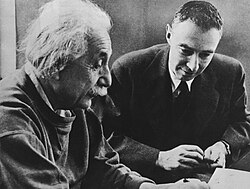
Oppenheimer led the Manhattan Project; Einstein did not build the bomb. Einstein's role was indirect: in 1939 he signed a warning letter to Roosevelt after physicists feared Nazi Germany might develop nuclear weapons first.
Gravity is no longer modelled as force pulling objects together. Mass and energy bend spacetime, and objects move through that curved geometry.
Einstein’s field equation says that matter and energy shape spacetime:

That curved spacetime is what we experience as gravity.
Einstein became a public intellectual as well as a scientist. He spoke about pacifism, civil rights, Jewish refugee aid, and the political dangers of nuclear weapons.
He spent his later years pursuing a unified field theory, even as quantum mechanics moved in directions he found philosophically troubling.
Einstein explained the photoelectric effect by proposing that light can behave as packets of energy, later called photons. Light energy competes with the material's work function:

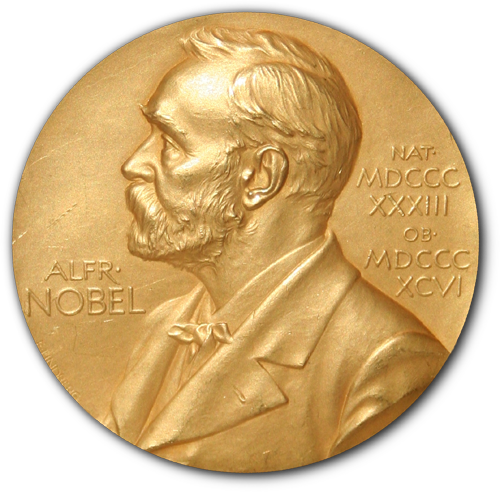
Einstein helped launch quantum theory and earned him the 1921 Nobel Prize in Physics.