VIZ
Created by Michal Mikeska
Visualization of vector fields
Texture based methods
Zooming
Geometric
Semantic
Fisheye
Manipulation
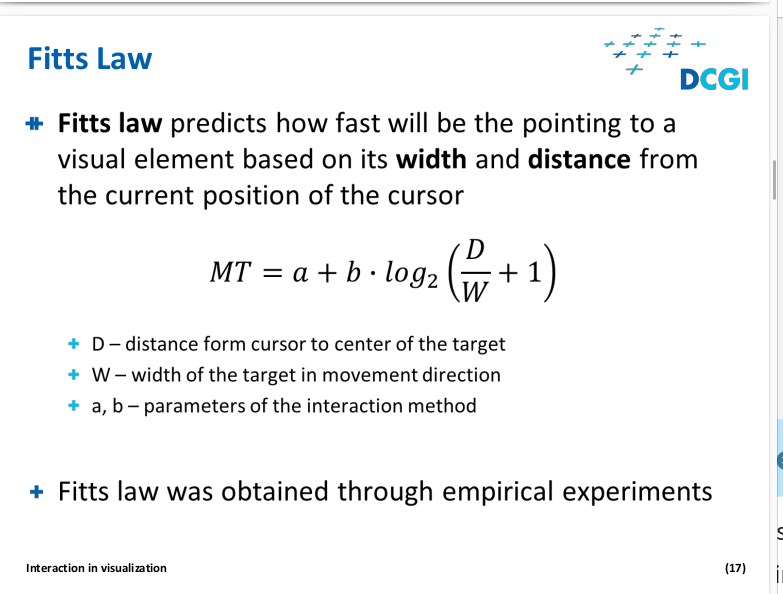
Fitts law
Navigation in the data
Overview and detail - spatial separation
Pan and zoom - temporal separation
Focus + context - deformation
Selection
- Values of attributes
- Pointing
- Fitts law
- Improved pointing
- Brushing
Pointing
Voronoi pointing
Bubble
Excentric labeling
Size
Position
Organization of data views
- Juxtaposition, Superimposition,
- Embedding Linked/coordinated views
- Multiform/multiple views
- Shared encoding views
- Brushing and linking
Shneiderman’s Taxonomy of Interaction Tasks
Overview
Filer
Zoom
Details on Demand
Relate
History
Extract
Accuracy, discriminability, separibility and popout
The number of different values that need to be shown for the attribute being encoded must not be greater than the number of steps available for the visual channel used to encode it.
Do not use RGB
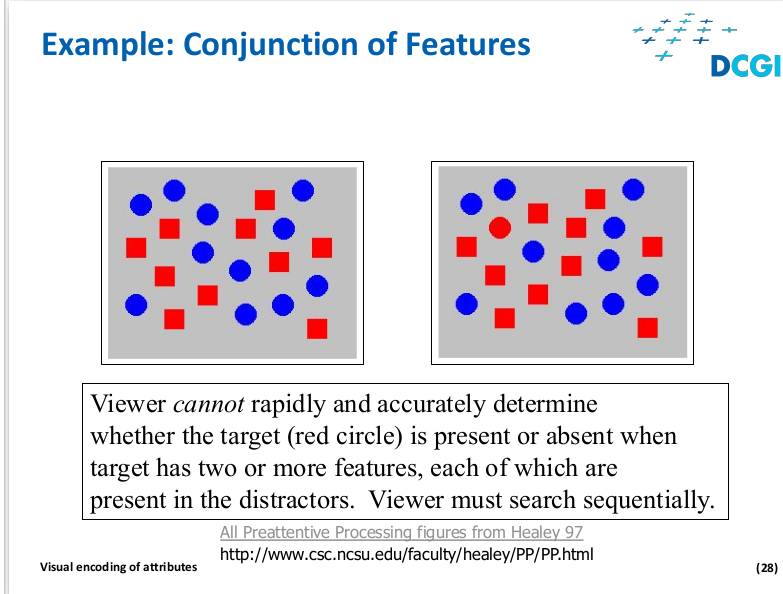
Pop out… visible first
Pop out (preattentive)
Orientation
Interaction
Low level
Higher level
Curvature and shape
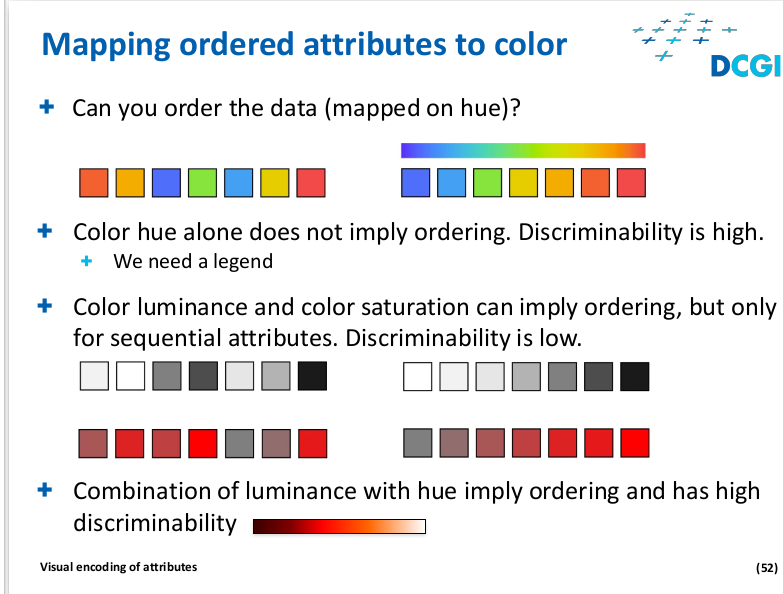
Mapping
Color
3 channels
Luminance, Saturation, Hue
Filtering
Dynamic quereis - classic min max e.g.
Reduction of data
Filering and aggregation
Encoding rules
Expressiveness principle: Visual encoding should express all of, and only, the information in the dataset attributes.
Effectiveness principle: Encode most important attributes with highest ranked channels
Encoding
Absolute and Relative Judgements
Aligned vs Unaligned
Brushing and linking
Aggregation
Binning
Clustering
Statistics distribution
Process
Data
Data enrichment
Filtering
Mapping
Rendering
Attribute
Tufte Rule
Visual attribute value should be directly proportional to data attribute value
Marks
Marks – geometric primitives
Viz
Nominal / Categorical
- No inherent order (in the sense of certain quantity)
- People, Companies, Cities, Types of diseases, ...
Ordering direction
- Sequential - the values of the attribute range from minimum to maximumvalue
- E.g., mountain height measured from sea level
- Diverging - the values of the attribute can be split into two groups thatdiverge in positive and negative direction from a common zero point
- E.g., Full elevation dataset containing mountain heights and depths of oceanfloor is diverging
- Cyclic - the values of the attribute wrap around to the starting point
- E.g., Hour of the day, Day of the week
Grouping
Similarity
Connectedness
Containment
Data
Attribute types
Task
Channels
+ Visual channels – control appearance of marks
- Position
- Color
- Tilt
- Size
- Shape
Ordered
Ordinal
- Ordered, but not at measurable intervals
- XS, S, M, L, XL, XXL, XXXL
- Mon, Tue, Wed, Thu …
Quantitative
- Ordered, arithmetic operations are possible
- Discrete: Integers
- Continuous: Floats
Types
Actions
Analyze
- Consume: Discover,Present, Enjoy
- Produce: Annotate,Record, Derive
Query (dotaz)
- Identify
- Compare
- Overview/Summarize
Search
- Lookup, Locate
- Browse, Explore
Targets
- All data - Trends, Outliners, Features
- Atrributes - one vs many
Spatial data
shape
Distance / proximity
Grid
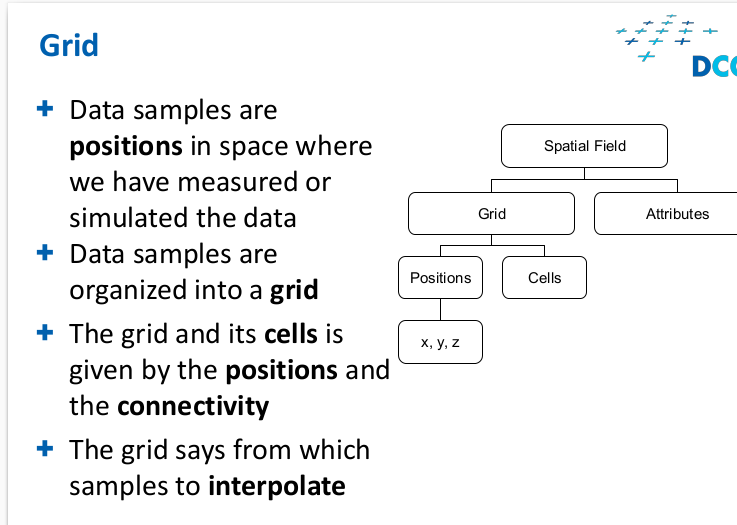
Attribute
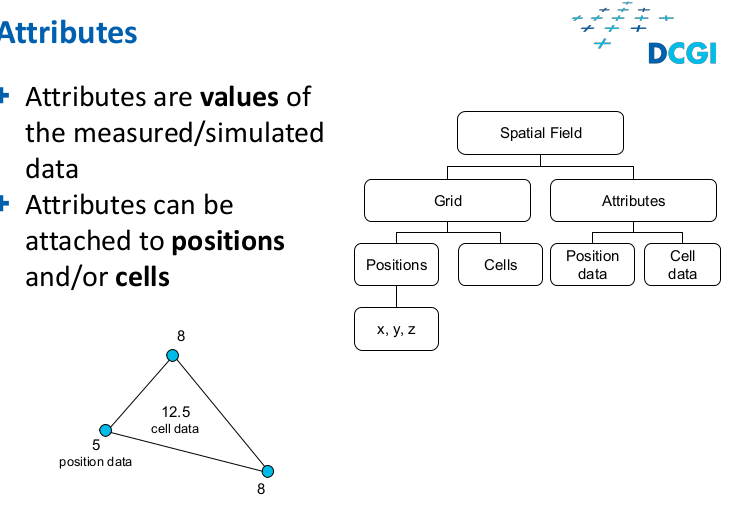
Spatial
Abstract
Text
Document
Collection of documents
Networks
Underlying field F(x,y)
F - dependent / it s attribute
x,y - independent
Fields
Notation
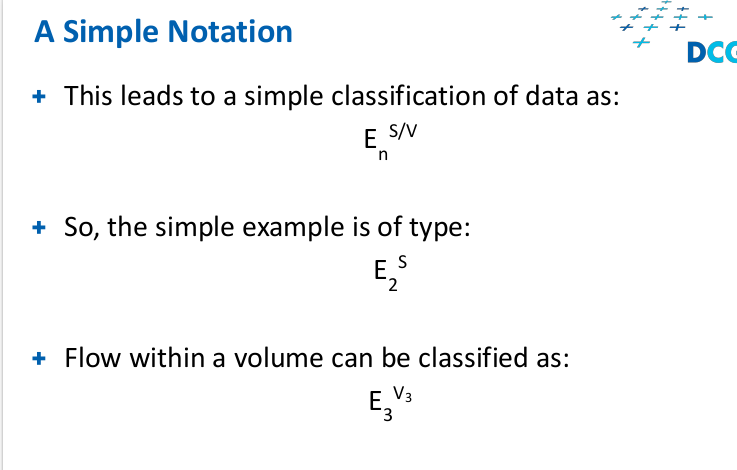
Geometry
- Meshes
- Vertices
- Edges
- Faces
- Typically, no attributes
Time varying data
Attributes and/or their
structure (topology) change
in time
Tabular
Tables
Relation
Networks
Data attributes
Cartograms, glyphs
Edge bundling
Techniques
Regresion
Box plots
Confidence interval
Signature-based detection
Outlier/Intrusion Detection
Anomaly Detection
Trajectories
Force-directed edge bundling
Geographical data visualization
3V- definition
3V-definition: Big data is high-volume, -velocity and -variety
information assets that demand cost-effective, innovative forms of
information processing for enhanced insight and decision making.
Big data
Visual analytics
How do i treat data?
If we have quantitative attribute measured at geographic locations, we treat the data as scattered spatial data
If we have nominal attribute obtained at geographic locations, we cannot treat the data as spatial filed
Layers
Raster model
Change the real data into grid
Area, midpoint, importance
Vector model
Maps
Topological relations
Arc - node model
Acceleration Data Structures forVector Data Model
Mercator
Frequency-based
Clustering
Data mining
Visual Data Mining
- New approach for exploring very large data sets
- Combination of traditional mining methods and visualization techniques+Advantages
- Combination of strengths of data mining and visualization+Challenges
- User needs to select the appropriate data mining technique in a givensituation
- Find visualization techniques suitable for the results of data miningoperations
- User needs to be experienced both in data mining and in visualization
Label placement
Usable label layout should exhibit 4 main characteristics +
- Readability – we can read all labels
- Unambiguity – we can associate label with the labeled feature
- Compactness – the map is not larger because of the labels
- Aesthetics – the label layout should look nice (aesthetics are subjective)
Visualization of tabular data
Model
Topology Connectivity: Arcs are connected to others (at nodes). This identifies possible routes and networks, such as rivers and roads, via the lists of arcs and nodes in the database.
- Containment: An enclosed polygon has a measurable area;lists of arcs define boundaries and closed areas.
- Contiguity: The adjacency of polygons can be determinedby shared arcs.
- These are fundamental to GIS analysis and queries, forexample:+
- From point A, how can I get to point B using the city road system?
- What is the area of the combined areas of all residential housing?
- Which residential areas are next to city parks?
Objcects, lines
Stream ribbons
Colormap vorticity
Euler method
x(t+dt) = x(t) + v(x(t))·dt
Shape / glyps
Continuous attributes
Text analysis
Lexical
Syntactic
Semantic
Mapping
Grayscale, blind ppl., intuitive
Visualization of scalar fields
Color
Should be HCL
Discrite,nominal, ordinal attributes
Faceting
Scatterplot matrix
Brushing
Visualization of relation data
Text and software visualization
Types of grids and cells
regular,uniform, rectiliner,curvilinear
Visualisation of Volumetric data
Volumetric data are spatial fields
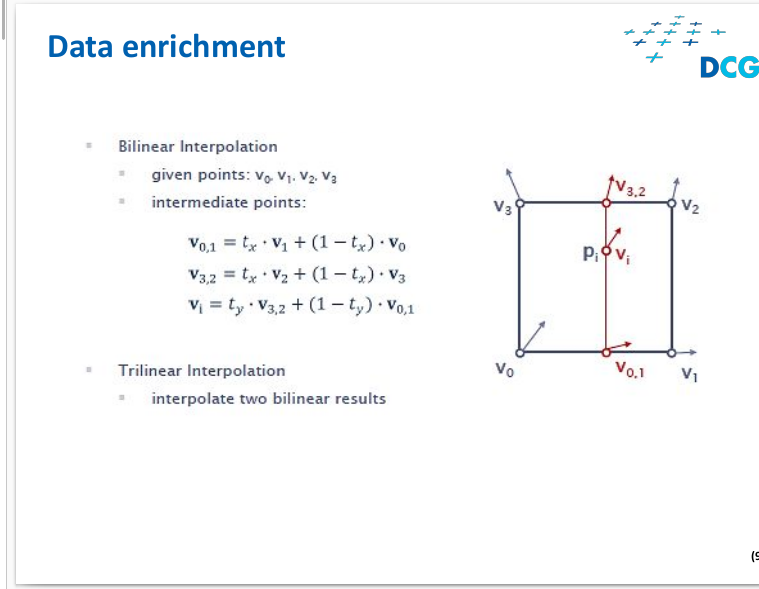
Data enrichment
- Nearest neighbor
- Value in every point of space correspond to the value of the nearest sample
- Linear interpolation
- Cubic interpolation
Stream objects
Some flow
Bilinear interpolation
Aggregation
Good
Connections
Proximity
Visual encoding
Properties
- The tangent to a contour line is the direction of the height field’s minimal (zero) variation
- The perpendicular to a contour line is the direction ofthe height field’s maximum variation: the gradient
Contouring
A contour line C is defined as all points p in a dataset D that have the same scalar value, or isovalue s(p)=x
Perceptual problems
No interpolation
Sparse vs scalar field is dense
amples
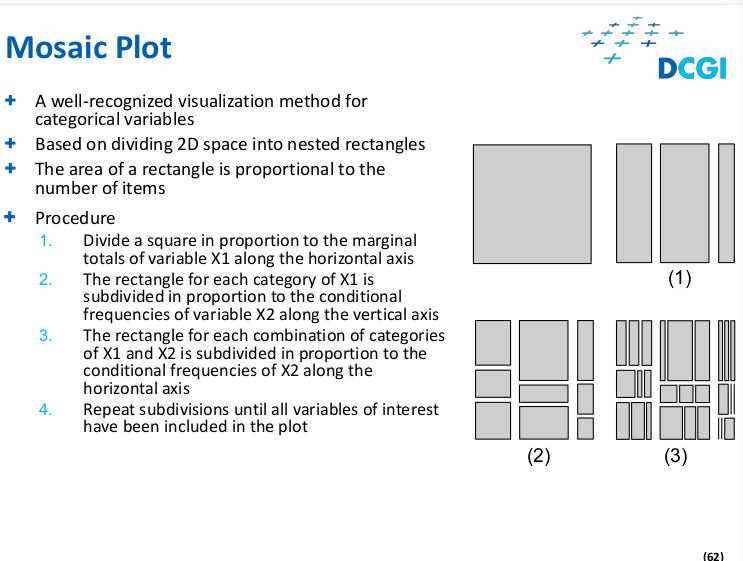
Mosaic plot
Glyphs
Star glyphs
Chernoff faces
Stick figures
Binning
Dimensional projections
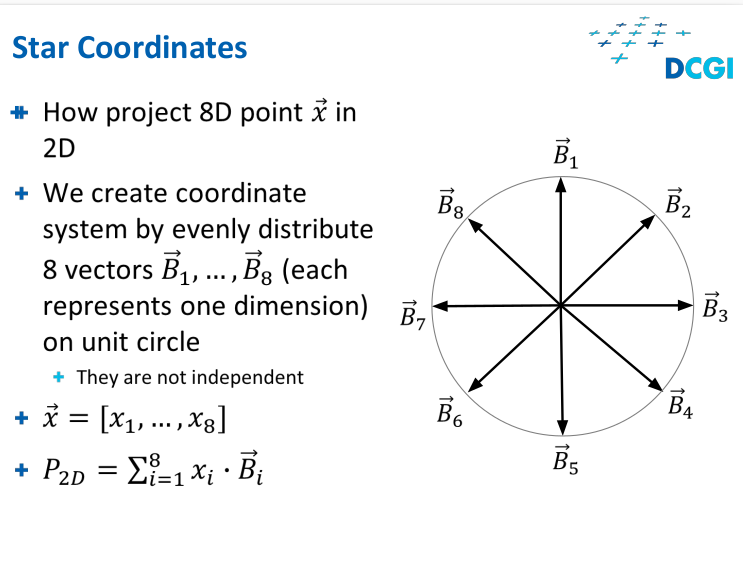
Star projection - maybe no clusters
Parallel coordinates
Not so good
Similarity
Containment
Hiearchy
Network
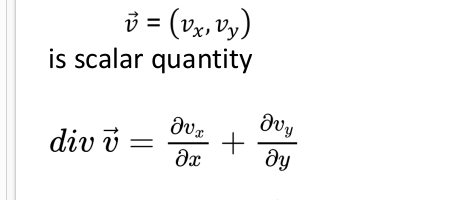
Divergence
Sink is minus
Plus is source
Text visualization
Document
Corpus
Streams
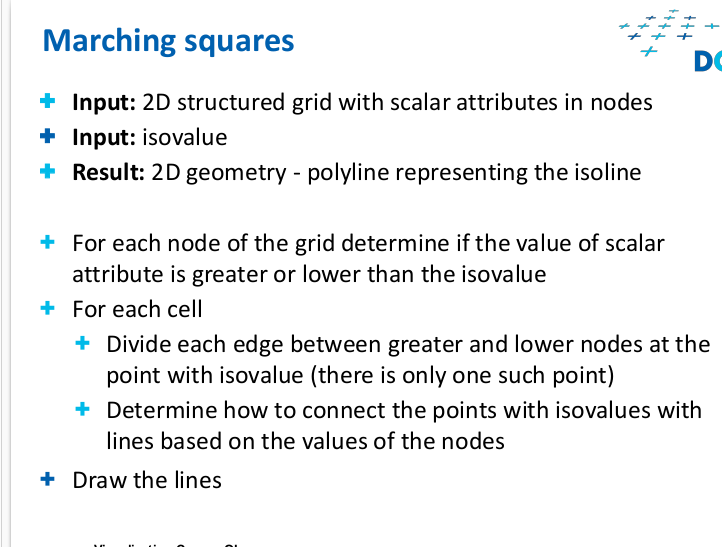
Marching squares / cubes
Volume rendering
Indirect
- Intermediate geometric representation
- Cutting plane, tiny cubes, iso-surface
- Pros: Easy shading, perception of shape, fast rendering – can bedivided into conversion to geometry and rendering
- Cons: Occlusion, no context
Direct
- No intermediate geometric representation
- Ray function, Ray integration
- Pros: Illustrate the interior, semi-transparency, great flexibility
- Cons: High computational cost, large memory requirements
Glyphs
Just arrow or line, it s mapping technique of vector fields
Line integral convolution
- Correlate with neighboring texture values along theflow (in flow direction)
- Do Not correlate with neighboring texture values across theflow (normal to flow direction)
Parallel sets
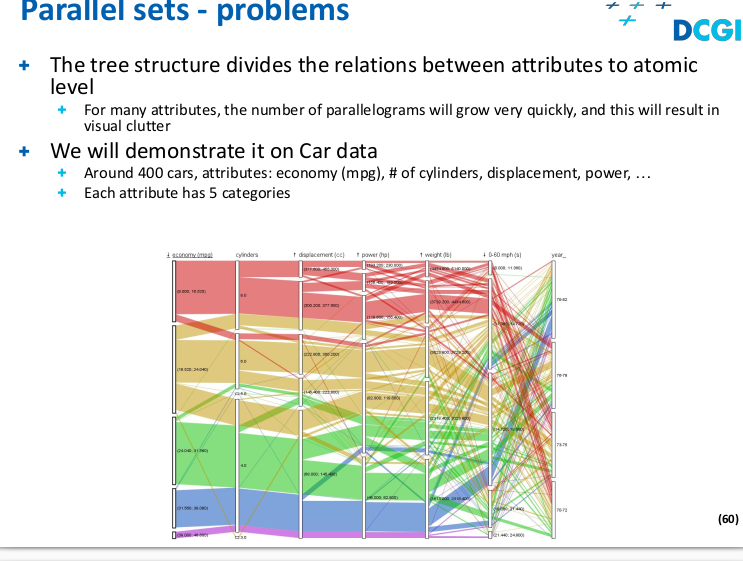
Trends, outliners, focus
Document metadata
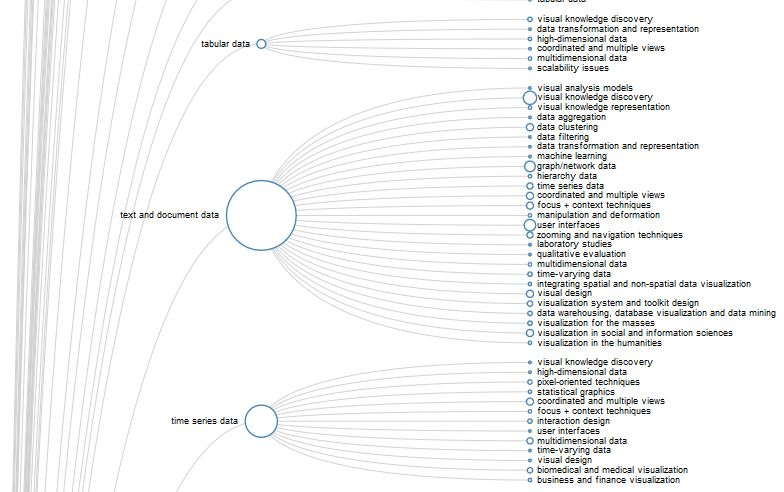
Software
Relation data
Diagrams
See soft
Indirect
2d planes
Tiny cubes
Countouring - iso surface calculation
Vorticity
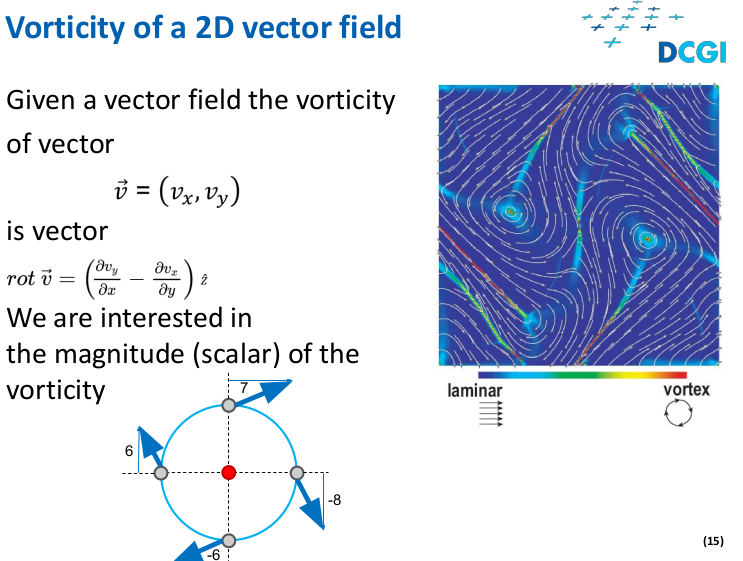
cross product give us the orientation of the rotation
Good
Containment
Connections
Good
Connections
Containment not scalable!
Single document
Word Cloud
Facet clouds
Spark clouds
TempoTaggram
Collection
Linguistic
Direct
Resampling
Random vs uniform
Better for rotated
Types
Word Tree
Netspeak WordGraph
DocuBurst
Phrase Nets
Ray integration
Mapování na barvu a průhlednost pomocí transfer funkce
Overlapping
Glyph longer then distance between samples..sometimes not problem
We can take every second sample...subsampling
Containment
Using tree map
Cannot use!
Similarity
Proximity
Ray function
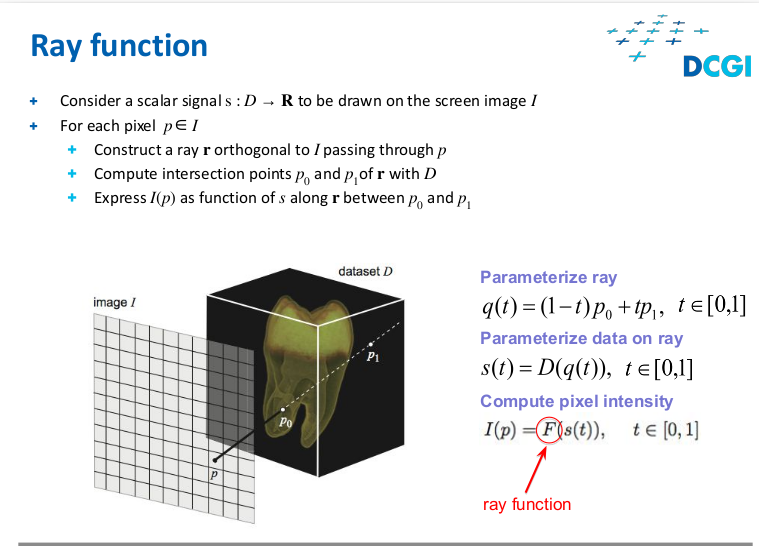
Graphs
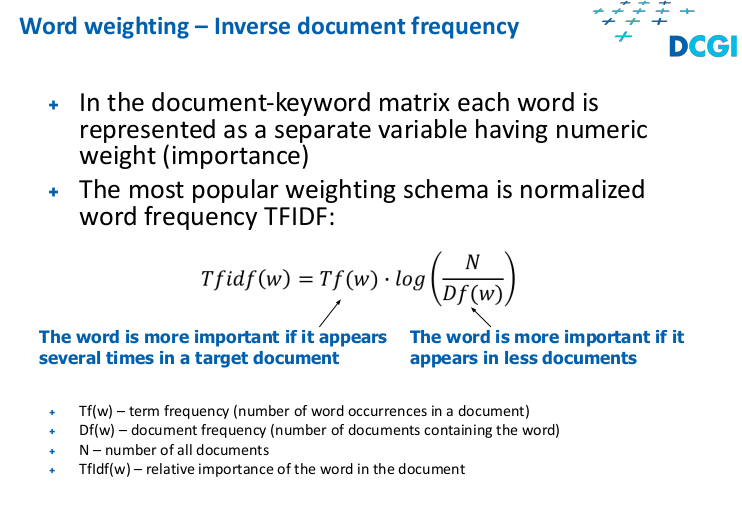
Doc-term matrix
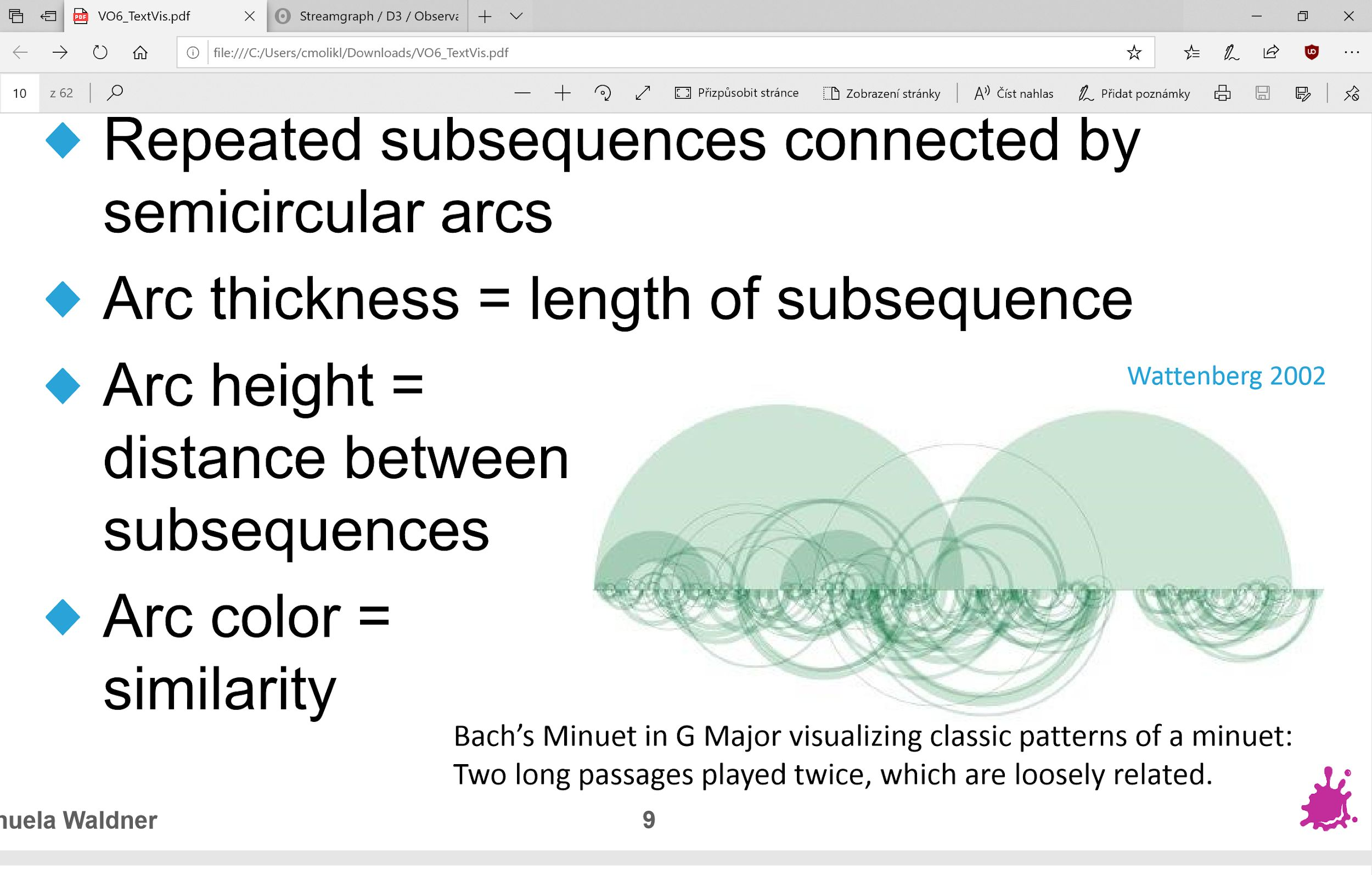
Arcdiagram
Transfer function
1D - 1 attribute
2D - 2 attribute
To color and opacity
Ballon, radial, cone...
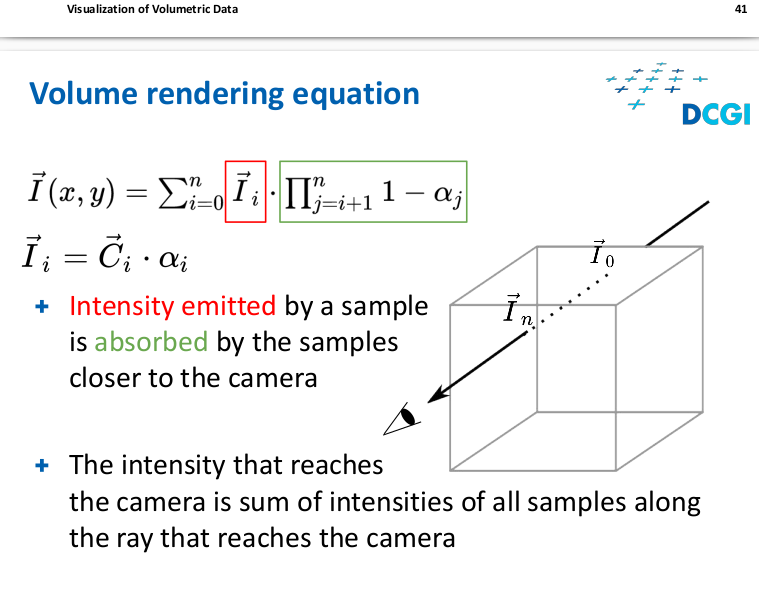
Volume rendering equation
MIP
AIP
Distance to value
Similarity
cosine product
Sugiyama framework
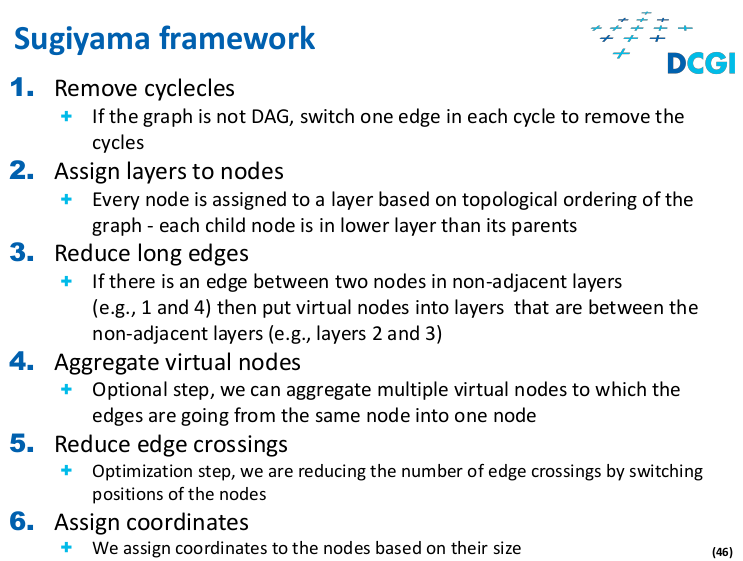
Creation
Force-directed methods
Intervals and spans
Ganchart
Net trees
Problems
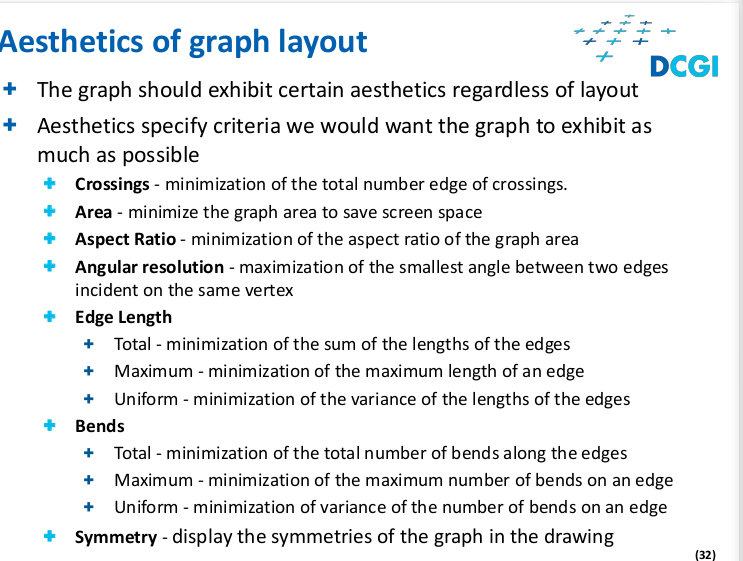
- They do not consider edge crossings
- Hairball result for densegraphs
- The result is very oftena local minimum
Weights
Back to front
- We need to calculate only one equation in each sample
ba
Front to back
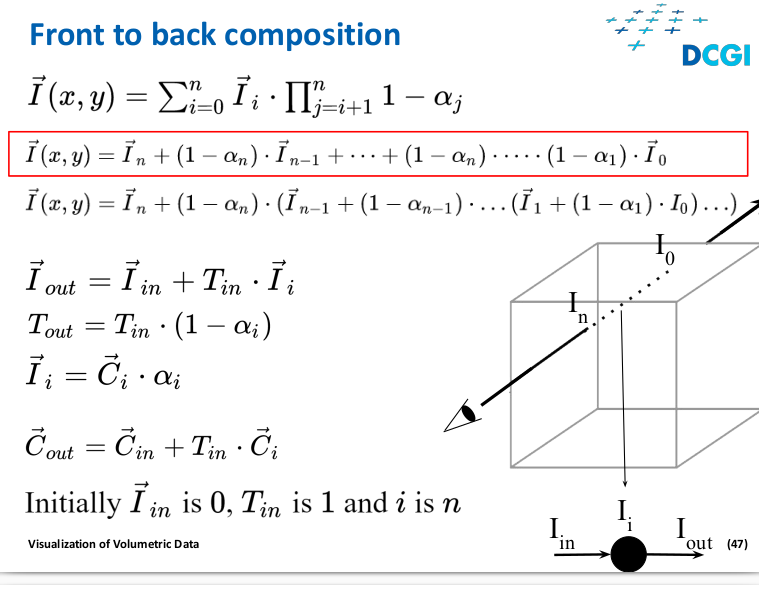
- We need to calculate two equations for each sample
- When the opacity reaches a defined “large” value the process ends we terminatethe composition
Time primitives
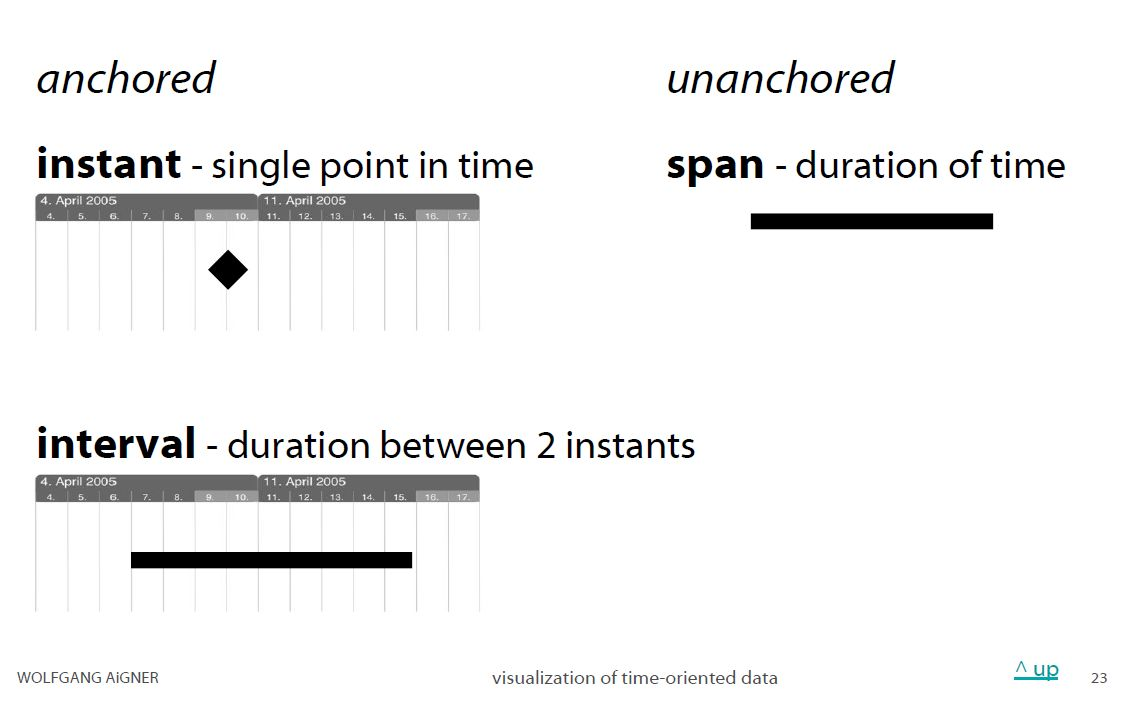
Time-oriented data
Examples
Spiral graphs
Faceting
Cycle plots
Text Insight via Automated Responsive Analytics (Tiara)
amples
Granularity issue
Instans spatial data
Lexis pencil
Helix icons
GeoTime
Conversion
Relations
E.g. google calendar
Domain
Ordinal
Discrete
Continuous
structure
Linear
Cyclic
Branching
