Created by Pavel Klavík
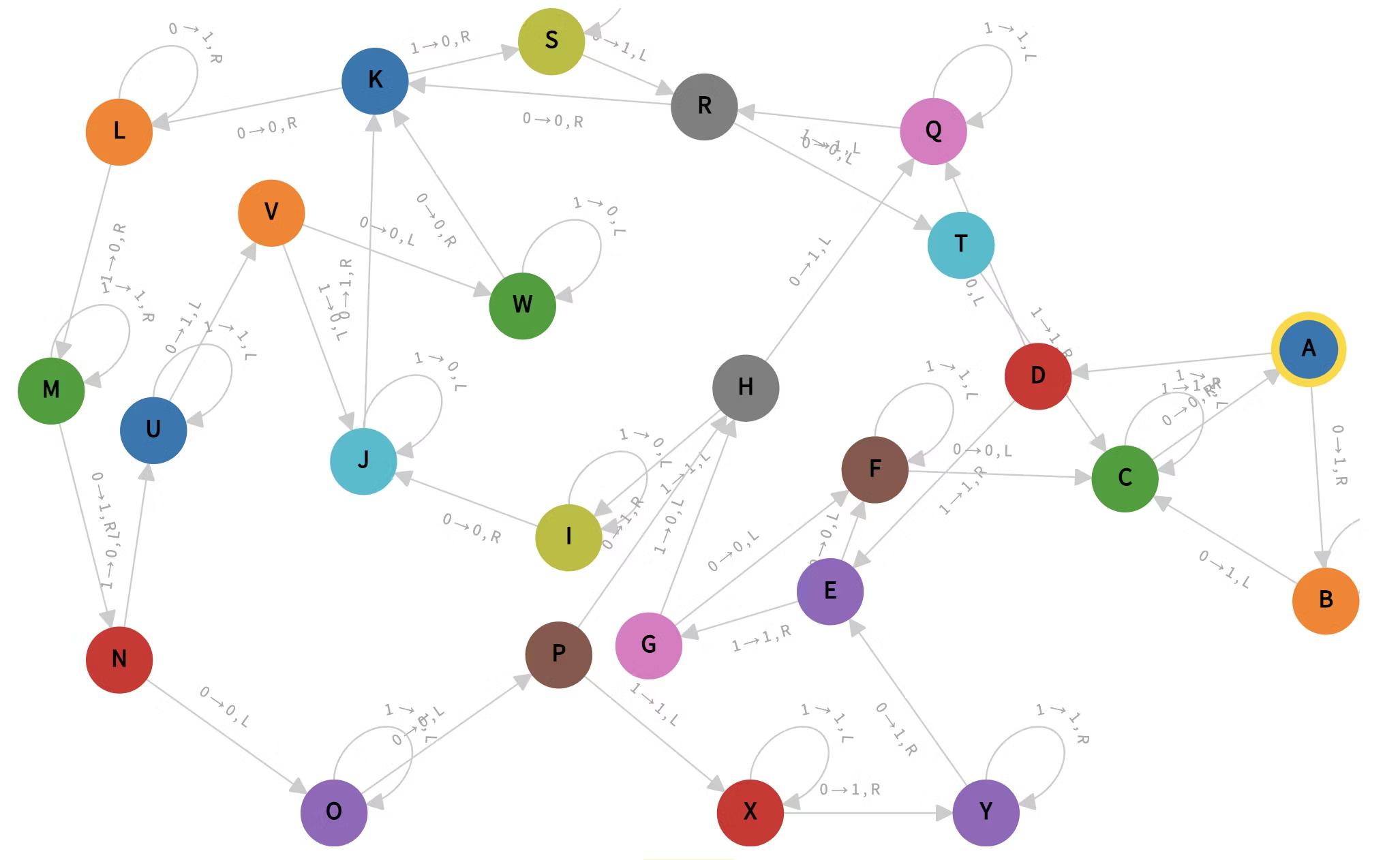
Every N-state Turing machine either runs forever or halts after some number of steps. The machine halting after most steps is called the Nth Busy Beaver, and the number of its steps is BB(N). Recently, a Discord math community was able to establish BB(5) and are currently working on BB(6) and other related problems. This map describes their progress, the current challenging machines and relation of this problem to general math and computer science: Gödel's incompleteness theorems in logic and Halting problem in computability.
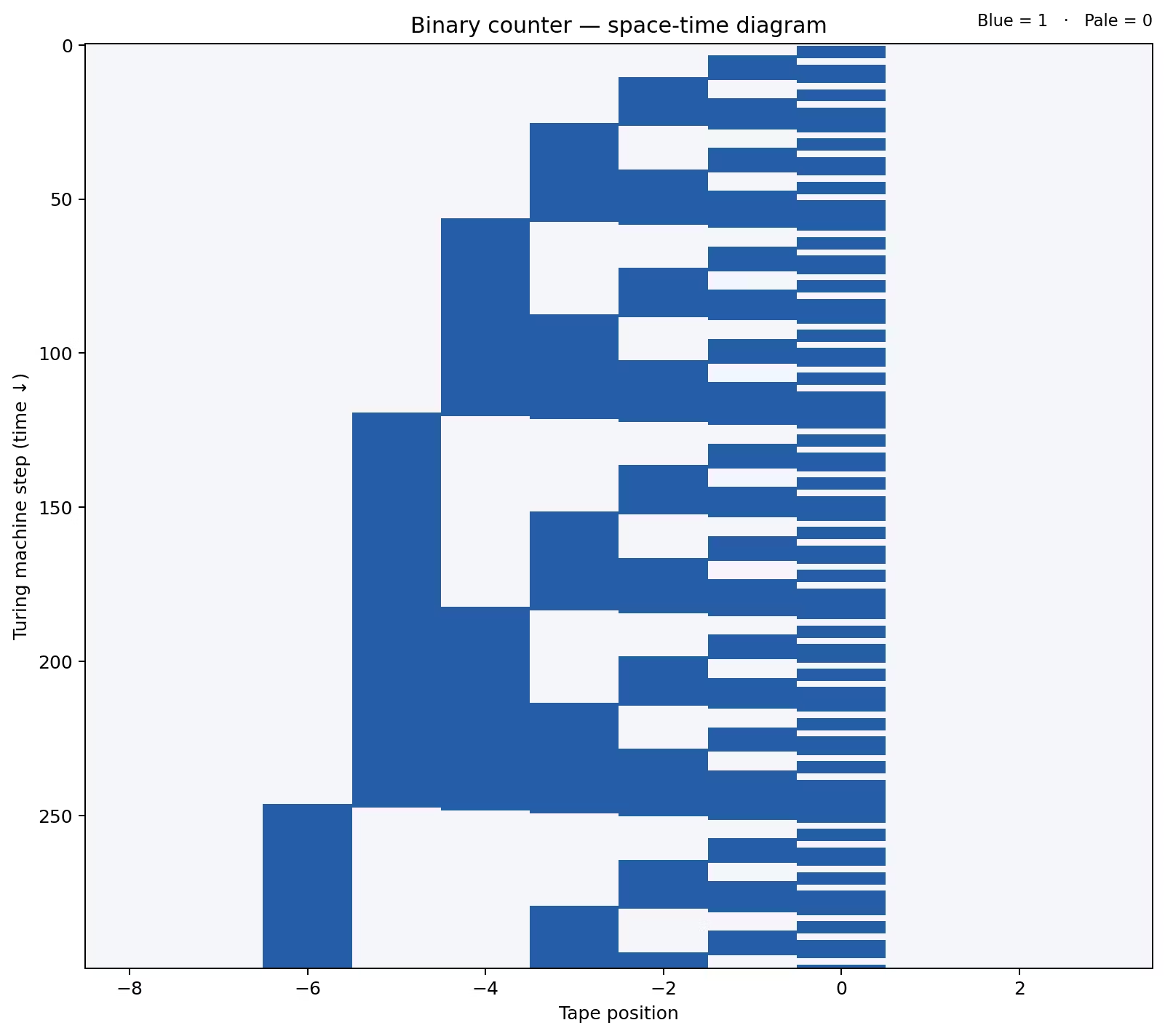
Certain machines can be quickly understood by drawing their tape configurations after each step. Here, we show an example of a 2-state binary counter. Its behavior is immediately clear from the picture.
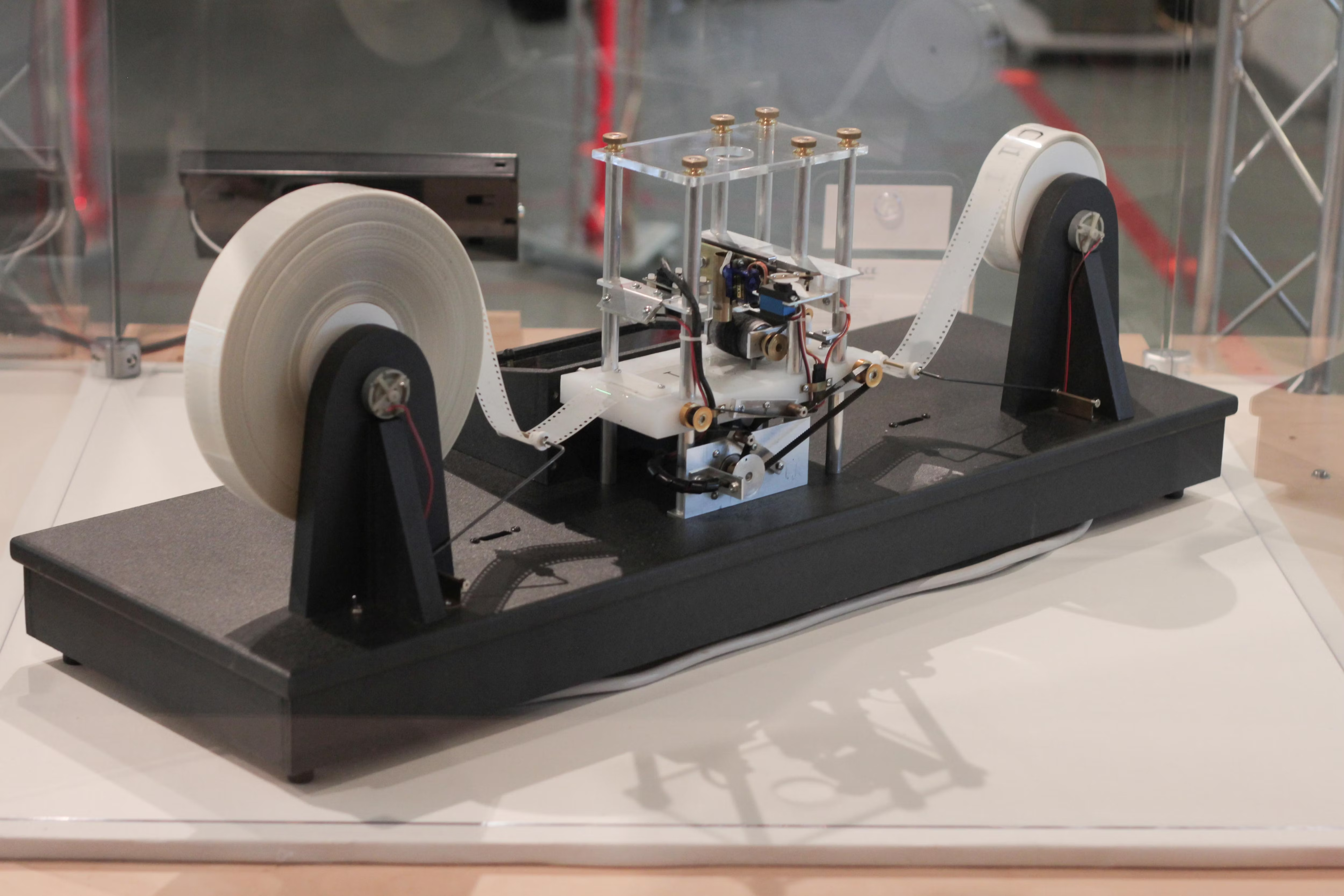
A mathematical model of a computer consists of:
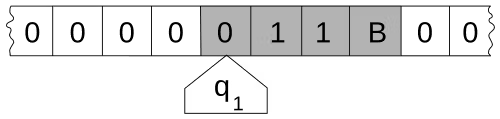
Memory is an infinite tape extending in both directions and consisting of linearly ordered cells. Each cell has one symbol written in it. For binary Turing machines, it is either 0 or 1. The initial contents of the tape encode the machine's input.
The machine has a head that is at some position at each step. The head reads the symbol and writes a new one (potentially the same as before).
This is an example of a 2-state Turing machine which halts at the 3rd step.
| 0 | 1 | |
| A | 1RB | HALT |
| B | 1LA | 0RB |
Play the video to see how it behaves.
The machine consists of  different states, named
  ,
,  ,
,  , … The initial state is .
At each step, the machine is in some state and reads the current symbol from the tape. Based on its state and the symbol it reads, it does the following:
The transition can instead be HALT, which immediately stops the computation.
Goldbach's conjecture states that every even number  can be written as a sum of two prime numbers:

The conjecture was computationally verified for all  , but a general proof is not yet known.
The conjecture may seem unlikely, but it appears to hold. As  grows, one always has to be lucky to match two primes together; on the other hand, the number of possible primes to choose from grows with .
There is a weaker version of Goldbach's conjecture stating that every odd number  can be written as a sum of three prime numbers. This was proved by Helfgott in 2013. Note that if the three-prime statement held for all numbers
  , not only odd ones, it would imply Goldbach's conjecture.
Each -state Turing machine with  symbols can be described by a table having rows and columns. Each cell specifies one transition for a state and read symbol, for example
 1RB specifies that the newly written symbol is 1, the head moves to the right and the new state is . If the transition is halting, it is described as --- or HALT.
BBChallenge uses the format where the entire table is written into a single line such as
1RB1LB_1LA---
Here, _ is the line separator, so this is a 2-state binary Turing machine. The code 1RB1LB gives the transitions in state : the machine transitions either to 1RB if it reads 0, or to 1LB if it reads 1. Similarly, in state, the machine follows 1LA---, so it transitions to 1LA if it reads 0 and halts if it reads 1. This machine is the second Busy Beaver champion.
Here is another 2-state Turing machine which runs forever.
| 0 | 1 | |
| A | 1RB | 1RB |
| B | 0LA | HALT |
Play the video to see how it behaves.
There certainly exists a Turing machine which implements the described pseudocode. It can be further optimized into the following 25-state Turing machine which halts if and only if there exists a counterexample for Goldbach's conjecture:
If we knew  , we could run this machine for
  steps: if it did not halt, no counterexample would exist.
So would knowing actually help us in solving Goldbach's conjecture? Not really. First of all,  would be so huge that simulating a Turing machine for this number of steps wouldn't be feasible anyway.
But computing would require deciding, for every 25-state Turing machine, whether it halts. In particular, includes Goldbach's conjecture as a subproblem, as well as many harder problems, some of which might even be unprovable in a chosen formal theory. So working on the Busy Beaver number is not a way to solve hard math problems.
A simple machine for testing Goldbach's conjecture works as follows. It checks even numbers  one by one. For each , it checks for all numbers
  whether both
  and
and  are prime. To check whether is prime, we only need to check that has no divisor between
  and
and  .
.
isPrime(p):
  for l = 2, 3, ..., sqrt(p):
    if p % l = 0:
      return false;
  return true;

for n = 4, 6, 8, 10, ...:
    found := false

    for p = 2, ..., n/2:
        q := n - p
        if isPrime(p) and isPrime(q):
            found := true
            break

    if not found:
        HALT
So if we could solve halting for this program, we would know whether Goldbach's conjecture is correct.
For

The Riemann zeta function is obtained by meromorphic continuation to  . It has trivial zeros for
  . The Riemann Hypothesis asks whether all other non-trivial zeros lie in the critical line
  where
where  . It is a famous unresolved problem of mathematics, one of the Millennium Prize Problems with a $1,000,000 prize, deeply related to the distribution of prime numbers. Recently, OpenAI proved in a preprint that there are no zeros for
  .
.
On September 23, 2026, a 120-state Turing machine was constructed which tests the Riemann Hypothesis. It halts if and only if the Riemann Hypothesis is false. Instead of searching for non-trivial zeros outside the critical line, it verifies certain arithmetical equalities involving

If any of them is invalid, a counterexample to the Riemann Hypothesis is found.
To solve  , one would need to solve Riemann Hypothesis among many other very hard problems.
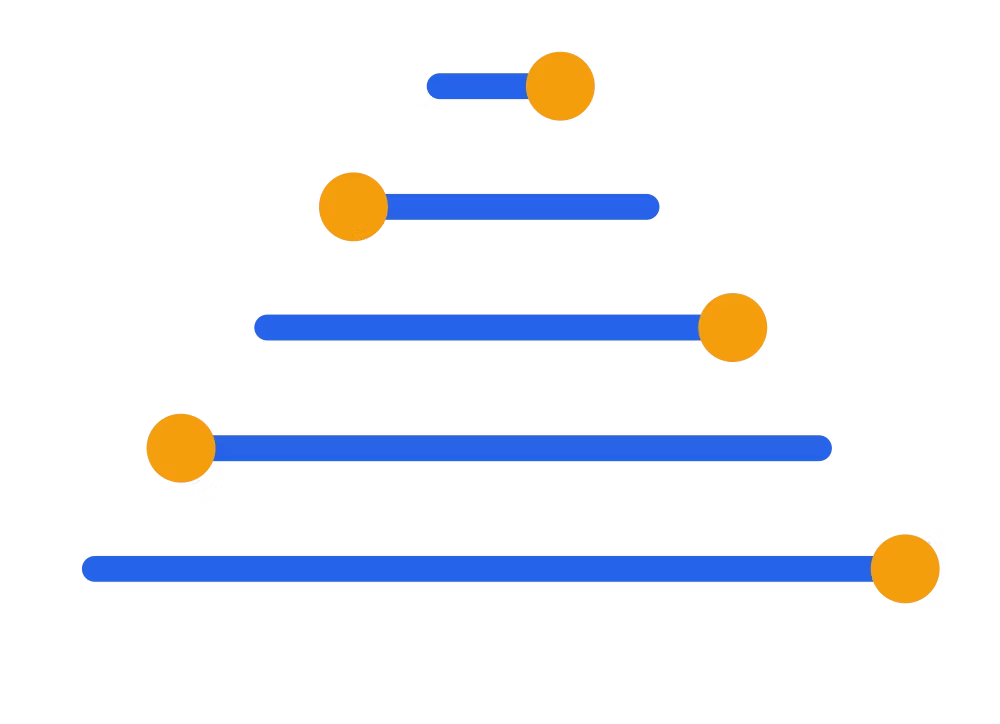
Machines repeatedly sweeping across an expanding region. A proof can often use an inductive rule describing how each sweep transforms the tape.
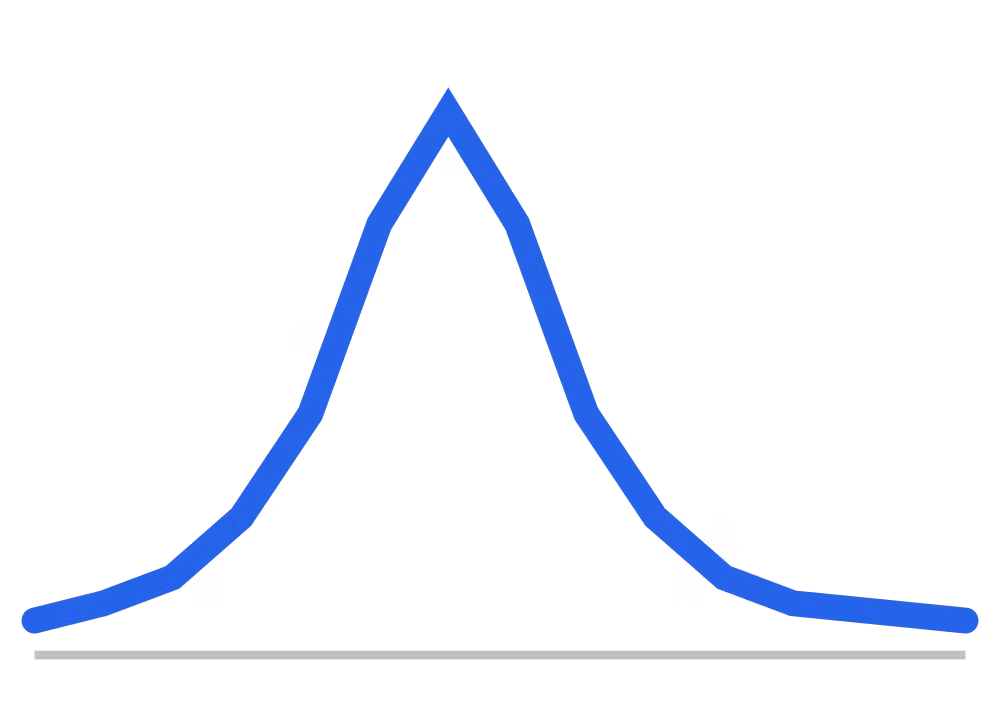
Their space-time diagrams have characteristic widening and narrowing, bell-like shapes. Some exhibit polynomial growth or inverted-bell patterns.
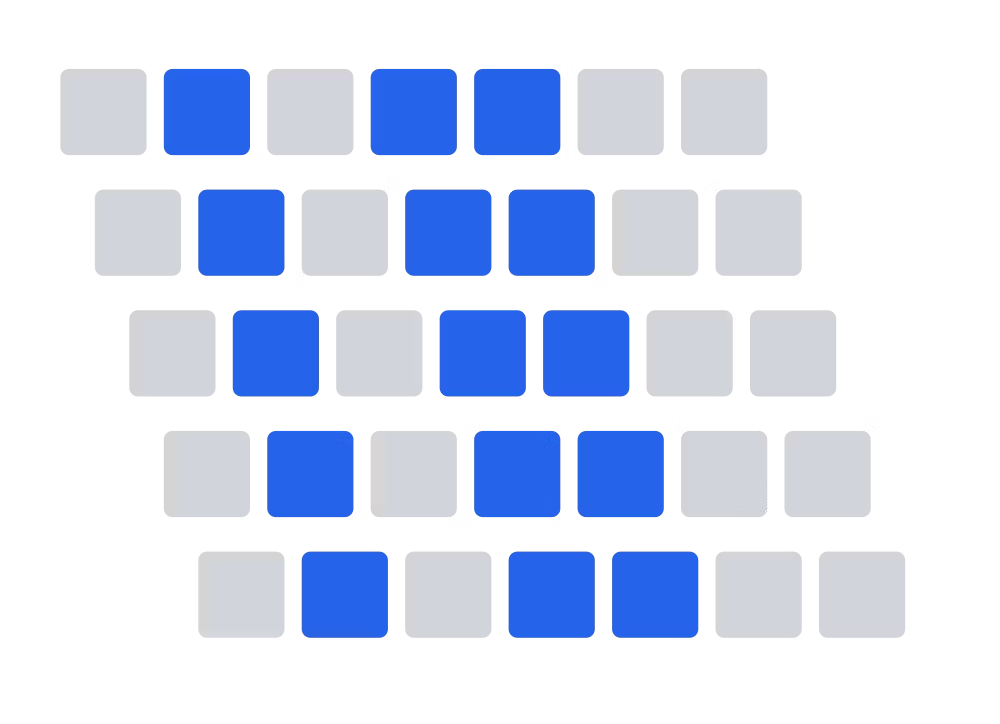
The machine constructs the same local pattern at a different tape position, often continually moving left or right. This behavior is also quite simple to analyze, but it may emerge only after a large number of initial steps.
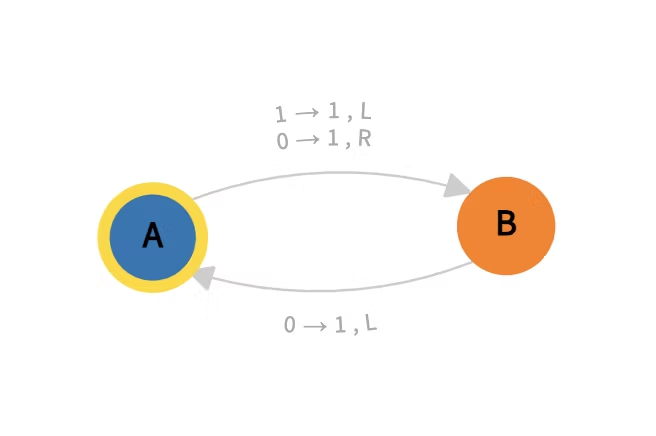
Instead of a table, we can create a graph where each machine state is represented by a node. From each node, there are at most outgoing labeled edges, describing the read symbol, the written symbol, and how the head moves. The target node is the new state. When the outgoing edge is missing, the machine halts.
For example, here is the mentioned 2nd Busy Beaver champion.
Each -state binary Turing machine is described by  transitions. Each transition may be halting (1 choice) or specifies a new state ( choices) + tape direction (2 choices) + written symbol (2 choices), so in total there are
  choices. Since transitions can be chosen independently, there are
  different -state binary Turing machines.
When studying all these machines, some of them behave the same, and we just need to understand one of them. So we can identify machines up to symmetry and removal of unreachable states, yielding so-called TNF (Tree Normal Form), which significantly decreases the number of studied machines. Further, after unifying symmetries and ignoring machines which clearly run forever, we know that A0 either transitions to 0RB or 1RB. A commonly used restriction only studies machines where A0 transitions to 1RB, denoted TNF-1RB.
 | All  machines machines | TNF-1RB candidates |
| 1 | 25 | 1 |
| 2 | 6,561 | 41 |
| 3 | 4,826,809 | 4,057 |
| 4 | 6,975,757,441 | 620,261 |
| 5 | 16,679,880,978,201 | 126,891,605 |
| 6 | 59,604,644,775,390,625 | ≈33,436,000,000 |
The reason is that  has to grow really fast. It grows faster than any computable function
  . Why?
Suppose that there were some computable function  which is an upper bound for . Then one could solve the halting problem for any -state Turing machine by first computing
  and then simulating the machine for steps. If the machine stops beforehand, it halts. Otherwise it runs longer than and we know that it will run forever.
So grows faster than exponential functions, tower functions, the Ackermann function, and everything else whose values can be computed.
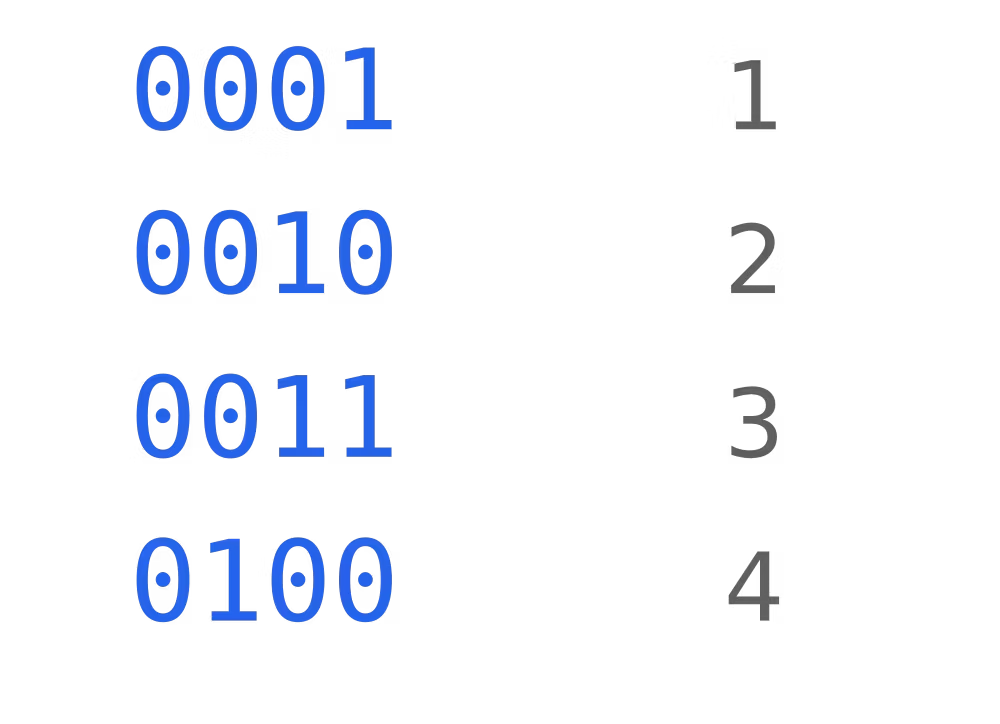
The machine encodes an integer that is incremented or transformed. Variants include binary, Fibonacci, exponential, and superexponential counters.
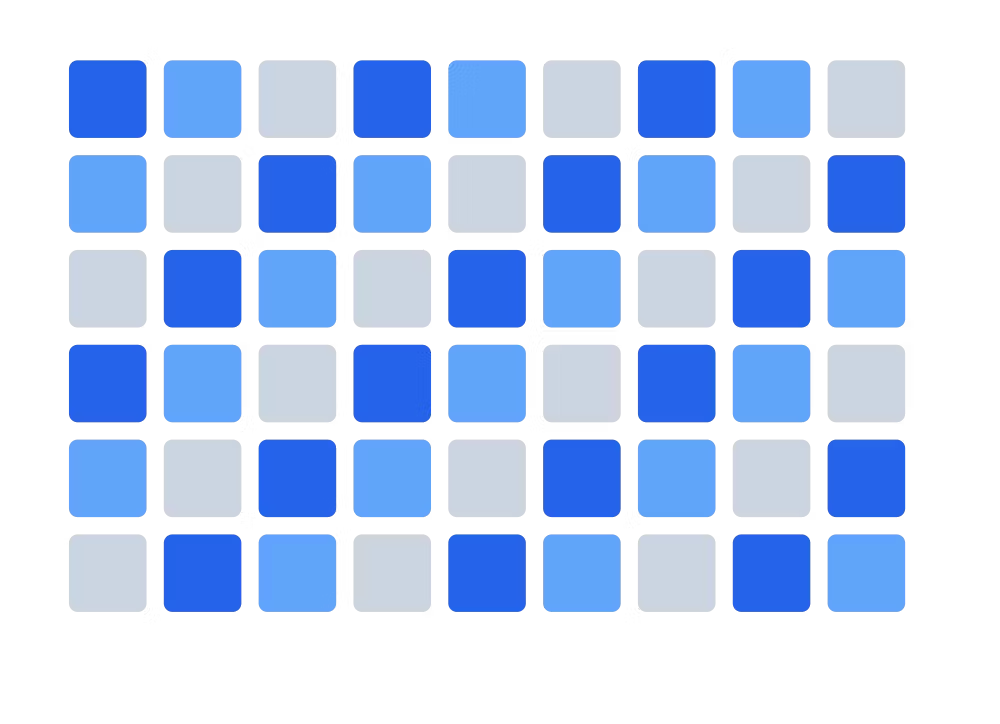
These are the simplest machines: they repeatedly go through the same pattern. They are easiest to analyze.
Let's take a look at the first few values of . They grow very fast:
 ,
,
 ,
,
 ,
, .
.How large is  ? The notation
  is the tower of
  's of height . So just

is incredibly huge, already so much larger than a googolplex  . But next it has another tower raised to this huge height, and the humongous result is used as the height of another tower.
Usually when working with programs, we care whether they compute something correctly and how fast the computation runs. For example, if we want to sort numbers, we care that the resulting sequence is correctly sorted and whether the algorithm runs in  or
or  steps.
So why is the Halting problem even interesting? This was not explained to me clearly when I was studying computer science at university. There is a practical programming motivation: to know whether a program gets stuck in an infinite loop. But the theoretical reason is that we can encode a lot of different questions into whether some program halts or runs forever.
Holdouts are Turing machines that are not yet understood. They may halt or run forever.
Computing is equally hard as solving the Halting problem for -state Turing machines. Why?
If we could solve the Halting problem, we could just check all -state Turing machines one by one. A hypothetical solution to the Halting problem would identify those that run forever; we could then simulate the others until the last one stops. Then we know how large is .
On the other hand, if we knew , we could just simulate the given -state Turing machine for  steps. If it halts beforehand, it halts. Otherwise it runs forever.
Cryptids are Turing machines which correspond to a known mathematical problem. So they are fully analyzed, but finding out whether they halt or run forever depends on whether a mathematical conjecture is true or false. So resolving them might be hard and might require the discovery of new mathematics.
Consider all -state Turing machines with binary tapes starting at all zeros. Some of the machines run forever, so we ignore these. Others halt after some number of steps.
is the maximum number of steps a halting -state Turing machine takes. So the -th Busy Beaver machine is the halting -state machine which takes the most steps before halting.
Similarly,  asks the same for all -state Turing machines using different tape symbols; so
  .
.
Is it possible to construct a machine which decides whether other machines halt or run forever? It is of course possible to simulate the machine, but if it keeps running, we never know whether it will run forever or halt just after a few more steps.
Two sets and are of equal size if there exists a bijection between them, pairing their elements.
We want to show that the set of all infinite binary sequences is larger than  . We therefore want to show that not all binary sequences can be numbered by . We therefore want to show that not all binary sequences can be numbered by  . For contradiction, suppose that they can, so . For contradiction, suppose that they can, so  are all binary sequences. Write them as an infinite table. Consider the diagonal of this infinite table and construct are all binary sequences. Write them as an infinite table. Consider the diagonal of this infinite table and construct  by flipping all values on it. It is a valid binary sequence which is different from all numbered sequences in the table. For by flipping all values on it. It is a valid binary sequence which is different from all numbered sequences in the table. For  , it is different in the , it is different in the  -th value. So not all binary sequences were enumerated. -th value. So not all binary sequences were enumerated. | 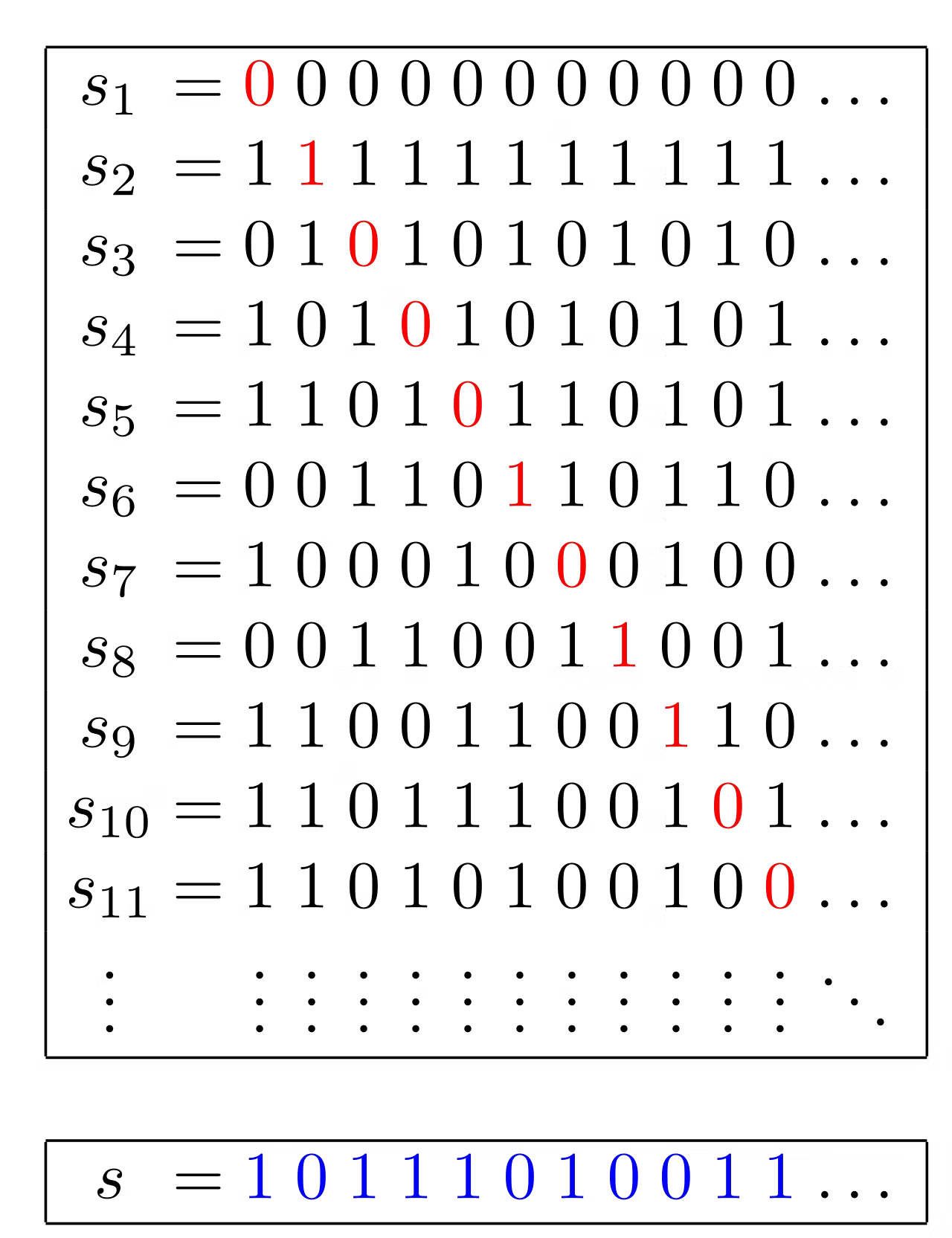 |
Cantor used this argument to prove that  and for every set , the set of all its subsets
  is larger:
  .
.
See BBChallenge Wiki for up-to-date values.
Orange and tan values have known cryptids, so solving the Busy Beaver problem for them might require new mathematics.
Consider the two-input halting function  , which states whether
  halts on
  . Construct an infinite table containing all programs and their halting behavior on all inputs, so . The key point is that every program appears as a row in this table.
Consider the diagonal formed by  . The construction of
  negates the values on the diagonal so

Now, if a program computing exists, it would be equal to some program  and would appear in the table. But this is impossible:
  , while the table gives the opposite value
  . So no program computes .
See its status page.
Reformulating hard Turing machines as mathematical problems lets mathematicians solve them without considering the details of Turing machines and their tape structures:
https://wiki.bbchallenge.org/wiki/Beaver_Math_Olympiad
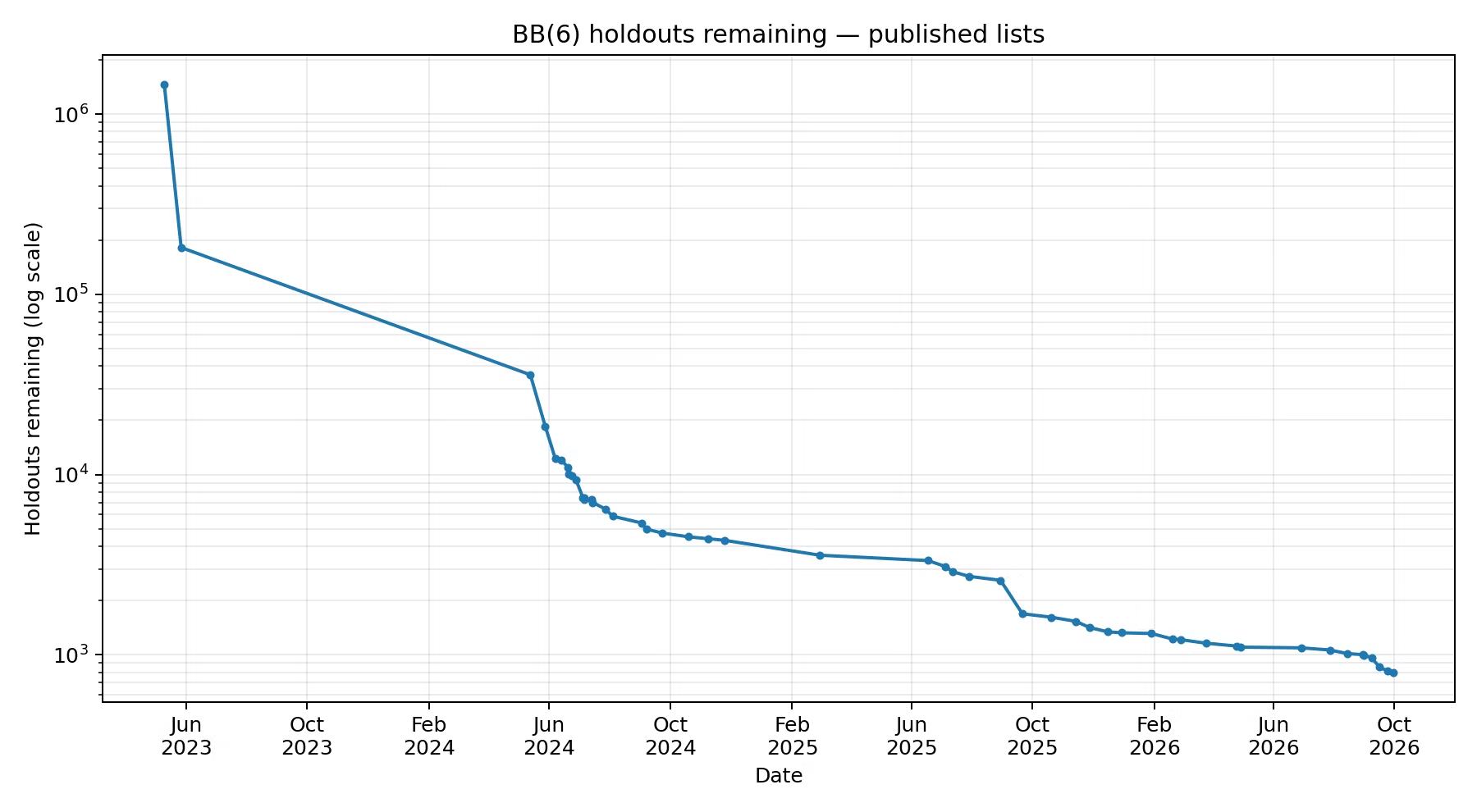
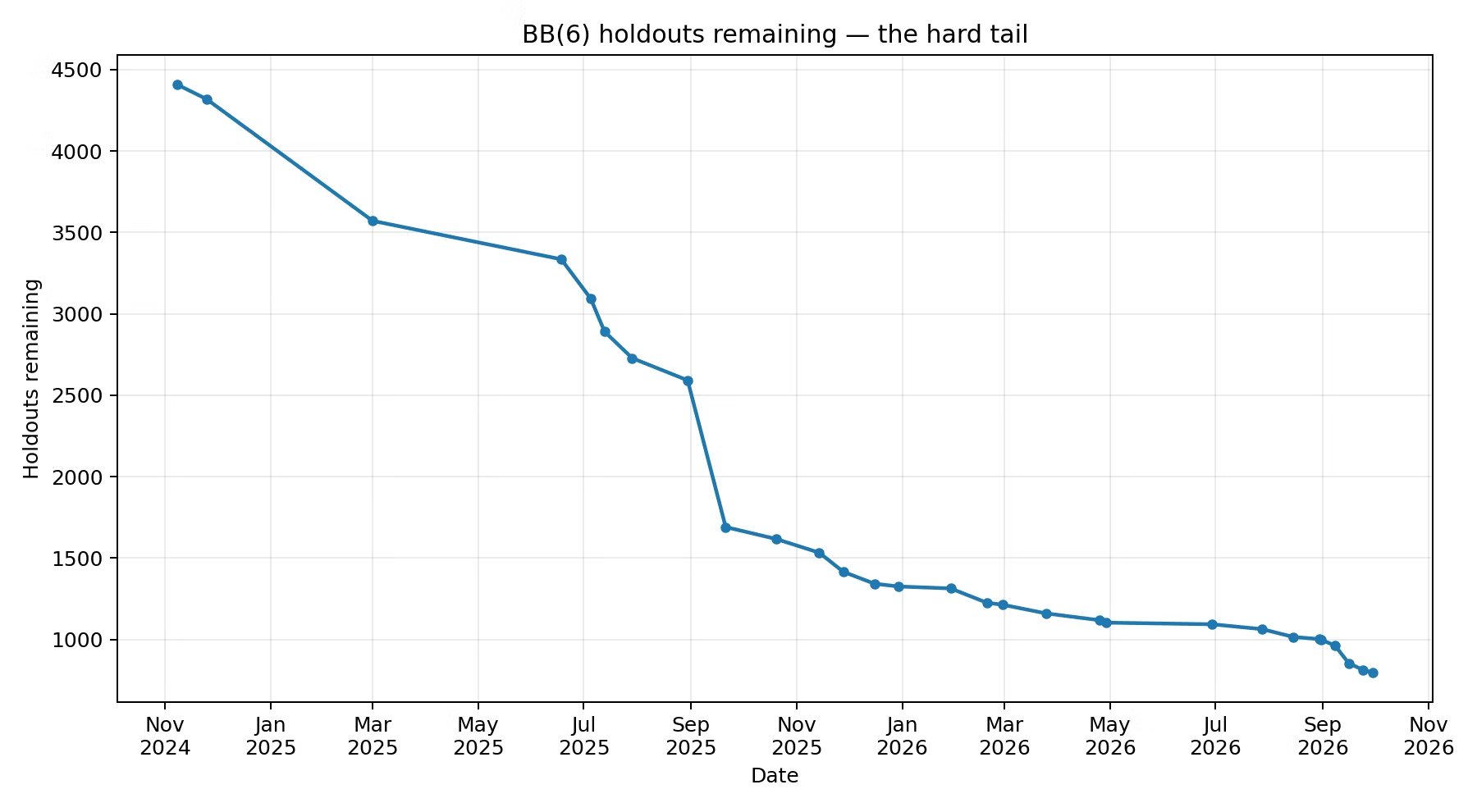
As of October 7th 2026, only 778 representative 6-state Turing machines have to be solved to resolve .
Turing proved that there is no Turing machine solving the halting problem. The argument uses Cantor's diagonalization.
Programs can be encoded as integers and numbered  . Their inputs are integers and we will be using their codes as inputs. Let
  be the output of the program on the input
  .
.
Suppose for contradiction that there exists a program  which solves halting. We construct a new program by negating . on the input runs the halting subprogram
  so it learns in finite time whether halts on . Then it does the opposite:
if
loop forever
else:
halt
We conclude the proof by showing that does not exist, implying that also does not exist.
What happens when runs on the input ? It first runs  , so it learns in finite time whether halts on the input . But then it does the opposite, which contradicts correctness of . If halts on , it does not halt on , and vice versa. Therefore cannot exist and thus the halting program does not exist.
Efforts over the last three years have reduced the total number of machines from 33 billion to just 778 remaining representative holdout machines. So is almost done?
Not really. Most machines are quite easy to solve: they either stop quickly or clearly run forever. The remaining machines are actually the true hard part of the problem. This includes some cryptids: their Turing machines are fully understood, but whether they halt or run forever seems to be a hard question in number theory.
Statements and proofs can be numbered. This allows arithmetic to make statements about which formulas are provable. Gödel constructs a sentence that refers to its own provability and thereby escapes what the formal theory can prove.
A theory  is consistent if it cannot prove both a statement
  and its negation
  . Equivalently, no contradiction, such as
  , is provable.
Second Gödel's Theorem states that any sufficiently powerful consistent theory cannot prove its own consistency.
If is inconsistent, it is possible to prove anything from a contradiction. So a sufficiently strong theory can prove its own consistency only if it is inconsistent.
Note that it still might be possible to prove consistency of inside a stronger theory  . For example, it is possible to prove consistency of PA inside ZFC.
Another research direction is the study of 3-state Turing machines with 3 symbols 0, 1, 2. We are relatively close: only six machines need to be solved. Unfortunately, their behavior is also already quite complex. So resolving  might take a long time and might be very difficult.
In particular, Bigfoot is doing a Collatz-like recurrence and it is likely non-halting. Wily Coyote and its variants are also quite complex.
By Gödel's Second Theorem, no sufficiently powerful consistent theory can prove its consistency. On the other hand, for some  , it is possible to construct an -state Turing machine which examines proofs in one-by-one and checks for a contradiction, say . Therefore
  for every
  cannot be proven inside a consistent theory , otherwise it could be used to prove its own consistency.
One of the remaining 6-state Turing machines. When carefully analyzed, the machine simulates the following recurrence on pairs of integers  , called the hydra function.
is even, it is mapped to  . is odd, it is mapped to
  .
.The machine reaches  after some initial steps. It halts if ever reaches
  .
.
One of the remaining 6-state Turing machines. When analyzed, the machine simulates the following recurrence on starting at 6. Let  , where
  is odd.
 , then is a power of two, so the machine halts. becomes
The first few steps are:

A theory is complete if for every statement expressible in , either proves or .
First Gödel's Theorem states that any sufficiently powerful consistent theory is incomplete, so there exist statements for which there is no proof for and .
So in a sufficiently powerful consistent theory, there are statements which cannot be proven or disproven.
For example, consider the Continuum Hypothesis (CH) stating that there is no set whose size is strictly between  and
and  . In ZFC, assuming its consistency, CH cannot be proven or disproven, it is independent.
As of September 2026, the trajectory of was computed for 100,000,000 steps. No power of 2 was encountered. The highest encountered was just 25 for  . The final value has 94,125,050 bits (28,334,464 decimal digits) and it seems quite unlikely that will ever be a power of 2.
Of course, this is not a proof that the machine runs forever; perhaps it will eventually be exceptionally lucky.
One of the 3-state 3-symbol Turing machines. Analysis shows that its high-level behavior iterates triples  by rules according to divisibility of by six:

The machine starts at  and halts if it ever reaches
  .
.
After 24,000,000 steps,  . It is very unlikely that the machine will ever halt. If its behavior were modeled as a random process, it would be twice as likely that increases by one than that it decreases by one. It would then be a random walk biased toward
  . Of course, it is not a random process but a fully deterministic process, so this is not a valid mathematical proof that Bigfoot runs forever.
There is a construction of a 372-state Turing machine which searches for a contradiction in PA and halts if it finds one. So the value of  cannot be proven inside PA, unless it is inconsistent.
PA is a formal theory for natural numbers. It contains 0, the successor operation  , addition and multiplication, and axioms describing how they behave. For example, the axiom of induction states this:
If  and for every
  implies
  , then
  contains every natural number.
This makes PA a natural framework for proving general statements about natural numbers.
A proof in PA is a finite sequence of simple formal steps that can be checked mechanically. For example, it can be proved that addition is commutative. PA is a precise foundation for elementary arithmetic, even though it does not directly speak about arbitrary sets, functions or real numbers.
If the parity of behaved randomly, the process would resemble a biased random walk: with probability  , it would move two steps to the right, and with probability , one step to the left. It would therefore tend toward .
Antihydra was simulated for  steps, during which reached
  and never hit . It is very unlikely that the walk will ever reach .
This is not a proof: the parity of in the process is fully determined, not random.
There is a construction of a 423-state Turing machine which searches for a contradiction in ZF (without the Axiom of Choice) and halts if it finds one. So the value of  cannot be proven inside ZF, unless it is inconsistent.
ZFC is the usual foundational theory of sets. It takes sets as its basic objects and describes which sets may be formed from other sets. The final letter, C, stands for the Axiom of Choice, a principle used throughout much of mathematics.
Natural numbers can be constructed inside ZFC:

Ordinary arithmetic and PA can be expressed within it. ZFC therefore provides a common formal language in which a large part of modern mathematics can be developed.
Its axioms allow building other familiar mathematical objects from sets, including functions, real numbers, spaces, and many other structures.
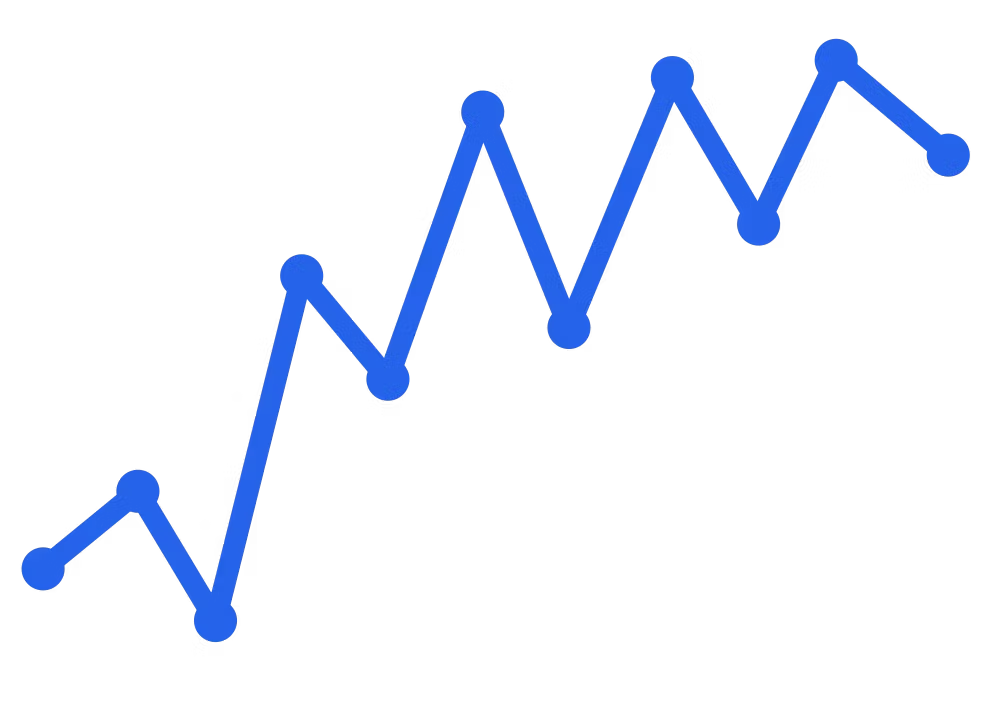
These are recurrences starting with some number which is updated at each step according to divisibility of the current number. When some Turing machines are carefully analyzed, these recurrences are simulated over multiple low-level steps. The question whether such a Turing machine halts then becomes a problem in number theory.
Even though these recurrences are similar to Collatz Conjecture, we don't know whether they are really hard. Not much research effort has been devoted to them, so there might be some simple arguments that solve them.
By Gödel's Theorems, we know that in every sufficiently strong consistent mathematical theory, there exist statements which are undecidable. But the proof constructs artificial self-referencing statements, unlike common problems which are solved in mathematics. So a natural question is to ask how close is the boundary of undecidability?
The Busy Beaver problem might allow us to gain a better understanding of this. What is the first which is unprovable in PA or ZF? We can improve upper bounds by constructing better Turing machines solving unprovable problems. It is very unlikely that the current machine upper bounds are optimal, since relatively little overall effort has been devoted to their construction. Scott Aaronson conjectured in  The Busy Beaver Frontier.pdf that
  is already unprovable in PA and
  in ZF.
On the other hand, by investigating Turing machines for smaller values of , we push the lower bound for up. Even if we cannot determine the precise value of , we can still catalog and understand possible -state Turing machines.
The fifth Busy Beaver machine simulates the following recurrence. It starts at number  . At each step, according to its residue modulo 3:
 , it becomes
  .
. , it becomes
  .
. , the machine HALTS.
The recurrence goes through the following sequence of numbers:
0 → 6 → 16 → 34 → 64 → 114 → 196 → 334 → 564 → 946 → 1584 → 2646 → 4416 → 7366 → 12284 → HALT.
It runs for 47,176,870 steps because it simulates this recurrence incredibly slowly.
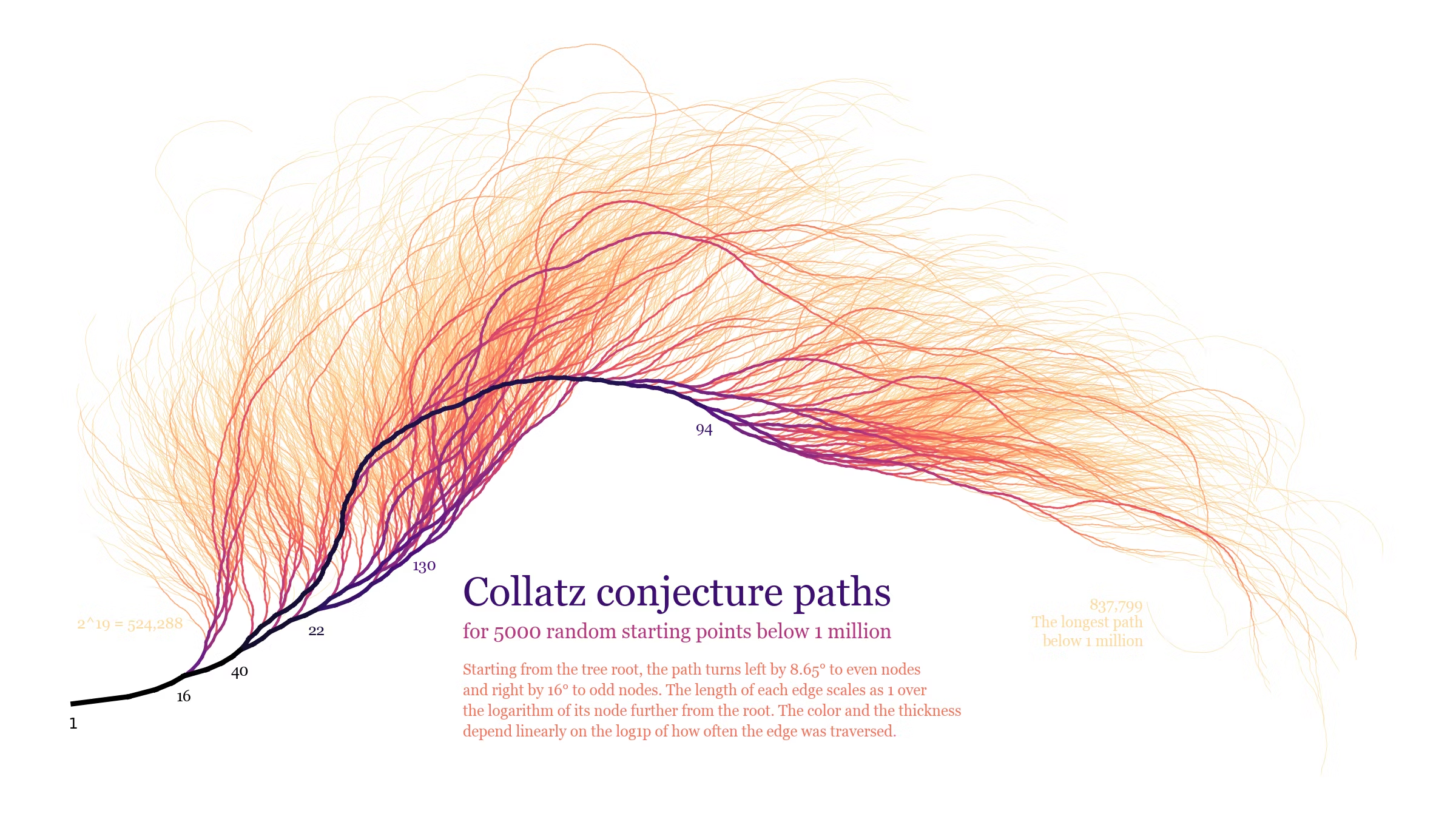
A famous unsolved mathematical problem that is incredibly simple to state. Start with any positive integer and apply these rules repeatedly:
is odd, replace it with  . is even, replace it with
  .
.Collatz Conjecture: For all starting numbers , the process eventually reaches  .
.
Example of two starting values:


The behavior is chaotic and very hard to predict. Starting at  , the process takes 111 steps to finish and even reaches 9232 before eventually falling to 1.
 . This is strong evidence, not a proof.
Behavior on some small odd values. Even values in the middle are skipped for clarity.